The Grow Awards 2026 🏆 







Likes
15
Share
@Saltoa
Follow
Day 57 5 litre water
10 mg sensi bloom ab
5 mg call mag
5 mg nirvana
5 mg owerdrive
5 mg b52
5 mg carboload
5 mg senszym
5 mg revive


Likes
262
Share
@Ju_Bps
Follow
Hello my friends grower 👨🌾👨🌾,
All was fin this week,
Humudity not well but better, average 60%HR, min 50%HR, max 70%HR.
Buds stopped to grow up and start to bulk up, so I've given pk 13/14 this week.
I've given this week,
Water + rqs bloom tabs 2.25l
Water + rqs bloom tabs + sugar royal 2.25l
Water + pk 13/14 2.25l
Again a couple of weeks..
Want to try it, she smells like nice sweet and fruity 🌲🤪,
Have a good week mate, see you soon.

Likes
6
Share
@MaestroBud
Follow
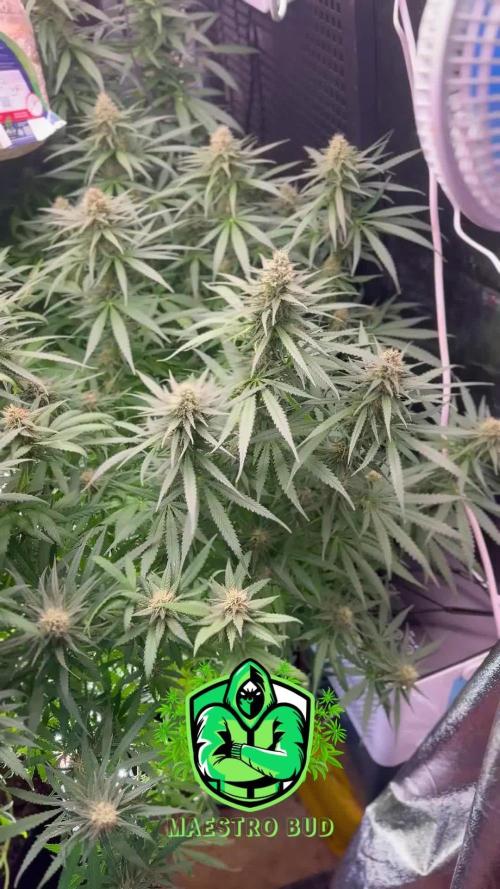
The stretch has stopped with precision, and Skywalker Haze has now set a course for floral compaction and terpene production.
The AN Master Recipe protocol is in full effect with Overdrive just activated. The 3 daily watering cycles via drip kit ensure gradual and balanced absorption throughout the day, adapting to the plant's metabolic rate.
💡 Lighting:
Phlizon FD9600 on maximum
Mars Hydro 100W on low

Likes
5
Share
@69XINEYESEEKAYX69
Follow
A lot of growth this week, the ladies are just shooting up, they all look healthy, the Humboldt sour diesel that was looking kinda funky is growing good and all the new growth looks normal an healthy gunna FIM the Matanuska Thunder an Humboldt Sour Diesel, waiting on the blue Sunset Sherbert till it gets a bit taller.


Likes
11
Share
@Skull
Follow
Good week my diesel glue is really starting to branch up after topping at the end of last week I have continued 4days ago and today moderate defoliation I need the Poppin Cherrys pheno to get growing lol, I had a cultivator mystery stain, not last grow the one before that had a decidely slow start but bloomed into an exceptional phenotype, hopefully more similarities than Early leaf structure
Likes
17
Share
@Cultivandomedicinanatural
Follow
Bueno esta semana es la última de vida de nuestras pequeñas, un tamaño reducido y muchas juntas... pero una calidad.. dureza y resina... envidiables.. Esta semana usamos solamente agua con un ph de 6,2 y líquido solo usamos la final solution de b.a.c para limpiar nuestras raíces, al igual que aumentamos la cantidad de agua por riego para ir lavando bien nuestras raices. El olor es muy fuerte pero un aroma apetecible a más no poder... en cuanto abro el armario para los riegos y cuidados sale un olor... que si no fuera por el generador de ozono apestaría la casa!😍😋 En grandes rasgos una variedad de floración relativamente corta.. y con unos resultados impecables.. Hay una media de 5 puntas por planta y algunas incluso más!😍


Likes
40
Share
@Totogrowuk
Follow
After a two day heat wave it’s rained for 4 days….
So we are well flushed ☔️
Likes
2
Share
@Dico29
Follow
Looking good pistils coming in but probably won’t touch it too much and prune
Likes
7
Share
@GermanGrow182
Follow
Sonne satt. Auch beim 2. Lauf läuft's sehr gut. Die Autos fangen an, zu blühen, die Photos wachsen stark und gesund, wurden nun alle getoppt. Hier und da hab ich die Autos entlaubt, um den Knospen mehr Licht zu verschaffen. Es läuft gut 👍 bis nächste Woche ✌️
Likes
8
Share
@Rabidreject
Follow
I always find it hard to say how much water they are taking because the whole auto pot thing. It would be more useful to maybe have an option to be able to change the unit because it would be way easier for me to say how much water has been put in the res during the week - sometimes even that’s hard to remember for me!
Aaaaanyway, things are going fine in the grow - I turned down the light just a tiny bit as the pistols were showing signs of having too much light and they were just looking a little bleached out, so I turned down the light to around 80-90% as well as I think I raised it a little bit also.
It’s much harder keeping everything stable in such a small space when I am used to having a room to use but oh well, it is what it is - I am really lucky / stupid to be doing this one, however, I also went into the grow knowing I may have to kill her at any moment - dependant upon visits etc. I know photo growers always say there is no difference in speed between autos and photos but there is a couple of weeks in it most of the time - at the very least. I tried it, my last proper grow I selected all fairly fast flowering photos (not those photos that have been bred with autos to make them quick but just generally fast flowering plants) and it still took longer than my longest auto has taken and it annoyingly Hermes so had to turn into hash coz it was super annoying.) but that’s all in the past now…
So I haven’t had to resort to using my AC yet but I did get a 1/4 of the price knocked off because it doesn’t work with the app properly and that’s basically what it was sold on! Don’t go to klarstein, people!
She’s def been stretching for sure but I remember this being a really squat plant anyway and I have also trained it in a bit of an odd manner so that it grew outwards with a flatter canopy - I wouldn’t top in future. I don’t really know why I did - maybe because I always have (for the most part) but I think she’d have grown taller and had bigger side branching if I hadn’t but having said that it is pretty much impossible to tell! Unless you do an A/B test - which I obviously don’t have room for!
In the next week I am hoping to see her get really hairy and hoping to have to attach a carbon filter - as that would mean she’s happy and I’m going to get some dank.
With regards to expected harvest - I genuinely have no idea. She averages at around 2.5z/plant going on the info put into grow diaries and that it about what I got last time - I don’t think I ever weighed it tbh coz I grew it just to turn into rosin. Having said that, it is a totally different set up and the first time I am using this light, so I’m not sure of the capabilities of what is probably a 120-140w light - now I have dimmed it down. I mean, I guess if she was starved for light I wouldn’t have had to turn it down so I’m confident it can produce sticky buds. I will also turn it up to full power in the last couple weeks.
She’s meant to be a 10 week or 70 day strain - and I hope that is true because I am going on holiday in early July so I can’t have her going on and on and on. She will have to be cut when she will have to be cut - and maybe hung whilst I am away with the ability to control the environment over Wi-Fi (and probably a camera). Iv just looked at dates and actually she can go on for 13 weeks and so it is all good - she should still be drying by the time I go there and should be ready for me when I get back - I’ll be doing a dry trim as I always do just because it slows down the drying process even more - although actually to be fair the main reason I used to do that was I didn’t have seperate climate control for drying and couldn’t use the tent as was on a perpetual grow. This time I’ll be able to set it tov 60%/60f and hopefully keep it there for a full couple of weeks.
Obviously I get rid of big the fan leaves and also chop it into smaller branches but other than that I prefer to do it all dry - saves your choppers for one thing!
Likes
59
Share
@Bakeryguy420
Follow
Rolling through week 4 of flowering for the first rhino Ryder and white Russian things are starting to look good !
Rhino Ryder 2 coming to and end of week 2 of flowering not to far behind the other two glad all plants are pulling through strong !! Same ratio with nutrients temps between 72 and 77 and humidty between 30 to 50%
Smell is pretty strong would say 6.5 outta ten !
Water every 3 days 2 gals a week pretty much using Poland spring natural water for now.
Check out the rest on my Instagram bakeryguy420 doing my first give away for seeds and glass spoon
Some updates photos towards the end of the week and some videos!!


Likes
4
Share
@Ledros
Follow
Day 57 (2020-07-05): Feeding @ 5.8 PH. Removed a few leaves.
Day 58 (2020-07-06): Noticing a few amber trichromes on the CBD Crack. Wondering if it might be time to start thinking about pre-harvest flushing.
Day 59 (2020-07-07): Fed today @ 5.75 PH.
Day 60 (2020-07-08): No news today. Plants are kind of on autopilot at this point.
Day 61 (2020-07-09): Waiting to feed until tomorrow.
Day 62 (2020-07-10): Fed today @ 5.6 PH
Day 63 (2020-07-11): Leaves on both plants look pretty rough at this stage, but buds are looking nice all around! Guessing 1-2 weeks left on the CBD. Will probably start flushing sometime next week. G14 seems to be running behind at least a week.
Likes
3
Share
@DrewZenRox
Follow
Into 2nd day of week 3.
Jealousy/Green Poison inside the Epic Attic Tent 1.2x1.2x1.6. Growing Under 'Karma EVO 3'
SkyWalker OG Inside unbranded 60x60x120 Tent. Growing under 'Karma Stealth 1000'


Likes
2
Share
@gr3g4l
Follow
esto ya se acaba .Próximos 3 o 4 riegos solo con agua y en 10 dias áprox. la cosecha. Por lo que parece estas variedades deben tener bastante carga índica ,las Project algo mas que las banana. Dejaron de aparecer estigmas blancos y actualmente estan ya en su mayoria desaparecidos o bien tostaditos, esto no puede dar mucho más de si.