The Grow Awards 2026 🏆 





Likes
Comments
Share
@6ix6ix6ix
Follow
Hello! How’s it growing, duuuude? (Very smart joke going-growing haha).
So the day has finally come.
Week 9 sharp.
day 63 - cut down two out of 3 girls.
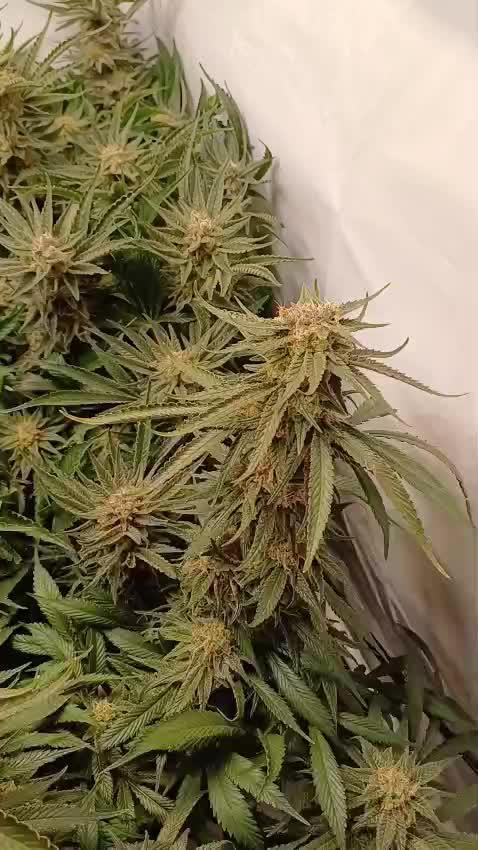
The trichs are good, the plants themselves are funny of course because of the nitrogen diet, the leaves are not fading, crunchy as pringles.
Girl 1 has pretty dense buds and heavy, girl 2 is more airy and light but still enough for me ;)
Girl 3 asked for some time to get herself ready and I don’t mind. However she is foxtailing As Fuuuuu.
Could this be because of N overfeeding in flower? Cuz the temperatures are not THAT high.
Anyway, she is welcome as she is.
Already getting ready for round two.
The soil ill go with will be biobizz light mix. And will be putting big bucks in the feeding. Probably will get the whole range of biobizz.
Have purchased beautiful seeds from RQS
This time i want to grow 2 plants instead of three to give them more air and light.
I chose cookies to be one of the girls, but still not sure between Purple Punch and Mimosa. Maybe you have something to say?
Collected all the leaves and waiting for the trim of ms. “Late to the party” and will be making canna butter and hope to bake some brownies for my wife to enjoy because she cant smoke in any form.
Hellava hobby we got guys and girls. Love every minute of it!
Will add harvest report when i cut down the third plant and dry out to see final weight.
Enjoy your growing and thanks for stopping by!

Likes
Comments
Share
@Odins_Farmer
Follow
Overall happy with the outcome, really aesthetically pleasing plant but I've never been a big fan of cookie based strains and probably wouldn't do it again. It did produce some male flowers late into flowering. It's a nice plant to grow though from the always dependable Sensi.


Likes
46
Share
@Chubbs
Follow
420 Fastbuds Week 7
Gorilla Punch Auto
What up what up. Weekly update for these two is pretty much the same as I've kept the same routine. I did up the tds to about a 1000 for a boost. I'll dial it down on the up coming weeks as they start to finish up. The taller of the two does look a little further along but not by much. All in all Happy Growing

Likes
18
Share
@BudgetGrows
Follow
So when seedstockers asked if I wanted to test some 3rd gen genetics I obviously obliged, now having grown a few of seedstockers beans previously I can certainly say I wasn't expecting this, I have topped, lollypopped, cut in half as they outgrew my space twice, super cropped, removed whole branches, double scrog - yes these are autos !!!
Thanks for stopping by 👍

Likes
14
Share
@ThatoneAKguy
Follow
this is almost the end of week 6. Hoping to see some bulking soon. Lower sites are still producing pistils and the top site pistils are starting to curl over.

Likes
12
Share
@mikemobes
Follow
I am pleasantly surprised with this grow. This is my second time growing Cream Cookies and my yields have increased by 400%. Cream Cookies #2 was the heaviest yielder coming in at 224.04 grams wet. Coming in at almost a quarter POUND for one plant just makes me grin from ear to ear. Im so extremely happy with how ive been taking care of them. It seems that proper and methodical defoliation is the key to massive yields. Cutting fan leaves which block out a significant portion of the available light to the lower and developing bud sites proved to be a great choice. The plants look a little 'skinny' after defoliation, but the newly exposed bud sites explode into the canopy. Im just so very happy with how everything went.
Haven't smoked yet its curing now, will update in two weeks!
Likes
4
Share
@PielgrzymkOlaMagicGarden
Follow
End of vege REPOT 14 l to 20 l with plagron batmix. 5.10 lights switch to SpiderFarmer SF4000 12/12.

Likes
74
Share
@Hou_Stone
Follow
❄️Après 53 jours de floraison j'ai récolté 2 plantes de kong's krush qui m'ont donné 41 grammes de bourgeons sec et manucurées.
❄️Je pense que j'aurais pu ajouter + de nutriment dans mon sol et arrosé plus fréquemment pour avoir un plus gros butin, c'est prévu pour la prochaine culture !
❄️Je commence à gouter mes bourgeons qui sont encore en train de curer depuis 5 semaines.
❄️Chaque variétés ont des saveur particulière et j'ai toujours ça trouvé assez complexe de les décrire. En tout cas La saveur de la kong's krush est vraiment inédite pour moi et vraiment plaisante. Je lui trouve un petit coté pétillant,☄️
❄️
❄️Mon instagram : https://www.instagram.com/hou_stone420/
❄️
❄️Passez une bonne journée mes amis, Merci pour votre visite 🙌
☄️☄️☄️☄️☄️☄️☄️☄️☄️☄️☄️☄️☄️☄️☄️☄️

Likes
48
Share
@Truro
Follow
Will definitely grow again. Harvested some earlier than others, really tried to get an idea of how much of a difference what point of the harvest window you harvest makes to the effect. Very high quality genetics - big thanks to Barney's Farm! 👌

Processing
Likes
24
Share
@rasta_puri
Follow
Finally did the last topping and achieved the shape i wanted so much! Can see the "H" on top, this gonna serve as base for the next following branches. quite symmetrical.
Likes
12
Share
@Staffedition
Follow
Привет друзья. Моей растихе сегодня 34 дня.
Начал применять LST технику на 19 дне и продалжаю применять её через день, а 18 августа добавил ДЕФОЛИЗАЦИЮ
С 20.08 ДЕФОЛИЗАЦИЮ делаю каждые 3,4 дня
С 20.08 применяю технику LST каждые 3,4 дня
На сегодняшний день влажность 63%
Растение растёт хорошо. генетика радует.
Всем мира и добра!
#Smail_Seeds
Likes
11
Share
@Beedog
Follow
Day 70 Really struggled with high temperatures this week everyday was 33 plus and nights wasn’t much cooler just glad it’s over now got a week left until I have to harvest hopefully they be ready to go by then most of em anyways
Likes
6
Share
@IamCy
Follow
She's starting to fatten up nicely! Terps still off the meter,and the roots are ridiculous. Definitely one of the best plants I've ever grown.


Likes
85
Share
@Tropicannibis_Todd
Follow
Start of day 98 ...... January 15 2022 Start of week 14 ........ 72 DAYS INTO FLOWERING
😕 LOOKS LIKE THERE GONNA GO A LITTLE LONGER THEN EXPECTED ? 😕 Gonna be honest , I didn't expect it to go over 85 days but here we are ........
( I BELEIVE IT HAS ALOT TO DO WITH THE SIZE OF MY GROW MEDIUM , AND THERE HEALTH AS I AM RUNNING 45 LITERS OF SOIL MEDIUM) .... SHE SEEMS TO WANNA RIPEN ON HER TERMS
( OMG THEY SMELLING GREAT ) !!!!!!!
Check out the full grow video on latest weekly update
Super Exceptional Growth Daily
Still adjusting LST when needed and leaf tucking.......
Water Only when needed but its drinking more every otherday and adjusting lights when needed......
Rain Water Only .......
( DAY 26 AND BOTH NL 1 & NL 2 SHOWED PREFLOWERS )
( DAY 49 AND RESIN PRODUCTION HAS STARTED )
( DAY 57 , EQUIPMENT FAILURE , main FAN , over heated😡 tripped breaker , reset light timers , lost a DAY, REPLACED new Main Fan 😁 back up running 👌)
( DAY 70 DID ITS FINAL FLUSHING TODAY TO GET RID OF ANY BUILDUP )
( DAY 77 AND IT SHOWS A SLIGHT DEFICIENCIE MAYBE A CAL/MAG GETTING CLOSE TO END OF LIFE ) IM ALSO DOING VERY LITTLE, SLIGHT DEFOLIATION
( DAY 101 AND ALL IS GOOD , THERE FATTING UP )
DAY 101 .....NL 1
SHOWS SOME CLEAR TO MOSTLY CLOUDY RESIN HEADS , LOOKS LIKE THERES STILL AWAY TO GO😩😩 .......
DAY 101 .....NL 2
SHOWS MOSTLY CLOUDY TO MILKY RESIN HEADS ( 💀 PROBABLY PEAK THC LEVEL 💀 ) , AMBER IS JUST GETTING STARTED , GETTING CLOSE BUT SEEMS MORE TIME NEEDED...... VERY CLOSE ( AS I WANT SOME % OF AMBER 😁 )
I hope you enjoy my growlog...
(Who the hell is TropiCannibis Todd😎 Well This is not only my FIRST AUTOFLOWER but my FIRST GROW in over 11-12 Years😳 I Grew from 2002-03 TO 2010-11 , I'm back nahnahnahnahnah , Been a fun grow , learned alot , and it looks like I am gonna have a great harvest with some great smoke....... who new 😁 )

Likes
33
Share
@ganjaman24
Follow
I typically use the nutes at 1/2 tsp per gal but I have cut back on nitrogen since transitioning to flowering😎
Likes
4
Share
@GroloCup
Follow
I use a 70/30 solution of H2O2 and tap water inside a small capsule, allowing the seed to soak for 24 hrs, and she was ready for her birthday, already showing a tap root in that time span... I then place the seed into a damp paper towel to allow the tap root to extend a little further out in preparation for the transplant. I'll start her in a small grow bag filled with my amended Pro Mix seed starter blend, hopefully making a strong seedling for my first AutoPot run. This is for their grow off, which I found on their Discord server, but they are very active on FB and IG... Their catalog of offerings are definitely connoisseur genetics, most importantly, Made in the USA! 🇺🇲
Likes
1
Share
@Rhah420
Follow
Die Ladys verbreiten einen himmlischen Duft, beerig/ süß. Trichome sind zu 70% milchig/ 10% Bernstein. Gegossen wird seit dem 17.2 nur noch mit pH angepassten Wasser. Die Ernte wird an diesem Wochenende, dem 27.02 vollzogen.

