The Grow Awards 2026 🏆
Likes
Comments
Share
@Shefman93
Follow
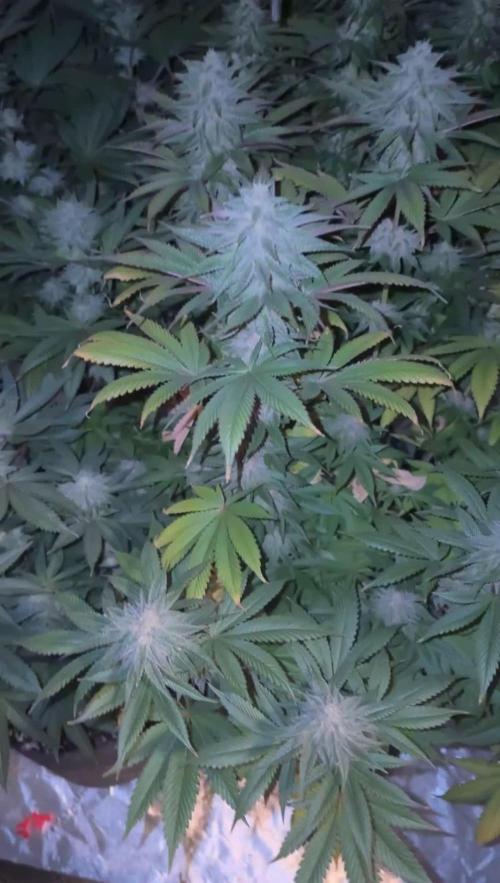
Trichomes are half cloudy. Will harvest at 25-30% amber.
Likes
79
Share
Week 9: Navigating the Path to Harvest! Greetings once again, fellow cultivators! As we journey deeper into the heart of our botanical adventure, Week 9 brings us closer to the long-awaited harvest of our beloved Epsilon F1. In this week's installment, we dive into the intricacies of nutrient management and the final stages of flower development. Our Epsilon F1 stands tall and proud, a testament to the care and dedication lavished upon her throughout her growth journey. With each passing week, her beauty becomes more radiant, her buds more plump and resinous. It's a sight to behold, a testament to the magic of nature and the art of cultivation. Ah, but this week brings a significant shift in our approach to feeding. We've made the bold decision to cut all additional nutrients, relying solely on Fluvic Blast and Enzym+, both trusted companions from the Aptus Holland lineup. Why, you ask? Because at this stage of the game, our focus shifts from nutrient uptake to nutrient utilization. Fluvic Blast, with its rich blend of organic acids and trace minerals, acts as a catalyst for nutrient absorption, ensuring that our Epsilon F1 can make the most of the resources available to her. Enzym+, on the other hand, plays a crucial role in breaking down organic matter, releasing valuable nutrients that might otherwise remain locked away in the soil. Together, these two powerhouses work in harmony to optimize nutrient availability and promote healthy, vigorous growth in the final weeks before harvest. As we approach the culmination of our journey, let us not forget the lessons learned along the way. From the delicate balance of light and nutrients to the art of patience and perseverance, each day in the grow room has been a lesson in humility and gratitude. We owe a debt of gratitude to Royal Queen Seeds for providing us with the genetic masterpiece that is the Epsilon F1, and to Aptus Holland for crafting nutrients that have nourished our plant from seedling to harvest. And so, as we bid adieu to Week 9 and prepare for the final stretch, let us take a moment to marvel at the beauty of our Epsilon F1 and the miracle of nature's creation. May her harvest be abundant, her buds potent, and her legacy enduring. Until next time, dear friends, happy growing! #EpsilonF1HarvestJourney #Week9FinalStretch #BotanicalBeauty #RoyalQueenSeedsGenetics #AptusHollandNourishment Genetics -Epsilon F1 @rqs_esp @royalqueenseedssp @rqsglobal Food - @aptusholland @aptus_world @aptus_es @aptus_portugal @aptusbrasil @aptusplanttechaus @aptus_thailand @aptusplanttechnz @aptususa_official LED @lumatekeu Controls - @trolmaster.eu @trolmaster.agro @trolmaster.support As always thank you all for stopping by, for the love and for it all , this journey of mine wold just not be the same without you guys, the love and support is very much appreciated and i fell honored and blessed with you all in my life With true love comes happiness , Always believe in your self and always do things expecting nothing and with an open heart , be a giver the universe will give back to you in ways you could not even imagine so #aptus #aptusplanttech #aptusgang #aptusfamily #aptustrueplantscience #inbalancewithnature #trueplantscience #rqs #ApoloMission #MoonHarvestAdventure #playwithlego #lego #legotime #legovideo #tothemoonandback More info and complete updates from all my adventures can be found Link in the profile description Friendly reminder all you see here is pure research and for educational purposes only Growers Love To you All
Likes
9
Share
@Mo_Powers
Follow
another week has passed and it is growing and thriving excellently. there has been a lot of sunshine and occasionally the necessary rain from above. it is slowly entering the flowering phase. it has made another good leap in height. i am currently using LST to provide the lower shoots with more sunshine
Likes
6
Share
Ya paso a la tercera semana de floración, todo va bien hasta el momento, fertilice 2 veces seguida y solo 1 vez con agua esta semana, senti visualmente que le faltaba nutrientes y aun siento que le faltan 😂 saludos!
Likes
5
Share
@Chubbs
Follow
What up Fam. These girls are growing amazing. Now that I can control the temps a little better they've taken off with growth. Starting the flower period which we all no know what that means. The countdown is on. Over all Happy Growing.
Likes
56
Share
@Aedaone
Follow
The temperatures, humidity, and watering volume(if measured) in grow conditions are all averaged for the week. The pH is soil pH. Any watering done by me is well water which is 7.6 pH and 50° F. Any listed nutrients are ml/gallon of soil. Day 1 we had lots of sunshine and a lite breeze. The soil began to dry out and I watered about 1.5 - 2 gallons per plant, from the water hose, that afternoon. Day 2 we had rain early morning and showers throughout the day. The girls look like their roots found the iron I added last week. Day 3 we had early morning rain, drizzle and showers in the afternoon. I added an additional 50ml of ferrous sulfate top dressed. I also spread just enough peat moss to cover the ferrous sulfate to prevent the rain from splashing it onto plants. Previously the rain splashed granules of ferrous sulfate onto the leaves, burning them. I used 50ml or 1.66ml/gallon of soil. as I've only got about 25 gallons of soil. I'm waiting to top off after this excessive rain is done. Day 4 we had more rain, drizzle, and mist intermittently throughout the . The good news is the ferrous sulfate has lowered soil pH to 6.2 👌. There's still a small excess of phosphorus, but the girls will grow into it. Day 5 we had more rain. It rained all morning for about 8 hours. The pots are soaking wet. Day 6 We missed the scattered showers but it's been 80-90% humidity all day. Even with the beautiful sunshine the soil isn't drying out. I'm looking at the nodes to see when I'll be topping. Day 7 we had lots of sunshine and temps over 80°F. These girls are loving it. I'm looking at the 4th node to top. I'll wait for more stem above the 4th node.There needs to be enough stem above the node that it won't split as the branches grow heavy from large buds. This week was a success. The girls more than doubled in height. They performed their job while battling excessive rain and winds. I'll be looking to top these girls and add soil to top off their pots next week. I'm hoping for less rain and more sunshine next week.
Processing
Likes
8
Share
Processing
Likes
88
Share
@Fergie
Follow
Hey guys so here we are week two into flower and the tent is filling right up now got some awesome bud sights forming and my aim of 1kg dry out of the 2 plants is on course . Root structure is amazing and I have always had good results when I get the wrapped root over top as can see in pic . Anyway til next week guys
Processing
Likes
6
Share
***Update*** have switched 2 of 3 to 5 gals will do the other one as soon as I get more coco..looking to veg maybe another 2 weeks then going to flip. Recently acquired LED light for my veg room so have 250w hps n 300w LED..ladies seem to be loving it.
Likes
8
Share
Frosty !! And Dark ! Going to def regrow under stronger lights
Likes
56
Share
Once again she passes my expectations, late to the show with trichome production. I'm surprised there is purple on the bud, maybe Purpinator does work. I thought I could see hints under the grow lights and thought my eyes were deceiving me, I was just being hopeful. But nah 2 of the 3(under the UV) have developed a beautiful tone of purple. I was never going to bother with a deep freeze but maybe the whole bud will change given conditions, that would be something, fingers crossed. 🤔 was a little skeptical that reducing temps humidity would change density, but it does, buds are solid something I've not been able to achieve before. Rule of thumb is never to surpass 60% RH in the flowering phase and try to progressively reduce it down to 40% in the last 2–3 weeks before harvest. The plant will react as it seeks to protect its flowers, responding by producing denser buds and a higher concentration of resin. Cannabis plants are sensitive to sudden temperature changes, especially in the flowering stage. Extreme heat or cold can impact bud density and overall yields. In nature as a defense mechanism from cold, the plant sensing sudden dips in temperature will attempt to remove the pockets of air within the bud, it achieves this by compacting itself in doing so to better protect itself from cold snaps which are normally indicators in nature that worse weather is on the way. Terpene levels are the highest just before the sun comes out. Ideally, you want as many terpenes present in your plants as possible when you harvest. Cannabis plants soak up the sun during the day and produce resin and other goodies at night. The plant is at its emptiest from "harvest undesirables," so to speak,k right before the lights come on. Freshly cut buds are greener than dried buds because they still contain loads of chlorophyll. However, when rushed through the drying process, the buds dry but retain some chlorophyll, and when you smoke it, you will taste it. Chlorophyll-filled buds are smokable, but they aren’t clean. Slow drying gives the buds enough time and favorable conditions to lose the chlorophyll and sugars, giving you a smoother smoke. How the plant disposes of the chlorophyll and sugars by a process of chemically breaking them down and attaching the decomposed matter once small enough to water molecules, which then evaporate back into the ether. Time must be given to the process to break down the chlorophyll and sugars. Think of it like optimizing the environment for decay. Plant growth and geographic distribution (where the plant can grow) are greatly affected by the environment. If any environmental factor is less than ideal, it limits a plant's growth and/or distribution. For example, only plants adapted to limited amounts of water can live in deserts. Either directly or indirectly, most plant problems are caused by environmental stress. In some cases, poor environmental conditions (e.g., too little water) damage a plant directly. In other cases, environmental stress weakens a plant and makes it more susceptible to disease or insect attack. Environmental factors that affect plant growth include light, temperature, water, humidity, and nutrition. It's important to understand how these factors affect plant growth and development. With a basic understanding of these factors, you may be able to manipulate plants to meet your needs, whether for increased leaf, flower, or fruit production. By recognizing the roles of these factors, you'll also be better able to diagnose plant problems caused by environmental stress. Water and humidity *Most growing plants contain about 90 percent water. Water plays many roles in plants. It is:* A primary component in photosynthesis and respiration Responsible for turgor pressure in cells (Like the air in an inflated balloon, water is responsible for the fullness and firmness of plant tissue. Turgor is needed to maintain cell shape and ensure cell growth.) A solvent for minerals and carbohydrates moving through the plant Responsible for cooling leaves as it evaporates from leaf tissue during transpiration A regulator of stomatal opening and closing, thus controlling transpiration and, to some degree, photosynthesis The source of pressure to move roots through the soil The medium in which most biochemical reactions take place Relative humidity is the ratio of water vapor in the air to the amount of water the air could hold at the current temperature and pressure. Warm air can hold more water vapor than cold air. Relative humidity (RH) is expressed by the following equation: RH = water in air ÷ water air could hold (at constant temperature and pressure) The relative humidity is given as a percent. For example, if a pound of air at 75°F could hold 4 grams of water vapor, and there are only 3 grams of water in the air, then the relative humidity (RH) is: 3 ÷ 4 = 0.75 = 75% Water vapor moves from an area of high relative humidity to one of low relative humidity. The greater the difference in humidity, the faster water moves. This factor is important because the rate of water movement directly affects a plant's transpiration rate. The relative humidity in the air spaces between leaf cells approaches 100 percent. When a stoma opens, water vapor inside the leaf rushes out into the surrounding air (Figure 2), and a bubble of high humidity forms around the stoma. By saturating this small area of air, the bubble reduces the difference in relative humidity between the air spaces within the leaf and the air adjacent to the leaf. As a result, transpiration slows down. If the wind blows the humidity bubble away, however, transpiration increases. Thus, transpiration usually is at its peak on hot, dry, windy days. On the other hand, transpiration generally is quite slow when temperatures are cool, humidity is high, and there is no wind. Hot, dry conditions generally occur during the summer, which partially explains why plants wilt quickly in the summer. If a constant supply of water is not available to be absorbed by the roots and moved to the leaves, turgor pressure is lost and leaves go limp. Plant Nutrition Plant nutrition often is confused with fertilization. Plant nutrition refers to a plant's need for and use of basic chemical elements. Fertilization is the term used when these materials are added to the environment around a plant. A lot must happen before a chemical element in a fertilizer can be used by a plant. Plants need 17 elements for normal growth. Three of them--carbon, hydrogen, and oxygen--are found in air and water. The rest are found in the soil. Six soil elements are called macronutrients because they are used in relatively large amounts by plants. They are nitrogen, potassium, magnesium, calcium, phosphorus, and sulfur. Eight other soil elements are used in much smaller amounts and are called micronutrients or trace elements. They are iron, zinc, molybdenum, manganese, boron, copper, cobalt, and chlorine. They make up less than 1% of total but are none the less vital. Most of the nutrients a plant needs are dissolved in water and then absorbed by its roots. In fact, 98 percent are absorbed from the soil-water solution, and only about 2 percent are actually extracted from soil particles. Fertilizers Fertilizers are materials containing plant nutrients that are added to the environment around a plant. Generally, they are added to the water or soil, but some can be sprayed on leaves. This method is called foliar fertilization. It should be done carefully with a dilute solution because a high fertilizer concentration can injure leaf cells. The nutrient, however, does need to pass through the thin layer of wax (cutin) on the leaf surface. It is to be noted applying a immobile nutrient via foliar application it will remain immobile within the leaf it was absorbed through. Fertilizers are not plant food! Plants produce their own food from water, carbon dioxide, and solar energy through photosynthesis. This food (sugars and carbohydrates) is combined with plant nutrients to produce proteins, enzymes, vitamins, and other elements essential to growth. Nutrient absorption Anything that reduces or stops sugar production in leaves can lower nutrient absorption. Thus, if a plant is under stress because of low light or extreme temperatures, nutrient deficiency may develop. A plant's developmental stage or rate of growth also may affect the amount of nutrients absorbed. Many plants have a rest (dormant) period during part of the year. During this time, few nutrients are absorbed. Plants also may absorb different nutrients as flower buds begin to develop than they do during periods of rapid vegetative growth.
Likes
12
Share
Likes
8
Share
April 4th 2024 Went on vacation for few days and came back to lil disappointment with one I was using the acinfinity bottom watering pot and one plant didn’t even drink from its water reservoir I have no clue why not and other did came back to empty pot so hopefully the water I watered with from top works that’s only problem I came back to other plant is going did some defoliation Welp today April 7th I messed around and found out what to much LST can do if ya to rough I cracked one plant right down the middle but with quick thinking got some tape and taped that hoe right up so hopefully I’m good besides that feed recharge today bout half gal each to scared to go full gallon don’t want to drown them
Likes
21
Share
*******This week will be used for 4 cuts that were taken of the seeds......Gorilla Girl from Sweet Seeds SWS74......There were three of the green pheno and the last of the purple pheno*********** ********Week of June 1 to 7, 2019. First full week of 12/12 light schedule and she is setting in her flowers. Second SCROG put in to help with those future heavy buds😀👍 More detail coming :)
Likes
21
Share
Hi all, Finally at that stage and I am so excited to be able to write this out.. have been Flushing these 2 beautiful girls since Friday just passed. They have also been flushed for 2days with flashclean so I just cannot wait now :) Will have a harvest next week with some weights to follow early after that... Good luck growmies.. stay tuned 😉 🌿🌱
Likes
6
Share
Processing
Likes
22
Share
Esta semana está empezando a crear unas buenas porras de cogollos que se ven que tienen muy buena pinta 🔥 El ritmo que tiene es bastante bueno y parece que tiene mucha fuerza 💪 Hemos mantenido los valores en la misma linea exceptuando la humedad que la hemos bajado un 10%.
Likes
9
Share
Day 57 The leaves are a deep, rich green, indicating good nutrient health. There's minimal sign of deficiency or stress; only very slight tip burn on a few leaves, which could be from nutrient intensity or light exposure but nothing concerning. The plant structure is compact and bushy, suggesting effective training earlier in the grow (possibly some LST or topping). The growing environment looks clean and well-maintained - reflective walls help maximize light efficiency, and there's a good airflow setup visible in the background. The pot and tray system seem to be managing runoff effectively.