The Grow Awards 2026 🏆
Likes
Comments
Share
@Random80
Follow
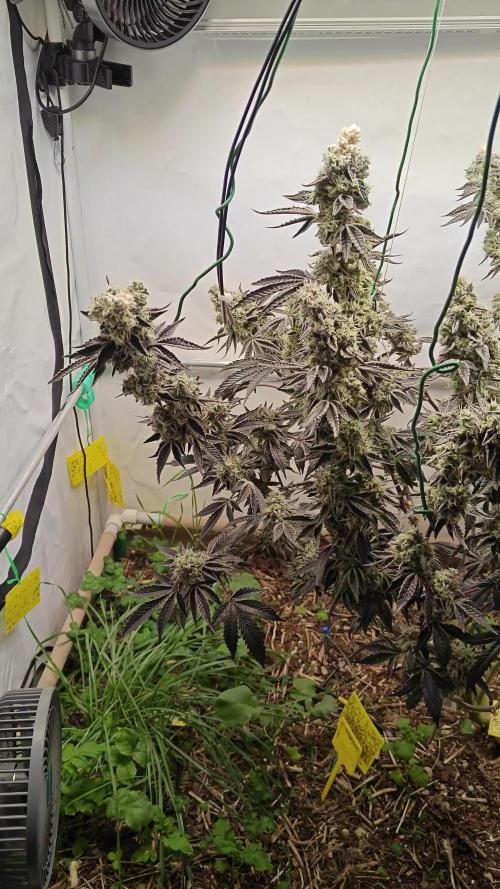
She took over the complete tent surface!! Bearly have place to keep humidifier and heater. I am thinking never again to go with more than one plant as this way she will give her full potential. And tent is 80cmx80cmx180. She seem super healthy however I did found several leaves with brown spots. Not enough nutrient, too much nutrients? No idea...will need to google and ask you guys. I have disconnected her from the autopot after 5 days and will wait until root is dry. Need to leave her for 6-7 days again and the plan is to give her 10ml of BIO PK 5-8 and 8 ml of orgatrex diluted in 1,5 lit of water. Also I ve diluted 8 ml of orgatrex in tank with 18liters water added, hopefull she will use all of it at the time I am back and strart drying the root. Did some defoliation to pass down the light for lower flowers and spayed her with BOOM BOOM spray. Let see how next week will turn out. Cheers!
Likes
5
Share
@BunnyBud
Follow
This week starts well, obviously some deficiencies can never be missing 🤣, slowly I hope to solve everything, as a first cultivation I'm super proud, I'm understanding more and more the ideal times and doses for my setup
Likes
8
Share
Week 8, the last feed! Defoliated to let more air flow and light penetrate down into the lowers of the plant. Bud's are smaller than i expected at this stage, but they'rr sticky, plant is covered in frost, the pics don't do it justice.
Likes
59
Share
Likes
2
Share
Not as much volume this time around but flowers look much better
Likes
47
Share
All content on this diary is for inspirational and educational purposes only. The ideas shared are not a substitute for professional advice. This diary/account is not officially affiliated with Alan Watts or his estate. All materials are used under the principles of fair use. I honor the legacy of Alan Watts by sharing his wisdom respectfully and with the intention of inspiring awareness and self-understanding. 2nd net is up. Early bud formations are promising. holding up to the extremes pretty well, some leaves taking minor damage, but overall, she is holding up, gave her 1 night at 50F see how she would react, stressful. Not advised as it messes with her metabolism, but I want to see if it triggers any anthocyanin response. Love to see her purp up but no signs yet. Remember, For every molecule of glucose produced during photosynthesis, a plant needs to split six molecules of water. This process provides the hydrogen needed for synthesizing glucose and other organic compounds, while oxygen is released as a byproduct. Homework. If Rubisco activity is impaired and it cannot properly function or regenerate its substrate, the plant's leaves are likely to turn a pale green or lime green, a condition known as chlorosis. Essentially, Rubisco activity is highly regulated and susceptible to various environmental and metabolic factors that can cause it to become inhibited, leading to an apparent failure in RuBP regeneration due to a lack of consumption. Rubisco regeneration is intrinsically linked to nitrogen supply because Rubisco is a major sink for nitrogen in plants, typically accounting for 15% to over 25% of total leaf nitrogen. The regeneration phase itself consumes nitrogen through the synthesis of the Rubisco enzyme and associated proteins (like Rubisco activase), and overall nitrogen status heavily influences the efficiency of RuBP regeneration. RuBisCO is a very large enzyme that constitutes a significant proportion (up to 50%) of leaf soluble protein and requires large investments in nitrogen. Insufficient nitrogen supply limits the plant's ability to produce adequate amounts of RuBisCO, thereby limiting the overall capacity for photosynthesis and carbon fixation. Maintaining the optimal, slightly alkaline pH is crucial for the proper function and regeneration of Rubisco. Deviations in either direction (too high or too low) disrupt the enzyme's structure, activation state, and interaction with its substrates, leading to decreased activity and impaired RuBP regeneration. (Lime/yellowing) Structural Component: Nitrogen is an essential building block for all proteins, and the sheer abundance of the Rubisco protein makes it the single largest storage of nitrogen in the leaf. Synthesis and Activity: Adequate nitrogen supply is crucial for the synthesis and maintenance of sufficient Rubisco enzyme and Rubisco activase (Rca), the regulatory protein responsible for maintaining Rubisco's active state. Nitrogen deficiency leads to a decrease in the content and activity of both Rubisco and Rca, which in turn limits the maximum carboxylation rate, Vmax, and the rate of RuBP regeneration Jmax, thus reducing overall photosynthetic capacity. Nitrogen Storage and Remobilization: Rubisco can act as a temporary nitrogen storage protein, which is degraded to remobilize nitrogen to other growing parts of the plant, especially under conditions of nitrogen deficiency or senescence. Nitrogen Use Efficiency (NUE): The allocation of nitrogen to Rubisco is a key determinant of a plant's photosynthetic nitrogen use efficiency (PNUE). In high-nitrogen conditions, plants may accumulate a surplus of Rubisco, which may not be fully activated, leading to a lower PNUE. Optimizing the amount and activity of Rubisco relative to nitrogen availability is a target for improving crop NUE. Photorespiration and Nitrogen Metabolism: Nitrogen metabolism is also linked to the photorespiration pathway (which competes with carboxylation at the Rubisco active site), particularly in the reassimilation of ammonia released during the process. To increase RuBisCO regeneration, which refers to the process of forming the CO2 acceptor molecule Ribulose-1,5-bisphosphate (RuBP) during photosynthesis, the primary methods involve optimizing the levels and activity of Rubisco activase (Rca) and enhancing the performance of other Calvin-Benson-Bassham (CBB) cycle enzymes. Biochemical and Environmental Approaches: Optimize Rubisco Activase (Rca) activity: Rca is a crucial chaperone protein that removes inhibitory sugar phosphates, such as CA1P (2-carboxy-D-arabinitol 1-phosphate), from the Rubisco active site, thus maintaining its catalytic competence. •Ensure optimal light conditions: Rca is light-activated via the chloroplast's redox status. Adequate light intensity ensures Rca can effectively maintain Rubisco in its active, carbamylated state. •Maintain optimal temperature: Rca is highly temperature-sensitive and can become unstable at moderately high temperatures (e.g., above 35°C/95F° in many C3 plants), which decreases its ability to activate Rubisco. Maintaining temperatures within the optimal range for a specific plant species is important. •Optimize Mg2+ concentration: Mg2+ is a key cofactor for both Rubisco carbamylation and Rca activity. In the light, Mg2+ concentration in the chloroplast stroma increases, promoting activation. •Manage ATP/ADP ratio: Rca activity depends on ATP hydrolysis and is inhibited by ADP. Conditions that maintain a high ATP/ADP ratio in the chloroplast stroma favor Rca activity. Enhance Calvin-Benson-Bassham (CBB) cycle enzyme activity: The overall rate of RuBP regeneration can be limited by other enzymes in the cycle. •Increase SBPase activity: Sedoheptulose-1,7-bisphosphatase (SBPase) is a key regulatory enzyme in the regeneration pathway, and increasing its activity can enhance RuBP regeneration and overall photosynthesis. •Optimize other enzymes: Overexpression of other CBB cycle enzymes such as fructose-1,6-bisphosphate aldolase (FBA) and triose phosphate isomerase (TPI) can also help to balance the metabolic flux and improve RuBP regeneration capacity. Magnesium ions, Mg2+, are specifically required for Rubisco activation because the cation plays a critical structural and chemical role in forming the active site: A specific lysine residue in the active site must be carbamylated by a CO2 molecule to activate the enzyme. The resulting negatively charged carbamyl group then facilitates the binding of the positively charged Mg2+ion. While other divalent metal ions like Mn2+ can bind to Rubisco, they alter the enzyme's substrate specificity and lead to dramatically lower activity or a higher rate of the non-productive oxygenation reaction compared to Mg2+, making them biologically unfavorable in the context of efficient carbon fixation. The concentration of Mg2+ in the chloroplast stroma naturally increases in the light due to ion potential balancing during ATP synthesis, providing a physiological mechanism to ensure the enzyme is activated when photosynthesis is possible. At the center of the porphyrin ring, nestled within its nitrogen atoms, is a Magnesium ion (Mg2+). This magnesium ion is crucial for the function of chlorophyll, and without it, the pigment cannot effectively capture and transfer light energy. Mg acts as a cofactor: Mg2+ binds to Rubisco after an activator CO2 molecule, forming a catalytically competent complex (Enzyme-CO2-Mg2+). High light + CO2) increases demand: Under high light (60 DLI is a very high intensity, potentially saturating) and high CO2, the plant's capacity for photosynthesis is high, and thus the demand for activated Rubisco and the necessary Mg2+ cofactor increases. Mg deficiency becomes limiting: If Mg2+ is deficient under these conditions, the higher levels of Rubisco and Rubisco activase produced cannot be fully activated, leading to lower photosynthetic rates and potential photo-oxidative damage. Optimal range: Studies show that adequate Mg2+ application can enhance Rubisco activation and stabilize net photosynthetic rates under stress conditions, but the required concentration is specific to the experimental setup. Monitoring is key: The most effective approach in a controlled environment is to monitor the plant's physiological responses e.g., leaf Mg2+ concentration, photosynthetic rate, Rubisco activation state, and adjust the nutrient solution/fertilizer to maintain adequate levels, rather than supplementing a fixed "extra" amount. In practice, this means ensuring that Mg2+ is not a limiting factor in the plant's standard nutrient solution when pushing the limits with high light and CO2. Applying Mg2+ through foliar spray is beneficial to Rubisco regeneration, particularly in alleviating the negative effects of magnesium (Mg) deficiency and high-temperature stress (HTS). While Mg can be leached from soil, within the plant it is considered a mobile nutrient, particularly in the phloem. Foliar-applied Mg is quickly absorbed by the leaves and can be translocate to other plant parts, including new growth and sink organs. Foliar application of: NATURES VERY OWN MgSO4 @ 15.0g L-1 in a spray bottle. For those high-intensity workouts when 1 meal a day is just not enough! Foliar sprays are often recommended as a rapid rescue measure for existing deficiencies or as a supplement during critical growth stages, when demand for Mg is high. Application in the early morning or late evening can improve absorption and prevent leaf burn. The plant was getting a little limey yellow in the centre. Shortly thereafter, she was back in business, green mostly regenerated. The starting point [of creativity] is curiosity: pondering why the default exists in the first place. We’re driven to question defaults when we experience vuja de, the opposite of déjà vu. Déjà vu occurs when we encounter something new, but it feels as if we’ve seen it before. Vuja de is the reverse—we face something familiar, but we see it with a fresh perspective that enables us to gain new insights into old problems. Confidence is evidence... nothing more. You are confident because you have driven 10,000 times, you are confident because you have spoken 10,000 times. People think confidence is a feeling, but it's not. If you want more confidence, then you need to create evidence, take more shots, collect more data, build more experiences, take more risks; fail, confidence doesn't come first; it is the reward you get for doing the work. no one else wants to do.
Likes
91
Share
@Salokin
Follow
Hi Growmies, Not much to report, other than that her buds are coming along very nicely, filling the colas and starting to cover herself in trichomes. She is extremely thirsty, finishing up to 1.8—2l a day. I fed her the last tester of rokzbastic and will afterwards go down with the nutes. Still defoliated slightly as I wanted to get the colas a bit separated for aeration and light penetration. I have also added a pic of the orca bottle I use, just in case ;) Thanks for stepping by and hope to see you next week.
Likes
16
Share
Started week off with a medium defoliation. started the girls on a PK booster. Additional details in video.
Likes
13
Share
3/26 swelling up nicely 3/29 the swell has been quite swell lol starting to show first orange Pistils on lower buds. The main cola still has a few weeks I believe
Likes
9
Share
Empezando la recta final, a partir de ahora serán regadas solo con agua.
Processing
Likes
24
Share
@GrowGuy97
Follow
Day 14 - Everything seems to be going great, not much to say right now! Will be feeding tomorrow! Happy growing friends!✌️🏼🌱 Day 15 - Feeding day, started a nutrient comparison test between fox farm & technaflora which is why I have both of them listed but I am not mixing them! I have 2 plants on the fox farm & 1 on technaflora! We shall see which comes out better! Day 16 - Ladies are looking great!✌️🏼 Day 17 - Got watered with PH at 6.4 today, all 3 ladies are coming along nicely😍 Day 18 - 🌱✌️🏼 Day 19 - Ladies got watered again today with PH at 6.4, will probably be starting some LST in the next week sometime! Thanks for following friends & happy growing!✌️🏼🌱 Day 20 - End of week 3 & could not be happier with how things are going! Can’t wait to see some buds on these ladies!😍
Likes
3
Share
@Fyno_TH
Follow
Week 5 update 🌱🔥 — the tent is looking full and healthy! Main plant is wide and strong after topping + LST, really starting to show her structure. The second plant is still smaller but holding steady, pushing new growth and showing good recovery 💪. Feed mix this week: Corex + Eldex + Terra + CalMag + Bud Candy + Mira + Terpinator (~1400 ppm @ pH 6.0). Watering to 10–20% runoff each time keeps the coco clean and roots thriving. Temps holding steady around 27 °C with RH 60–70% 🌬️. Leaves are praying hard under the Spider Farmer G3000 with no signs of stress or burn. 💡 Grower Tip (for Thailand growers 🇹🇭): If an RO system isn’t convenient, you can use the local street purified water machines (1-1.5L = 1 Baht). Cheap and clean enough for coco grows without the heavy tap water ppm.
Likes
155
Share
@deFharo
Follow
Bienvenidos cultivadores de marihuana clandestinos y también a los que tienen la fortuna de no serlo!🖐️👨‍🌾👍 Este es un diario donde semanalmente explico algunas de mis técnicas de cultivo y preparados orgánicos, los cuales llevo experimentando dos años en cultivos de marihuana interior. • Hay dos componentes absolutamente necesarios para cualquier cultivo y de los que no se puede prescindir: La luz y el agua... hoy toca hablar de agua, homenajear al agua que la montaña y el cielo me regalan para mis plantas de marihuana!! 💧💧💧 Tengo que decir, que hasta el momento, nunca he usado agua con cloro en mis cultivos, mi interés por el agua pura de manantial ya venía de antes, pues yo mismo la consumo habitualmente, el cloro es añadido al agua corriente para hacerla potable y acabar con posibles bacterias o patógenos, pero no distingue entre buenos y malos. Siempre he creído que el consumo de agua pura, ayuda a mantener la micro biota de nuestro sistema digestivo, os podría hablar de las ventajas palpables, pero voy a obviar comentarios escatológicos. En el caso de mi modo de cultivo, donde baso toda mi técnica en el mantenimiento e inoculación masiva de Microorganismos de Montaña (MM) en el sustrato, el uso de agua pura sin cloro es obligado. El 03 de julio de 2020, publiqué lo siguiente: GROWING TIP: Agua!! Mineralizada, viva y estructurada. La importancia de la calidad del agua para el cultivo es vital para mi, he recorrido los manantiales, ríos y arroyos de mi zona con el medidor de EC y el de PH para conocer las aguas que me rodean, recojo siempre que hay oportunidad agua de lluvia de la terraza de un vecino, nunca me falta agua pura, desecho regar con agua del grifo. Para mi, y actualmente, la mejor mezcla de agua que puedo ofrecer a mis plantas es agua de lluvia 75% con otra de un manantial de montaña de agua alcalina (Carbonato cálcico PH: 9.2) y muy mineralizada (EC: 0.85), esta agua yo mismo la consumo regularmente, consigo una mezcla de agua pura con un EC alrededor de 0.19, me garantizo así el aporte de calcio y otros minerales. En épocas donde no llueve uso agua pura de manantiales y arroyos con EC de 0.3. Estas aguas las filtro y almaceno a obscuras en mi casa, la cuestión es que el agua parada pierde oxígeno y también desordena su estructura molecular haciéndola caótica. Para poder recuperar esta estructura y oxigenación, el agua debe estar en movimiento como en la naturaleza, yo me ayudo de un agitador magnético para volver a tener agua viva, el agitador crea un vórtice implosivo que en 10 minutos pone las cosas en su sitio y carga de oxígeno nuestra agua, una vez hecho este proceso voy añadiendo los nutrientes uno a uno y sigo agitando hasta el final. El agua tratada con esta técnica, mejora la asimilación de nutrientes porque favorece el intercambio catiónico e inunda de oxígeno nuestro sustrato y raíces, también con esta técnica se pueden bajar las concentraciones normales de EC en un 30% y conseguir los mismos resultados, prueba y verás!! ------ Hoy tengo algunos comentarios nuevos sobre los diferentes tipos de agua que uso y usé. - Agua de río: Comencé recogiendo agua de los dos ríos caudalosos que cruzan mi pueblo, buena agua, no hay industrias en su cauce, pero sin embargo las aguas fecales de los pueblos acaban en él. Por lo que, ante la duda, deseche el uso de este tipo de agua. - Agua de lluvia: Como comenté antes, recogía agua de lluvia desde el desagüe de la terraza de un vecino (PH: 7, EC: 0.07), mucho trabajo, exposición vecinal y explicaciones surrealistas a los transeúntes que me preguntaban, como decir que recogía el agua para mi perro que no podía tomar agua con minerales por tener tendencia a la formación de piedras en la vejiga, en otras ocasiones, respondía con entusiasmo que era la mejor agua para cocinar alubias!! 🤷‍♂️😎 Definitivamente dejé de recoger agua de lluvia de ese lugar, pues el agua que explico a continuación ya viene con los niveles de EC que yo busco... - Agua de montaña: Manantial permanente a 700m de altitud, el PH varía según la época del año, cuando en otoño, invierno y primavera hay más lluvia, el PH está en 7, y el EC en 0.25, en verano el PH sube a 8 y el EC a 0,5, esto es debido a que la carga de minerales es mayor cuando no hay lluvias. Según la geología de la zona, rocas cálcicas, arcillas y basalto principalmente, este agua mineral contiene suficiente mineral (Ca, Mg, Si, Al, Fe, K...) para no tener necesidad de usar aditivos como CalMag. Esta, es el agua que más uso para riegos. - Agua de manantial alcalino: Casi a nivel del mar, muy mineralizada, con menos variación de PH y EC en épocas de lluvia: PH entre 8 y 9.2, EC entre 0.5 y 0.9. Esta agua la uso de varias maneras: a) Es el agua que yo bebo. b) El café y la comida la hago con esta agua. c) Por su nivel de alcalinidad la uso para los diferentes fermentados anaeróbicos, compensa la extrema acidez de estos preparados y aporta minerales ya solubilizados. d) Este invierno la he usado para riegos mezclada con agua de des-humificador al 50%, obteniendo agua con un EC de 0,25. e) Las raras ocasiones en que riego sólo con agua, uso ésta si el cultivo va bien, y si necesitara hacer un lavado de sustrato por sobre fertilización, uso el agua de des humificador: PH: 7, EC: 0.09, que al no contener minerales el poder de disolución es mayor. - Agua de des humificador: Este invierno debido a las bajas temperaturas, alta humedad relativa y aparición de oídio, me vi obligado a tener funcionando permanentemente un des humificador, y para hacer de la necesidad virtud, he estado recogiendo esta agua exenta de minerales, mezclándola al 50% con las aguas del manantial alcalino, de esta manera me he he ahorrado algunos viajes al manantial de montaña. Recientemente medí el consumo de este aparato, y casi me caigo de espaldas al comprobar un consumo de 140w, lo he tenido encendido más de 3 meses las 24h del día y en ocasiones he tenido funcionando dos des humificadores! y yo, engañosamente, pensé que no consumían más de 50w... bueno, después del disgusto de saber el despilfarro de vatios, yo, que me he esforzado mucho en los últimos cultivos, acarreando macetas del interior al exterior, por consumir el mínimo de luz eléctrica y que me ha supuesto obtener unas cosechas medio bajas para lo que estaba costumbrado, ahora, en mis nuevos 4 cultivos la luz no va a ser el obstáculo, ya que ahora los des humificadores están guardados, y voy a alumbrar estas plantas con todo lo que me quepa en la carpa, la media de vatios por planta de mi última temporada de cultivos fue de 40w/planta, esta temporada voy a llegar a los 100w por planta... más luz es igual a más masa floral!!🌲🌲🌲🌲 - Agua de mar (for nerds): Yo no me he atrevido a usarla para riegos, pero con el agua de mar preparo Ormus casero con agua del mar Cantábrico, donde separo el sodio y hago precipitar los minerales: Publicado el 10 de julio de 2020 a) Fuente principalmente de Magnesio, Azufre y calcio para todo el cultivo. El Ormus contiene de un 30 al 60% de magnesio. Yo lo uso sistemáticamente en todos mis riegos, las dosis van desde el 1% al 2%. b) Contiene más de 70 minerales, la mayoría en modo monoatómico que mejora el intercambio catiónico y la asimilación de nutrientes. c) Al ser un producto alcalino se puede usar para subir el PH del riego cuando se necesite. Aumenta muy poco la carga de EC. d) Forma parte de mis componentes en la solución acuosa que preparo para germinación y establecimiento de semillas. e) Almacenado a obscuras el producto no tiene caducidad conocida. • Agua de coco (for nerds). Producto natural rico en azúcares, vitaminas, proteínas y aminoácidos, enzimas citocininas (División celular, crecimiento), ácido giberélico (Estimulación de raíces) y minerales (Ca, Fe, P, Mg). - Los momentos clave de más demanda de enzimas citocininas comienzan en la mitad de la primera etapa de germinación y establecimiento de la plántula, y al comienzo de la etapa de floración/reproducción. En la última etapa de los cultivos es innecesaria. - Los momentos clave del ácido Giberélico comienzan también en la primera mitad de la primera etapa de cultivo y las últimas semanas de crecimiento vegetativo, después de estas etapas la necesidad del ácido decae hasta hacerlo innecesario en las últimas semanas del cultivo. - Yo uso el agua de coco, alternándola con otros nutrientes, sólo en las primeras etapas de la planta y hasta la preflora. - Las dosis dependen de la carga de EC que se prefiera. Como mínimo aconsejo una carga en disolución de EC de 0,4 o PPM 200. - El agua de coco natural se debe guardar en el refrigerador, como máximo 4 días, pues fermenta con mucha facilidad. y esto es todo por hoy... tengo sed! 😁 Hasta la próxima semana... SALUDOS CULTIVADORES!!🖐️👨‍🌾💧💦🌞💡 =================================
Likes
2
Share
Likes
2
Share
@TEKNOGROW
Follow
CONTEST TEKNOGROW BIG BUDDHA SEEDS BUDDHA TAHOE GROWER GIOVANNI
Likes
18
Share
@BudsBros
Follow
Alert alarm we have a beast. The few friends who have seen her were amazed and with their eyes open, she is a real monster, in height and she is filling all the flowers very, very well along the entire length. There is a very wise friend from the early hours of ganja cultivation who always tells me that Bubble Gum is a security, he explains it with genetics now I don't remember very well why but I think he's right. You can admire it with your own eyes. The flowering is over we are just waiting for another bit of ripening of the flowers, a bit of red pistil and let's hope it gets a bit cold for the resin the spring arrives here with us. Really kudos to the guys at Seeds Mafia https://seedsmafia.com/en/ The light is sent to us by the legendary Emily of Viparspectra we are sorry not to hear from her anymore these lights drive me crazy they are so perfect. https://www.viparspectra.com/ The finally good photos were taken by our friend at @Breadandbuds who, in addition to being a great grower, is now a boss with photos. hefe.
Likes
6
Share
@Luv2Grow
Follow
Day 71 - Starting week 11 and still not much going on. Gave her water and nutes yesterday and just letting her fatten up as much as possible before chopping. From the looks of her, she’s still got a couple weeks but starting to show quite a bit of cloudy trichs but still quite a few clear. Day 72 - No major issues still, she is definitely foxtailing and not looking like the buds are gonna be as fat and dense and they could be but thinking it was either because of the heat we had for a bit or could of been from stress when I did the heavy defoliation or just a combo of them both but she’s for sure stinky and sticky and should still produce a good amount. I did give her two gallons of water and nutes today and thinking about just straight water from here on out. Day 73 - Still nothing new today but I am noticing that most of the colas aren’t really fattening up much but continuing to foxtail so might end up chopping her this weekend, especially since she’s pretty much all cloudy trichs in there with just a few sporadic clear and ambers. Gonna give her a few more days to see what happens and decide what to do this weekend. Day 74 - She’s most likely going to be getting the chop tomorrow. She’s foxtailing pretty bad now and I looked all over and couldn’t find any clear trichs, all cloudy with scattered amber. So instead of her continuing with the foxtailing, I’ll harvest her and salvage what I can. Day 75 - Nothing new, decided to give her another day or two before chopping, might end up doing it on Sunday. Day 76 - Still not ready to chop this girl yet so gonna give her a little more time and might not do it tomorrow either. Might end up giving her another week. Every time I think I’m ready to chop, I’ve been told to give her another week so that’s what I’m gonna do. Day 77 - The end of week 11 and giving her some more time before chopping. Not sure when I’m gonna cut her down yet but she keeps throwing out more and more pistils so letting her go at least another week.
Likes
5
Share
@alafmalaf
Follow
The plants would have been growing well if I were there to figure out what was wrong with them but I was on the first week of a 2 week vacation so my gf didn't know what to do with them and I could only try to give tips from afar. I assumed they would all die.
Likes
16
Share
We're moving right along on this grow! Buds are really filling out and they are covered in resin. The smell is of sweet candy and grapes. Can definetly tell she's going to be pungent! Still water every other day or so ph'd 6.8 to 6.5. Completely stopped feeding 2 weeks ago. So going with a 5 week flush before harvest. Again, I went all organic. As you can see the fan leaves are beginning to yellow as well and I went ahead and raised the light just incase they are getting some light burn. Thanks for tuning in🤙
Likes
57
Share
@Kmikaz420
Follow
Bonjour a toute et tous alors voilà première plante couper normalement je lui aurait laissé encore 5 jours mais la plante commencé à tomber par terre et j aime pas que les tête trainent dans la poussière 😀 donc j ai couper hier la première cherry cola et demain la 2eme suivi de la gorrila x purple punch mais pour les prochaine j ai le temp (elle tiennent debout encore) je vais completer le journal cette après-midi voilà voilà bonne journee.. Et voilà la 2eme cherry cola à été couper aussi et quel beauté !!! Cristallisation au top , odeur sucrée que j adore (vraiment c est une de mes autofloraison fast bud que je préfère !! Si vous ne l avez pas tester je vous conseille de le faire (ils ont pas menti en disant (modern master pièce) Bon comme dit sur le journal gorrila x purple je ne peut pas peser le poids humide (plus de pile dans la balance) Mais je vous mettrez le poids sec dès 3 plantes qui sont entrain de sécher.. Et d ici la les strawberry x gorrila et dos i dos auront fini leur flusch .. Voilà c est tous pour aujourd'hui les amis.. Petite update vue que j vien de mettre la première cherry cola en bocale avec un jolie 88g sec et trimer se qui est pas mal du tout si on prend en compte que j ai du la recolter une semaine avant sa sœur vue quel ne tenais plus Voilà voilà les plantes on été sécher et mis en bocale j ai obtenu 170g (sec ) De têtes bien dense et couvert de trichomes vraiment un bag-apeal de folie!!
Likes
17
Share
We are in week 6 of bloom on a 7 to 8 week flowering time! I am LOVE LOVEING this strain! Within this last week its gotten a Bit hotter later in May! We sare doping grereat tho, She is showing some signs of heat stress in my eyes causde of the burnt tips, I dont think nutrients caused this cause I have not been giving here many nutrients, the top feed and one tiime I gave her some Tastey Terpenes from advanced nutrients. This living soil has been amaazing I honestly dont think I needed to give the plant the Nirvana, I do think it helped. I am light watering with irrated ph balanced for the next few days, might gvive her some sugars molasses yummm. much love looooking to harvest soon, This strain is blowinig my mind, so is this soil. With everything I put into the soil and learning how to build a soil has beeen a journey and im on it! Hoping this plant swells up some in the next weeek put some weight on, now that all the pistols are brown ill check thrichomes soon!!