The Grow Awards 2026 🏆
Likes
Comments
Share
Some trichomes are clear others are turning cloudy , still no Amber. I'll lower the feed from now with a view to harvesting in the next week to ten days .
Likes
11
Share
@russrahl
Follow
Coming along nicely at this point, we got one smaller plant of the 3 x Obi-Wan that was the runt and finished up at 8 weeks a bit earlier then the other 2, so she was pulled this week and is drying. 2 to go, both much larger and still got another week or so at least. We could have run all three longer as well but we are running low on supply as well. Cheers 💨
Likes
35
Share
🍼Greenhouse Feeding BioGrow & Bio Bloom ⛺️MARSHYDRO The ⛺️ has a small door 🚪 on the sides which is useful for mid section groom room work. 🤩 ☀️ by VIPARSPECTRA (models: P2000 & XS 2000)
Likes
5
Share
@CalGonJim
Follow
2/17 MONDAY They are getting TALL. I did this video last night. 2/18 Tallest canopy Ive had in a while, I need supplemental lighting!!! Finally found a use for the extra AC Infinity Nursery lights!!!!! Extra lights only use 15.5W max!!! 2/19 8am the light setup works pretty good, I do turn them every couple of hours they work great. The canopy is very dense and I have one more plant than I expected so this will have to do. 2/20 530pm They did great, not sure if the light is helping. I will have to defoliate very soon. 2/21 defolate day 2/22 430pm took off LST clips doing gre
Likes
5
Share
@CalGonJim
Follow
12/18 4am CANNAKAN!!!! Giving my FAST Flowers a try. A late spring early summer grow. CannaKan is my new best friend, I had a 100 per cent success rate last time!!! Ok I got it all done at 5:30 am, I set the Temp to 88 MPH or the Time Machine wont work, EVERYBODY KNOWS THAT! Marty will meet me in the parking lot at the mall, I have a great feeling about this. 11am Room temperature is 73. Heating Pad set to 88. Water temp 77.7 PERFECT!! 2:30pm blue dream is already starting to open. I think Tropicana cookies looks like she’s opening a little bit. They should all be open by tomorrow. It’s only been about nine hours.👍👍. 11:30pm They all opened. I drained the water put in new distilled water, made sure water level was right. Looks great!!!! 12/19 4am The temp looks good, all are opening nicely. I have to get the pots ready now, put on new stickers, they help identify the plants from different angles, especially in photos. Im doing a low power fast turn around grow in easy to move 1 gallon pots. They will all be topped above the 3rd node, then the bottom or 2nd to the bottom branches will be cut off to achieve a 4 cola grow. Very simple, easy to manage. 11am. 2:30pm, 5:30pm..so tired, finish in the morning. 12/20 12 am 1:30am Just finished TC & GS I had a little trouble seating GS, TC no problems, takes a while to learn. BD is still sprouting, not a long enough tail to bury yet. 9am I think im getting another CannaKan. 10am 👍👍👍 12/21 Put BD in the pot, not sure if she will go or not, I'm firing up the CannaKan and doing another, since its a photo I will keep it in Veg until my next grow cycle. I may do a full 3 gallon grow with this one and take clones, this is fun!!!! gardening, who knew? The new filter paper I got is a little thicker than what came with it takes longer to sink, more dramatic, I got medium in that blue box from amazon. 7am Tropicana Cookies is the Winner of fastest to sprout, she looks great! GS has the shell and skin, it could still fall naturally so I'll wait. BD is unchanged. Micro-surgery on TC got the skin off and she popped right open!! 12:30pm SUCCESS!!! 4 hours later, she's PERFECT, worked GREAT!!! I NEVER thought I would be able to do seed surgery. That was my 3rd time doing that, success every single time! 4pm looks good. 12/22 9am. all look great, GS is taking off VERY strong overnight, TC has taken root her main stalk is already thick!! BD #2 is almost ready. I kept BD#1 underwater too long...then I accidentally ripped her head off this morning......so really not my fault......shhhhh..... 1 pm BD looks perfect 🤩 almost ready. 330pm Did the transplant...I really need to work on that....so nervous when I do it. Im not paid for this but CannaKan is one of the best products Ive ever used. I need lots of practice planting the radicles ...""In botany, the radicle is the first part of a seedling (a growing plant embryo) to emerge from the seed during the process of germination. The radicle is the embryonic root of the plant, and grows downward in the soil (the shoot emerges from the plumule)""..... I had to look radicle up... It makes a complete difference, I dont lose seeds now It just a million times easier using CannaKan.
Likes
9
Share
Feedings during this period were alternated with water and calmag+. Everything ph'd to 6.5. Started watching my VPD. I try to keep it above 1 and below 1.6
Likes
37
Share
This was a beautiful strain to grow. With her flowers getting big towards the end of harvest as well as the purple colours! I would definitely recommend that you try grow this strain. The buds are super dense and very well formed. An absolute treat to smoke and look at.
Likes
7
Share
@Echo_Base
Follow
12/15: Plant is looking real good, the roots are soaking with water and air, increased to the normal nutrient schedule, and have been adding ph down every day to keep it under 6.5. I also just lowered the light about a few inches, the taller bud sites were about 20 inches, I wanted to lower ones to get more light... the leaves haven't had any effect, the other bud sites seem to be thrivingg now. 12/17: water level down about 1/4 inch. Everything looks ok.
Likes
29
Share
@Reaper
Follow
day 15 (december 19) start of week 3 roots everywhere plant starts to take of now, the hydro is slightly bigger then the soil plant day 17: the hydro plant made a new set of leaves in just 2 days! day 19: i cut off the lowest leaves of both plants. i do this because on any autoflower these leaves produce a stem that wastes a lot of energy on small nugs. day 20: hydro plant got topped (3nodes) day 21: soil plant got topped (3nodes) same strategy with the topping, i do this early (i could pinch them off with my fingers) to reduce the time to recover. the plants bounce back like they didnt feel it and with the lowest leaf and small tiny stems cut off, these plants will produce 6 main stems with nice big and dense buds instead of a huge christmass tree with more leaves than bud.
Likes
14
Share
Likes
13
Share
@Oyziphar
Follow
This week wasn't as bad as last week 😊 Nights were cold 😰, but not to much rain 😿 and a few hours of sun 😍 Temperatures in the greenhouse were medium : during the day 20°C 💀; min temp 3.5°C ; max temp 31,7°C 😤 Cookies Gelato has turned completely purple 👍👍👍 I defoliated the plants 😙 and had to remove budrot (especially in the Cookies Gelatoes)😨 I took the prettiest Cookies Gelato outside for a photo session in my garden 😍 Probably these will be the last pictures of the plans, before harvesting ! 👍😄
Likes
9
Share
Well it finally happened, the girls have outgrown the 4x4! Was mid week and was having a hard time keeping humidity below 65%. Thought of defoliating, but can't keep doing that weekly or it will shock them sooner than later. So I decided to move the front left plant to the 3x3 under the Photontek SQ300W, giving the girls in the 4x4 some much needed breathing room. Set about retraining the plants to maximise space in the big tent, and then flattened out the lonely girl in the 3x3. Crazy enough the 4x4 still looks full by end of week, and the one by itself is getting close to filling the 3x3! This could be a pretty big grow by the time we finish 🤞. Have the solo plant running on the older Autopot valves with 6mm hose, and already had one clogging issue. Seems really early on, in past would take 2-3 weeks so thinking maybe I didn't have the lines 100% clean to start. Either way easy fix just blow out the clog and flush the lines with a liter or so and back in business. Always remember to flush the on/off valve as well as the main valve in the tray. Otherwise raised the lights in 4x4 to their max height (5" from roof) and took all the slack out of the cables to keep them off the lights. Adjusted the ties on last day of the week, but things seem pretty set now in the big tent so will just be widening out the lone girl once she grows a bit more. I'm sure by end of week that tent will be packed as well!
Likes
8
Share
@4F1M6
Follow
Pollen was dropping like crazy as the male flowers got ripe and ready. The females got good and coated and fully pollinated. I harvested the males to collect and preserve the pollen. Some dried and I veiled it up. But the bulk majority is still drying up. I left just the bottom portion of the male kicking for some extra pollen well the females throw off. The diary will now begin to focus on the pollinated females. The journey to beans is well under way! Until next update. Happy growing and stay lit fam.
Likes
25
Share
@NONSENSE
Follow
Hi all! Today I continue to record my DARK Phoenix lady vegetation stage. This week the plant has grown a little. I continue to stretch the branches to the sides, thereby freeing up space for air circulation and light penetration. There are enough fertilizers from the Green House Seeds and the plant looks healthy and strong. I added some root food from GHE and also the Urtica from GHE. I continue to water every day, since it is COCONUT and it should always be wet - then there will be no salting. And I keep the PH in the range between 6.3-6.5. I Added slightly more fertilizer to water this week, so the PPM is about 650-700.
Likes
93
Share
@Roberts
Follow
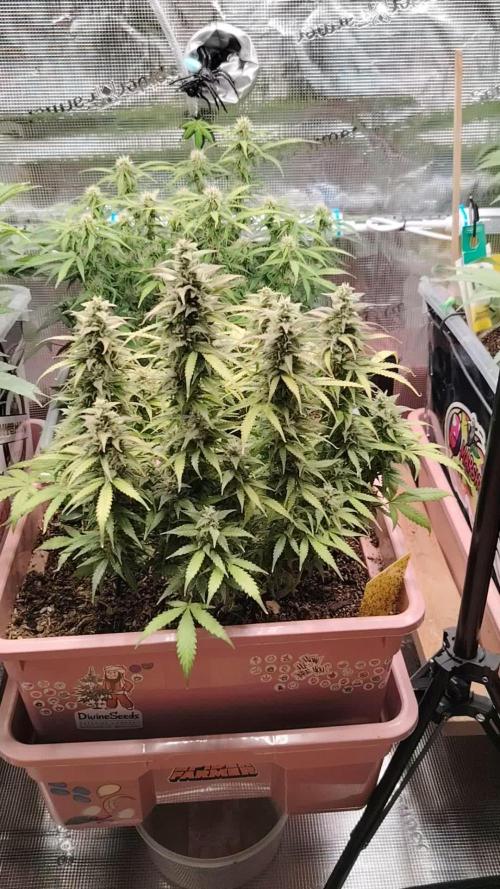
Auto Opium is growing good. I lollipopped the canopy, and did some selective defoliation today I did a solution change on her about 4 days ago. Everything is looking on track. I am sure she will do some stretching this next week. Nothing more to report at this time thank you Divine Seeds, and Medic Grow. 🤜🏻🤛🏻🌱🌱🌱 Thank you grow diaries community for the 👇likes👇, follows, comments, and subscriptions on my YouTube channel👇. ❄️🌱🍻 Happy Growing 🌱🌱🌱 https://youtube.com/channel/UCAhN7yRzWLpcaRHhMIQ7X4g
Likes
25
Share
ANTHOCYANIN production is primarily controlled by the Cryptochrome (CR1) Photoreceptor ( !! UV and Blue Spectrums are primary drivers in the production of the pigment that replaces chlorophyll, isn't that awesome! 1. Diverse photoreceptors in plants Many civilizations, including the sun god of ancient Egypt, thought that the blessings of sunlight were the source of life. In fact, the survival of all life, including humans, is supported by the photosynthesis of plants that capture solar energy. Plants that perform photosynthesis have no means of transportation except for some algae. Therefore, it is necessary to monitor various changes in the external environment and respond appropriately to the place to survive. Among various environmental information, light is especially important information for plants that perform photosynthesis. In the process of evolution, plants acquired phytochrome, which mainly receives light in the red light region, and multiple blue light receptors, including his hytropin and phototropin, in order to sense the light environment. .. In addition to these, an ultraviolet light receptor named UVR8 was recently discovered. The latest image of the molecular structure and function of these various plant photoreceptors (Fig. 1), focusing on phytochrome and phototropin. Figure 1 Ultraviolet-visible absorption spectra of phytochrome, cryptochrome, phototropin, and UVR8. The dashed line represents each bioactive absorption spectrum. 2. Phytochrome; red-far red photoreversible molecular switch What is phytochrome? Phytochrome is a photochromic photoreceptor, and has two absorption types, a red light absorption type Pr (absorption maximum wavelength of about 665 nm) and a far-red light absorption type Pfr (730 nm). Reversible light conversion between the two by red light and far-red light, respectively(Fig. 1A, solid line and broken line). In general, Pfr is the active form that causes a physiological response. With some exceptions, phytochrome can be said to function as a photoreversible molecular switch. The background of the discovery is as follows. There are some types of plants that require light for germination (light seed germination). From that study, it was found that germination was induced by red light, the effect was inhibited by subsequent far-red light irradiation, and this could be repeated, and the existence of photoreceptors that reversibly photoconvert was predicted. In 1959, its existence was confirmed by the absorption spectrum measurement of the yellow sprout tissue, and it was named phytochrome. Why does the plant have a sensor to distinguish between such red light and far-red light? There is no big difference between the red and far-red light regions in the open-field spectrum of sunlight, but the proportion of red light is greatly reduced due to the absorption of chloroplasts in the shade of plants. Similar changes in light quality occur in the evening sunlight. Plants perceive this difference in light quality as the ratio of Pr and Pfr, recognize the light environment, and respond to it. Subsequent studies have revealed that it is responsible for various photomorphogenic reactions such as photoperiodic flowering induction, shade repellent, and deyellowing (greening). Furthermore, with the introduction of the model plant Arabidopsis thaliana (At) and the development of molecular biological analysis methods, research has progressed dramatically, and his five types of phytochromes (phyA-E) are present in Arabidopsis thaliana. all right. With the progress of the genome project, Fi’s tochrome-like photoreceptors were found in cyanobacteria, a photosynthetic prokaryotes other than plants. Furthermore, in non-photosynthetic bacteria, a homologue molecule called bacteriophytochrome photoreceptor (BphP) was found in Pseudomonas aeruginosa (Pa) and radiation-resistant bacteria (Deinococcus radiodurans, Dr). Domain structure of phytochrome molecule Phytochrome molecule can be roughly divided into N-terminal side and C-terminal side region. PAS (Per / Arndt / Sim: blue), GAF (cGMP phosphodiesterase / adenylyl cyclase / FhlA: green), PHY (phyto-chrome: purple) 3 in the N-terminal region of plant phytochrome (Fig. 2A) There are two domains and an N-terminal extension region (NTE: dark blue), and phytochromobilin (PΦB), which is one of the ring-opening tetrapyrroles, is thioether-bonded to the system stored in GAF as a chromophore. ing. PAS is a domain involved in the interaction between signal transduction-related proteins, and PHY is a phytochrome-specific domain. There are two PASs and her histidine kinase-related (HKR) domain (red) in the C-terminal region, but the histidine essential for kinase activity is not conserved. 3. Phototropin; photosynthetic efficiency optimized blue light receptor What is phototropin? Charles Darwin, who is famous for his theory of evolution, wrote in his book “The power of move-ment in plants” published in 1882 that plants bend toward blue light. Approximately 100 years later, the protein nph1 (nonphoto-tropic hypocotyl 1) encoded by one of the causative genes of Arabidopsis mutants causing phototropic abnormalities was identified as a blue photoreceptor. Later, another isotype npl1 was found and renamed phototropin 1 (phot1) and 2 (phot2), respectively. In addition to phototropism, phototropin is damaged by chloroplast photolocalization (chloroplasts move through the epidermal cells of the leaves and gather on the cell surface under appropriate light intensity for photosynthesis. As a photoreceptor for reactions such as escaping to the side of cells under dangerous strong light) and stomata (reactions that open stomata to optimize the uptake of carbon dioxide, which is the rate-determining process of photosynthetic reactions). It became clear that it worked. In this way, phototropin can be said to be a blue light receptor responsible for optimizing photosynthetic efficiency. Domain structure and LOV photoreaction of phototropin molecule Phototropin molecule has two photoreceptive domains (LOV1 and LOV2) called LOV (Light-Oxygen-Voltage sensing) on the N-terminal side, and serine / on the C-terminal side. It is a protein kinase that forms threonine kinase (STK) (Fig. 4Aa) and whose activity is regulated by light. LOV is one molecule as a chromophore, he binds FMN (flavin mononucleotide) non-covalently. The LOV forms an α/βfold, and the FMN is located on a β-sheet consisting of five antiparallel β-strands (Fig. 4B). The FMN in the ground state LOV shows the absorption spectrum of a typical oxidized flavin protein with a triplet oscillation structure and an absorption maximum wavelength of 450 nm, and is called D450 (Fig. 1C and Fig. 4E). After being excited to the singlet excited state by blue light, the FMN shifts to the triplet excited state (L660t *) due to intersystem crossing, and then the C4 (Fig. 4C) of the isoaroxazine ring of the FMN is conserved in the vicinity. It forms a transient accretionary prism with the tain (red part in Fig. 4B Eα) (S390I). When this cysteine is replaced with alanine (C / A substitution), the addition reaction does not occur. The effect of adduct formation propagates to the protein moiety, causing kinase activation (S390II). After that, the formed cysteine-flavin adduct spontaneously dissociates and returns to the original D450 (Fig. 4E, dark regression reaction). Phototropin kinase activity control mechanism by LOV2 Why does phototropin have two LOVs? Atphot1 was found as a protein that is rapidly autophosphorylated when irradiated with blue light. The effect of the above C / A substitution on this self-phosphorylation reaction and phototropism was investigated, and LOV2 is the main photomolecular switch in both self-phosphorylation and phototropism. It turns out that it functions as. After that, from experiments using artificial substrates, STK has a constitutive activity, LOV2 functions as an inhibitory domain of this activity, and the inhibition is eliminated by photoreaction, while LOV1 is kinase light. It was shown to modify the photosensitivity of the activation reaction. In addition to this, LOV1 was found to act as a dimerization site from the crystal structure and his SAXS. What kind of molecular mechanism does LOV2 use to photoregulate kinase activity? The following two modules play important roles in this intramolecular signal transduction. Figure 4 (A) Domain structure of LOV photoreceptors. a: Phototropin b: Neochrome c: FKF1 family protein d: Aureochrome (B) Crystal structure of auto barley phot1 LOV2. (C) Structure of FMN isoaroxazine ring. (D) Schematic diagram of the functional domain and module of Arabidopsis thaliana phot1. L, A’α, and Jα represent linker, A’α helix, and Jα helix, respectively. (E) LOV photoreaction. (F) Molecular structure model (mesh) of the LOV2-STK sample (black line) containing A’α of phot2 obtained based on SAXS under dark (top) and under bright (bottom). The yellow, red, and green space-filled models represent the crystal structures of LOV2-Jα, protein kinase A N-lobe, and C-robe, respectively, and black represents FMN. See the text for details. 1) Jα. LOV2 C of oat phot1-to α immediately after the terminus Rix (Jα) is present (Fig. 4D), which interacts with the β-sheet (Fig. 4B) that forms the FMN-bound scaffold of LOV2 in the dark, but unfolds and dissociates from the β-sheet with photoreaction. It was shown by NMR that it does. According to the crystal structure of LOV2-Jα, this Jα is located on the back surface of the β sheet and mainly has a hydrophobic interaction. The formation of S390II causes twisting of the isoaroxazine ring and protonation of N5 (Fig. 4C). As a result, the glutamine side chain present on his Iβ strand (Fig. 4B) in the β-sheet rotates to form a hydrogen bond with this protonated N5. Jα interacts with this his Iβ strand, and these changes are thought to cause the unfold-ing of Jα and dissociation from the β-sheet described above. Experiments such as amino acid substitution of Iβ strands revealed that kinases exhibit constitutive activity when this interaction is eliminated, and that Jα plays an important role in photoactivation of kinases. 2) A’α / Aβ gap. Recently, several results have been reported showing the involvement of amino acids near the A’α helix (Fig. 4D) located upstream of the N-terminal of LOV2 in kinase photoactivation. Therefore, he investigated the role of this A’α and its neighboring amino acids in kinase photoactivation, photoreaction, and Jα structural change for Atphot1. The LOV2-STK polypeptide (Fig. 4D, underlined in black) was used as a photocontrollable kinase for kinase activity analysis. As a result, it was found that the photoactivation of the kinase was abolished when amino acid substitution was introduced into the A’α / Aβ gap between A’α and Aβ of the LOV2 core. Interestingly, he had no effect on the structural changes in Jα examined on the peptide map due to the photoreaction of LOV2 or trypsin degradation. Therefore, the A’α / Aβ gap is considered to play an important role in intramolecular signal transduction after Jα. Structural changes detected by SAXS Structural changes of Jα have been detected by various biophysical methods other than NMR, but structural information on samples including up to STK is reported only by his results to his SAXS. Not. The SAXS measurement of the Atphot2 LOV2-STK polypeptide showed that the radius of inertia increased from 32.4 Å to 34.8 Å, and the molecular model (Fig. 4F) obtained by the ab initio modeling software GASBOR is that of LOV2 and STK. It was shown that the N lobes and C lobes lined up in tandem, and the relative position of LOV2 with respect to STK shifted by about 13 Å under light irradiation. The difference in the molecular model between the two is considered to reflect the structural changes that occur in the Jα and A’α / Aβ gaps mentioned above. Two phototropins with different photosensitivity In the phototropic reaction of Arabidopsis Arabidopsis, Arabidopsis responds to a very wide range of light intensities from 10–4 to 102 μmol photon / sec / m2. At that time, phot1 functions as an optical sensor in a wide range from low light to strong light, while phot2 reacts with light stronger than 1 μmol photon / sec / m2. What is the origin of these differences? As is well known, animal photoreceptors have a high photosensitivity due to the abundance of rhodopsin and the presence of biochemical amplification mechanisms. The exact abundance of phot1 and phot2 in vivo is unknown, but interesting results have been obtained in terms of amplification. The light intensity dependence of the photoactivation of the LOV2-STK polypeptide used in the above kinase analysis was investigated. It was found that phot1 was about 10 times more photosensitive than phot2. On the other hand, when the photochemical reactions of both were examined, it was found that the rate of the dark return reaction of phot1 was about 10 times slower than that of phot2. This result indicates that the longer the lifetime of S390II, which is in the kinase-activated state, the higher the photosensitivity of kinase activation. This correlation was further confirmed by extending the lifespan of her S390II with amino acid substitutions. This alone cannot explain the widespread differences in photosensitivity between phot1 and phot2, but it may explain some of them. Furthermore, it is necessary to investigate in detail protein modifications such as phosphorylation and the effects of phot interacting factors on photosensitivity. Other LOV photoreceptors Among fern plants and green algae, phytochrome ɾphotosensory module (PSM) on the N-terminal side and chimera photoreceptor with full-length phototropin on the C-terminal side, neochrome (Fig. There are types with 4Ab). It has been reported that some neochromes play a role in chloroplast photolocalization as a red light receiver. It is considered that fern plants have such a chimera photoreceptor in order to survive in a habitat such as undergrowth in a jungle where only red light reaches. In addition to this, plants have only one LOV domain, and three proteins involved in the degradation of photomorphogenesis-related proteins, FKF1 (Flavin-binding, Kelch repeat, F-box 1, ZTL (ZEITLUPE)), LKP2 ( There are LOV Kelch Protein2) (Fig. 4Ac) and aureochrome (Fig. 4Ad), which has a bZip domain on the N-terminal side of LOV and functions as a gene transcription factor. 4. Cryptochrome and UVR8 Cryptochrome is one of the blue photoreceptors and forms a superfamily with the DNA photoreceptor photolyase. It has FAD (flavin adenine dinucle-otide) as a chromophore and tetrahydrofolic acid, which is a condensing pigment. The ground state of FAD is considered to be the oxidized type, and the radical type (broken line in Fig. 1B) generated by blue light irradiation is considered to be the signaling state. The radical type also absorbs in the green to orange light region, and may widen the wavelength region of the plant morphogenesis reaction spectrum. Cryptochrome uses blue light to control physiological functions similar to phytochrome. It was identified as a photoreceptor from one of the causative genes of UVR8 Arabidopsis thaliana, and the chromophore is absorbed in the UVB region by a Trp triad consisting of three tryptophans (Fig. 1D). It is involved in the biosynthesis of flavonoids and anthocyanins that function as UV scavengers in plants. Conclusion It is thought that plants have acquired various photoreceptors necessary for their survival during a long evolutionary process. The photoreceptors that cover the existing far-red light to UVB mentioned here are considered to be some of them. More and more diverse photoreceptor genes are conserved in cyanobacteria and marine plankton. By examining these, it is thought that the understanding of plant photoreceptors will be further deepened.
Likes
26
Share
Week 4 8/9 - All the girls are still moist so no water today as I'll let them dry out a bit until tomorrow when I'll check them again in the morning. The FastBuds Purple Lemonade and Seedsman Gelato OG girls are ALL getting it done! They are all 8" and bushy as hell! I've been tucking leaves, gently bending branches and doing my daily LST on all the girls to stay on top of them in this stretch before flower. 8/10- Checked the soil on all the ladies and it was very moist down deep, but fairly dry in the top 4" so I gave all the ladies a small drink (1 quart each) of de-chlorinated water ph'd to 6.8 @ 77deg. OMG they are really starting to bush out and stretch now, especially the girls in the Fox Farm/Natures Living Soil Autoflower Concentrate mix, they're literally exploding! FastBuds Purple Lemonade and Seedsman Gelato OG's continue to lead the pack with growth and overall looks although the rest are now looking like they're gonna give them a run for their money! 8/11- No water for the girl's today. Mail Call! The Nematodes arrived today, 10 million of them, goodbye Fungus Gnats!😀 Temp's, RH and VPD all remain on point with day temps running 75-84 deg. and 68-74 deg. during the 5 hour dark period, RH maintaining @ 50-55% (I've been running the humidifier set @55% and I'm adjusting the ph to 6.5 on the water in it as well and the VPD runs from .90 to 1.18. Started a batch of Compost Tea ( 4g de-chlorinated 6.9ph water, 4 cups Worm Castings, 2/3 cup Kelp Meal, 2/3 cup Alfalfa Meal, 1/4 cup Bat Guano, 2 scoops Great White Mycorrhiza, 4 tbsp. Neptune's Harvest Seaweed Extract, 2 tbsp Alaskan Fish Extract and 1/3 cup unsulfured molasses) for the girls breakfast in 2 days. They're all growing like crazy now and the FastBuds Crystal Meth is beginning to flower along with one of the FB Purple Lemonades, the rest shouldn't be far behind. 8/12- Applied the Nematodes to all the girls this morning mixed into 2 gallons of 75 deg de-chlorinated 6.8ph water divided equally among them. I continued with my daily mild LST on all the girls, continuing to spread them out to allow light to reach all parts of the plants. I also cranked up the HLG 650R's to 450 watts each for a total of 900w @ the wall hung @ 36" from the soil. After I eventually have them cranked to max during flower I may drop them slightly depending on how the girls react. 8/13- Compost Tea for breakfast! Fed the girl's 1/2g each through the top with tea (840ppm, 1780EC, 7.6ph @ 81 deg), tucked shade leaves and LST'd where needed. FastBuds Purple Lemonade's and Crystal Meth's are all in flower, still waiting on Seedsman! Growth is phenomenal, girls are healthy looking with the exception of the Seedsman Gelato OG in SOHUM Living Soil - she is getting what appears to be tip burn, I'll be keeping an eye on her. 8/14- Well well...almost the end of Week 4 and I thought it would be prudent to calibrate my Blue Labs Soil PH Pen and TDS/EC Pen, which I did. I then proceeded to check all of the ladies mediums ph and OMG am I glad I did! All of the Natures Living Soil/Happy Frog mixes ph'd between 6.2 and 6.8 which is perfect! The SOHUM Living Soil with the Seedsman Gelato OG in it also had an acceptable ph of 6.4 ----BUT, and I mean a BIG but, the SOHUM Living Soil with the FastBuds Crystal Meth #2 in it had a ph of 5.2-5.4 checked at four places around the pot!...WTF! I double checked everything and same result. The plant looks generally healthy, although not as robust as it's sister in NLS/FF mix. Gonna sleep on this and ponder my next move. The rest of the ladies are on FIRE😍 They are all in flower now with the Seedsman Zkittles the furthest behind and the FastBuds Crystal Meth #1 and both of the Purple Lemonade's are the furthest along so far. No water today as they got a healthy dose of compost tea yesterday but I did do my daily leaf tucking and light LST to keep the light penetration good into the lower bud sites. Speaking of light penetration, I cranked the HLG 650R's up to 450w at the wall each for a total of 900w hitting my girls now and lowered both of the 650R's 4" from 36" to 32" and will see how the ladies respond. 8/15- Well, I slept on what to do with the Crystal Meth #2 in the SOHUM Living Soil with the ACIDIC ph. Today I ran 4 1/2 gallons of de-chlorinated water @ 7.7 ph to try to get some ph back. I measured the ph and PPM/EC of the runoff and more surprises awaited. The runoff had a PH of 4.2, repeat FOUR POINT TWO, 1480 PPM and an EC of 6550 @ 77 deg. I don't know how this girl looks as good as she does considering that she's basically living in ten gallons of between black coffee and tomato juice! I'll check the ph of her medium tomorrow and see where we go from here. I gave all the rest of my girls 1 gallon of de-chlorinated water ph'd to 6.9 @ 76 deg. and defoliated a couple of leaves on the OG's, Zkittles and lightly LST'd everybody, even the girl living in a pot of coffee!...LMAO😂 ONWARD to Week FIVE!!! Whoo Hoo!!!👍💪