The Grow Awards 2026 🏆
Likes
Comments
Share
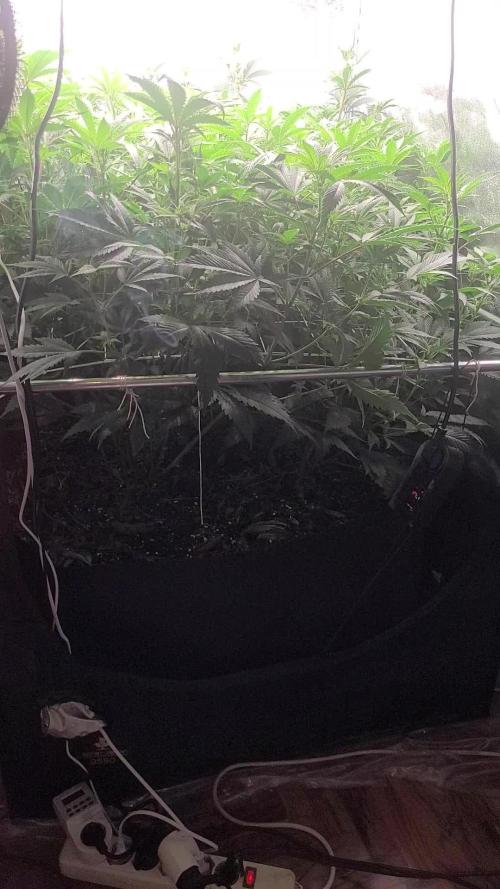
Bonjour à tous Comme vous pouvez le voir , RAS pour cette semaine , seulement deux gros arrosage , cela fais 4 jours qu'il fait plus ou moins 50 degrés dans la serre mais avec un bon sceau d'eau dans un coin , cela ne leurs poses aucun problème !!! Je suis toujours en près floraisons.... Pour l'instant c'est vraiment léger le passage en floraison Hormis la "Black Domina 0" et oui, le retour... Elle se porte très bien mais étant isolé ailleurs je ne peux pas la prendre en photo entière... Niveau engrais , Peau de banane à tout vas et Marc de café , je tiens à signaler qu'en cette fin de semaine dernière un important arrosage avait était fais avec du fumier de vache , cet engrais est naturel , gratuit et très riche en nutriment !!!! Je pense arrêter de fournir de l'azote pour la semaine prochaine afin de forcé "un peu" le passage en floraison Bon week-end !!!!!!
Likes
10
Share
Voltage, also known as electric pressure, electric tension, or (electric) potential difference, is the difference in electric potential between two points. In a static electric field, it corresponds to the work needed per unit of charge to move a test charge between the two points. In the International System of Units (SI), the derived unit for voltage is named volt. The voltage between points can be caused by the build-up of electric charge (e.g., a capacitor), and from an electromotive force (e.g., electromagnetic induction in generators, inductors, and transformers). On a macroscopic scale, a potential difference can be caused by electrochemical processes (e.g., cells and batteries), the pressure-induced piezoelectric effect, and the thermoelectric effect. Since it is the difference in electric potential, it is a physical scalar quantity. A voltmeter can be used to measure the voltage between two points in a system. Often a common reference potential such as the ground of the system is used as one of the points. A voltage can represent either a source of energy or the loss, dissipation, or storage of energy. Dropping the temps will slightly raise the humidity, air holds less % water the colder it is. Lights on 25-35rh% the same water content will spike to 50rh% + at night just by dropping the temps. At night all the juice photosynthesis has been storing up is mashed and mixed up to make all the goodies we need for bud, water is used to transport all these things everywhere, like little solvent transport devices, once a nutrient/protein has been delivered to destination the plant needs to get rid of all this excess water molecules it was using to transport. The only solution at night is to spit it back out into the air at night. During the peak of flower, this can catch a grower unaware, with a 4x4 full tent it can be a challenge to control all that moisture exhaust overnight especially if you're really pushing the limits. We live in a water world, above or below, our misconception is we live on dry land, we don't live in less watery conditions than above or below. We fit into a very narrow band of moisture that just so happens to be full of lots of air and everything else required for life. Got my first full whiff of the smell of purple lemonade, always surprises me how accurately the smell fits names, the dominant terpenes in the Purple Lemonade weed strain are carene, linalool, limonene, and myrcene. Carene gives this strain its sweet, citrus flavor and some woody notes, whereas the linalool I recognize so well from Granddaddy Purp. Myrcene has been shown to have sedative qualities while bringing musky, earthy elements to the flavor profile. Trichome production started to ramp up, and the plant that grew taller/closer to UV showed noticeably thicker coatings. The taller plant shows slight yellowing of lower leaves, and the smaller plant is green and lush but the buds are slightly less progressed, interesting. I super-cropped the main stem of the tall one just over a week ago (clean). I expected it to be the one slightly behind in development. The plant has roughly 10-15% "Total resources" that it keeps in case emergencies arise. Reserves if you will. My rationale behind breaking anything goes hand in hand with slowing things down as production is lost due to the time it takes to repair damage. I recall watching a YouTube video, where a curly hair gentleman would super crop in a manner to damage but not disrupt using a twisting method, using fingers and thumbs placing them close together one goes clockwise other counter clock this varies a lot depending on the thickness of stem but what you wait for is a tiny snap, it may take several rolls to weaken if walls are tough I found. No snapping or bending of the stem, you want just to fracture it but not puncture this way the xylem and phloem channels remain flowing,the damage is repaired almost instantly and the 10-15% is dispatched with very little repair time. Everything in the general vicinity of the stress will now grow stronger so as to prevent further similar damage. This is why I had expected the tall one to lag behind in development once I had cropped it but low and behold it worked and the tall one has slightly more developed buds. The effects of birdsong on plant life may at first glance be far-fetched. Nigh on ten years ago an article appeared in Nexus Magazine on the discovery or invention of a method of growing plants using bird sounds. Christopher Bird and Peter Tompkins describe the development of Dan Carlson’s Sonic Bloom in their book The Secret Life of Plants. Many others have, it seems, recognized the role of birdsong in the growth of plants, and influenced or directly helped Carlson to develop his invention. Dan Carlson’s desire to see that no one need be hungry through shortage of food sought to understand the optimum growth of plants. He discovered that plants also feed from ‘the top down’ as well as the roots. Underneath all leaves are pores called stomata which open to take in nutrients and moisture from the air. Carlson’s observation that the more bird life there is on the farm, the more abundant is plant life, has been echoed by farmers throughout history, except in modern times. Where there is little bird life, plants are stunted, and dwarfed. Nature has the birds sing at dawn and dusk, which dilates the stomata, and so feeds the plants. One can immediately see the importance of trees. The development of Sonic Bloom was to create birdsong, which is played to the plants, while a foliar nutrient is sprayed onto the plants at the same time as they are being stimulated by the sound, to enhance their growth. This method produced fantastic results in the amount of abundantly nutritious produce from one plant, often in poor soils and in drought conditions. Carlson showed that the breathing leaves of plants are the source of the nutrient intake for growth. This of course is also true for humans—the breath is food. We shall discourse on this on another occasion. Plants transfer nutrients to the soil via this breathing, and Carlson showed that his plants improved the soil and helped earthworms proliferate. The secret of Sonic Bloom was the development of the music of the same frequency as the dawn chorus of the birds. With the help of a Minneapolis music teacher, Michael Holtz, a cassette was prepared. It seems that both birds and plants found Indian melodies called ragas delightfully suitable. This is actually quite profound, although the American farmers, especially women, who had to endure this music whilst it was played to the plants, found it irritating. Holtz found the “Spring” movement of Vivaldi’s The Four Seasons appropriate and concludes: “I realized that Vivaldi, in his day, must have known all about birdsong, which he tried to imitate in his long violin passages. Holtz, it is related by the authors Bird and Tompkins, also realized that the violin music dominant in “Spring” reflected Johann Sebastian Bach’s violin sonatas broadcast by the Ottawa University researchers to a wheat field, which had obtained remarkable crops with 66 percent greater yield than average, with larger and heavier seeds. Accordingly, Holtz selected Bach’s E-major concerto for violin for inclusion on the tape. “I chose that particular concerto,” explained Holtz, “because it has many repetitions but varying notes. Bach was such a musical genius he could change his harmonic rhythm at nearly every other beat, with his chords going from E to B to G-sharp and so on, whereas Vivaldi would frequently keep to one chord for as long as four measures. That is why Bach is considered the greatest composer that ever lived. I chose Bach’s string concerto, rather than his more popular organ music, because the timbre of the violin, and its harmonic structure, is far richer than that of the organ. Birdsong has long been loved but also studied with reference to the musical scale and harmonics. As Holtz deepened his study he said, “I began to feel that God had created the birds for more than just freely flying about and warbling. Their very singing must somehow be intimately linked to the mysteries of seed germination and plant growth. The spring season down on the farms is much more silent than ever before. DDT killed off many birds and others never seem to have taken their place. Who knows what magical effect a bird like the wood thrush might have on its environment, singing three separate notes all at the same time, warbling two of them and sustaining the others. Tree and bird life are essential to Earth's existence, which Carlson, Holtz, and others have shown, but indeed others see and feel. “Plants”, says Steiner, “can only be understood when considered in connection with all that is circling, weaving, and living around them. In spring and autumn, when swallows produce vibrations as they flock in a body of air, causing currents with their wing beats, these and birdsong, have a powerful effect on the flowering and fruiting of plants. Remove the winged creatures, Steiner warns, and there would be stunting of vegetation. Nothing more needs to be added here. It has been said that you cannot hurt the humblest creature or disturb the smallest pebble without your action having a reaction upon something else...You cannot think of an evil thought, no matter how private, without it having an effect upon somebody else. Whatsoever you do in life sets up some form of resonance. When I say the morning chorus of the birds awakens the earth I mean that the characteristic song of the birds sets in motion a series of vibrations which react upon other forms of life. Remember, the soil of the earth is full of living microorganisms. The plants are also living organisms. You, yourselves, are living organisms. Now, this is the beauty and wonder of it all—when one aspect of nature has been moved into a state of resonance it immediately relays its vibrational motion to something else. So when I say the dawn chorus awakens the earth I literally mean what I say. I do not suggest that the earth would come to a standstill without the bird song, but I do mean that life on earth would be sluggish and ineffectual without that first instigating outburst of vibrational power poured forth at just the right pitch and tone to set off a chain effect. I know some of you will say, what happens in those parts of the world where there are no birds? Well, what does happen? Very little, I assure you. The hot deserts and the polar regions where there are few, if any, birds are not renowned for their wonders of nature. It is as though they are asleep. Nothing grows, few things live. Little resonates and there is a great stillness over everything. You see, that outburst of sound just before dawn is like the little lever that works the bigger lever which turns the wheel which moves the machine…and so on. Never underestimate small things. Animals are blessed with instantaneous and unthought-out wisdom. They are in direct contact with God and they act and live as though they are fully aware of it. Men are also in contact with God, but most of them act as though they have never heard of God because they are largely veiled from their divine center by their own thinking minds of which they are so proud.
Likes
92
Share
🌱 Week 1: The Journey Begins! 🌟 Hey Grow Fam! 🙌 We’re off to an epic start with our TrolMaster adventure, and I’m already feeling the love for the setup, the seeds, and the growth happening in the room! So, let’s dive right in and get into the details of this exciting week! 🌿 Germination Update: Our first Gorilla Melon seed from Fast Buds didn’t sprout, but no worries—round two was a success! 🦍🍈 The second seed has germinated and is looking full of potential. I’m throwing in a Sweet Seeds Papaya Zoap into the germination station too, so we’re keeping this exciting lineup going strong! Germination is such a key part of the journey, and having a healthy start is what it’s all about. 🔧 Room Build & TrolMaster Setup: The build is coming along beautifully, and I gotta say, the TrolMaster system is blowing my mind! Everything’s under control like magic 🎩✨, and the TM+ app? Wow, just wow. I mean, I can literally be in the bathroom and still keep an eye on the plants—check all the metrics, adjust settings, and fine-tune what I need, all from my phone! 😂💧 This level of control is next level. I’m loving how smooth and seamless it makes managing the room. The gear is just unreal, and seeing it all come together is truly something special. 🌱 Nutrition Talk: As for feeding, we’re starting light but smart! I’ve begun with 0.15ml of Regulator and 0.25ml of Startbooster per liter for now. I always believe in starting easy and ramping up as the plants develop. These early stages are crucial—balance is everything. For the time being, I feel this is more than enough to keep the babies happy and healthy. 🌿💧 The Regulator is working wonders in maintaining plant structure and health, while the Startbooster is fueling the early root and vegetative growth, laying down a solid foundation for the weeks to come. It’s about getting it right from the start—too much too early can be a killer. Keeping it steady with precision, that’s the goal! Big Shout-Outs: To the amazing team at @TrolMaster, @Fast_Buds, @Sweet_Seeds, @AptusHolland, and all the incredible sponsors—I’m beyond grateful for the support! 💚 And to my GrowDiaries fam and followers, you guys make this journey what it is—thank you for the love, and I’m so honored to have you along for this ride. 🙏 We’re just getting started, and I can’t wait to show you what’s next. Stay tuned for more updates, epic builds, gear reviews, and plenty of insight. Don’t forget to follow me on GrowDiaries, YouTube, and IG for exclusive content, and let’s make this grow the best one yet! 🌿🔥 Growers Love to All 💚💚💚 P.S.- A deep dive into the Full Spectrum Quantum Sensor (MBS-PAR): The Full Spectrum Quantum Sensor (MBS-PAR) is an essential tool for any serious grower looking to optimize their light environment. This sensor measures photosynthetically active radiation (PAR), which refers to the spectrum of light that plants actually use for photosynthesis—typically between 400 and 700 nanometers and more depending . What makes the MBS-PAR sensor special is its full spectrum capability, meaning it accurately detects not just visible light but also far-red and UV light—which are crucial for maximizing plant growth, development, and flowering. With this tool, I can monitor the exact intensity of light my plants are receiving, making sure they’re getting the optimal levels for every stage of growth. By using this sensor in my grow room, I’ll be able to ensure that the light distribution is uniform across the canopy. Plus, it allows me to fine-tune the light output from my ThinkGrow LED setup, ensuring my plants are thriving under the best conditions. Whether it’s increasing light during the vegetative phase or fine-tuning it for flowering, the MBS-PAR sensor helps me keep everything on point. And the best part? I can monitor it all through the TrolMaster app, ensuring I can make adjustments whenever needed—even if I’m not in the grow room! This level of precision means healthier plants, better yields, and maximum efficiency. It’s a game-changer for taking the guesswork out of lighting and getting closer to growing perfection! 🌱💡 Growers Love to All 💚💚💚
Likes
39
Share
@MyStery21
Follow
No nutrients burn, no problems at all. She's getting bigger every day. but i think its going to take more than 12 weeks ;(
Likes
16
Share
@Gulliver
Follow
Все хорошо 👌 Начал промывку субстрата
Likes
43
Share
@deFharo
Follow
Bienvenidos cultivadores de marihuana clandestinos, y también, a los que tienen la fortuna de no serlo!🖐️👨‍🌾 16 semanas de vida para esta planta hija de una Reina, nacida en casa y ahora cultivada al calor del hogar, siete semanas en horario de floración 12/12h y todavía tiene mucho que decir, su madre tuvo un periodo de 11 semanas de floración y si esta princesa sigue sus pasos los cogollos vana a ser majestuosos... a jugar He estado fuera unos días y al llegar todas las plantas gozaban de buena salud, las flores crecen y esta planta apesta, mis dedos se quedan pegados a las flores si las toco! Hoy al llegar he preparado una comilona para todas mis plantas, ahora, todos reunidos con música de fondo, hemos bebido felices y comido con placer y en abundancia... que siga el juego! Hasta la próxima... SALUDOS Y SALUD A TODOS!! ================================ Semilla obtenida el año pasado de la planta original, probablemente un retro cruce S1, un paso más hacia la auto suficiencia total en cultivos de marihuana! Mira el diario original: https://growdiaries.com/diaries/146971-grow-journal-by-defharo Info de la cepa original: https://en.seedfinder.eu/strain-info/Queen_Mother/Delicatessen/ Floración: 8 semanas Queen Mother es una cepa sativa estabilizada, gracias al minucioso y sistemático trabajo de selección y mantenimiento de la cepa, que el breeder Mario Bellandi, afincado en España desde hace más de 30 años, desarrolla sin descanso y con la máxima coherencia. El cruce inicial de esta cepa, y que hoy permanece intacto, surgió a finales de los 90 entre una sativa desconocida, cultivada en los altos de Tarragona (España) por la misma persona desde los años 60, unas semillas de la isla de Reunión y semillas de un cruce estabilizado de dos landrace congoleñas... ==============
Likes
1
Share
27/05 - Day 1 of Veg(1L of Nutrients dissolved in water poured into the tray) 1/06 - Day 6 added toothpick to help give support 2/06 - Day 7 checked on their root development, so I can transplant (Tomorrow we transplant)
Likes
3
Share
Likes
20
Share
"¡Finalmente llegó el momento de la cosecha de mi Lemon Mandarin de 420FastBuds! Esta planta ha sido un verdadero placer desde el inicio hasta el final. La genética autofloreciente mostró su resistencia, y no tuve mayores complicaciones durante todo el proceso de cultivo. Las flores tienen una estructura densa y pegajosa, llenas de tricomas que dan un brillo impresionante. El aroma es increíblemente fresco, con notas cítricas que se combinan con un toque dulce a mandarina, ¡sin duda, una mezcla deliciosa! Estoy muy satisfecho con los rendimientos y la calidad de la cosecha. El efecto es equilibrado, ideal para disfrutar tanto de día como de noche. ¡Sin duda volveré a cultivar Lemon Mandarin en el futuro! Un gran trabajo de 420FastBuds, como siempre."
Likes
24
Share
Mismos riegos que la semana anterior de acuerdo a la tabla de advanced nutrients. Las 4 nenas que están en floración(maceteros de 11lt) beben mucha agua, 8lt cada dos días y reciben un riego a la semana con nutrientes, el resto de riegos sólo con agua. Mientras que las otras 2 que siguen en vegetación (maceteros de 30lt) están bebiendo 9lt cada tres días, también con sólo un riego con nutrientes por semana. Saludos! Muy buenos humos a toda la gente que le da vida y vibra positiva a este mundo 💚🍀🤓
Likes
20
Share
@AsNoriu
Follow
They are runing well. More light would be better. Still doubt about defoliation. Thinking to make last heavy one on week 7 and start to flush at the end of it. Girls super healthy, i think i will easy beat 1g/w... Fingers crossed ;) Extra : Made second round of defoliation. All looks great ! Plus some night footage before defoliation If you ask where i found courage to make it again : https://m.youtube.com/watch?v=m7j3GMgKEM0 Miami Mango conviced me again ;) P.s. my plants where all time healthy, thats why i can try out such tricks. Anyway one plant no clearing, no lolitoping, no defoliation. We shall see the weight results, i have a competitor for her. On third week of flowering they both where the same. Time will tell ... I rotate my plants everyday so they get even light and same feeding. P.s.2 Plant in the midle is Choco Lopez auto, dont count her ;) i did all the same to her as to other photoperiod plants. She is the Beast ;) P.s.3 24 hours after dofoliation they started to smell really hard... Citrus and berries aroma all the way .. No sign of stress and easy to see how healthy they are , still blooming ;) P.s. 4 I always work with plants before watering them and when i harm them - i always water with ph water only. Soil is ritch enough and if damage will happen less feeding will reduse it ...
Likes
18
Share
Week 4 , day 1 plants are doing well some putting on more weight than others blue gelato are getting really dense and frosty . Watermelon punch buds are getting big aswell . Terple and wedding cakes are doing well
Likes
54
Share
@valiotoro
Follow
Once again GALACTIC buds! And once again cant add the comment lol
Likes
9
Share
@Kin_G
Follow
00000 000 00000 0 0 0 0000 00000 0 0 000 0 0 000 0 00 0 0 0 0 0 0 00000000 0 0 0 0 000 0 00 0 000 0 000 00 0 0 0 0 0 000 00 0 0 0 0 0 0 0000 0 0 0 0 0 00 0 0 0 00 0 0 0 0 00000 0 0 0 0 0 00 0 0 0 0 0 0 0 0 0 0 0
Likes
77
Share
Day 51. Growth: The girls stopped growing vertically and are between 62 and 75cm. Theyre all frosty already so im guessing theyll be frosty girls once they have put on weight. They arent looking healthy and i fucked up this week :( Ill explain everything down below. Training: Selective deleafing (cannabalized leaves) Nutrients: Ok so i had some ph issues last week and flushed as soon as i could( had to wait for soil to dry) I explained this in depth in last week's diary. Anyway, they got flushed and finally fed them 3 ml of canna terra florres 2-2-4. And next feeding will be 1ml of Canna Mono Calcium 15% and 1ml of Canna Mono Magnesium 7% Issues: The soil wasnt completely dry yet when i first fed after the flush but the girls were suffering and begging for theyre first dose of flores. I also carefully gave a foliar feeding to help her a bit during her flush instead of cannabalizing the shit out of theirselves. According to the time I have set on the timer the girls shouldve had 2 more hours of darkness after the foliar. Turns out somehow my timer wasnt set the way i left it and it ended up burning a few leaves, luckily it was a big foliar feeding. I must of bumped into it when setting up the tent. My dumbass shouldve checked the timer more often and im so mad at myself for letting this happen. Environment: So the ladies have a new home, a 27"×27"×63" tent. I didnt expect them to fit properly but it did!. The tent is definitely full. But i dont think ill run into issues. Right now i have a 150m3/h filter with a 185m3/h fan. The temperature and humidity is under control for now. I do have a little bit of positive pressure in the tent but not enough to inflate the tent, the room doesnt smell so im assuming no air is escaping from anywhere other then the exhaust. I will be updrading the inline fan and filter so i dont run into heat problems
Likes
2
Share
@Lexus
Follow
Flowers week 3 good teknik and low stress good harvest
Likes
13
Share
@Rwein93
Follow
Ciao ragazzi e bentornati qui per gli aggiornamenti sul diario stellare Questa settimana è andata più che bene direi, 3 ragazze hanno preso il volo rispetto alle altre 2, che mostrano ancora rallentamenti dovuti alla troppa foltezza delle foglie e la poca luce nei siti inferiori.🤙 Nel complesso alla grande, ho eseguito dell altro LST e nel giorno 24 e 28. Negli stessi giorni ho anche defogliato per aggiustare i rami mentre li legavo.👍 Ho bagnato loro nel giorno 25 con 2 litri di acqua e nuts, avevano davvero sete il vaso era leggerissimo.🔝 Anche per questa settimana è tutto amici Grazie per aver guardato e restate sintonizzati per nuovi aggiornamenti stellari.🙏 Buona settimana e felice crescita🌱🌱🌱
Likes
17
Share
Hello Diary. In the end, I have my own praise for this strain. Although they did not both emerge at the same time, they eventually had a harvest together. The outcome is in the end almost 140 g which is a great average. The dried flowers are hard and compact, reminiscent of velvet to the touch, really beautiful. They dried in a growbox for a total of 14 days along with their roommate Watermelon. My wife, although not a consumer, enjoys trimming which suits me great because I can take photos during that time. After trimming, we put the dry tops in jars where they matured for another 20 days. And now as I write this report, I’m enjoying the smoke of Purple Punch, drinking coffee, and trying to remember if I left something out in the report. If so, feel free to write and ask. I apologize for the delay with the reports, but a lot of photos and videos and other commitments have slowed me down in that. And hope those who visited the diary got useful information, thank you to everyone who supported this trip, thank you for all the compliments and comments. See you soon with new diaries.
Likes
4
Share
@Pechu420
Follow
Ak4 is growing a lot, with lots of vibrant colors, and gaining a lot of weight. Ak3 is the slowest of them all, the smallest, but it's gaining weight at its own pace and resining well. 12/12 from seedWatering with filtered tap water every 2/3 days, when the pot is lighter Soil: peat, coconut powder, perlite, carbonized rice husk, sheep manure and worm humus. essential mineral mix, vegetable flours, vegetable cakes, biochar, bokashi EM1 and other organic inputs, Algae ascophyllum nodosum small pots 3,7liters // 1gallon light: lm301h-evo 120watts with other plants