The Grow Awards 2026 🏆 






Likes
Comments
Share


Likes
23
Share
@SirDillton
Follow
First grow. Ph 6.3 /temp 23 /RH%60 /water ppm 210 /Co2 500 ppm/18-6 light/ par value 600/ techna flora recipe for success nutrient cycle. Kryptonite organic worm casting soil. No training yet. 3.5 litres of water every 3 days . First mistake and note to growers and self when using spray bottle to we surface make sure not rip off any leaves as your pulling the trigger...oh well she will live.


Likes
6
Share
@I_roll_my_own_420
Follow
Hey growers, another week finished. Plants got much bigger and buds are growing nicely. Smells starts to be fruity and plants are looking beautiful. Cheers!

Likes
19
Share
@CannabisAprendiz
Follow
Hola hemos tenido problemas con la cámara del celular y no hemos podido tomar muchas fotos por lo mismo .
Esta es la Segunda semana de floración de este seguimiento , me parecen bastante rápidas la formación de sus flores y ya se está viendo una formación de resina en las flores.
tenemos una SBR que se espigo más que las demás intentaremos ir controlando su crecimiento con algún cropping.
Hello, we had problems with the cell phone camera and we could not take many photos for the same.
This is the second week of flowering of this follow-up, the formation of its flowers seems quite fast to me and a resin formation is already being seen in the flowers.
We have an SBR that spikes more than the others, we will try to control its growth with some cropping.


Processing
Likes
14
Share
@MG2009
Follow
11/21/2020
Soaked in water 24 hours all seed fell to bottom, put in paper towel over night and 6 out of 10 have sprouted.
In this cross I will be looking for powdery mildew immunity first and foremost. ( goal achieved see week 15)
Also hope to make cookie cake stretch more and bring a sativa influence.
11/28/2020
One week old today 5 out of 10, 6th sprout had stem rot 60% germination. Now hope for 3 girls at least 🙏


Likes
6
Share
@mrcrop
Follow
They are fatting up really fast, the thing is all of them are smell like too much)) the neighbors are happy) Looks like the glookies is the less resistant to pests and desieses of all of them. I think i´m gonna chop the Purple lemonade next week.

Likes
20
Share
@MoGrow
Follow
This week was a bit of a struggle. Plant was moved to 5 gallon container and into a tent. It took me a few days to get the humidity under control but all is well now that I've got a little better ventilation. The only thing I'm very concerned with now is bringing the ph down to a 6.5 -7. I'm going to use distilled water instead of nutrient mix for the next week and likely will heavily dilute the nutrient mix before next feeding.

Likes
19
Share
@Mrs_Larimar
Follow
2025-09-26
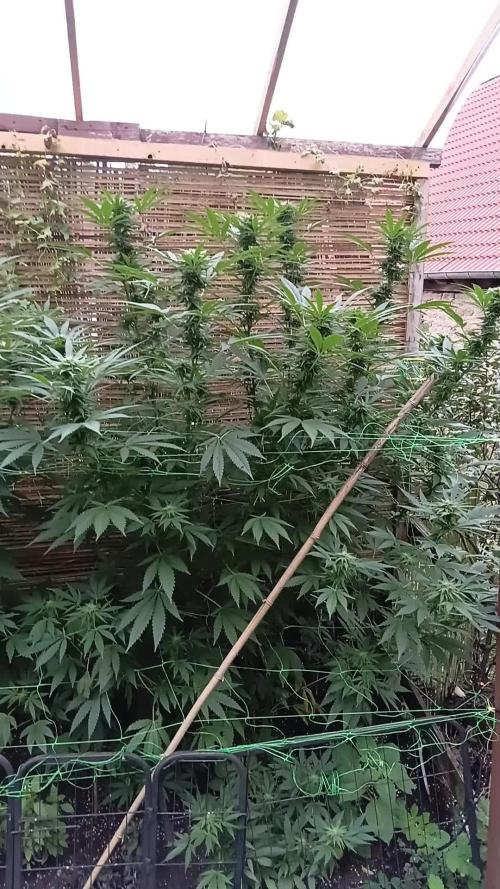
We are under 13 Hours of Light, we had a cold and rainy Week
from Sunday on until today ( Friday) weather was cold.
it was raining heavyly-
and iam hoping some dryer and warmer days to come
for the moment everything is fine, plants are standing under the Roof and getting stabilized by 2 SCROG- nets
we will see.

Likes
22
Share
@PrairieFrostGrow
Follow
*
*********** Week 11 - June 20 to 26, 2020 - Days 71 to 77 from germination ***********
*
These girls have been continuing their growth this week and looking better all the time. GSC2 still slow though and will not have much yield. Her leaves have turned very dark this week due to lockouts I suspect. Her hairs are still very white and coming out pointy looking for pollen and swelling. GSC is still swelling and her buds are bigger at the end of the week. Purple colours also coming out in her.
The big girl has done well being squished in the corner as I had to put the two in one tent this week. The frost in GSC has been coming out for the last two weeks and is really getting sticky this week. The pH is still crazy high for the girls but they are pushing through this issue and finishing up. These are very resilient plants and I am impressed with her vigour!!
Still giving them feedings in the 3.0 pH range to help as her runoff is still coming in at mid 7’s......for both girls. GSC has been feed hard because her leaves have a nice pale colour, unlike GSC2, so keep her going and swelling. They were given a heavy watering of 8L each on day 71 to find out where the medium is. They were 7.9pH when started and last runoff was roughly 7.1pH......should have gone further to bring down more but stopped there so I didn’t flush out all of the feed since they have a couple fo weeks left. The hairs on GSC are turning more of a tan colour rather than snow white. I suspect she they have roughly this week plus another yet before thinking about harvest.......I see them going to 84 days roughly, 12 weeks.
GSC bud sites are getting pointy this week. Added bamboo steaks to GSC to tie the long branches to and support her weight. GSC2 less so and are still looking more round as she continues to fill in her buds. GSC stems have been turning purple more and more this week. Suspect it is a combination of pH and stresses with temps. GSC2 was tied more this week as well to let more light in closer to the main stem. This paid off as well as she is stacking the lower points more. She, GSC2, has also paid a bit of a price over the last week because she was kept in the flower tent with other more mature girls. The environment in that tent was striving for 76 degrees and 51% humidity but GSC2 wants 82 degrees and 65% humidity........didn’t have much choice😢
Fast Buds has rocked this strain and dialled her in after the generations of breeding!! She is very frosty for an auto and had she been given the correct watering, she would be considered an easy grow In my opinion! The two girls are growing very different but that is grower related to transplant and not genetics. Awesome job Fast Buds......the girls are keeping me smiling......and scratching my head at the same time👍👍👍👍
Little more detail.......
June 20/20 - Day 71
- 6L low ph flush of plain water @ 4.0 to bring down pH..........3L each girl.
- Followed with a low pH feeding of 4L watering with Rezin, Liquid Wt, CalMag, B52 @ 2ml, Piranha @ 1ml, Voodoo @ 0.5ml/L, = 1170ppm and pH 4.4
- GSC1 tops are getting lots of purple in the bud.
- GSC1 is filling in nicely and top leaves are starting to fade yellow.
- GSC2 is dark😞
June 21/20 - Day 72
- continuing flush with 12L of plain water pH to 3.3 to bring down pH.
- 6L given to each girl.
- added bamboo stakes to pull GSC1 apart and open up the middle bud sites to more light.
- GSC1 is 38" tall and 36" across now😀👍
- GSC2 is 20" tall and 24" wide👍
June 22/20 - Day 73
- 2L each watering with Rezin @ 1ml
- hairs are turning more red and more white to tan now.
- GSC1 is closer.....getting to home stretch soon.
June 23/20 - Day 74
- 5L - Massive @ 3ml/L, Rezin & L.Weight & B52 @ 2ml/L, Vitathrive & Dual Fuel @ 1ml/L = 1110ppm
- GSC 3L, GSC2 - 2L
- they are getting close to the end so getting the last bits of everything into them😀
- noticing GSC1 top cola may start to bleach out a bit.
- GSC2 feels like she has stalled.
June 24/20 - Day 75
- watering 3L each with Massive & Terpinator @ 3ml/L, Rezin & Vita & L.Wt @ 2ml/L, Dual Fuel @ 1.5ml/L, CalMag @ 1ml/L = 1385ppm and pH to 3.9...crazy!
- moved the two girls together today as the other two are going into darkness now, they are done.
June 25/20 - Day 76
- Dry out day
- GSC is doing well with her buds filling in now and firming up. Top leaves are drying more.
- GSC2 is dark.....F......plain water and not much more we can do.
June 26/20 - Day 77
- 7L watering with Rezin and Sensyzime @ 2ml = 75ppm and pH at 4.0
- 4L given to GSC and 3L given to GSC2.
- Staying with RO water now.......tap water appears to have been an issue.
- too bad the ph was such an issue.....GSC would be a monster😞
- run off numbers in pots:
GSC 7.6pH and 780ppm
GSC2 7.6pH and 1850ppm (she has stalled)
Awesome strain Fast Buds.......will be running her again!!!!!!


Likes
30
Share
@SolitudeCorners
Follow
Last week of flowering (72days from the light switch) Gonna cut soon when the dirt is dry. A quite late harvest. Many buds denser more, and stem can’t longer resist.
This season so satisfy. Thank for all mentor and comment. You all are my inspiration for grows.
Feeding
23/1 Water 13.5L+Flawless 20ml ppm80 ph6.2
MDR 3L 2Lx5
Runoff
MDR 1400 /1155
Zkittle 1600/1300/1150
Pineapp 900/600
Purp 1300 /1200
Sapp 2000/1100
Dozdos 1100/1000
25/1 10.42 6L ppm9 ph6 1L per pot
3L+Flawless6ml ppm116 ph5.9 1.5/1.5 Purp, Zkittle
4.5L+ Flawless7ml ppm119 ph6 1.5/3 Sapp,MDR
Runoff
Purp 1300
Zkittle 1500/1200
Dozdos 1400
Sapp1300
Pineapp850
MDR950
27/1 runoff
Pineapp 500
Purp 900
MDR 600
Zkittle 400
Sapp 300
Dozdos 400

Likes
12
Share
@Kenpowarrior
Follow
●on 12/12 light so that honey girls can start to flowering. They are no auto's.
●Royal dwarf girls are on green sensation and sugar royal for better tast en smell. Lets see what it gives.
●they are growing slow now not much change to see. Waiting for fatter buds.
Likes
11
Share
@CURATI_DA_SOLO
Follow
Purtroppo per colpa di qualche altro stronzo non ho potuto vendemmiare non so quanto avrei raccolto ma secondo me sarebbe uscirà un erba bellissima, come sempre fast buds non ne sbaglia una....spero di coltivare presto altre loro varietà e postare nuovi diari....intanto vi saluto un abbraccio a tutti
Likes
109
Share
@MadeInGermany
Follow
Welcome to the GHSC Cup 🏆
Day 13 since the time change to 12/12 h.
Day 3 since the beginning of flowering. Hey everyone 🤗.
This week she developed beautifully 😍.
Yesterday she got GHSC Powder Feeding Bio Bloom for the first time (2 g per l substrate).
Yesterday she got enhancers like every 2 weeks (1 g per l water). In the 3-4 week of flowering, she gets another 1 g per liter of substrate from GHSC Powder Feeding Bio Bloom :-).
That should go to the end 🙏🏻.
The bottom shoots have also been removed so that the energy doesn't go down into the popcorn buds.
The topping did her very good :-) she got a very nice shape 😍.
I am very excited about what she will do this week and wish you all a nice weekend, stay healthy 🙏🏻 and let it grow 🌱👍
You can buy this Strain at :
https://greenhouseseeds.nl/
☝️🏼☝️🏼☝️🏼☝️🏼☝️🏼☝️🏼☝️🏼☝️🏼☝️🏼☝️🏼☝️🏼☝️🏼
Green House Seeds Company Cup 🏆
Type:
Wonder Pie
☝️🏼
Genetics:
Wedding Cake x OG Kush
👍😍
Vega lamp: 2 x Todogrow Led
Quantum Board 100 W
💡
Flower Lamp : 2 x Todogrow Led
Cxb 3590 COB 3500 K 205 W
💡💡☝️🏼
Earth: Canna Bio
☝️🏼
Fertilizer: Bio Grow Feeding ( GHSC ) , Enhancer ( GHSC ) , Bio Bloom ( GHSC)
☝️🏼🌱
Water: Osmosis water mixed with normal water (24 hours stale that the chlorine evaporates) to 0.2 EC. Add Cal / Mag to 0.4 Ec Ph with Organic Ph - to 6.0

Likes
8
Share
@jayizrollin
Follow
Day 49
TG1 is starting to dense up already, super even canopy and even size buds everywhere. It’s so small compared to my other plants I have it on a shoebox to get more light.
TG2 is looking better now, it has healed well from my abuse last week and is producing buds everywhere, super tight spacing, I haven’t seen any more pollen sacs.
Thanks for checking out my grow!

Likes
9
Share
@FrostRailz
Follow
Ran 9.5 weeks
Whole plant hang dry 17 days
Growing wasnt easy, would not recommend to beginner, not heavy eater, but other than that she was a dream to grow, genetics spot on!

Likes
25
Share
@Ganjeiro420
Follow
Eai comunidade Growdiaries 💚
Estamos chegando na reta final desse ciclo, quase não tive problemas as sementes auto florescentes da @Fastbuds são incríveis ☘️
Já estou na 2° semanas fazendo a limpeza do solo com água pura, como vocês podem ver as meninas estão bem amareladas e se preparando para o corte ✂️
Os primeiros tricomas âmbar estão começando a aparecer, pretendo cortar ela no dia 14 (Domingo) mas estou observando e se os tricomas âmbar chegarem em 30% da planta antes dessa data então vou cortar.
Os Buds estão super densos com um cheiro de frutas que e incrível, com certeza vou ficar feliz com o resultado na balança⚖️