The Grow Awards 2026 🏆 





Likes
Comments
Share
@Cameltoe
Follow
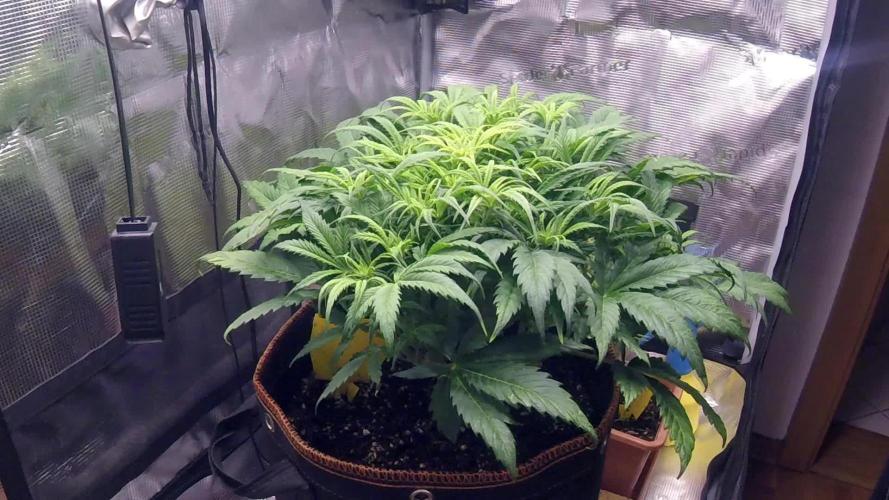
Week 3 is in the books. Breaking all the rules with this autoflower. Growing in a super tiny pot and topping it. Topping was done on day 17 with defoliation of the lowest growth. Humidity is super low so misting her a few times a day.
😍
Likes
8
Share
@sellem
Follow
Welcome to week 10. First trichome pics coming in. one BPP seems to be getting there, rest is still 1-2 weeks out, my estimate right now, might change in the future.
No watering as of yet, problably next on 16/04.
Watered on 16/04., 1.5L, 5.7PH 1.5 EC, 5ml/L Bloom 1ml/L Green Sensation
Watered the two BPPS only on 18/05, 1.5L, 5.7PH 1.7EC, Same nutes
Trichomes on all seem to ambering up, but still a bit to go. Closely monitoring their progress.

Likes
2
Share
@Farmeryo901
Follow
Experiencing what seems to be my first nutrient lock out. Bought a soil ph tester from homdepo its reading 7.0 so that what bring me to that conclusion on top of the slower growing and the slight yellowing around the leaves. I was being cheap and using the liquid ph tester that comes with the ph up and down and im regretting now seeing my plants in not the best condition. Im ordering a better ph pen today i used the vivosun one the i currently have got the water to 5.8 checked the run off and its at 6.2 hopefully that helps. Saturday im going to top dress and water at 5.8 aging and im thinking that should put me back on track
Any advice i could definitely use some tips and pointers or advice
Likes
18
Share
@ButterfliesLittleFarm
Follow
Hello Diary.
The second week of flowering is behind me. I did a little defoliation this week, I honestly didn’t dare remove more leaves and branches, I didn’t know how they would react to it. Maybe I needed more?
The temperature is still high, sometimes rising to 29, 30 degrees, but mostly around 28. Humidity in the air is an average of about 55% but sometimes rises to 60%. The problem is frequent rains this summer which creates high humidity in the air and this affects the humidity in the box as well. But plants tolerate these conditions very well.
The flowers are developing nicely, and they have started to smell as well, but let the pictures speak for themselves.
Green Gelato is twice as small compared to her roommates, but there is still a big crowd in the box. Gelato grew with very dense branches and spread more than it grew in height. The 120 x 60 box size is perhaps too small for three plants (two Hulkberries and one Green Gelato), so the real jungle is in the box.
Due to the height of the Hulkberry in the box, and the spreading branches, it has become difficult to take them out every week for photography, but I am extremely careful with them.
The Green Gelato has grown to 48 cm and does not look like it will grow much in height. Probably due to the excessive distance from the light, which I had to raise because of the Hulkberry which reached a height of 1m.
18/07/2020. - Day 30.
Defoliation. I removed the leaves at the very bottom of the plant to make it easier for me to water them, after that I watered the plants but this time I didn’t put BioBizz, I just watered them with clean water.
21/07/2020. - Day 33.
Watering. This time I gave them BioBizz, on schedule for the second week of flowering. I also added CalMag 1.5ml / L, preventively. While they don’t show they’re missing anything, I’ll keep adding CalMag.
23/07/2020. - Day 35.
Photography and height measurement.
Green Gelato Auto - Day 35. - 48cm
That’s all for this week, see you soon.

Likes
2
Share
@PINUFLA
Follow
Día: 78
Riego: 1,5L x Pl.
- Agua
Día: 81
Riego: 1L x Pl.
- FinalFlush 2mlxL
Día: 83
Riego: 1L x Pl.
- Agua


Likes
12
Share
@PolezGardn
Follow
week two flower everything looks healthy :D
today i defoliated them
i watered them with 1.5l every 48h
the light i use was set to 80% and it hangs 80cm away from the tops

Likes
32
Share
@MadeInGermany
Follow
Info:
Unfortunately, I had to find out that my account is used for fake pages in social media.
I am only active here on growdiaries.
I am not on facebook instagram twitter etc All accounts except this one are fake.
Hi everyone :-) .
It develops really strong and beautiful from week to week :-).
In the next 14 - 20 days I will put them in the flower chamber :-).
Until then, I will train you with topping for the last time today 👍.
Otherwise the tent was cleaned and everything checked 👍.
Have fun and stay healthy 🙏🏻
You can buy this Strain at :
www.Zamnesia.com
Type:
Runtz
☝️🏼
Genetics:
Zkittlez x Gelato
👍
Vega lamp: 2 x Todogrow Led
Quantum Board 100 W
💡
Bloom Lamp : 2 x Todogrow Led
Cxb 3590 COB 3500 K 205 W
💡💡☝️🏼
Soil : Bio Bizz Coco
☝️🏼
Nutrients : Green House Seeds Company Powder Feeding Bio
☝️🏼🌱
Water: Osmosis water mixed with normal water (24 hours stale that the chlorine evaporates) to 0.2 EC. Add Cal / Mag to 0.4 Ec Ph with Organic Ph - to 5.8

Likes
21
Share
@Gram_Solo
Follow
These have shooted right up! 🚀🚀
I only topped once and she's responded well
1 has deficiency I think some weird leaves but she looks healthy overall
Switching to flower in 2 weeks 🙌

Likes
92
Share
@yan402
Follow
Hi this is Apple fritter auto by Royal Queen
No idea of the week as I have not been keeping track and the only updates will be pictures and a video once a week until harvest.
Wish you all a successful grow.
No water no feed since 23.07.24 till harvest 26-27.07.24
Likes
120
Share
@Themythicalchristine
Follow
These are doing awesome!
We have had a little bit of a change in the weather in the last week, the nights have gotten nice and cool, and the days are still quite warm.
We have also had a few showers this week which they seem to have loved.
We are at about 13.5 hours of sunlight a day, and cute little buds are forming quickly.
These smell peppery, sharp and sweet.
One of these babes has reached 7 ft from the ground; the others are between 6.5 and 7 ft aswell.
We heavily defoliated these giants today.
These ladies continue to impress me as we move slowly toward the autumn equinox; and into the harvest season 🌾

Likes
114
Share
@Drgreen13
Follow
Bonjour guys, so from the moment I popped this seed up until now, I've had no issues with this strain at all, no deficiencies, very easy to grow, and she is piling on the weight now, the buds are the whole length of the main colas (x4) and are over half a metre in length, I must say I'm very, VERY impressed with this pheno, I just wish I'd taken a cutting, I have got one more seed left tho 🙏🏼. Anyway, please check out my other diaries, and feel free to leave a like, maybe even a follow, and I'll be sure to check out your diaries too.
Drgreen13#6724 (discord)
Stay high, stay fly, #420everyday.


Likes
5
Share
@BasiGoToGrow
Follow
Week5
The week is over and all looks fine.
Both ladies are preparing to bloom and are growing. Orange Sherbet is now 28 cm tall. Bruce Banner has caught up a lot this week and is at 25 cm.
For 1 liter of water there was 0.5 ml of silicate;;
0.5 ml of Calmag;; 2 ml of BioNova BN-Zym, 2 ml of BioNova TheMissingLink;; 2 ml of BioNova Auto complete fertilizer and 1 ml of 100% organic algae juice.
Ph 6.0-6.3 23°C
Likes
5
Share
@BenChasinBigBudz
Follow
Sorry I only have two pictures today but it really isn't much to see. She's still in half veg half bloom mode. Soon she should be loading up.
Either way I will be uploading this entire grow journal to my YouTube channel which is easy to remember. I am Ben and I chase big budz. Ben Chasin' Big Budz
Hope to see you there

Likes
17
Share
@Colibri_grow
Follow
Runtz muffin with 9 days from germination (15/02/22)
Strawberry, gelato and Jack dream - 4 days
Strawberry, gelato and Jack dream - 7 days (04/03/22)
As strains mais recentes foram para terra no dia 24, dia 25 já estavam nascendo.




Likes
77
Share
@SooSan
Follow
Dans l'ordre:
1) Afghan Peach x Blue Monkey
2) Gelato Cake
3) Fast Critical Poison
4) Tropical Fuel
5) Hindu Kush
6) (Blueberry x Black Domina) X (Kosher Kush x Mk-Ultra)
7) Blueberry
8) Herz OG
9) (Blueberry x Black Domina) X (Kosher Kush x Mk-Ultra)


Likes
Comments
Share
@Appalachia_bucket
Follow
Day 19. Another defoliation. Watered in a gallon from the top. Then topped off sip buckets.
Likes
60
Share
@m0use
Follow
Plant #3 yellow hermied and pollinated the tent :(
Can see some of the seeds in the bud closeups as well as the pollen and mini sacks of the plant on lower growth.
Not a big fan of this, It was the one plant closest to the tent door zipper and only happened on the lower growth. Almost wondering if there was a light leak or if it was just the plant. Will test for light leaks when the plants are chopped and I can crawl in and manage it.
The liverwort from last grow survived outside and is making weird spiky umbrella like things. Looks to be its flower for lack of better understanding and how its going to release a lot of spores for the next generation to grow.
Big shoutout to Medic Grow for sponsoring the lighting in my tent, They have provided me with 2x Mini Sun 2's in the 240w configuration, They use the v1 growing spectrum that is a all purpose seed to harvest spectrum so their is no hassle of switching it mid grow. If you're interested in learning more about Medic Grow products please visit the web link below.
https://medicgrow.com/
https://growdiaries.com/grower/MedicGrowLED
Likes
27
Share
@Mr_weed_pt
Follow
Another week.struggling with mold because of high humidity..I will give 5more days and then 48ho darkness…almost there 🙏..
