The Grow Awards 2026 🏆
Likes
Comments
Share
@ZZZSmo2
Follow
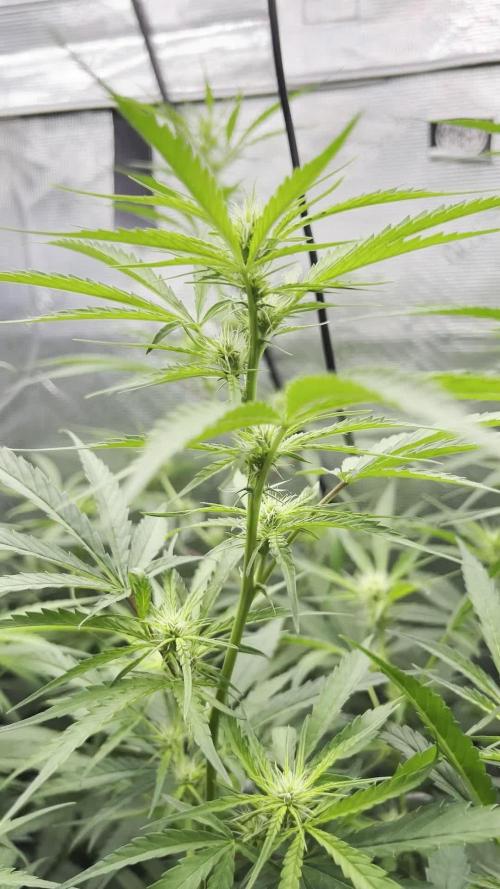
11l Pots Topping during week 4 +26C Temp. +60-65% Hum. Soil: Coco Light Mix + Humus Worm Casting (60/40) + Mycorhize Water + Cocos A + Cocos B + Pure zym Ph 6.0 - 6.5
Likes
6
Share
Mein outdoor spot ist noch nicht vollstĂ€ndig vorbereitet ich muss den boden noch dĂŒngen Dieses Jahr ist ein typ der ganz in der nĂ€he von meinem pflanzen rumhĂ€ngt Ich behalte die jungen pflanzen 2-3 Wochen drinnen bevor ich sie direkt in den Boden einpflanzen werde. Ich habe hilfreiche Pflanzen rund um mein beet gepflanzt Lavendel, kerbel, marigold und basilicum.
Likes
11
Share
@Sup3rNov4
Follow
Slow and steady wins the race Juan has slowed right down Finally the leaves are starting to turn, this is the latest in flower the leaves have lasted me. Shame she isn’t fattening up
Likes
124
Share
📆 Week 4, 12-18 May 2024 12 May - Upgraded light to ViparSpectra XS1500Pro. 13-14 May - Observed the plant. 15 May - Plant shows first pistils. 16-18 May - Observed and let the plant grow. 📑 It was time to upgrade my light and it was an easy choice to stay with ViparSpectra. In my opinion, for small tents and the home grower they are the brightest lights available on the market. The only problem with the *2024 new versions are the dimmer switches. They limit how you can adjust the power: 5, 25, 50, 75 and 100% are the only settings, nothing in between. If you are trying to “dial” in your DLI/PPFD it makes it impossible without adjusting light height, which is quite cumbersome comparatively. Your forced to work around an issue which should have never been one! The plant is showing its first pistils this week. This doesn’t mean its in flower. There is no bud formation yet, she is just letting you know she is female. It could be another 2-3 weeks or longer before buds start developing. Right now she is still in a veg state so no changes will be to a nutrient schedule that reflect a flowering stage. đŸ¶ 12 May nutrient solution changed đŸœïž 12 May feeding schedule updated 💧 Using reverse osmosis water with EC/TDS at 0 🐉 Nutrient solution EC 1.7 at 70 degrees F 🔆 Light power at 50%, DLI 28 canopy coverage at 18hrs đŸ˜€ Using PYPABL, Air Pump, 400GPH That is it for this week. Thanks for the look, read and stopping by.
Processing
Likes
17
Share
@Hawkbo
Follow
Hey guys I am a day late on the update cuz I went away for the weekend to a buddy's bachelor party and ended up with a broken clavicle in two places and need surgery tomorrow. I dont know how I'm gunna keep things rollin here but I'll figure it out. Anyways I couldn't get the plants out of the tent tonight but when I have some help tmm I'll try and get some better individual pics. I fed them before I left Friday at 1110 ppm with the green buzz and got a little burn, which is a good thing because that kinda shows me that less is more with this line and may save you a few bucks over time. It's also nice that there isnt 11 different bottles to pour from so far I couldn't be more impressed with GBL. The planta were all pretty bone dry today but look better than ever. Pics were taken at day 29 this week, temps have been around 73°F and 58% RH. This tent is in a basement so even with the dehumidifier the rh is pretty high especially with the lights out but the plants seem to enjoy it and I have plenty of air circulating. The big one is one of the more impressive girls in the tent in terms of overall structure. I pray that I get some fiery red Panama pistils although its probly unlikely. The little one is hidden in the corner I couldn't really get to it. I'll get some pics tmm when I take them out of the tent to feed I just gave them a splash tonight to hold them over til I have help. Edit: I fucked somethin up here in the video I put day 29 bloom, these were flipped on june 9th and got 36 hr dark period, I uploaded the video last monday so it was actually on day 22 flower not day 29 but it's a little late to edit the video so ignore that day and I'll make a new one tonight which is actually day 28
Likes
17
Share
9/2/25 Overall I'm delighted with these. 17 weeks grows for me are few & far between. These 2 phenos had 7 weeks in 2L pots. And were put into a 20L pot of coco/pebbles and gives 10-14 days to recover and were flipped. I purposely grew them this shape as I had to make sure I kept them apart if hit with WPM or anything like that. As grows these long, buds this dense. And running a tent with a bunch of mixed grows from done to days into the start of the 12-12 flip. I would have liked to run for another week on a 100w light and high doses of UV but because of such a mixed bag of grows in my tents. Running reds/uv just wasn't even attempted. 10/2 She smells absolutely amazing, buds are super big, sticky & very smelly. They're still mainly hard for the moment. And leaves not even limp. So, I removed the big fan leaves to allow air to move around better. They're hanging behind my 100cm2 tent kept out of UV rays.
Likes
114
Share
đŸ’©Alrighty Then Growmies We Are Back At it đŸ’© Well folks we just finished up the last run and so we are back to do it all over again 😁 So what do you say we have some fun 👈 We got some Gorilla Punch 👊 👊 👊 DAY 42 👉 Its been a really crazy couple of week's 😳 So I've had a few issues what's done is done , but I think we are on track and she's doing good 👌 So i gave them a flush and then there normal feeding so hope that fixes it đŸ€” Time will tell 🙂 FC4800 from MarsHydro Lights being readjusted and chart updated .........👍👉Added an RU45 too the mix 👍 www.marshydro.ca 👉I used NutriNPK for nutrients for my grows and welcome anyone to give them a try .👈 👉 www.nutrinpk.com 👈 NutriNPK Cal MAG 14-0-14 NutriNPK Grow 28-14-14 NutriNPK Bloom 8-20-30 NutriNPK Bloom Booster 0-52-34 I GOT MULTIPLE DIARIES ON THE GO đŸ˜± please check them out 😎 👉THANKS FOR TAKING THE TIME TO GO OVER MY DIARIES 👈 Would you like to hang with the growdiary community 👉 https://discord.gg/gr4cHGDpdb 👈
Likes
1
Share
đŸŒ± : 💧 : 5l day 31 💡 : Dli: 40 mol/mÂČ/d đŸ€” :
Likes
11
Share
5 week veg was too long IMO for the size of pots...8 week flowering but she changes rather quickly...nothing really and then boom a see of orange...wonderful tricoms...broke 2 plants down and hung for 6 days the other 2 got hung whole for 10...all is jarred up and curing and cant wait to taste her full potential...took a sample bud but speed drying does no justice to taste and strenght any how the ash was light gray to almost white so 2 weeks of just water seemed to do the trick but we will see...
Likes
2
Share
@Ninjabuds
Follow
Divine jelly has some really interesting leaves they are pointy and small I can already tell this plant is going to show attributes that are not common. I’m excited to see what kinda exotic looking plant it turns into It’s day 41 from seed and all of the plants are really thriving
Likes
4
Share
@GeminiCQC
Follow
Can't wait for each of them to finish out. Giving them hopefully their full amount of water, less with the auto as it was stunted by the 12/12.
Likes
3
Share
unfortunately we noticed some budrod in the headbud. we cut it generously sb, unfortunately the papaya cookies still need something and the weather is now autumnal cold and rainy. We'll see in 7 days at the latest, but hopefully there won't be any more budrod by then... It's the most beautiful of all the outdoor plants so far.
Likes
14
Share
@SUMAN
Follow
Transplanted the photos,they are stunted do lack of nutrients should recover shorty also the runtz muffins with the broken stem has recovered nicely and have started lst on it and the gorilla cookies auto
Likes
8
Share
1 GC last stunted survivor, 1 SG stunted survivor and remainder 2 SG and 3 SS are going good let's see where this grow will take us. I tried germinating Gorilla glue 4 but both of them didn't push through after sowing them. I might be doing something completely wrong while sowing. Can't push more seeds through germination because the rest of them are at different stages of grow and everything will fall apart. Let's hope the 7 plants make it through fingers cross. Review: Plants aren't as green as I would expect them to be either the medium is too inert that they are turning yellow and stunted. So I tried fixing it with aggressive push of nutes and checked the EC and now it's at a comfortable 0.70 average among all the pots improving from meager 0.20.
Likes
52
Share
Lacewings seemed to have mostly killed themselves by flying into hot light fixtures. I may have left the UV on which was smart of me :) Done very little to combat if anything but make a sea of carcasses, on the bright side its good nutrition for the soil. Made a concoction of ethanol 70%, equal parts water, and cayenne pepper with a couple of squirts of dish soap. Took around an hour of good scrubbing the entire canopy. Worked a lot more effectively and way cheaper. Scorched earth right now, but it seems to have wiped them out almost entirely very pleased. Attempted a "Fudge I Missed" for the topping. So just time to wait and see how it goes. Question? If I attached a plant to two separate pots but it was connected by rootzone, one has a pH of 7.5 ish the other has 4.5. Would the Intelligence of the plant able to dictate each pot separately to uptake the nutrients best suited to pH or would it still try to draw nitrogen from a pot with a pH where nitrogen struggles to uptake? Food for stoner thought experiments! Another was on my mind. What happens when a plant gets too much light? Well, it burns and curls up leaves. That's the heat radiation, let's remove excess heat, now what? I've always read it's just bad, or not good, but when I look for an explanation on a deeper level it's just bad and you shouldn't do it. So I did. How much can a cannabis plant absorb, 40 moles in a day, ok I'll give it 60 moles. 80 nothing bad ever happened. The answer, finally. Oh great........more questions........ Reactive oxygen species (ROS) are molecules capable of independent existence, containing at least one oxygen atom and one or more unpaired electrons. "Sunlight is the essential source of energy for most photosynthetic organisms, yet sunlight in excess of the organism’s photosynthetic capacity can generate reactive oxygen species (ROS) that lead to cellular damage. To avoid damage, plants respond to high light (HL) by activating photophysical pathways that safely convert excess energy to heat, which is known as nonphotochemical quenching (NPQ) (Rochaix, 2014). While NPQ allows for healthy growth, it also limits the overall photosynthetic efficiency under many conditions. If NPQ were optimized for biomass, yields would improve dramatically, potentially by up to 30% (Kromdijk et al., 2016; Zhu et al., 2010). However, critical information to guide optimization is still lacking, including the molecular origin of NPQ and the mechanism of regulation." What I found most interesting was research pointing out that pH is linked to this defense mechanism. The organism can better facilitate "quenching" when oversaturated with light in a low pH. Now I Know during photosynthesis plants naturally produce exudates (chemicals that are secreted through their roots). Do they have the ability to alter pH themselves using these excretions? Or is that done by the beneficial bacteria? If I can prevent reactive oxygen species from causing damage by "too much light". The extra water needed to keep this level of burn cooled though, I must learn to crawl before I can run. Reactive oxygen species (ROS) are key signaling molecules that enable cells to rapidly respond to different stimuli. In plants, ROS plays a crucial role in abiotic and biotic stress sensing, integration of different environmental signals, and activation of stress-response networks, thus contributing to the establishment of defense mechanisms and plant resilience. Recent advances in the study of ROS signaling in plants include the identification of ROS receptors and key regulatory hubs that connect ROS signaling with other important stress-response signal transduction pathways and hormones, as well as new roles for ROS in organelle-to-organelle and cell-to-cell signaling. Our understanding of how ROS are regulated in cells by balancing production, scavenging, and transport has also increased. In this Review, we discuss these promising developments and how they might be used to increase plant resilience to environmental stress. Temperature stress is one of the major abiotic stresses that adversely affect agricultural productivity worldwide. Temperatures beyond a plant's physiological optimum can trigger significant physiological and biochemical perturbations, reducing plant growth and tolerance to stress. Improving a plant's tolerance to these temperature fluctuations requires a deep understanding of its responses to environmental change. To adapt to temperature fluctuations, plants tailor their acclimatory signal transduction events, specifically, cellular redox state, that are governed by plant hormones, reactive oxygen species (ROS) regulatory systems, and other molecular components. The role of ROS in plants as important signaling molecules during stress acclimation has recently been established. Here, hormone-triggered ROS produced by NADPH oxidases, feedback regulation, and integrated signaling events during temperature stress activate stress-response pathways and induce acclimation or defense mechanisms. At the other extreme, excess ROS accumulation, following temperature-induced oxidative stress, can have negative consequences on plant growth and stress acclimation. The excessive ROS is regulated by the ROS scavenging system, which subsequently promotes plant tolerance. All these signaling events, including crosstalk between hormones and ROS, modify the plant's transcriptomic, metabolomic, and biochemical states and promote plant acclimation, tolerance, and survival. Here, we provide a comprehensive review of the ROS, hormones, and their joint role in shaping a plant's responses to high and low temperatures, and we conclude by outlining hormone/ROS-regulated plant-responsive strategies for developing stress-tolerant crops to combat temperature changes. Onward upward for now. Next! Adenosine triphosphate (ATP) is an energy-carrying molecule known as "the energy currency of life" or "the fuel of life," because it's the universal energy source for all living cells.1 Every living organism consists of cells that rely on ATP for their energy needs. ATP is made by converting the food we eat into energy. It's an essential building block for all life forms. Without ATP, cells wouldn't have the fuel or power to perform functions necessary to stay alive, and they would eventually die. All forms of life rely on ATP to do the things they must do to survive.2 ATP is made of a nitrogen base (adenine) and a sugar molecule (ribose), which create adenosine, plus three phosphate molecules. If adenosine only has one phosphate molecule, it’s called adenosine monophosphate (AMP). If it has two phosphates, it’s called adenosine diphosphate (ADP). Although adenosine is a fundamental part of ATP, when it comes to providing energy to a cell and fueling cellular processes, the phosphate molecules are what really matter. The most energy-loaded composition for adenosine is ATP, which has three phosphates.3 ATP was first discovered in the 1920s. In 1929, Karl Lohmann—a German chemist studying muscle contractions—isolated what we now call adenosine triphosphate in a laboratory. At the time, Lohmann called ATP by a different name. It wasn't until a decade later, in 1939, that Nobel Prize–-winner Fritz Lipmann established that ATP is the universal carrier of energy in all living cells and coined the term "energy-rich phosphate bonds."45 Lipmann focused on phosphate bonds as the key to ATP being the universal energy source for all living cells, because adenosine triphosphate releases energy when one of its three phosphate bonds breaks off to form ADP. ATP is a high-energy molecule with three phosphate bonds; ADP is low-energy with only two phosphate bonds. The Twos and Threes of ATP and ADP Adenosine triphosphate (ATP) becomes adenosine diphosphate (ADP) when one of its three phosphate molecules breaks free and releases energy (“tri” means “three,” while “di” means “two”). Conversely, ADP becomes ATP when a phosphate molecule is added. As part of an ongoing energy cycle, ADP is constantly recycled back into ATP.3 Much like a rechargeable battery with a fluctuating state of charge, ATP represents a fully charged battery, and ADP represents a "low-power mode." Every time a fully charged ATP molecule loses a phosphate bond, it becomes ADP; energy is released via the process of ATP becoming ADP. On the flip side, when a phosphate bond is added, ADP becomes ATP. When ADP becomes ATP, what was previously a low-charged energy adenosine molecule (ADP) becomes fully charged ATP. This energy-creation and energy-depletion cycle happens time and time again, much like your smartphone battery can be recharged countless times during its lifespan. The human body uses molecules held in the fats, proteins, and carbohydrates we eat or drink as sources of energy to make ATP. This happens through a process called hydrolysis . After food is digested, it's synthesized into glucose, which is a form of sugar. Glucose is the main source of fuel that our cells' mitochondria use to convert caloric energy from food into ATP, which is an energy form that can be used by cells. ATP is made via a process called cellular respiration that occurs in the mitochondria of a cell. Mitochondria are tiny subunits within a cell that specialize in extracting energy from the foods we eat and converting it into ATP. Mitochondria can convert glucose into ATP via two different types of cellular respiration: Aerobic (with oxygen) Anaerobic (without oxygen) Aerobic cellular respiration transforms glucose into ATP in a three-step process, as follows: Step 1: Glycolysis Step 2: The Krebs cycle (also called the citric acid cycle) Step 3: Electron transport chain During glycolysis, glucose (i.e., sugar) from food sources is broken down into pyruvate molecules. This is followed by the Krebs cycle, which is an aerobic process that uses oxygen to finish breaking down sugar and harnesses energy into electron carriers that fuel the synthesis of ATP. Lastly, the electron transport chain (ETC) pumps positively charged protons that drive ATP production throughout the mitochondria’s inner membrane.2 ATP can also be produced without oxygen (i.e., anaerobic), which is something plants, algae, and some bacteria do by converting the energy held in sunlight into energy that can be used by a cell via photosynthesis. Anaerobic exercise means that your body is working out "without oxygen." Anaerobic glycolysis occurs in human cells when there isn't enough oxygen available during an anaerobic workout. If no oxygen is present during cellular respiration, pyruvate can't enter the Krebs cycle and is oxidized into lactic acid. In the absence of oxygen, lactic acid fermentation makes ATP anaerobically. The burning sensation you feel in your muscles when you're huffing and puffing during anaerobic high-intensity interval training (HIIT) that maxes out your aerobic capacity or during a strenuous weight-lifting workout is lactic acid, which is used to make ATP via anaerobic glycolysis. During aerobic exercise, mitochondria have enough oxygen to make ATP aerobically. However, when you're out of breath and your cells don’t have enough oxygen to perform cellular respiration aerobically, the process can still happen anaerobically, but it creates a temporary burning sensation in your skeletal muscles. Why ATP Is So Important? ATP is essential for life and makes it possible for us to do the things we do. Without ATP, cells wouldn't be able to use the energy held in food to fuel cellular processes, and an organism couldn't stay alive. As a real-world example, when a car runs out of gas and is parked on the side of the road, the only thing that will make the car drivable again is putting some gasoline back in the tank. For all living cells, ATP is like the gas in a car's fuel tank. Without ATP, cells wouldn't have a source of usable energy, and the organism would die. Eating a well-balanced diet and staying hydrated should give your body all the resources it needs to produce plenty of ATP. Although some athletes may slightly improve their performance by taking supplements or ergonomic aids designed to increase ATP production, it's debatable that oral adenosine triphosphate supplementation actually increases energy. An average cell in the human body uses about 10 million ATP molecules per second and can recycle all of its ATP in less than a minute. Over 24 hours, the human body turns over its weight in ATP. You can last weeks without food. You can last days without water. You can last minutes without oxygen. You can last 16 seconds at most without ATP. Food amounts to one-third of ATP production within the human body.
Likes
13
Share
Recette du tco pour 20 litres. (Grammes : gr) 50gr biochar 250gr zĂ©olite 3gr granulĂ© Micro-Organisme IT45 10gr pollen d’abeilles 10gr levure de biĂšre 3gr endomychorize 10gr consoude 20gr vers de farine 10gr cendre coque de ricin 12gr ortie microniser 15gr Kelp 10gr spiruline 10gr de cbd living soil 20ml de miel liquide 30ml de mĂ©lasse 20ml d’acide humiques et fluvic Mettre tous les ingrĂ©dients (sauf la mĂ©lasse ,l’acide h/f et le miel) dans un filtre 400micron, le placer dans un seau avec de l’eau (10litres). Rajoutez le miel et 10ml de mĂ©lasse Y mettre un micro bulleur alimenter sur une pompe Ă  air et faire oxygĂ©nĂ© le mĂ©lange pendant 24h. Rajout de 10ml de mĂ©lasse aprĂšs 12h le dĂ©but de la mise en route de la pompe. A la fin des 24h rajoutez le restant de mĂ©lasse et d’acide h/f, mettez y en plus 10litres d’eau au mĂ©lange. Reste plus qu’à arroser! j’y ai incorporĂ© 7litre de mĂ©lange La veille j’ai prĂ©parĂ© le pot Ă  l’arrosage avec 500ml d’eau et 2gr de Bacillus IT35 Amyloliquefaciens X5 Bacillus Amyloliquefaciens : rhyzosphĂšre, probiotiques. Aspersion et arrosage. Utilisable pour toutes cultures. La bactĂ©rie Bacillus Amyloliquefaciens se fixe dans la rhizosphĂšre en se nourrissant des exsudats racinaires. En contrepartie, elle stimule la croissance racinaire en sĂ©crĂ©tant des mĂ©tabolites de croissance et solubilise le phosphore en sĂ©crĂ©tant des phytases (enzymes). Effet probiotique consistant en l’utilisation de micro-organismes bĂ©nĂ©fiques pour la nutrition et la santĂ© des plantes. La spiruline, le plus riche et le plus complet des amendements organiques La Spiruline est une algue aquatique connue comme complĂ©ment alimentaire, la Spiruline est aussi un amendement organique et Ă©cologique trĂšs complet. D'une grande qualitĂ© nutritive, elle apporte Ă  vos plantes une quantitĂ© de nutriments, dont l'azote, phosphore, potassium, minĂ©raux, acides aminĂ©s, vitamines, chlorophylle et protĂ©ine. Le charbon vĂ©gĂ©tal actif est capable d’absorber jusqu’à cinq fois son poids propre en eau ainsi que les Ă©lĂ©ments nutritifs qui s’y trouvent. Il joue ainsi le rĂŽle de catalyseur et d'amplificateur pour les fertilisants traditionnels, qu'ils soient d'origine organique ou minĂ©rale. Ce pourquoi il est idĂ©al pour activer un sol et pour les thĂ©s de compost oxygĂ©nĂ©s. Le charbon vĂ©gĂ©tal amĂ©liore la diffusion et la disponibilitĂ© des Ă©lĂ©ments nutritifs dans le sol et offre des conditions propices au dĂ©veloppement des micro-organismes. Le Biochar peut ĂȘtre introduit dans une grande variĂ©tĂ© de sols. Il est particuliĂšrement efficace dans les sols pauvres, difficiles et acides. Pour faire agir rapidement et efficacement sa capacitĂ© d’amendement, le charbon vĂ©gĂ©tal est enrichi et biologiquement activĂ© avec des micro-organismes. Le Biochar se comporte ainsi comme un structurateur et un activateur dans le but de valoriser les sols. Composition : ‱ Charbon vĂ©gĂ©tal actif 31%‹‱ MatiĂšre organique 33%‹‱ MatiĂšre sĂšche 75%‹‱ C/N : 17‹‱ PH : 7,2‹‱ Azote (N) : 2,1 % dont 1,2 % azote organique‹‱ Phosphore (P205) : 0,74%‹‱ Potassium (K20) : 1,18%‹‱ Calcium (Ca) : 6,8%‹‱ MagnĂ©sium (MgO) : 0,65% Le pollen est l'ingrĂ©dient de base de la fabrication du miel par les abeilles. Riche en vitamines et minĂ©raux, il est qualifiĂ© « d'aliment parfait », y compris pour les plantes ! Les zĂ©olithes sont des roches cristallines, prĂ©sentant des capacitĂ©s d'adsorption particuliĂšrement importantes vis Ă  vis des polluants que l'on rencontre dans l'eau et dans certains liquides, ainsi que dans l'air et les gaz. Elles sont extrĂȘmement poreuses comme les charbons activĂ©s et elles peuvent ĂȘtre chargĂ©es Ă©lectriquement pour opĂ©rer comme des Ă©changeurs d'ions. La zĂ©olithe est un produit naturel qui respecte notre environnement. UtilisĂ© dans le milieu industriel depuis de longues annĂ©es dĂ©jĂ , ce minerai aux propriĂ©tĂ©s filtrantes particuliĂšres commence Ă  se vulgariser dans le domaine de la piscine privĂ©e, de l'aquariophilie, des bassins d'agrĂ©ment, de la rĂ©cupĂ©ration des eaux de pluie, ou encore de la culture des bonsaĂŻs et autres plantations diverses par exemple... 4 points techniques majeurs : - GrĂące Ă  leur propriĂ©tĂ© hydrophile, les zĂ©olithes peuvent adsorber l'eau jusqu'Ă  30% de leur poids total et sans aucune variation de volume : pas de gonflement en prĂ©sence d'eau ni de craquement en cas de dĂ©shydratation comme certaines argiles. Les zĂ©olithes sont d'ailleurs de puissants agents anti-mottant (anti-agglomĂ©rant). Cette propriĂ©tĂ© est trĂšs apprĂ©ciĂ©e dans le cas des terrains de golf et autres aires de jeux. - Les zĂ©olithes ne captent pas l'eau de façon irrĂ©versible, elles se comportent comme une rĂ©serve au voisinage des racines. Celles-ci peuvent capter l'eau en fonction de leur besoin. Les zĂ©olithes permettent ainsi de rĂ©duire les besoins d'arrosage jusqu'Ă  35 %. - Une zĂ©olithe se comporte comme une "Zone de Stockage" qui retient l'azote et les Ă©lĂ©ments minĂ©raux nutritifs au voisinage des racines et les relĂąche lentement en fonction des besoins de la plante. Cela se traduit par une croissance harmonieuse mais rapide du vĂ©gĂ©tal. - La capacitĂ© d'adsorption et l'Ă©norme rapport surface/volume des zĂ©olithes, vont permettre Ă  la fois la rĂ©tention de la solution du sol et une bonne oxygĂ©nation au voisinage du systĂšme racinaire. Les zĂ©olithes favorisent donc l'organisation biologique des sols en contribuant au dĂ©veloppement de la micropopulation. L'apport en nutriments (N, P, K) est rĂ©duit de 20 Ă  25 %. Ces derniers, adsorbĂ©s par la zĂ©olithe, sont beaucoup moins sensibles au lessivage et Ă  l'Ă©vaporation. Composition minĂ©ralogique : * Chabasite 70 % * Phillipsite 2 % * Feldspath 5 % * Augite 3 % * Illite - Mica 2% Analyse atomique: * Sio2 52 % * AL2o3 17 % * CaO 5,7 % * K2O 6,1 % * MgO 2 %, * Na2O 0,6 % * Fe2O3 3,6 % Amendement calcaire, dolomie et gypse avec prĂ©paration microbienne Ă  base de Bacillus Amyloliquefaciens IT45 et Saccharomyces cerevisiae LYCC6420 Formulation : micro granulĂ©s (1 – 1,6 mm) Ă  base de rhizobactĂ©ries favorisant la croissance des plantes qui se multiplient et colonisent rapidement la zone des racines, et de levures Saccharomyces cerevisiae souche LYCC ayant un effet probiotique. Les PGPR produisent des enzymes qui solubilisent le phosphore Ă  partir de complexes inorganiques et organiques dans le sol et stimulent la croissance des racines efficaces augmentant ainsi la zone d'interception des Ă©lĂ©ments nutritifs. Les levures LYCC permettent une occupation de la rhizosphĂšre par une flore bĂ©nĂ©fique. Composition :‹‱ MatiĂšre sĂšche : 96,8%‹‱ MatiĂšre organique : 91,5%‹‱ N total : 6,6% dont N soluble dans l'eau 0,17%‹‱ P total : 2%‹‱ K total : 1,7% Micro-granulĂ©s : ‹‱ Oxyde de calcium (CaO) total : 30%‹‱ Oxyde de magnesium (MgO) total : 7%‹‱ Anhydride sulfurique (SO3) : 13% La levure de biĂšre est une matiĂšre vivante qui permet un meilleur fermentation pour les thĂ©s de compost oxygĂ©nĂ©s notamment conseillĂ© pour accompagner les croissances ou apporter un gros coup de pousse pendant la floraisons. La levure stimule la vie des sols Ă©galement Ă  l'arrosage direct en apportant tout aussi bien que dans le TCO sa population l'espĂšce micro-bactĂ©rienne positive pour votre sols ainsi que des oligo-Ă©lĂ©ments et diverse vitamines. Composition : ‱ 2,8% (N) total dont 1% (Norg), ‱ 2,3% (P205) ‱ 1,6% (K20) ‱ 35% de MO ‱ C/N : 8. PH : 8,4. Sous forme de poudre mouillable. Il contient des spores du champignon mycorhizien Rhizophagus Irregularis MUCL57891 avec des levures inactivĂ©es spĂ©cifiques. 2000 spores/gramme d’endomycorhize Rhizophagus Irregularis MUCL57891 et Saccharomyces Cerevisiae LYC6420 inactivĂ©e. Se connecte efficacement au systĂšme racinaire et forme un vaste rĂ©seau souterrain de filaments, qui agissent comme des extensions pour atteindre les nutriments et l’eau au-delĂ  de la rhizosphĂšre Composition : ‱ Poudre contenant 2000 spores/g. d’endomycorhizes Rhizophagus irregularis La Consoude (Symphytum Officinale) est une plante prĂ©sentant de nombreuses propriĂ©tĂ©s. ParticuliĂšrement riche en Potassium (K) organique, la consoude est une alliĂ©e idĂ©ale pour les pĂ©riodes de floraison. La consoude a tout pour plaire : riche en vitamine B12, elle agira Ă©galement comme stimulateur racinaire, mais aussi comme biostimulant cellulaire, grĂące aux alcaloĂŻdes, aux allantoĂŻnes et jusqu'Ă  30% de protĂ©ine ! 100% dĂ©jection de vers de tĂ©nĂ©brions.‹TrĂšs riche en microorganismes, le guano de vers de farine est une matiĂšre directement compostĂ© par les vers. En effet, c'est bien la digestion de matiĂšres vĂ©gĂ©tales par des larves, insectes ou autres arthropodes qui valident le processus de compostage, que ce soit en zone de production de cultures d'insectes, pour le compost maison ou la dĂ©gradation de litiĂšre forestiĂšre. Les bactĂ©ries et autres champignons obtenus grĂące au systĂšme digestif de nos vers, permettent la dĂ©gradation accĂ©lĂ©rĂ©e des Ă©lĂ©ments nutritifs dans vos supersoils, et les symbioses permettant l'assimilation des Ă©lĂ©ments nutritifs. Cette bio-activation intense mettra dans vos sols, Ă  la disposition de vos plantes, un panel tellement variĂ© de nutriments frais qu'il nous est aujourd'hui technologiquement impossible de pouvoir tous les nommer et de les compter. Le guano de vers de farine fournit une grande polyvalence. TrĂšs Ă©quilibrĂ©, il s'utilise en entretien ou en apport ciblĂ© seul ou en complĂ©ment de d'autres amendements ou fertilisants organiques. Il agit comme un puissant activateur de sol et/ou de substrat. Cendre coque de ricin NPK 0,1-18,6-16,5. 0,1% (N-Azote), 18,6% (P205-Phosphore), 16,5% (K2O-Potasse), 11,7%(Ca0), 9,1 (Mg0) - Origine : Inde ACTION SOL ‱ rend rapidement accessible au sol Phosphore, Potasse, MagnĂ©sium et Calcium. ACTION PLANTE ‱ Apport aux stades agronomiques propices. ‱ Produit riche en Ă©lĂ©ments fertilisants : combinaison NPK 35%. ‱ RĂ©gularitĂ© de l’apport, milieu et fin de floraison. . Favorise la sĂ©nescence. Analyse chimique : ‱ NPK 0,1-18,6-16,5 ‱ N-Azote 0.1% ‱ P205-Phosphore 18,6% ‱ K2O-Potasse 16,5% ‱ CaO-Calcium 11,7% ‱ MgO-MagnĂ©sium 9,1% Ortie bio micronisĂ©e Stimule la vie du sol et la vĂ©gĂ©tation. Composition : ‱ 2,8% (N) total dont 1% (Norg), ‱ 2,3% (P205) ‱ 1,6% (K20) ‱ 35% de MO ‱ C/N : 8. PH : 8,4 KELP poudre‹ascophyllum nodosum‹- amendement sol Croissance et floraison - Meilleure germination - Meilleur dĂ©veloppement racinaire Meilleure assimilation - RĂ©sistance aux stress osmotiques - Augmente la production de chlorophylle = plantes plus vertes = lumiĂšre mieux captĂ©e - Lutte contre le stress osmotique - DĂ©veloppement des Micro-Organismes dans le sol – Riche en vitamines, fer, iode, oligo-Ă©lĂ©ments, hormones de croissance auxines et cytokinines - IdĂ©al en Ă©pandage et pour les thĂ©s de compost oxygĂ©nĂ©s. Important : notre Kelp est un goĂ©mon noir mais il n'est pas le varech bien moins fertile de la mĂȘme famille qui est l'algue qui pullule et pollue la Bretagne, notre algue pousse uniquement Ă  plus de 50 mĂštres de fond dans les grands courants froids au large de la NorvĂšge.
Likes
37
Share
@kizdog
Follow
I love this time of the week, when I sit down and think about what to write here. It reminds me of how simple this organic living soil method is. There’s really not much to say!! The girls are doing great, the leaves have a slightly yellow hue, but the plants will get their final top dress today (day 103, F43) and should be done 2-3 weeks from now. So excited!!! My little population of hypoaspis mites seems to get out of hand. I’ll admit, it scares me and I can get quite hostile with them. I’ve made my peace with them for now though! I’m sorry little guys 💔 The smells are so intense. Reminds me of those pineapple cheese sticks at parties. Absolute stank city, I can’t wait to smell them post-cure 😎 See you next week growmies! These buds are already fat, God knows what they’ll be like when I chop 😍😍🍃🍍