The Grow Awards 2026 🏆 







Likes
33
Share
@valiotoro
Follow
Always rock hard buds💥
Sticky glue👀
The smell is divine & refreshing :
imagine a walk in a pine Forest in Summer with hint of lemon🤤🍋🌲
Moon safari effect

Processing
Likes
18
Share
@OrganicAlphapak420
Follow
Here she is ! DAWG DAZE at Day 78/ Week 11 from seed. Standing strong at 22 inches tall from top of soil. Using only 2x 100w closet case LED @spectrum_king_led kept at 10 inches from tops. She's grown in a 3 gallon smart pot @smartpots with 2 1/2lb kind soil and filled rest with cocoloco bush doctor soil and fed only tap water every 2 days as needed..kept the daily temps between (day) 80°-65° (night ) and humidity between 30%-45%. My preference. ..did her final minor lst training to get them left side colas in line. She fattening up real good now and her aroma is a strong sweet lemon pine . Great to enjoy everytime I walk in. Shes reaching her final weeks of flowering now. Maybe 2 more solid weeks . Looking forward to it. Will update next week on her organic growth. Enjoy.
Likes
40
Share
@Chronicbastard
Follow
I switched over to 12 and 12 four days ago.i went out and bought the net so I'm about to get my Scrog on.i really don't have a lot to say.everything has ran smoothly.my ppm is kind of high but nectar of the gods is pretty gentle as long as you go by the feeding schedule. i have been feeding with my line up every other other feeding.then it's fish shit and herculean harvest and ph ro water to 6.4.


Likes
13
Share
@Prozak
Follow
the strain is really strong ,
low temperatures resist , 3 weeks around 12/16º graus and steell growing wel
nice new colos between week 4/6 in flowering.
really good strain to manipulate! 5 stars * * * * *

Likes
8
Share
@Kirsten
Follow
6.4.25:
FastBuds Mystery Seed #1:
She has been topped twice and is looking pretty strong 💪 She has grown vertically, and leaves are always praying. Possibly too much light, so I have turned the dimmer down to about 90%. There are slight bleached tips on a couple of top leaves.
I'm hoping to do the same LST with garden wire here very soon.
Overall, the plant has nice big, fat leaves. Seemingly lush colour and vigorously growing since the double toppings. Very nice plant so far. 👌
13.4.25:
This week has been so busy in the garden!
I forgot to take any notes, so I'll see what I can do from memory! 😅
14.4.25:
I have been super busy with all the other harvests in the past several days, so this is a little late.
FastBuds Mystery seed #1 has been topped twice and the growth has been thick and lush.
I watered several times this week, and I used Ecothrive Biosys with dechlorinated water PH'd to 6.4.
I watered about 2 litres to each plant.
I have been using wire, clips, and Bio stretch fabric plant ties to LST the plant.
The plant has reached the 8 Gallon pot perimeter. The plant is in the first week of flower. I'm hoping to keep the canopy even with my RQS Northern Lights grow as I need to be able to compare the plants accurately for the experiments.
I did snap off a branch, again the day after I said I'd be very careful 😖
The plant is very resilient though, and you wouldn't know anything happened at all, minus one of the first tops is missing. Thankfully I topped twice, so I still have 5 tops.
Training Techniques used this week are LST and defoliation.
I watered on 13th and 14th with the following solution;
4 litres of dechlorinated water PH'd to 6.4 which contained:
♡ 8 ml Xpert Nutrients Cal-Mag amino acids
♡ 1/2 Teaspoon Mega Crop Part A by Greenleaf Nutrients.
PPM: 1000.
2 litres were given on two consecutive days. I watered in a top dress, which I will add what I used here, but it was another mess up, I'm sure you'll be surprised to hear 😅
Top dress:
4 gallons containing approximately:
50% Canna Terra Mix soil
25% Worm Castings
23% Perlite
2% Organic Dry Amendments, which were;
☆ Ecothrive Life Cycle
☆ Ecothrive Charge
☆ Diatomaceous Earth
☆ Ground Cinnamon
☆ RHS Mycorrhizal Fungi granules
I used the top dress amount for established plants for a pot size of 30L / 8 Gallons.
I'm not keen on the soil. I was supposed to get Canna Coco but I got sent Canna Terra in error.
It was overdue for a top dress and I had nothing else to use. I don't like it in comparison. Coco is best for my needs. It's much fluffier, lighter, and easier to work with.
Thanks for hanging out 🍃 ✌️ 💚 🙂

Likes
32
Share
@Growbody
Follow
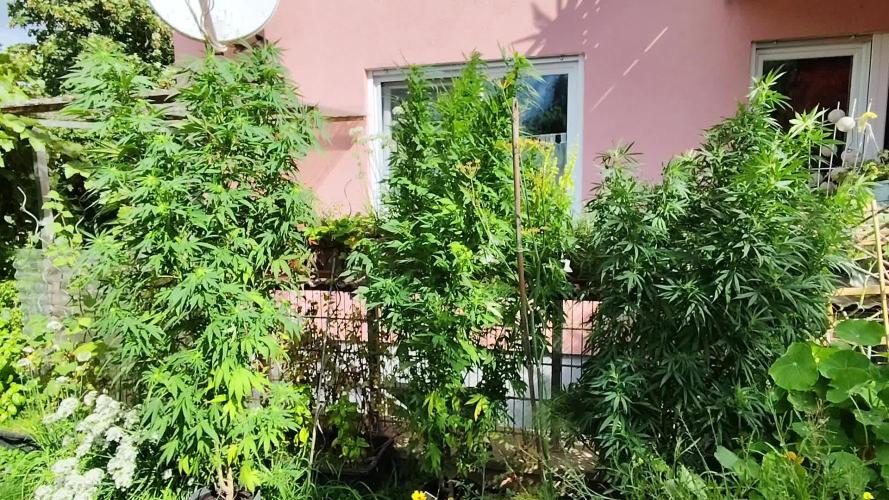
Hallo und herzlich willkommen zu meinem Growbericht Outdoor 2025 mit den Sorten Power Flower Feminized, Royal Medic Feminized und Special Kush #1 Feminized, alle 3 von Royal Queen Seeds. Es ist das erste Mal, das ich Töpfe für den Outdoor grow verwende, bisher waren alle Gorilla grows und direkt in die Erde gepflanzt.
Die URL der Power Flower Feminized: https://www.royalqueenseeds.de/feminisierte-hanfsamen/120-power-flower.html
Die URL der Royal Medic Feminized: https://www.royalqueenseeds.de/cbd-samen/148-royal-medic.html
Die URL der Special Kush #1 Feminized: https://www.royalqueenseeds.de/feminisierte-hanfsamen/138-special-kush-1.html
Die Planung für den Grow ist, die Samen in easyplug Anzuchtwürfeln keimen zu lassen und danach in 0,6L und 2,2L Plastiktöpfen, dann letztlich in die neuen komplett doppellagigen ROOTIES 15 Liter Wide Version Stofftöpfe umzutopfen. Sobald die Witterung es zuläßt, sollen die Pflanzen an die frische Luft.
Es ist schon eine Weile her, das der Grow losging, die Bilder sind jetzt aktuell.
Tag 187: Die drei Ladies haben sich unter der Obhut meiner Nachbarin sehr schön entwickelt. Es hatte sehr viel geregnet, hinterm Rückhaltebecken war ein See und der Bach war voll bis zum Rand. Der Brunnen ist auch wieder offen. Die drei großen stehen jetzt wieder in der Sonne, heute hat's nur ein paar Wölkchen. Die Power Flower fem. ist jetzt 215 cm hoch, die Special Kush #1 fem. 205cm und die Royal Medic fem. 175 cm. Der Blütenzuwachs ist jetzt endlich deutlich zu erkennen.
Tag 188: Heute ist es sehr windig und stark bewölkt. Die drei Großen sind jetzt doppelt am Zaun festgemacht, nur eine Befestigung hat nicht mehr gereicht.
Wenn's dir gefallen hat, schau wieder vorbei ✌️😎


Likes
4
Share
@captaincondor
Follow
I have just been giving her plain water the past few feedings and am planning on harvesting her on tuesday which will be day 67 from seed which is very impressive . I think grown in coco under the spider farmer it would probably be even quicker , also finally a strain that has lived up to its name and actually gone purple whoopee. I am looking forward to trying this when its dried and cured !!! . This seems to be an awesome strain and I am very impressed with the size and density of the buds and the growing time
Likes
19
Share
@Basementganja
Follow
Black Cream auto is hands down, the most beautiful strain that I've grown to date! 75grams isn't bad for a day 60, from seed harvest!

Likes
19
Share
@Mo_Powers
Follow
we have the second week of flowering behind us. the plant grows a good 10 cm a week. i have removed the large leaves. unfortunately the german summer is a long time coming. we sometimes only have 8 degrees at night. lots of rain. i hope it's not too much stress for the plant. because of all the rain, it only gets fertiliser every two days at the moment.
Likes
17
Share

Likes
72
Share
@JUNGLE_B4RNS
Follow
Week number 4 , I had to swap the 55w neons ramps for the HID 600w MH , plants were overtaking the light coverage surface meaning it’s time to give some more growing space under more coverage !
Also, I will start giving the first feeding by the end of the week, around 700ppm’s / 1.4mS, Cellmax Soil Mix is pre-fertilized ( like most of all horticultural Soil Mix ) and as you can see plants didn’t need any extra feeding !
Topping the plants at the 3rd node at the seedlings stage didn’t make any stress at all , they just have redirected the energy in the sides shoots as you can see on the video.
(Tip of the week : If you wanna play the chemist with your super duper nootz without burning your sh*t you better get an EC/TDS meter 😉 Following this diary to the end will learn you how to Water/or/Feed your plants)
[Day 24]
I was planning to Feed the plants by the end of the week, but as always things can changes from what you were expecting 😊
- Water + Earth Grow Mix + RootBooster + AllZymes
[Day 27]
- Water
(P.S: Looking for a job in the Cannabis industry as Master Grower, Mineralogist, Quality Control 🐞)
This Diary is updated daily ☝️

Likes
4
Share
@ChiloteAnonimo
Follow
SEMANA DOS VEGE (12-05-2022)
* Al día 15 desde que salieron del sustrato entra en el día 1 de la segunda semana de vegeta
* Se agrega al riego 1m/l del fertilizante para vegetación de Laboratorio LAAOS, "Vegalquimia"
* Al día 20 desde que salieron del sustrato, se le aplico LST a las 6 plantitas

Likes
6
Share
@IamCy
Follow
Week 3. This is where the fun begins. The smell is amazing.
The stretch is crazy and the stems are stiff like bamboo. There's no loss in terps. They're actually getting a lot stronger!!
Likes
11
Share
@Bread_n_Buds
Follow
Trainwreck is now an established strain in the history of cannabis, now we can see how the automatic one from Zamnesia is coming along.
Remember that we are growing a plant worked with the techniques indicated and another left to grow without pruning to preserve its speed; in the previous/next diary you will find the other plant of the same variety.
In this diary we find left to grow straight, we have done a bit of cleaning underneath as is necessary, we do not like popcorn and we like beautiful well-composed flowers. We have the first signs of pre-flowering but we consider this week as the last of vegm let's go!
Comparison is the salt of experience, so the plant in the other diary will be treated very differently, go and see it to compare.
We started the Plagron fertilization program, we are in 100% organic configuration, the soil is recycled Promix + 1/3 fresh soil + 10% Perlite + RQS Mycorrhizae Mix (4 g in the mix, 1 g under the small fiber pot).
We fertilize with: 1 ml/l Power Roots - 1 ml/l Pure Zym - 1 ml/l Sugar Royal - 3 ml/l Alga Grow
We sprayed 3 ml/l Vita Race foliar fertilizer once a week.
https://plagron.com/it
We always have the excellent RQS mycorrhizae flowing in the soil.
https://www.zamnesia.io/it/5778-mix-micorrhiza-easy-roots.html
Take a taste of this strain, it's a cross of legendary strains
https://www.zamnesia.io/en/11055-zamnesia-seeds-trainwreck-automatic.html
Short Description Zamnesia // Trainwreck Automatic is the autoflowering descendant of the popular cannabis strain Trainwreck (a stunning cross of Thai and Mexican landraces). Much loved for its 70% sativa genetics and sativa-like effects, Trainwreck Automatic is as easy to grow as an indica (even in cold climates).
This autoflowering strain goes from germination to harvest in 11–12 weeks, meaning you'll be harvesting sativa buds in no time. It prefers warmer climates, but thanks to its short life cycle, it can also be grown in more northern areas (provided it is germinated a few weeks early when growing outdoors)
Trainwreck Auto offers delicious lemon and lime flavors that enhance the classic sativa profile of its parents. Furthermore, thanks to the spicy and earthy notes, the overall experience will be even more intense, regardless of whether you smoke or vape it. In terms of its effects, Trainwreck Auto is euphoric, uplifting and energizing. Fueled by a THC content of around 21%, this strain is perfect for socializing and best suited to smokers who prefer to stay active after consuming cannabis, rather than lazing around doing nothing.
The whole world of cultivation and much more is from Zamnesia: just take a look at the site and you will find "all the best that nature has to offer" in various shapes and colors.
-- // www.zamnesia.com
Likes
67
Share
@BrediGreeny
Follow
So like at the end of last week can be seen she started flowering. I defoliated her because she was bushy, LST and a little super cropping. I see the tips of the leafs turned down so i didn't gave her any more BioGrow since last week. All is going smooth and kinda fast :D. The humidity in my tent is going up because the wedding cakes are in full flower :D but no problem, I did put 2 small dehumidifiers in the tent and turned the Mars Hydro oscillating fans on almost all of the time. The fans are also new to me because i had cheap ones in the past , must keep an eye out not to give them wind burn :) . In just 12 hours i reduced the humidity from at it's peak 64% to 50% and at times a little lower then that. It is also pretty stable, except like the day i water. I am pretty pleased with that for now 😊.
1/10/25
Because I see a lot of clawing and here and there burnt tips i did a little flush. At the end of flush runoff at PH 6,0 ppm 1050. I like how I can play with the lights up and down to try and create the perfect amount of light for each plant. RH in tent at 48 % and stable. Must keep and eye on because of the flush :D
1/11/25
So 24 h after the flush and she is reaching for the sky. I also see very little improvements or it is a placebo effect :)) Tent temp 23C and RH 44%- 48% . New photos added :D.
1/12/25
After 48h she is reaching and preaching with her branches to the sky :D Happy and growing, developing very nicely. Little Purple calyxes can also be seen at the bases of developing flowers. End of week, in tent RH 50% temp 22 avg. Doing LST once every 2 days or so. Not to often or to harsh but just to show my love
Likes
111
Share
@Cyrusdavirus
Follow
Kannabia Seed , Columbian Jack
High everyone 👋 another week in the books and the ladies are looking pretty good 👍 I'm not sure on training for them yet but it's almost time to start 😀 I'll have to decide what I'm doing very soon.
I received and installed the new UR45 from Mars Hydro they are UV-IR supplement light bars designed to fit the Fc6500 and Fc8000 I'm excited about having them in my growroom. Check out my Instagram if you want to see closer pictures of them installed.
Mars-Hydro.com discount code " Cyrus "
Thank you Mars Hydro and Kannabia Seed Company


Likes
3
Share
@Aleks555
Follow
The fourth week of growth has begun, and our FBA 2504 from 42Fast Buds is thriving. After the transplant into a 10-liter pot, the plant has adapted well and continues to develop strong and healthy. Despite being an autoflower, we're experimenting with a 12/12 light cycle, and so far, the results look promising.
The temperature remains stable, reaching up to 30°C during the day, with an average of 27°C–28°C. Humidity is maintained between 60% and 65%, providing optimal conditions for growth. The plant has grown noticeably, now standing between 20 and 25 cm, with well-developed foliage.
We've started applying low-stress training (LST) to shape its structure, encouraging better light penetration and maximizing potential yields. Additionally, we continue to feed our beauty with Xpert Nutrients, and the results are already visible—strong, vibrant growth and lush green leaves.
Everything is on track, and we’re excited to see how our experiment unfolds in the coming weeks!