The Grow Awards 2026 🏆 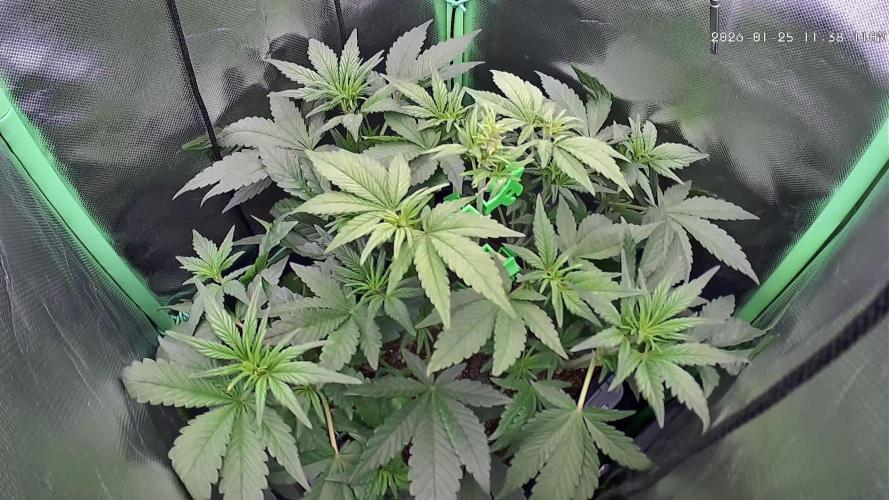










Likes
8
Share
@Nillenium
Follow
Woche 5, alles läuft nach Plan. Sie hat sich bis auf 53cm gestreckt und will auch noch ein paar cm machen. Die Lampe + Cam mussten täglich angepasst werden. Die Timelapse ist diese Woche nicht ganz so schön geworden.
Sobald der Stretch in den kommenden Tagen durch ist, gibt es eine großzügige Entlaubung und die erste Runde Blütedünger.

Processing
Likes
7
Share
@Kushizlez
Follow
Days 35-42
(Day 36) Some minor problems starting to arise here. A few times this week it got up to 90+ degrees which I think may have caused a bit of heat stress in some of the plants. I’m seeing a bit of cupping/crinkles on some of the fan leaves and some of the new growth is looking pretty gnarled and twisted. I hear windburn can cause this too so I’m turning my fans down to low speed. This could also be a problem with humidity so I’m going to turn off my humidifier, dim the lights and raise them. During my last feeding I mulched in some worm castings but it seems like they’re keeping the soil/coco from drying out. Pots are still decently heavy and even the surface is still quite moist but they aren’t showing any major signs of overwatering. I figure it will only be a few weeks before the castings break down so I will just leave it.
A few of the plants are starting to show yellowing leaf tips which is probably some kind of micro nutrient lockout from my PH being slightly too high. It could also be from nute burn so I will water in 6.0 until I see some runoff. Although the most likely culprit is potassium excess. I’ve been feeding potassium almost as much as nitrogen so far. I know that can cause the yellowing of leaf tips by locking out trace minerals. It can also cause leaf problems like crinkling. Excess K can even cause water retention! Will water at 6.0 until run off next watering.
The lst is coming along nicely. It was a good idea to remove the first two sets of branches (not leaves). Now I have 4-6 perfectly even stems coming from each plant that I plan to top one more time each.
(Day 37) Today I’m going to vacuum, clean, wipe down and spray all my equipment in the tent. I’ve been letting the floor get quite dirty and I haven’t had the chance for a thorough clean since last round. I’m kind of surprised I haven’t seen any powdery mildew yet. I guess the prevention spray is working because the room has to be infected from my last crop.
(Day 40) I was reading that you can foliar spray whatever you are deficient in for an immediate uptake. I‘m going to try that with my current potassium excess since it locks out trace minerals. I’m going to foliar feed a bit of phytoplankton at 15ml/L and some MagnifiCal + VeloKelp from Remo nutrients both at 5ml/L. The cal mag is not organic but as long as it’s not going into the soil and doesn’t contain chlorine I’m fine with it. I’m also going to be changing the light cycle to 18/6 for the remainder of veg. This will be their first dark cycle so they can properly foliar feed. Edit: humidity shot up to 85% a few hours after foliar spray.
I went to top dress everything today and I mixed up the plants while doing so! So the ones I was unsure about I gave 1 extra tablespoon. I won’t top dress again for at least 10 days. Might give a light tea sometime next week. I also tilled the shit out of the top of each pot. It had a hard crusty layer on top that was keeping the medium from drying out properly. I’m not going to water again until everything is bone dry. Then I will water until slight runoff at 6.0 ph with some Dr. Marijane bacteria/root probiotic.
I’m starting too see a lot more of these abrasions on some of the bigger fan leaves. It almost looks like thrip damage but I’m 100% sure it’s not a pest above ground. It could be bulb mites, which I found in my worm castings but I can’t check until the roots are more established in their pots. The leaves themselves are cold and feel damp to the touch. I haven’t even seen a fungus gnat since I last fed. I’m hoping it’s related to the K excess and clears up with the troubleshooting.
(Day 41) Just ordered a wire cube rack to prop my plants up with and help evaporation/root warmth. Each cube is 11.8”x11.8”x11.8” and it comes with 16 cubes. So it will fit just perfectly in my 4x4. Depending on the size, I might order another one for the flower room where I would need 25 cubes.
Likes
42
Share
@Kirsten
Follow
We're starting to make some progress, leaves are looking good. Gaining some decent height, not too much.
I'm probably going to top her, so I'm keeping an eye on the optimal time to do that.
This week, I did not water, as the soil was sufficiently hydrated. So not much to report here!
Thank you for stopping by this week and hanging out! 😉💚✌️🍃😊


Likes
19
Share
@EmeraldLakeCannabis
Follow
Great week both inside the tent and out this week. Inside they've been fattening and frosting up like crazy. Carl 1 is 50/50 on pistils and still mostly clear trichomes, I'm thinking 2-3 weeks. UKBS 1 is 80/20 on pistils and starting to cloud a little more, I'm thinking 1-2 weeks in that department.
Outside, I've built a little greenhouse thing for the plants to chill in, out of the extreme winds. They've been acclimatizing fairly well to the low night temps and very hot days, but that's not to say they're entirely thrilled with it. Hopefully they take fully and flower out well.
EOS Rebel T5 shots coming soon, tomorrow or the next day.
6/24/2021- Had some rain overnight, structure held up and kept the moisture out. Came outside to totally dry plants, and it'd been raining for several hours.
6/25/2021- Got the EOS T5 out tonight, got some real good shots of both plants. Carl 1's HUGENESS and UKBS 1's frostiness are definitely showcased well in my opinion.
-Timelapse is out this week. Should only be another couple weeks on the indoor plants, probably not enough for a month. (unfortunate as the youtube "Month" Timelapse is going up this week.)
6/29/2021 - Fade on both plants coming in nicely. Purple and yellow on Carl 1, and a much darker color scheme on UKBS 1.


Likes
71
Share
@DogDoctorOfficial
Follow
Hello, friends! It's been an exciting second week of flowering in the Anesia run, and I can't wait to share all the amazing progress with you.
Our lovely ladies are well into their flowering stage, and the changes are spectacular! The transition from vegetative growth to blooming is always thrilling, and this week has been no exception.
We've adjusted the nutrient mix to support their flowering needs. Here’s what’s been on the menu:
Regulator: Keeps plants stress-free and promotes healthy growth.
CalMag Boost: Ensures they get enough calcium and magnesium for robust bud development.
Top Booster: Enhances flower production and increases the number of bud sites.
P Boost: Provides the phosphorus needed for energy transfer and flowering.
Watering pH: Maintained at 5.8 to ensure optimal nutrient uptake.
TDS: Held steady at 420, giving them the perfect balance of nutrients.
The Anesia Beauties 🌟
Each plant is showing unique characteristics, and it's fascinating to watch them develop their own personalities. The buds are starting to form nicely, and the aroma is beginning to fill the air.
Future #1: This strain is living up to its hype, with dense bud formation and a vibrant green color.
Zoomiez: Looking strong with vigorous growth and promising flower sites.
Apricot Oreo: Developing beautifully with a sweet fragrance that’s already noticeable.
Red Banana Pudding: The solo survivor is a true champion, showing great resilience and structure.
Training Techniques
This week, I focused on some light defoliation and training to ensure optimal light penetration and air circulation. These techniques are crucial for maximizing yield and preventing mold or mildew.
Maintaining the perfect environment is key. Temperature is kept at a steady 25°C, ensuring the plants are comfortable and stress-free. Humidity levels are carefully monitored to avoid any issues during the flowering stage.
I've captured some stunning shots of the girls in full bloom, which I'll be sharing on Instagram. The sight of those trichome-covered buds is truly a feast for the eyes.
A huge thank you to:
Anesia Seeds for these amazing genetics.
Aptus Holland for providing top-notch organic nutrients.
Future of Grow LED for the incredible lighting that keeps our garden thriving.
Grow Diaries for the platform to document and share our journey.
The Grow Diaries Community for your constant support and inspiration.
Stay tuned for more updates, and don’t forget to check out the latest episode of Welcome to the Green Oasis on YouTube, where I dive deeper into the garden's progress and share more tips and tricks.
Keep growing, keep glowing!
Genetics Red Banana Pudding = RBP
Apricot Oreoz = AO
Zoomiez = Z
Future#1 = F
https://anesiaseeds.com/
Plant nutrition - Aptus Holland - https://aptus-holland.com
LED Photons - Future of Grow - https://www.thefuturofgrow.com/
Controls - Trol Master - https://www.trolmaster.eu/
Watering - Autopot - https://autopot.co.uk/
Tent - Mars Hydro - https://marshydro.eu/
Love and attention - Me, myself and i
As always thank you all for stopping by, for the love and for it all , this journey of mine wold just not be the same without you guys, the love and support is very much appreciated and i fell honored and blessed with you all in my life, With true love comes happiness. Always believe in your self and always do things expecting nothing and with an open heart , be a giver and the universe will give back to you in ways you could not even imagine so
More info, the ocasional give-away and exclusive updates from all my adventures can be found - links in the profile description
Friendly reminder all you see here is pure research and for educational purposes only
Growers Love To you Al


Likes
Comments
Share
@DaddyPrime2
Follow
10/02/24 buds are a nice calyx structure. some purple coming in on the leaves. excited to see how she finishes
10/08/24
shes stanky and frosty. luckily the colas arent very thick due to lack of direct sunlight hecause our humidity levels are ridiculous and id have so much more of an issue with mold
Likes
3
Share
@SkunkyDog420
Follow
Hallo zusammen 🤙.
Sie wächst sehr schön und macht keine Probleme.
Rabattcode für den BIOTABS-Webshop https://biotabs.nl/en/shop/ GDBT420, damit erhalten Sie 15 Prozent
Likes
158
Share
@love_2_grow
Follow
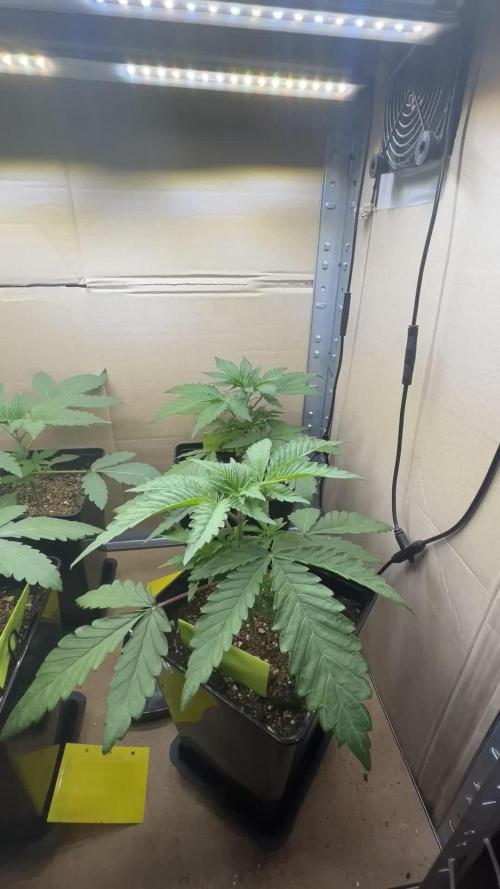
D60.
I'm back again after being out of town for six days. Not much has changed, to be honest. The flowers have fattened up a bit, and I see the first signs of senescence.
------------------------------
D63.
We're at the end of the fourth week of flower, and all is well.
The Gorilla girl will soon be alone in the tent as the Purplematic will get chopped in a day or two. I will also change the lights, moving the Kingbrite light into the photo tent, and I'll put my trusted Viparspectra P600 in this tent instead. That will save quite a bit of energy, which is good considering the insane electricity prices we're having right now.
------------------------------



Processing
Likes
11
Share
@zombikush81
Follow
happy day my friends, because little space I decided to put two of the three in bloom, the 3 girls I want to grow it again for a while. Today the first day of flowering 12/12, they are beautiful full they will make many buds

Likes
2
Share
@valiotoro
Follow
Hello everyone week 1 has passed for this Auto Kerosene Krash from Dutch Passion 😎
this plant is doing very well growing at fast pace and with a beautiful green colour on the leaves.
Spider Farmer SE-7000 50%
wish you all happy growing!

Likes
6
Share
@xMuuy
Follow
Reduced the humidity further, set it to ~40% right now, but since we're in a severe heat-wave in germany right now (we are peaking at 30°C indoors and ~33°C in our "growroom") our dehumidifier is working overtime.
Defoliating every few days, leaving us with sticky fingers and scissors.
Buds are developing fine and growing very quickly in size. Leaves are getting more and more frosty, even removed some when defoliating and took a look at the trichomes under our mikroskopic lense. Very beautiful and dense trichome-structure; especially on the buds. The red-purple coloured parts of the buds, mentioned last week, are developing nicely and much quicker than expected. Even spotted some milky trichomes on the headbud here and there.
Likes
3
Share
@Organic473
Follow
Monsters on the rise and training has begun…not even the high humidity can stop them now. The marathon continues for some Classic Skunk!

Likes
30
Share
@DrewbieDoobieNoobie
Follow
Water the ladies with some PH 6.0 CALMAG 5ml/gal and a small shot of KING COLA and EMREALD GODDESS about 1ml/gal in between feedings.
I am using a little heavier feeding this week than last weeks late flower per EH chart. I leaned into it a little more by 2ml extra per gallon I have not seen any nuite burn the whole time so I think they can handle an extra 250ppm its my last feeding I am hoping for some swell up on the colas, I know there is some sacrifice in yield with the 11/13 flower shedule but these bitches smell bad ass. I have to leave the fan and filter on all the time now as soon as I open the tent it wafts through the garage. If a bag of citrus fruit were to slapping sloppies with a brick of Blonde Lebanese is the only way I can describe it. I am going to feed this week and start flushing next week with PH 6 rainwater for the last two to three weeks. The hairs are starting to turn orange and trichomes are getting more cloudy. thanks for liking.

Likes
7
Share
@Eddjack
Follow
Ci siamo !!! No vedo l ora di farmi il regalo di natale. Odora di dolce, fragola e zucchero. Il terreno e carico di nutrienti infatti credo che questa settimana andrà ad acqua . Piena di gemme appiccicose e profumate sarà pronta prima di natale speriamo bene.
Dajeforte growers!


Likes
200
Share
@Ferenc
Follow
Day 96, 15th of December 2020:
Wao and wao... this is what I can say.
A bit late I was on holiday I usually start the week with the first day but now with the last one.
So let's start with the "black sheep" of this group as she is alone here RQS Wedding Gelato.
Easy growing issue free little bushy lady. Absolutely great choice of grow. Pretty much ready for Christmas but she can be cut even now lol....
And now let's speak about the Original Sensible Seeds' girls...
Well Black Ghost OG similarly to RQS Wedding Gelato is calm little bushy and issue free lady.... no problem all good ready for Christmas....
Runtz Gum the thick chick with heavy big buds and excellent appearance is really amazing. I placed a stick there and fixed her to look better... It was not necessarily but i have done it.
She needs more time pretty much done ny Christmas or a bit after....
Gelato from Original Sensible Seeds is similar in terms of acting such as streching and all that ...
The same situation applies not much to really say we wait ;)
I am really happy to have these ladies....
Well, Do-Si-Dos OG is the craziest one ever... lol.... not only due her crazy kind of streching style but the trichome developement that comes along to the fan leaf "holder" stem is pretty crazy....
Those buds are like a diamonds sticky and she would be ready to harvest but need to wait because I need to go....
I really had to fix her by placing a stick there I broke one stem but fixed as it did not come off... so crazy especially now because of the weight of the buds... now she looks even more beautiful...
I think she is the most challenging grow ever.
Original Sensible Seeds genetics is unique really high quality just look at them.
Royal Queen Seeds as well but this is my second grow from them my first was a Green Gelato which is the same calm littlw bushy plant. Amazing very good for newbies ;)
I am going on holiday again and back on 28th of December so after harvest starts.
Girls will be cut after.
The 7th weeks starts with tomorrow 16th of December....
Only flushing and no more nutritient will be used.
Soon full report comes. Lamp is the same 11 hours on and 13 off....
The last 4 days they will get 4 days darkness and only ventilation will be working no even more water ;)
