The Grow Awards 2026 🏆
Likes
Comments
Share
@Naujas
Follow
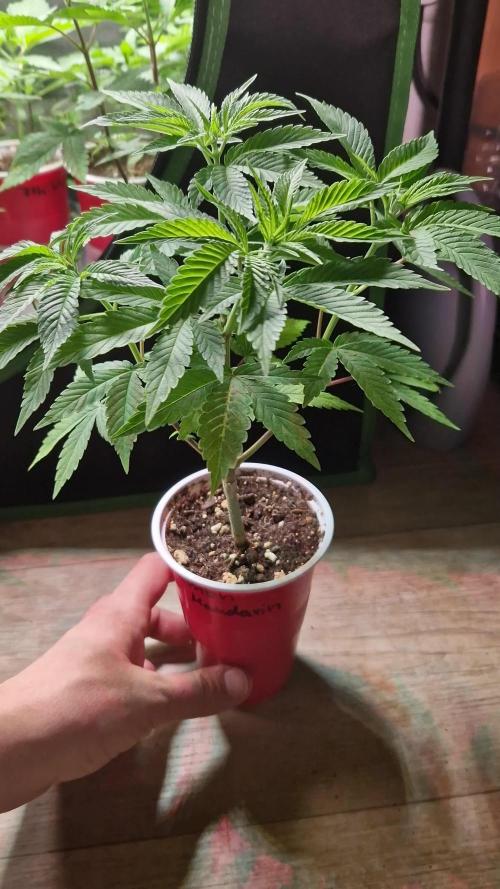
Well, I came back after vacation, and this is what I found: it jumped up to the light.... I made a little cropping and tried to use more LST, the problem is that it no longer fits :D :D :D but at the same time, it's really interesting to me trip :)also, several rings are already affected by the light, my 50w light currently shines at 100%, maybe it would be better to reduce it to at least 80%?.
Likes
30
Share
It's the same height that it was last week but I did top it this week. So she did grow I just cut her back down. I topped and defoliated every plant. I'm trying to form them into canna-bushes. Hopefully I'm doing the correct training procedures to make them all grow that way both indoors and out.
Likes
10
Share
@Yolka
Follow
As for the ground - worked for 99%. Water+organic stimulants = great set-up. Saw a bit of an excess of nutrients, I will take that into account next time. 120 grams of flowers not including trimmings, yes, there are some sugar leaves - and I'll keep those :))
Likes
7
Share
@Drtomb
Follow
Just back from a vacation. Plants are looking amazing. However I did notice slower development of buds on the opposite side of the tent. I relate this to an issue with the swap out between H2O2 and bleach for sterilization of my reservoir and roots. I will be discontinuing bleach and using H2O2 if needed in fact I'm going to be adding a different product to the girl going forward I'm testing out a product called Hydro bio. This item contains microorganisms, humic acid, folic acid, sea kelp, and molasses. The guy at the grow store claims this item will also clean your Reservoir and the supplying tubes as well as keep the roots healthy. Let's give it a go stay tuned to my next girl to see that one with it right from start
Likes
30
Share
@BudXs
Follow
5 weeks of flower complete and its still a jungle in there despite the heavy defoliation. Too early to tell, but this defo may be a great tool, or it could be a flop. An article shared with me by BeanswithPork via JohnnyRonco says that what I am doing is idiotic. We shall see. Ive been called worse. Having fun, gonna be a massive harvest Article for those interested: https://www.cocoforcannabis.com/community/photons_corner/to-defoliate-or-not-to-defoliate/ SBG will love it
Likes
2
Share
@SKIDR0W
Follow
edding Cheesecake: ein Leckerbissen für Geist und Körper. Ein Hybrid mit Wurzeln in Asien, Afrika, Europa und der USA. Unvergleichlicher Geschmack und Wirkung. Weiter oben im Wedding Cheesecake-Stammbaum sind die OG Kush, die Granddaddy Purple und die Purple Urkel von der Westküste der USA sowie die beliebtesten Sorten von Sensi Seeds – die Hindu Kush, die Big Bud und – beide Seiten der Familie beeinflussend – die Durban, die wirksame, reine Sativa aus Südafrika. Die feminisierten Wedding Cheesecake-Hanfsamen von White Label zeigen die gewünschten Eigenschaften von 5 Zuchtgenerationen. Ein komplexes, intensives Geschmacksprofil, eine unglaubliche Harzbildung sowie große, dichte Buds an einer robusten, kompakten, schnell blühenden Pflanze. Die feminisierten Wedding Cheesecake-Hanfsamen wachsen in einem Gewächshaus oder draußen in einem warmen, sonnigen Klima, bevorzugt mit einer relativ niedrigen Feuchtigkeit. In Innenräumen unter Lampen gedeiht diese Sorte jedoch am besten. Als schnell wachsende, pflegeleichte Sorte kann die Wedding Cheesecake sogar von Einsteigern kultiviert werden. Die wichtigsten Faktoren für diese Variante sind viel Licht und wenig Feuchtigkeit, um ihr Blütenpotenzial zu maximieren. Züchter sollten auch berücksichtigen, dass der Duft dieser Sorte ab Beginn der Blüte zunehmen kann, sodass ein gutes Belüftungssystem wichtig ist. Das komplette Zuschneiden der Zweige für ein enges Aneinandersetzen (auch Lollipopping genannt) wird nicht empfohlen. Das enge Aneinandersetzen und ein guter Ertrag sind möglich, indem kleine Klone mit der Sea of Green (SOG)-Methode zum Blühen gebracht werden. Durch Beschneiden/Topping der Hauptstämme größerer Pflanzen lässt sich die Anzahl der Austriebe und der Gesamtertrag steigern. Die Wedding Cheesecake verdoppelt bei der Blüte ihre Größe, wobei einige Pflanzen um 150 % wachsen. Ab und zu verdreifachen Exemplare ihre Größe in der Blütephase. Die White Label Wedding Cheesecake blüht schnell und kräftig und bildet massive, schwere Blütendolden in der oberen Hälfte des Hauptstammes und der Zweige. Kleinere, aber dennoch gleich dichte und harzige Blütentrauben befinden sich an den unteren Nodi, sodass an den kompakten Pflanzen erstaunlich wenig freier Platz vorhanden ist. Die Blütenkelche sind sehr harzige Kugeln, in der Regel mittelgroß, mit langen Blütenstempeln, die sich während der Reife manchmal pink statt orange verfärben. Die Kombination aus großen Buds mit mittelgroßen Blütenkelchen und üppigen Trichomen und langen Blütenstempeln verleihen den Hauptblütendolden der Wedding Cheesecake ein einzigartiges Aussehen, das zur selben Zeit flauschig und funkelnd ist. Nach der Ernte bleiben die Buds groß, fest und klebrig durch das Harz. Wenn sie aufgebrochen (oder nicht vorsichtig behandelt) werden, riecht man das tolle Terpenprofil aus dem Wedding Cheesecake-Stammbaum. Die stärkste Komponente stammt von der Cheese – einer grandios intensiven Skunk mit starken, süßen Beerennoten – in Kombination mit starken Zitrus-, Erd- und Holznoten von anderen berühmten Vorfahren. Es liegt auf der Hand, dass White Label Wedding Cheesecake eine extrem starke Wirkung hat und selbst von erfahrenen Konsumenten mit Bedacht eingesetzt werden sollte. Beim ersten Mal ist es ratsam, einen oder zwei moderate Testzüge zu machen und dann kurz zu warten, wie stark die Wirkung ist. Das High dieser Sorte erzeugt in jeder Dosis das typische warme, positive und anregende Gefühl. In mittleren bis hohen Dosen kann die Wirkung von starker, kontemplativer vollständiger Körperentspannung bis hin zu einer überschwänglichen, die Kommunikation fördernden und kreativen Stimmung und sogar psychedelischen Momenten reichen.
Processing
Likes
5
Share
@Ozgrow
Follow
Plants have stretched more than i thought. Been trying to fill out the screen as best as i can, some have worked better than others. Looks like there are plenty of bud sights. Began pk heavy this week so looking forwsrd to seeing them fatten up. I also gave a light defoliation under the canopy removing skinny stretchy stems receiving little light. I also removed some massive fan leaves that were blocking light from budsights. Not too many just enough to have light penetrate.
Likes
Comments
Share
@Pixie
Follow
Still not started to flower pistols are shouting out everywhere tho can't wait to see it flower iv never grow weed before so it's going to be good having a ganja plant
Processing
Likes
6
Share
@kking6321
Follow
Last feed was a week ago, have watered twice in the past week with ph'd water. Ladies are progressing nicely. Will feed tomorrow, and see how things progress. Got the dehumidifier and control put in, have it set at 45 rh, right now. Have seen the humidity come down substantially but still swings between 40 and 54. Thinking about lowering the setting a bit to around 40 to try and get tighter control as I finish out the grow over the next several weeks.
Likes
45
Share
2nd net is up. Early bud formations are promising. holding up to the extremes pretty well, some leaves taking minor damage, but overall, she is holding up, gave her 1 night at 50F see how she would react, stressful. Not advised as it messes with her metabolism, but I want to see if it triggers any anthocyanin response. Love to see her purp up but no signs yet. My homework. Rubisco regeneration is intrinsically linked to nitrogen supply because Rubisco is a major sink for nitrogen in plants, typically accounting for 15% to over 25% of total leaf nitrogen. The regeneration phase itself consumes nitrogen through the synthesis of the Rubisco enzyme and associated proteins (like Rubisco activase), and overall nitrogen status heavily influences the efficiency of RuBP regeneration.Structural Component: Nitrogen is an essential building block for all proteins, and the sheer abundance of the Rubisco protein makes it the single largest storage of nitrogen in the leaf. Synthesis and Activity: Adequate nitrogen supply is crucial for the synthesis and maintenance of sufficient Rubisco enzyme and Rubisco activase (Rca), the regulatory protein responsible for maintaining Rubisco's active state. Nitrogen deficiency leads to a decrease in the content and activity of both Rubisco and Rca, which in turn limits the maximum carboxylation rate, Vmax, and the rate of RuBP regeneration Jmax, thus reducing overall photosynthetic capacity. Nitrogen Storage and Remobilization: Rubisco can act as a temporary nitrogen storage protein, which is degraded to remobilize nitrogen to other growing parts of the plant, especially under conditions of nitrogen deficiency or senescence. Nitrogen Use Efficiency (NUE): The allocation of nitrogen to Rubisco is a key determinant of a plant's photosynthetic nitrogen use efficiency (PNUE). In high-nitrogen conditions, plants may accumulate a surplus of Rubisco, which may not be fully activated, leading to a lower PNUE. Optimizing the amount and activity of Rubisco relative to nitrogen availability is a target for improving crop NUE. Photorespiration and Nitrogen Metabolism: Nitrogen metabolism is also linked to the photorespiration pathway (which competes with carboxylation at the Rubisco active site), particularly in the reassimilation of ammonia released during the process. To increase RuBisCO regeneration, which refers to the process of forming the CO2 acceptor molecule Ribulose-1,5-bisphosphate (RuBP) during photosynthesis, the primary methods involve optimizing the levels and activity of Rubisco activase (Rca) and enhancing the performance of other Calvin-Benson-Bassham (CBB) cycle enzymes. Biochemical and Environmental Approaches: Optimize Rubisco Activase (Rca) activity: Rca is a crucial chaperone protein that removes inhibitory sugar phosphates, such as CA1P (2-carboxy-D-arabinitol 1-phosphate), from the Rubisco active site, thus maintaining its catalytic competence. •Ensure optimal light conditions: Rca is light-activated via the chloroplast's redox status. Adequate light intensity ensures Rca can effectively maintain Rubisco in its active, carbamylated state. •Maintain optimal temperature: Rca is highly temperature-sensitive and can become unstable at moderately high temperatures (e.g., above 35°C/95F° in many C3 plants), which decreases its ability to activate Rubisco. Maintaining temperatures within the optimal range for a specific plant species is important. •Optimize Mg2+ concentration: Mg2+ is a key cofactor for both Rubisco carbamylation and Rca activity. In the light, Mg2+ concentration in the chloroplast stroma increases, promoting activation. •Manage ATP/ADP ratio: Rca activity depends on ATP hydrolysis and is inhibited by ADP. Conditions that maintain a high ATP/ADP ratio in the chloroplast stroma favor Rca activity. Enhance Calvin-Benson-Bassham (CBB) cycle enzyme activity: The overall rate of RuBP regeneration can be limited by other enzymes in the cycle. •Increase SBPase activity: Sedoheptulose-1,7-bisphosphatase (SBPase) is a key regulatory enzyme in the regeneration pathway, and increasing its activity can enhance RuBP regeneration and overall photosynthesis. •Optimize other enzymes: Overexpression of other CBB cycle enzymes such as fructose-1,6-bisphosphate aldolase (FBA) and triose phosphate isomerase (TPI) can also help to balance the metabolic flux and improve RuBP regeneration capacity. Magnesium ions, Mg2+, are specifically required for Rubisco activation because the cation plays a critical structural and chemical role in forming the active site: A specific lysine residue in the active site must be carbamylated by a CO2 molecule to activate the enzyme. The resulting negatively charged carbamyl group then facilitates the binding of the positively charged Mg2+ion. While other divalent metal ions like Mn2+ can bind to Rubisco, they alter the enzyme's substrate specificity and lead to dramatically lower activity or a higher rate of the non-productive oxygenation reaction compared to Mg2+, making them biologically unfavorable in the context of efficient carbon fixation. The concentration of Mg2+ in the chloroplast stroma naturally increases in the light due to ion potential balancing during ATP synthesis, providing a physiological mechanism to ensure the enzyme is activated when photosynthesis is possible. At the center of the porphyrin ring, nestled within its nitrogen atoms, is a Magnesium ion (Mg2+). This magnesium ion is crucial for the function of chlorophyll, and without it, the pigment cannot effectively capture and transfer light energy. Mg acts as a cofactor: Mg2+ binds to Rubisco after an activator CO2 molecule, forming a catalytically competent complex (Enzyme-CO2-Mg2+). High light + CO2) increases demand: Under high light (60 DLI is a very high intensity, potentially saturating) and high CO2, the plant's capacity for photosynthesis is high, and thus the demand for activated Rubisco and the necessary Mg2+ cofactor increases. Mg deficiency becomes limiting: If Mg2+ is deficient under these conditions, the higher levels of Rubisco and Rubisco activase produced cannot be fully activated, leading to lower photosynthetic rates and potential photo-oxidative damage. Optimal range: Studies show that adequate Mg2+ application can enhance Rubisco activation and stabilize net photosynthetic rates under stress conditions, but the required concentration is specific to the experimental setup. Monitoring is key: The most effective approach in a controlled environment is to monitor the plant's physiological responses e.g., leaf Mg2+ concentration, photosynthetic rate, Rubisco activation state, and adjust the nutrient solution/fertilizer to maintain adequate levels, rather than supplementing a fixed "extra" amount. In practice, this means ensuring that Mg2+ is not a limiting factor in the plant's standard nutrient solution when pushing the limits with high light and CO2. Applying Mg2+ through foliar spray is beneficial to Rubisco regeneration, particularly in alleviating the negative effects of magnesium (Mg) deficiency and high-temperature stress (HTS). While Mg can be leached from soil, within the plant it is considered a mobile nutrient, particularly in the phloem. Foliar-applied Mg is quickly absorbed by the leaves and can be translocate to other plant parts, including new growth and sink organs. Foliar application of: NATURES VERY OWN MgSO4 @ 15.0g L-1 in a spray bottle. Foliar sprays are often recommended as a rapid rescue measure for existing deficiencies or as a supplement during critical growth stages, when demand for Mg is high. Application in the early morning or late evening can improve absorption and prevent leaf burn. The starting point [of creativity] is curiosity: pondering why the default exists in the first place. We’re driven to question defaults when we experience vuja de, the opposite of déjà vu. Déjà vu occurs when we encounter something new, but it feels as if we’ve seen it before. Vuja de is the reverse—we face something familiar, but we see it with a fresh perspective that enables us to gain new insights into old problems. Come walk in the enchanted forest.
Likes
12
Share
*Week 3 Flowering 09/17* Fastbuds - Mimosa Cake (Auto) (2) Thus far the flower transition has run smoothly and both plants are running accordingly Nute feeds have increased *Week 3 End of week Flowering 09/23* Flowering for both Mimosa's is proceeding accordingly. Light defoliation was applied Light LST to heavy COLA's was applied, anchored to the trellis net. *FRONT TENT (MIMOSA-2) QUICK VIDEO ADDED*
Likes
21
Share
Alright I've updated this postmortem and cure just to give an idea of what I was up to during the dry and cure weeks. This grow was a ton of work and I'm very please with the results. I learned a ton about soil and environment control and really feel like I'm gaining confidence and coming into my own as a cultivator. I've been playing a lot with ice water hash and rosin and have set some neat goals for the future like hunting ice water hash cultivars, going perpetual and expanding the amount of canopy I can work with by building a network of remote-operated satellite flower tents in friends' and family's abodes . I'm not sure I'll go through all this effort of documentation here again, but please follow along on my instagram, stay in touch and chill out with me sometime @Fullmeltalchemist.00 All in all, I was running 1000w of quantum board across three tents and pulled just over 1100 grams, which was a big goal of mine. Thanks for all the advice and love growmies! And thanks growdiaries for the platform. It's been coo.
Likes
94
Share
Every beginning has an end ... The Jumanji by Cellmax is almost over , last few plants left are finishing the fade. This will be the last week before putting the plants on Harvest. Greetings to Cellmax for their nutrients, they really rox 👍 I will put details about it on Harvest 😉 N.B: Looking for a job in the Cannabis industry as a mineralogist, plants keeper, master grower, or quality controler 🐞
Likes
4
Share
@Weediz
Follow
Day 28: Decided to do some LST as the dark green leaves are getting better! These babies are growing strong 💪 I am still very gentle with the feeding, and that are going to continue until more is needed Day 32: The girls have fully recovered from the LST. They already was 1 day after. Everything seems to go smooth so far
Likes
2
Share
This week, with the seedlings stabilizing, I slowly and gradually lowered the humidity to about 75% RH by removing the cling film, as well as focusing on a reduction of the moisture content within the first few centimeters of the substrate. This should give the plants more resilience for what's about to come and also - in combination with more sticky fly traps - further disable the sciridae's ability to lay eggs. Removing the foil while increasing the PPFD by 100 also decreased the temperature by about 1K, which will be compensated for with an increase of light intensity over the upcoming weeks.
Likes
23
Share
Good week this week last day of week 8 and looking really well buds starting to swell and ripen
Likes
14
Share
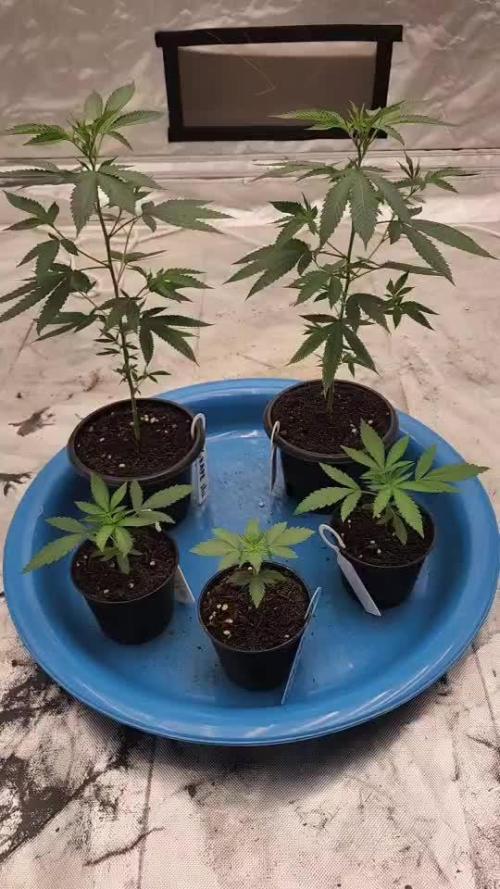
@Farmerted
Follow
Starting off with small in mind. What is better than ice cream and Baileys? So this ice cream cake seed is about to hit the Baileys ice cream dish.