The Grow Awards 2026 🏆 







Likes
Comments
Share
@Earthsower
Follow
She has started to move again with no further deficiency so I will continue her draught and see if she improves more!

Likes
96
Share
@amazongrow
Follow
Hey guys,
The end is near, I think. I hope to get lots of buds and weight from this girls, she was nice from the start, a huge plant, beautiful genetics... a strong being, I thank the universe for her. It was my dream to grow a NL and it was much more then I expected. Im so happy.
Last feeding this week and the next weeks are going to be just pure amazonian water... :)
Added some trichome images from my small microscope, it is from a bottom bud that was shaded so I cut it. Even so I think it was good and growing, so I thought "why should I took the popcorn?" - next time I will not cut anything, not even a leaf. Let's see if it makes a difference.
So, do you think about the trichomes? The big buds up there are more ripe and developed, but judging from this small bottom bud... she's getting there? :)
How much weight do you think she can yield, dry?
Thanks for being here with us!
Tchau, do Brazil!

Likes
20
Share
@amazingautoflowers
Follow
Beginning of week 3. The ZKittles are looking good for 15 days. Had a full feeding yesterday, considering the growth overnight it looks like they liked it! Interested to see how much they grow this week.
The end of week 3. the girls are 20 days old today. They got a watering with Azos and Molasses this morning. And the "water" on the plants is foliar spray. They are right at 6 inches tall as of this evening.
They grew since I took the pictures this morning. Really happy. They just look great.

Likes
9
Share
@HeartStrong_Garden
Follow
Those first leaves really grew out. This is my first seed popped of the new year! This strain is an Attitude Seedbank and Fast Buds collaboration, it is actually called STRAWBERRY WHIP and wasnt an available strain option


Likes
7
Share
@Cannabiszimba
Follow
iniciando segunda semana de flora eu dei uma defoliada pra priorizar os galhos maiores e diminuir a umidade ali no meio. vamos ver como ela reage.


Likes
26
Share
@420DeepGrow
Follow
* Actualizo 2 dias antes para cuadrar diarios.
Gracias al equipo de Seedsman y XpertNutrients sin ellos esto no sería posible.
💐🍁 Bubba Cheescake:
Bubba Cheesecake es un cruce de Bubba Kush anterior al 98 con Cheese Cake (Wedding Cake x Exodus Cheese). Se trata de un híbrido 70% índica con muy buenos rendimientos, alto en THC y bajo en CBD. Bubba Cheesecake prospera en interiores y exteriores. En interior se aconseja un corto periodo de crecimiento vegetativo debido a la cantidad de estiramiento que presentan las plantas. Las plantas pueden crecer hasta una altura de 250 a 350 cm. cuando se deja crecer naturalmente al aire libre. En interior, la floración dura entre 60 y 65 días, con rendimientos entre buenos y altos, de 400 a 550 gr/m2. Las plantas de exterior son capaces de producir entre 700 - 800 gr. peso seco. En las latitudes norteñas, en exterior, los productores pueden esperar cosechar a principios de octubre. Los cogollos son grandes y duros como piedras. Las plantas maduras muestran atractivos colores púrpuras y azules y brillan con una resina pegajosa que cubrirá las manos del cultivador si no tiene cuidado. El componente Wedding Cake agrega dulzura al sabor del regaliz y el aroma es terroso y musgoso. La producción de THC es muy alta con un nivel bajo de CBD. El efecto es intensamente narcótico, fuerte y duradero.
🌻🚀 Consigue aqui tus semillas:
🍣🍦🌴 Xpert Nutrients es una empresa especializada en la producción y comercialización de fertilizantes líquidos y tierras, que garantizan excelentes cosechas y un crecimiento activo para sus plantas durante todas las fases de cultivo.
Consigue aqui tus Nutrientes:
https://xpertnutrients.com/es/shop/
📆 Semana 4:
Continuamos la etapa de vegetación, ella se desarrolla muy bien 😎, comienza el buen tiempo, temperaturas agradables para todos.
Esta semana se aplica una solución de trichodermas para una mejor adaptación aunque realmente va genial.
Se mantiene 1/3 de nutrientes Master Root y Master Grow
Processing
Likes
24
Share
@Cogollo_eu
Follow
**Encontrarás la traducción a español al final de la descripción**
From/Desde: 23/09/19 || To/Hasta: 29/09/19
From day/Desde día: 63 || To day/Hasta día: 69
If you like this week, please hit a like, it costs you nothing! 👊. Thanks in advance 😉!
-----IMAGES & VIDEOS-----
I'm sorry to not having more Alice timelapses, the tent is too small to record some decent videos due to Alice size, a think that I must have in mind for upcoming grows.
-----WEEK SUMMARY-----
One week more that Alice overpass my expectations, I'm really not having any time to do nothing to her, but she's still beauty. Those buds are looking amazing on it's start, I can't wait more to see those full buds formed.
I'm not vey proud of using mineral s#@ts, but i already tested it and results are really appreciable. Anyway I'm not using it in excess, just the day 29 and probably at October 8, just 2 applications. I'm also using Bloombastic, Organic PK Booster & Overdrive.
-----WATERING CALENDAR-----
25/09/19 DAY 65 - 3 l with Rhino Skin, Bud Candy, Big Bud, MegaBud (1 g/l) @ (1.9 EC | PH 6.4 | 25.7ºc)
29/09/18 DAY 69 - 4 l with all week nutrients -(MegaBud) @ (1.65 EC | PH 6.2 | 25ºc)
*****ESPAÑOL*****
Por favor, si te gusta esta semana dale un like, no te cuesta nada 👊. ¡Gracias por adelantado 😉!
-----IMÁGENES & VÍDEOS-----
Siento no tener más timelapses de Alice, el armario es muy pequeño y no me permite grabar videos decentes dado el tamaño de Alice, una cosa que he de tener en cuenta para futuros grows.
-----SUMARIO SEMANAL-----
Una semana más que Alice sobrepasa mis expectativas, no estoy teniendo tiempo para cuidar nada de ella, pero por lo que parece ni falta que le hace. Los cogollos se ven hermosísimos en su inicio, no puedo esperar a que se unan y engorden.
No estoy muy orgulloso de usar mi@#¢das minerales, pero este producto ya lo he probado y los resultados fueron muy buenos. De todas maneras uso muy poquito, 2 aplicaciones durante todo el periodo de floración. También uso los demás PK's así que no hay problema.
-----CALENDARIO DE RIEGO-----
25/09/19 DÍA 65 - 3 l Con Rhino Skin, Bud Candy, Big Bud, MegaBud (1 g/l) @ (1.9 EC | PH 6.4 | 25.7ºc)
29/09/18 DÍA 69 - 4 l Con todos los nutrientes semanales -(MegaBud) @ (1,65 EC | PH 6,2 | 25ºc)

Likes
Comments
Share
@deseed_uy
Follow
Esta semana las molesté bastante, estuvieron afuera dos dias mientras limpiaba toda la carpa pero ya quedo todo instalado y controlado.
La black domm quemada se recuperó, la daikiri sigue estancada.. puse a germinar la ultima q quedaba y no salió asiq supongo fue falla del pack. Las demas vienen hermosas y ahora se van para arriba con todas las condiciones lo mas posible ajustadas, lo unico malo es que sigo sin medidor asiq estoy regando a ojo de temoeratura y ph


Likes
8
Share
@Growmeo_and_Bloomiette
Follow
This week the girls were getting a bit heavy leafed and sweaty. Getting into LST techniques, we went a bit crazy with the defoliation for some of the plants. Their growth seems a bit stunted so we moved them to the center to fill out the canopy with the bigger plants. Probably gonna have to veg a bit longer than we were hoping.
Growth seems good though with some leaf tips yellowing. Hopefully it's just the old nutrient deficiency that should be now fixed. The canopy looks nice and even. The dehumidifier gets filled too fast, so we should've gotten a bigger one. Currently trying to keep the humidity at max 70% but we are struggling when the tank gets filled up. After getting two fans and still struggling with the airflow and sweaty leaves, we got a better third fan and stopped using the other two.
We got a small greenhouse heater for our tent because we opened the window due to the growing humidity. It's winter around here. Main issues for the upcoming weeks seem to be getting the temperature and humidity in control before flowering.
Right at the end of the week we installed our SCROG.


Likes
57
Share
@PEAKYPLANTERS
Follow
good evening to all, my friends
God only know what I spent to keep these gems up, but in cure a thing I swallowed another!
The too much warmth in tent has arisen a reaction of strong stress in the plant by transforming their peaks from the shape of fox's tail.
This happens in some cases when the temperature is very high in a tent and makes it believe the plant that is still full summer making it bloom and vegetate at the same time

Likes
4
Share
@Bossman
Follow
I wasn’t gonna post this grow, then I figured why not. I couldn’t come up with a reason not too so here goes nothing


Likes
10
Share
@RivenWaters
Follow
Starting 7 seeds, only six made it to the solo cups. ETHOS genetics seeds are ; Planet of the Grapes 55ind/45sat, Cotton Candy Grapes 70/30, Grape Diamonds 50/50, Apex Kush 90/10, and Skunk Hero x Afghgan Kush 100/0 ; DNA Genetics seed, Cataract Kush 99/1 Ind. dom.

Likes
27
Share
@TheCannaProphet
Follow
------------------------------------
~SEEDSMAN PEYOTE ZKITTLEZ~
------------------------------------
Description
Peyote Zkittlez is an Indica-dominant hybrid strain bred by pollinating Peyote WiFi with the sweet-tasting Zkittlez. Peyote WiFi is itself a cross of Peyote Purple and the US Indica WiFi strain. Zkittlez is a 3-way cross of Grape Ape, Grapefruit and a third, top secret, strain.
Peyote WiFi is an Indica-dominant strain which is a cross of Peyote Purple, derived from a single purple phenotype which was back-crossed for several generations to cement its qualities, and WiFi, a US Indica strain created by crossing The White with Fire OG. This plant is medium-sized with large, broad leaves and takes around 75 days of flowering before it is ready to harvest producing very generous yields of highly potent weed - up to 650 gr/m2 indoors and 1500 gr/plant when cultivated outdoors. The THC potential of this strain is very high with plants attaining 26 - 28%.
Zkittlez is a sweet-tasting Indica-dominant (80%) cannabis strain which produces high yields boasting high levels of THC. This is a very colorful strain displaying green and purple colors with bright orange pistils.
Zkittlez is a 3-way cross between Granddaddy Purple, Grapefruit and Afghani. It is suitable for growing in all environments and takes between 60 - 65 days to complete flowering indoors. Outdoors it will be ready to harvest during late September in northern latitudes. Yields are very good and vary between 450 - 600 gr/m2.
Zkittlez' scent is very sweet and entices with ripe tropical fruits and candy which also follow through in the taste as well. THC production is in excess of 20%. The effect is very uplifting, especially for an Indica strain. Therapeutically it is used to combat stress, depression and anxiety as well as for those with ADHD.
Peyote Zkittlez will make a superb, highly potent and high-yielding Indica-dominant addition to all seed collections which is certain to become a growers' favorite. Get yours from Seedsman now.
*description credit to Seedsman Seeds
__________________________________________________________________________________________________________________________________________________________________________________________________________________________________________________________________________________________________________________________________________________________________________________________________________________________________________________
BREEDER/BRAND: Seedsman
PRODUCT TYPE: Seeds THC
GENETICS: Peyote WiFi (The White x Fire OG) x Zkittlez
VARIETY: Mostly Indica
FLOWERING TYPE: Photoperiod
SEX: Feminized
THC CONTENT: 20%+
YIELD: Indoors: up to 650 gr/m2; Outdoors: up to 1500 gr/plant
GROWS: Indoors, Outdoors
FLOWERING TIME: 60 days
MEDICAL CONDITIONS: Anxiety, Depression, Stress
MEDICINAL PROPERTIES: Yes
EFFECT: Powerful, Relaxing
__________________________________________________________________________________________________________________________________________________________________________________________________________________________________________________________________________________________________________________________________________________________________________________________________________________________________________________
THE SETUP:
~Planted into Jiffy Peat Pellets that were hydrated with de-chlorinated water with SuperThrive added then ph'd to 6.0 @ 80℉
~Grown 100% organic in 10g fabric pots with Mother Earth 70/30 Coco/Perlite medium amended with 2tbs/g of Down To Earth 4-4-4 / 2 cups/g of Earthworm Castings / 1tbs/g of Dr. Earth Flower Girl 3-9-4, 1tbs/g of Dr. Earth Bat Guano, 3/4 cup of Down To Earth Azomite and 1 tsp/g Down To Earth Fish Bone Meal.
~24hr light cycle during Germination / 19/5 light cycle for Vegetation and 12/12 for Flower
~Straight water ph'd @ 6.2-6.8 when needed and weekly Compost Tea's.
__________________________________________________________________________________________________________________________________________________________________________________________________________________________________________________________________________________________________________________________________________________________________________________________________________________________________________________
WEEKLY UPDATES:
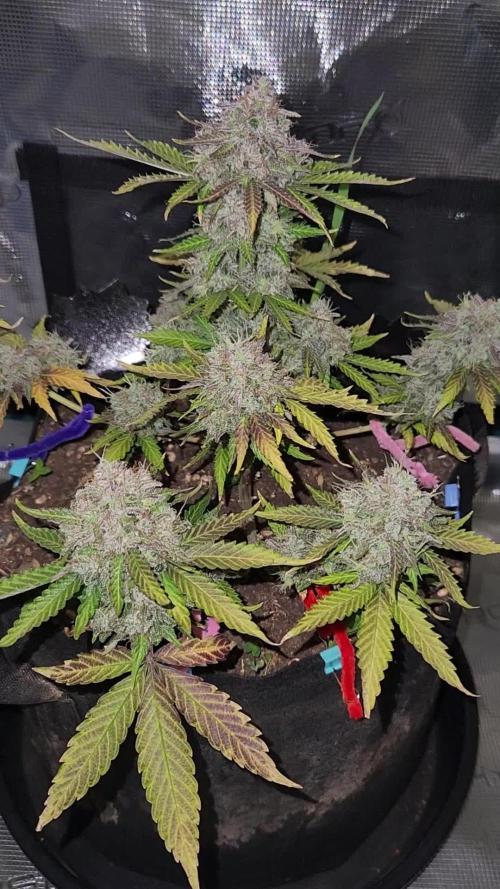
9/20- 💥BOOM!💥 Week Six of flower is here and my girl's in high gear, stacking her flowers and pumping out trichomes!
Today I watered her with 1.5g de-chlorinated water with 5ml/g of Botanicare CalMag+ added, then ph'd to 6.2 @ 72℉. I turned her pot and plucked a couple of yellow shade leaves...the basic daily maintenance.
9/22- I didn't water her yesterday as she looked great and was 'praying' hard. Today she was given 1.5g of de-chlorinated water which was ph'd to 6.2 @ 72℉ which I gave her through her drip pan (bottom chuggin) and I also gave her pot a turn.
She continues to pile on the trichomes and is taking on a exquisite purple hue to her flowers! She is definitely one of the most photogenic cultivar's I've grown, especially with her 'Triple Headed flower', and is looking lovelier by the day! 😍
9/24- We're getting close to wrapping up Week Six of flower in a couple of days, which will put her around two or three more weeks from finishing, with the most exciting weeks yet to come!
I didn't water yesterday and today I went ahead and Top Dressed her with 2 tbsp/g Dr. Earth Flower Girl 3-9-4, 1 tbsp/g Dr. Earth Gold Premium 4-4-4, 1/2 cup Down To Earth Bio-Fish, 1/3 cup Down To Earth High Phosphorus Bat Guano and 2 cups of Worm Castings.
I watered in the Top Dress with 1.5g of de-chlorinated water which was ph'd to 6.2 @ 72℉ and let her enjoy her meal! 😜
9/26- After her heavy watering on the 24th I didn't water yesterday and when I checked her today at 'lights on' and she still had some weight to her pot and her leaves were praying hard so I held off on watering today and will hit her tomorrow with her usual 1.5g watering.
~Thanks for stopping in! Things should be getting a lot more interesting in the coming weeks...Stay lifted and be Blessed! 😎🙏~
Processing
Likes
11
Share
@Newbie5648
Follow
Last week of flower. Flushing plants this week with 150 to 200ml water ph 7.0 to 8.0each day
Day 76 plants are pretty much ready for harvest. Buds have fattened up a abit.
Day 77. Alot more orange hairs. Buds fattening up still by a little. Plenty of milky trichomes. Harder to spot orange trichomes but can see them.
Likes
48
Share
@DogDoctorOfficial
Follow
And in to flower mode this girl goes, and i think she will be the more stable from all of the 4 testers going, she is vigorous half size plant, en comparing to the rest, and an excellent hybrid, these by the looks could very well be released some point this next year or so, she is performing like a queen !!!
Cuting the root boosters and i will at some point start some extra P and K as well some bloombooster to help them fruits get big and tasty hihi
And as the week goes the room starts to getting to full, i need to get my hands dirty and defoliate the hell out of her and them all
As always thank you all for stoping by and for supporting me on this journey, i am super passion about growing and fell blessed to have you all with me on this new journey <3 <3 <3
Genetics - Fast Buds Tester 2310
Ligth - LUMATEK ZEUS 465 COMPACT PRO
Food - APTUS HOLLAND
#aptus #aptusplanttech #aptusgang #aptusfamily #aptustrueplantscience #inbalancewithnature #trueplantscience #fastbuds #dogdoctorofficial #growerslove
With true love comes happiness <3 <3 <3 Always believe in your self and always do things expecting nothing and with an open heart , be a giver and the universe will give back to you in ways you could not even imagine so <3 <3 <3
All info and full product details can be find in can find @
https://2fast4buds.com/ wen released
https://aptus-holland.com/
https://autopot.co.uk/
https://lumatek-lighting.com/
<3 <3 <3 Growers love to you all <3 <3 <3