Likes
Comments
Share
@Mycroft
Follow
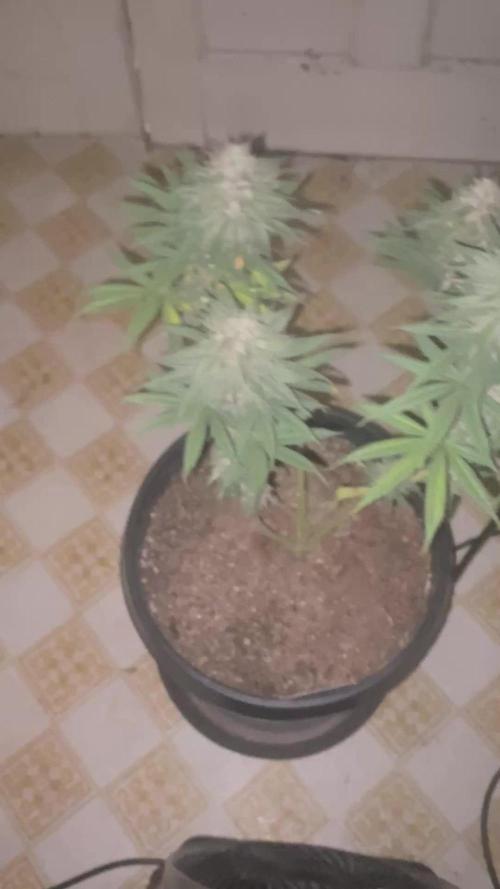
Easy week, with some photos under UV lights (i used a UV torchlight) make those girls look like corals. One or two more weeks to go.

Likes
4
Share
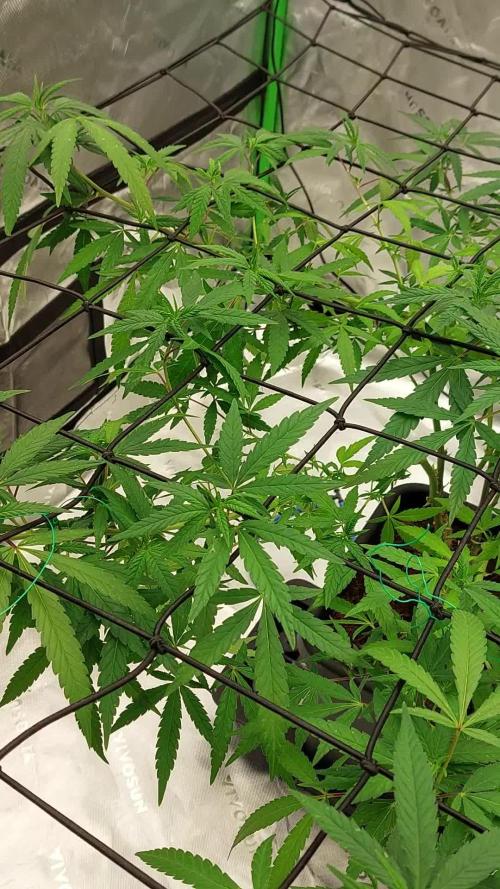
First Week of Flower. I gave them 36h of darkness before flipping to 12/12 light schedule. Canopy is filled somewhat good and more important is a even canopy. Installed a second net in the middle of the week. The support will be necessary later. Did a bit of defoliation but the lollipop will be done in 2 weeks. Conditions of the Grow: 💡 PPFD: 900 umol/m2/s ☀️ DLI: 38.8 mol/day 🌓 Lightcycle: 12/12 h 💨 Humidity: 50-55 % 🌡️ 🌞Daytime Temp.: 21-23 *C 🌡️ 🌙Nighttime Temp.: 18-19 *C 🌡️🌱Leaf Temperature: 21 *C 🌡️💧Water Temperature: 18-19 *C Water TDS: 1000ppm | EC: 2000us/cm 🚰Watersource: Rainwater (TDS: 15ppm | EC: 0.03 us/cm Vegetation Equipment: 🔦 Lamp: Mars Hydro FC-E6500 📤Container: 3x DIY 63L Euro-Box with lid Pot: Netpot 2 inch 💦Pump: M.R.S. Ultimate Whisper Powerpump 22 bar 🚿Nozzles: 12x 0.3mm 🫧Waterfilter: 150 microns 🌬️Fan: 3x Clipfan 🌪️Duct-Fan: AC Infinity 200 mm with Controller and Carbon Filter 🍶Nutrient Brand: Terra Aquatica 🔬Sensors: Waterstation (EC, TDS, Temp, PH, Salt), CO2, Air Temp. & Humidity (VPD), Temperature-Sensor Root Container
Likes
6
Share
@Bluemels
Follow
Tag 75: Ich habe heute nicht geerntet weil ich mich verrechnet habe 😲
Likes
20
Share
8/14 been chopping them. i got a clone a couple months back and she had spider mites. luckily, these autos werent overly affected. i do think that may have been the cause of some of the airy buds.
Likes
18
Share
Did some super cropping to get some more light penetration in the last month of flowering. plant got hit with a case of spider mites but I believe I got it on time. She smells super sweet and should be done in another month
Likes
6
Share
All good here. Except for the fact that I might not be LSTing correctly, oh well this is my first grow so...😺👍
Likes
21
Share
She is the shortest one, healthy but short - just her genetics. 💚💜 my Blueberry strains. I have both a Blueberry & Blueberry OG in, I'm excited for both.
Likes
16
Share
June 22: planted peat pot into final 5 gallon grow bag. Tore bottom off peat pot and ripped sides. Warm overnight so she’ll be outside for first time. June 23: first hot days of summer. Late to start autos but with warm weather they will start quickly. June 28: not much change in the first few days but she should start growing quickly here soon. Gave first compost tea this morning.
Likes
18
Share
Green light is radiation with wavelengths between 520 and 560 nm and it affects photosynthesis, plant height, and flowering. Plants reflect green light and this is why they appear green to our eyes. As a result, some growers think that plants don’t use green wavelengths, but they actually do! In fact, only around 5 – 10% of green light is reflected from leaves and the rest (90 – 95 %) is absorbed or transmitted to lower leaves [1]. Green wavelengths get used in photosynthesis. Chlorophyll pigments absorb small amounts of green wavelengths. Light that doesn’t get absorbed is transmitted to leaves that are shaded out from direct light. This means that leaves at the bottom of the canopy get more green light than leaves at the top. A high proportion of green wavelengths compared to other colors tells lower leaves that they are being shaded out, so they are able to react accordingly. Lower leaves may react by opening or closing their stomata or growing longer stems that help the leaves reach brighter light [1, 2, 3]. When it comes to growing cannabis, many cultivators are interested in the quality of light used for the flowering stage. In many plants, flowering is regulated by two main photoreceptors: cryptochrome and phytochrome. Both photoreceptors primarily respond to blue light but can also respond to green, although to a lesser extent. Green can accelerate the start of flowering in several species (although cannabis has yet to be tested) [1, 4, 5]. However, once flowering has begun, it’s important to provide plants with a “full spectrum” light that has high amounts of blue and red light, and moderate amounts of green, in order for photosynthesis to be optimized. Green light mediates seed germination in some species. Seeds use green wavelengths to decide whether the environment is good for germination. Shade environments are enriched in green relative to red and blue light, so a plant can tell if it is shady or sunny. A seed that senses a shaded environment may stay dormant to avoid poor growing conditions [1]. Some examples of plant species where researchers have documented this response are: ryegrass (a grass that grows in tufts) and Chondrilla (a plant related to dandelion) [1, 6]. Although green wavelengths generally tell plants NOT to germinate, there are some exceptions! Surprisingly, green wavelengths can stimulate seed germination in some species like Aeschynomene, Tephrosia, Solidago, Cyrtopodium, and Atriplex [1, 6, 7]. Of course, light is not the only factor affecting seed germination – it’s a combination of many factors, such as soil moisture, soil type, temperature, photoperiod, and light quality. When combined with red and blue light, green can really enhance plant growth [1, 8]. However, too much green light (more than 50% of the total light) can actually reduce plant growth [8]. Based on the most current research, the ideal ratio of green, red, and blue light is thought to be around 1:2:1 for green:blue:red [9]. When choosing a horticultural light, choose one that has high amounts of blue and red light and moderate amounts of green and other colors of light. Not many studies can be found about the effect of green light on cannabis growth or metabolism. However, if one reads carefully, there are clues and data available even from the very early papers. Mahlberg and Hemphill (1983) used colored filters in their study to alter the sunlight spectrum and study green light among others. They concluded that the green filter, which makes the environment green by cutting other wavelengths out, reduced the THC concentration significantly compared to the daylight control treatment. It has been demonstrated that green color can reduce secondary metabolite activity with other species as well. For example, the addition of green to a light spectrum decreases anthocyanin concentration in lettuce (Zhang and Folta 2012). If green light only reverses the biosynthesis of some secondary metabolites, then why put green light into a growth spectrum at all? Well, there are a couple of good reasons. One is that green penetrates leaf layers effectively. Conversely red and blue light is almost completely absorbed by the first leaf layer. Green travels through the first, second, and even third layers effectively (Figure 2). Lower leaf layers can utilize green light in photosynthesis and therefore produce yields as well. Even though a green light-specific photoreceptor has not yet been found, it is known that green light has effects independent from the cryptochrome but then again, also cryptochrome-dependent ones, just like blue light. It is known that green light in low light intensity conditions can enhance far red stimulating secondary metabolite production in microgreens and then again, counteracts the production of these compounds in high-intensity light conditions (Kim et al. 2004). In many cases, green light promoted physiological changes in plants that are opposite to the actions of blue light. In the study by Kim et al. blue light-induced anthocyanin accumulation was inhibited by green light. In another study it has been found that blue light promotes stomatal opening whereas green light promotes stomatal closure (Frechilla et al. 2000). Blue light inhibits the early stem elongation in the seedling stage whereas green light promotes it (Folta 2004). Also, blue light results in flowering induction, and green light inhibits it (Banerjee et al., 2007). As you can see, green light works very closely with blue light, and therefore not only the amount of these two wavelengths separately is important but also the ratio (Blue: Green) between these two in the designed spectrum. Furthermore, green light has been found to affect the elongation of petioles and upward leaf reorientation with the model plant Arabidopsis thaliana both of which are a sign of shade avoidance symptoms (Zhang et al. 2011) and also gene expression in the same plant (Dhingra et al. 2006). As mentioned before, green light produces shade avoidance symptoms which are quite intuitive if you consider the natural conditions where the plants grow. Not all the green light is reflected from the highest canopy leaves in nature but a lot of it (50-90%) has been estimated to penetrate the upper leaves at the plant level ((Terashima et al., 2009; Nishio, 2000). For the plant growing in the understory of the forest green light is a signal for the plant of being in the shade of a bigger plant. Then again, the plants growing under unobstructed sunlight can take advantage of the green photons that can more easily penetrate the upper leaves than the red and blue photons. From the photosynthetic pigments in higher plants, chlorophyll is crucial for plant growth. Dissolved chlorophyll and absorb maximally in the red (λ600–700 nm) and blue (λ400–500 nm) regions of the spectrum and not as easily in the green (λ500–600 nm) regions. Up to 80% of all green light is thought to be transmitted through the chloroplast (Terashima et al., 2009) and this allows more green photons to pass deeper into the leaf mesophyll layer than red and blue photons. When the green light is scattered in the vertical leaf profile its journey is lengthened and therefore photons have a higher chance of hitting and being absorbed by chloroplasts on their passage through the leaf to the lower leaves of the plant. Photons of PPFD (photosynthetic photon flux density) are captured by chlorophyll causing an excitation of an electron to enter a higher energy state in which the energy is immediately passed on to the neighboring chlorophyll molecule by resonance transfer or released to the electron transport chain (PSII and PSI). Despite the low extinction coefficient of chlorophyll in the green 500–600 nm region it needs to be noted that the absorbance can be significant if the pigment (chlorophyll) concentration in the leaf is high enough. The research available clearly shows that plants use green wavelengths to promote higher biomass and yield (photosynthetic activity), and that it is a crucial signal for long-term developmental and short-term dynamic acclimation (Blue:Green ratio) to the environment. It should not be dismissed but studied more because it brings more opportunities to control plant gene expression and physiology in plant production. REFERENCES Banerjee R., Schleicher E., Meier S. Viana R. M., Pokorny R., Ahmad M., Bittl R., Batschauer. 2007. The signaling state of Arabidopsis cryptochrome 2 contains flavin semiquinone. The Journal of Biological Chemistry 282, 14916–14922. Dhingra, A., Bies, D. H., Lehner, K. R., and Folta, K. M. 2006. Green light adjusts the plastic transcriptome during early photomorphogenic development. Plant Physiol. 142, 1256-1266. Folta, K. M. 2004. Green light stimulates early stem elongation, antagonizing light-mediated growth inhibition. Plant Physiol. 135, 1407-1416. Frechilla, S., Talbott, L. D., Bogomolmi, R. A., and Zeiger, E. 2000. Reversal of blue light -stimulated stomatal opening by green light. Plant Cell Physiol. 41, 171-176. Kim, H.H., Goins, G. D., Wheeler, R. M., and Sager, J. C. 2004.Green-light supplementation for enhanced lettuce growth under red- and blue-light emitting diodes. HortScience 39, 1617-1622. Nishio, J.N. 2000. Why are higher plants green? Evolution of the higher plant photosynthetic pigment complement. Plant Cell and Environment 23, 539–548. Terashima I., Fujita T., Inoue T., Chow W.S., Oguchi R. 2009. Green light drives leaf photosynthesis more efficiently than red light in strong white light: revisiting the enigmatic question of why leaves are green. Plant & Cell Physiology 50, 684–697. Zhang, T., Maruhnich, S. A., and Folta, K. M. 2011. Green light induces shade avoidance symptoms. Plant Physiol. 157, 1528-156. Wang, Y. & Folta, K. M. Contributions of green light to plant growth and development. Am. J. Bot. 100, 70–78 (2013). Zhang, T. & Folta, K. M. Green light signaling and adaptive response. Plant Signal. Behav. 7, 75–78 (2012). Johkan, M. et al. Blue light-emitting diode light irradiation of seedlings improves seedling quality and growth after transplanting in red leaf lettuce. HortScience 45, 1809–1814 (2010). Kasajima, S., et al. Effect of Light Quality on Developmental Rate of Wheat under Continuous Light at a Constant Temperature. Plant Prod. Sci. 10, 286–291 (2007). Banerjee, R. et al. The signaling state of Arabidopsis cryptochrome 2 contains flavin semiquinone. J. Biol. Chem. 282, 14916–14922 (2007). Goggin, D. E. & Steadman, K. J. Blue and green are frequently seen: responses of seeds to short- and mid-wavelength light. Seed Sci. Res. 22, 27–35 (2012). Mandák, B. & Pyšek, P. The effects of light quality, nitrate concentration and presence of bracteoles on germination of different fruit types in the heterocarpous Atriplex sagittata. J. Ecol. 89, 149–158 (2001). Darko, E. et al. Photosynthesis under artificial light: the shift in primary and secondary metabolism. Philos. Trans. R. Soc. B Biol. Sci. 369 (2014). Lu, N. et al. Effects of Supplemental Lighting with Light-Emitting Diodes (LEDs) on Tomato Yield and Quality of Single-Truss Tomato Plants Grown at High Planting Density. Environ. Control Biol. 50, 63–74 (2012).
Likes
11
Share
@Natesnugs
Follow
Day 99 dealing with annoying humidity issues seeing some damage on the leaves i think becuz of the humidity issue i got it all foxed up now an they look happier so hopefully i can maintain that the alien is showing no signs yet so shes really resistant to what ever it is so thats good Day 100 getting dialed back in im hoping iv fixed the problems Day 101 seems every plant is mostly happy but the qc blast still figuring out mayb a root problem Day102 trying a flush with hygro products the qc blast is still dealing with problems hopefully this will fix it everything else seems to be doing better Day 104 i think the flush fixed it 105 trics colors and smells coming in 🙌
Likes
9
Share
She is very quickly its best strain i ever got its real CashCow smells strong like ⛽️🍋🥦☕️ Buds are really huge and frosty hope she will be strong as looks 😉soon ✂️I will make smoke report
Likes
21
Share
Flowering day 12 since time change to 12/12 h. Hey everyone ☺️. Once again a wonderful week goes by 😀. It has developed so far and is now slowly starting to develop its flowers :-). As soon as the first forms of buds can be seen (I think in 5-10 days) 2 g GHSC Powder Feeding Bio Bloom per liter of substrate are added. In the third week, 1 g per liter of substrate is added so that it lasts through to the end :-). This week it was poured 3 times with 1 liter each 👍. The entire tent was also cleaned and the electronics checked for functionality. The humidifier was refilled every day and fresh osmosis water was drained into the tank for the coming week ☺️. The plants have all been checked for health and pests 👍. Next week the bamboo sticks are inserted towards the end for support and the lowest shoots are removed so that at the end the energy is not wasted in the lower area 👍. Otherwise there is nothing more to report this week :-). I wish you a lot of fun with the update 😎. Stay healthy and let it grow 🍀. You can buy this Strain at https://www.amsterdamgenetics.com/product/kosher-tangie-kush/ Type: Kosher Tangie Kush ☝️🏼 Genetics: Kosher Kush X Tangie 👍 Vega lamp: 2 x Todogrow Led Quantum Board 100 W 💡 Bloom Lamp : 2 x Todogrow Led Cxb 3590 COB 3500 K 205W 💡💡☝️🏼 Soil : Canna Coco Professional + ☝️🏼 Fertilizer: Green House Powder Feeding ☝️🏼🌱 Water: Osmosis water mixed with normal water (24 hours stale that the chlorine evaporates) to 0.2 EC. Add Cal / Mag to 0.4 Ec Ph with Organic Ph - to 5.5 - 5.8 .
Likes
9
Share
Likes
2
Share
Week 5 Veg and things are cruising along. The lanky girl in the 2 gal pot is starting to look better structure wise than the other 5. Thinking about transferring her to a 7 gallon pot for clones! The Tri leaf mutation is really taking off, throwing tops for days with out training or topping. 3 of the ladies have been topped to make bushes and the other are growing natural with some defoliation.
Likes
80
Share
@Roberts
Follow
The pure Ice cream clone has been growing nicely and doing her thing. I did move her back to the SE3000 tent. She is steady growing, and likely needs a bigger potter very soon. Everything has been going great. Plus the other clone finally started to grow. It is showing deformities, but it is growing now. Thank you Spider Farmer, and Pure Instinto Seeds. 🤜🏻🤛🏻🌱🌱🌱 Thank you grow diaries community for the 👇likes👇, follows, comments, and subscriptions on my YouTube channel👇. ❄️🌱🍻 Happy Growing 🌱🌱🌱 https://youtube.com/channel/UCAhN7yRzWLpcaRHhMIQ7X4g
Likes
46
Share
Day 81: This week I have been flushing and will continu to until the end of this week. With growing this many plants and due some heat problems at some spots, not all of the plants will be done at the same time. I try to start cutting halve of all of my plants down and putting them upside down in another room. The others I will keep flowering until they are done. Might be a week, could be even two LOL.
Likes
15
Share
Welcome to week 7! Almost time to flower and things are looking good. Since last week I did some light defoliation and cleaning up of the bottoms over a few days. I also lightly tied some of the branches out to allow a bit more light penetration but also to spread the canopy. This week (at the end of the week) the plants got one water containing a 2tsp of kelp, and 2 tsp of freeze dried coconut. The ladies also got one foliar spray with Mountain Organics sprouts, citrus and Rita oil combined with a small amount of Method 1pps (see picture in week 6). Temperature and humidity has really been steady thanks to the help of my Grow Ratio ESU and fans. Hoping I can keep this rate of growth into flower.  Strain: Moon Boots bred by Archive Seed Bank Tent: 2" X 4" @highdrogro Light: Scyence Dragon S Turbo 450 Watt LED Light Cycle: 18/6 Soil: Black Swallow Living Soil, KIS organic mix Air Circulation: AC Infinity Cloudline T6 Inline Duct Fan 7 Gallon Living Soil Bags: Grass Roots Fabric Pots