@AsNoriu
Follow
Day 0. Got new setup : aka light and tent from Mats Hydro and went for small grow off ;)
Great AMS strain, loved the taste
Ts1000 great light with dimmer for insane low price.
Solid durable Mars hydro tent, tested not one.
Day 2. Girls could not loose shell, so streched a bit, helped with fingers before photo shoot;)
Happy Growing !!!


@LX1977
Follow
J-50 arrosage eau (pH6.5)
J-51 légère défoliation.
J-52 arrosage avec engrais (pH6.6) + défoliation.
J-54 arrosage eau (pH6.7)
J-55 arrosage avec engrais (1 fastberry est très en retard comparé à l'autre)
Mise en route d'un déshumidificateur pour arriver à 50% d'humidité.
Sinon tout se passe bien et hâte de récolter les Forbidden Runtz 😁



@wolfvb
Follow
🌿 RS11 "B" - Following in Her Sister's Footsteps! 🏙️?
Let's go! New week for RS11 "B". She is doing absolutely incredible out on the balcony and is right behind her giant sister, officially hitting a massive 145cm!
📈 The Details / Progress Report:
Chasing the Canopy: She is at 145cm and stretching beautifully! She might be a little shorter than her sister, but she is building a fantastic, wide, and sturdy structure to handle the outdoor breezes. 🌳
Still Vegging Hard: Just like her sister, she is a true photoperiod plant enjoying the Berlin summer. With around 16 hours of daylight right now, it is not possible for her to be in flower yet! She is strictly in her vegetative phase, using all that glorious sun to pack on size and build up her frame before the days get shorter. ☀️
Flawless Health: Looking at the close-ups, her canopy is a vibrant, lush green. The fan leaves are completely pristine, praying beautifully to the light with zero signs of stress or pests. The preventative care we did a couple of weeks ago has kept her perfectly safe! 🍃
Pre-Flower Prep: While she isn't flowering, you can see that the top nodes are getting incredibly tight. She is structuring herself perfectly so she's ready to explode with bud sites as soon as that light schedule naturally flips.
💧 Next Steps:
With her hitting 145cm, making sure she has proper wind support on the balcony is still a top priority. I'm going to keep her feed consistent to support this massive vegetative growth and just let her keep soaking up the long Berlin days until the transition begins!
She is looking amazing! Let's keep it growing! 🌱💨


@Bossman
Follow
Looks like I'm going to be satisfied with the autos and the photos their coming along fine very nicely. I super cropped the one outside and that's turning out fantastic


@Farmerskr
Follow
Este es el avance finalizando la 3ra semana, tienen 21 días, ahora les haré una defoliación y una poda de bajos, van maravillosas las Gorilla Banana de BSF Seeds. Planeo pasarlas a floración el día 31 para cerrar con 30 días de vegetación.
Saludos
@farmer.skr 🤙






@hilfa
Follow
Defoliated bottom parts of plants and lower growth. It's fairly evident now that the CBDiesel isn't going to produce much. The fan leaves and bud sites are tiny in comparison to the other two strains.
Roots have become completely entangled and almost reach the perimeter of reservoir.
Continued to tuck taller growth back under trellis to create even canopy.
Foliar fed 3 times throughout week with half strength solution.
Added pH balanced ice cubes 3 times throughout week to boost oxygenation
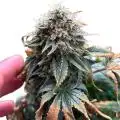
Humidity way too high, need to address this fast.








@Leonardo_DaGrower
Follow
I continue to struggle with humidity. Most of the time it’s above 30% but sometimes can drop as low as 16. I had many fan leaves die off this week. I trimmed them off.
I will be patient as she ripens.


@KcKush
Follow
*Increased ppm from 850 to 950
*Week 3 of flowering.
*Did some defoliation will leave it as if and see how it turns out.
*Smell is weak. Just a piney smell to it.




@Thebeardserkers
Follow
Semaine 6 – Transition Floraison : Pistils et Défis Nutritionnels
Jour 35–41 (17 avril – 23 mai)
La semaine 6 marque officiellement l’entrée en floraison. Gorilla Cookies a ouvert le bal avec ses premiers pistils la semaine passée, suivie par Toof Decay. Les autres génétiques (Mephisto’s Wedding, Hubbabubbasmelloscope) montrent des signes avant-coureurs de floraison. L’environnement reste stable : 24–25°C, RH 62–64%, VPD 1.17–1.21 kPa, conditions proches de l’idéal.
Nutrition et PPM
Transition vers Bud Ignitor (1 ml/L) et maintien du GMB 1:1:1 à 1.5 ml/L. Cal/Mag augmenté à 2 ml/L. = ~570–610 ppm réels.
Problèmes identifiés
Carence en Cal/Mag sur Hubbabubbasmelloscope et Gorilla Cookies (chlorose interveinal, feuillage jaune). Traitement direct : 2–3 ml/L Cal/Mag appliqué par pot. Réaction positive après 3–4 jours.
Observation critique : les 4 plants en AutoPot (AQUAValve 5.0) montrent 2x moins de vigueur que les 3 plants en bases AC Infinity avec les pots en tissus. Hypothèse : le système AQUAValve maintient le substrat trop humide en continu, tandis que les bases AC Infinity crée une meilleure oxygénation. Aussi, c'est seulement sur les auto pots que j'ai observé des carences, peut-être dû à un blocage nutritionnel. À évaluer pour les futures canopées.
Lumière et PPFD
IF500 (500w) + Mars Hydro 500w maintiennent 660–700 µmol. Pas de stress lumineux, feuillage bien coloré (sauf carence identifiée).
Statut réservoir
47L, 15L pots coco 100%. Consommation d’eau stable. Changement complet prévu mi-floraison.
Prochaine semaine : suivi de la carence corrigée, ajustement graduel du calendrier nutritionnel Advanced Nutrients pour la phase de développement floral.
Tent: 4x8 Gorilla | AC Infinity 69 Pro + Pulse One | 20/4 | 7 plants autoflower | Jour 35
COMPTE RENDU TECHNIQUE — RUN INTÉRIEURE #1 2026
Problème AutoPot et Solution
Date du diagnostic :24 mai 2026 (Jour 37)
Système : AutoPot 4-pot, AQUAValve 5.0, réservoir 47L
Génétiques affectées : Hubbabubbasmelloscope (1), Gorilla Cookies (1)
PROBLÈME IDENTIFIÉ
Symptômes observés
- Décoloration inter-nervures (jaunissement) sur feuilles supérieures
- Diagnostic initial : carence en calcium/magnésium (Cal/Mag)
- Plantes : Hubbabubbasmelloscope #1 & #2, Gorilla Cookies
Prélèvement d’eau au fond des pots AutoPot(jour 37) a révélé :
- pH : 6.8(hors cible 5.8–6.2 pour coco)
- Eau stagnante depuis activation AutoPot (jour 17 = 20 jours)
Analyse de la stagnation
1. Timing AutoPot précoce→ Plantes jeunes, consommation faible
2. Eau restante dans les pots → Contact prolongé avec air dômes
3. Air dômes + coco neuve → Oxydation progressive, dérive pH vers alcalin
5. pH 6.8 en coco→ Blocage d’absorption de Cal/Mg (disponibilité réduite de 40–50%)
Résultat : Symptômes de carence alors que les nutriments étaient présents = blocage nutritionnel, pas déficience réelle
SOLUTION APPLIQUÉE
Étape 1 : Correction immédiate (24 mai)
- Prélèvement eau au fond des 4 pots AutoPot
- Pompage progressif jusqu’à pH 5.8
- Volume pompé : ~1-2 L par pot (estimation)
- Nouveau pH : 5.8 stabilisé
Étape 2 : Traitement localisé (jours 20–24)
- Application directe Cal/Mag : 2–3 ml/Lpar pot (non-réservoir) Top wathering
- Appliqué sur : Hubbabubbasmelloscope Mephisto, Gorilla Cookies Fast Bud
- Méthode : versement manuel aux racines
- Fréquence : 2 applications espacées de 3–4 jours
Étape 3 : Maintenance réservoir
- PPM réservoir principal : maintenu 400–420 ppm (Hanna HI98301, scale 500)
- Note calibration : Vrai PPM = lecture × 1.4 = ~560–588 ppm
- Cal/Mag réservoir : maintenu à 2 ml/L
- pH réservoir : vérification quotidienne post-correction
Étape 4 : Surveillance continue
- Routine hebdomadaire établie : Prélèvement fond pots, vérif pH
- Objectif : Détecter remontée pH avant accumulation
- Seuil intervention : pH 6.2 = pompage correctif
RÉSULTATS & OBSERVATIONS
Court terme (5–7 jours post-correction)
- Pistillage accéléré visible sur Gorilla Cookies (confirmé jour 37)
- Décoloration n’a pas progressé → blocage levé
- Plants Mephisto’s Wedding : vigueur stable (10% affectés)
- Toof Decay : vigueur stable (10% affectés)
Comparaison système
Observation importante : Plants en bases tissu AC Infinity (manual feed via bleed valve) montraient plus de vigueur que plants AutoPot
- Raison probable : Cycle humide/sec régulier vs eau stationnaire
- Implication : AutoPot inadapté pour timing de croissance lente initiale
LEÇONS APPRISES
Sur le système AutoPot
1. Activation tardive recommandée→ Jour 25–30, pas jour 17
1. Monitoring pH hebdo obligatoire → Coco + air dômes = dérive pH naturelle
1. Eau stagnante = problème→ Même avec nutriments corrects, pH alcalin = blocage
Sur la coco neuve
- Nécessite ajustement pH plus fréquent en début
- Se stabilise après 3–4 semaines d’utilisation
- Minéraux s’accumulent lentement → nettoyage hebdo bénéfique
Choix système pour Run #3
AutoPot déclassé pour prochaines runs
- Passage à : 8× bases AC Infinity + 8× flottes automatiques individuelles
- Avantage : drainage régulier, pas de stagnation, PPM/pH plus stables
- Setup réel : coco/Bio-Urbain, 5 gallons, 75L réservoir centralisé
DONNÉES COMPLÈTES
CONCLUSION
Problème :Eau stagnante + pH alcalin = blocage nutritionnel (pas déficience)
Solution : Correction pH + Cal/Mag localisé + routine hebdo de monitoring
Statut : Résolu, plants en rétablissement, early flower progression normale
Impact rendement : Minimal — correction avant dégâts sévères



@DogDoctorOfficial
Follow
💙 8×8 Adventure – Week 15 🌿
Blueberry Muffin – Pheno B
🌸 A More Colourful Goodbye — The Compact Girl Finishes Her Story in Her Own Style
Welcome back to another chapter of the 8×8 Adventure! 🌱💚
And before we get into this beautiful girl, I want to start with a little explanation.
First of all, apologies for the slightly different format of these reports lately. There is quite a lot happening behind the scenes, and with so many individual plants, phenotypes, photographs, observations and different stages of development, I've decided to give every girl the space she deserves.
So, for anyone joining us for the first time, let's take a moment to explain what we're doing here.
────────────────────────
🌱 THE 8×8 ADVENTURE — A LITTLE RECAP FOR NEWCOMERS
This project is a full 12/12-from-seed experiment.
Yes, you read that correctly!
We're exploring what happens when different genetics and individual phenotypes share the same general environment under a 12/12 light schedule from the beginning.
No traditional extended vegetative period.
No separate lighting schedules for different plants.
Just one shared room, one general environmental approach, and a collection of different genetic expressions developing alongside one another.
And that's precisely where things get interesting.
Some plants stretch considerably.
Some remain compact.
Some develop quickly, while others take their time.
Some finish earlier, some need longer, and even plants from the same cultivar can show noticeably different characteristics.
That's why we're documenting each plant individually.
Although several girls share the same genetics, each phenotype has her own diary, photographs, observations and development timeline.
We want every report to tell a complete story on its own.
Someone following Pheno A shouldn't need to search through Pheno B's diary to understand what's happening.
And someone discovering Pheno B halfway through the project should be able to follow her journey from beginning to end.
There will naturally be some overlap between reports, because these plants share the same room and many of the same conditions.
But their individual stories are worth documenting separately.
Same room.
Same general conditions.
Different genetics, different expressions, and sometimes very different personalities.
That's the heart of the 8×8 Adventure.
💙🌱
────────────────────────
💙 BLUEBERRY MUFFIN PHENO B — HER OWN KIND OF FINALE
And now...
Let's talk about this beautiful little lady!
Blueberry Muffin Pheno B.
😂💙
If you've been following her diary, you already know that she was never particularly interested in competing with the taller girls.
She's been compact throughout the run, developing at her own pace and generally giving us the impression that she has absolutely no intention of rushing anything.
And honestly, she stayed true to that personality right until the end.
But there is something I particularly like about the way this girl finished.
Compared with her sister, Pheno B developed a more colourful expression towards the end of her journey.
The difference is especially interesting when we look at the flowers closely.
Two Blueberry Muffins.
Same general environment.
Same overall treatment.
Two individual phenotypes.
And two slightly different final expressions.
That's exactly the kind of detail I want to preserve in these diaries.
Because if we simply photographed the two plants together and called them Blueberry Muffin, we'd miss part of the story.
Pheno B deserves her own spotlight.
And today, we're giving it to her.
💙🌸✨
────────────────────────
🌈 A LITTLE MORE COLOUR IN THE FINAL CHAPTER
One of the things that immediately caught my attention was the colour development.
Compared with Pheno A, this girl finished with a more colourful appearance.
And I absolutely love seeing these differences between sisters.
The final photographs give us a beautiful look at the flowers, their different shades, the pistils, and the individual structures that developed throughout the run.
There is something particularly rewarding about looking back at the photographs from the early weeks and comparing them with what we have in front of us now.
At the beginning, we were looking at a small plant under a 12/12 schedule.
Then came the development of her structure.
The first flowers.
The stacking.
The gradual changes in the flowers.
And eventually, this.
A compact Blueberry Muffin with her own personality and a more colourful finish than her sister.
No need to make her story bigger than it is.
She's beautiful exactly as she is.
💙🌈🌸
────────────────────────
📸 THE MACRO WORLD — THIS IS WHERE THINGS GET REALLY INTERESTING
Now, my friends...
Let's get closer.
A lot closer.
😂🔬
This report includes quite a collection of photographs, and I wanted to give the flowers the attention they deserve.
We've gone deep into the details with our macro photography and focus-stacking work.
And when I say deep, I mean DEEP.
We're not only looking at the overall flower structure.
We're exploring individual details that are almost impossible to appreciate in a normal photograph.
The trichomes.
The resin-covered surfaces.
The pistils.
The different textures.
The tiny structures surrounding the flowers.
And some of the less conventional subjects that most people probably wouldn't think of photographing.
We even included root photography and focus-stacking experiments.
Because why stop at the flowers?
😂🌱🔬
The roots are part of the story too!
For anyone unfamiliar with focus stacking, it's a photographic technique where multiple images are captured at different focus distances and combined to produce a photograph with a greater depth of field.
At macro magnifications, the depth of field can become incredibly shallow.
A tiny change in focus can make a huge difference.
By combining multiple photographs, we can reveal much more detail across a small subject than a single image would normally show.
And that's what makes this kind of photography so fascinating.
We're not simply taking a close-up.
We're exploring a miniature world that is already there, waiting to be discovered.
📸🔬💙
────────────────────────
❄️ TRICHOMES, RESIN AND THE LITTLE DETAILS
If there is one thing this photo collection makes particularly clear, it's how much detail there is to appreciate in these flowers.
The trichomes are everywhere in our close-up photographs.
Different structures, different angles, different levels of focus, and a completely different perspective from what we see when looking at the whole plant.
Some of these photographs are really something else.
And I particularly enjoy the way the macro work reveals the relationship between the flower surface, the trichomes and the surrounding plant structures.
You can spend quite some time looking at these images.
And that's exactly the point.
Sometimes we become so focused on the overall plant that we forget just how much is happening at a microscopic scale.
There's an entire little world hiding in those flowers.
And this girl gave us plenty of opportunities to explore it.
❄️🔬🌸
────────────────────────
🦋 COLOURFUL WINGS AND UNEXPECTED VISITORS
And then we have some of my favourite little discoveries from this photo session.
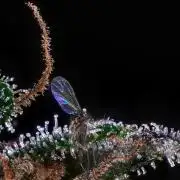
Those beautiful colourful wings!
Some of the macro photographs capture tiny details that are easy to overlook when looking at the plant normally.
The colours, reflections and delicate structures make for some fascinating images.
And, of course, we also have our little visitors.
Fungus gnats caught on the sticky traps.
😂?
Not exactly the guests we invited to the photography session, but apparently they wanted to participate.
Jokes aside, they're part of the real-world observations from the room, and I like documenting what we actually encounter rather than pretending everything is always perfectly staged.
Not every photograph needs to be glamorous.
Sometimes the little details tell us something about the environment around the plants too.
And sometimes they simply make us laugh.
😂🌱
────────────────────────
🌿 ONE CULTIVAR, TWO SISTERS, TWO DIFFERENT EXPRESSIONS
I want to make a point of highlighting the difference between Pheno A and Pheno B.
Their diaries naturally share some similarities.
They belong to the same cultivar.
They shared the same general environment.
They followed the same overall approach throughout the run.
But their final appearances weren't identical.
Pheno B developed a more colourful finish than her sister.
And that's a lovely distinction to have documented.
This is one of the reasons I enjoy keeping individual phenotype records.
A cultivar name gives us a starting point, but it doesn't tell us everything about how an individual plant will express herself.
Two plants can share a genetic background and still develop different structures, colours, flowering patterns and individual characteristics.
We're not trying to decide which sister is better.
We're simply documenting what each one gave us.
Pheno A has her own story.
Pheno B has hers.
And both deserve to be remembered individually.
💙🌸
────────────────────────
💡 SAME ARTIFICIAL SUN — SAME LIGHTING ECOSYSTEM
Throughout this journey, the lighting environment has remained part of the shared setup.
Our Future of Grow Black Series LEDs provide the main lighting, supported by the additional Black Series 600W fixtures that expanded the lighting capability of the room.
After introducing the extra fixtures, we adjusted their output to approximately 59% from the plug.
Our upper-canopy reference was approximately 1,500 PPFD, with actual intensity varying according to plant height and position.
The idea was never simply to throw more light into the room.
It was to have additional lighting capability and flexibility without needing to operate every fixture at maximum output.
And once again, it's interesting to remember that Pheno A and Pheno B shared this same general lighting environment.
Same photons.
Same artificial sun.
Different plants.
Different expressions.
A huge thank you to Future of Grow for supplying the additional Black Series fixtures and allowing us to explore the expanded lighting setup.
💡🌱🙏
────────────────────────
❤️ A LITTLE RED LIGHT BEFORE THE NIGHT
We're also documenting our additional 15-minute red-light period after the main lighting period.
This has been part of the lighting routine we're exploring during this run.
As discussed in previous reports, red and far-red wavelengths interact with plant photoreceptors, including the phytochrome system.
It's important, however, not to confuse different lighting treatments or assume that one automatically produces the effects of another.
The classic Emerson effect, for example, describes enhanced photosynthetic activity under particular combinations of red and far-red light.
That is not the same thing as claiming that a short end-of-day red-light treatment automatically produces the Emerson effect.
The spectrum, intensity, timing and conditions matter.
And I prefer to keep the science honest.
We're documenting what we're doing, exploring the subject and learning along the way.
No magical promises.
Just curiosity and observation.
🔬💡
────────────────────────
🌱 THE FINAL CHAPTER — KEEPING THE SAME GENERAL APPROACH
As with the other plants in the room, Pheno B shared the same general environmental and nutritional approach throughout this stage.
The room continued under the established 12/12 schedule, with the same lighting ecosystem and overall project conditions.
There was no separate environmental strategy created specifically for this phenotype.
That's important to remember when looking at the differences between the sisters.
They weren't given two completely different environments to produce two different appearances.
They shared the same general conditions, and we're documenting the individual expressions that developed.
For this final chapter, the focus is no longer on introducing new changes.
It's on documenting what we have.
The flowers.
The colours.
The structure.
The macro details.
And the complete journey from seed to finish.
💙🌿
────────────────────────
🎬 A LITTLE SNEAK PEEK — SOMETHING FOR THE NEXT REPORT!
And now, a little teaser...
Some of you might have noticed a few photographs that look a little different from the usual plant and macro photography.
That's intentional.
I've included a small behind-the-scenes preview of the dried flowers.
Just enough to give everyone a glimpse of what is coming next.
Because the next report will take us into another part of the journey.
We'll be looking at the dried buds, giving them their own attention and documenting the next stage of this girl's story.
I don't want to reveal everything just yet.
😂💙
Let's leave a little something for the next chapter!
But I thought it would be nice to give everyone a small preview rather than keeping all those photographs hidden until the next update.
So consider this a little appetizer.
The main course is coming.
🌸📸✨
────────────────────────
🔬 WHY ALL THESE PHOTOGRAPHS MATTER
One thing I really want to highlight is that this project isn't only about growing different plants.
It's also about documenting them.
And documentation doesn't have to stop at the usual full-plant photographs.
We can explore different photographic techniques.
We can experiment with macro photography.
We can look at the roots.
We can photograph the flowers at different stages.
We can use focus stacking to reveal details that a normal photograph cannot capture clearly.
And we can preserve those observations for later comparison.
That's why I enjoy combining the grow diaries with the photography side of the project.
The plants give us the subject.
The camera gives us another way to explore it.
And sometimes the results are absolutely fascinating.
This Blueberry Muffin Pheno B has given us a lovely collection to look back on.
💙📸🔬
────────────────────────
💙 FINAL THOUGHTS — A COLOURFUL GOODBYE
And here we are.
Week 15.
Blueberry Muffin – Pheno B.
Our compact girl.
The one who always seemed perfectly comfortable taking the scenic route.
😂💙
She finished a little more colourfully than her sister, giving us another beautiful example of how individual phenotypes can express themselves differently even when sharing the same general conditions.
And this final collection of photographs gives us plenty to appreciate.
Beautiful flowers.
Colourful details.
Trichomes.
Resin-covered surfaces.
Delicate structures.
Unexpected little visitors.
Root photography.
And a whole lot of macro work that takes us into a world we normally wouldn't see.
We also have a small preview of the dried flowers, because her journey isn't quite finished here.
There's another chapter coming.
And I want to give that chapter the same attention.
For now, I simply want to appreciate what this girl has given us.
From a small seed under a 12/12 schedule to this beautiful final expression.
She didn't need to become the tallest plant in the room.
She didn't need to be the fastest.
She didn't need to look exactly like her sister.
She simply needed to be herself.
And she was.
Same room.
Same general conditions.
Same cultivar.
Two sisters.
Two different stories.
That's the 8×8 Adventure.
💙🌱🌸
Thank you, Blueberry Muffin Pheno B, for another beautiful chapter.
You may have taken the scenic route, but you certainly made it worth the journey.
And now...
Let's get those dried-bud photographs ready.
😂💙
────────────────────────
🙏 THANK YOU — THE PEOPLE BEHIND THE ADVENTURE
A huge thank you to Zamnesia for the Blueberry Muffin genetics and for giving us the opportunity to explore and document these individual phenotypes. 💙🌸
Thank you to Plagron for supporting the nutritional side of this adventure and being part of the journey. 🌱
A massive thank you to Future of Grow for the Black Series lighting and especially for supplying the additional Black Series 600W fixtures that expanded our lighting ecosystem. 💡🙏
Thank you to LumiFlora for helping illuminate the deeper parts of the canopy.
Thank you to TrolMaster for the technology and environmental control supporting the room behind the scenes.
And a big thank you to everyone following the project on GrowDiaries.
Your comments, questions, observations and support make these diaries what they are.
A special thank you as well to everyone joining us in the DogDoctorOfficial Discord community.
The grow diaries are only one part of this adventure. The conversations, shared knowledge, photography, experiments and friendships are what make the whole community special.
If you're not already part of it, come and join us!
Discord:
https://discord.gg/dogdoctorofficial
And, of course, thank you to everyone who takes the time to look at the photographs.
Especially the macro ones.
😂🔬💙
────────────────────────
💚 GROWERS LOVE, MY FRIENDS!
That's another beautiful chapter completed in the 8×8 Adventure.
Blueberry Muffin Pheno B has finished her journey with her own character, her own colours and her own individual expression.
Now we have the photographs, the observations and the memories to look back on.
And the next chapter?
The dried flowers are waiting.
So stay tuned, because we're not finished exploring this little lady just yet.
Until then, keep growing, keep observing, keep experimenting, and never forget to appreciate the little details.
Sometimes the most interesting things are hiding right in front of our eyes.
Growers Love, my friends, and happy growing! 🌱💚💙
See you in the next chapter of the 8×8 jungle...
where every phenotype has a story,
every photograph reveals another detail,
and there's always something new to discover.
LET'S GROW! 💙🌸🔬


@Lazuli
Follow
The pistils are still white
Shes very fat now and i think 2 weeks before harvest, i feed less now at 400ppm and starting ripen feed when half of her pustils turned brown
August 18 (mid this week)
I flushed her completely and fed ripen untill runoff got in the 200ppm.
Now she is ready to finish
Harvest will be at august 28th