


Likes
Comments
Share


@Regenwurm
Follow
Die 9 Blütewoche ist erfolgreich abgeschlossen!
Tage der Wachstumsphase = 32 Tage.
Tage der Blütephase = 63 Tage
Wachstum h in Blütewoche 9= 0 cm
Blütenbildung: Hoch
Die Mutationen nehmen ihren Lauf! Die Pflanze (Blüte) wächst und wächst und wächst.....
Wenn ich es richtig recherchiert habe handelt es sich bei ein und derselben Pflanze um mehrere Mutationen
Im Einzelnen...
Mutation 1= strähnige Blüten (wie bei der Dr. Greenspoon öfter mal vorkommt)
Mutation 2 = Gigantismus (doppelt so viele DNA Ketten wie regulär)
2 mal in dieser Woche mit Purolyt Mischung 1:25 besprüht
Lichtstärke: 85 %
Lichtabstand: 36 cm
Std Tag/Nacht: 12/12
Temperatur Tag: 25-26,5 Grad
RLF Tag: 55-61%
Temperatur Nacht: 20-21 grad
RLF Nacht: 50-55 %
VPD Wert: ca. 0,90-1,1
PH Wert Wasser/Düngelösung: 6,5
EC Wert: 1,3
Ventilator Oszillation: Stufe 2
Befeuchter: aus
Entfeuchter: mit Steuerung an
Zusätzlicher Entfeuchter: 1 Stk außerhalb vom Zelt im Raum
Bewässerung: 1* Wasser PH 6,6 EC 0,1/ 5 * bewässert mit Dünger mit den o.g. Mengen
Purolyt Besprühung: 2 mal
Controlling: Grow Control
Dünger: Greenbuzz Nutrients
Licht: Pro Emit Vollspektrum
Abluft: EC Carbon Active 750 m3 gesteuert/PrimaKlima 480m3
https://greenbuzznutrients.com/de/
Danke an Greenbuzz
Ihr bekommt 25 % Rabatt bei der Nutzung des Codes auf der GB Homepage
https://greenbuzzliquids.com/de/shop/
Code: GD42025
(Mindestbestellwert 75€)

Likes
5
Share


@Mrpickles774
Follow
So end of week 4 and I’ve lst and growing in coco ... got a friend in tne tent !!!
This auto is just starting to show some hairs now. There’s 8-10 good bud sites so hoping for a nice plant here .

Likes
16
Share


@Albeginner420
Follow
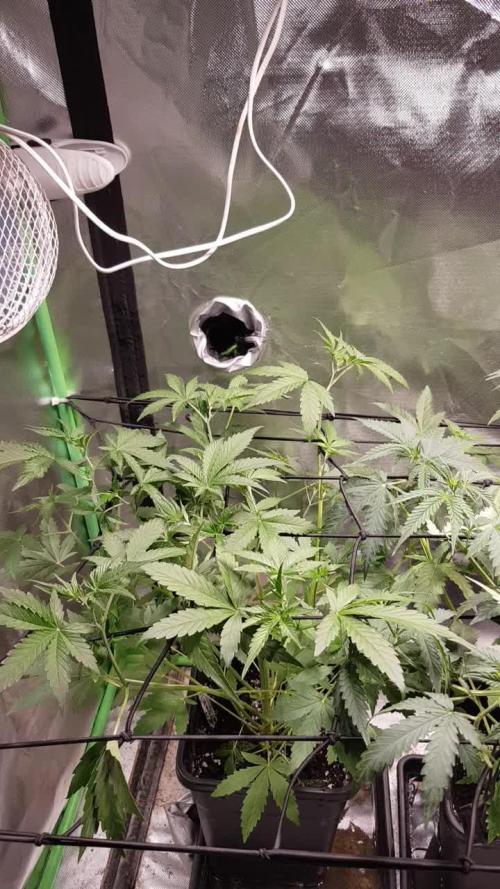
I give her only pH water as She has already the nutrient in the soil and she's thriving. The buds are really starting to fatten up. The flower stretch Is over.




Likes
47
Share

@Sadhus
Follow
**Semaine Harvest : Récolte Finale – Sticky Broccoli (28 avril 2026)**
**Note :** Fin du cycle Eternity Grow Cup 2. Récolte effectuée en semaine 10 de floraison (légèrement anticipée). Tout le journal de culture est maintenant complet.
### Contexte et Bilan du Cycle
Après 10 semaines de floraison (semaine 14 globale), la récolte a été déclenchée suite à un départ de botrytis sur une autre plante du même espace. J’aurais pu laisser encore quelques jours pour laisser mûrir un peu plus les trichomes ambrés, mais la sécurité prime.
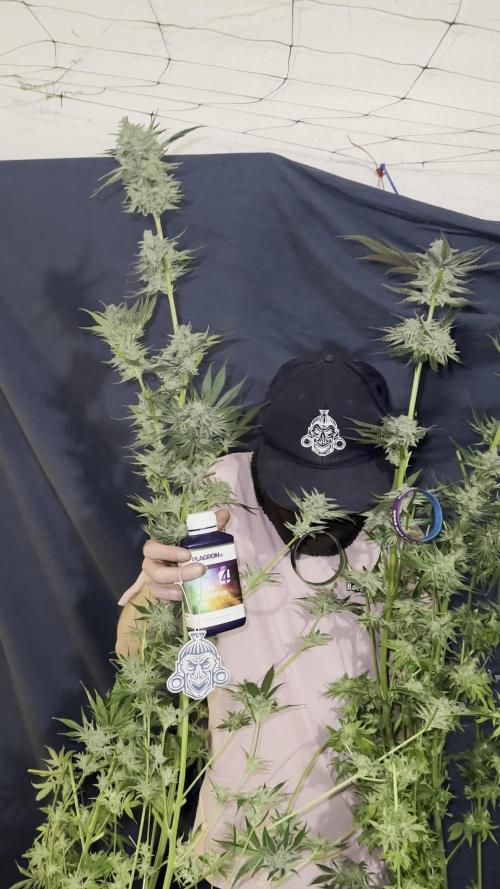
La plante dominante (150 cm) a donné un beau rendement qualitatif, avec des buds denses, extrêmement frosty et résineux.
**Poids frais : environ 780 grammes** (poids humide total des buds trimés, sans les grosses tiges).
Mise à jour prévue dans 2 semaines pour le **poids sec final** après un bon curing.
### Observations à la Récolte
- **Buds** : Denses et compacts, très collants. Couverture trichomale exceptionnelle (majoritairement laiteux avec quelques têtes ambrées). L’aspect sugar est magnifique, les buds brillent littéralement.
- **Odeur** : Très agréable, sucrée, épicée et florale, typique de Sticky Broccoli. Puissante même après le flush.
- **Résine** : Extrêmement résineuse au toucher – parfait pour du dry sift ou un petit Ice-o-Lator.
- **Structure** : Belle densité globale, même si la taille individuelle des buds reste dans la moyenne haute pour la variété (pas les plus gros que j’ai vus, mais la qualité trichomale compense largement).
- **Santé** : Plantes propres jusqu’à la fin, pas de carence visible. Le flush des 3 derniers jours (EC 0,7) a bien aidé à nettoyer les sels.
**Clones** : Quelques clones prélevés plusieurs semaines auparavant ont été repiqués avec succès dans leur nouveau système. Ils sont bien enracinés et prêts à repartir pour un prochain cycle de végétation/floraison. La génétique est conservée !
### Paramètres en Fin de Cycle (semaine 10)
- Température jour/nuit : 19-21 °C / 14-15 °C
- Humidité : 48-58 % jour / 29-39 % nuit
- VPD : 0.9-1.3 kPa
- PPFD : 550 (DLI 24)
- UV : 90 min/jour
- EC final : 1.0 puis flush à 0.7 (Terra Aquatica seul)
- pH : 5.8-6.0
- Steering : génératif jusqu’à la fin
- 48h de blackout avant récolte : appliqué pour booster la résine et améliorer la qualité des trichomes.
### Plans Post-Récolte
- **Séchage** : 7-10 jours à 18-20 °C et 55-60 % d’humidité dans un espace sombre et ventilé.
- **Curing** : Minimum 2-3 semaines en bocaux (burping régulier) pour affiner les terpènes et la douceur. Mise à jour dans 2 semaines avec le poids sec final.
- **Utilisation** : Une partie en fleurs séchées/cure, et un petit batch pour **dry sift** + **Ice-o-Lator** (bubble hash) histoire de se régaler avec la résine exceptionnelle de cette Sticky Broccoli.
**Tips éducatif final : Le flush et le blackout en fin de cycle**
- **Flush** (3 derniers jours à EC très bas) : Permet d’éliminer les sels accumulés et améliore nettement le goût final (moins de chimie, plus de terpènes purs).
- **48h de blackout** : Technique simple mais efficace qui stress légèrement la plante de manière positive, augmentant la production de résine et la clarté des trichomes juste avant la coupe.
Ce fut un très beau cycle, propre et instructif malgré l’interruption due au botrytis. La qualité résineuse et l’odeur compensent largement. Merci à Zamnesia et Plagron pour le matos !
**#GrowLegendary #Zamnesia #Plagron #EternityGrowCup2 #StickyBroccoli**
Dans 2 semaines je mettrai à jour avec le poids sec et les premières impressions après curing.
**Estimation du poids sec final**
Avec **780 grammes de poids frais** (buds humides, après trim initial mais avant séchage complet), voici une estimation réaliste pour cette Sticky Broccoli :
### Estimation raisonnable
- **Poids sec attendu** : **180 à 230 grammes** (environ **23-30 %** du poids frais).
**Pourquoi cette fourchette ?**
- Les buds frais contiennent typiquement 70-80 % d’eau.
- Après un bon séchage (jusqu’à 10-12 % d’humidité résiduelle) + curing, il reste généralement **20-30 %** du poids humide initial.
- 20 % → **156 g** (estimation basse, si buds très denses ou séchage poussé)
- 25 % → **195 g** (estimation moyenne, la plus courante pour des buds compacts comme les tiens)
- 30 % → **234 g** (estimation haute, si les buds retiennent un peu plus d’humidité ou sont particulièrement résineux)
Tes buds étant décrits comme **denses, très collants et frosty**, je pencherais plutôt vers le **milieu/haut de la fourchette** : **190-220 grammes** une fois bien secs et cured.
### Facteurs qui influenceront le résultat final
- **Qualité du séchage** : Température 18-20 °C, humidité 50-60 %, bonne circulation d’air sans vent direct → perte d’eau progressive et uniforme.
- **Trim** : Si tu as fait un wet trim assez serré, le poids sec sera un peu plus bas que si tu as laissé plus de sugar leaves.
- **Densité des buds** : Plus ils sont compacts et résineux, moins ils perdent de poids relatif (mais ils sèchent parfois un peu plus lentement).
- **Curing** : Pendant les 2-4 semaines en bocaux, tu perdras encore un peu d’humidité, mais le poids se stabilisera.
### Prochaines étapes
1. **Séchage** : 7-10 jours jusqu’à ce que les tiges cassent net (pas pliables).
2. **Curing** : Minimum 2 semaines (idéalement 4+) avec burping quotidien au début.
3. **Pesée finale** : Une fois le poids stabilisé (après 2 semaines de curing),

Likes
38
Share


@Silverback_Guerilla
Follow
8/4:
I decided that instead of taking them outdoors to the "solar surface bugstorm," I'm just gonna grow them and a few autos that popped when I was testing my new cloners as a seed germinator indoors in the closet.
So...I went ahead and ordered a new carbon filter, set the timers and flipped them to 12/12. I'll continue to take the auto seedlings out for 24 hours of light for a while.
I'm really digging the TPS ONE...makes life easy for an old stoner like me. I no longer have to remember whether I fed the last time or just watered...with this stuff, it's the same feed with every watering.
8/8:
Preflowers on the more indica looking plants...all 4 of them..pretty sure they are the #10's, and preflowers on a couple of the other ones too.

Likes
2
Share


@MindFlowers68
Follow
Well she transitioned into flower this week but she is stretching at a fast rate. I'm hoping she keeps stretching another week or two. Two of the other autos started to bud this week but i was hoping this one would be offset beings that is was germinated a little later so Im wondering if theirs something that triggered them to flower other than its genetics. It did cool down this week from in the 100's, to mid 80's and mid 60's at night. They got more compost tea this week and some rain a few days earlier in the week followed by sunshine.
Likes
2
Share

@Snugens
Follow
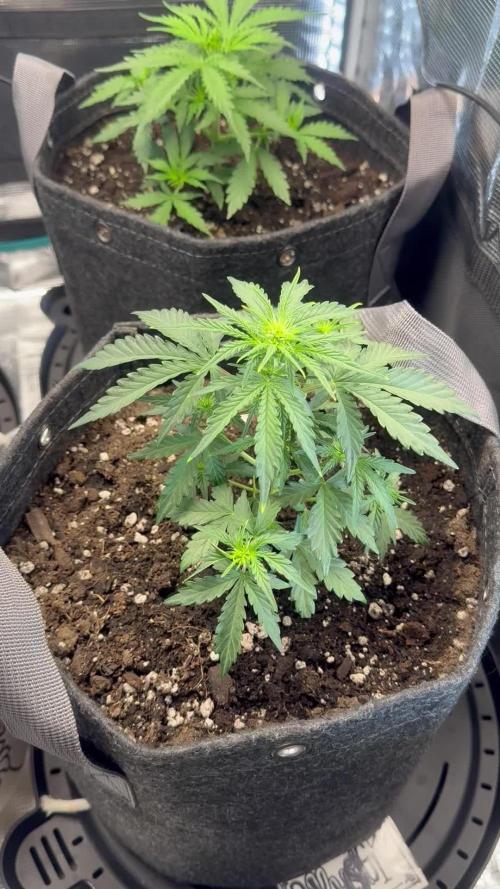
This week the girls all got hair cuts. Pineapple actually had to get 2 cause she’s such a grower. Put a little ogk in a pot for the wife so she can have a window plant if you see that in the video. Little burn on ogk but they’re all loving life right now.

Likes
41
Share


@Cannaguy
Follow
The plants have been drinking up water rapidly with the increased heat, I have stopped using individual gallons and now started using a hose in order to speed up the process. They seem to take about 2-3 gallons each while the larger plant I have been trying to water until I see small amounts trickling out near the bottom. Will give them a second round of organic granular feeding soon! I also started to notice this week that there are a good amount of small black flies above soil. I will have to take care of this sooner than later


Likes
34
Share


@SalocinSpecial
Follow
D40 (31/12/2020): Second week of flower and everything is good! They are still stretching a lot. I'm not continuing LST with ties but just by tucking and banding stems and leaves. I will continue to slowly remove leaves and small bud site under canopy that will never receive enough light. The higher buds receive around 520 and 600 PPFD (40 000 to 46 000 lux) for a DLI (for 20 hours of continuous light) around 37,44 and 43,2 moles of photons which is perfect. This Glue Gelato phenotype is weird as it grows weird leaf structure since a couple of weeks. Probably since I discovers a nutrient lock in the soil with too much nutrients. Banana Kush is super healthy and look amazing! 😎
- temp: 25C
- no water
- RH: 56%
D41 (01/01/2021): They are stretching like crazy so it's a sign of good health! I fed with nutrients 3/4 of the recommended dose for transition week. I gave more then a gallon approx. 4L per plant. I did remove leaves today but no bending. I want to let them grow in height.
- temp: 25 C
- water: PH6.3, 820 PPM approx. 4L each plant
- run off: PH6.7, 1150PPM for BK ; PH6.8, 1120 PPM for GG
- RH: 54%
D42 (02/01/2021): Nothing special today. I try to turn the plant 180 degree each day to make sure fan is blowing air on every side of the pot and plant and to make sure light is distributed evenly. I also swap the two plants every 2-3 days to make sure again that the plants receive light equally. I continue removing leaves and small buds site under canopy.
- temp: 25 C
- no water
- RH: 54%
D43 (03/01/2021): The lights are now at 16 inch from the top buds and just 12h later I saw a big difference. They are now ready to receive intense light 😎. They receive approx. 650 to 780 PPFD and even 900 PPFD for the top buds (50 000 to 60 000 lux, and even 70 000 lux). I will check closely in the next days to make sure the buds and leaves are not burning. I fed only Max Minerals full recommended dose for transition week. I gave more then a gallon approx. 4L per plant. I placed a round stake in each pot for when the buds will be heavy.
- temp: 25 C
- water: PH6.3, 460 PPM approx. 4L each plant
- run off: PH6.8, 1550PPM for BK ; PH6.9, 1480 PPM for GG
- RH: 55%
D44 (04/01/2021): Nothing new today.
*** UPDATE ON BUGS: I did not see any more larvae since last week. It's the 3rd week since adding nematodes and after adding 2 pouch per plant, doing 2 insecticidal soap treatment and removing 1 inch of soil, I feel like I did control the infestation. I still see some mature fungus gnats on sticky traps but nothing alarming. Increasing air flow and reducing RH also helped a lot for those bugs.
- temp: 25 C
- no water
- RH: 55%
D45 (05/01/2021): Nothing special today. I let them grow without new LST. I did not removed leaves since a couple of days. They are growing in height and that's what I want. I might do a defoliation in beginning of week 7 (or week 3 of flowering). I want to reduce RH in the tent under 50%. When the lamps are off, I have a lot of difficulties to maintain a proper RH for flowering stage. During night, it is around 57% with the 4 inch AC Infinity inline fan blowing full speed. RH in the room where the tent is is around 35%-40%. With 5 plants in the tent (2 cannabis, 2 tomatoes and 1 mint) it will be more difficult to control RH in the next week with flower and fruit growing bigger. I ordered a small dehumidifier on Amazon to help me reduce the RH.
- temp: 25 C
- no water
- RH: 53%
D46 (06/01/2021): I fed today half of the recommended dose for transition week. The PPM of the run off from last fed was high so I want to cut a bit on nutrients. The run off of both plant is down under 900PPM which is what I wanted 👍
-temp: 25 C
- water: PH6.3, 480 PPM, approx. 3.5L each plant
- run off: PH6.9, 860PPM for BK ; PH6.9, 766PPM for GG
-RH: 52%


Processing
Likes
13
Share


@GrowGuy97
Follow
Got everything moved around & the new carbon filter, fans & lights so hopefully I got better coverage with less power👍🏼 Topped 1 of the Gelato OGs today was getting way taller than the rest we will see how she bounces back! Everything else seems to be going great!
Day 22 topped & trimmed them up a bit
Day 23 started LST on a few
Day 24 started mainline on one of the GZ
Day 25 trimmed them a little more today


Likes
15
Share


Likes
7
Share


@Mr_nugs_lover_David
Follow
The first in breaking the shield was the pheno number 2 on this pair of jack orange! Let's see how they keep developing!!
Out of the 2 seeds that I started only one was good and I decided to discard the #1 because of a deformation or a genetic fail. So I just kept #2, hope you like this strain!

Processing
Likes
17
Share


@Majormolasses
Follow
I can’t believe it’s week 7 already these weeks have been flying by these lady’s have been really easy to grow so far not much slowly them down I have been putting them threw the ringer with trying new stuff and they both are doing great I’m thinkibthe bigger lady’s actually a male it’s funny how the bigger stronger faster ones are usually males and the lady’s grow low and slow hmmmmm.




Likes
20
Share


@xbabybitchx
Follow
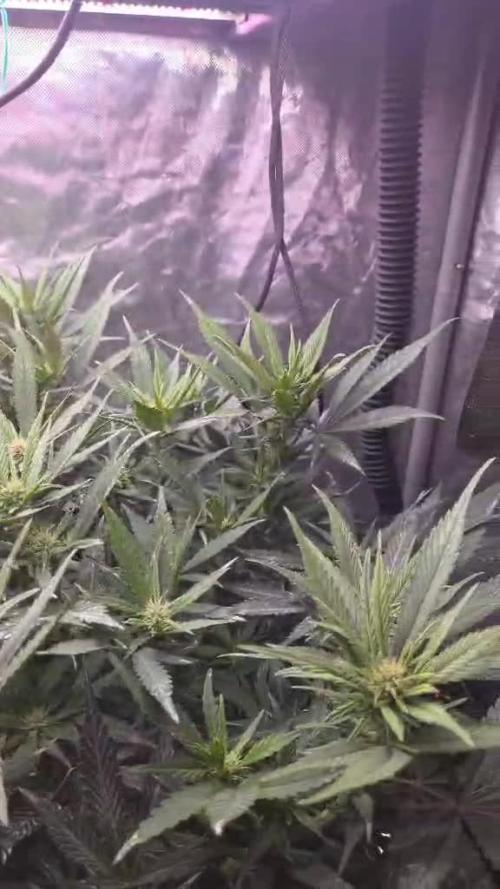
Happy Chrimbus. TW is looking better this week, lots of growth in the nodes, the stalk looks THICK. BUT she also is a weird plant because I know nothing about it. Was found in my bud from the test plant. Just switched over to my large tent so the two can be alone to grow. I topped her a few days ago and looks to recovering well. :)
2019.12.29 well well well this beautiful bitch is pre flowering and showing ITS A GIRL! im so so so happy. YAY I plant to keep her in veg maybe 2/3 more weeks- she isnt very tall.