


Likes
Comments
Share


@Unkraut
Follow
very nice strain with 2 great ancestors, solid taste and scent, got some great buds with great taste and awesome looking plants with incredible colors


Likes
10
Share

@Klyaksa
Follow
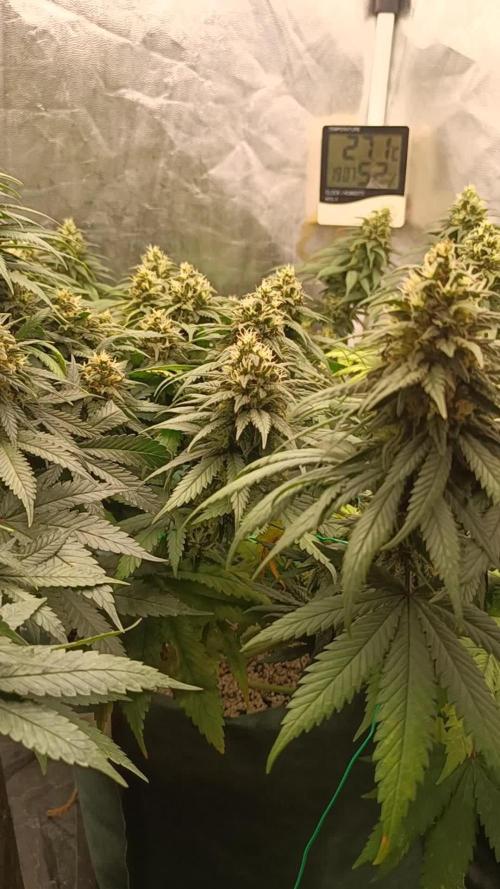
72 день от каски и 37 день 12/12
Растут,наливаются,пахнут
NLB очень много стали есть,последний полив дал 1200ppm,выход был 1080,до этого с предыдущего полива был выход 1490ppm,а им все мало,подъедают веерные листья,может перебор по светом все таки
А так цветут и пахнут:)
Mazar в полном порядке,нормально себя чувствует,красивая:)
3 с конца фото - Mazar
Последние 2 - NLB
На видео 75 день от каски и 40 день 12/12
Выглядеть стали неочень,особенно NLB который стоял отдельно,дренаж нормальный 6-6.3ph 1350ppm.
Последний полив был 1200ппм только вода+гибрид.
Ну в любом случае соцветия увеличиваются и очень приятно пахнут:)
Mazar красивый,ест умеренно,проблем нет)


Likes
93
Share


@Roberts
Follow
Auto Opium is doing her thing. She made one more little push of stretching. Now tge bulking should begin. She had a solution change about 5 days ago. Been selectively defoliating around her center when I get time. Everything is going well. Thank you Divine Seeds, and Medic Grow. 🤜🏻🤛🏻🌱❄️🌱
Thank you grow diaries community for the 👇likes👇, follows, comments, and subscriptions on my YouTube channel👇. ❄️🌱🍻
Happy Growing 🌱🌱🌱
https://youtube.com/channel/UCAhN7yRzWLpcaRHhMIQ7X4g
Likes
44
Share


@Weird_Jimmy
Follow
👉The last waiting game is just about at an end. It has mostly cloudy trichomes, with still a few clears. Some ambers are scattered about and are mostly on the sugar leaves. Super frosty, super intoxicating aroma or sweet citrus. The leaves have faded only slightly. I could harvest it today if I had time. I think it may be a couple more days. I am set up and ready to harvest when it feels right.
👉I have been giving it nutrient mixed at the high end of the EC range for the Ripen mix from the General Hydroponics Drain to waste feed schedule. I have given a couple of H20nly irrigations followed by a full strength solution fertigation. The EC spikes in a couple days and the pH drops. One H2Only event gets the run-off and pH back in the target zone. I will continue fertigations till harvest day. Any day now.😎
Likes
20
Share


@NONSENSE
Follow
Week2:
The plants looks very nice. x 3 are ROYAL Cookies
And the two babies are Afghan regular and Diesel fem.
The middle Cookies plant is bigger= 2 days older then other ones. You can see the difference.
From tomorrow I will start to train the plants. I will LST two small plants.
The bigger one will be topped also.
The genetic is very good. There are a lot of colas and they are located close.
I hope to have time to develop about 8 colas for each plant.
Less than three months are left until the end of the RQS cup.
So from January 1, I plan to start flowering.
The plants eat and drink good. i see small iron deficiency( the leaves are a little bit yellow.) i will Flush the plant with pure 6.0pH water and microelements only. Flushing should remove nutrient salt build-up

Likes
50
Share


@DogDoctorOfficial
Follow
Eternity Grow Cup - Week 9 Veg Update
We are stepping into Week 9 of vegetation, and things are getting exciting! The plants are thriving—compact, bushy, and growing beautifully. This week, we introduced a SCROG (Screen of Green) net, an essential tool for maximizing yield and optimizing plant structure. Let’s dive deep into the why and how of scrogging:
Why Install a SCROG Net Now?
Maximizes Light Exposure: The net allows even light distribution across all branches, ensuring every bud site gets the optimal amount of light.
Controls Plant Height: By guiding the branches through the net, we keep the canopy even and prevent excessive vertical growth.
Enhances Airflow & Reduces Mold Risks: Spreading the plant out increases air circulation, reducing humidity pockets and minimizing risks of mold and pests.
Increases Yield: More bud sites exposed to light mean higher-quality flowers and greater overall production.
For now, we’re still not using the under-canopy lights, though they will come into play soon. The ICL 300 is positioned strategically, and we will likely move them around as needed later. For now, the focus is on structuring the plants and ensuring they fill out the available space properly.
Optimizing Airflow - The Vortex Effect
Air circulation is crucial for plant health, and this week, we’ve optimized airflow by positioning the fans to create a vortex effect:
Fan Positioning: Each fan is placed at the tent corners, pointing in different directions, ensuring dynamic airflow instead of direct wind hitting the plants.
Benefits of a Vortex System:
Reduces hot spots and evenly distributes CO₂.
Strengthens stems by creating a natural resistance.
Prevents stagnant air, reducing mold and pest risks.
The extraction system is powered by an AeroFan, connected to the AeroFan Smart Remote FRC1, currently running at 60% speed. This setup efficiently manages humidity and temperature while maintaining optimal air exchange.
Current Environmental Conditions & Feeding
For now, we’re maintaining the same water schedule and nutrient regimen. The environmental conditions remain stable:
Temperature: Holding steady at ideal growth levels.
Relative Humidity: Balanced to encourage healthy transpiration.
PPFD (Photosynthetic Photon Flux Density): Kept at optimal levels to support vigorous vegetative growth.
CO₂ Levels: Elevated but within safe limits, promoting faster growth.
The plants are filling the space beautifully, but we know that the flip to flower is approaching soon! The next phase will depend on how fast they continue to spread, and adjustments will be made accordingly.
Closing Thoughts & What’s Next?
This week was all about structural optimization—ensuring proper airflow, training the plants with the SCROG net, and keeping everything in balance before the transition to flower. The upcoming weeks will be crucial, as we fine-tune the environment, possibly introduce the under-canopy lighting, and prepare for the flowering stage.
A huge thank you to our sponsors Aptus Holland, TrolMaster, CannaKan, Grove Bags, Ziggi Papers, and of course, Zamnesia, Plagron, and Grow Diaries for making the Eternity Cup possible. And to our incredible community—followers, supporters, and even the critics—we appreciate every single one of you!
Stay tuned for next week’s update, and don’t forget to follow along on YouTube and Instagram for exclusive content and behind-the-scenes looks! See you soon, and happy growing!
Let’s keep pushing forward, and best of luck to all the competitors—we’re all growing something incredible together. Until next time!
Genetics - Runtz https://www.zamnesia.com/6000-zamnesia-seeds-runtz-feminized.html
Nutrients - Plagron https://plagron.com/en/hobby
- Aptus Holland https://aptus-holland.com/
Controls - Trol Master https://www.trolmaster.eu/
LED - https://www.futureofgrow.com/en
LED - https://www.thinkgrowled.com
Soil - https://www.promixgardening.com/en
Germination - Cannakan https://cannakan.com/?srsltid=AfmBOopXr-inLXajXu3QFgKXCXXos4F1oEvScjMKIB5MR5dk8-GJ-F49
DOGDOCTOR 15% off
Smoking Papers - https://ziggioriginal.com/
Terpene saver - https://grovebags.com/
As always thank you all for stopping by, for the love and for it all , this journey of mine wold just not be the same without you guys, the love and support is very much appreciloved and i fell honored with you all in my life
With true love comes happiness Always believe in your self and always do things expecting nothing and with an open heart , be a giver and the universe will give back to you in ways you could not even imagine so
As always, this is shared for educational purposes, aiming to spread understanding and appreciation for this plant. The journey with nature is one of discovery, creativity, and respect. Let’s celebrate it responsibly and continue to learn and grow together!
Growers Love To you All 💚
#EternityGrowCup #RuntzHunt #GrowersLove #CannabisCommunity #AptusHolland #ProMixSoil #TrolMaster #Zamnesia #Plagron #ZiggiPapers #Grovebags


Likes
43
Share


@Jack_Greenstalk
Follow
Now that V started, both ladies have began flush. Nemo actually started early last week since (20 ml heavy 16 finish and 1 gallon of RO watrr per feed). Nemo on left, a little less directly under the light is more developed, both bud structurely and trichome color (clear transitioning to cloudy or milky trichs more each day). V on the right side is much less finished, being a more haze influenced pheno. it seem lankier and slower to finish, however severe light stress from being grown up to close to light has bleached maybe 6-10 tops of the 15 tops on v. nemo will be done sometime later this week or early next week. Going to harvest the tops entire plant on nemo, then rewaeave V back thru the scrog to allow greater distance to light and better airflow for it to fill in a little more and finish up over next 2 weeks or so. will be closely monitoring bud sites in top colas to harvest when trichomes are almost fully milky white, just before amber.

Likes
80
Share


@Fatnastyz
Follow
3-17
Photo bombs today 😂😂
Gave 4ml green sensation, 3ml cal/mag and 1 ml slf-100.
Run off ppm 1300 ph 7.0
Hope can get the ph down a bit.
3-21
1.5 grams game time, 3ml green sensation, 3ml cal/mag, 1ml Slf-100 ph 6.0 ppm 350
Runoff 1432 ph 6.9
Yo, dropped 1 💪🤘
See ya next week
Likes
11
Share


@hannabis420
Follow
fast growing auto, overloaded on nutes with this one but she still produced beautiful buds

Likes
27
Share


@Theia
Follow
This girl has been the surprise for me this run. She was more of a space filler than a chosen strain but my god has she impressed me. The structure of the plant is immense. So strong with super thick branches. Buds are very fat and very dense with a great frosting already.
I'm looking forward to see how this one finishes..
I've run out of big fruits which is a flowering booster I use and have come to rely on for very dense buds..
I hope to get some more this week..🤞🏼
Uvb runs twice a day for an hour each session.
X-Bars are at 55% and are giving an average of 1005umols.
Feeds are at 1.8ec still. Last week for more pk then we will be just on bloom.
Thanks for passing.
Grow well 🌿💚🌿🙏🏼🌿

Likes
16
Share


@GreeneScene
Follow
Let’s see , humidity is an issue . It’s higher than I’d like it to be . I added drip pans & two different miniature forms of dehumidifiers one electronic and the other passive .
I need recommendations on affordable dehumidifiers before I run into mold issues .
After breaking the apical dominance there was one or two issues but it gave me all the more admiration for the genetics to take a beating and still remain unbothered & WHOLE .
A main top was bound too tightly & broke in half trying to pull itself back up . It remained broken and unnoticed for atleast 3 days before I saw the damage and taped it .
She is now almost fully scarred over & healed .
Vertical growth was decent this week I wouldn’t describe it as fast or explosive.
Still watering to activate the dry amendments I can tell they haven’t began taking it up quite yet.
Holy shit do they stink when not premixed into the soil before planting !
Just monitoring & trying to get as much dense continuous resin packed bud stacked up in there .


Likes
19
Share


@cpt420
Follow
A few more days left before I start to harvest my plants. For now I'm going to start with the two on the left and work my way around to the plant that's still in reveg, shooting heads like crazy for some reason. Smells amazing and the stickyness is out of this world. Much love ❤️🍀

Likes
12
Share


@MicroHidroGrow
Follow
Esta es la última semana de crecimiento. Espero llegar a unos 30cm de altura para esta semana. He hecho varios cortes de bajos, defoliacion y super cropping. Se ven saludables y sigo esperando el estiramiento de la pequeña que quedó atrás. Iré actualizando.
Día 25. Hoy hice una corte de hojas grande. Esta noche voy a aplicar EMRO foliar. Algunas plantas se van muy arriba. Pero dentro de todo vienen parejas. En unos días paso a floración. Probablemente ya la próxima semana sea naranja.
Día 28. Último día de crecimiento. Esta noche cambio el depósito. Voy a tener que comprar otro, o ir rellenando a los 3 días del cambio, dado que estan tomando mucha solución. Algunas se estiraron más de lo esperado y la pequeña no alcanzó el tamaño deseado, pero no importa. Voy a ir aplicando LST para mantener una altura pareja. Las raíces crecieron muchísimo, pero por ahora es manejable el tema. Ahora llega la hora de la verdad.


