


Likes
Comments
Share


@skaterblasted
Follow
Days 74 - 80 (from seed)
4/15/24 - 4/21/24
Lamp distance: 13" @ 50% power (estimate PAR?)
VPD: not checking - humidity set to 40%
Feed schedule: feed schedule once a week, 1/4 gallon water per plant daily - FPE added at 2oz per gallon every third day
IPM: visual inspection only
Notes:
Final push, fading occurring on all plants now and some amber starting to show during trichome inspection. Cookies & Berries taking the most time of the group to finish while Mango Sky crossed the finish line first. All four plants will be chopped next week on the morning after the full moon, April 24th - according to the moon gardening calendar it is "best time to pick medicinal herbs and plants, while flowers if cut during this time have an intense scent and endure longer." They're close to finished in my book so it can't hurt to follow the lunar suggestion.


Likes
4
Share


Likes
12
Share

@GrowX-FarmZ
Follow
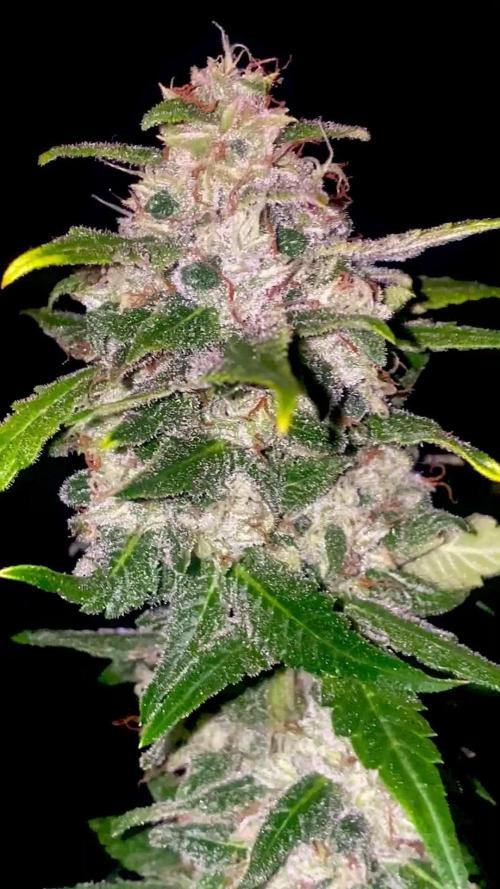
Nun wurde endlich geerntet, die Damen liegen aktuell im trockennetz bei einer RLF von 55% und 22 Grad
Jetzt erstmal trocknen lassen, weiteres folgt 😇

Likes
14
Share


@Terpyboyz
Follow
So this grow came to a finshed but I had a. Few issues that’s held me up from finishing up the diary, but in due time I will reupload it all in order soon. But over all I will also update with a final weigh in of each strain produced so stay tuned 🤙🏻🔥


Likes
4
Share


@KaavinKushing
Follow
Smell has increased in a good way. 2 of the 4 plants main colas are turning purple, very cool. One plant has yellowing of the leaves even though I stuck to fox farms recommend fertilizing schedule.
There is. 4” height difference between the 2 taller and shorter plants. This week I put some books under the shorter ladies to give an even canopy height.

Processing
Likes
18
Share


@Manic
Follow
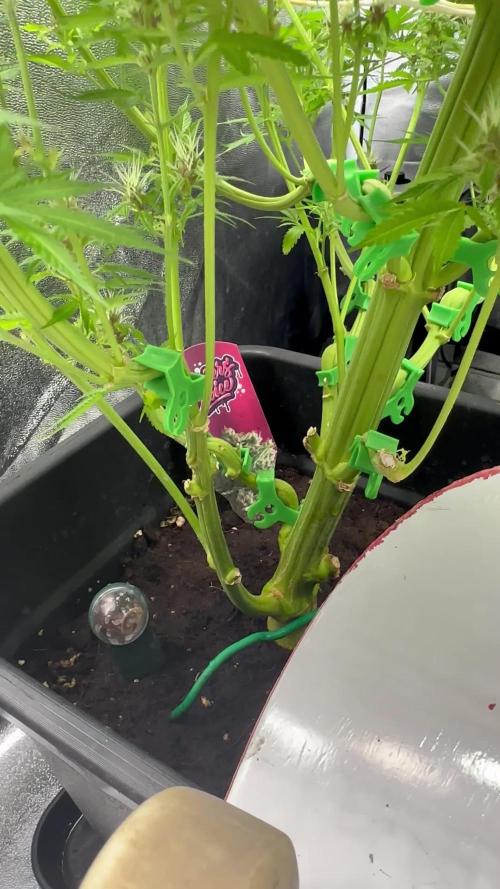
Gonna start giving them cal mag in there feeding every other feeding. Blueberry is continuing to impress with her growth. Alaskan purple still a little behind but just as healthy as blueberry. Days 15-21 should be interesting and hopefully start to really implode in growth. Haven't had any problems in days from either of the ladies they seem happy and flourishing at this point.

Likes
7
Share


Processing
Likes
23
Share


@KenSpliffeyJr
Follow
So all my stuff arrived this week. Will be using fox farm ocean floor soil for this grow. I have blue dream going for this grow. My seeds are germinating and I don’t have pics of them from the paper towel and from when I first put them beneath to soil in the dixi cups. The soil I used was miracle grow bloom potting soil for my initial planting (now I know was probably not the best choice) but I actually noticed some great results to start with the grow. I’ll keep updating as I go and hope to get some great feed back and comments while I go along. Happy growing everyone.

Processing
Likes
7
Share


@EhlersChick
Follow
Pink Kush Day 21 - 2020.01.21: Hello friends, I'm sorry for being delinquent in commenting on this grow; I got hit by a car last autumn and I'm still struggling a bit with depression and anxiety (hence the weed!). Let me assure you that the Shishkaberry from last year was very helpful 😌
So to begin with I have to thank Barney's Farm for their great genetics. These seeds can be found as part of their Cali Collection: https://www.barneysfarm.com/pink-kush-455 or if you're here in Canada: https://niagaraseedbank.com/product/pink-kush/
Ok, both young plants are doing well at the end of the third week (calculated from when the taproots were put into the Jiffys).
This week I started the regular fertigation schedule for the vegetative period. I'm getting very precise with the measuring of the nutrients, I'm using some industrial syringes for accuracy like Dr. Coco recommends. The TDS is high - I'm working on it.
Next week I think they'll be ready to top to begin the HST.
Alright gang, I'll close for now, with love. 😊


Likes
12
Share


@StoneyMelony
Follow
Overview of my grow:
Tent: Secret Jardin DS120 4 x 4 (120 cm by 120 cm)
Lights: 2 x 120 Watt CTlite c4 clusterled
Climat: Trotec Dehumidifyer 240 watt- 10L/24h
Filter: Prima Klima carbon filter PK2600
fan: 2 x Secret Jardin 20watt osc. fan
Pots: Gronest 4 x 11 liter airpots
Water : automated water system
PH: bluelab
Nutrients: Plagron cocos A + B
Plagron PK 13/14
ATA cal/mag
Epsom salt
no rights to music in the videos
Week 9. I did read it, but somehow i didn't expect her to be this fast, so instead of boosting her a final time, i decided to start to flush allready. Today is day 63 i think this is insain how fast this big sativa looking buds where developed. I'm going to harvest her next week ,She is smelling freaking delicious, the diesel smell is still there but now with some sweet smell and also the lemon as well. I hope she is as tasty as all the smells coming from this wunderfull plant. The buds are a bid foxtailing, like a sativa she is building flower on flower. Thanks for checking 😋


Likes
32
Share


@birdmountain
Follow
It was another two beautiful, sunny weeks that have now come to an end. To be on the safe side, I examined Durban Poison, Shaman and Frisian Dew more closely and found that all the ladies, with the exception of Frisia n Dew, which are in the garden, had initially developed mould in the flowers. In addition, some green caterpillars fell out of the Durban Poison when the plant was shaken. Durban Poison had also completely stopped flowering, which I found unusual. I therefore decided to harvest all the ladies, except for Frisian Dew in the garden. This Frisian Dew is only now entering its main bloom and is not yet so susceptible.
Durban Poison has developed very thick and heavy colas, followed by Shaman and Frisian Dew. See the picture with the scale.
I was able to weigh a part of the harvest after the raw trimming, then at the weekend the batteries of the digital scale were empty. It will take a few more days until everything is dried and stored in jars for maturing but one thing is for sure, it's quite a lot. The plants are still standing with remaining flowers to see how they will handle the coming bad weather.

Likes
8
Share


@Mikeyc420
Follow
Start of week 4 flowering buds are starting to fill out and feeling alot more compact
Alot more smelly now appearing also a rise in thc
Light 11cm from the top with humidity staying around 45-50%
Feeding around 1.5-2L every 1-2 days when soil is dry and pot is light to lift

Likes
162
Share


@nonick123
Follow
Día 86 (01/01/2024)
Riego solo con H2O con pH ajustado 6,21
Día 87 (02/01/2024)
Avanzando hacia la cosecha. Observo algunos tricomas ámbar 😁
Día 88 (03/01/2024)
Al inspeccionar y tocar los cogollos, vuelven a salir los aromas a skunk y naranjas. Delicioso! 😍
Día 89 (04/01/2024)
El aroma se está volviendo complejo en esta recta final, como naranjas, skunk y con toques picantes de fondo. Impresionante 😍
Día 90 (05/01/2024)
Mañana la cosecha! Hoy le tocaría riego, pero como mañana es la cosecha, la dejo con 24 horas de estrés hídrico.
Día 91 (06/01/2024)
Al final cosecharé un día más tarde. Los tricomas están prácticamente perfectos, con la mayoría nublados y alguno ámbar
Día 92 (07/01/2024)
Día de la cosecha! 😍💥💨😁
Peso húmedo 150
Increíble rendimiento para 92 días desde semilla, y con el estrés hídrico de los dos últimos días
Ahora comenzamos el proceso de secado (7-10 días) donde pondré la semana de la cosecha, y posterior curado (+30 días), tras lo que tendremos el informe de humo
Gracias a todos los que estais al otro lado de este diario!
Likes
4
Share


@NoviciOnWeed
Follow
Semana 8, cada vez falta menos jajaja
Todo bastante bien, los tricomas invadieron por todos lados, parece brillantina jaja
Los cocos ya están bastante formados y comienzan a engordar.
También fue constante la defoliación ( también saque los brotecitos chicos que no tomaran volumen y solo sacarían recursos valiosos) y el acomodo de los cables del lst.
Cada día mas bella, puedo quedarme horas viéndola y hablando con ella.

Likes
27
Share

@TrickzGrowz
Follow
Servus Moin!
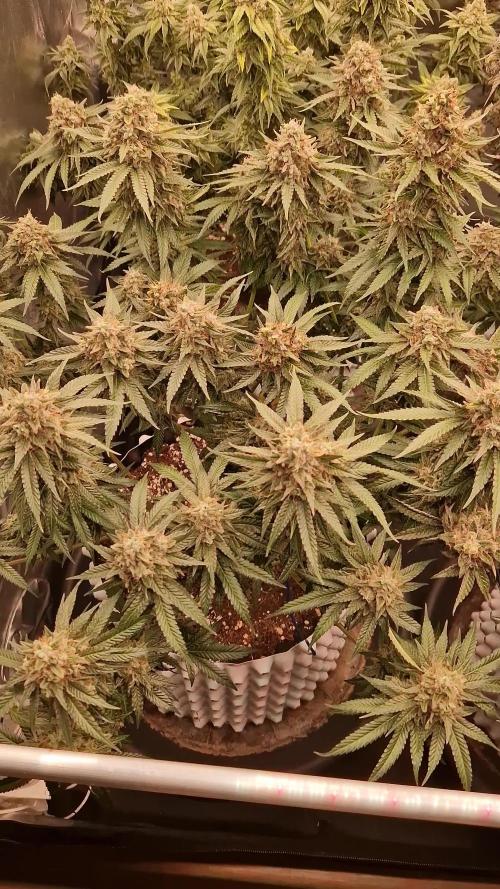
Die letzte Woche läuft an! In dieser Zeit gieße ich nur noch mit Wasser. Die Epic Buzz hat sich prächtig entwickelt und richtig feste Buds gemacht. Bin super zufrieden.

Likes
9
Share


@Chuckwaggon420
Follow
This week with this girl has been awesome she has really started to take off now that her soil is rite! She grew over 5" in the last week and that's what I chose to take for my clones. 2 to be exact and hopefully will have better results with this go around.
Took me 2 clones off this mom plant so now she has been topped twice. Hopefully with the lessons from personalsmoke will end up with a couple clones of puffinz. They look sad at the moment but I havnt seen what normaly happens to clones 24 hours later.
I give momma about 330 ml of de-clorinated 6.8 ph water every 2 or 3 days when the hydrometer goes around 3. She is in living soil so for now will just sit how we are and just straight water to make her happy!
Thanks everyone for the love
All sent back 10

Likes
179
Share


@StarLorr
Follow
Welcome to my Øpium diary.
In this diary:
Seeds: sponsored by Ðivine Șeeds
Media: Promix HP
Nutrients: Advanced Nutrients, Diablo Nutrients, Gaia Green Power Bloom.
Light and Weather: Şun☀️and Mother Earth.🌎
___________________________
Feeding:
Tue 06Aug: 4L nutrients pH'd 6.5 and 4L water not pH'd
Wed 07Aug: 8L water not pH'd
Thu 08Aug: top dressed Gaia Green Power Bloom 6 tbsp
Sat 10Aug: 2L water not pH'd
Sun 11Aug:6L water not pH'd
Mon 12Aug: 8L water not pH'd
___________________________
*please note that most water only feedings are 2L at the time throughout the day in bottom saucer*
___________________________
Øpi survived the wrath of Debby(Tropical Storm)she stood her ground(in her pot)😂Monday I added a piece of wood to the anti-tipping device to hold up the lower branches as they pull the plant sideways and will only get worse as the buds gets bigger and now Øpi look more straight than leaning sideways.😃
______________________________
Øpi and other sisters got the defoliation treatment, mostly fan leaves.
_______________________________
Top dressed her up with Gaia Green Power Bloom about half a 3/4cup as i can't keep up feeding her liquid nutrients in such industrial amounts😅but the results are already showing and she seems to like it, i will continue liquid nutrients feeding once or twice a week.
______________________________
Thanks for stopping by, likes and comments are appreciated!👊🏻😎
Keep on growin!
Keep on tokin!!!
😙💨💨💨💨💨


