The Grow Awards 2026 🏆
Likes
27
Share
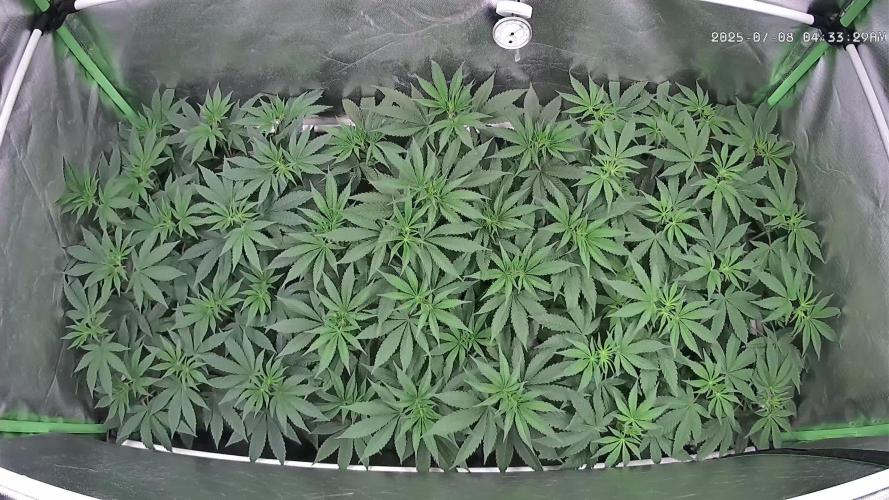
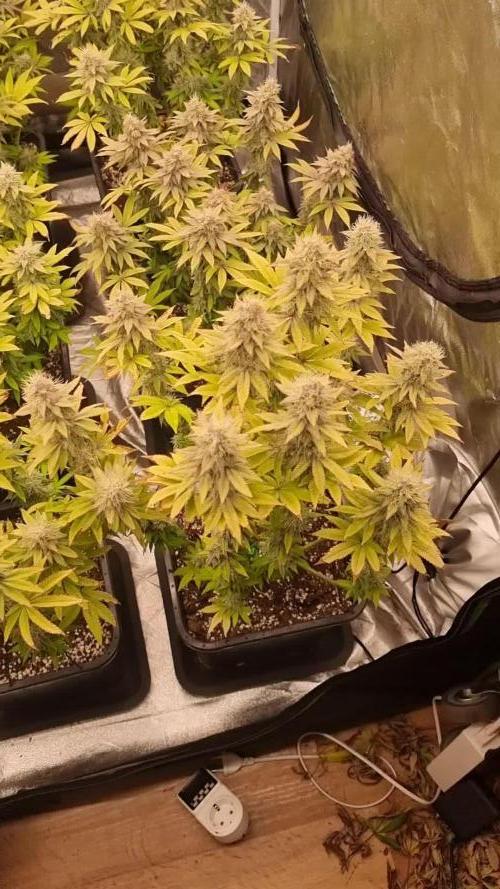
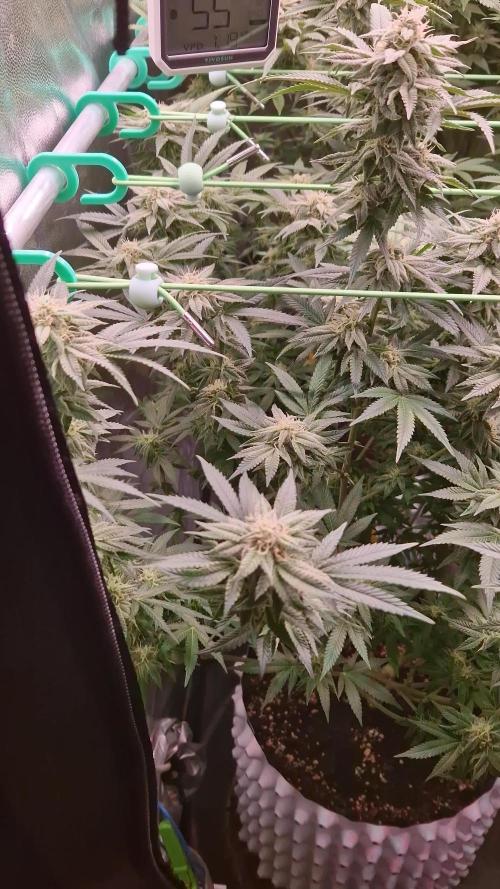
Day 28: Last night I had a real scare, I watered and by the end of the day she was drooping and looking very sick, there was no runoff at water so I feel I overwatered the little thing, thankfully this morning she has bounced back with great strength and this morning is looking healthier than ever! I'm noticing a few holes in leaves, a few spots on the leaves and a few very fine silk trails on the leaves, so I'm thinking she's got thrips 😣 next to impossible to get any pictures of the damage I'm talking about because I think I've caught the infection incredibly early, so today I'm picking up some Neem oil and I'll spray her completely at lights out , hopefully it is thrips and not spider mites because thrips this late in the grow wouldn't be too bad! If it's spidermites I'll be in a bit more trouble, thankfully flower has only JUST begun so I'm not so worried about a neem oil application at this time I'm going to let the soil dry out completely before watering again, I was dubious whether it was needed yesterday but the top inch was dry, I think I'll just wait until it's a couple of inches moving forwards Day 29: last night I drenched the leaves in diluted neem oil, I'm not seeing a lot of pest activity but there is some level, so since we're just starting to flower I decided now was the time just to blast anything that might be floating around, In ten days I'll do it again, maybe sooner if the buds are really getting going in that time Because of my overwatering scare the other day, I'm giving her another 24 hours to dry out deep into the pot, there's still a level of moisture in there and as of this morning the plant looks really healthy, really happy with how shes looking today, got 5 exposed tops which I believe will become the colas, 2 are the apex and on the same level and 3 lower ones are all on the same level. There are other potential Colas but they're hidden under the plant, I'll probable defoliate that side once the times right, unless they can break through in the next couple of days, which would be nice Day 29 update: (7 hours after lights on) opened the cabinet to find temps of 29 degrees c wasn't running extraction, soil is dry, but most importantly I noticed the top leaves praying for rain, I gave the soil a small amount (300ml) of distilled water and tap water , just to wet the soil enough to give another reason for the roots to spread through the pot, tomorrow I'll give another small water with feed and Humic acid just to top up her nutes and give her one last big hit of growth before she starts flowering properly, if we can trigger another growth spurt whilst she's still inbetween veg and flower, this is looking like a good first harvest! Day 29 Update (6 hours until lights off) following the water the plant has done her best to expose every inch of her leaves in light, she's bushier than ever and presumably getting ready to have a serious growth spurt, I watered around the far edge of the pot and let this pull through the soil, no run off because it was so little but, possibly a small feed of 1:1:1 tomorrow to top up nitrogen for any growth spurts planned ;) Day 29 Update (lights out) Today was an exceptional day for this girl, over the course of the day there's been some real developments! This evening she was foliar fed a mixture of 1:1:1 nutes and fulvic acid, a single drop in around 400ml of water, she should bounce back with an extra growth spurt with the extra nitrogen, on day 31 I will most likely be watering again with the same mixture to help push one last growth spurt before a flip to flower occurs and we move onto bloom nutes for the rest of the grow In 24 hours the fulvic acid should kick in and give one last growth spurt hopefully adding another node or two to the plant at the vest last moment, next photos i'm hoping will be a significant growth period if todays behaviour was anything to go by Day 31: Yesterday I squeezed in one last round of LST, the main stem cola was rising quite high above the rest of the canopy, I pulled that down out of the way and by the end of the day It had sorted itself out, I also spread out some of the other new cola sites to expose deeper into the plant to more light Yesterday I also watered with NPK 1:1:1 and Humic acid solution, as well as foliar fed with Bloom nutes and Humic acid again, this should help the plant through it's last growth spurt whilst allowing it to start creating flowers, today the soil will be left without water, possibly the next day too but I think it is ready for flowering to begin so I'm looking forwards to watering her with Bloom Nutes to get that process started well! Now that she's turning to flower i'm noticing the stems of each top are quite thin, I have a small fan on them constantly keeping them moving but I'm expecting to have to SCROG to provide all the support she needs, even if the stems thicken up in flower like I'm expecting, this will support the big buds I'm hoping for! Lot's a vertical growth starting the insides of the plant are starting to open up and there's very little leaf growth below the main canopy Day 31 - Whilst I watered yesterday with Nutes and Humic Acid, I'm spotting some very early signs of some flowering deficiencies, this isn't really a surprise as there has been hardly any nutrients added to the soil over the whole grow, so I've sprayed with the nutrient solution listed a move, the top of the soil was getting dry but not ready for a full water yet, just wet the topsoil through to help her transition to a higher quality nutrient, should start seeing some fairly decent growth from here on out! Day 32 - Today the soil was getting pretty dry, I diluted down my foliar feed mix a little and watered around 400ml of water with Humic, Fulvic, Bio Bloom and a few drops of 1:1:1, may have been a little too early but she's slightly showing some signs of deficiencies, foliar feeding has helped a little to keep these back but today I gave her the first feeding of specific bloom nutrients, should see her return to a healthy colour soon! She's starting to get quite tall as well, I think next few days we'll have some serious growth ongoing (as has become tradition) You can see from the images how her colour has gotten a bit lighter over the past few days, Foliar feeding has definitely slowed this and hopefully prepared her for a bigger dose of Nutrients, in 48 hours I'll be ready to water again this time with a heavier balance of nutes to really get things started for a healthy harvest Today or tomorrow she needs respraying with insecticides just to make sure nothing survived the early infestations and do ensure a pest free grow until the very end! Day 32 update: Today the flowers on what I expect will be the main 2 Colas have started forming, There's around 7 potential colas but 2 will be substantial if they're left long enough, hopefully tonight the nutrients kick in, but I'm considering another decent hit of nitrogen and bloom fert together, then water till flush, I think that will be 2-3 days off though, day 33: today she's looking all round healthier, the colours were good yesterday but today she's a much healthier shade of green for sure :D giving a decent feeding regime of flower nutes seems to have balanced her out nicely, I'm gonna leave watering today and let her dry out to give the roots another big push to grow, the other day I was digging down into the soil on the opposite side of the pot to the plant and found roots there, I'm really excited to see this girls root ball! Flowering is well on the way, HOPING for a Christmas harvest but I think it's going to be more new year when she's fully ready to be chopped, can't wait! I have pulled off 2 leaves today, they were starting to turn brown, I think the plant has cannibalised them, not because of a nutrient issue, because of a light issue, these leaves were completely shaded by the whole plant
Likes
5
Share
@Radagast_
Follow
02.11.'24 After 5 days of drying, this little girl who was a little bigger than a meter gave 950 grams and a little bit of popcorn...this picking was 870 and a little bit of popcorn, and 4-5 weeks ago during a storm, one branch broke, which yielded about 100, but let's say 80 for sure, a total of 950 grams of beautiful, huge, potent buds
Likes
15
Share
It is a fantastic plant, very strong in its growth, easy to cultivate, root system is not comparable to the others I have here...đŸ’Ș It has an incredible fullness predominating over the others 😏 The productivity is really great being the heaviest I have harvested 😎 Now it's waiting to try it out 👌 Thanks to everyone who enjoyed this girl... And good vibes and trips to all!🙏🙌 👊
Likes
22
Share
Well unfortunately Misty was chopped ahead of schedule because on Monday morning I found the dread BUD ROT (Botrytis) infecting one of the side colas. I discarded that cola and am drying the rest.
Likes
34
Share
Welcome to my Kosher Cake Diary. Be sure to drop a like so I can visit your diaries. Wk 4 VD23 25/5 Doing really well. Loving life and she a very nice plant to grow. Takes to LST and any light training like a champ. Very nice lady to have in anyone's garden. A beginners delight. Looks like she's coming into preflower gonna be a small harvest. 27/5/22 Made a new batch for feeds for this week. Brought it down to 810. Added Atlas, goddesslada, fire yields to jungle juice trio. Will give another Epson Salt feed this week also. Had to add PH + as it was only 4.3. Brought up to 6.2 keeping EC at 1.6/800ppm. 28/5/22 I know this is the 2nd round of Epsom Salt. But this one marks the start of a new weekly process I'll be adding. I usually do 2 feeds 2 water feeds mix em up over 8 days. So, for one of them water feeds will now be Epsom Salt. Every 2 weeks Calmag will be added with it instead, or just calmag by itself instead of Epsom. I've heard ppl swear by it and then some not. So, I'll make up my own mind. I'm overal happy with how I've done this grow. I've sat back much more and been very hands off. I think I'm going to scale it back down a lil.. too big for my needs. This 1 will be my shorty and we gonna c how dense we can get the buds with high co2 with negative pressure environment. Ye, I know the exhaust will take away from the co2 but the ambient co2 in the room is fairly high. I have 2 co2 exhale bags going and got my friends co2 meter wasn't home but my partner said he dropped by but couldn't leave it as he was passing through and took a measurement for me. 825 in the tent and 8-850 in the sealed grow room. 29/5/22 Yup, I was right days ago. She has more or less started flowering. 1st 1 to leave the veg stage. Thankfully I'm using jungle juice trio, so no need to flush grow nute, I'm going to even the nutrients ratios out and after a week I'll do 1 part grow to 3 parts bloom and fill micro. With a few Terra Power specials. 31/5/22 Coming to the last week in the 4th. She started flowering around D25 was showing signs she was coming into preflower have a video up to show what to look for to know when to flip to bloom nutrients. If I was running on GROW+BLOOM separate nutrients I'd of flushed with water for 2-3 days before you flip to bloom base nutrients but as these nutrients (jungle juice trio), it's just a case of changing the nutrients ratio. For the 1st wk of pre flower it's recommend you use half and half then 1rd grow to 3 parts bloom so that's 1ml grow to 3ml bloom (these are just ratios not the actual mls that will be used). I have started flushing my other grows that are showing signs of coming into pre flower. I'm still giving the grow&bloom base nutrient La Sirena as this is given through grow and bloom so no need to flush that out. Shes short. The way I want her. I had this 1 set at 30-35cm after wk 2 up until flower and I'll move her close to the light at 20cm as I have high co2. I know you need high PPFD to get the most out of it but the benefits are the same, (been able to withstand a higher temp/ higher RH/ higher PPFD) SO, hoping to get a short nice dense buds from top of canopy right down to the middle, everything below that has been stripped so dense buds throughout is the goal here not so much mass but quality and eye appeal. At 20cm the ppfd will be 11-1200. Not perfect I know but it'll give some sort of better bud quality. The rest are grown nice and big. All plants are 45-59cm just before coming into pre flower there's a few more that are still young so height is still yet to be seen. But the aim of the game is nice dense kosher cake bud. Thanks for reading gottagrowsometime
Likes
5
Share
@Wenz004
Follow
experiment explanation see week1 This week both different living soil experiments Tropicana No2 and No3 did not grow anymore...only the flowers got a bit bigger...especially No3
Likes
52
Share
Lacewings seemed to have mostly killed themselves by flying into hot light fixtures. I may have left the UV on which was smart of me :) Done very little to combat if anything but make a sea of carcasses, on the bright side its good nutrition for the soil. Made a concoction of ethanol 70%, equal parts water, and cayenne pepper with a couple of squirts of dish soap. Took around an hour of good scrubbing the entire canopy. Worked a lot more effectively and way cheaper. Scorched earth right now, but it seems to have wiped them out almost entirely very pleased. Attempted a "Fudge I Missed" for the topping. So just time to wait and see how it goes. Question? If I attached a plant to two separate pots but it was connected by rootzone, one has a pH of 7.5 ish the other has 4.5. Would the Intelligence of the plant able to dictate each pot separately to uptake the nutrients best suited to pH or would it still try to draw nitrogen from a pot with a pH where nitrogen struggles to uptake? Food for stoner thought experiments! Another was on my mind. What happens when a plant gets too much light? Well, it burns and curls up leaves. That's the heat radiation, let's remove excess heat, now what? I've always read it's just bad, or not good, but when I look for an explanation on a deeper level it's just bad and you shouldn't do it. So I did. How much can a cannabis plant absorb, 40 moles in a day, ok I'll give it 60 moles. 80 nothing bad ever happened. The answer, finally. Oh great........more questions........ Reactive oxygen species (ROS) are molecules capable of independent existence, containing at least one oxygen atom and one or more unpaired electrons. "Sunlight is the essential source of energy for most photosynthetic organisms, yet sunlight in excess of the organism’s photosynthetic capacity can generate reactive oxygen species (ROS) that lead to cellular damage. To avoid damage, plants respond to high light (HL) by activating photophysical pathways that safely convert excess energy to heat, which is known as nonphotochemical quenching (NPQ) (Rochaix, 2014). While NPQ allows for healthy growth, it also limits the overall photosynthetic efficiency under many conditions. If NPQ were optimized for biomass, yields would improve dramatically, potentially by up to 30% (Kromdijk et al., 2016; Zhu et al., 2010). However, critical information to guide optimization is still lacking, including the molecular origin of NPQ and the mechanism of regulation." What I found most interesting was research pointing out that pH is linked to this defense mechanism. The organism can better facilitate "quenching" when oversaturated with light in a low pH. Now I Know during photosynthesis plants naturally produce exudates (chemicals that are secreted through their roots). Do they have the ability to alter pH themselves using these excretions? Or is that done by the beneficial bacteria? If I can prevent reactive oxygen species from causing damage by "too much light". The extra water needed to keep this level of burn cooled though, I must learn to crawl before I can run. Reactive oxygen species (ROS) are key signaling molecules that enable cells to rapidly respond to different stimuli. In plants, ROS plays a crucial role in abiotic and biotic stress sensing, integration of different environmental signals, and activation of stress-response networks, thus contributing to the establishment of defense mechanisms and plant resilience. Recent advances in the study of ROS signaling in plants include the identification of ROS receptors and key regulatory hubs that connect ROS signaling with other important stress-response signal transduction pathways and hormones, as well as new roles for ROS in organelle-to-organelle and cell-to-cell signaling. Our understanding of how ROS are regulated in cells by balancing production, scavenging, and transport has also increased. In this Review, we discuss these promising developments and how they might be used to increase plant resilience to environmental stress. Temperature stress is one of the major abiotic stresses that adversely affect agricultural productivity worldwide. Temperatures beyond a plant's physiological optimum can trigger significant physiological and biochemical perturbations, reducing plant growth and tolerance to stress. Improving a plant's tolerance to these temperature fluctuations requires a deep understanding of its responses to environmental change. To adapt to temperature fluctuations, plants tailor their acclimatory signal transduction events, specifically, cellular redox state, that are governed by plant hormones, reactive oxygen species (ROS) regulatory systems, and other molecular components. The role of ROS in plants as important signaling molecules during stress acclimation has recently been established. Here, hormone-triggered ROS produced by NADPH oxidases, feedback regulation, and integrated signaling events during temperature stress activate stress-response pathways and induce acclimation or defense mechanisms. At the other extreme, excess ROS accumulation, following temperature-induced oxidative stress, can have negative consequences on plant growth and stress acclimation. The excessive ROS is regulated by the ROS scavenging system, which subsequently promotes plant tolerance. All these signaling events, including crosstalk between hormones and ROS, modify the plant's transcriptomic, metabolomic, and biochemical states and promote plant acclimation, tolerance, and survival. Here, we provide a comprehensive review of the ROS, hormones, and their joint role in shaping a plant's responses to high and low temperatures, and we conclude by outlining hormone/ROS-regulated plant-responsive strategies for developing stress-tolerant crops to combat temperature changes. Onward upward for now. Next! Adenosine triphosphate (ATP) is an energy-carrying molecule known as "the energy currency of life" or "the fuel of life," because it's the universal energy source for all living cells.1 Every living organism consists of cells that rely on ATP for their energy needs. ATP is made by converting the food we eat into energy. It's an essential building block for all life forms. Without ATP, cells wouldn't have the fuel or power to perform functions necessary to stay alive, and they would eventually die. All forms of life rely on ATP to do the things they must do to survive.2 ATP is made of a nitrogen base (adenine) and a sugar molecule (ribose), which create adenosine, plus three phosphate molecules. If adenosine only has one phosphate molecule, it’s called adenosine monophosphate (AMP). If it has two phosphates, it’s called adenosine diphosphate (ADP). Although adenosine is a fundamental part of ATP, when it comes to providing energy to a cell and fueling cellular processes, the phosphate molecules are what really matter. The most energy-loaded composition for adenosine is ATP, which has three phosphates.3 ATP was first discovered in the 1920s. In 1929, Karl Lohmann—a German chemist studying muscle contractions—isolated what we now call adenosine triphosphate in a laboratory. At the time, Lohmann called ATP by a different name. It wasn't until a decade later, in 1939, that Nobel Prize–-winner Fritz Lipmann established that ATP is the universal carrier of energy in all living cells and coined the term "energy-rich phosphate bonds."45 Lipmann focused on phosphate bonds as the key to ATP being the universal energy source for all living cells, because adenosine triphosphate releases energy when one of its three phosphate bonds breaks off to form ADP. ATP is a high-energy molecule with three phosphate bonds; ADP is low-energy with only two phosphate bonds. The Twos and Threes of ATP and ADP Adenosine triphosphate (ATP) becomes adenosine diphosphate (ADP) when one of its three phosphate molecules breaks free and releases energy (“tri” means “three,” while “di” means “two”). Conversely, ADP becomes ATP when a phosphate molecule is added. As part of an ongoing energy cycle, ADP is constantly recycled back into ATP.3 Much like a rechargeable battery with a fluctuating state of charge, ATP represents a fully charged battery, and ADP represents a "low-power mode." Every time a fully charged ATP molecule loses a phosphate bond, it becomes ADP; energy is released via the process of ATP becoming ADP. On the flip side, when a phosphate bond is added, ADP becomes ATP. When ADP becomes ATP, what was previously a low-charged energy adenosine molecule (ADP) becomes fully charged ATP. This energy-creation and energy-depletion cycle happens time and time again, much like your smartphone battery can be recharged countless times during its lifespan. The human body uses molecules held in the fats, proteins, and carbohydrates we eat or drink as sources of energy to make ATP. This happens through a process called hydrolysis . After food is digested, it's synthesized into glucose, which is a form of sugar. Glucose is the main source of fuel that our cells' mitochondria use to convert caloric energy from food into ATP, which is an energy form that can be used by cells. ATP is made via a process called cellular respiration that occurs in the mitochondria of a cell. Mitochondria are tiny subunits within a cell that specialize in extracting energy from the foods we eat and converting it into ATP. Mitochondria can convert glucose into ATP via two different types of cellular respiration: Aerobic (with oxygen) Anaerobic (without oxygen) Aerobic cellular respiration transforms glucose into ATP in a three-step process, as follows: Step 1: Glycolysis Step 2: The Krebs cycle (also called the citric acid cycle) Step 3: Electron transport chain During glycolysis, glucose (i.e., sugar) from food sources is broken down into pyruvate molecules. This is followed by the Krebs cycle, which is an aerobic process that uses oxygen to finish breaking down sugar and harnesses energy into electron carriers that fuel the synthesis of ATP. Lastly, the electron transport chain (ETC) pumps positively charged protons that drive ATP production throughout the mitochondria’s inner membrane.2 ATP can also be produced without oxygen (i.e., anaerobic), which is something plants, algae, and some bacteria do by converting the energy held in sunlight into energy that can be used by a cell via photosynthesis. Anaerobic exercise means that your body is working out "without oxygen." Anaerobic glycolysis occurs in human cells when there isn't enough oxygen available during an anaerobic workout. If no oxygen is present during cellular respiration, pyruvate can't enter the Krebs cycle and is oxidized into lactic acid. In the absence of oxygen, lactic acid fermentation makes ATP anaerobically. The burning sensation you feel in your muscles when you're huffing and puffing during anaerobic high-intensity interval training (HIIT) that maxes out your aerobic capacity or during a strenuous weight-lifting workout is lactic acid, which is used to make ATP via anaerobic glycolysis. During aerobic exercise, mitochondria have enough oxygen to make ATP aerobically. However, when you're out of breath and your cells don’t have enough oxygen to perform cellular respiration aerobically, the process can still happen anaerobically, but it creates a temporary burning sensation in your skeletal muscles. Why ATP Is So Important? ATP is essential for life and makes it possible for us to do the things we do. Without ATP, cells wouldn't be able to use the energy held in food to fuel cellular processes, and an organism couldn't stay alive. As a real-world example, when a car runs out of gas and is parked on the side of the road, the only thing that will make the car drivable again is putting some gasoline back in the tank. For all living cells, ATP is like the gas in a car's fuel tank. Without ATP, cells wouldn't have a source of usable energy, and the organism would die. Eating a well-balanced diet and staying hydrated should give your body all the resources it needs to produce plenty of ATP. Although some athletes may slightly improve their performance by taking supplements or ergonomic aids designed to increase ATP production, it's debatable that oral adenosine triphosphate supplementation actually increases energy. An average cell in the human body uses about 10 million ATP molecules per second and can recycle all of its ATP in less than a minute. Over 24 hours, the human body turns over its weight in ATP. You can last weeks without food. You can last days without water. You can last minutes without oxygen. You can last 16 seconds at most without ATP. Food amounts to one-third of ATP production within the human body.
Likes
13
Share
Week 3 flowering some flowering quicker then others which is expected as its about 15 different fire strains I have had to show my diaries in 3 parts this is my inhouse gentics I am so glad to finally get my hands on these , I'm pheno hunting a massive summer run with some fire gentics. I have inhouse 2x platinum gushers 2x terples 1x dolato s1 1x slurmint All from seed so hopefully I find a nice pheno I also have seedsman 2x strawberry banana grape which are both the biggest in tent 2 x peyote gorrilla 2 x wedding cake limited editions . Smells aboustley fire already đŸ”„ I have zamiensa seeds 3x larry bird kush one of the phenos are smelling like nothing I have smelt before Barneys farm 3x phantom OG which was clones from my last run Phoenix seeds X5 super kush clones from my last run Also I have grew 2 super silver haze OG which I got as freebies from seedsman they smell beautiful 😍
Likes
9
Share
@Scilef
Follow
Week overview: Starting this week I will feed my lady with week 2 AN nutrients from the table (without the base solutions). I will check income ppm level and outcome ppm and pH levels to find a point when to begin feeding process (adding the base to the mixture). Also, since night 1 I changed my light panel settings and set it up to a 50% of power (enlarged lamp to plant distance to 60 cm) --------- Daily reports: ‱ Day 1: Watered at night with a 91 ppm solution (6 pH) in and 911 ppm (5.9 pH) out. Prepared coco contain 0.2 g/kg of nutrients so it will take some time for the plant to consume them. ‱ Day 2: In - 6.0 pH 104 ppm; Out - ??? (1l is not enough to have a flush) ‱ Day 3: In - 6.0 pH 99 ppm; Out - 6.0 pH 741 ppm (2l looks perfect to get a drain. Nutrients from coco soon will run out based on out ppm level in dynamic) ‱ Day 4: In - 6.0 pH 94 ppm; Out - 6.1 pH 774 ppm (2l now looks too much, I got 1l of drainage and it is more than enough) ‱ Day 5: In - 6.2 pH 74 ppm; Out - 6.2 pH 889 ppm (I accidentally mixed 1.5l instead of 1l. That's why pH is so big this time. And still, I have a half drain back, so 1l should be just fine) ‱ Day 6: In - 6.0 pH 94 ppm; Out - 6.3 pH 867 ppm ‱ Day 7: In - 5.8 pH 99 ppm; Out - 6.3 pH 931 ppm (why does out pH and ppm grow? Is it bad or good?) --------- Plant Height delta: day 1 - 5.1 cm; day 7 - 7 cm.
Likes
26
Share
@Growin
Follow
Holaaa Hoy día 43 desde la germinación retomamos el seguimiento a estås señoritas. Altura Sweet gelato auto 81 CM Altura Cmxl1 62 CM Altura Cmxl2 60 CM Hoy se realiza riesgo de 1 Lt , la Sweet gelato ha demostrado mås signos de mayor requerimiento de agua, por lo que aumentarle la frecuencia de riego para esta planta. Me sorprende que la Sweet gelato auto ha crecido lentamente, alcanzando una altura considerable de XL, y ahora que ha entrado en floracion, se siente ese gran aroma dulce. Comienza la cuenta regresiva para las Cream Mandarine, cada día se aprecian mayor tamaño de las flores . Día 45. Riego con 1 Lt por planta Día 47 Altura Sweet gelato auto 89 CM Altura Cmxl1 67 Altura Cmxl2 60 Dia 48 Riego 1Lt por planta Aportes, sugerencias, favor comentar.
Likes
38
Share
TROPICANA COOKIES đŸȘ FF/FASTBUDS WEEK #12 OVERALL WEEK #4 FLOWER This week was a good week for this lady she is getting frosty her buds are covered in trichomes she's really a beautiful looking plant!! Stay Growing!! Thank you for stopping by and taking a look it's much appreciated!! Thank you FASTBUDS!! TROPICANA COOKIES đŸȘ FF/ FASTBUDS
Processing
Likes
5
Share
@pegonter
Follow
Planta cresceu em repouso nas Ășltimas duas semanas e voltarei a praticar o LST na prĂłxima semana. Planta estĂĄ crescendo em um grow com outras 4 plantas em estado vegetativo e uma em revegetativo. todas as outras 4 plantas da mesma semente nĂŁo germinaram.
Likes
28
Share
@SensiHank
Follow
Brachiale Buds, Intensiver Geruch, Vorfreude auf den geschmack ! so kann man die Woche in kĂŒrze beschreribe. DIe Buds werden immer dicker und die Ladys reifen immer mehr vor sich hin : bald muss ich wieder das Microscope raus suchen um die Trichome zu checken :slight_smile: ich bin wirklich gespannt ob die Ladys noch ihre Dunkle farbe bekommen oder ich es nĂ€chstes mal etwas kĂ€lter machen muss wĂ€rend der nachtphasen :slight_smile: mal schauen
Likes
4
Share
Topped this girl this week. Growing pretty good so far. I’ll be potting up to 3 gal pots next week sometime. I also have a Bison Brew that I’ll be using sometime after transplant.
Likes
89
Share
Ya la he cultivado varias veces y siempre ofrece tremendos resultados en todos los aspectos del cultivo. MĂĄs que contento nuevamente!!! Saludos!!
Likes
28
Share
Always a very pleasing on the eye strain to grow and was surprisingly easy to get a good yield with such a short veg and almost no training. Quality is pretty much 10/10