


Processing
Likes
Comments
Share


@Phenohunter88
Follow
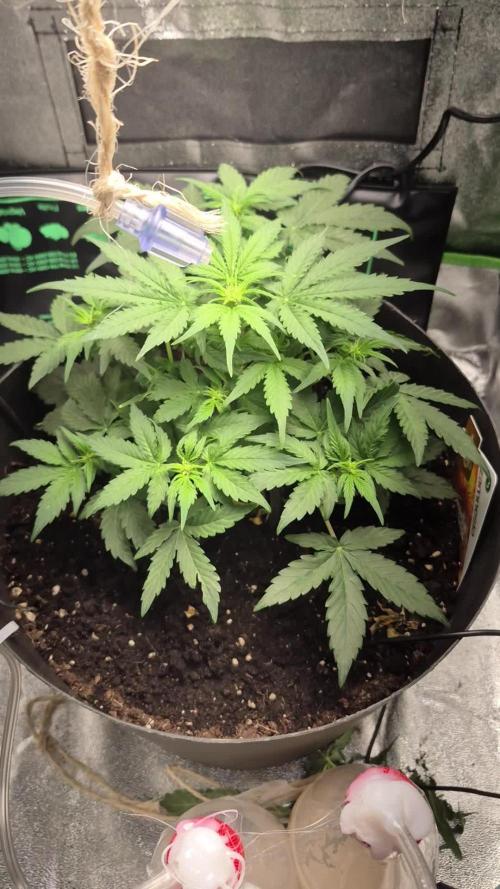
Constant LST on these girls. They are so leggy I'm worried that if I let up the canopies will get out of control. I feel like i'm doing a good job with it thought.
The occasional super cropping is needed and I leaf tuck and even take leaves almost everyday. Doesn't seem to slow em' down.
Lights are at about 75% now. Weather has calmed down so temperature in the tent is consistently below 80F. Happened just in time for mid-flower.
Right before the weather changed I build an exhaust to vent everything outside so controlling the atmosphere is a lot easier and I think it shows.
Switched to bloom nutes towards the end of this week. Miracle Berry Remix IMMEDIATELY perked up and stopping being droopy all the time. CDLC woke up and I'm really happy with her now. Phosphorous is really important once pre-flower begins.
Getting impatient....gonna pop some Double Grapes for the Solo Cup competition.
Lowering my PH to 5.5 - 5.7 to accomodate for any salt build up in the coir since they drink water so quickly. Their response was very good. CDLC loved the drop in PH the most I believe.
I cut my veg nutrients (nitrogen) to half because they aren't in full flower but i'm giving them full doses of the Maxibloom and additives.
I've learned that most chlorosis I am experiencing is a nutrient deficiency. PH and increasing PPM steadily is a MUST to be successful I believe. Potassium is what generally causes the "nutrient burn". You'll catch nitrogen toxicity before any chlorosis and phosphorous is really difficult to give your plant too much of. Especially in flower. I'm gettin' the hang of this....
If anyone could answer me this....Why would you use a feeding schedule when your plant is going to require different nutrients than any other plants? There are too many variable to use a feeding schedule correct?
Really not much to see this week besides the plants bulking up. They are gorgeous...except for the CDLC...she's got some work to do.
Day 49 - Watered with some whacked out PH water today...didn't catch it until it was too late. Mango Smile was dropping by the end of watering...hopefully I didn't stall anyone out. Check out the pheno difference between the two Miracle Berry Remixs.


Processing
Likes
93
Share


@Ferenc
Follow
12th week. I removed some unwanted yellow leaves. I really like this plant, nothing changed, watering happens the same way and same amount of water. I am so excited. Really nice flowers on it and stinky like citrus smell and sweet very well coated with THC. Beautiful plant and really short.😅 I just checked the trichomes and they are still immatured, not even milky. Very strong smell and big buds. Beautifully coated with THC everywhere. I love this plant. Fan leaves started getting yellow as well. I think it is 4 weeks more approximately to be finished. I removed some fan leaves the biggest ones as it started turning yellow because the plants takes the energy out of it. Better airflow and more light to the flowers, and good tea for me from the leaves 🥂🤪😇 I also set the lamp distance to be 20 cm. End of the week Purple Punch is 43 cm.

Likes
60
Share


@m0use
Follow
This week was good, Did the transplant from 7.5L/2Gal to 28L/7Gal, Stared to do some LST but the main stem broke on two "blue and Red" of the three plants. Kinda sucks but a bit to aggressive, on the third plant "yellow" I also used LST just not as strong and got the shape and placement I was looking for. Will have to wait for the others to heal and then I can try again. IDK how long it will take, but I'll give it a full week. Sucks as the tips will be getting more light then the others.
I also ran out of soil so had to make up a half batch as well to top off the pots, got about 8L leftover for transplanting the peppers and what not, tents so full I had to remove the clones and one smaller plant. They are growing in a window now. The extras where Gaia Green All Purpose 4-4-4, Gaia Green Power Bloom 2-8-4, Gaia Green Insect Frass 3-2-4, Gaia Green Seaweed Extract 0-0-17, Bokashi Grains, Epsom Salts, Yeast Powder, Fluvic Acids, Enzymes, Silicon and Multiple Microbes.
PH adjusted really low as the amendments have a lot of rock dusts and such, wanted them to be broken down by the time the roots reach em. Watered in with 4L on each container, Should be ok for the first few days, will need to judge how they are doing in a bit and see if their roots are colonizing the new area. no idea how the clones will do outside the tent, Still have them in a plastic bag till I can see roots in the containers they are in. Checking about once a week.
My goal is to veg this out for another 3-4 weeks and top it one last time they switch to bloom with a SROG net, should have good coverage and lots of cola sites per plant.
Big shoutout to Medic Grow for sponsoring the lighting in my tent, They have provided me with 2x Mini Sun 2's in the 240w configuration, They use the v1 growing spectrum that is a all purpose seed to harvest spectrum so their is no hassle of switching it mid grow. If you interested in learning more about Medic Grow products please visit the web link below.
https://medicgrow.com/
https://growdiaries.com/grower/MedicGrowLED

Likes
22
Share


@Njaak
Follow
pH was important as expected and a bit of light burn later on in the grow but ultimately it was pretty smooth sailing. I used a very common nutrient (GHE) and not overly strong.
Buds were thick, dense, and moderately pine smelling. The plant did not grow excessively tall thanks to LST, and the LST did not seem to have any ill effects at all. Foliage was thick, and I let it go for a very long time before doing any sort of defoliation. Even then it was modest and just to get light to the lower colas.
Still in trimming mode and will continue to update :)
Also, other plants in the house got spider mites. Not this one. Could have been that it was in hydro and others weren't but hard to say.

Likes
29
Share


@SweetKush
Follow
Dag 92. Nu börjar dom glittra, lukten är helt magisk. Kristallerna är mjölk vita . Så spolning inom kort. Längtar efter att få smaka på detta.
Dag 94. Slutet närmar sig. Blir en 10 dagars spolning i slutet av kommande vecka. Vattnas i munnen nu 🤤..

Likes
6
Share


@CookiDoggi
Follow
I noticed that my soil is 3.1 ec☠️ so, next week i will transplant her to a bigger white pot with a lighter soil!!
I also topped her just to experiment!!


Likes
71
Share


@ClubRiot
Follow
Zkittlez Feminized by Club Riot Seeds ( www.clubriotseeds.com )
Week 1
0.5L Pot
LED: MIGRO 200 (210W) for Veg. Stage
Canna COCO
Seeds are put at germinated in wet paper towels for 72 hours
Name: Zkittlez Feminized
Genetic: Grape Ape x Grapefruit
Type: Feminized ( Indica Strain )
Indoor Yield: 80 ~ 140 grams/plant ( 15L Pot ) with LST growth technique.
Indoor Height: 70 ~ 110 cm
THC: Very High
CBD: Low
Flavour: Grape , Sweet , Berry .
Effect: Relaxed , Happy and Euphoric.


Likes
28
Share


@Adkguerrilla44
Follow
Man oh man the gp x bkp is taking off like a champ and filling out very nicely now that she's starting to flower 🌼 🌸!!!!! Gp x shb is starting to come back finally and is about to start flowering smells like straight up sour d already!! The gp x bkp is smelling like skunk and fruit I'm super excited for these strains especially after seeing somebody went and tested a few of wicked genetics strains and all of them came out to be 23%thc-27%thc !!! Fricken pumped gary payton is supposed to be a heavy hitter so I cannot freakin wait until both of these are finished


Likes
1
Share


@PapaTerps
Follow
Zu-Tang Clan - N.Y.Ceeds
Week 4 Bloom
🌸 She's spectacular! She has a beautiful flower structure and even though she has strong thick stems, the weight of the flower has forced me to introduce some supports, which has never happened to me before this early! Her scent is also incredible, transporting you to the South of France with a strong sweet lavender scent, accompanied with a beautiful herbal creamy finish - simply divine! All the girls have been moved into the Spider Farmer 8x4, because the 5x5 and 4x2 were too difficult to manage 👍🏻
✂️ No work this week, she has good airflow and light is penetration to the lower budsites👌🏻
💧 Watered every three days with 4L of RO water - nutrients were mixed individually, in order and then finally pH'd to 6.3. I've increased her nutrients again to keep up with her flower production.
💡 PPFD: ~800
♒ VPD: 1.48kPa
🌱 Days from seed: 87
🌸 Days in Bloom: 28
Likes
14
Share


@Terpyboyz
Follow
Hi everyone thanks for stopping by 🙌🏻
So this is week 8 of vegetive stage almost complete 👌🏻 - I’ve had some hesitation holding of on flowering for all a good few reasons - Clones ✔️ starting to get most of them up to a decent ppm as I’ve had few N defs/calmag difficulties all in check now ✅
We’ll be setting up the second 2.4 grow tent, for the clones & others to veg for a week or so then get them into some 20litre 👞 Start flowering them the week after give or take 💪🏻 for this tent im going to add in a 12litre or 20litre dehumidifier to keep RH in check.


Likes
8
Share


Likes
388
Share


@yan402
Follow
🌸🍏✨🍭🌸🍏✨🍭🌸🍏✨🍭🌸
Hi and welcome to another Kannabia grow!
This time I’m running their Apple Fritter (feminized photoperiod). She’s going to veg under 24hr light and be manifolded.
Still cleaning the rest of my Candy Cream GF (11.04.25) — going to sow the seed tomorrow (12.04.25)
*been lazy, sowed on 14.04.25
🌸🍏✨🍭🌸🍏✨🍭🌸🍏✨🍭🌸
---
💭❗💭❗💭❗💭❗💭❗💭❗💭
❗Events & thoughts worth noting❗
💭❗💭❗💭❗💭❗💭❗💭❗💭
12.04.25 (GW1) – Cleaning + flushing the old coco coir. Might need to add another brick. *No new brick needed ✅
This is how I recycle my coco coir — fast, cheap, no BS.
🌿 Harvest plant
✂️ Chop roots small — they stay in for structure (organic perlite)
💦 Hot water rinse — remove salts & dust
🍶 Pre-soak with light feed:
Micro 10ml
Bloom 0ml
GreenBuzz 10ml
Cal-Mag 60ml
FFJ/FPJ 10ml (new disgusting batch)
pH down (citric acid)
♻️ Media stays — Roots stay — Back in service.
14.04.25 (GW1) – Planted seed in final pot ✅
16.04.25 (GW1) – Did last tent clean up + setup ✅📸
17.04.25 (GW1) – Seed germinated 🎉📸 — roughly 48hrs in final pot. Solid start👌♥️
23.04.25 (VW1) – Minimal burnt tips 📸 — not progressing, not a concern.
26.04.25 (VW1) – Started using the new batch of FPJ/FFJ
https://growdiaries.com/diaries/266849-grow-journal-by-yan402
30.04.25 (VW2) – Increased TriPartMicro & GreenBuzzBloom 10ml → 15ml
03.05.25 (VW2) – Increased TriPartMicro again 15ml → 20ml, topped the plant, and added final layer of clay pebbles around the base, trimmed side branches and did LST in preparation for "manifold" 📸
08.05.25 VW3 finished manifold📸
13.05.25 VW4 Increased TriPartMicro to 30ml and GreenBuzzBloom to 20ml.
15.05.25 VW4 Done defoliation and LST 📸
18-19.05.25 VW5 pruned all the shoots bellow my "mains" and did a full defoliation📸
24.05.25 VW6 increased GreenBuzzBloom to 30ml
04.06.25 VW7 did a cleanup📸
11.06.25 VW8 increase TriPartMicro to 40ml
17.06.25 (VW9) – Final structure pass 💈🌿
Did a clean perimeter prune + removed weak shoots. Ended up with 12 tops, was aiming for less, but she made the call
Didn’t fight it, just shaped it the best I could
Airflow’s good, structure’s stable
🛑 No more cuts until post-stretch
Pics coming shortly 😘
Flip coming soon — we’ll see how she handles it.
20.06.25 VW9 Switched lighting to 12 hours, may the stretch begin 🤞
22.06.25 VW10 Did a good LST session,made some pics, and came to some conclusions and a small change of plans:
Originally planned for 8 mains — long, spaced colas and maybe a couple stronger “titans” if she wanted to go that way.
But she’s showing me something else, and I’m not here to fight her — just guide her.
Now after stretch, I’m keeping side shoots only if they: Fill real canopy gaps
Don’t crowd neighboring tops (minimum 15cm spacing)
Aren’t growing into walls or toward the next plant
Anything too close, too low, or heading into shade gets removed. No point forcing it.
Looks like I’ll finish with 14–16 solid tops, depending on how she settles.
I’m just trying to give each one enough light and space to stack properly.
No overcrowding, no larf — just letting her do her thing with a bit of structure.
Increased Tri Part Micro to 50ml as well.
28.06.25 VW11 one week since I flipped to 12/12 and she is stretching nicely, a bit shy in showing pistils compared to the Fantasy Feast regulars I have in the same tent.
29.06.25 VW11 increased GreenBuzzBloom 30→ 60ml
06.07.25 FW1 TriPart Micro: 50→ 30ml
TriPart Bloom: 0 → 20ml
Home-made FFJ/FPJ (Watermelon + Pumpkin): 10 → 30ml
12.07.25 FW1 GreenBuzzBloom 60 →40ml, TriPart Bloom: 20 → 60ml, fpj 30→60ml
🌱💦🌱💦🌱💦🌱💦🌱💦🌱
🌿 Day to day tasks & actions 🌿
🌱💦🌱💦🌱💦🌱💦🌱💦🌱
11.07.25 FW1 – Fed 5l of #1 → 2l runoff
12.07.25 FW2 – Fed 5l of #1 → 2l runoff
(*RUNOFF reused for tomato plants)
🍶💧🍶💧🍶💧🍶💧🍶
💧 Nutrients in 30L #1 – Week 11 Veg
🍶💧🍶💧🍶💧🍶💧🍶
💧 TriPart Micro: 10 → 15 → 20 → 30 → 40 → 50ml → 30ml (1.00ml/L)
🍶 TriPart Grow: 0ml (0.00ml/L)
💧 TriPart Bloom: 0 → 20 → 60ml (2.00ml/L)
🍶 GreenBuzz Bloom: 10 → 15 → 20 → 30 → 60→40ml (1.33ml/L)
💧 Cal-Mag: 60ml (2.00ml/L)
🍶 Home-made FFJ/FPJ (new batch): 10ml → 30→60ml (2.00ml/L)
💧 pH Down: Citric acid (buxXtrade)
📦 TOTAL: 250ml per 30L
🔬 8.33ml/L
🍶💧🍶💧🍶💧🍶💧🍶
⚙️✂️⚙️✂️⚙️✂️⚙️✂️⚙️
✂️ Tools & equipment ✂️
⚙️✂️⚙️✂️⚙️✂️⚙️✂️⚙️
✂️ 2× MarsHydro SP3000
⚙️ MarsHydro 150mm ACF Ventilator
✂️ Trotec dehumidifier (big unit)
⚙️ Mini no-name dehumidifier
✂️ Kebab skewers (LST – stainless)
⚙️ Wire + roast skewers (LST assist)
✂️ Scissors (HST)
⚙️ Vacuum (for spills & cleanup)
✂️⚙️✂️⚙️✂️⚙️⚙️✂️⚙️✂️⚙️✂️⚙️
---
🍏🍪🌬️🍬🍏🍪🌬️🍬🍏🍪🌬️🍬
Apple Fritter (Kannabia Seeds)
🍏🍪🌬️🍬🍏🍪🌬️🍬🍏🍪🌬️🍬
Species: 50% Indica / 50% Sativa
Genetics: Sour Apple × Animal Cookies
THC: Up to 25%
Effect: Euphoric, relaxing, creative
Flavor: Sweet, fruity, pastry notes
Flowering: 56–63 days
Resistance: High
Indoor yield: 450–500g/m²
Outdoor yield: 600g/plant
Structure: Strong, bushy, dense buds

Likes
Comments
Share

@alex93
Follow
Vigorous plant (I avoid excessive defoliation). Despite a slight light stress last week, I quickly solved the problem and she recovered without any worries. It started its stretch and flowering well. I'm about to start Cal-Mag to support this!

Likes
9
Share


@Scoota710
Follow
It’s growing pretty good. I’ve been debating on topping it or doing some LST on it 🤔



Likes
20
Share


@WeEdandGrowLover
Follow
I cut my Big Bud After the night.
It was a great pleasure having this plant growing so well though i should have put her in a bigger pot,but well,i didnt expect her to grow this good😏😎.

Likes
1
Share


@BruWeed
Follow
Esta semana ya realice la poda. Se encuentra en estos momentos en etapa de secado dentro de una caja especial para secados de flores que uso siempre y nunca me falla.
En humedo hay 195g y utilice una lampara led de 150w en todas sus etapas.
Próximamente estaré publicando cuando este en curado.
