


3M ◉ African Sun



VEG
Light Emitting Diodes/100W
Custom
FLO
Light Emitting Diodes/133W
Custom


Soil
Custom

Coco Coir
Custom

Bocashi Other
Custom
Minerals Other
Custom
Zeolita Other
Custom
Earthworm humus Other
Custom
Rice husk Other
Custom
River sand Other
Custom

weeks 3
Topping
weeks 5
LST
weeks 6, 8
Defoliation
weeks 6, 8
15 liters
Pot Size
0.7 liters
Watering
Start at Harvest
G
Germination3y ago


Nutrients 3
Agua de Montaña
1000 mll
Miel
3 mll
Bio Coco EM
10 mll
deFharo NEW AUTUMN WINTER SEASON OF ORGANIC SELF-SUFFICIENT EXPERIMENTAL CROPS... I COME FROM A STRANGE WORLD!
Welcome clandestine marijuana growers, and also to those lucky enough not to be one! 🙋♂️👨🌾
New grow, a pure African sativa strain, a myth, a legend of cannabis, thanks to Anesia seeds for the opportunity to grow it. I love African sativas; they are not easy to grow indoors, but I think we will get along. Personally, I get really motivated with landrace strains. This season, I had this strain and a regular seed of Panama Red that hasn’t thrived, so I’m starting this journey through African lands... let’s play!
The seed was the first to peek through the substrate, three days ago. During the day, I keep the seedling by a window, without direct sunlight, and I maintain the humidity of the small pot with a plastic dome until it sheds the seed shell. At night, I have all the new seedlings under a LED panel with blue diodes at 450nm; this light frequency promotes root development and compactness. As the first true leaves appear, I will gradually decrease the distance from this upper panel and add other side panels with spectrums to maximize vegetative growth (7700 and 6400K). All of this while the seedlings are in the small pots. My intention is to transplant to the final pot within two weeks at most because I want to work on root development in the final pot as soon as possible. Once the transplant is done, I will distribute the plants between the two grow tents.
For this autumn/winter season, I have several techniques I want to improve, especially related to root development, watering, and light space. After emptying the pots from the previous season, I wasn’t happy with the root development I saw. I also didn’t like the small fabric pots I used for germination; it was very difficult to remove the seedling at the time of transplanting, and the process wasn’t clean, and I’m sure there were broken roots. For this season, I have germinated the seeds in small square pots with grooves inside to help prevent the roots from spiraling. I’ve also made a light substrate mix, using equal parts substrate, coconut fiber, and bokashi. Additionally, I added a bit of azomite and homemade powdered auxins, as well as a good amount of zeolite. This season, I want to try several things: the efficiency of zeolite compared to vermiculite, compare different substrate mixes for the final transplant, and finally, a different watering technique for the first weeks of growth.
To moisten this first substrate where I germinated the seeds, I used a mix of mountain water, homemade honey, gibberellic acid, and my coconut bio-fertilizer with Effective Microorganisms (EM). This preparation provides the presence of many minerals, sugars, and the cytokinin hormone. In short, I capture all the energy contained in green coconut water, energy designed to germinate and grow a coconut plant... let’s play! Also, for this new season, I will debut new specialized Bio Fertilizers that I have been fermenting anaerobically for at least six months.
Finally, this season I’m going to grow eight strains; so far, five seeds have germinated, while three have not made it. The seeds rotted because I buried them too deeply. Two days ago, I put three more seeds of the same strains to germinate, and I hope they peek through the substrate as soon as possible. I had a ninth seed in reserve that also hasn’t made it. I’m going to grow six plants in the main tent, two less than last season. In exchange, I’ve increased the pot size and the distance between pots. Additionally, I’ll have two more plants in my homemade cabinet, which allows me to light it from all sides. In the end, the seedlings will have to strive to get the biggest pot and the best cabinet for each, according to their morphology. This season, I’ve achieved a harvest similar to what I got in the second-to-last season. The difference is that in the first, I grew four large plants, and in the previous season, ten smaller ones. This difference means more work and expense, but I take on the effort to have more variety of weed in my stash... all for the cause!
For this season, I seek inspiration with enough excitement to enjoy my females and the publication of the grow diaries... let the journey begin!
================================
Info on the Malawi Gold strain: https://anesiaseeds.com/es/product/malawi-gold-landraces/
"Malawi Gold comes from Malawi, a country in southeastern Africa, and is one of the most psychoactive plants in the world." Anesia Seeds
- Genetics: African Landrace
- Pure Sativa: 100%
- Flowering Time - 10-13 Weeks
- Indoor Yield: 600/650 g/m²
- High THC - 20%
- Flavors: Floral and Lemon
==============
11 likes
8 comments
Share
Used method
Directly In Substrate
Germination Method
1
Week 1. Vegetation3y ago


5 cm
Height
22 hrs
Light Schedule
26 °C
Day Air Temp
7.5
pH
150 PPM
TDS
60 %
Air Humidity
24 °C
Solution Temp
25 °C
Substrate Temp
23 °C
Night Air Temp
15 cm
Lamp Distance
Nutrients 1
Agua de Montaña
1000 mll
deFharo Welcome clandestine marijuana growers, and also to those who are lucky enough not to be!🙋♂️🌱
The little African strain is growing and establishing itself; a few days ago I had to help it with a support because its delicate stem tended to bend, but now it’s firm and moving forward! During the day, the seedlings are in front of a window receiving filtered sunlight, and at night they go to their temporary grow tent. Yesterday I added a side LED panel with diffuse light and a color temperature of 6400K.
Until next time...
REGARDS TO ALL!!
================================
Info on the Malawi Gold strain: https://anesiaseeds.com/es/product/malawi-gold-landraces/
"Malawi Gold comes from Malawi, a country in southeastern Africa, and is one of the most psychoactive plants in the world." Anesia Seeds
- Genetics: African landrace
- Pure Sativa: 100%
- Flowering Time - 10-13 Weeks
- Indoor Yield: 600/650 g/m²
- High THC - 20%
- Flavors: Floral and Lemon
================================
8 likes
6 comments
Share
2
Week 2. Vegetation3y ago


6 cm
Height
22 hrs
Light Schedule
26 °C
Day Air Temp
7.0
pH
150 PPM
TDS
60 %
Air Humidity
23 °C
Solution Temp
25 °C
Substrate Temp
23 °C
Night Air Temp
10 cm
Lamp Distance
Nutrients 1
Agua de Montaña
1000 mll
deFharo Welcome, clandestine marijuana growers, and also to those lucky enough not to be one!✋👨🌾
It's been three weeks since I put the seed in the substrate, the African seedling is growing and strengthening, it's developing its first true leaves and the stem is fully strengthened. I'm going to wait another week before transplanting it; this year I'm in no rush to enter flowering.
During the day, the seedling is already exposed to direct sunlight, and at night in the grow tent, very short internodes are already noticeable. But not everything is happiness; yesterday my dog did a "defoliation" on all my seedlings, my fault for putting them within reach. The little nibbled leaves, the seedlings lying on the substrate, a disaster I'm trying to fix. I've had to put supports to keep the stems upright. In the end, I think all the seedlings will survive, and not only that, because if this doesn't kill them, they'll end up being stronger... let's play for life!
To compensate for the trauma, today I've prepared a watering solution made of mountain water and nettle tea. This will provide nutrients and minerals, mainly silicon to strengthen the whole plant, and it will also promote rooting and favor microbial life.
Until next time...
CHEERS TO EVERYONE!!
================================
Info on the strain Malawi Gold: https://anesiaseeds.com/es/product/malawi-gold-landraces/
"Malawi Gold comes from Malawi, a country in Southeast Africa, and is one of the most psychoactive plants in the world." Anesia Seeds
- Genetics: African landrace
- Pure Sativa: 100%
- Flowering Time - 10-13 Weeks
- Indoor Yield: 600/650 g/m²
- High THC - 20%
- Flavors: Floral and Lemon
================================
10 likes
7 comments
Share
3
Week 3. Vegetation3y ago


6 cm
Height
18 hrs
Light Schedule
25 °C
Day Air Temp
6.5
pH
225 PPM
TDS
60 %
Air Humidity
21 °C
Solution Temp
22 °C
Substrate Temp
20 °C
Night Air Temp
15 liters
Pot Size
10 cm
Lamp Distance
Nutrients 3
Agua de Montaña
1000 mll
Bio Coco EM
10 mll
Aminoácidos
5 mll
deFharo Welcome, clandestine marijuana growers, and also to those fortunate enough not to be one!✋👨🌾
Four weeks since I launched the seed into the substrate, today has been the big transplant day for this pure African strain, a round 15L fabric pot resting on a base of stones will be its home for the next few months... let’s play!
Today I’m going to talk a bit about the substrate I’ve prepared for this seedling. This growing season, I’m going to compare two substrate mixes: this one, primarily composed of artisanal components, and another with commercial substrate and nutrients. Check out other diaries today to see the difference.
In this case, I’ve used reused substrate from my previous season and homemade substrate in equal parts (30%). I’ve added 21% of a very special artisanal bokashi, composed of: organic chicken manure, rice husk, rice bran, cane molasses, biochar, micronized basalt, olive and oak ash, Mountain Microorganisms, sifted soil, and rainwater. Additionally, I’ve included previously inoculated coconut fiber from Mountain Microorganisms (MM) and bio-nutrients (21%) 15 days ago, as well as 11% worm humus, 3% perlite, and 4% zeolite (in this case, I’m replacing vermiculite with zeolite; both have the same moisture and nutrient retention properties, but unlike vermiculite, zeolite adds nutrients to the substrate). For the first time, I’m using rice husk in the substrate mix (7%). I hope this material will serve the same purpose as perlite in aerating the substrate, with the difference that the husk is organic matter rich in silicon, and as it decomposes, it will pass silicon to the plants. Finally, I add 17 powdered minerals (7%) at a rate of 1g for every liter of soil, mix everything, and fill the pot.
I differentiate three groups of components in this substrate:
- A nutritious, structured, and aerated base prepared to receive and reproduce microbiology: substrate, coconut, humus, and bokashi.
- More aeration with perlite and husk, moisture and nutrient retention with zeolite.
- And finally, the mineralization of the substrate to compensate for its plant nature and ensure the presence of the entire range of inorganic elements from the periodic table. Thanks to the mix of 6 clays, I achieve better performance in nutrient assimilation through the cation exchange of the clays... all for the cause!
The task of preparing these substrates is laborious, but it motivates me a lot. I consider the growing soil sacred. I enjoy kneading the substrate mix, adding components, and feeling how each new component changes the structure, texture, or smell of the substrate.
Before the transplant, I moistened the small pot quite a bit; the root ball came out pretty well. I buried the root ball, sunk the stem, and won’t water until tomorrow. I want the excess moisture from the small pot to spread through the surrounding substrate. Tomorrow the plant will be thirsty, and I’ll start with the first waterings.
In previous seasons, I did a deep watering of the entire substrate. This season, I’m going to water at the beginning with less water, trying to expand the roots efficiently and orderly. For now, I’m going to water while trying not to wet the center of the pot, which has enough moisture from the hydrated coconut and mainly the homemade substrate. This way, I want to maintain aeration in that substrate so that the roots can easily expand. I noticed in the previous season that the center of some pots wasn’t sufficiently populated with roots. Over time, I’ll moisten the base of the pot so that the roots quickly travel through the pot, drawn by that moisture at the bottom. I plan to start with 500ml on top and 500ml below. When I previously grew in this same pot, I started with a 3L watering that took almost 10 days to be consumed. I think it was counterproductive because the water invaded the entire substrate, displacing oxygen for too many days. The roots mostly grew towards the sides of the pot, where they found the most oxygen!
Once I do this first watering, I’ll cover the substrate with a good layer of mulch from the mulch rescued from previous crops, a lot of semi-processed and humified organic matter, and a lot of latent microbiology. I also have a very precious box with all the remains of leaves, branches, and roots from previous crops and the sticks from the marijuana I smoke—food for the substrate microbes to start reproducing very happily. For me, collecting dry organic matter is almost a ritual. I make use of everything from the plants I harvest; I only get rid of the thickest stems and return to the soil what was born from the soil, generating a life cycle with which I aim not only to imitate the processes of the forest but also to advance further on the path of self-sufficiency, rebellion, or independence. The great limitations and conditions of indoor crops in pots pose a significant challenge to achieving this, but I believe in what I do. It entertains me a lot, and I don’t stop doing, playing, and understanding... simplifying the complex!!
Until next time...
REGARDS TO ALL!!
Until next time...
REGARDS TO ALL!!
================================
Info about the Malawi Gold strain: https://anesiaseeds.com/es/product/malawi-gold-landraces/
"Malawi Gold comes from Malawi, a country in Southeast Africa, and is one of the most psychoactive plants in the world." Anesia Seeds
- Genetics: African landrace
- Pure Sativa: 100%
- Flowering Time - 10-13 Weeks
- Indoor Yield: 600/650 g/m²
- High THC - 20%
- Flavors: Floral and Lemon
================================
8 likes
4 comments
Share
Used techniques
0
Technique
4
Week 4. Vegetation3y ago


9 cm
Height
19 hrs
Light Schedule
24 °C
Day Air Temp
6.1
pH
450 PPM
TDS
60 %
Air Humidity
21 °C
Solution Temp
21 °C
Substrate Temp
20 °C
Night Air Temp
15 liters
Pot Size
0.25 liters
Watering Volume
10 cm
Lamp Distance
Nutrients 6
Agua de Montaña
1000 mll
Bio Coco EM
10 mll
Calabaza MMA
6 mll
deFharo Welcome clandestine marijuana growers, and also to those who are fortunate enough not to be! 🙋♂️👨🌾
Five weeks since I launched the seed into the substrate, the African seedling is settling comfortably in its new European home, the compactness it shows is excellent, the lateral branches have started to take center stage, I’ll probably do a first apical cut this week, I think this grow is going to be brutal... long live Africa!
Five days ago, I completed the pot setup, I added a thin layer of a mix of pre-cooked dry amendments with microorganisms and mulch remnants from previous crops, I moistened the mix with mountain water, molasses, and Lactic Acid Bacteria (LAB), I covered it all with a good layer of dry organic matter, coming from defoliations and branch remnants from last season's crops, for me, collecting organic matter for mulch is an essential practice in my growing style, to speed up the decomposition of this organic matter (OM), I moistened everything with LAB, particularly effective for the decomposition of OM and molasses, and I also did a foliar application with the same mix.
A day later, I did a watering with a mix of Bio nutrients with MMA and hormones from various sources (auxins, cytokinins, and gibberellic acid), with this I aim to enhance root and cell development, it also seems that my use of a smaller amount of watering mix is helping with a quick establishment in the pot, now, mainly I’m trying to develop roots in the center of the pot and downwards, because later with the progress of the grow and the amount of watering, the plant will naturally expand roots towards the sides of the pot, but I’ll only be able to confirm all this when I harvest.
Until next time...
REGARDS TO ALL!!
================================
Info on the strain Malawi Gold: https://anesiaseeds.com/es/product/malawi-gold-landraces/
"Malawi Gold comes from Malawi, a country in Southeast Africa, and is one of the most psychoactive plants in the world." Anesia Seeds
- Genetics: African landrace
- Pure Sativa: 100%
- Flowering Time - 10-13 Weeks
- Indoor Yield: 600/650 g/m²
- High THC - 20%
- Flavors: Floral and Lemon
================================
8 likes
6 comments
Share
5
Week 5. Vegetation3y ago


17 cm
Height
19 hrs
Light Schedule
25 °C
Day Air Temp
6.1
pH
500 PPM
TDS
60 %
Air Humidity
20 °C
Solution Temp
21 °C
Substrate Temp
20 °C
Night Air Temp
15 liters
Pot Size
0.3 liters
Watering Volume
10 cm
Lamp Distance
Nutrients 6
Agua de Montaña
1000 mll
Bio Coco EM
10 mll
Ormus
1 mll
deFharo Welcome, clandestine marijuana growers, and also to those who are fortunate enough not to be! 🖐️👨🌾
It's been six weeks since I planted the seed in the substrate, and the development of this African plant is fantastic... I think I'm falling in love! ❤️❤️
I did an apical cut three days ago, and even before the cut, the plant showed a very compact morphology with great natural development of lateral branches. Now it's going to explode; I'm sure I'll start tying the branches this week to try to tame this wild strain!
This week, I did two waterings with the first soluble bio-nutrients, and a foliar application with my enzymatic hydrolyzed fresh blood (Hidro Blood) and my lacto-fermented seaweed. I'm doing one foliar application per week, and this time I'm making the right mix because in other seasons I've gotten carried away by the efficiency of foliar applications, getting too excited and ultimately damaging the crops with too many consecutive applications.
After the first watering at the beginning of the week, I did a second one two days ago where I wanted to give the plant a boost. I used my potassium hydrolyzed humic and fulvic acids and 33% Hydro Blood (Humato Blood). The plants loved it; the amino acids from Hydro Blood stabilized with my leonardite humate provide a great energy boost and contribute enormously to the feeding and structure of the substrate!
Three days ago, I added two side LED panels to the main tent, one at 7700K and the other blue at 450nm. This way, I can bring the canopy lamps closer to the plants and compensate for the missing light on the sides. For now, I have 150w in 3 canopy lamps plus 66w from the two side panels and 14w for ventilation. The truth is, all the plants are very compact with very short internodes.
This season, to take advantage of all the horizontal space in the grow tent and ensure good airflow at the tips, I installed two 22cm fans that are only 3cm thick and hung them from the support bars on opposite sides. Last season, since I filled the grow tent too much, I had 4 fans, all above the lamps, which took up a lot of space, and I didn't really like it. I had problems with bud rot in some plants, so this season I'm going to solve it with these new fans. Plus, I'm going to save a ton of watts because the 4 fans from last season consumed 72w. Now, the new fans, which run on 12v, are connected to a voltage regulator and are working at 7.5v with a consumption of 8w and excellent airflow. Besides these, I'm only going to have one more fan above the lamps to disperse the heat from the dimmers. Additionally, I installed an extra extractor with two 12cm PC fans placed in series; they're very quiet, and I regulate the voltage, currently working at 7.5v and consuming 6w. I keep the main extractor, which is very noisy, turned off during the winter seasons because, for me, noise is important since I live with the grow tent in my workroom.
Until next time...
REGARDS TO ALL!!
================================
Info on the Malawi Gold strain: https://anesiaseeds.com/es/product/malawi-gold-landraces/
"Malawi Gold comes from Malawi, a country in Southeast Africa, and is one of the most psychoactive plants in the world." Anesia Seeds
- Genetics: African landrace
- Pure Sativa: 100%
- Flowering Time - 10-13 Weeks
- Indoor Yield: 600/650 g/m²
- High THC - 20%
- Flavors: Floral and Lemon
================================
5 likes
comments
Share
Used techniques
Topping
Technique
6
Week 6. Vegetation3y ago




19 cm
Height
19 hrs
Light Schedule
25 °C
Day Air Temp
6.3
pH
550 PPM
TDS
60 %
Air Humidity
20 °C
Solution Temp
21 °C
Substrate Temp
20 °C
Night Air Temp
15 liters
Pot Size
0.3 liters
Watering Volume
10 cm
Lamp Distance
Nutrients 8
Agua de Montaña
1000 mll
Bio Coco EM
5 mll
Bio Fish EM
5 mll
deFharo Welcome, clandestine marijuana growers, and also to those fortunate enough not to be one!✋👨🌾
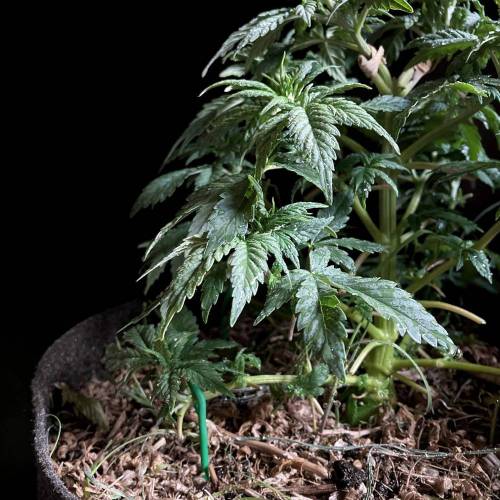
Six weeks into the life of this genuinely African strain, the apical cut has slowed vertical growth, while the side branches and stem are strengthening and fattening up.
Two days ago, I did a significant defoliation and have started tying down the branches to shape the plant. For now, the plant's morphology is tree-like; I love it! It's like a solitary tree in the African savanna, a plant wider than it is tall, to protect itself from the intense African sun.
Not much more for now, I'm waiting for the reactions from today's watering, where I start with specific Bio Nutrients to boost aerial growth. A good dose to keep the plant satisfied!
Until next time...
REGARDS TO ALL!!
================================
Info on the Malawi Gold strain: https://anesiaseeds.com/es/product/malawi-gold-landraces/
"Malawi Gold comes from Malawi, a country in Southeast Africa, and is one of the most psychoactive plants in the world." Anesia Seeds
- Genetics: African Landrace
- Pure Sativa: 100%
- Flowering Time - 10-13 Weeks
- Indoor Yield: 600/650 g/m²
- High THC - 20%
- Flavors: Floral and Lemon
================================
6 likes
4 comments
Share
Used techniques
LST
Technique
Defoliation
Technique
7
Week 7. Vegetation3y ago


23 cm
Height
20 hrs
Light Schedule
25 °C
Day Air Temp
6.2
pH
375 PPM
TDS
65 %
Air Humidity
19 °C
Solution Temp
20 °C
Substrate Temp
19 °C
Night Air Temp
15 liters
Pot Size
0.4 liters
Watering Volume
10 cm
Lamp Distance
Nutrients 4
Agua de Montaña
1000 mll
Bio Algas EM
20 mll
Enzimas
2 mll
deFharo Welcome clandestine marijuana growers, and also to those who are fortunate enough not to be! 🙋♂️👨🌾
Eight weeks into the life of this genuinely African strain that stands out for its strength and growth, it has fully recovered from last week's defoliation and is moving towards the zenith of its glory!
I’m growing this plant in a 15L fabric pot with homemade organic and mineralized substrate, it hasn’t shown any signs of problems unlike others, almost all my current grows. I also have to say that the waterings I've been doing have mostly been very nutritious without worrying about anything. This week after the last two waterings, the plant is showing powerful and healthy growth, the lateral branches are sticking out from the dense foliage, the trunk is very thick, and the current morphology is bulbous thanks to the light compression I’m applying to all my crops.
In the last watering, I made a mix with bio-stimulants from algae and enzymes. In this deep watering, I reached 100% substrate moisture for the first time. This season I won’t go over 15% moisture in the pot according to the liters of substrate. In the case of this 15L pot, the total watering amount is 2200ml. Last season for this type of pot, I reached 4200ml per pot. The concept was different this season; the substrate was much lighter in nutrients, and I was trying to emulate with soluble bio-nutrients crops in coco or something similar. The result wasn’t bad, but when I opened the pots, I observed sparse root development in the center, and I didn’t like it. So this season, I’m going to allow, with less water, for air to take the place it deserves in the substrate and try to improve root development this season. This week I also did two gentle foliar applications with my fruit bio-stimulant, blood amino acids, and nettle tea... let’s play! 🤓💃
I’m thinking of reaching 10 weeks in vegetative growth, if the height allows it. I’m going to do gentle waterings so the plant consumes the nutrients from the substrate and releases EC load, so that in the flowering stage I can feed mercilessly with my specific soluble bio-fertilizers for this stage. I have several flowering formulas that I’ll be trying out this season.
Finally, a few days ago, I added the last side LED panel (60x30cm, 4000K) to complete the light box 😁😁😁 for the vegetative growth period. When I switch to flowering, I’ll change the current 4 side panels (6400K, 7700K, 4000K, and 450nm) for others with warmer color temperatures. This season I’m pushing the amount of light in vegetative growth to the extreme, and the truth is I’m achieving a compactness in all the plants like never before. The thickness of the stems is considerable, and when I switch to flowering, these crops are going to explode!... let’s play!
Until next time...
REGARDS TO ALL!!
================================
Info on the strain Malawi Gold: https://anesiaseeds.com/es/product/malawi-gold-landraces/
"Malawi Gold comes from Malawi, a country in Southeast Africa, and is one of the most psychoactive plants in the world." Anesia Seeds
- Genetics: African landrace
- Pure Sativa: 100%
- Flowering Time - 10-13 Weeks
- Indoor Yield: 600/650 g/m²
- High THC - 20%
- Flavors: Floral and Lemon
================================
5 likes
comments
Share
8
Week 8. Vegetation3y ago


28 cm
Height
20 hrs
Light Schedule
25 °C
Day Air Temp
6.4
pH
535 PPM
TDS
65 %
Air Humidity
19 °C
Solution Temp
20 °C
Substrate Temp
19 °C
Night Air Temp
15 liters
Pot Size
0.5 liters
Watering Volume
10 cm
Lamp Distance
Nutrients 6
Agua de Montaña
1000 mll
Purín de ortiga
100 mll
Calabaza MMA
4 mll
deFharo Welcome, clandestine marijuana growers, and also to those fortunate enough not to be! 🖐️👨🌾
Nine weeks into the life of this genuinely African strain that stands out for its strength, the plant has started to highlight the lateral branches, and I've begun to tie them down for shaping. In a week, it will switch to flowering. I've done some defoliation of the lower leaves to improve airflow at the substrate surface.
Water consumption is increasing; I water every four days. This week, I did two deep waterings. The first was gentle with nettle tea and my bio-fermented pumpkin and Activated Mountain Microorganisms (MMA). The intention of this watering (EC: 0.65) was to give a boost to the crop both in the aerial part and in root expansion. The second watering was with Humato Blood, a new formula where I chelate the humic and fulvic acids from leonardite humate (60%) with the amino acids from my enzymatic hydrolyzed fresh blood (30%). I complete the formula with bone meal (10%), which through this process becomes calcium triphosphate that the plant can assimilate. The whole mix is an important contribution of Ca, P, and K. To finish the mixture, I added 1% of my Lacto fermented auxins from black beans with minerals to distribute energy to the lateral branches and the tips, and finally, a bit of Ormus from the Cantabrian Sea to regulate the pH and mainly provide Mg and many other minerals.
Next week will be the last in the vegetative growth stage. The plant is currently 28 cm tall, and by the end of the week, it will be a few centimeters taller, but it surely won't reach 40 cm, because I have intense lights above this and the other plants in the grow tent to flatten them as much as possible. With this type of light strategy, the trunk and branches become sturdier and thicker each day. According to the behavior of previous crops, after switching to flowering schedule, the plant can stretch up to 75% more than its initial height. For me, plants that are 80 cm tall are ideal to give them plenty of photons from all sides and grow thick buds throughout the height of the plant. Additionally, unlike previous crops, I will maintain the current configuration of side lights, panels with a lot of white and blue light, to try to curb the vertical stretching of the plants in flowering. Once the plants stop stretching, which usually occurs between the second and third week after switching to flowering schedule, I will change all the side panels for others with warmer color temperatures and will turn the canopy lamps to 100%... let’s play! 🖐️😁
Until next time...
REGARDS TO ALL!!
================================
Info on the Malawi Gold strain: https://anesiaseeds.com/es/product/malawi-gold-landraces/
"Malawi Gold comes from Malawi, a country in Southeast Africa, and is one of the most psychoactive plants in the world." Anesia Seeds
- Genetics: African landrace
- Pure Sativa: 100%
- Flowering Time - 10-13 Weeks
- Indoor Yield: 600/650 g/m²
- High THC - 20%
- Flavors: Floral and Lemon
================================
6 likes
6 comments
Share
Used techniques
LST
Technique
Defoliation
Technique
9
Week 9. Vegetation3y ago


36 cm
Height
20 hrs
Light Schedule
23 °C
Day Air Temp
6.5
pH
750 PPM
TDS
65 %
Air Humidity
19 °C
Solution Temp
20 °C
Substrate Temp
19 °C
Night Air Temp
15 liters
Pot Size
0.5 liters
Watering Volume
10 cm
Lamp Distance
Nutrients 7
Agua de Montaña
1000 mll
Bio Guanos EM
10 mll
Lacto Harinas
10 mll
deFharo Welcome clandestine marijuana growers, and also to those lucky enough not to be! 🙋♂️👨🌾
Ten weeks into the life of this African strain I'm falling in love with! 🌲🧡
Today is the last day of the vegetative stage, tomorrow I switch to flowering schedule 12/12h, the plant is ready, the leaf mass is very dense and for now I'm going to leave it defoliated because I want the plant to capture maximum light energy, the tips are popping up everywhere, water consumption is very high, the height today is 36cm, even though it’s going to double in size I don’t mind, because I’m prepared for plants up to 80cm, but if they’re shorter, even better, to help the plant not stretch too much while I switch to flowering schedule I’m going to set the canopy lights to 100%, until now it’s been at 70%, also until they stop stretching (2-3 weeks) I’m going to keep the white light spectrums on the sides... let’s play!
As a farewell to the growth stage, I’m going to keep the plants under light for 40 uninterrupted hours, I intend to give the plant a shock with the difference in light hours, from 40 to 12h, maybe this will make them flower earlier? I don’t know, that’s why I’m going to try!
This week two deep waterings, and today a foliar application to give extra energy to the crop with my fruit lacto-ferment (vitamins...) and my hydrolyzed amino acids extracted from fresh blood (Hidro blood). In the next two weeks, the waterings I do will be with low concentration and mainly bio-stimulants, the big hormonal change that happens in the plant with the transition to flowering needs peace, for me, it’s not the time for macro nutrients. 🤷♂️
Until next time...
GREETINGS TO ALL!!
================================
Info on the Malawi Gold strain: https://anesiaseeds.com/es/product/malawi-gold-landraces/
"Malawi Gold comes from Malawi, a country in Southeast Africa, and is one of the most psychoactive plants in the world." Anesia Seeds
- Genetics: African landrace
- Pure Sativa: 100%
- Flowering Time - 10-13 Weeks
- Indoor Yield: 600/650 g/m²
- High THC - 20%
- Flavors: Floral and Lemon
================================
8 likes
comments
Share
10
Week 10. Flowering3y ago


43 cm
Height
12 hrs
Light Schedule
24 °C
Day Air Temp
6.6
pH
275 PPM
TDS
65 %
Air Humidity
19 °C
Solution Temp
20 °C
Substrate Temp
19 °C
Night Air Temp
15 liters
Pot Size
0.7 liters
Watering Volume
10 cm
Lamp Distance
Nutrients 5
Agua de Montaña
1000 mll
Ormus
2 mll
Bio Guanos EM
15 mll
deFharo Welcome clandestine marijuana growers, and also to those lucky enough not to be one! 🙋♂️👨🌾
Eleven weeks into the life of this African strain I'm in love with! 🌲🧡 The first week since the switch to flowering has been spectacular, it has grown 7cm and has gained incredible volume, dozens of buds are growing in the canopy, the immense leaf mass is ready to capture a lot of energy and send it to each and every one of them. Water consumption is very high.
A few days ago, I did a foliar application with horsetail extract as a preventive measure against fungi, since the temperatures dropped a lot and the humidity rose too high. There have been days when I've had a dehumidifier inside the grow tent, as I don't want to take risks with plants that have a lot of foliage. I'm also maintaining good ventilation over the plants, so far everything is fine, I don't let the humidity rise above 70%. With the lights on, the humidity drops a lot without needing a dehumidifier.
This season I'm experimenting with two substrate mixes, also watering with less water, almost half of what I used last season, in order to aerate the substrate and facilitate root expansion, as I wasn't happy with this aspect last season. Additionally, I'm pushing the light intensity to promote compactness, leaf mass, and strengthening of branches and stems, and finally, testing my patience by allowing the plants to express themselves and evolve with minimal intervention. For this plant, just one apical cut and a bit of LST; otherwise, I'm still trying to mimic the forest, albeit at an accelerated pace, with my soluble Bio Fertilizers, speeding up the natural decomposition processes of raw and organic materials.
• First week since switching to 12/12h flowering, the plant is lush, it has four branches that stand out, each in a cardinal direction, and in the center, a population of buds is striving to stand out. The trunk is immense and still hidden behind the dense foliage. I'm doing two things in this transition stage:
- In order to slow down as much as possible the great vertical stretch that occurs in this stage, which according to previous crops lasts between 2 and 3 weeks, I increased the power of the 3 canopy lamps to 100%, they were at 70%, and I'm going to keep the 4 side LED panels for vegetative growth with very white color spectrums (7700K, 6400K, 4000K, and 420 nm) until the stretching stops. After that, I'll change them all for warmer ones with greater penetration. The plant was 36cm tall a week ago, today it's 43cm, I still have plenty of room!
- The waterings in these 2-3 weeks of transition I'm doing with EC: 0.5/6, I don't want to disturb the plant by forcing it to eat at this stage. Once the plant stops stretching and concentrates all its energy on flower formation, I'll start feeding it and giving it light without mercy or hesitation; the substrate, the roots, and I are ready... all for the cause!
Until next time...
REGARDS TO ALL!!
================================
Info on the Malawi Gold strain: https://anesiaseeds.com/es/product/malawi-gold-landraces/
"Malawi Gold comes from Malawi, a country in Southeast Africa, and is one of the most psychoactive plants in the world." Anesia Seeds
- Genetics: African landrace
- Pure Sativa: 100%
- Flowering Time - 10-13 Weeks
- Indoor Yield: 600/650 g/m²
- High THC - 20%
- Flavors: Floral and Lemon
================================
10 likes
10 comments
Share
11
Week 11. Flowering3y ago


48 cm
Height
12 hrs
Light Schedule
24 °C
Day Air Temp
6.6
pH
425 PPM
TDS
65 %
Air Humidity
17 °C
Solution Temp
18 °C
Substrate Temp
17 °C
Night Air Temp
15 liters
Pot Size
0.7 liters
Watering Volume
10 cm
Lamp Distance
Nutrients 4
Agua de Montaña
1000 mll
Ormus
2 mll
MMA Ultra
20 mll
deFharo Welcome clandestine marijuana growers, and also to those lucky enough not to be! 🙋♂️👨🌾
Twelve weeks into the life of this African strain that I’m in love with! 🌲🧡
It's the second week since the transition to flowering, and the plant has started pre-flowering, with countless branches popping up everywhere looking for their spot in the light. The huge leaf mass will turn light into a lot of energy, and I will feed her so my African girl has everything she needs.
This week she has grown 5cm, and next week will be the last of stretching. The final size is going to be fantastic for me because I’ll be able to light the plants from the substrate to the top with intense lights. I will continue this week with the white growth lights, and next week I will make a drastic change to all the side LED panels, replacing them with others that have warmer color temperatures. Additionally, I’m going to reinforce the canopy with two more lamps, one with diodes of 2700K+660nm (50w) and a COB of 2800K with a lens (50w). I don’t want any corner of the tent to be dark! 💡💡💡💡💡
The watering for this plant, during the last two weeks, as well as for all the other plants, has been with low concentration and components aimed at strengthening the plant and inoculating microorganisms for the accelerated decomposition of organic matter in the substrate, as well as the dissolution of minerals also present in the substrate. It’s about not overfeeding during this transition stage with soluble fertilizers and promoting, for the last time, root expansion, which will stop growing when the plant fully enters flowering. The moment the plant clearly stops growing and directs all energy to flower formation, the big game will begin—a very intense second part with beautiful moments. Flowering is the time when a wide variety of minerals is required, more than in vegetative growth, so the feeding I have prepared for this stage will be very varied... all for the cause!
Unlike last season, I am watering deeply but allowing the substrate to deplete more moisture in order to aerate it as much as possible between waterings. I monitor the exact water consumption every day, weigh my pots daily, and have an Excel sheet that calculates this and other data on the evolution of the crops. In the end, these techniques are helping me simplify the complex... every crazy person has their thing!
Until next time...
REGARDS TO ALL!!
================================
Info on the Malawi Gold strain: https://anesiaseeds.com/es/product/malawi-gold-landraces/
"Malawi Gold comes from Malawi, a country in Southeast Africa, and is one of the most psychoactive plants in the world." Anesia Seeds
- Genetics: African landrace
- Pure Sativa: 100%
- Flowering Time - 10-13 Weeks
- Indoor Yield: 600/650 g/m²
- High THC - 20%
- Flavors: Floral and Lemon
================================
5 likes
comments
Share
12
Week 12. Flowering3y ago




56 cm
Height
12 hrs
Light Schedule
24 °C
Day Air Temp
6.6
pH
700 PPM
TDS
65 %
Air Humidity
17 °C
Solution Temp
18 °C
Substrate Temp
17 °C
Night Air Temp
15 liters
Pot Size
0.7 liters
Watering Volume
10 cm
Lamp Distance
Nutrients 6
Agua de Montaña
1000 mll
Humato Blood
15 mll
Ormus
10 mll
deFharo Welcome clandestine marijuana growers, and also to those lucky enough not to be! 🙋♂️👨🌾
Thirteen weeks into the life of this pure African sativa, which I am in love with! 🌲🧡
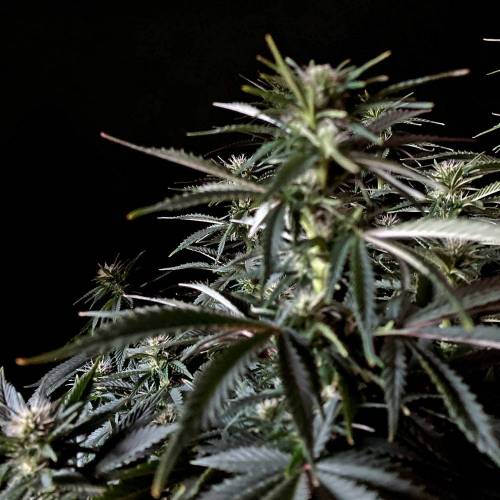
It's the third week since the switch to flowering; three weeks ago the plant started its flowering schedule at 36cm tall, and today it’s at 56cm, with the stretch coming to an end—perfect height for my intense lighting purposes.
The plant has a bulbous shape with countless branches ready to produce good buds on each of them. The leaf mass is lush and very dense; the plant is taking care of getting rid of useless leaves. In fact, it has already started sucking nutrients from some old leaves. I won’t be doing any defoliation; everything is set up to capture the maximum energy from the lights and feed this girl as she deserves... let’s play!
Two days ago, I changed all the side LED panels. I replaced the 6400K panel (60x30cm, 32w) with another one of 2800K. I also swapped the two side panels of 30x30cm, 32w (7700K and 450nm) for two others with 3000K and 660nm diodes. Additionally, I replaced a 60x30cm, 32w panel with 4000K for two 50cm, 23w TLED bars from Secret Jardin for flowering, with fantastic diodes of 2100K, 3000K, and IR. Finally, I completed the light canopy with two new lamps to cover the sides of the tent very well, as having the lights too close to the tips reduces lateral reach. I added a 2800K COB with a 90° lens and 50w, and on the other side of the canopy, I added a high-brightness LED panel (20x20, 50w) with 2700K and 660nm diodes... let’s play!
I’ve started to take advantage of this light change to switch up the Bio Fertilizers. I began the week with a deep watering and an energy boost based on amino acids, humic acids, and other macro and micro Bio nutrients. Gradually, I will be watering with mixes where I will mainly enhance phosphorus and potassium.
During the vegetative growth period, every 10-15 days I’ve been adding dry amendments to the substrate at a rate of 1g per liter of soil. I’ve used, in chronological order: Blood meal, Mealfrass, and feather meal. I also regularly replenish dry organic matter to the mulch; this week, a good handful of chopped dry leaves from defoliations—a fair return to the substrate that completes the life cycle, making the most of the waste generated by my crops, the defoliations, etc.
Until next time...
REGARDS TO ALL!!
================================
Info on the strain Malawi Gold: https://anesiaseeds.com/es/product/malawi-gold-landraces/
"Malawi Gold comes from Malawi, a country in Southeast Africa, and is one of the most psychoactive plants in the world." Anesia Seeds
- Genetics: African landrace
- Pure Sativa: 100%
- Flowering Time - 10-13 Weeks
- Indoor Yield: 600/650 g/m²
- High THC - 20%
- Flavors: Floral and Lemon
================================
4 likes
1 comment
Share
13
Week 13. Flowering3y ago




58 cm
Height
12 hrs
Light Schedule
24 °C
Day Air Temp
6.5
pH
675 PPM
TDS
65 %
Air Humidity
17 °C
Solution Temp
18 °C
Substrate Temp
17 °C
Night Air Temp
15 liters
Pot Size
0.75 liters
Watering Volume
10 cm
Lamp Distance
Nutrients 7
Agua de Montaña
1000 mll
Humato Bones
15 mll
Lacto Frutas PK
25 mll
deFharo Welcome, clandestine marijuana growers, and also to those lucky enough not to be one! 🙋♂️👨🌾
Fourteen weeks into the life of this pure African sativa, which I'm in love with! 🌲🧡
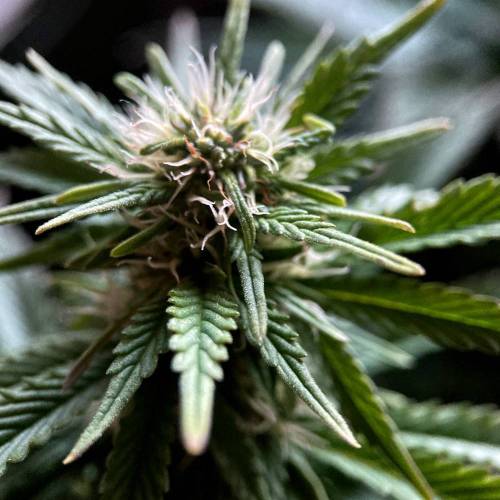
It's the fourth week since the transition to flowering; four weeks ago the plant started the flowering schedule at 36cm tall, and today it's 58cm, and the stretching has come to an end. Now all the plant's energy is focused on flower formation, with dozens of beautiful buds peeking out everywhere... let’s play!
The large leaf mass still hides the trunk and branches, perfect! The plant needs to capture a lot of energy to develop this sea of buds. At this stage, I ask myself if the grow is going well and what I can expect from it. I look at the leaf mass, especially if it's dense enough that I can't see the trunk and branches. Bare plants at the base depress me. The second crucial question I ask myself is whether this plant, as it is, could withstand being outdoors in harsh weather conditions. In this grow, as well as in others, the answer is YES!
I've started using new watering formulas aimed at boosting flowering. I water each plant with different mixes to see if I can identify differences in development. On another note, the plant has begun self-defoliating useless inner leaves. The plant absorbs all the nutrients and moisture from the old or light-hidden leaves, then throws them onto the mulch to complete the natural cycle.
Remember that this season I haven't done any defoliations; I've greatly enhanced the development of the leaf mass to capture the maximum light/energy. The intelligence of the plants will now lead to their own defoliation. The plants are now focused on flower formation and are getting rid of useless leaves, but first, they cannibalize them to recover the nutrients and minerals they grew with.
This week I've also completed the lighting strategy. I've added a new 3000K COB with a 120° lens (50w) to the canopy so that there’s powerful light on all sides and nothing is left in the shadows. Now with 6 lamps in the canopy (500w) and 5 LED side panels and bars (148w) covering the 4 corners, I total 648w. If I divide that by the 6 plants in the grow tent, that gives 108w per plant, which I think will help me achieve maximum yield from these grows!
Until next year...
REGARDS AND HEALTH TO ALL!!
================================
Info on the strain Malawi Gold: https://anesiaseeds.com/es/product/malawi-gold-landraces/
"Malawi Gold comes from Malawi, a country in Southeast Africa, and is one of the most psychoactive plants in the world." Anesia Seeds
- Genetics: African landrace
- Pure Sativa: 100%
- Flowering Time - 10-13 Weeks
- Indoor Yield: 600/650 g/m²
- High THC - 20%
- Flavors: Floral and Lemon
================================
7 likes
3 comments
Share
14
Week 14. Flowering3y ago


61 cm
Height
12 hrs
Light Schedule
24 °C
Day Air Temp
6.5
pH
700 PPM
TDS
65 %
Air Humidity
17 °C
Solution Temp
18 °C
Substrate Temp
17 °C
Night Air Temp
15 liters
Pot Size
0.75 liters
Watering Volume
10 cm
Lamp Distance
Nutrients 9
Agua de Montaña
1000 mll
Bio PKs EM
20 mll
Lacto Complex
10 mll
deFharo Welcome clandestine marijuana growers, and also to those lucky enough not to be one! 🙋♂️👨🌾
Fifteen weeks into the life of this pure African sativa, which I’m in love with! 🌲🧡
Completely focused on developing dozens of flowering buds, the plant maintains a beauty that matches its strength, great metabolism, and water and nutrient consumption.
These days I’m feeding the plant with various mixes of Bio Nutrients while also nourishing the soil with new layers of mulch that I bring from the leaves discarded by the plant itself. I crush them and add them to the substrate; these still-green leaves have proven to be an excellent habitat for the proliferation of aerobic microbiology. Currently, all the mulch in my crops has a greasy feel, which is the unmistakable sign of the humification of the organic matter in the mulch. Additionally, this week I’ve added dry amendments like bone meal (Ca, P...) and worm guano or mealfrass (P, K, Mg...). This guano is excellent for me, as it promotes microbiology proliferation like no other and is easier to digest than classic bird or bat guanos. I also have a formula where I’ve solubilized this guano with Activated Mountain Microorganisms (MMA) and Fermented Grass, proving to be a fantastic compound to revive lazy crops.
Until next year...
CHEERS AND HEALTH TO ALL!!
================================
Info on the strain Malawi Gold: https://anesiaseeds.com/es/product/malawi-gold-landraces/
"Malawi Gold comes from Malawi, a country in Southeast Africa, and is one of the most psychoactive plants in the world." Anesia Seeds
- Genetics: African landrace
- Pure Sativa: 100%
- Flowering Time - 10-13 Weeks
- Indoor Yield: 600/650 g/m²
- High THC - 20%
- Flavors: Floral and Lemon
================================
5 likes
comments
Share
15
Week 15. Flowering3y ago






61 cm
Height
12 hrs
Light Schedule
24 °C
Day Air Temp
6.5
pH
800 PPM
TDS
65 %
Air Humidity
17 °C
Solution Temp
18 °C
Substrate Temp
17 °C
Night Air Temp
15 liters
Pot Size
0.7 liters
Watering Volume
10 cm
Lamp Distance
Nutrients 10
Agua de Montaña
1000 mll
Bio Bones+ EM
15 mll
MMA Plus
10 mll
deFharo Welcome clandestine marijuana growers, and also to those lucky enough not to be one! 🙋♂️👨🌾
16 weeks into the life of this pure African sativa, which I’m in love with! 🌲🧡
As is traditional at this time of year, the plants and I are having big feasts with home-cooked products—no overindulgence here! We’re all getting healthy and happy... let the party continue! 💃🕺
••• Well, despite the low activity on GD and to avoid dying of boredom, I continue my organic experimental process, and this time taking advantage of the dark and rainy day and my well-stocked marijuana cellar, I’m going to explain with a joint in hand a new practice framed in the concept of "feeding and protecting the soil," which I started trying out this week with all my pots.
This practice is especially useful for those who have soil and space for outdoor crops; I don’t have that space, I can only currently do indoor crops in pots, but that doesn’t mean I give up on these types of techniques.
If I had soil and outdoor space, I would do this practice every year during the soil's resting season. This practice consists of covering the soil with fresh green grass and immediately provoking the proliferation of certain lactobacillus, Bacillus subtilis, and a multitude of enzymes that only exist when the grass is freshly cut. Once dried, the grass turns into pure organic matter rich in silicon that will also serve as food for the microbiology.
In this diary: https://growdiaries.com/diaries/134104-grow-journal-by-defharo/week/782852
You can read about the practice of making fermented grass for use in creating Soluble Bio Fertilizers, as the bacteria and enzymes from fermented grass are particularly efficient in mineral chelation.
"Fermented grass is the viable alternative for those organic growers who do not have access to fresh cow manure to create Bio Fertilizers. Fresh grass contains Lactobacillus and a multitude of enzymes, and in conjunction with Mountain Microorganisms, I create a Bio ferment with a high population of Microorganisms very efficient in: decomposing organic matter, mineral chelation, and reducing the incidence of pests and diseases in crops, as this type of fermentation presents antagonistic relationships and competition with different phytopathogenic microorganisms."
What have I done and how?
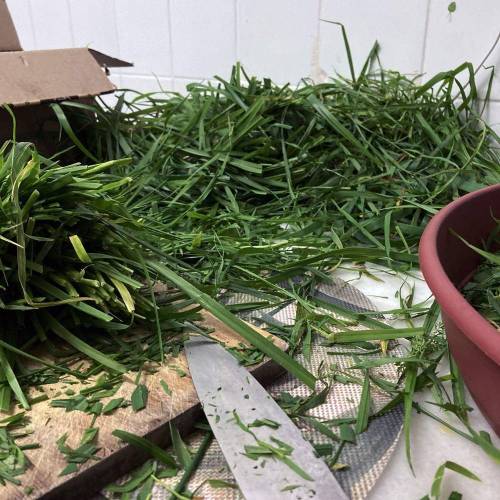
Yesterday I went for a walk in the countryside to look for fresh grass, but there are hundreds of types of grass that I don’t know, so the first choice for getting the optimal grass is to choose those fields where cows or ruminants generally graze. I chose yesterday to collect the grass because the day before it had rained quite a bit, which ensures the cleanliness from dust and impurities in the process.
I collected a good amount of fresh grass, still without seeds, mainly cutting the green leaves, but I also took some roots that contain trichoderma.
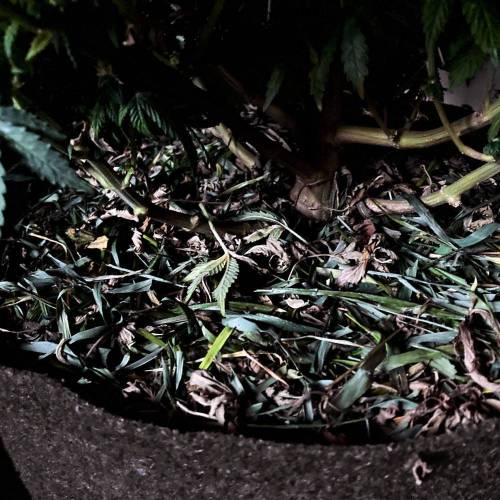
On the same day, when the grass is still fresh, I chop it up; this is important because the microbiology of this material is lost very quickly as the grass dries. Once chopped, I mixed it with crushed marijuana leaves that I had accumulated. Then I raked the mulch from my pots, where I already have a lot of microbial activity, humified organic matter, and remnants of dry amendments in the process of disintegration. I added a good layer of grass and mixed it all on the surface.
After doing the above, I concluded the process with a practice that will allow me to capture and proliferate the lactobacillus, Bacillus subtilis, and trichodermas in record time, before all that living material is lost with the dehydration of the grass.
Finally, I sprayed the entire surface of the grass mixed with the mulch with a solution of mountain water, molasses, and fresh yeast. I want to provoke an accelerated fermentation in the grass that will allow the capture of all living elements, enzymes, and minerals. Although I think this practice would have been better during the vegetative development stage, it’s still valuable now, especially to observe the behavior of the practice.
This practice arose from reflection on the care and feeding of outdoor cultivation lands, for me a whole theoretical development that I now apply in my pots.
In reality, if I had farmland and thinking about the rotational rest of the plots, I would do it as follows: For the land that will rest that year, I would plant grass and let it grow even until it produces seeds. Then I would cut it and leave it on the land; in this case, the solution with molasses and yeast wouldn’t be necessary since the soil where the grass was planted already contains all the microbiology that would take care of turning the grass into organic matter and then into humus. However, if we want to speed up the process, we can also use the solution with molasses and yeast, but in this case, we spray the grass before cutting it to immediately cut it and leave it moistened with the mixture on the soil. In a year, I could have at least two harvests of grass in these resting lands.
As in all my practices and organic solutions, what I try to do is accelerate all the natural decomposition processes of the forest through the management of waste, raw materials, and indigenous microbiology, in order to obtain high-yield crops and above all independence from the industry... for me today, there’s nothing more subversive than having a self-sufficient organic farm!
Until next time...
REGARDS AND HEALTH TO ALL!!
================================
Info on the strain Malawi Gold: https://anesiaseeds.com/es/product/malawi-gold-landraces/
"Malawi Gold comes from Malawi, a country in Southeast Africa, and is one of the most psychoactive plants in the world." Anesia Seeds
- Genetics: African landrace
- Pure Sativa: 100%
- Flowering Time - 10-13 Weeks
- Indoor Yield: 600/650 g/m²
- High THC - 20%
- Flavors: Floral and Lemon
================================
4 likes
comments
Share
16
Week 16. Flowering3y ago




61 cm
Height
12 hrs
Light Schedule
24 °C
Day Air Temp
6.5
pH
Normal
Smell
875 PPM
TDS
65 %
Air Humidity
17 °C
Solution Temp
18 °C
Substrate Temp
17 °C
Night Air Temp
15 liters
Pot Size
0.7 liters
Watering Volume
10 cm
Lamp Distance
Nutrients 8
Agua de Montaña
1000 mll
Lacto Mineral PK
20 mll
Bio Algas EM
20 mll
deFharo Welcome clandestine marijuana growers, and also to those lucky enough not to be one! 🙋♂️👨🌾
17 weeks into the life of this pure African sativa, seven weeks since the switch to 12/12 flowering schedule 🌲🧡
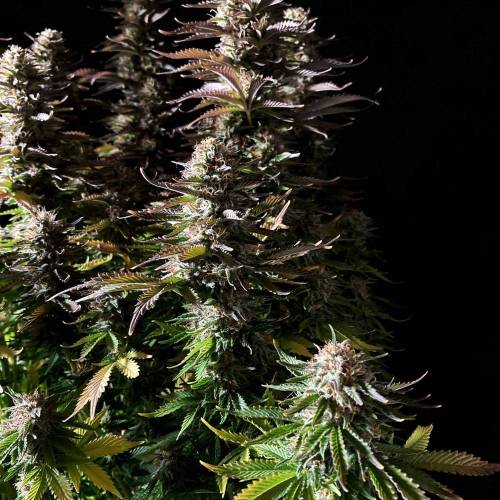
The plant is moving towards the zenith of its glory, with many floral buds everywhere and large branches, each vying to be more beautiful than the other.
The plant smartly sheds its dense foliage, absorbs nutrients, and drops the leaves onto the substrate to complete the forest cycle, while allowing better light penetration inside, meanwhile it eats and drinks eagerly to fatten up the buds.
The cold of this season is coloring many leaves on all the plants, they sense the arrival of winter and are striving hard to grow very fragrant, sticky, and beautiful flowers, waiting for a pollination that is not going to happen, but they don't know that yet.
Until next time...
CHEERS AND HEALTH TO ALL!!
================================
Info on the strain Malawi Gold: https://anesiaseeds.com/es/product/malawi-gold-landraces/
"Malawi Gold comes from Malawi, a country in Southeast Africa, and is one of the most psychoactive plants in the world." Anesia Seeds
- Genetics: African landrace
- Pure Sativa: 100%
- Flowering Time - 10-13 Weeks
- Indoor Yield: 600/650 g/m²
- High THC - 20%
- Flavors: Floral and Lemon
================================
6 likes
7 comments
Share
17
Week 17. Flowering3y ago




62 cm
Height
12 hrs
Light Schedule
24 °C
Day Air Temp
6.4
pH
Normal
Smell
825 PPM
TDS
65 %
Air Humidity
17 °C
Solution Temp
18 °C
Substrate Temp
17 °C
Night Air Temp
15 liters
Pot Size
0.7 liters
Watering Volume
10 cm
Lamp Distance
Nutrients 9
Agua de Montaña
1000 mll
Humato PK
5 mll
Guamato LE
10 mll
deFharo Welcome, clandestine marijuana growers, and also to those fortunate enough not to be one! 🖐️👨🌾
18 weeks into the life of this pure African sativa, eight weeks since switching to the flowering schedule 12/12h 🌲🧡
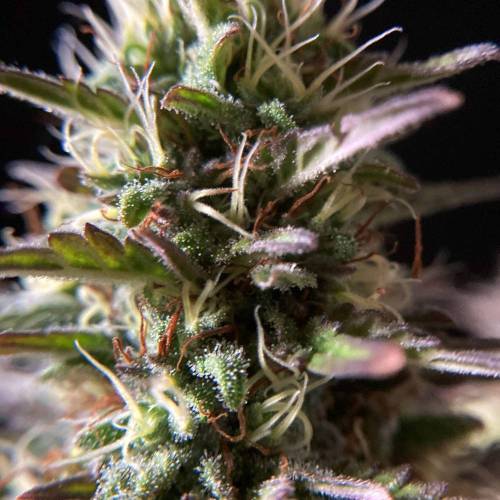
This plant from the African sun is growing and beautifying; this week there has been significant swelling of the buds, the leaf mass remains mostly intact, the plant continues with a slow but smart defoliation, and the buds are turning red! Complex and intense aromas manifest with any touch...
This plant consumes a lot of water and eats many nutrients, it is never satisfied! A sign of the great metabolism driven by the intense light surrounding it, currently this grow is a whole, a living organism in perfect symbiosis and harmony between light, substrate, and microbiology; the enormous buds crowning the plant and the leaf mass are the true reflection of the health and efficiency of everything in the substrate.
Two days ago, after a week without seeing my garden, I organized a big feast with all my plants, a fraternal meal where I cooked new recipes, we drank, ate, and danced to the music, enveloped in the smoke of my best marijuana!
According to the producer, there are at most 5 weeks left in the grow; at the rate this plant is going, the result is going to be monstrous, although I have to say that this season I am applying a technique, which I will explain if I see results, where I try to delay the senescence of the plant, extending the flowering period, and thus giving more time for the buds to swell, a kind of Elixir of Life. At the same time, I remind everyone that I feed my plants with every watering until the end of their life; I don’t do water-only waterings, and I always feed my plants whenever I water, as if it were for myself... let’s play!
In nature, this plant would be experiencing autumn; the light during this time is softer and reddish, I have moved the lights a bit away from the canopy, I don’t want to stress the upper tips!... we are on the road to glory!
Until next time...
REGARDS AND HEALTH TO ALL!!
================================
Info on the strain Malawi Gold: https://anesiaseeds.com/es/product/malawi-gold-landraces/
"Malawi Gold comes from Malawi, a country in Southeast Africa, and is one of the most psychoactive plants in the world." Anesia Seeds
- Genetics: African landrace
- Pure sativa: 100%
- Flowering Time - 10-13 Weeks
- Indoor Yield: 600/650 g/m²
- High THC - 20%
- Flavors: Floral and Lemon
================================
5 likes
comments
Share
18
Week 18. Flowering3y ago


62 cm
Height
12 hrs
Light Schedule
24 °C
Day Air Temp
6.5
pH
Strong
Smell
925 PPM
TDS
65 %
Air Humidity
17 °C
Solution Temp
18 °C
Substrate Temp
17 °C
Night Air Temp
15 liters
Pot Size
0.75 liters
Watering Volume
10 cm
Lamp Distance
Nutrients 11
Agua de Montaña
1000 mll
Alga Flora MMA
20 mll
Coco Bloom EM
10 mll
deFharo Welcome, clandestine marijuana growers, and also to those who are lucky enough not to be! 🙋♂️👨🌾
19 weeks into the life of this pure African sativa, nine weeks since switching to the 12/12 flowering schedule 🌲🧡
Huge colas crown this great plant, dozens of buds are waiting for their chance, the leaf mass is holding up, water consumption is steady, eat greedily and live happily!
I just hope the flowering lasts as long as possible to give the colas time to show their full potential; I predict monstrous, dense, sticky, and stinky colas... Long live Africa!
Until next time...
CHEERS AND HEALTH TO ALL!!
================================
Info on the strain Malawi Gold: https://anesiaseeds.com/es/product/malawi-gold-landraces/
"Malawi Gold comes from Malawi, a country in Southeast Africa, and is one of the most psychoactive plants in the world." Anesia Seeds
- Genetics: African landrace
- Pure Sativa: 100%
- Flowering Time - 10-13 Weeks
- Indoor Yield: 600/650 g/m²
- High THC - 20%
- Flavors: Floral and Lemon
================================
4 likes
comments
Share
19
Week 19. Flowering3y ago




62 cm
Height
12 hrs
Light Schedule
24 °C
Day Air Temp
6.5
pH
Strong
Smell
1000 PPM
TDS
65 %
Air Humidity
17 °C
Solution Temp
18 °C
Substrate Temp
17 °C
Night Air Temp
15 liters
Pot Size
0.65 liters
Watering Volume
10 cm
Lamp Distance
Nutrients 5
Agua de Montaña
1000 mll
Humato PK
30 mll
MMA One
30 mll
deFharo Welcome clandestine marijuana growers, and also to those lucky enough not to be one! 🙋♂️👨🌾
20 weeks into the life of this pure African sativa, ten weeks since switching to the flowering schedule 12/12h 🌲🧡
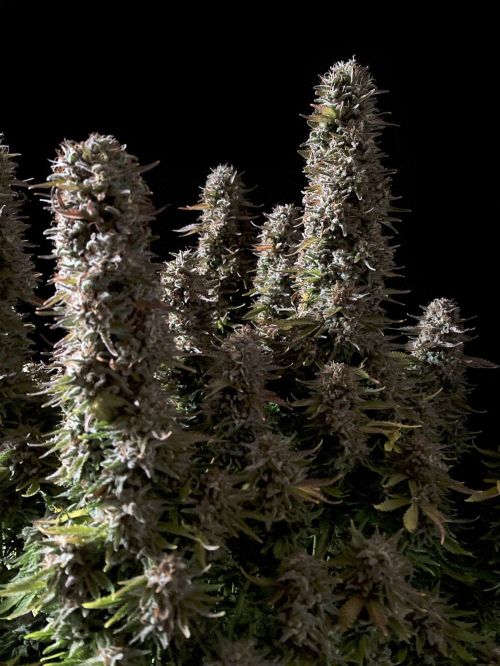
The buds are growing dark and dense, the plant drinks and eats abundantly, and little by little the leaves are falling, better defining the shape of the multiple colas.
This and the other plants of the season, although still beautiful, do not hide the passage of time; they are veteran plants resisting aging in the desperate wait to be pollinated one day.
- To avoid dying of boredom, I made a video where I talk about the daily tasks I do related to shaping the plants in my grow tent (60x120x178cm) with extra side lights. I hope everyone understands that with this "democratic" technique of moving pots, I give equal opportunities to all sides of the plants in all corners of the grow tent, achieving a more balanced morphology and growth... all for the cause!
Until next time...
CHEERS AND HEALTH TO EVERYONE!!
================================
Info on the strain Malawi Gold: https://anesiaseeds.com/es/product/malawi-gold-landraces/
"Malawi Gold comes from Malawi, a country in Southeast Africa, and is one of the most psychoactive plants in the world." Anesia Seeds
- Genetics: African landrace
- Pure Sativa: 100%
- Flowering Time - 10-13 Weeks
- Indoor Yield: 600/650 g/m²
- High THC 20%
- Flavors: Floral and Lemon
================================
7 likes
comments
Share
20
Week 20. Flowering2y ago




62 cm
Height
12 hrs
Light Schedule
24 °C
Day Air Temp
6.3
pH
Strong
Smell
725 PPM
TDS
65 %
Air Humidity
17 °C
Solution Temp
18 °C
Substrate Temp
17 °C
Night Air Temp
15 liters
Pot Size
0.65 liters
Watering Volume
10 cm
Lamp Distance
Nutrients 9
Agua de Montaña
1000 mll
Melaza
1 mll
Lacto Frutas EM
15 mll
deFharo Welcome clandestine marijuana growers, and also to those lucky enough not to be one! 🖐️👨🌾
21 weeks into the life of this pure African sativa, 11 weeks since switching to the flowering schedule of 12/12h 🌲🧡
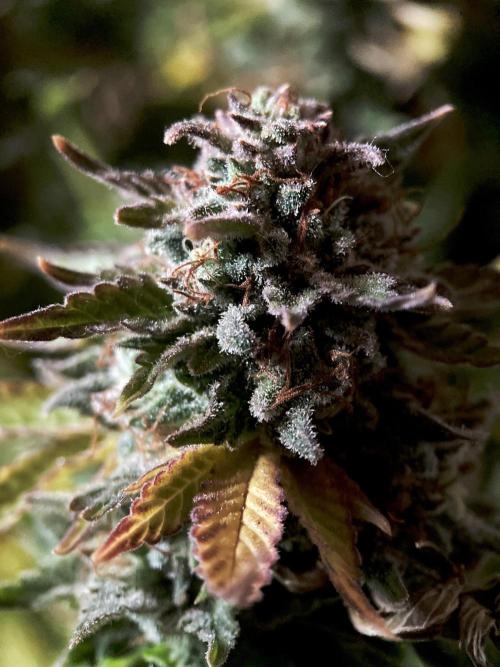
The evolution this week is impressive, the volume has increased and the big colas are fattening up, there’s no limit! Water consumption has also risen, the plant is living its maturity with great vigor, it wants to keep living.
This week after a first gentle stimulating watering with my fruit lacto-ferment and guano hydrosol, I returned in the second watering to the big feedings, the plant is asking for it and I’m giving it... all for the cause!
The plant retains a lot of energy and health to keep cultivating it, I think at least two more weeks will be necessary to bring out the full potential of this great African strain!
Until next time...
CHEERS AND HEALTH TO ALL!!
================================
Info on the strain Malawi Gold: https://anesiaseeds.com/es/product/malawi-gold-landraces/
"Malawi Gold comes from Malawi, a country in Southeast Africa, and is one of the most psychoactive plants in the world." Anesia Seeds
- Genetics: African landrace
- Pure Sativa: 100%
- Flowering Time - 10-13 Weeks
- Indoor Yield: 600/650 g/m²
- High THC 20%
- Flavors: Floral and Lemon
================================
6 likes
4 comments
Share
21
Week 21. Flowering2y ago


62 cm
Height
12 hrs
Light Schedule
24 °C
Day Air Temp
6.6
pH
Strong
Smell
700 PPM
TDS
65 %
Air Humidity
17 °C
Solution Temp
18 °C
Substrate Temp
17 °C
Night Air Temp
15 liters
Pot Size
0.65 liters
Watering Volume
10 cm
Lamp Distance
Nutrients 7
Agua de Montaña
1000 mll
Humato Plus
20 mll
Bio Fish EM
10 mll
deFharo Welcome clandestine marijuana growers, and also to those lucky enough not to be one! 🙋♂️👨🌾
22 weeks into the life of this pure African sativa, 12 weeks since switching to the 12/12 flowering schedule 🌲🧡
The plant continues to thrive, I've started watering with a lower concentration of nutrients, I think the grow can go at least another week, I'm in no rush, I observe the trichome development daily, the plant consumes the watering water in four days, as soon as the trichomes start maturing I'll give it one last watering and harvest, I'm really looking forward to trying this strain!
Until next time...
CHEERS AND HEALTH TO ALL!!
================================
Info on the strain Malawi Gold: https://anesiaseeds.com/es/product/malawi-gold-landraces/
"Malawi Gold comes from Malawi, a country in Southeast Africa, and is one of the most psychoactive plants in the world." Anesia Seeds
- Genetics: African landrace
- Pure Sativa: 100%
- Flowering Time - 10-13 Weeks
- Indoor Yield: 600/650 g/m²
- High THC 20%
- Flavors: Floral and Lemon
================================
2 likes
comments
Share
22
Week 22. Flowering2y ago




62 cm
Height
12 hrs
Light Schedule
24 °C
Day Air Temp
6.5
pH
Strong
Smell
575 PPM
TDS
65 %
Air Humidity
17 °C
Solution Temp
18 °C
Substrate Temp
17 °C
Night Air Temp
15 liters
Pot Size
0.7 liters
Watering Volume
10 cm
Lamp Distance
Nutrients 5
Agua de Montaña
1000 mll
MMA Ultra
7 mll
Alga Flora MMA
20 mll
deFharo Welcome, clandestine marijuana growers, and also to those who are lucky enough not to be!🙋♂️👨🌾
23 weeks into the life of this pure African sativa, 13 weeks since switching to the 12/12 flowering schedule 🌲🧡
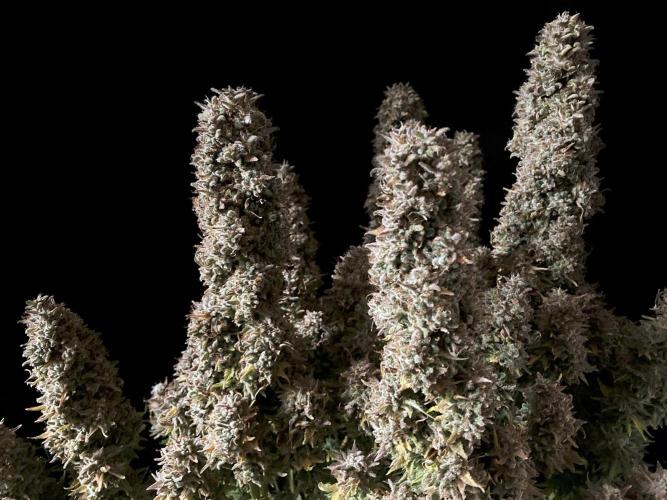
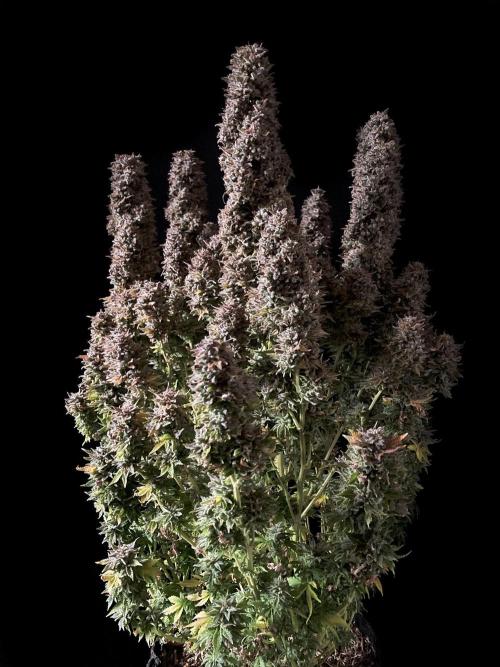
Last week of life for this African immigrant plant, just waiting for the final watering with mountain water before harvesting it; now it happily lives out its old age, the previous watering was like a last supper.
The plant is enormous, the countless buds are competing with each other to see which one is the fattest! Hakuna Matata!
Until next time...
CHEERS AND HEALTH TO EVERYONE!!
================================
Info on the strain Malawi Gold: https://anesiaseeds.com/es/product/malawi-gold-landraces/
"Malawi Gold comes from Malawi, a country in Southeast Africa, and is one of the most psychoactive plants in the world." Anesia Seeds
- Genetics: African landrace
- Pure Sativa: 100%
- Flowering Time - 10-13 Weeks
- Indoor Yield: 600/650 g/m²
- High THC 20%
- Flavors: Floral and Lemon
================================
4 likes
comments
Share
23
Week 23. Harvest2y ago
Happy Harvest Day!


10/10
Rated
Frankly the best plant of the season and that's considering it was competing with other equally sativa and mythical strains.
The strength, vigor, and joy have been noticeable throughout the entire cultivation, the plant resisted the attack of mold on the buds, gifting me dozens of them hard as rocks, very sticky and fragrant.
The leaf/flower ratio has been exceptional in favor of the flowers!
With this crop, I have tripled the producer's yield indications (Indoor yield: 600/650 g/m²)... not by coincidence!
Show more
Original
Spent 156 days
Ger Veg Flo Har
691 g
Bud wet weight per plant
236 g
Bud dry weight per plant
1
Plants
0.12 m²
Grow Room size
Easy
Difficulty

Creative, Happy, Giggly
Positive effects

Citrus, Earthy, Flowery
Taste
Height
Day air temperature
Air humidity
PPM
PH
Light schedule
Solution temperature
Night air temperature
Substrate temperature
Pot size
Lamp distance


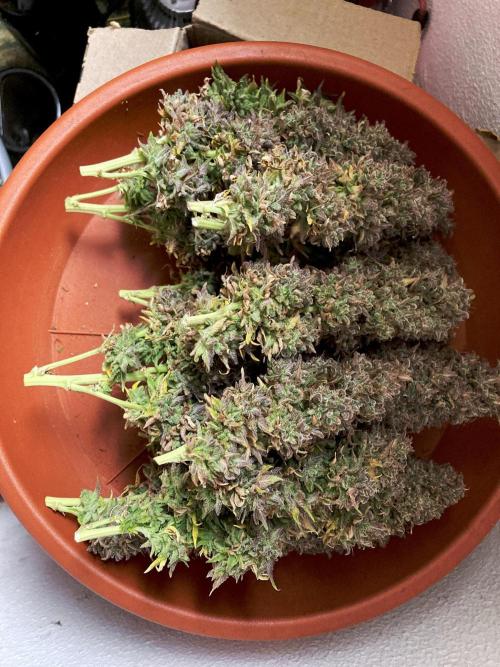


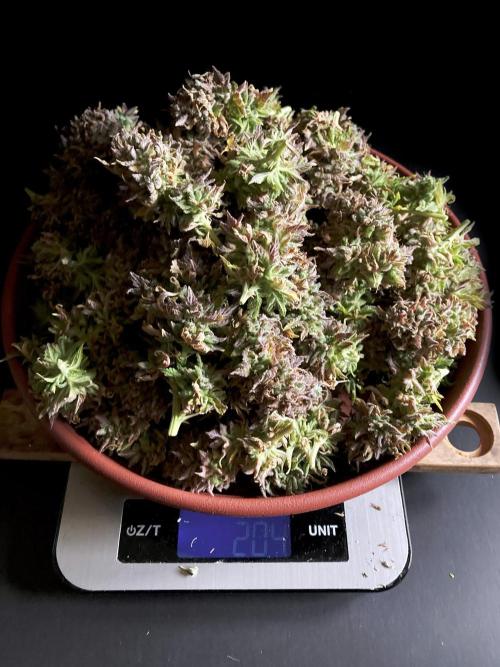

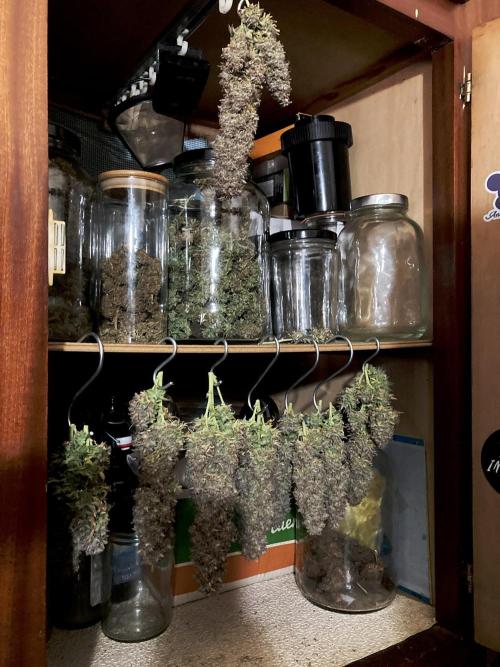


deFharo Bienvenidos cultivadores de marihuana clandestinos, y también, a los que tienen la fortuna de no serlo!🖐️👨🌾
24 semanas de vida de esta sativa africana pura, 14 semanas desde el cambio a horario de floración 12/12h 🌲🧡
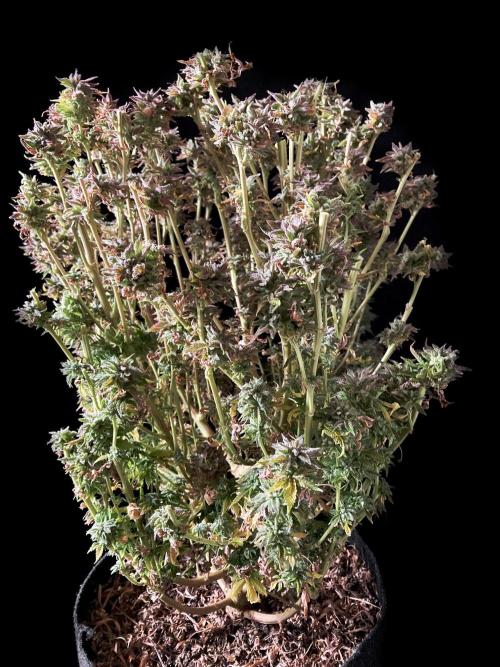
Hoy al amanecer he saqueado esta gran planta, la cual indiscutiblemente se ha coronado como la mejor de la temporada, he cosechado enormes colas y docenas de cogollos medianos, todos duros como rocas, pegajosos como la miel y tremendamente olorosos! ¡Mi bodega de sativa se recupera y ennoblece definitivamente... a fumar!
Hasta la próxima y gracias por estar ahí...
SALUDOS Y SALUD A TODOS!!
================================
Info de la cepa Malawi Gold: https://anesiaseeds.com/es/product/malawi-gold-landraces/
"Malawi Gold procede de Malawi, un país del sudeste de África, y es una de las plantas más psicoactivas del mundo." Anesia Seeds
- Genética: Landrace africana
- Sativa pura: 100%
- Tiempo de Floración - 10-13 Semanas
- Rendimiento en interior: 600/650 g/m²
- THC Alto 20%
- Sabores: Floral y Limón
================================
16 likes
6 comments
Share
Equipment Reviews

6 comments
Sort by
popularity
popularity
newest
oldest

11BNK11 commented2y ago
Hey buddy! Quick question: do you use CO2 to help with your grow or not? Just curious (you have some beautiful artwork, my friend).👌
likes 2

deFharo commented2y ago
@11BNK11, Hi. I don't use CO2; what I do is bring in a lot of fresh air to the grow tent. One season I made some CO2 generators, but I didn't notice anything and they took up space, so I stopped using them. growdiaries.com/diaries/134104-grow-journal-by-defharo
likes

GunnCat commented6mo ago
Fantastic! I hope taking pictures and growing weed is your profession because you're really good at it, brother. 🤙🏼
like 1
deFharo commented6mo ago
@GunnCat, Thanks a lot, mate! No, growing marijuana isn't my profession. I just play around in my clandestine garden. 😋
like 1
GunnCat commented6mo ago
@deFharo, Have you grown Zamaldelica?
like 1
deFharo commented6mo ago
@GunnCat, No, I haven't had the opportunity to grow Zamaldelica. But I have seen some great plants of that strain.
likes

the end.
Enjoying this diary? Follow for more updates!

Prefer the old Diary view?
Go back to the old Diary view