


Growing Stardawg and Strawberry Cough


Stardawg




Fan
AeroWave E6 Gen2, Grow Tent Clip Fan 6"


Cond
8,000 BTU Portable Air Conditioner
TOSOT


Indoor
Room Type
12-12
weeks 3-15
Four-Headed Monster
weeks 3-15
Topping
weeks 2
Defoliation
weeks 4-9, 11-14
LST
weeks 3-7, 9-14
11 l
Pot Size
2 l
Watering
Start at Harvest
G
Germination3mo ago
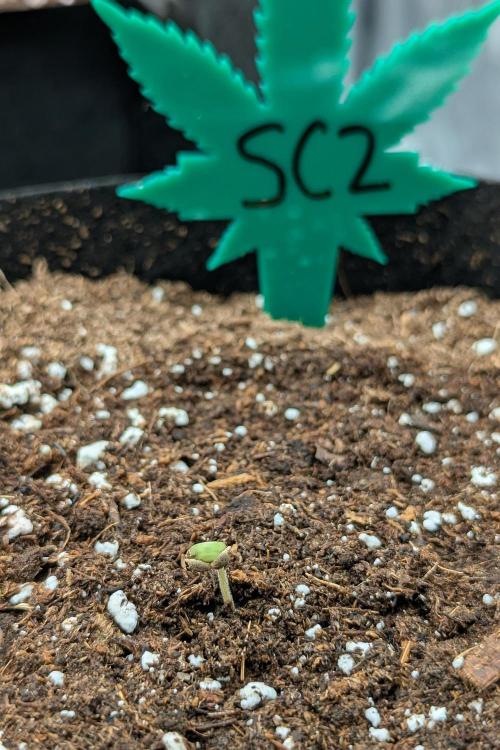
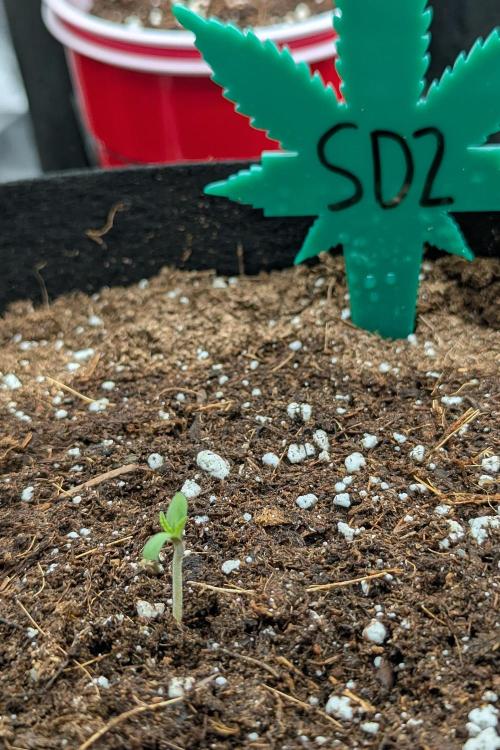
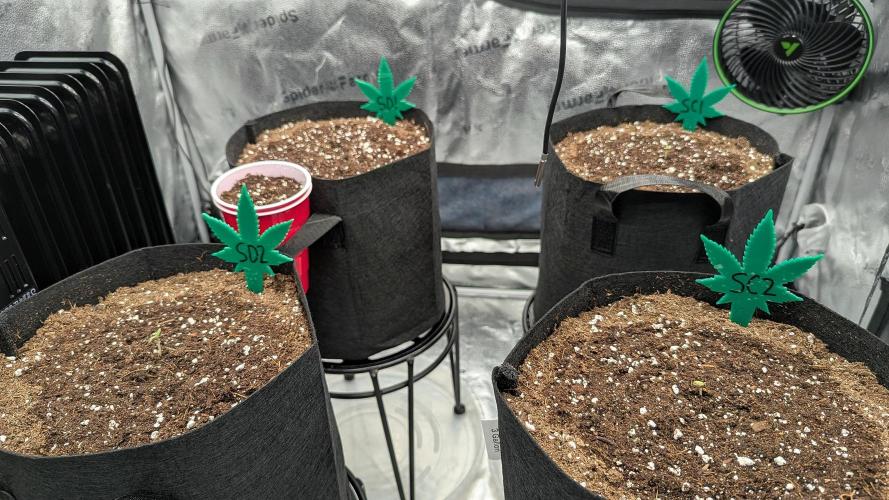
MichaelTheBarnOwl Grow #6, Entry #1: Germination & Emergence
Days Since Emergence: 1
The objective of this stage was to achieve uniform germination and emergence while establishing favorable environmental conditions for early root development and seedling establishment. During this period, environmental control and moisture management were prioritized with the intent of minimizing stress during the transition from seed to active growth.
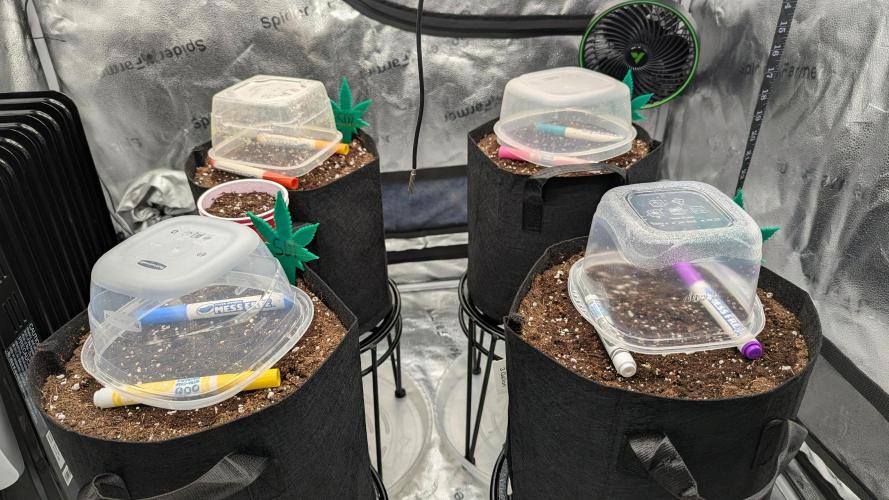
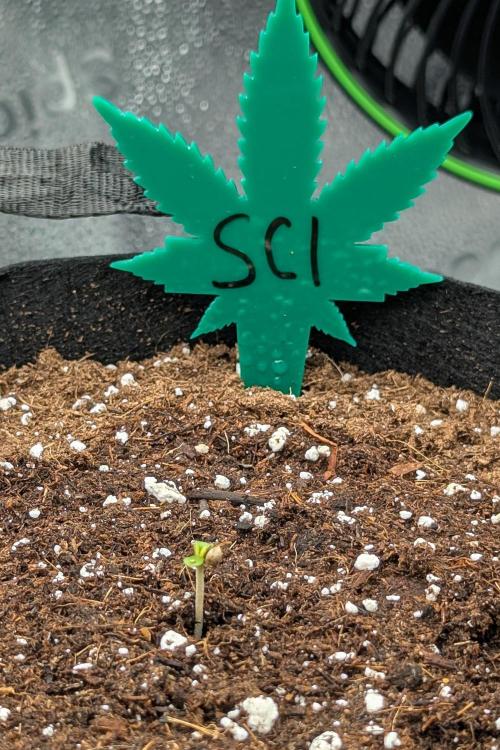
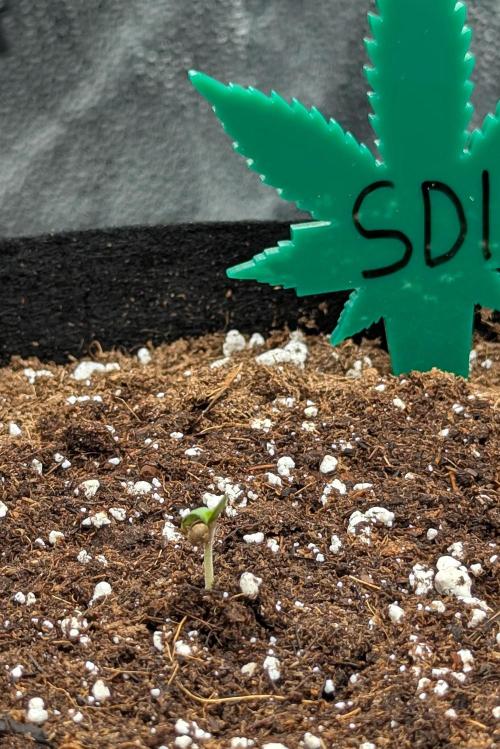
Four feminized photoperiod plants were established for the grow consisting of two Strawberry Cough (Dutch Passion) and two Stardawg (Blimburn). Individual plant identifiers were assigned at planting to support tracking throughout the grow cycle: Strawberry Cough #1 (SC1), Strawberry Cough #2 (SC2), Stardawg #1 (SD1), and Stardawg #2 (SD2).
Seeds were planted directly into final containers to avoid transplant stress later in development. Each plant was grown in a 3-gallon fabric pot filled with Pro-Mix HP with Mycorrhizae, a low nutrient, high-porosity growing medium selected for its drainage characteristics, aeration, and root-zone oxygen availability. No dry amendments or pre-amended soils were incorporated at planting, allowing complete control over nutrient delivery throughout the grow.
Prior to planting, the medium was lightly pre-moistened using distilled water to establish uniform starting conditions while avoiding saturation. Moisture levels were maintained conservatively during this phase to encourage root exploration and reduce the risk of delayed emergence. Water applications were localized around the planting zone rather than fully saturating the container volume.
Environmental conditions during germination and emergence were maintained toward the warmer end of the target range to support rapid metabolic activity and encourage uniform seedling development. Light intensity was intentionally kept low during this stage, providing sufficient energy for emergence while minimizing unnecessary transpiration and stress before root establishment.
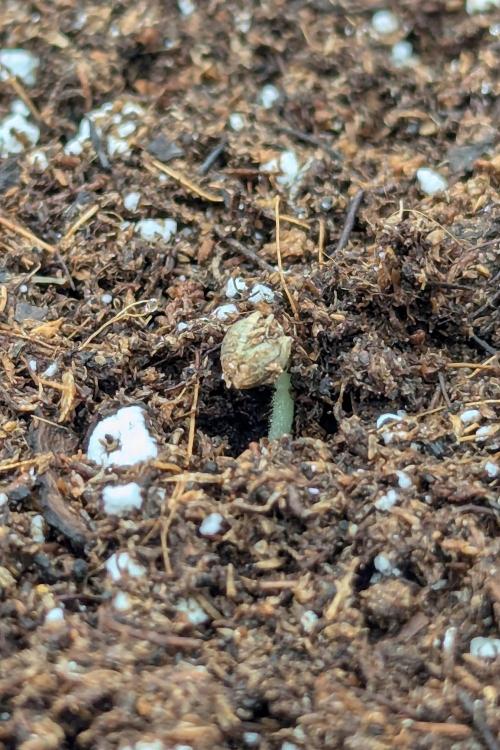
Emergence occurred rapidly and uniformly across all four plants, with seedlings breaking the surface within approximately 48 hours of planting. Cotyledon development was normal and no manual intervention was required to remove seed shells or assist emergence. Initial observations indicated good early vigor, upright posture, and no visible signs of environmental stress, damping off, stretching, or abnormal morphology.
Humidity domes were removed immediately following emergence to maximize unobstructed light availability to the seedlings and to avoid maintaining excessively humid conditions around the foliage that could encourage stretching. Following dome removal, environmental conditions remained controlled to support continued establishment while allowing the seedlings to begin acclimating to the open tent environment.
1 like
comments
Share
Used method
Glass Of Water
Germination Method
1
Week 1. Vegetation3mo ago
6.99 cm
Height
18 hrs
Light Schedule
27 °C
Day Air Temp
6.0
pH
No Smell
Smell
420 PPM
TDS
60 %
Air Humidity
21 °C
Solution Temp
26 °C
Substrate Temp
24 °C
Night Air Temp
11.4 l
Pot Size
0.25 l
Watering Volume
45.72 cm
Lamp Distance
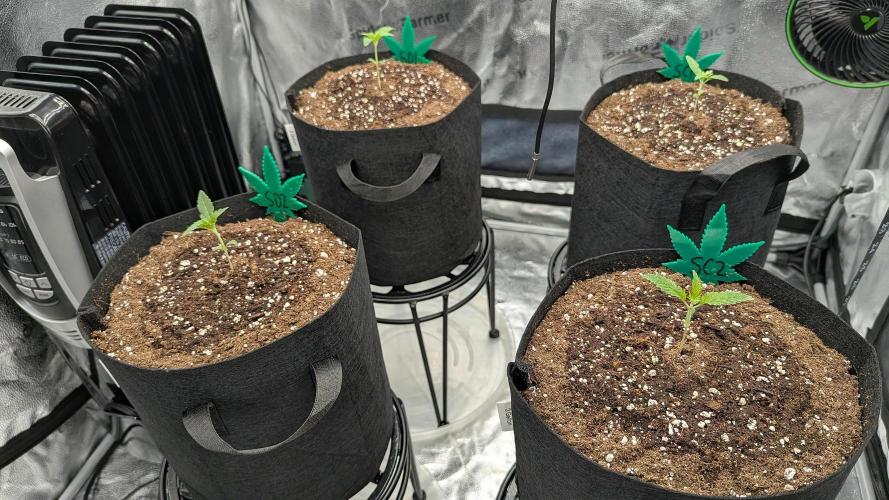
MichaelTheBarnOwl Grow #6, Entry #2: Seedling Stage
Days Since Emergence: 7
Irrigation strategy during this stage intentionally avoided full-container saturation. Water was applied either daily or every other day in progressively larger quantities as plant demand increased. Applications were delivered in a circular pattern several inches from the base of each seedling to encourage outward root exploration rather than concentrated root establishment directly beneath the stem. At the beginning of the week, approximately 0.05 L per plant was applied per watering event. By the end of the week, irrigation volume increased to approximately 0.25 L per plant. Water pH was maintained within a target range of 5.8–6.2 throughout the stage.
Nutrients were introduced during the middle of the week following successful establishment and continued expansion of the first true leaves. General Hydroponics Flora Series was introduced at concentrations suitable for seedlings and maintained intentionally low to avoid unnecessary stress while beginning the transition toward active feeding. Solution strength increased gradually from approximately 340 ppm at nutrient introduction to approximately 420 ppm by the end of the week. Supplemental CAL-MAG was introduced mid-week at an equivalent concentration of 2 ml/gal, and silica was also introduced at a low concentration (0.5 ml/gal) to support early structural development and prepare plants for increasing light intensity later in the cycle.
The vegetative schedule (18/6) was set to run from 8:00 PM through 2:00 PM. Near-infrared supplementation was incorporated at both the beginning and end of the photoperiod for a total of 30 minutes per light cycle. Light intensity was increased incrementally while fixture height remained unchanged, allowing seedlings to acclimate through output adjustments rather than distance changes. At the start of the week, measured light intensity ranged from approximately 310–330 PPFD across all four plants, corresponding to approximately 20–21 DLI. Mid-week, fixture intensity was increased from 40% to 45% output. By the end of the week, measured light intensity increased to approximately 375–400 PPFD, corresponding to 24–26 DLI.
End-of-week plant-specific light measurements were recorded as follows: SC1 measured 380 PPFD and 25 DLI, SC2 measured 375 PPFD and 24 DLI, SD1 measured 400 PPFD and 26 DLI, and SD2 measured 375 PPFD and 25 DLI. Taking plant growth into consideration, final canopy distance was maintained between approximately 18–19 inches, with the intent of allowing plants to gradually grow into increasingly intense light over time rather than continually repositioning the fixture.
UV-A supplementation was introduced during the middle of the week and delivered at the midpoint of the light cycle. Exposure began at 10 minutes per day and increased to 15 minutes per day by the end of the week.
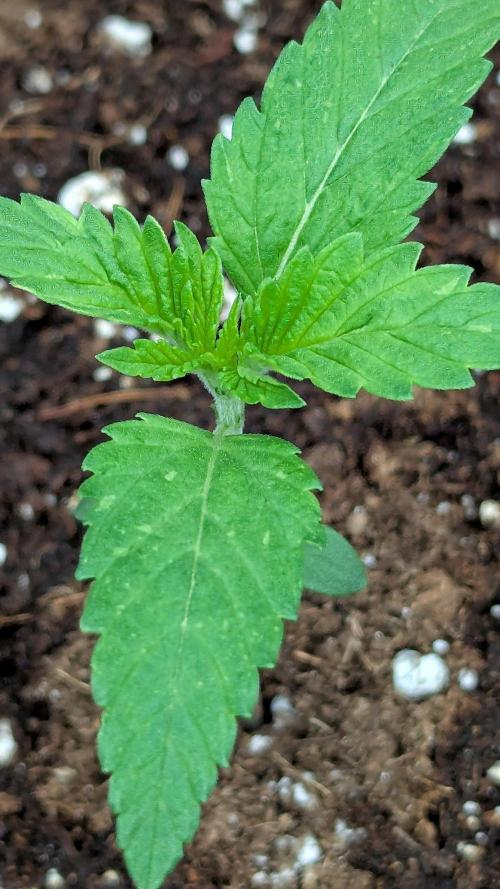
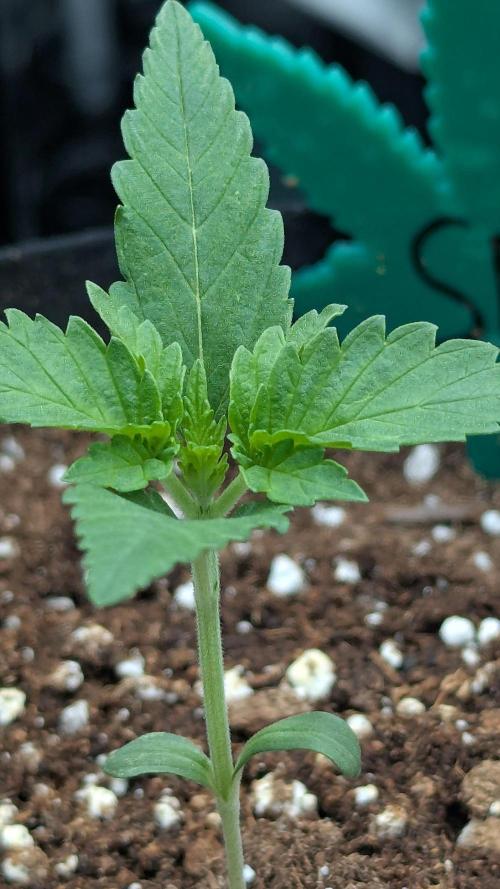
Growth remained compact and generally uniform throughout the seedling stage. By Day 7 since emergence, final recorded plant heights were 2.25 inches (SC1), 2.75 inches (SC2), 2.75 inches (SD1), and 2.50 inches (SD2). By the end of the week, all four plants had successfully established a first node with active expansion of the second node, while no third node development was yet observed. Internodal spacing remained tight with no meaningful signs of stretching following humidity dome removal.
2 likes
comments
Share
2
Week 2. Vegetation3mo ago
19.05 cm
Height
18 hrs
Light Schedule
27 °C
Day Air Temp
6.1
pH
No Smell
Smell
555 PPM
TDS
60 %
Air Humidity
18 °C
Solution Temp
23 °C
Substrate Temp
21 °C
Night Air Temp
11.4 l
Pot Size
0.95 l
Watering Volume
33.02 cm
Lamp Distance
MichaelTheBarnOwl Grow #6, Entry #3: Vegetation and Topping
Days Since Emergence: 14
Watering frequency transitioned from daily applications at lower volumes into an every-other-day schedule at progressively larger volumes as root establishment improved and plants became capable of utilizing greater moisture availability. Irrigation strategy also evolved throughout the stage. At the beginning of the week, water was delivered in a circular “donut” pattern several inches from the base of each seedling to encourage outward root exploration and discourage concentrated root establishment directly beneath the stem. As plants developed and root mass increased, irrigation zones were gradually expanded outward and by the end of the week water was routinely applied to the edge of the container. This approach was intended to encourage lateral root expansion prior to further increasing irrigation volume to drive root development downward through the container. Irrigation volume increased from 0.25 L per plant at the beginning of the stage to 0.75 L per plant by the end of the week. Water pH remained controlled within a target range of 5.8–6.2.
Nutrient concentration increased progressively throughout the stage as plants transitioned out of seedling feeding and into active vegetative growth. The week began utilizing General Hydroponics seedling-strength nutrient concentrations and gradually transitioned into General Hydroponics “Early Growth - Week 2” feed levels, progressing from light toward medium-strength applications by the end of the week. Solution strength increased from 400 ppm at the beginning of the week to 555 ppm by the end of the week in response to increasing irrigation volume, growth rate, and nutrient demand. Supplemental CAL-MAG concentration increased from 2 mL/gal to 3 mL/gal, while silica concentration increased from 0.5 mL/gal to 1 mL/gal.
Light intensity was increased progressively while fixture height remained fixed, allowing plants to grow into increasing intensity rather than continuously repositioning the fixture. Fixture output increased from 45% at the beginning of the week to 50% by the conclusion of the stage. Measured light intensity increased from approximately 375–400 PPFD, corresponding to approximately 24–26 DLI, to approximately 475–520 PPFD, corresponding to approximately 31–34 DLI by the end of the week. Final canopy distance to the fixture was recorded at approximately 14–16 inches.
UV-A supplementation increased from 15 minutes per day at the beginning of the week to 20 minutes per day by the end of the week.
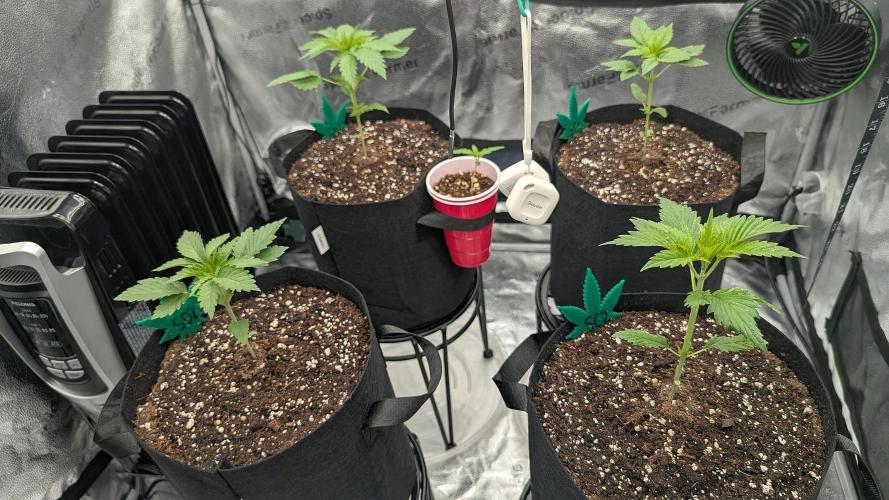
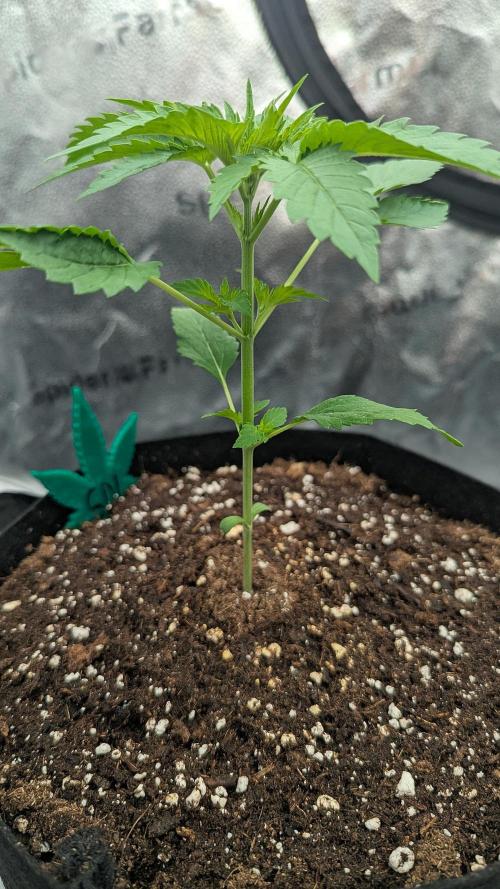
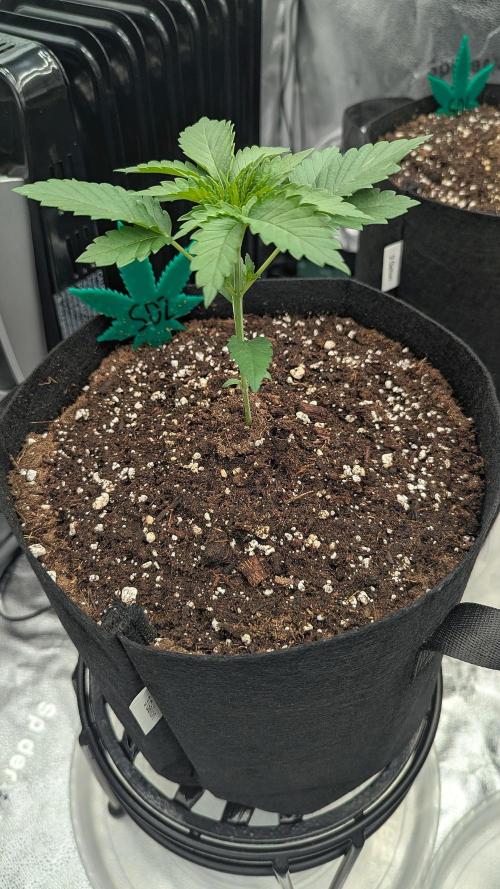
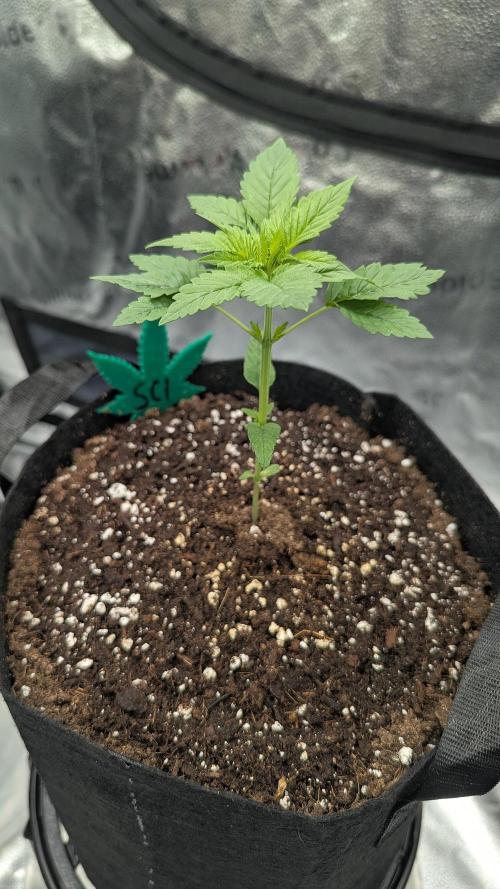
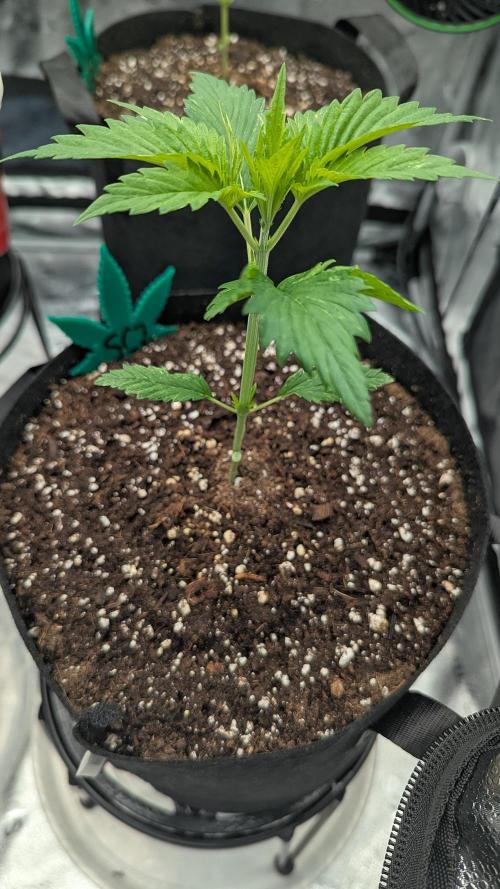
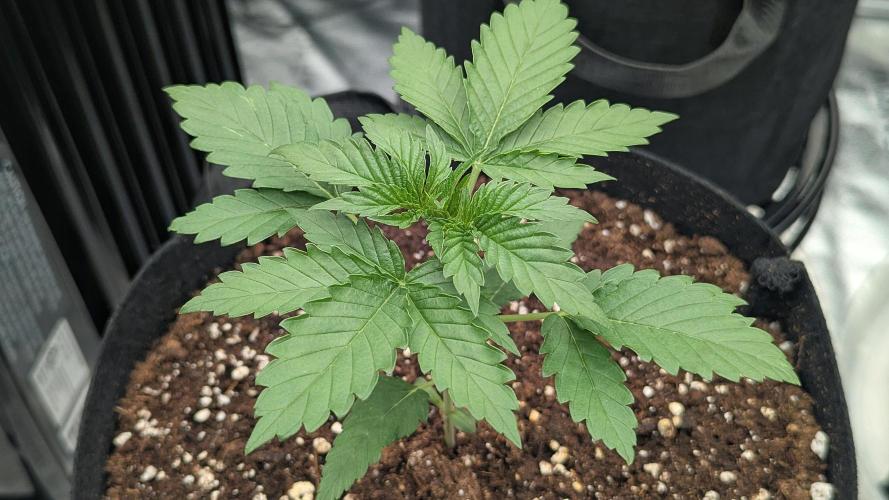
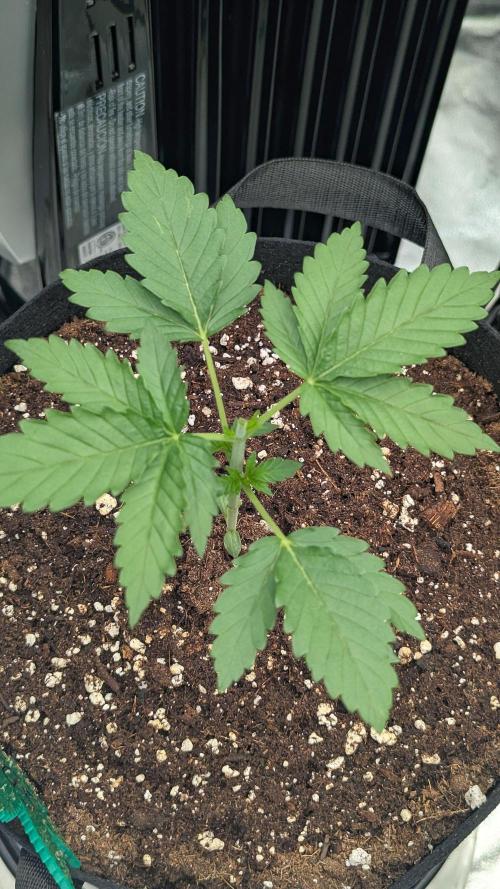
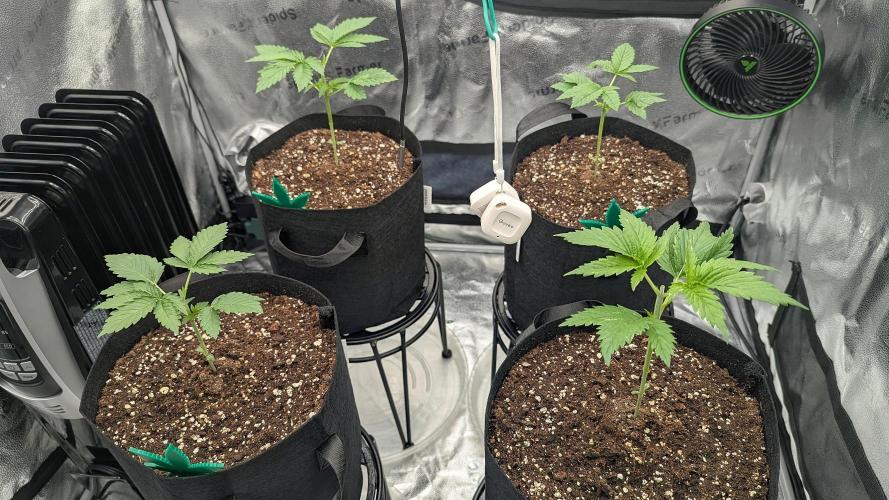
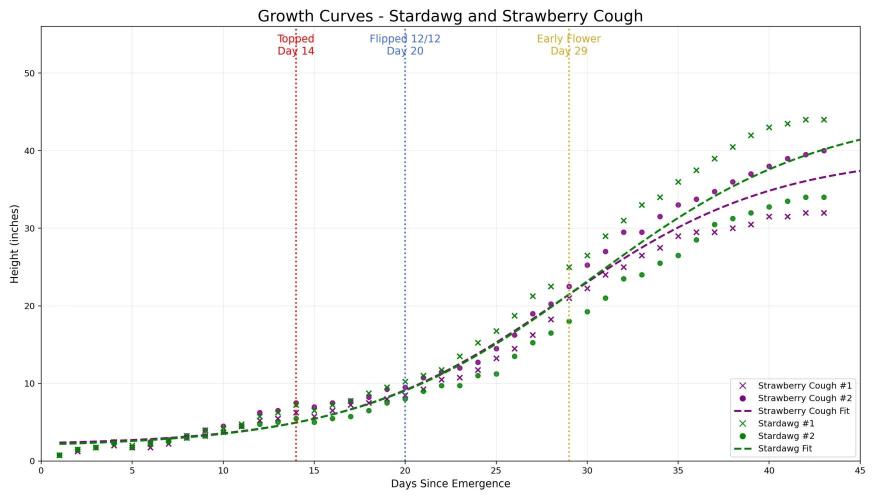
Vegetative growth accelerated substantially during this period and differences in vigor between individual plants became increasingly apparent. Height measurements recorded immediately prior to topping on Day 14 were 6.25 inches (SC1), 7.50 inches (SC2), 7.25 inches (SD1), and 5.50 inches (SD2). SD1 and SC2 demonstrated the strongest vertical growth during the stage while SC1 and SD2 remained shorter.
Node development progressed rapidly throughout the week. By the end of the stage, all four plants had successfully established three fully developed nodes with active expansion of the fourth node. On Day 14 since emergence, all four plants were topped. The apical meristem was removed above the third node, while the first node was removed entirely, leaving behind the second and third nodes as the intended permanent structure. This approach was selected to cultivate four primary branches per plant (“four-headed monsters”) while minimizing time spent in vegetative growth and maintaining control over final plant height. Plants were intentionally topped immediately after establishing the desired node count to allow a short recovery period prior to transition into flowering conditions.
Plants tolerated topping well with no signs of developmental slowdown or stress.
2 likes
comments
Share
Used techniques
Topping
Technique
3
Week 3. Vegetation3mo ago
27.94 cm
Height
18 hrs
Light Schedule
27 °C
Day Air Temp
6.1
pH
No Smell
Smell
750 PPM
TDS
60 %
Air Humidity
18 °C
Solution Temp
21 °C
Substrate Temp
21 °C
Night Air Temp
11.4 l
Pot Size
1.25 l
Watering Volume
33.02 cm
Lamp Distance
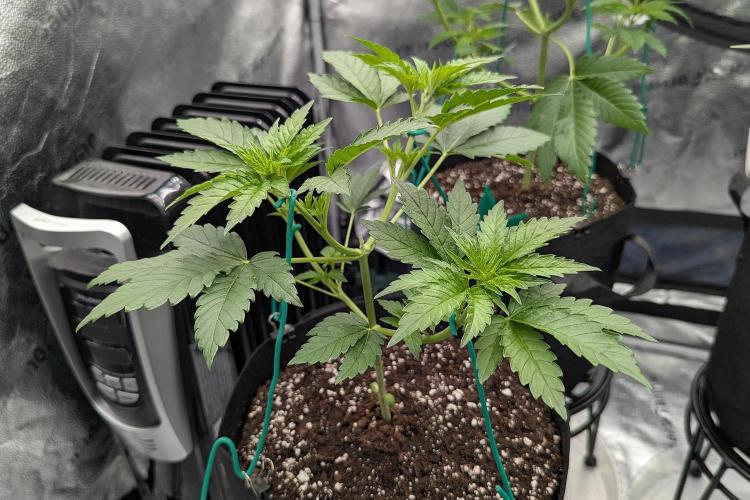
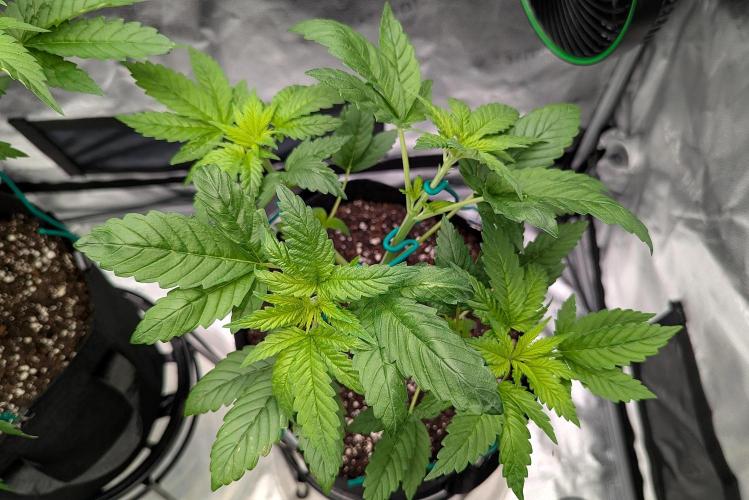
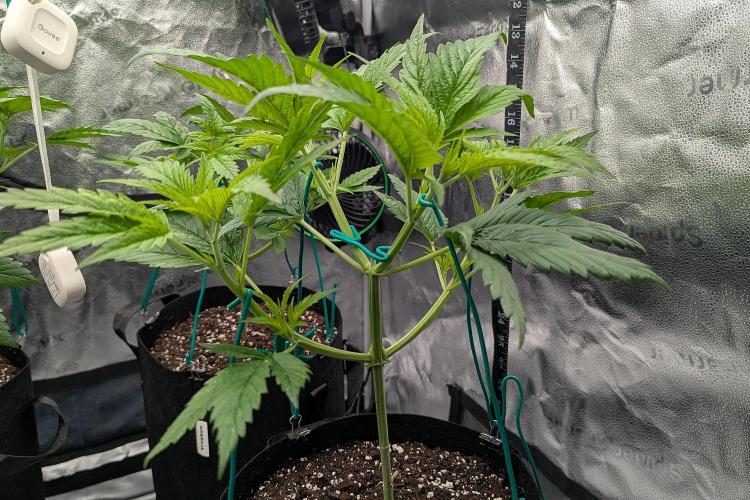
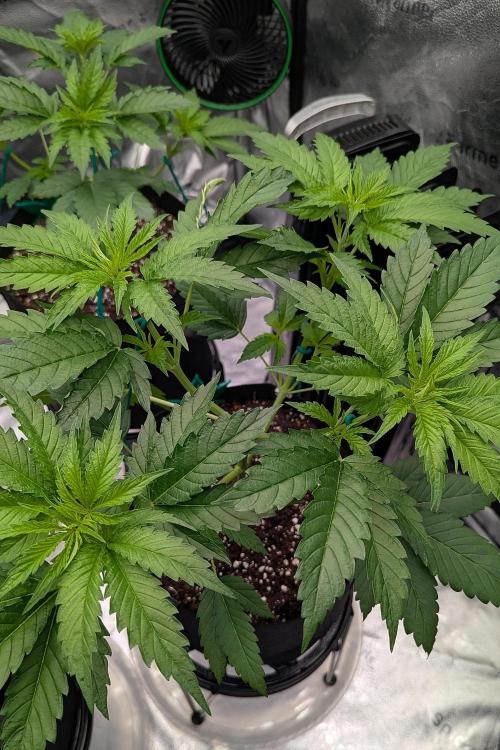
MichaelTheBarnOwl Grow #6, Entry #4: Post-Top Recovery and Flip
Days Since Emergence: 21
Days Since Flip: 1
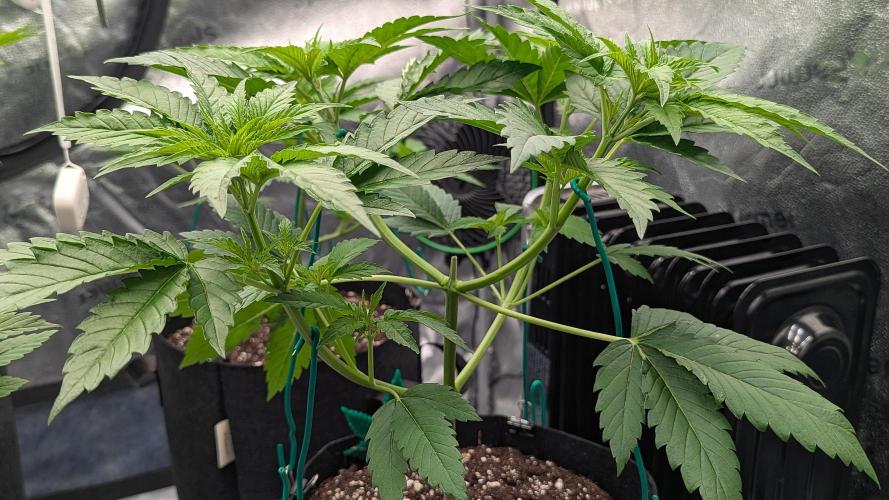
Watering volume and nutrient demand increased substantially throughout the stage as plants recovered from topping and accelerated their vegetative expansion. Irrigation remained on an every-other-day schedule, with watering continuing across the full active root zone following the root expansion strategy established previously. Irrigation volume increased from 0.75 L per plant at the beginning of the week to 2.0 L per plant by the end of the stage. Water pH remained controlled within a target range of 5.8–6.2.
Nutrient concentration increased throughout the week as plants transitioned from recovery into aggressive vegetative growth prior to the flip. Feeding began utilizing General Hydroponics “Early Growth – Week 3” at light concentration, progressed into “Early Growth - Week 3” at medium concentration, and by the end of the week were transitioned into “Late Growth” at light concentration in preparation for flip. Solution strength increased from 555 ppm at the beginning of the period to 750 ppm by the end of the period. Supplemental CAL-MAG concentration increased to 4 ml/gal, while silica concentration increased to 2 mL/gal and was now being applied with every other feeding.
Light intensity continued increasing as the plants were allowed to grow into stronger lighting conditions. Fixture output increased from 50% at the beginning of the week to 60% by the end of the stage. Measured light intensity increased from 475–520 PPFD, corresponding to approximately 31–34 DLI, to 590-655 PPFD, corresponding to 38-43 DLI on the day before the flip. Toward the end of the period, fixture height was increased to maintain target intensity as canopy expansion accelerated. Final canopy distance to the fixture was recorded at 13–15 inches.
UV-A supplementation continued and exposure duration increased to 30 minutes per light cycle.
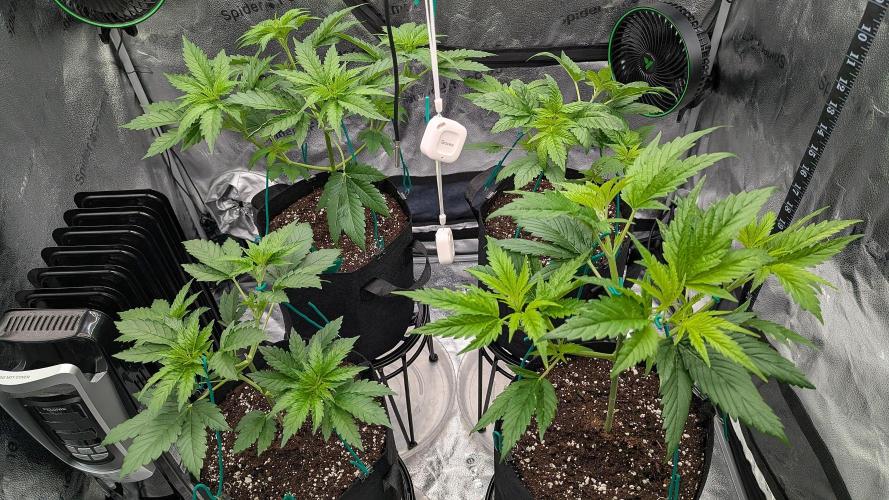
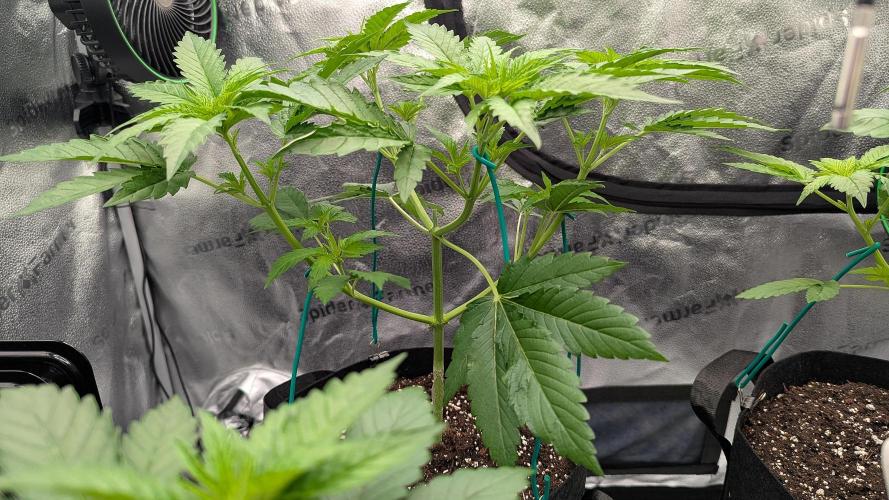
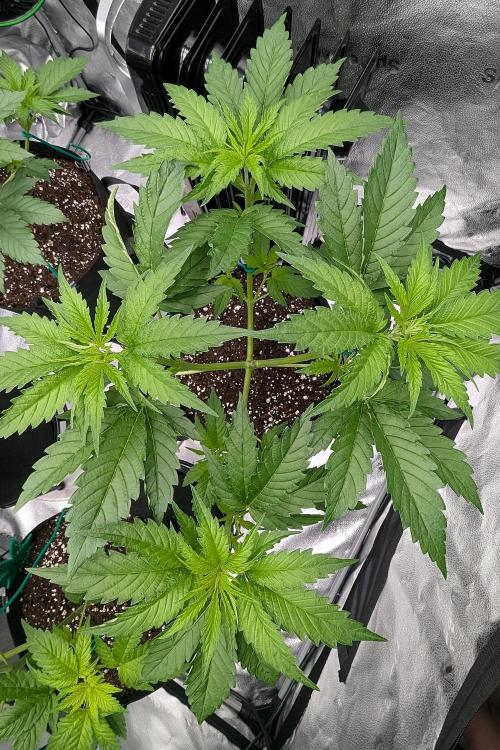
Plants responded rapidly following topping and showed no pause in growth whatsoever. Vertical growth resumed immediately and branch expansion accelerated within 48 hours of topping. It became clear during this stage that topping had successfully redistributed growth into the retained branch sets, which quickly became dominant growth points. Because sufficient branch development had been achieved with five days of recovery post-topping, the decision was made not to pursue additional vegetative time.
On Day 20 post-emergence, the light was flipped from 18/6 to 12/12.
Low-stress training (LST) was initiated during the middle of the week. Branches exceeding 2 inches in length were progressively trained outward and secured with the intention of maintaining a low, even canopy and directing growth toward the edge of each container rather than allowing them to go vertical. Adjustments were made daily as branch orientation changed. The objective of training was both to maximize horizontal spread and to maintain height control and improve future canopy uniformity heading into flower.
Plant height continued increasing throughout the stage. Height measurements recorded on the day of flip were 8.50 inches (SC1), 9.50 inches (SC2), 10.25 inches (SD1), and 8.00 inches (SD2). Differences in vigor became more apparent this week.
Plant height on Day 21 post-emergence / Day 1 post-flip was 9.25 inches (SC1), 10.75 inches (SC2), 11.00 inches (SD1), and 9.00" (SD2). My weekly reports always reflect the most recent set of measurements / the last day of the period being logged.
By the end of the period, branch sets generated from topping had established successfully and all plants had entered the desired structural condition moving into the transition stage. The light schedule was transitioned from 18/6 (8:00 PM–2:00 PM) to 12/12 (8:00 PM–8:00 AM) beginning on Day 20 post-emergence, marking the initiation of the ‘transition’ stage.
3 likes
comments
Share
Used techniques
LST
Technique
12-12
Technique
Four-Headed Monster
Technique
4
Week 4. Flowering3mo ago
57.15 cm
Height
12 hrs
Light Schedule
27 °C
Day Air Temp
6.1
pH
No Smell
Smell
800 PPM
TDS
60 %
Air Humidity
18 °C
Solution Temp
19 °C
Substrate Temp
18 °C
Night Air Temp
11.4 l
Pot Size
2 l
Watering Volume
25.4 cm
Lamp Distance
MichaelTheBarnOwl Grow #6, Entry #5: Transition Post-Flip
Days Since Emergence: 28
Days Since Flip: 8
Water demand increased substantially throughout the first week following flip as plants accelerated vegetative expansion and began establishing their flowering structure. Irrigation remained on an every-other-day. Water volume increased from 2.0 L per plant at the beginning of the period to 4.0 L / 1 gal per plant by the end of the period. Watering to runoff was intentionally introduced during this period both to discourage salt accumulation within the medium as nutrient concentrations increased and to ensure moisture penetrated the full container, encouraging roots to continue colonizing the entire volume of the grow medium. Water pH remained controlled within a target range of 6.0–6.2 throughout the period.
Nutrient concentration continued increasing to support rapid structural expansion and increasing irrigation demand. Feeding began the period utilizing General Hydroponics Late Growth at light concentration, progressed into Late Growth at medium concentration, and by the end of the period transitioned into a 50% Late Growth / 50% Early Bloom blend at medium concentration in preparation for flower onset. Solution strength increased from 750 ppm at the beginning of the period to 800 ppm by the end of the period. CAL-MAG increased from 4 mL/gal to 5 mL/gal, while silica remained at 2 mL/gal and continued being applied every other feeding.
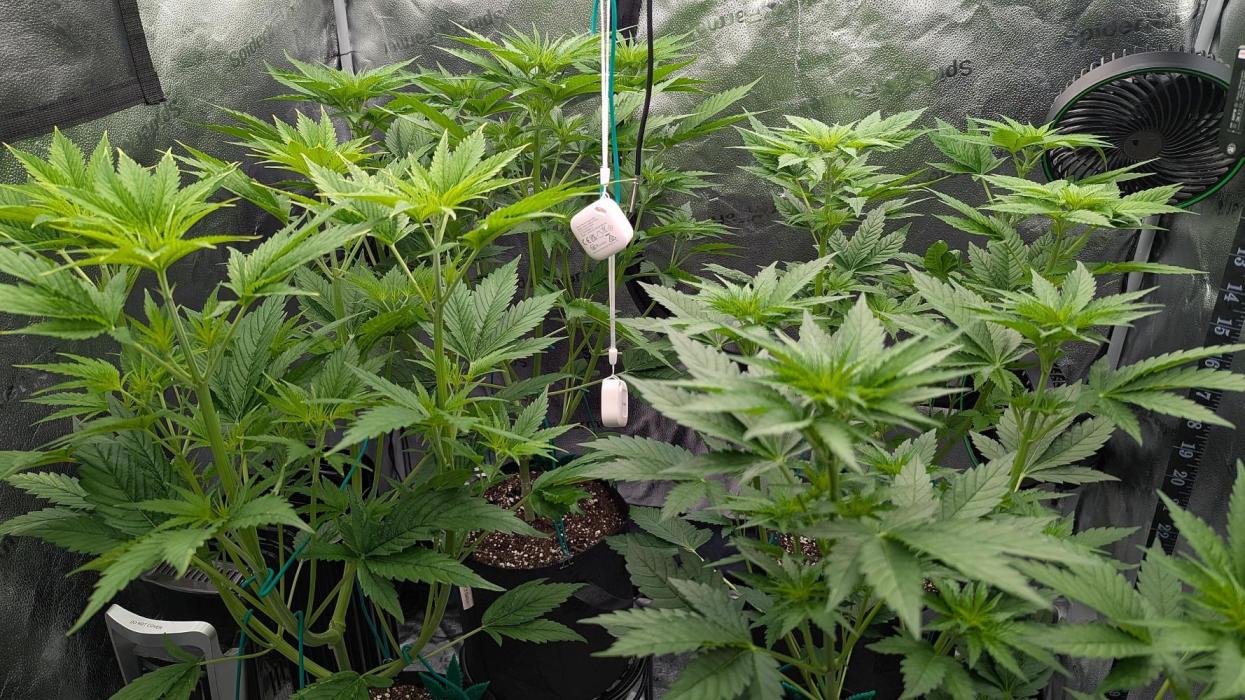
Light intensity continued increasing while fixture positioning was adjusted to maintain uniform canopy exposure as plant vigor differences became more pronounced. Fixture output increased from 60% at the beginning of the period to 65% by the end of the period. Measured light intensity entering the period ranged from 590–655 PPFD. By the end of the period, light measurements ranged from 690–750 PPFD, corresponding to 30–32 DLI. Plant-specific end-of-period measurements were recorded as follows: SC1: 700 PPFD / 30 DLI; SC2: 720 PPFD / 31 DLI; SD1: 750 PPFD / 32 DLI; SD2: 690 PPFD / 30 DLI. Fixture height and plant elevation were adjusted throughout the week to maintain more uniform exposure across the canopy. By the end of the period, distance between the canopy and fixture ranged from 10–17 inches depending on plant position.
Because differences in vigor and vertical growth rate became increasingly apparent during transition phase, shorter or taller plant stands were exchanged and repositioned throughout the period to maintain a more uniform canopy and reduce variability in light exposure across plants.
UV-A exposure increased from 30 minutes per light cycle to 45 minutes per light cycle.
Low-stress training remained highly active and was adjusted regularly to maintain horizontal structure and preserve an even canopy as branch elongation accelerated.
Targeted canopy management was introduced during this period through selective defoliation. Inward-facing leaves and selected lower leaves were removed where necessary to improve airflow through the interior of the canopy and reduce unnecessary shading of developing branch sites. Defoliation remained conservative and focused primarily on improving structure rather than reducing leaf mass.
Plant height increased substantially throughout transition. Final recorded heights on Day 28 since emergence / Day 8 since flip were 18.25 inches (SC1), 20.25 inches (SC2), 22.50 inches (SD1), and 16.50 inches (SD2).
SC2 began showing minor signs consistent with elevated nutrient demand, primarily nitrogen, calcium, and magnesium depletion associated with extremely rapid growth. Feeding concentration was increased accordingly and observations following adjustment indicated improvement without evidence of toxicity.
By the end of the period, pistils were observed on all four plants and rapidly spreading across plant nodes.
3 likes
comments
Share
Used techniques
LST
Technique
Defoliation
Technique
12-12
Technique
Four-Headed Monster
Technique
5
Week 5. Flowering3mo ago
91.44 cm
Height
12 hrs
Light Schedule
27 °C
Day Air Temp
6.1
pH
Weak
Smell
815 PPM
TDS
58 %
Air Humidity
18 °C
Solution Temp
19 °C
Substrate Temp
18 °C
Night Air Temp
11.4 l
Pot Size
2 l
Watering Volume
35.56 cm
Lamp Distance
MichaelTheBarnOwl Grow #6, Entry #6: Early Flower
Days Since Emergence: 35
Days since Flip: 16
Days in Flower: 7
Water demand continued increasing substantially as plants transitioned from stretch-dominant growth into early flower development and canopy occupancy accelerated. Irrigation remained on an every-other-day. Standard irrigation volume increased to 1 gallon per plant, although selected irrigation events were increased to 1.25 gallons per plant where necessary to ensure runoff. Runoff continued being used intentionally to discourage salt accumulation within the medium as nutrient concentrations increased and to ensure roots remained active throughout the entire container profile rather than concentrating in upper zones of the medium. Water pH remained controlled within a target range of 6.0–6.1 throughout the period.
Nutrient concentration continued increasing as flower initiation accelerated and plants entered a period of substantially higher demand. Feeding began the period utilizing an approximately 25% Late Growth / 75% Early Bloom blend at medium concentration, transitioned fully into Early Bloom at medium concentration, and by the end of the period moved toward Early Bloom at aggressive concentration. Solution strength progressed from 805 ppm at the beginning of the period to 815 ppm by the end of the period. CAL-MAG was held at 5 mL/gal, while silica application frequency remained every other feeding but concentration was reduced from 2.0 mL/gal to 1.5 mL/gal.
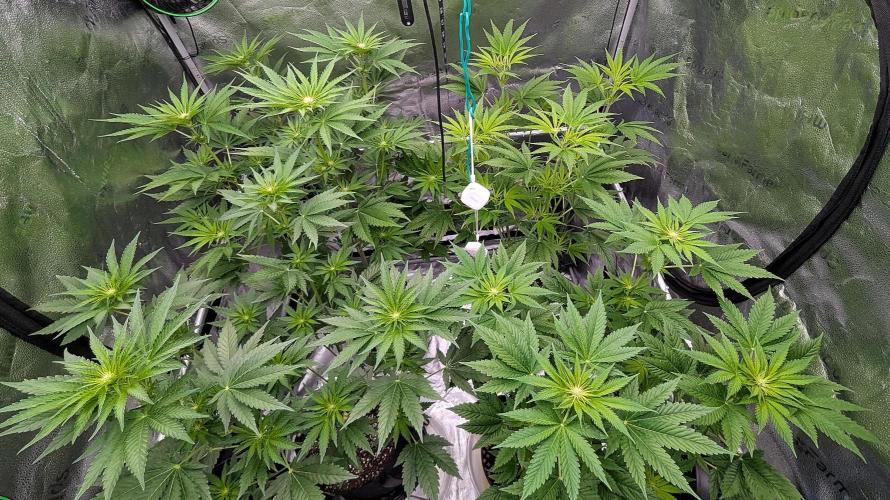
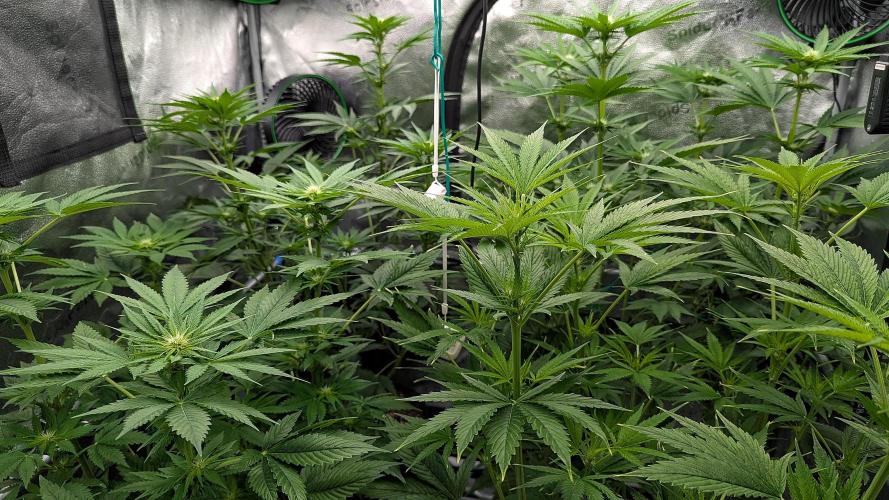
Light intensity continued increasing while fixture positioning and canopy elevation strategies evolved to maintain uniform light exposure despite rapidly diverging plant vigor. Fixture output increased from 65% at the beginning of the period to 70% by the end of the period. End-of-period light measurements were recorded as follows: SC1: 810 PPFD / 35 DLI; SC2: 780 PPFD / 33 DLI; SD1: 930 PPFD / 40 DLI; SD2: 945 PPFD / 41 DLI. As canopy expansion accelerated, fixture height was repeatedly adjusted and ultimately raised to the ceiling of the tent to preserve workable spacing and maintain target intensity. Distance between the canopy and fixture ranged from 14–19 inches throughout the period. Shorter and taller plant stands continued being exchanged, repositioned, or removed entirely where necessary to maintain a more uniform canopy and reduce variation in light exposure across plants.
UV-A supplementation increased from 45 minutes per light cycle to 60 minutes per light cycle.
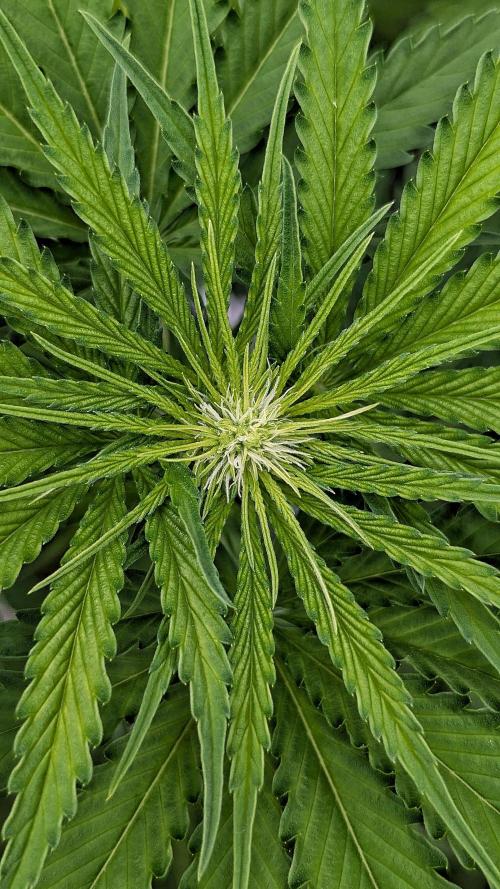
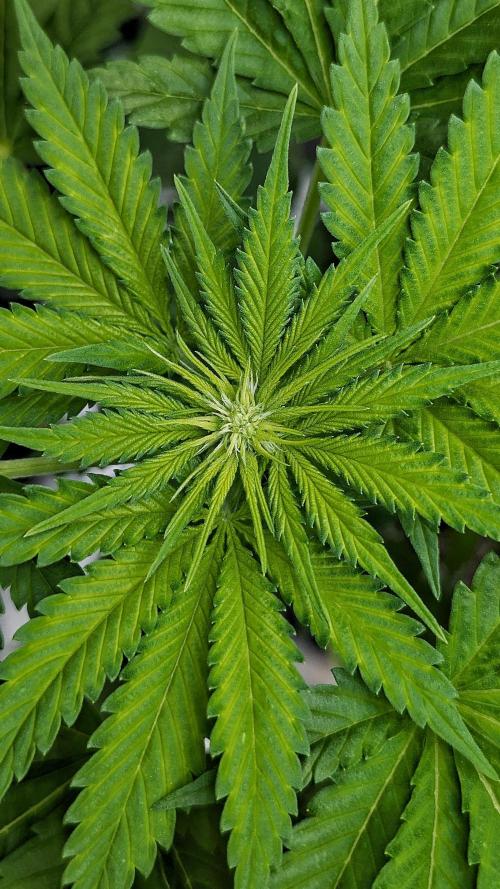
Low-stress training remained active throughout the period but shifted from aggressive branch positioning into canopy maintenance. Adjustments continued regularly to maintain horizontal structure and prevent excessive vertical dominance from faster-growing tops but this proved difficult. As branch positions became established, selective branch removal was introduced. Lower interior branches and growth sites unlikely to reach the canopy or produce quality flower were removed in favor of concentrating plant resources into the productive upper growth zones. Targeted defoliation also remained ongoing but intentionally conservative, focusing primarily on inward-facing leaves and lower interior foliage to improve airflow and reduce unnecessary shading.
Environmental control became increasingly important as transpiration accelerated and canopy density increased. A dehumidifier was installed and tested during the beginning of the period in preparation for later flower and increasing density. A support grid was also installed while plants remained movable, with the intention of providing future structural support for developing colas without restricting access during active canopy management.
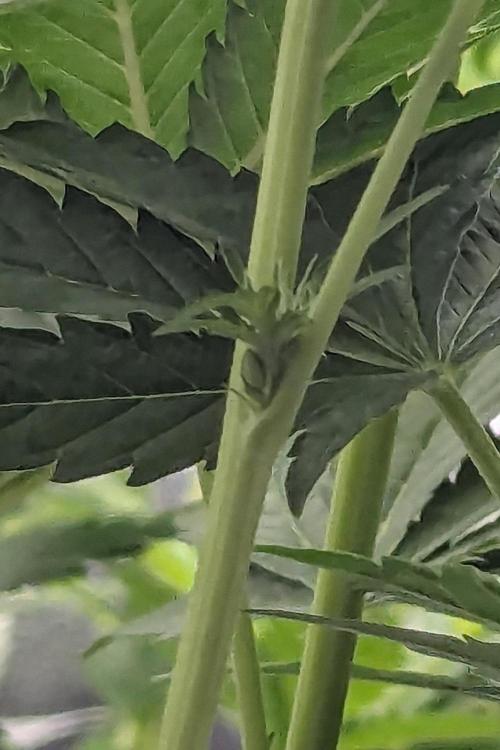
Flower initiation became increasingly apparent throughout the period. Pistil production accelerated and flower clusters began forming across all four plants. Development remained uneven between cultivars, however. SC2 appeared slightly behind the remaining three plants in visible cluster formation and stacking, although vigor remained strong and expectation remained that development would normalize in subsequent periods. By contrast, SC1, SD1, and SD2 showed more rapid cluster establishment and increasing node tightening.
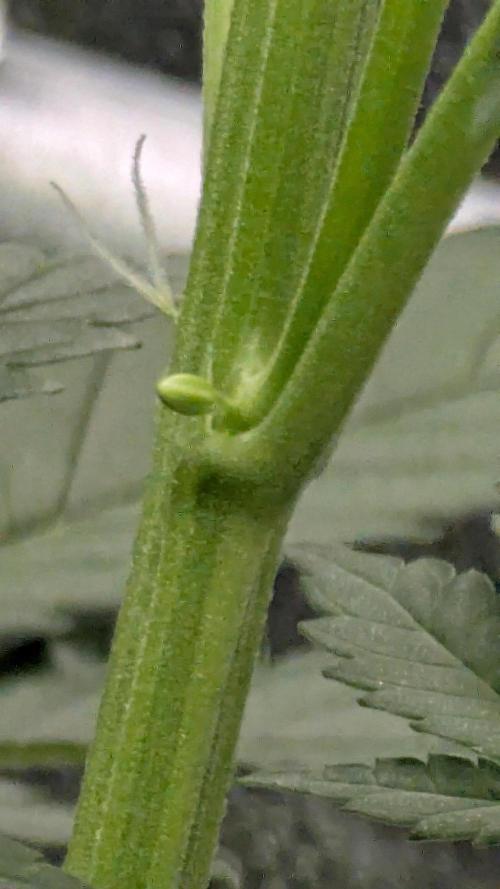
Because Stardawg lines are known to occasionally express intersex traits under stress or under aggressive cultivation targets, routine inspections were performed every several days throughout the period. During these inspections, developing pollen sacs and isolated nanner formation were identified and removed immediately. Findings remained limited and localized and were addressed promptly. Herm inspections are standard maintenance with chemdawg genetics.
Aroma suddenly appeared on day 2 of flower with a citrus-forward profile, becoming increasingly apparent throughout the period.
Plant height increased substantially despite indications that stretch was beginning to slow. Final recorded heights on Day 35 since emergence / Day 7 since flower were 29.00 inches (SC1), 33.00 inches (SC2), 36.00 inches (SD1), and 26.50 inches (SD2). By the end of the period, the tent had become substantially more occupied and future management priorities shifted toward maintaining airflow, preserving light penetration, and supporting developing flower clusters.
3 likes
comments
Share
Used techniques
LST
Technique
Defoliation
Technique
Four-Headed Monster
Technique
12-12
Technique
6
Week 6. Flowering3mo ago
111.76 cm
Height
12 hrs
Light Schedule
28 °C
Day Air Temp
6.2
pH
Normal
Smell
910 PPM
TDS
55 %
Air Humidity
18 °C
Solution Temp
19 °C
Substrate Temp
18 °C
Night Air Temp
11.4 l
Pot Size
2 l
Watering Volume
27.94 cm
Lamp Distance
MichaelTheBarnOwl Grow #6, Entry #7: Early Flower
Days Since Emergence: 42
Days Since Flip: 23
Days in Flower: 14
Irrigation remained on an every-other-day schedule throughout the reporting period. Standard irrigation events consisted of 1 gallon per plant, with selected events increased to 1.25 gallons per plant where necessary to ensure plant demand was met and adequate runoff was achieved. Water pH remained controlled within a target range of 6.0–6.1 throughout the period.
Nutrient strategy shifted from transitional feeding into sustained flower support. Plants remained on General Hydroponics Early Bloom at aggressive concentration throughout the reporting period with nutrient strength holding near 910 ppm. Feeding intensity was maintained as plants continued building flower mass without showing signs of widespread excess. CAL-MAG remained fixed at 5 mL/gal, while silica continued being applied every other feeding at 1.5 mL/gal.
Light output remained unchanged during this period and fixture power was held at 70% throughout the entire week. Rather than increasing intensity further, management focused on preserving uniform distribution across an increasingly uneven canopy. Distance between the highest tops and the fixture ranged from 11–21 inches depending on cultivar and position within the tent. Plant stands continued to be exchanged, removed, or repositioned where necessary as stretch slowed and canopy shape became more fixed.
By the end of the period, measured light intensity reflected the developing vertical separation between primary tops and secondary flowering sites. Recorded measurements were:
SC1: 550–950 PPFD / 24–41 DLI
SC2: 580–885 PPFD / 25–33 DLI
SD1: 350–1040 PPFD / 16–44 DLI
SD2: 595–930 PPFD / 25–40 DLI
These ranges reflect measurements collected across upper canopy flower sites through mid-canopy flower positions rather than a single point measurement per plant.
Because lower flower sites remained important contributors to final yield, additional canopy observations were recorded for mid-level flower positions. Distance between the fixture and mid-canopy flowering sites at the end of the period measured 19 inches (SC1), 20 inches (SC2), 21 inches (SD1), and 20 inches (SD2). Maintaining usable light penetration into these lower flower zones became increasingly important as canopy density increased.
Low-stress training became progressively less aggressive during this period as structural positioning was largely established and stretch approached completion. Training efforts shifted toward preserving spacing between tops, improving airflow, and preventing crowding rather than actively redirecting branch growth. Targeted defoliation remained ongoing but conservative, with selected leaf removal focused primarily on improving penetration into productive interior flower sites and maintaining airflow through increasingly dense sections of the canopy.
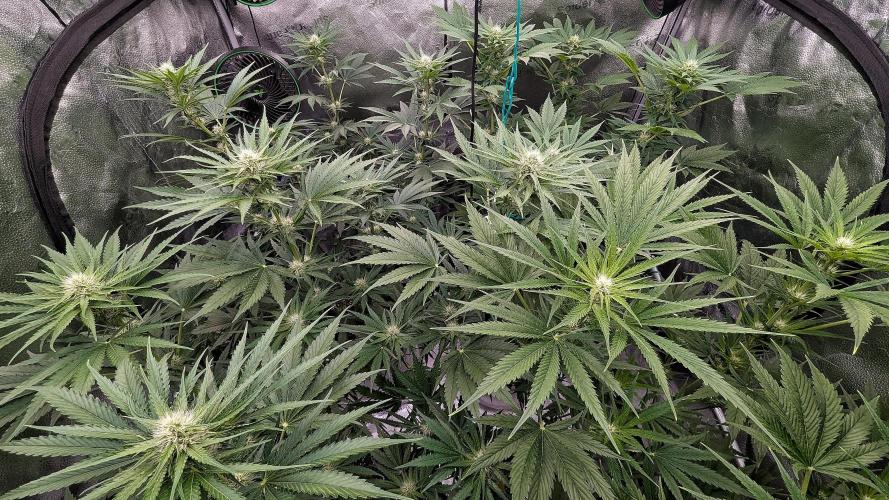
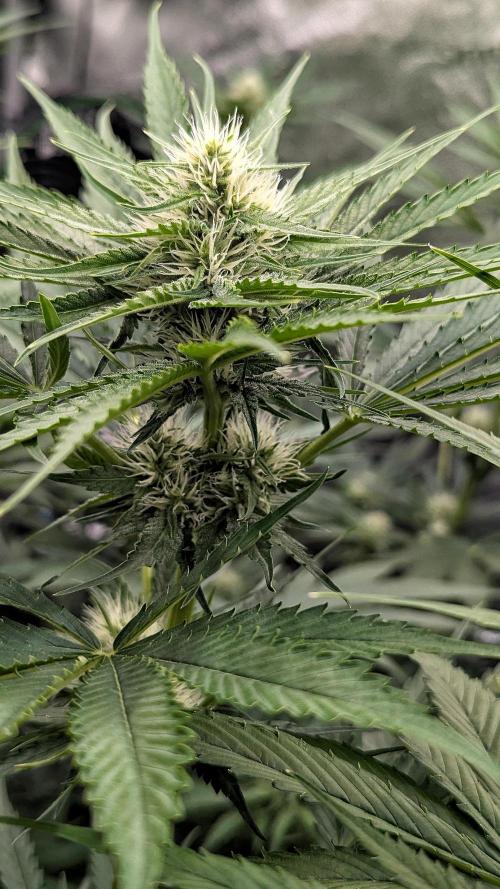
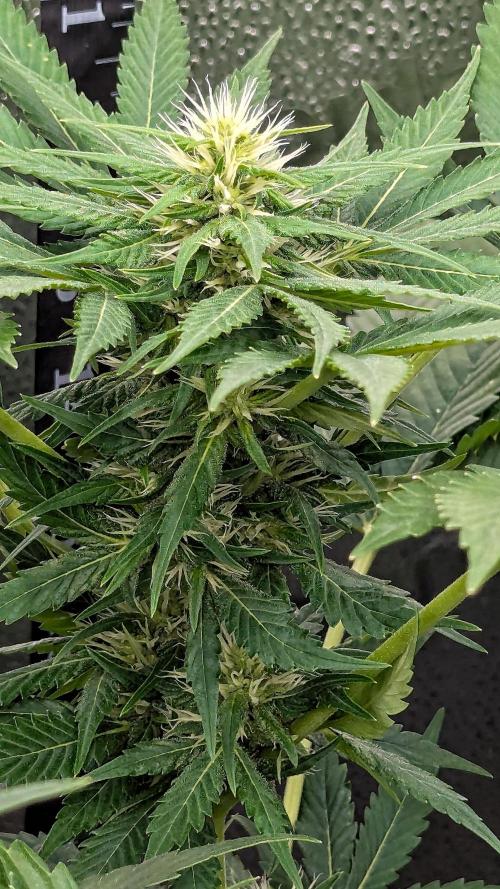
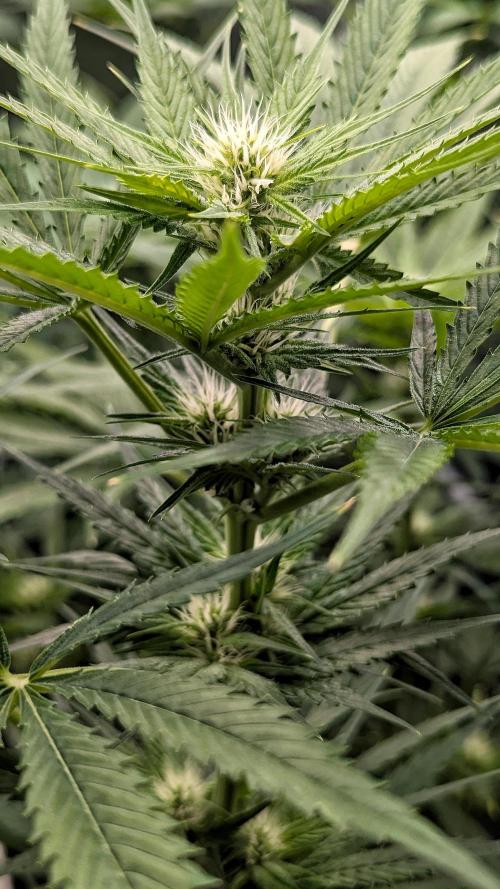
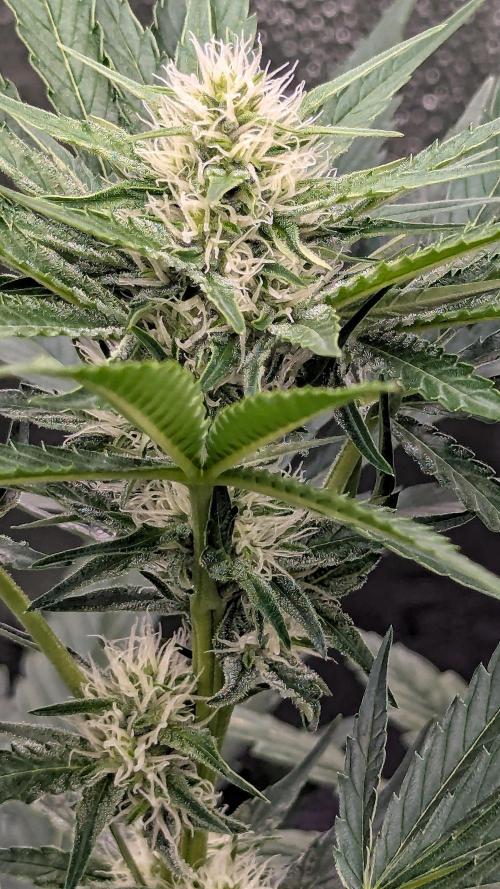
Flower development accelerated substantially throughout the period. Flower clusters enlarged, stacking became increasingly apparent, and pistil density increased across all cultivars. SC2 remained slightly behind the remaining plants in cluster development but showed continued improvement and increasing flower set. SD1 continued displaying the greatest overall vigor and maintained dominance in both vertical growth and floral expansion.
Routine reproductive inspections remained part of standard maintenance due to the Chemdawg lineage present in Stardawg. During this period, additional isolated pollen sacs and occasional anthers were identified and removed immediately upon discovery. Findings remained localized and were addressed before development progressed. Continued inspection intervals remained every several days.
Environmental management shifted increasingly toward preserving air movement and preventing moisture accumulation within interior flower zones as canopy occupancy approached practical limits.
Plant height increases slowed noticeably during this period and indicated that stretch was approaching completion. Final recorded heights on Day 42 since emergence / Day 14 since flower were:
SC1: 32.00 inches
SC2: 39.50 inches
SD1: 44.00 inches
SD2: 34.00 inches
By the end of the period, canopy structure had largely stabilized and management priorities transitioned away from shaping and toward maintaining environmental consistency, preserving light penetration into secondary flower sites, and supporting continued flower development heading into mid flower.
4 likes
comments
Share
Used techniques
LST
Technique
Defoliation
Technique
Four-Headed Monster
Technique
12-12
Technique
7
Week 7. Flowering3mo ago
111.76 cm
Height
12 hrs
Light Schedule
27 °C
Day Air Temp
6.2
pH
Strong
Smell
910 PPM
TDS
56 %
Air Humidity
18 °C
Solution Temp
19 °C
Substrate Temp
18 °C
Night Air Temp
11.4 l
Pot Size
2 l
Watering Volume
20.32 cm
Lamp Distance
MichaelTheBarnOwl Grow #6, Entry #8: Stretch Ends, Mid Flower Begins
Days Since Emergence: 49
Days Since Flip: 30
Days in Flower: 21
Irrigation remained on an every-other-day schedule throughout the reporting period. Standard irrigation events continued at 1 gallon per plant, with selected events increased to 1.25 gallons per plant where necessary to ensure runoff and maintain full saturation of the active root zone. Water pH remained controlled within a target range of 6.1–6.2 throughout the period.
Nutrient strategy transitioned alongside the completion of stretch and the beginning of active flower bulking. The period began utilizing General Hydroponics Early Bloom at aggressive concentration and remained there until stretch completion was confirmed. Following the end of stretch, nutrient composition transitioned into a 50% Early Bloom / 50% Mid Bloom blend at aggressive concentration, and by the end of the period moved fully into Mid Bloom at aggressive concentration. Despite changes in nutrient composition, overall solution strength remained stable at 890–910 ppm throughout the reporting period. CAL-MAG remained fixed at 5 mL/gal, while silica frequency and concentration were reduced substantially and standardized to 1 mL/gal once weekly.
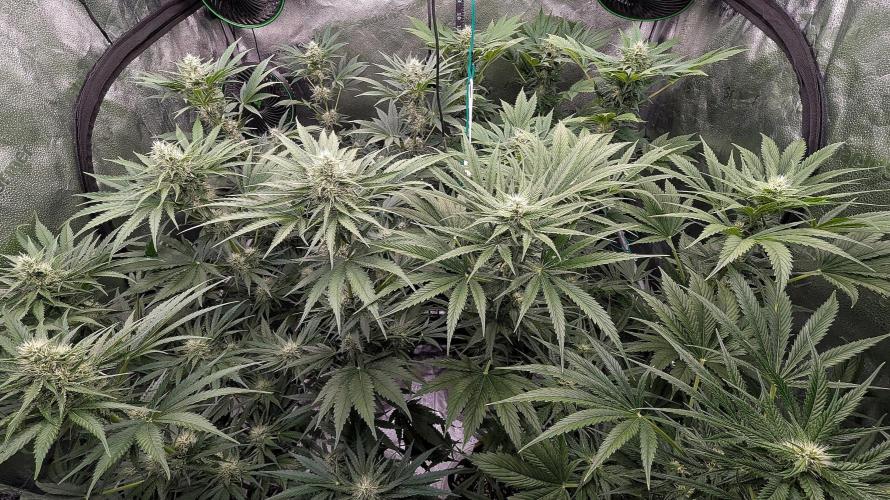
Light intensity remained unchanged throughout the period and fixture output was held at 70%. Rather than increasing intensity further, canopy management focused on preserving usable light distribution through increasingly dense flower sites. Beginning-of-period light measurements reflected the final phase of stretch and ranged from 550–950 PPFD (24–41 DLI) depending on cultivar and canopy position. By the end of the period, measured light intensity ranged from 420–1100 PPFD (18–52 DLI) across plant tops and mid-canopy flower sites. Variation increased substantially due to canopy depth and intentional maintenance of productive lower flower zones.
Distance between the fixture and the highest tops remained extremely tight and ranged from 8–11 inches, while mid-canopy flowering sites maintained greater separation (19-22 inches) and therefore lower PPFD exposure. This difference intentionally allowed preservation of productive secondary flower sites without overdriving upper colas. Continued use of plant stands, selective stand removal, and canopy repositioning allowed maintenance of a workable and relatively uniform canopy despite large differences in plant vigor.
UV-A supplementation remained unchanged at 60 minutes per light cycle.
Canopy management became increasingly selective during this period. Minor defoliation continued with the specific objective of exposing productive bud sites to light rather than reducing total leaf mass. Additional airflow management was introduced by increasing circulation through the lower, middle, and upper canopy zones to improve environmental consistency and reduce stagnation around developing flower clusters.
Stretch was formally considered complete during this reporting period. Although vertical growth had slowed substantially entering the week, measurements collected following Day 15 of flower demonstrated no meaningful additional height gain and stretch was therefore considered complete at that point.
Using final heights recorded at the time of flip and final heights at the end of stretch, we arrive at the calculated stretch multipliers for each plant:
SC1: 8.00" → 32.00" (4.00x)
SC2: 9.25" → 40.00" (4.32x)
SD1: 9.50" → 44.00" (4.63x)
SD2: 7.50" → 34.00" (4.53x)
These values indicate aggressive vertical expansion across all four plants despite topping, early flip timing, and active low-stress training.
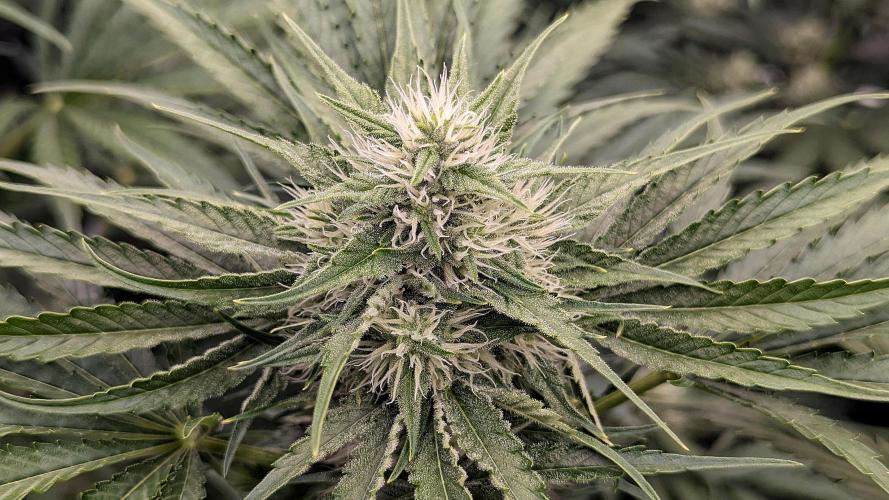
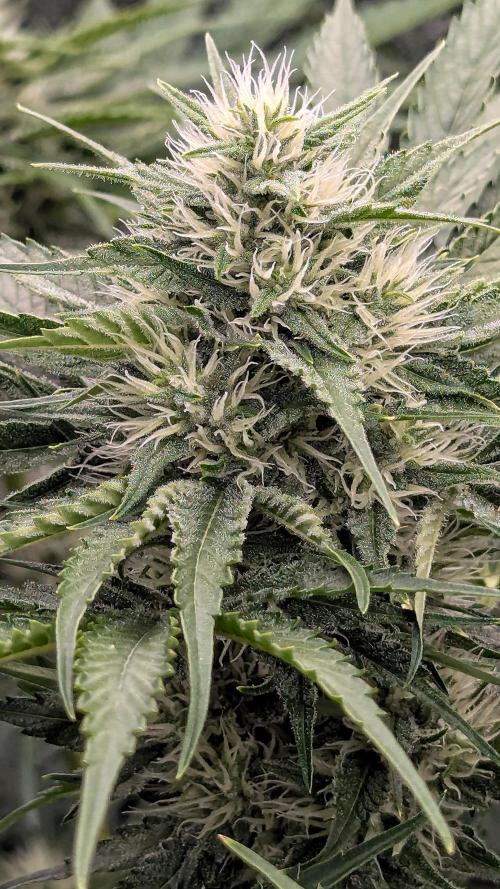
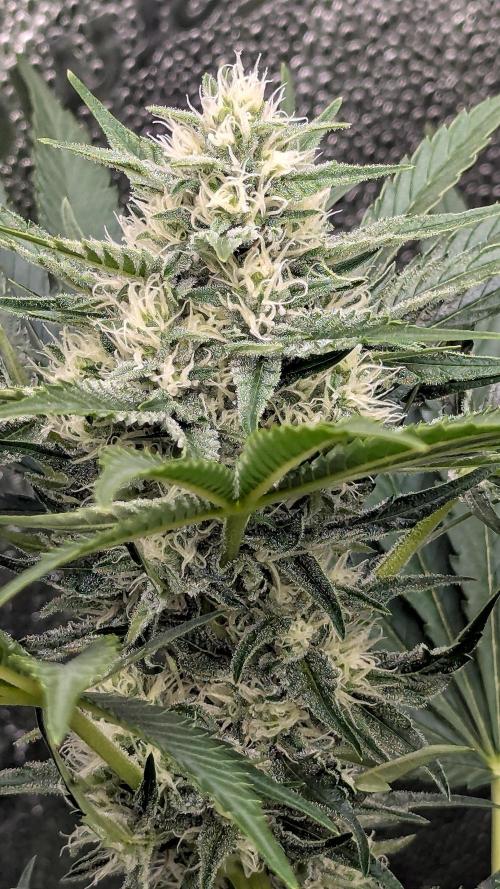
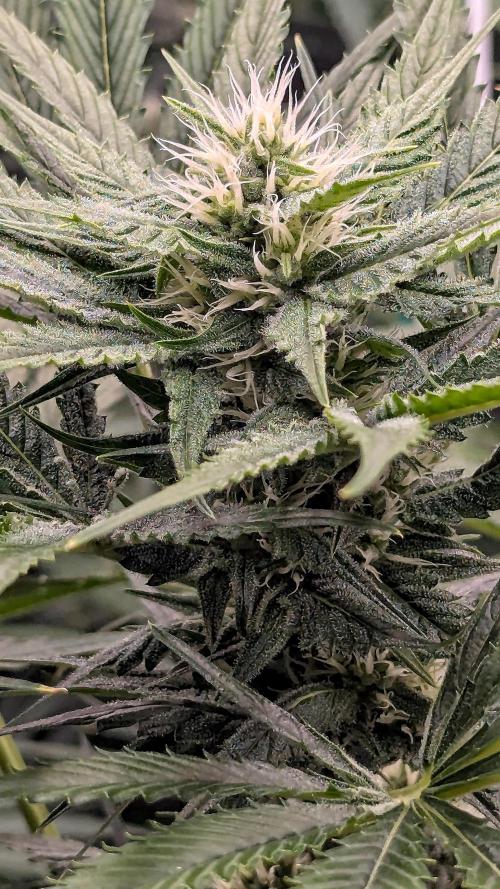
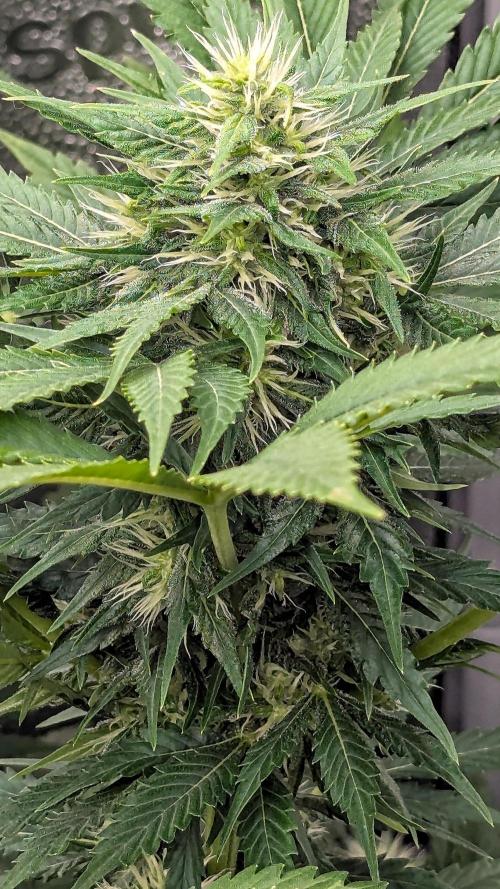
Flower development accelerated noticeably during this period and active bulking became increasingly apparent across the canopy. Around Day 18 of flower, aroma underwent a clear transition. Earlier citrus-forward characteristics gave way to a significantly stronger profile best described as spicy pink bubblegum, accompanied by a substantial increase in overall aromatic intensity. Flower clusters continued enlarging and becoming more defined as calyx production accelerated.
Herm checks continued throughout the period; however, no intersex traits, pollen sacs, or anthers / nanner formation were observed this week.
5 likes
comments
Share
Used techniques
LST
Technique
Defoliation
Technique
Four-Headed Monster
Technique
12-12
Technique
8
Week 8. Flowering3mo ago
111.76 cm
Height
12 hrs
Light Schedule
27 °C
Day Air Temp
6.1
pH
Strong
Smell
900 PPM
TDS
57 %
Air Humidity
18 °C
Solution Temp
19 °C
Substrate Temp
21 °C
Night Air Temp
11.4 l
Pot Size
2 l
Watering Volume
20.32 cm
Lamp Distance
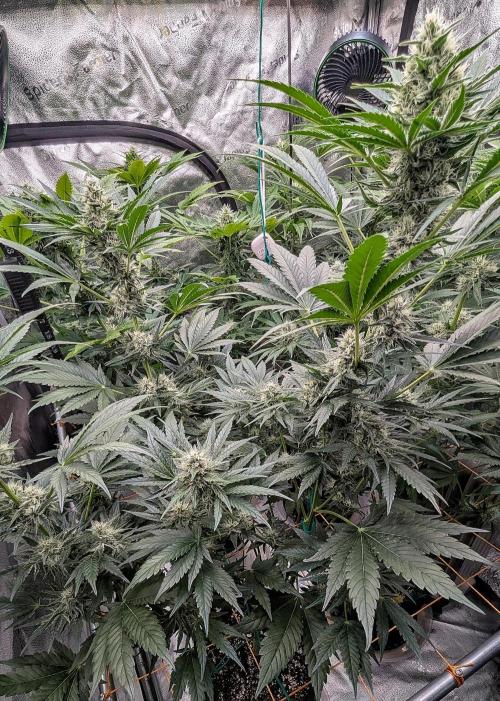
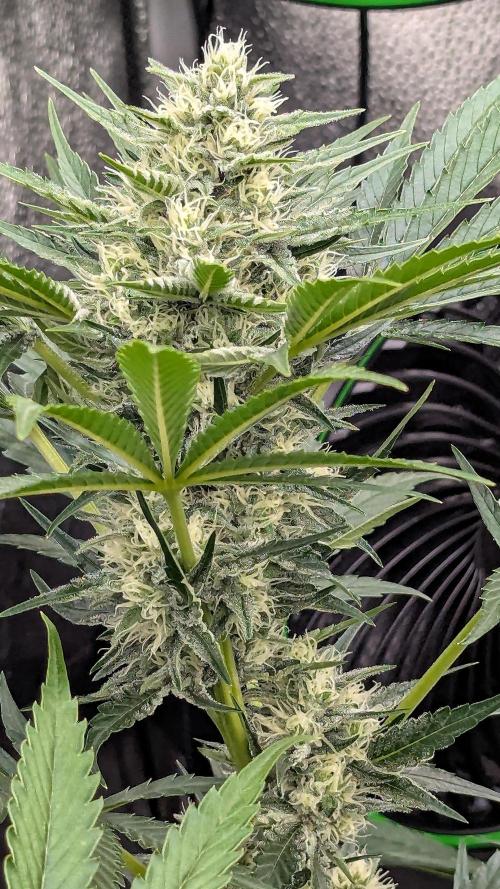
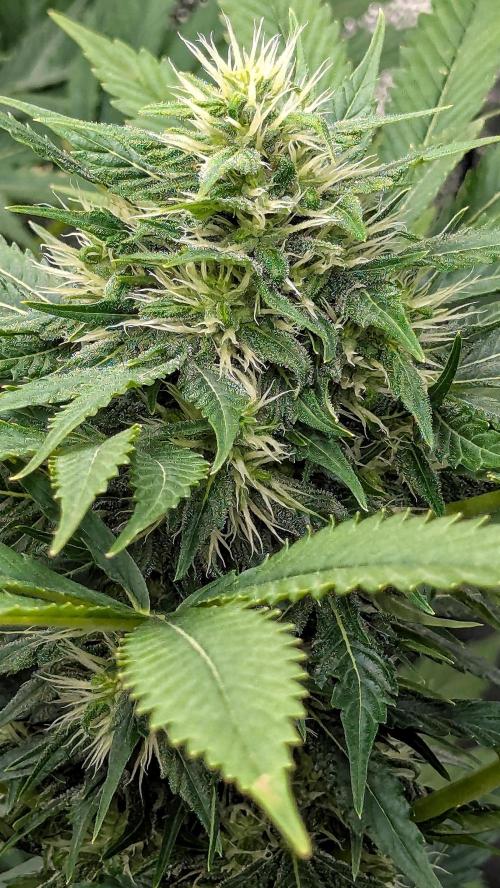
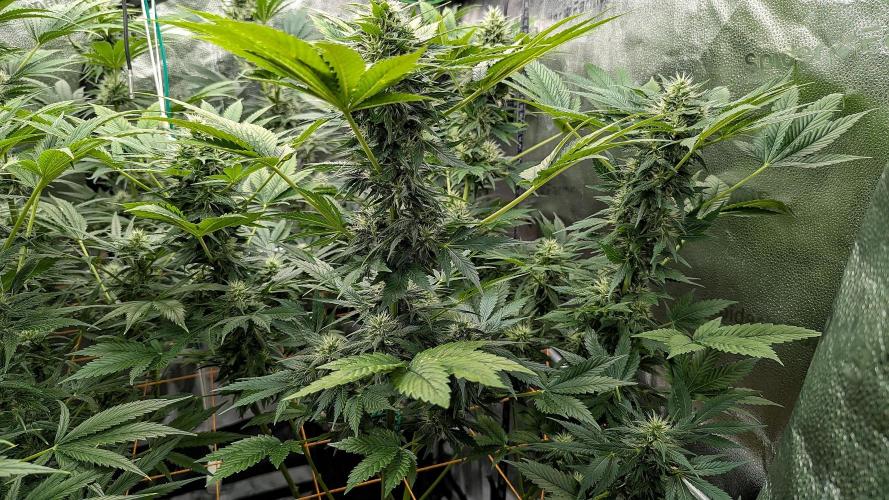
MichaelTheBarnOwl Grow #6, Entry #9: Mid Flower
Days Since Emergence: 55
Days Since Flip: 36
Days in Flower: 27
Standard irrigation volume remained near 1 gallon per plant, with selected events increased to approximately 1.25–1.50 gallons where necessary to ensure full saturation and periodic runoff. Water pH remained tightly controlled within a target range of 6.1–6.2 throughout the reporting period.
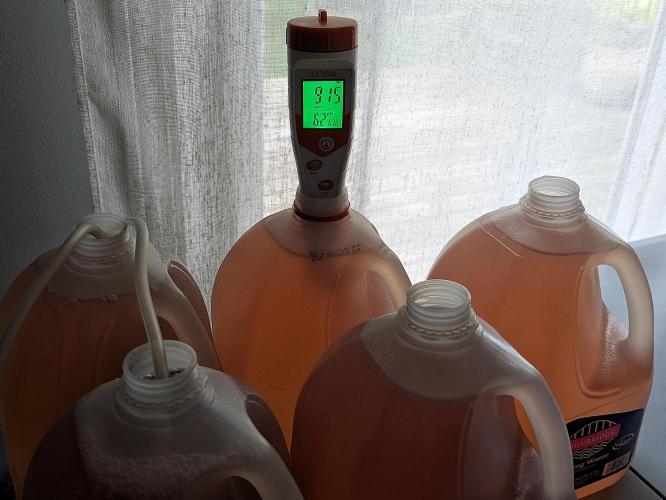
Nutrient composition remained unchanged following the transition into Mid Bloom completed during the prior week. General Hydroponics Mid Bloom continued at aggressive concentration with overall solution strength maintained at approximately 890–900 ppm. CAL-MAG remained fixed at 5 mL/gal throughout the week. Silica supplementation continued at a reduced maintenance schedule of 1 mL/gal once weekly. No adjustments were made, as plants continued exhibiting strong flower development, healthy foliage retention, and no meaningful signs of nutrient excess or deficiency.
Light intensity remained unchanged throughout the reporting period and fixture output remained fixed at 70%. Since stretch had concluded during the previous week, management focus shifted away from increasing intensity and toward maximizing light utilization across the established canopy structure.
Measured mid- and upper-canopy flower tops received approximately:
SC #1: 475–1100 PPFD (20–48 DLI)
SC #2: 420–1050 PPFD (18–45 DLI)
SD #1: 525–1150 PPFD (22–50 DLI)
SD #2: 530–1230 PPFD (22–52 DLI)
These measurements represent values collected from both the tallest flowering tops and lower mid-canopy bud sites. Mid-canopy flowers remained approximately 19–22 inches below the fixture and therefore received lower PPFD exposure while still maintaining direct light penetration following canopy adjustments.
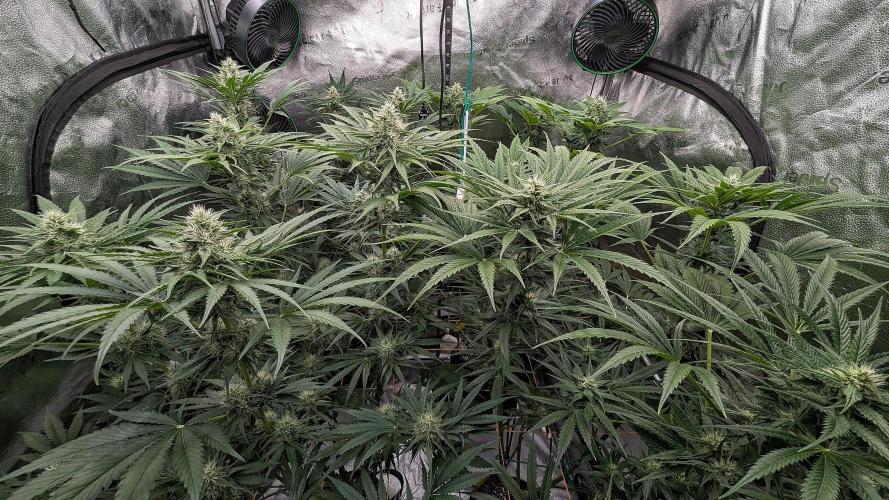
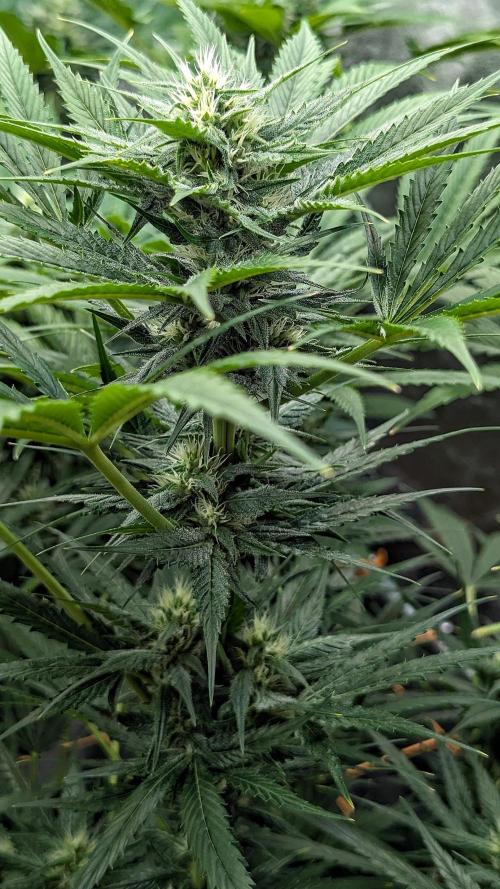
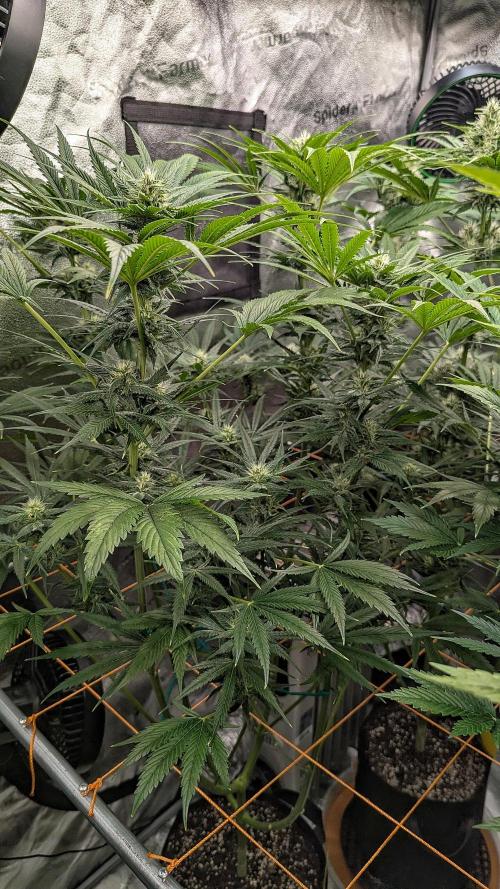
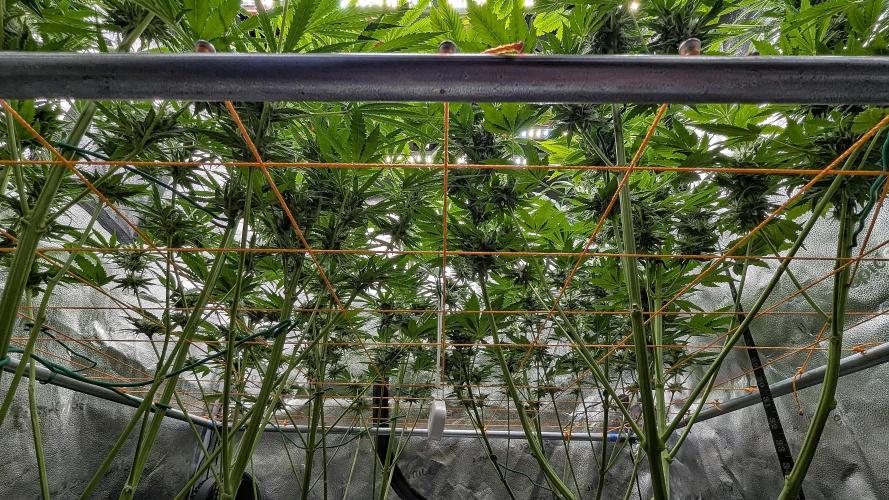
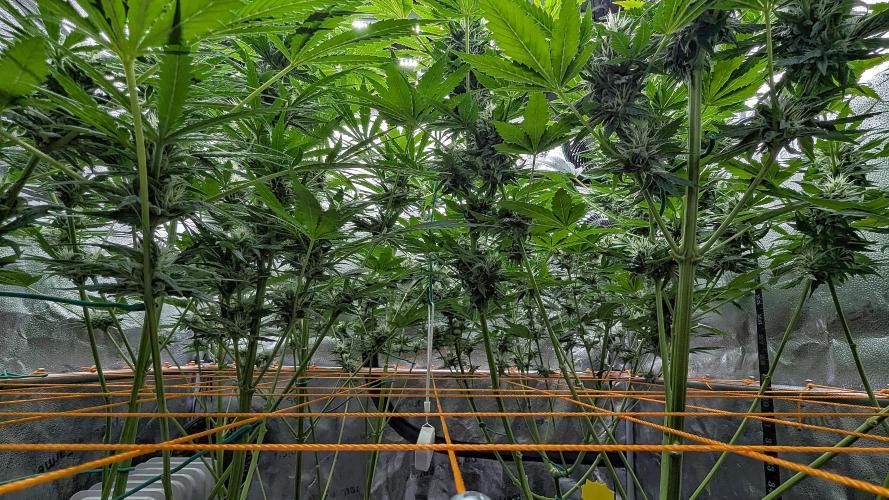
Final canopy positioning work was completed during the week. Following confirmation that stretch had fully ended, upper colas were progressively released from earlier restraint methods and allowed to assume their final flowering positions. This reduced light distance at the tallest sites from approximately 11 inches to as low as 8 inches while maintaining usable penetration into secondary flower sites. Additional garden wire was introduced selectively to create separation between dominant colas and crowded mid-canopy branches, improving airflow and preserving direct light access across the productive canopy.
UV-A supplementation increased from 60 minutes to 75 minutes per light cycle.
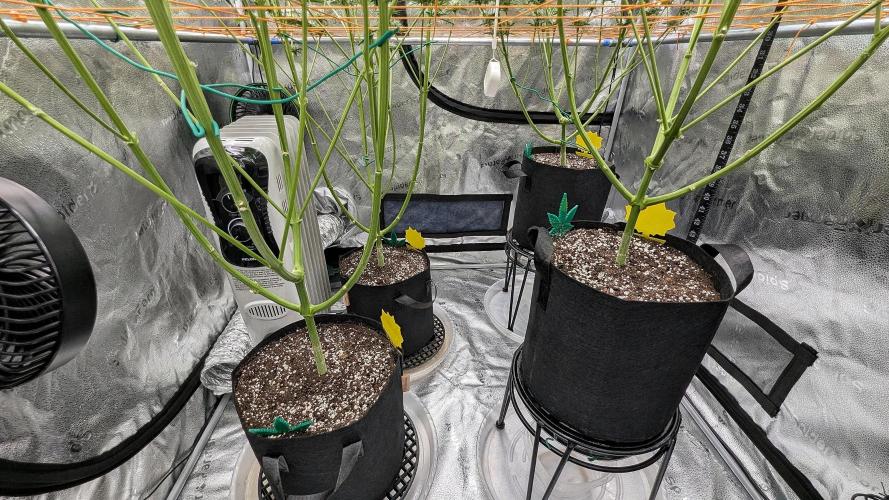
Environmental control became a major focus this week in anticipation of increasing seasonal humidity and continued flower bulking. Rather than conditioning the surrounding garage and relying on passive intake, conditioned air was directed intentionally into the tent itself. Portable AC operating in dry mode was routed along the floor of the tent to reduce humidity while avoiding direct airflow onto roots or flowering sites. In parallel, dehumidified air from a Spider Farmer unit was funneled into the tent and maintained with a target set point near 50% RH.
This approach maintained relative humidity generally within the 55–58% range, although short-duration excursions into the low 60% range continued to occur during equipment cycling. To maintain favorable VPD, cooling, heating, and dehumidification were occasionally used together as conditions required. Air movement and mixing were supported by 6–8 oscillating fans distributed across upper, middle, and lower canopy zones, while continuous monitoring through Govee sensors allowed active oversight even while away from the grow.
Root-zone conditions were monitored after introducing conditioned air directly into the tent. Measurements confirmed temperatures remained comfortably within the mid-to-upper 60°F range, indicating environmental control measures were not excessively cooling the containers.
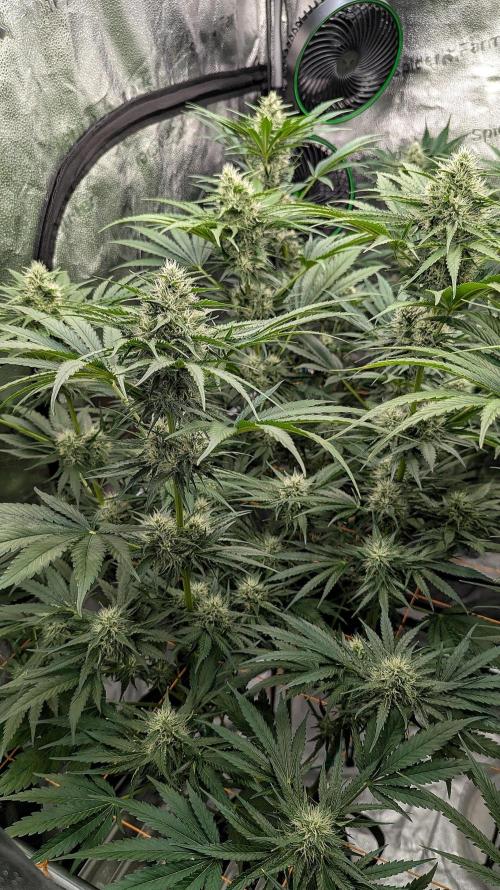
Canopy work this week focused on finishing structure rather than making major changes. Most non-productive lower growth had already been removed progressively during the first three weeks following flip and was completed before Day 21 of flower. By this stage, final plant architecture had become clear and remaining adjustments focused on preserving productive flower sites.
Additional defoliation remained light and targeted. Approximately 4–5 medium fan leaves per plant were removed from lower and middle canopy regions where airflow was restricted or where leaves shaded flower sites. Another 15–20 smaller fan leaves were removed where foliage faced inward, overlapped neighboring branches, or rubbed against developing buds. The objective was not to strip plants, but to improve airflow and maintain direct light access across productive canopy areas.
Support work was also completed this week. During a lower humidity window, masonry twine was installed across the support grid in preparation for increasing flower weight later in bloom. Garden wire was additionally used to spread selected colas and create more space between crowded branches. Following these adjustments, nearly all remaining flower sites now receive direct light.
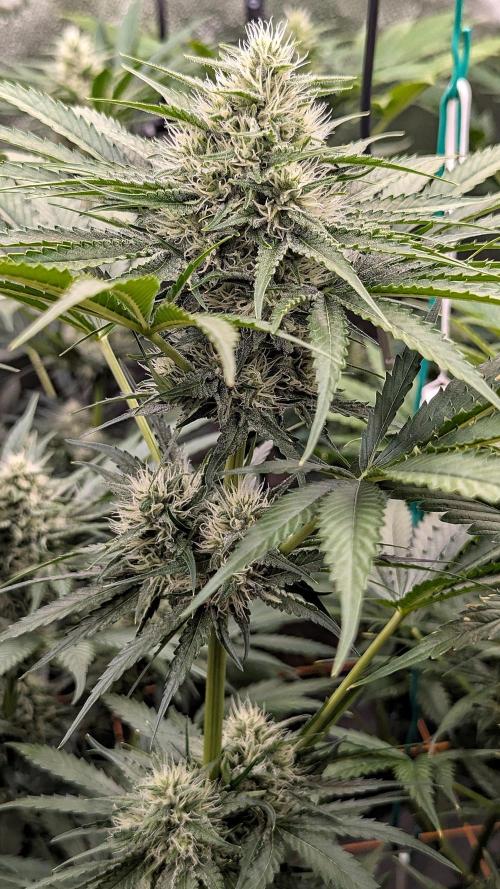
Flower development accelerated noticeably during the reporting period. Bud swelling became increasingly apparent across both primary colas and secondary flower sites, accompanied by a substantial increase in aromatic intensity. The existing profile of spicy pink bubblegum layered with citrus became even more pronounced as flowers enlarged and resin production continued increasing. Overall aroma has become richer, louder, and more complex compared to earlier flower.
Herm checks continued throughout the reporting period with no further intersex traits observed.
At this stage, nearly all structural work is complete. Unless environmental conditions require targeted adjustments, no additional defoliation is planned. The objective moving forward is simple: maintain environmental stability, maintain nutrient availability, and allow flowers to continue bulking naturally until indicators suggest transition into late flower over the coming weeks.
6 likes
comments
Share
Used techniques
12-12
Technique
Defoliation
Technique
Four-Headed Monster
Technique
9
Week 9. Flowering2mo ago
111.76 cm
Height
12 hrs
Light Schedule
26 °C
Day Air Temp
6.1
pH
Strong
Smell
900 PPM
TDS
55 %
Air Humidity
18 °C
Solution Temp
19 °C
Substrate Temp
18 °C
Night Air Temp
11.4 l
Pot Size
2 l
Watering Volume
20.32 cm
Lamp Distance
MichaelTheBarnOwl Grow #6, Entry #10: Mid Flower
Days Since Emergence: 62
Days Since Flip: 43
Days in Flower: 34
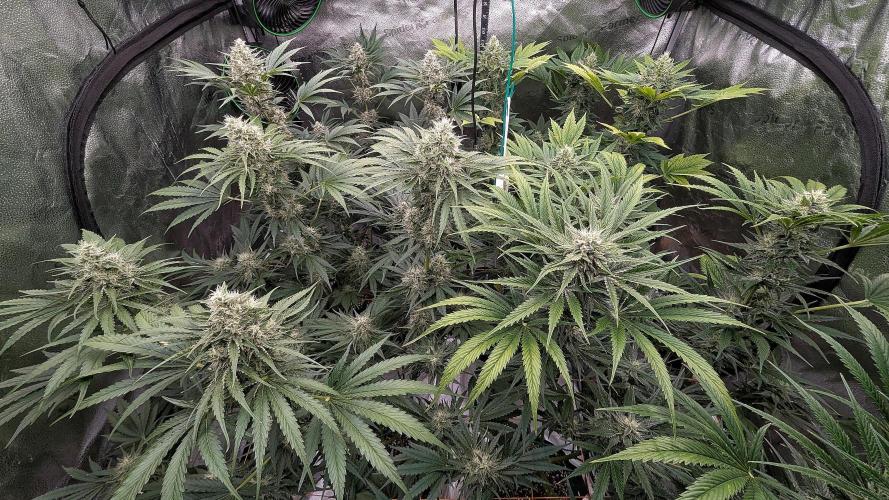
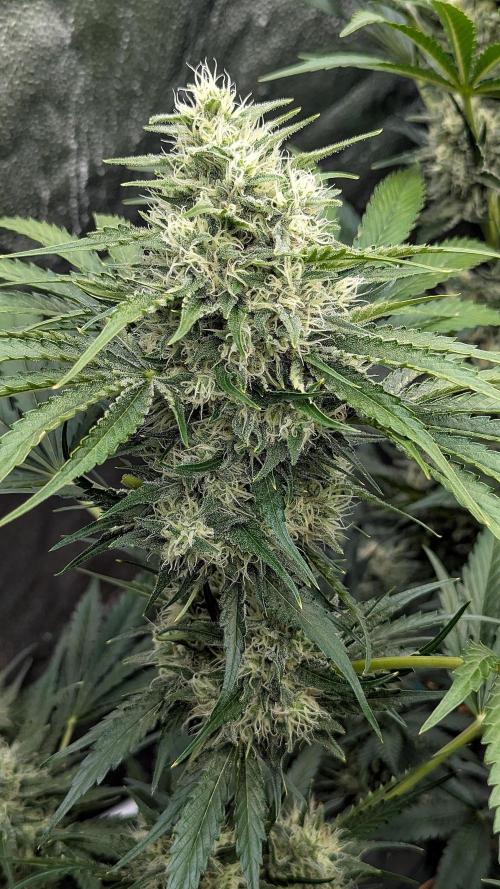
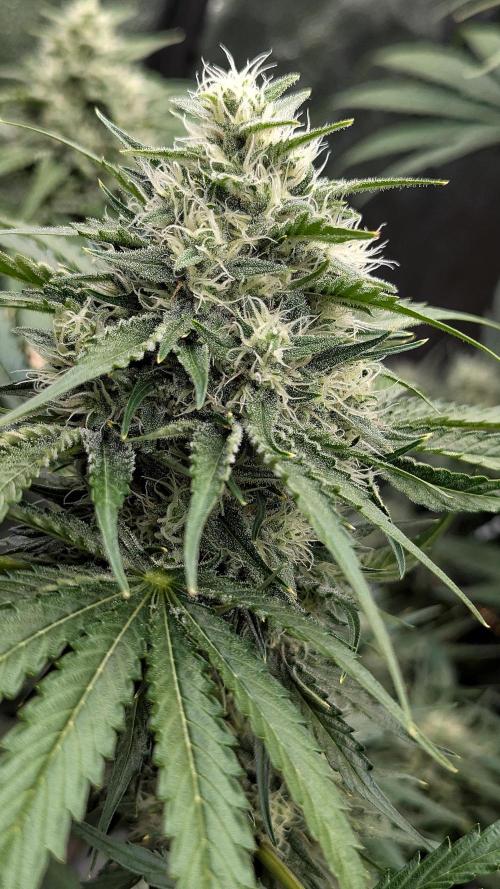
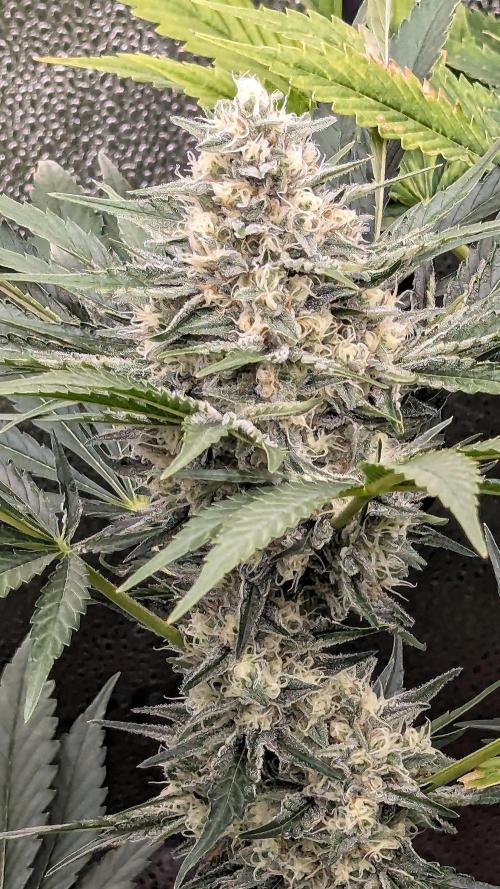
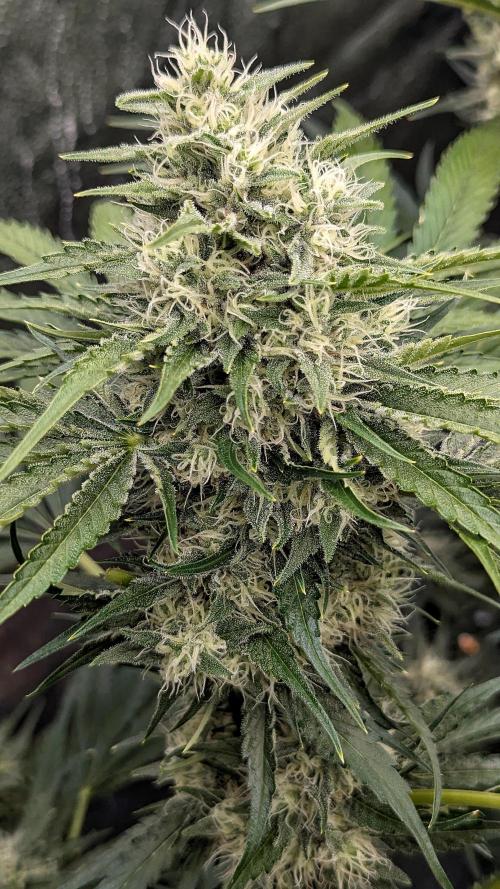
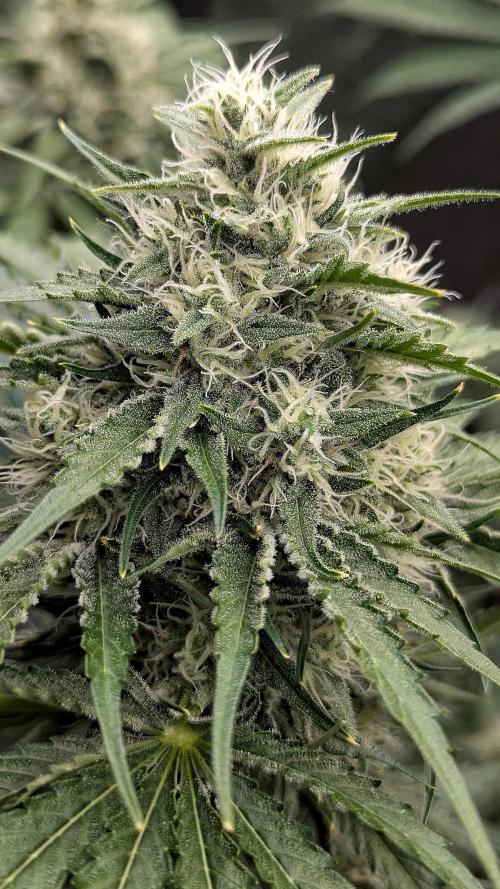
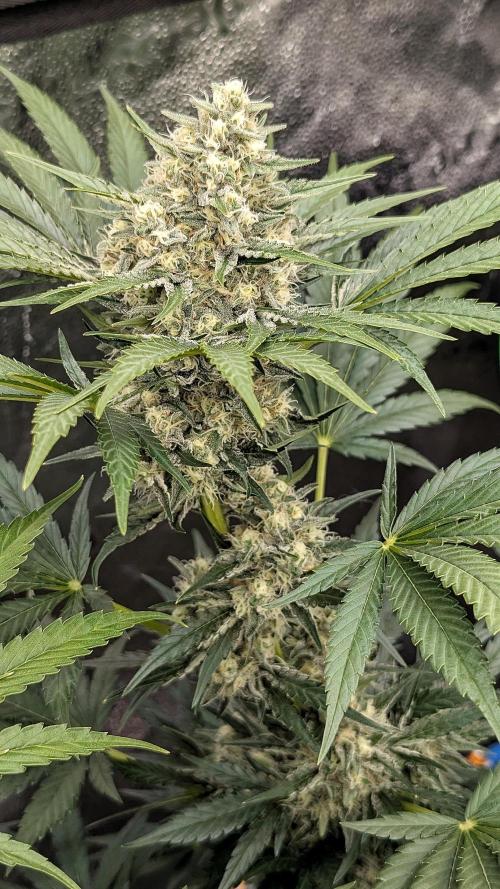
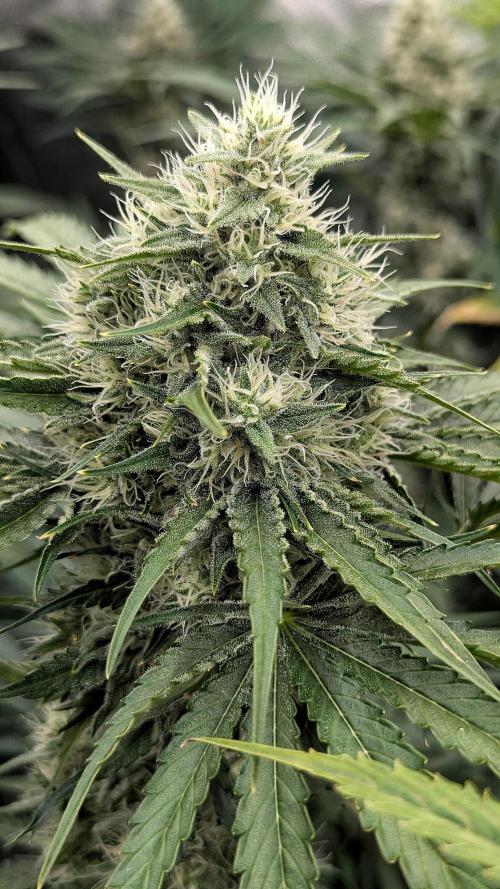
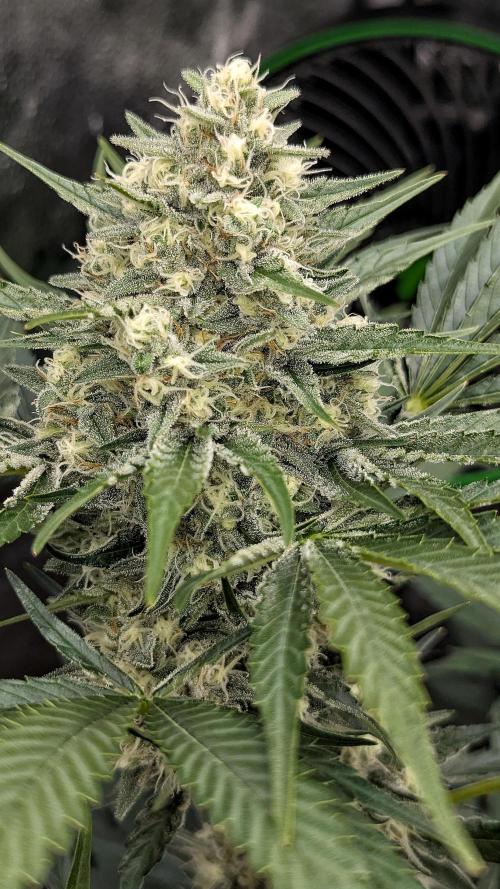
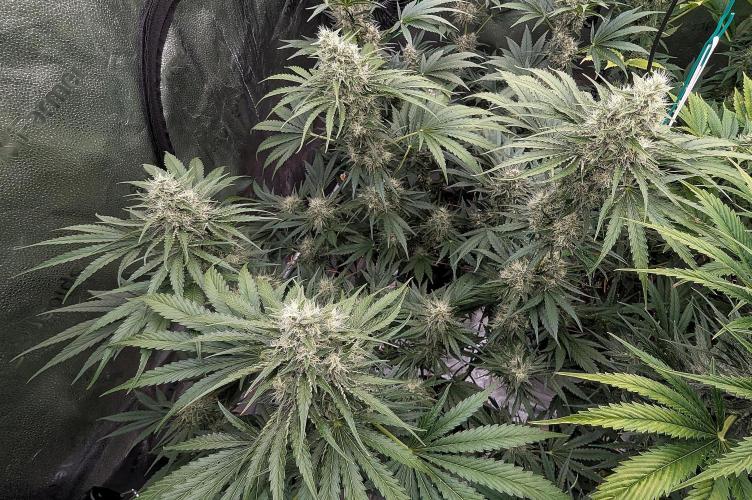
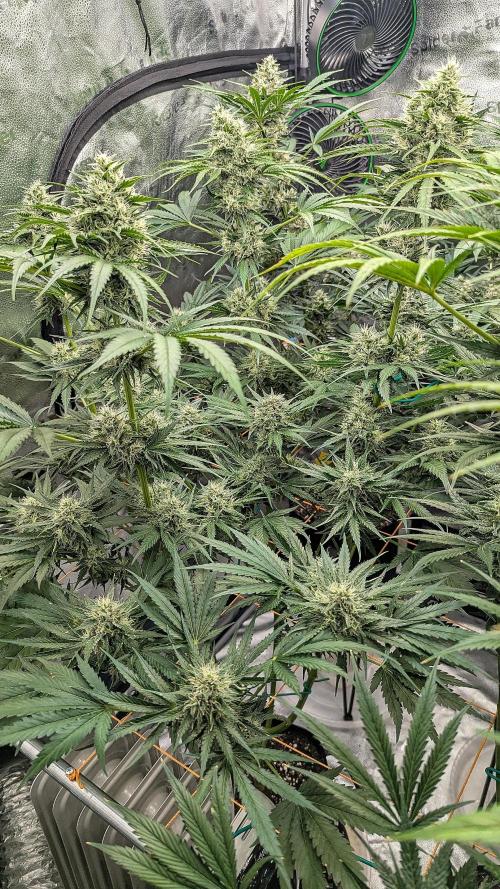
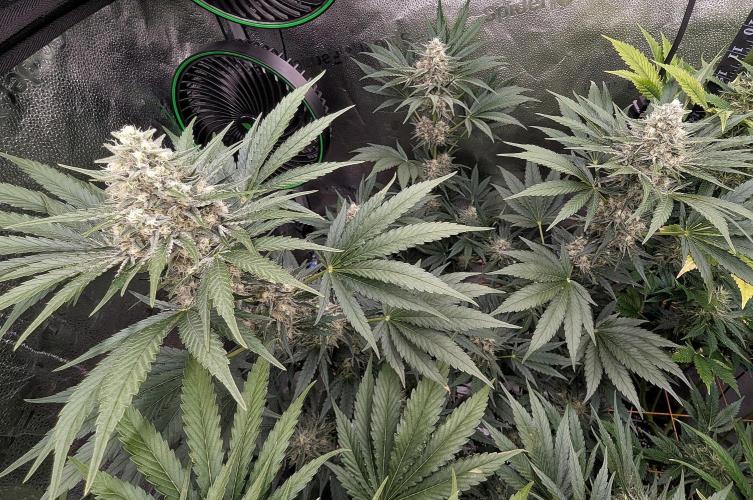
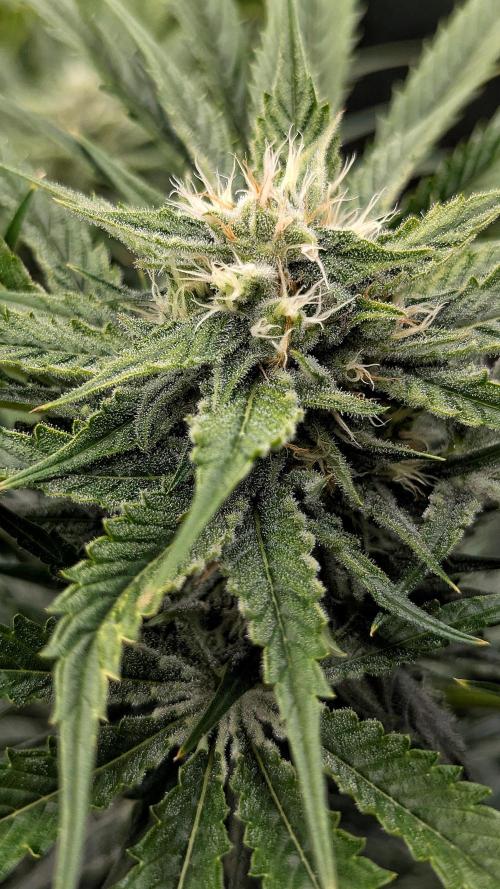
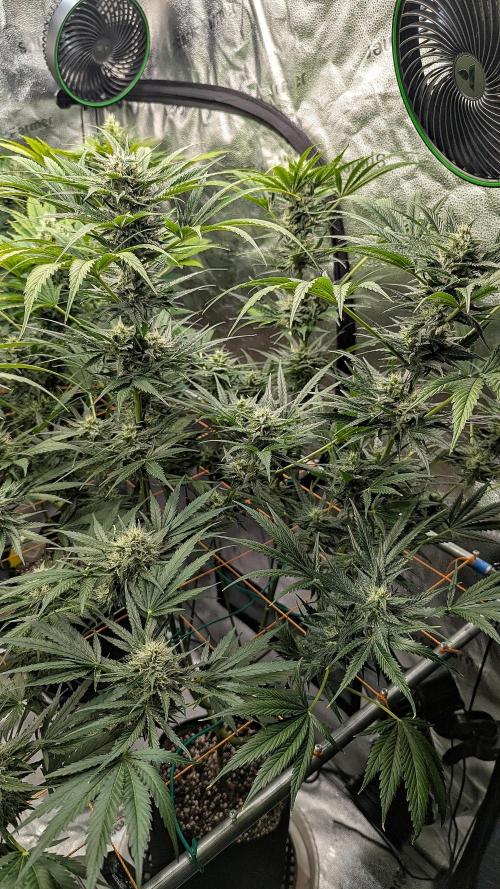
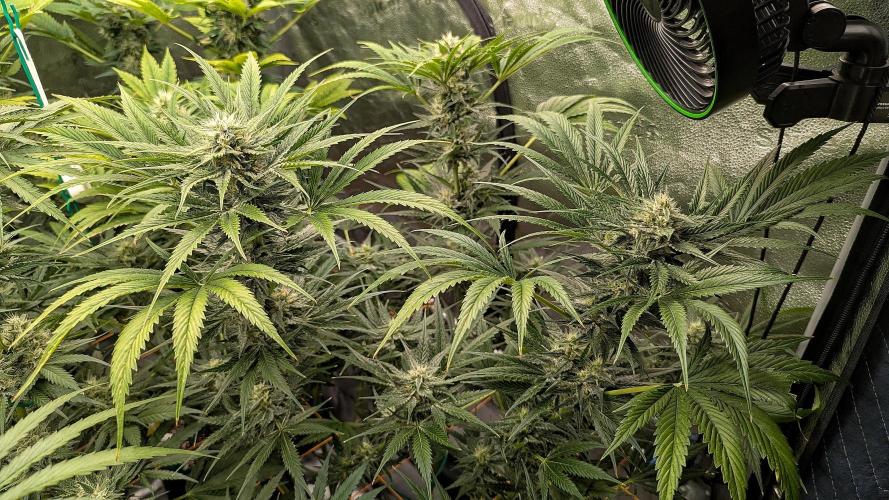
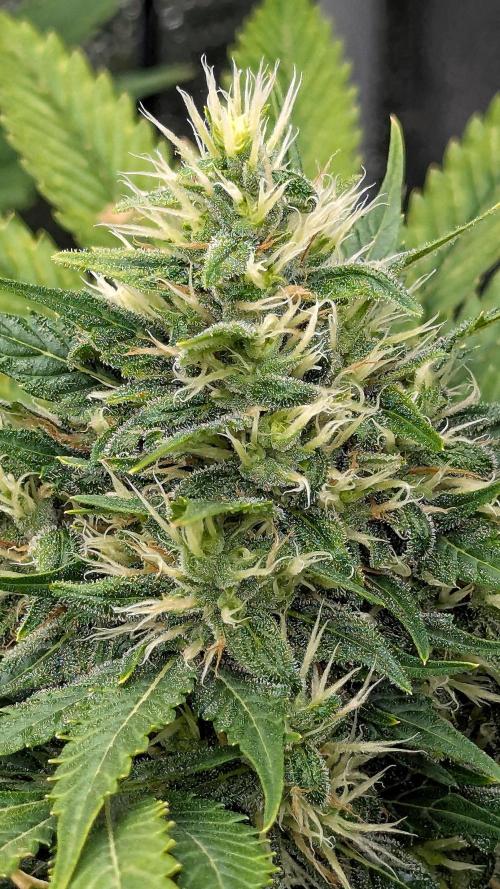
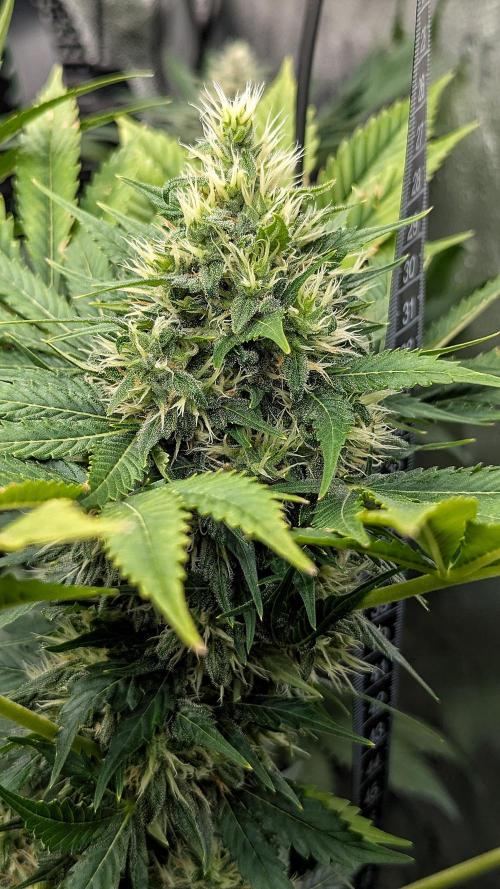
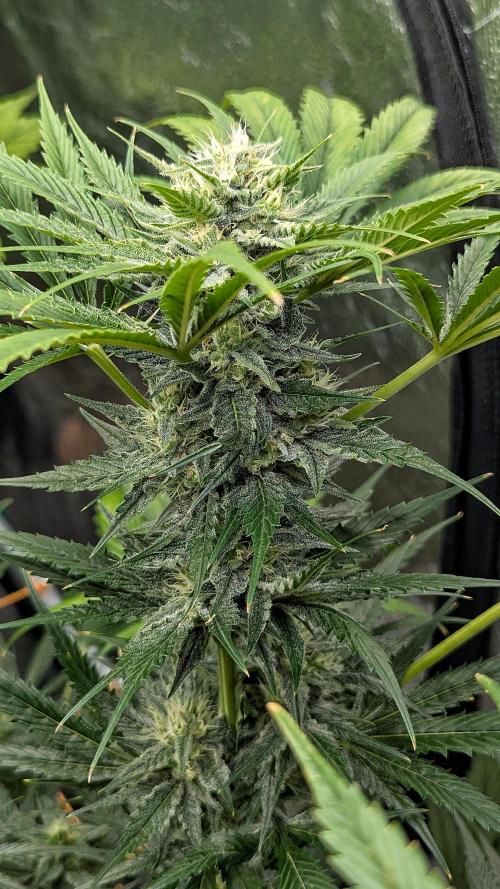
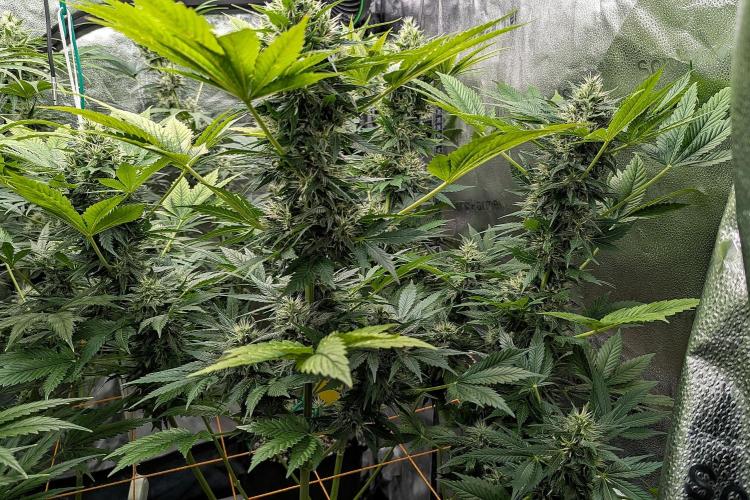
Flower development accelerated noticeably, with daily increases in bud size becoming apparent across all four plants. As flower mass accumulated, management efforts focused primarily on maintaining airflow, preserving light penetration into productive flower sites, and supporting increasingly heavy branches.
Light intensity remained unchanged during the period. Mid and upper canopy measurements recorded during the week were as follows:
SC1: 600–1100 PPFD (26–47 DLI)
SC2: 500–1040 PPFD (21–45 DLI)
SD1: 620–1180 PPFD (27–50 DLI)
SD2: 685–1230 PPFD (30–54 DLI)
While fixture output remained unchanged, strategic defoliation near the end of the period improved light penetration into portions of the mid canopy by removing inward-facing leaves that were shading productive flower sites below.
UV supplementation increased from 75 minutes to 90 minutes per light cycle.
Environmental conditions remained stable throughout the period. Temperatures ranged between 65–79°F, relative humidity averaged 55%, and average VPD remained near 1.3 kPa. Several warmer days required intermittent use of air conditioning to maintain favorable flowering conditions while preserving humidity and airflow targets.
Irrigation remained stable at 1–1.5 gallons per plant every other day with input pH maintained between 6.0–6.2.
Plants continued receiving Mid-Bloom nutrients at Aggressive strength (900 PPM). CAL-MAG remained at 5 mL/gal, while silica continued at 1 mL/gal once per week.
Routine herm inspections were performed every three to four days. No male flowers, pollen sacs, or nanners were observed this week.
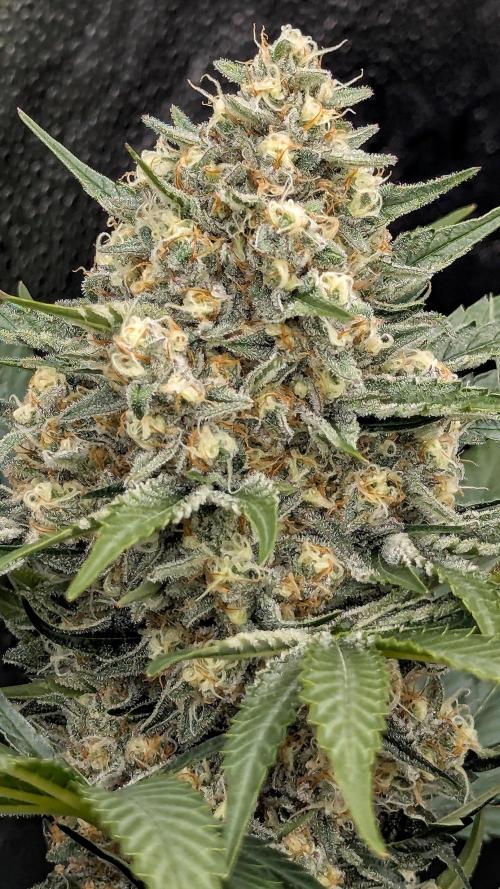
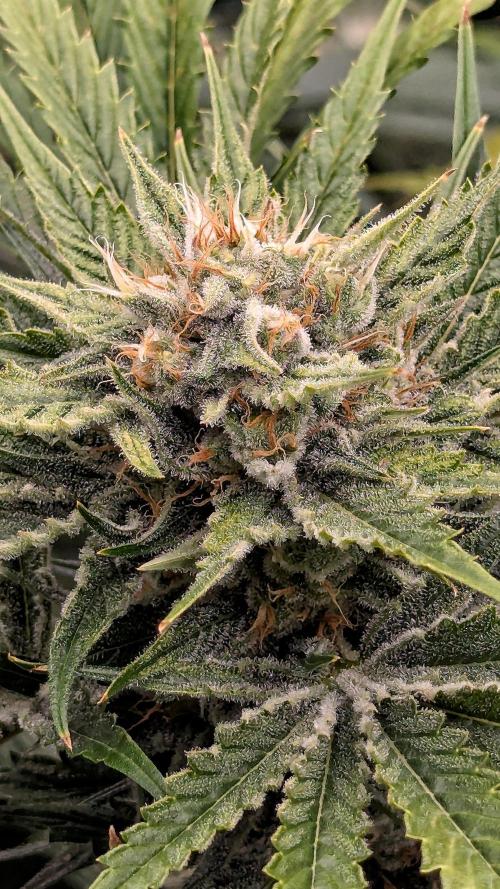
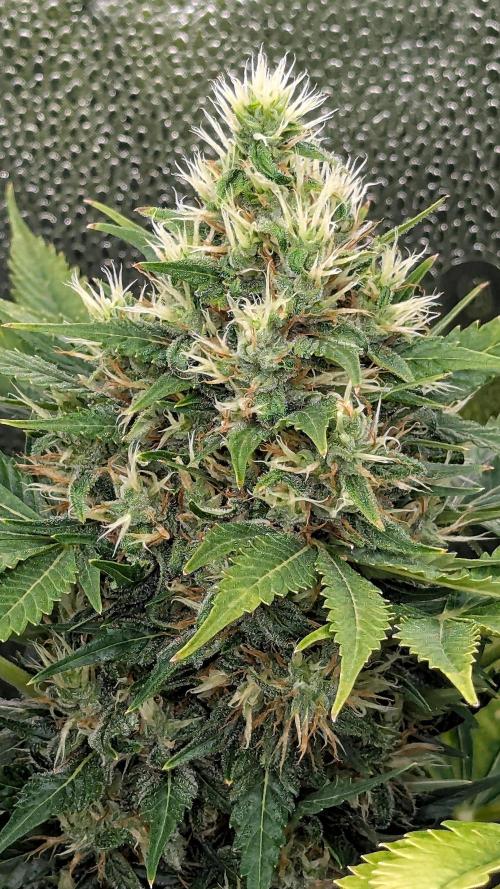
Aroma intensity increased dramatically during the week. The dominant profile remained heavily skunk-forward, followed by citrus and freshly cut grass notes. Earthy undertones remained present along with distinct chemical and fuel-like characteristics. A subtle sweetness could still be detected beneath the stronger aromas. Based on prior observations, much of the skunk, chemical, and fuel profile appears to be originating from the Stardawg plants.
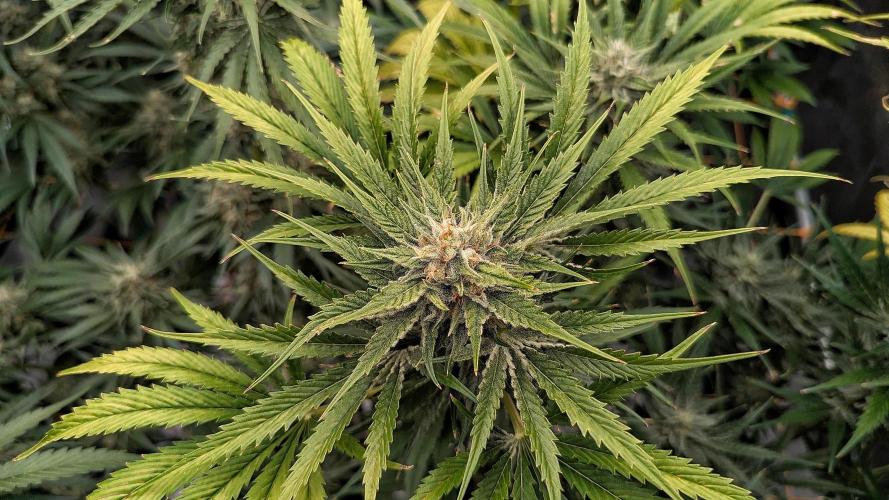
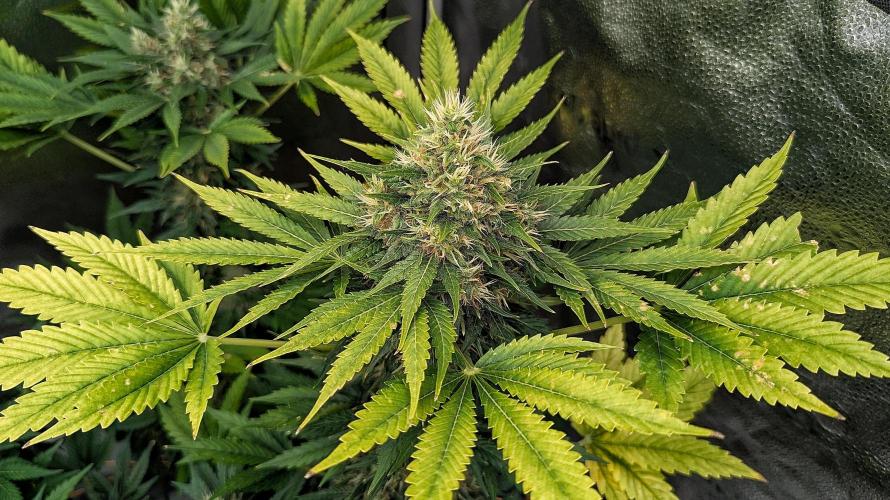
Differences in phenotype expression continued becoming more apparent. The two Stardawg plants remained remarkably similar in structure, flower formation, and overall growth habit, showing only minor differences in size and canopy position. The Strawberry Cough plants, however, displayed much greater variation. SC1 remained shorter and more compact with noticeably broader fan leaves and significantly thicker colas. SC2 expressed a taller, more open structure with narrower fan leaves and longer flower formations. Despite sharing the same cultivar, the two Strawberry Cough plants were beginning to display distinctly different growth characteristics, flower morphology, and architecture.
Differences in flower structure also became increasingly apparent. SC1 continued developing dense, compact flowers with *substantial* early bulk, while SC2 formed longer flowers that appeared somewhat less compact but continued exhibiting excellent density and resin production. The Stardawg plants continued producing elongated spear-shaped colas characteristic of the cultivar while maintaining remarkable uniformity between the two phenotypes.
Flower development accelerated substantially during this stage, with visible swelling occurring throughout the canopy. Several branches required additional support as flower weight increased and stems began leaning under accumulating biomass. Garden wire was used where necessary to support branches that were starting to lean.
Strategic defoliation was performed near the end of the period with emphasis placed on inward-facing leaves in the upper canopy that were shading productive flower sites below. Selective removal of these leaves noticeably improved light penetration into portions of the mid canopy. Additional leaves were removed where foliage was rubbing against flowers or becoming wrapped around developing buds.
likes
comments
Share
Used techniques
LST
Technique
Defoliation
Technique
12-12
Technique
Four-Headed Monster
Technique
10
Week 10. Flowering2mo ago
111.76 cm
Height
12 hrs
Light Schedule
26 °C
Day Air Temp
6.2
pH
Strong
Smell
970 PPM
TDS
53 %
Air Humidity
19 °C
Solution Temp
17 °C
Substrate Temp
18 °C
Night Air Temp
11.4 l
Pot Size
2 l
Watering Volume
20.32 cm
Lamp Distance
MichaelTheBarnOwl Grow #6, Entry #11: Mid Flower
Days Since Emergence: 69
Days Since Flip: 50
Days in Flower: 41
Light intensity remained unchanged. Mid and upper-canopy measurements were as follows:
SC1: 600–1100 PPFD (26–47 DLI)
SC2: 500–1040 PPFD (21–45 DLI)
SD1: 620–1180 PPFD (27–50 DLI)
SD2: 685–1230 PPFD (30–54 DLI)
UV-A supplementation remained unchanged at 90 minutes per light cycle.
Irrigation remained stable at 1–1.5 gallons per plant every other day with input pH maintained between 6.0–6.2. Due to periods of high outdoor humidity, irrigation volume was occasionally reduced while maintaining adequate moisture availability and plant posture.
Plants received General Hydroponics Mid Bloom at Aggressive feed strength for much of the period, with the Stardawg plants continuing to receive 900 PPM nutrient solution. CAL-MAG remained fixed at 5 mL/gal, while silica continued at 1 mL/gal once per week.
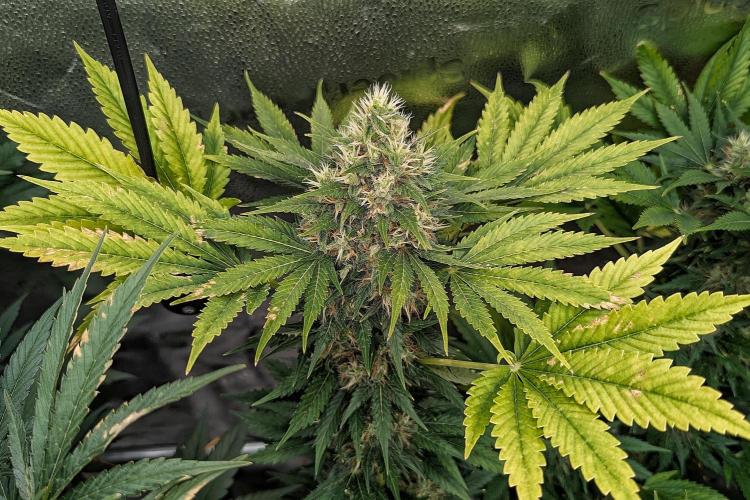
Strawberry Cough began showing more pronounced yellowing on larger upper and mid-canopy fan leaves during the period. Because pH had remained stable, runoff had been performed periodically throughout the grow, root-zone temperatures remained within target range, and environmental conditions continued tracking well, I was comfortable ruling out many of the more common causes. The symptoms appeared more consistent with Strawberry Cough simply demanding more nutrition than Stardawg at this stage of flower. Nutrient strength was therefore increased by 15% for Strawberry Cough while maintaining the same Mid Bloom nutrient ratio, increasing solution strength from 900 PPM to 970 PPM. The objective was to increase overall nutrient availability without altering the underlying nutrient balance.
Environmental management became increasingly important as outdoor temperatures and humidity increased significantly. Although this grow is located in a garage tent, multiple control methods were used to maintain favorable flowering conditions despite upper-80°F outdoor temperatures and low-70°F outdoor dew points. Cool, dry air from a portable AC unit was directed into the tent near the floor. A Spider Farmer dehumidifier was also used to support humidity control. This setup created positive pressure inside the tent and allowed VPD to remain within target ranges during both lights-on and lights-out periods.
During lights out, temperatures were generally held in the upper 60s to low 70s with VPD maintained near 0.9–1.1 kPa. During lights on, temperatures were maintained near 76°F with VPD generally between 1.3–1.5 kPa. These conditions allowed the tent environment to remain stable despite difficult outdoor conditions.
Routine herm inspections continued at least over per week. No male flowers, pollen sacs, or nanners were observed this week.
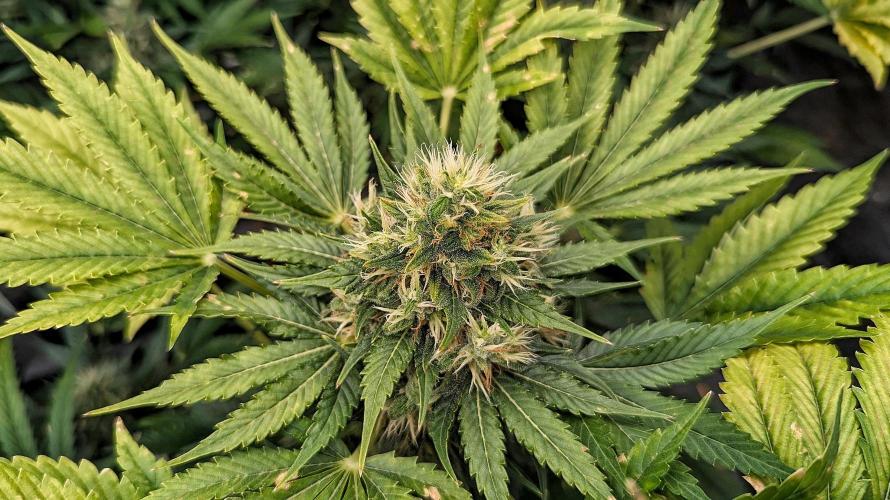
Aroma remained strong and continued developing in complexity. Sweet skunk and earthy tones were the most dominant aromas, with the overall profile remaining loud and persistent.
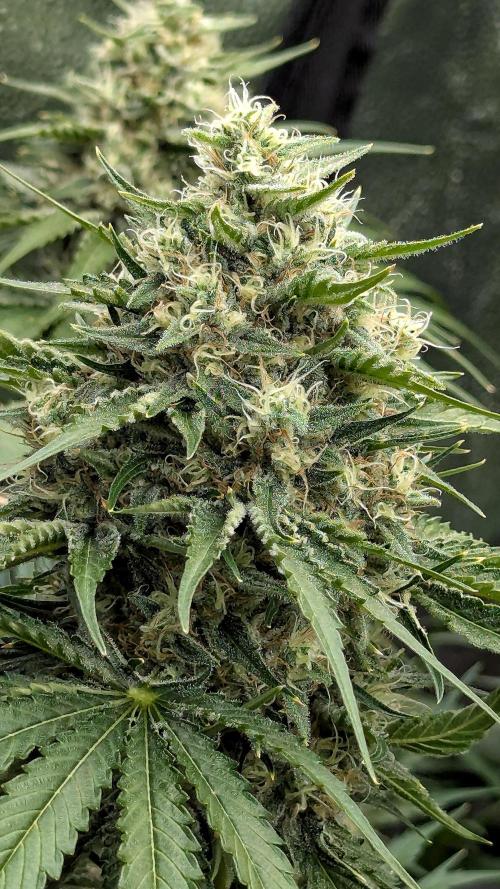
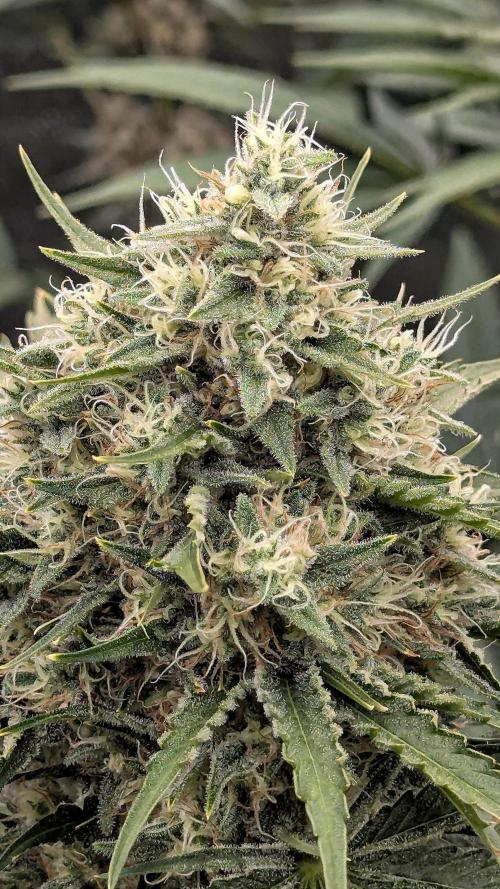
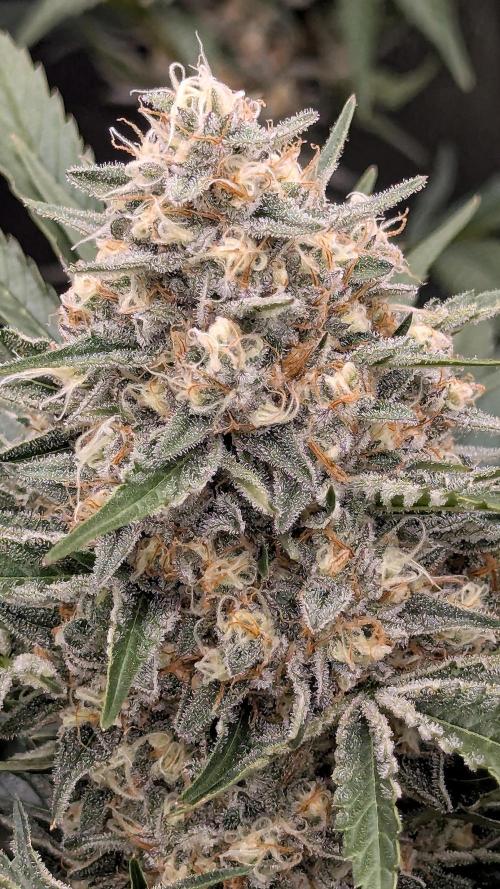
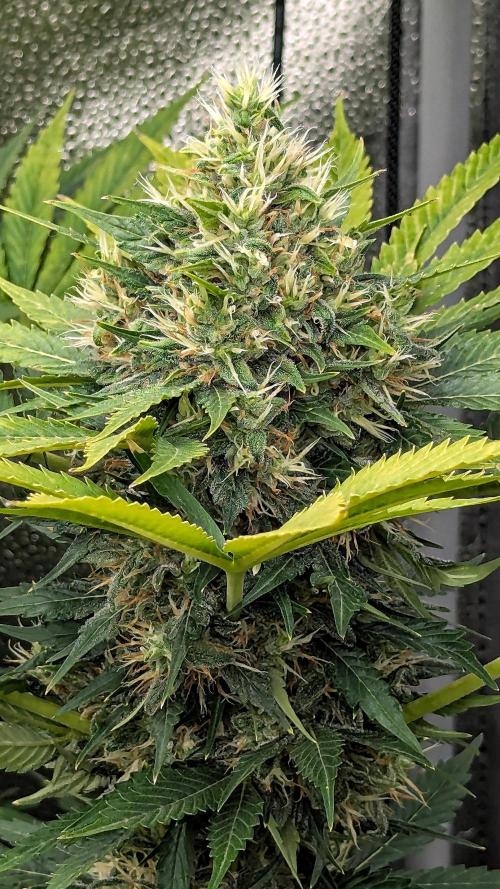
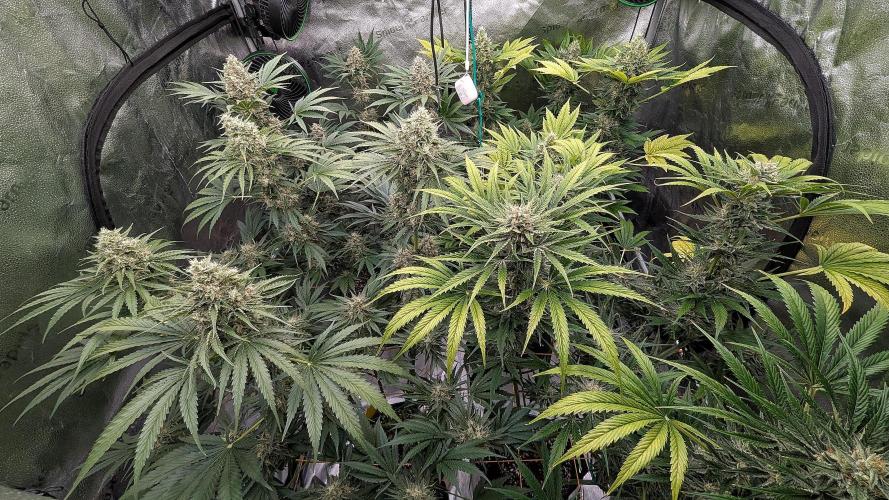
Flower weight increased noticeably this week. Branches on all four plants began leaning more under accumulating biomass, including both primary tops and side branches. Several branches already required support, and additional support will likely be needed soon as buds continue swelling.
The Stardawg plants continued showing strong uniformity between phenotypes, with both plants producing similar flower structure. Strawberry Cough continued displaying greater variation between plants, with one phenotype expressing denser, thicker flower development and the other maintaining a taller, more open structure with longer flower formations.
The focus moving forward remains on maintaining stable environmental conditions, monitoring Strawberry Cough response to the feed adjustment, supporting increasingly heavy branches, and allowing the plants to continue building through the remainder of mid flower.
likes
comments
Share
Used techniques
LST
Technique
12-12
Technique
Four-Headed Monster
Technique
11
Week 11. Flowering2mo ago
111.76 cm
Height
12 hrs
Light Schedule
26 °C
Day Air Temp
6.2
pH
Strong
Smell
815 PPM
TDS
53 %
Air Humidity
19 °C
Solution Temp
17 °C
Substrate Temp
19 °C
Night Air Temp
11.4 l
Pot Size
2 l
Watering Volume
20.32 cm
Lamp Distance
MichaelTheBarnOwl Grow #6, Entry #12: Mid-Late Flower Transition
Days Since Emergence: 77
Days Since Flip: 58
Days in Flower: 49
Light intensity was reduced from 70% to 65% during the period. At the beginning of the week, mid and upper-canopy measurements were as follows:
SC1: 600–1100 PPFD (26–47 DLI)
SC2: 500–1040 PPFD (21–45 DLI)
SD1: 620–1180 PPFD (27–50 DLI)
SD2: 685–1230 PPFD (30–54 DLI)
Following the light reduction, end-of-period measurements were as follows:
SC1: 710–850 PPFD at the tops; ~600 PPFD mid-canopy
SC2: 740–860 PPFD at the tops; 400–450 PPFD mid-canopy
SD1: 750–990 PPFD at the tops; ~500 PPFD mid-canopy
SD2: 920–1050 PPFD at the tops; ~500 PPFD mid-canopy
UV-A supplementation remained unchanged at 90 minutes per light cycle.
Irrigation remained stable at approximately 1–1.5 gallons per plant every other day with input pH maintained between 6.0–6.2. Due to periods of elevated outdoor humidity, irrigation volume was occasionally reduced while maintaining adequate substrate moisture and healthy plant posture.
At the beginning of the period, all four plants received General Hydroponics Mid Bloom nutrients. Mid-week trichome analysis indicated that the crop was beginning its transition into late flower, prompting a move to a 50/50 blend of Mid Bloom and Late Bloom nutrients.
The Stardawg plants continued receiving 100% Aggressive feed strength throughout the period. Mid Bloom feedings were delivered at 900 PPM with CAL-MAG maintained at 5 mL/gal. 50/50 Mid Bloom/Late Bloom blend was delivered at 815 PPM.
Strawberry Cough continued exhibiting higher nutritional demand than Stardawg. Following the feed increase implemented during the previous reporting period, nutrient strength was increased further to approximately 125% Aggressive strength. Mid Bloom feedings were delivered at approximately 1025 PPM, while the 50/50 Mid Bloom/Late Bloom blend was delivered at approximately 935 PPM.
Silica supplementation was discontinued during the period.
Strawberry Cough continued displaying yellowing on larger upper and mid-canopy fan leaves. While the increased feed strength appears to have slowed progression somewhat, the plants continue to consume nutrients aggressively as flower development accelerates. Natural senescence also appears to be beginning, making it increasingly difficult to separate nutrient demand from normal late-flower fading.
During lights out, temperatures were generally maintained in the upper 60s to low 70s with VPD averaging approximately 1.0–1.2 kPa. During lights on, temperatures averaged approximately 78°F with VPD generally ranging between 1.3–1.5 kPa. These conditions allowed the tent environment to remain stable and within target parameters throughout the week.
Routine herm inspections continued once per week. No male flowers, pollen sacs, or nanners were observed during this reporting period.
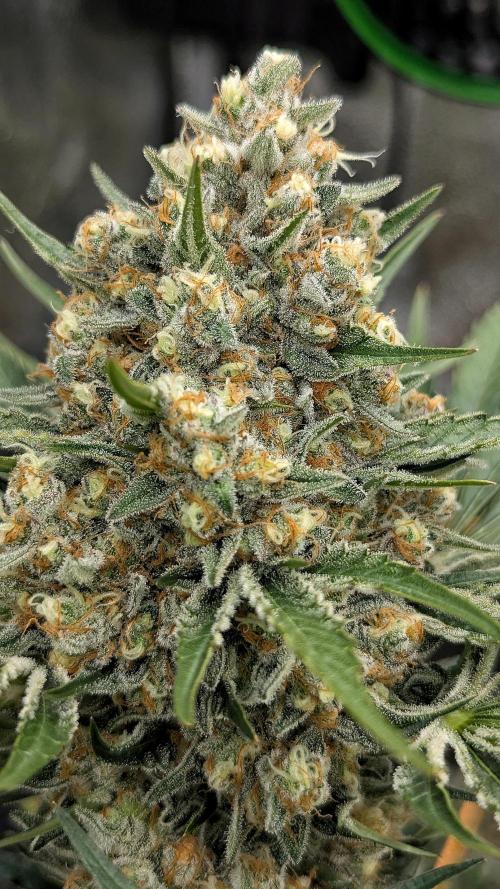
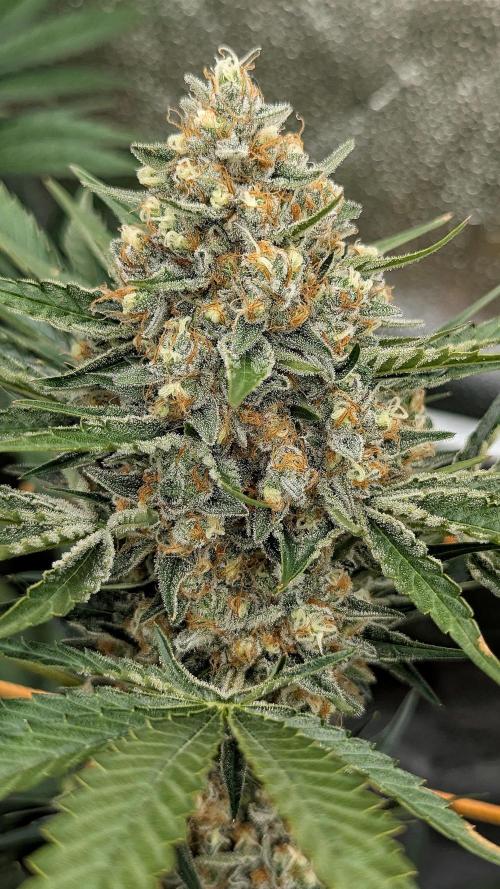
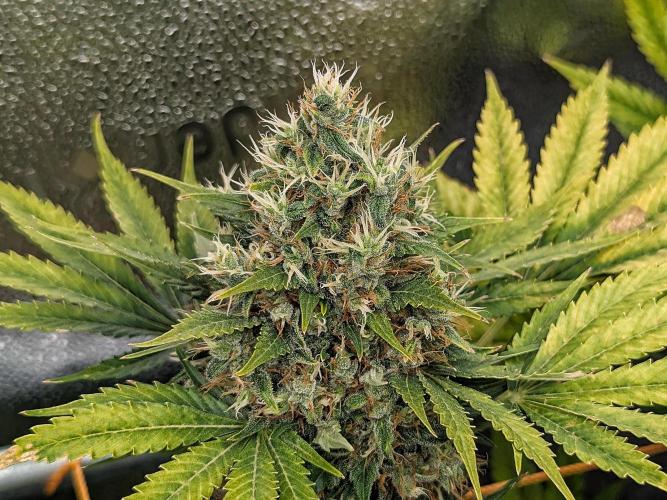
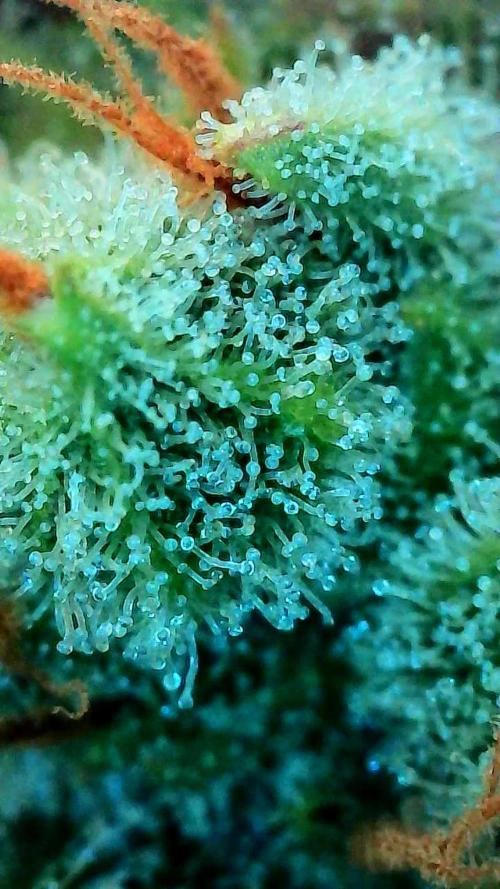
Aroma remained strong and continued increasing in intensity. Sweet skunk notes remained dominant, although the overall profile became deeper, richer, and more penetrating as flower maturity progressed. Opening the tent now results in an immediate and overwhelming release of aroma throughout the surrounding area.
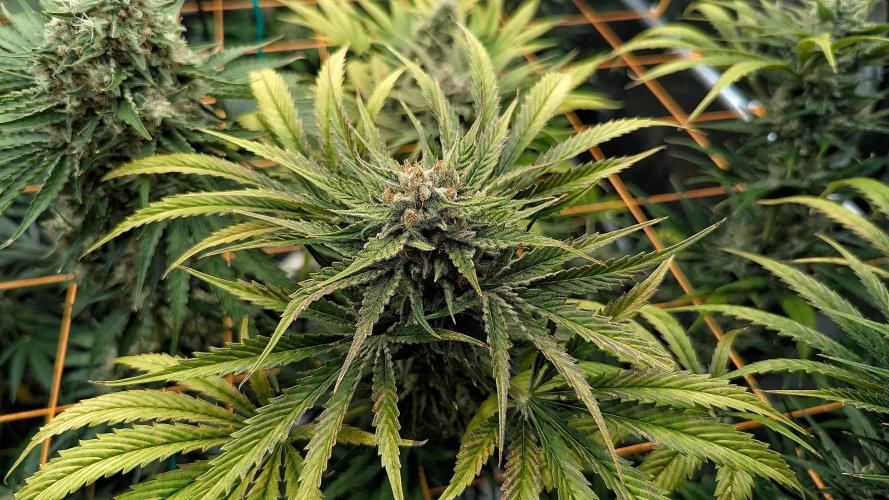
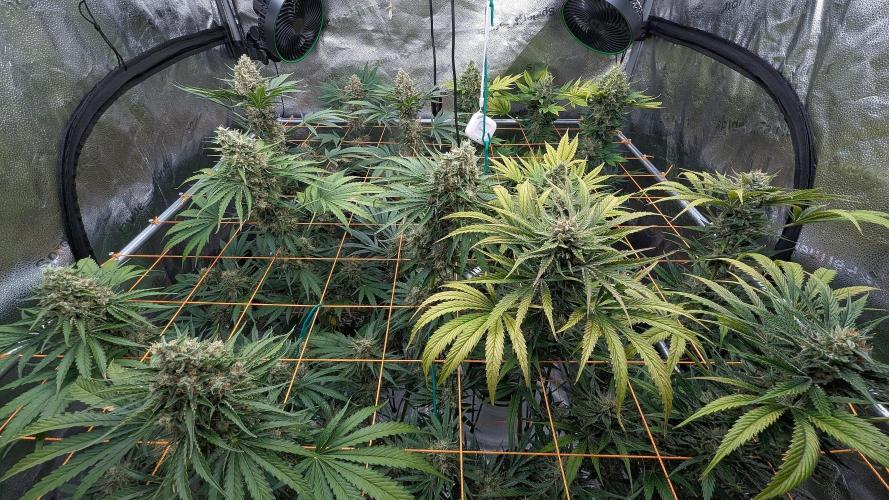
Bud mass increased significantly across all four plants, resulting in multiple mains beginning to lean under their own weight. Lower branches also began showing signs of strain as flowers continued stacking and swelling. To prevent branch collapse and provide additional support heading into the final weeks of flower, a second support grid was installed higher within the canopy.
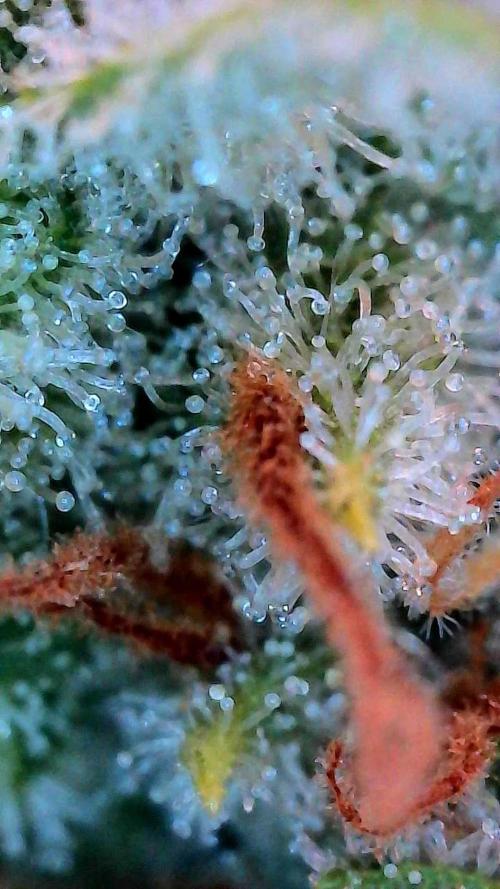
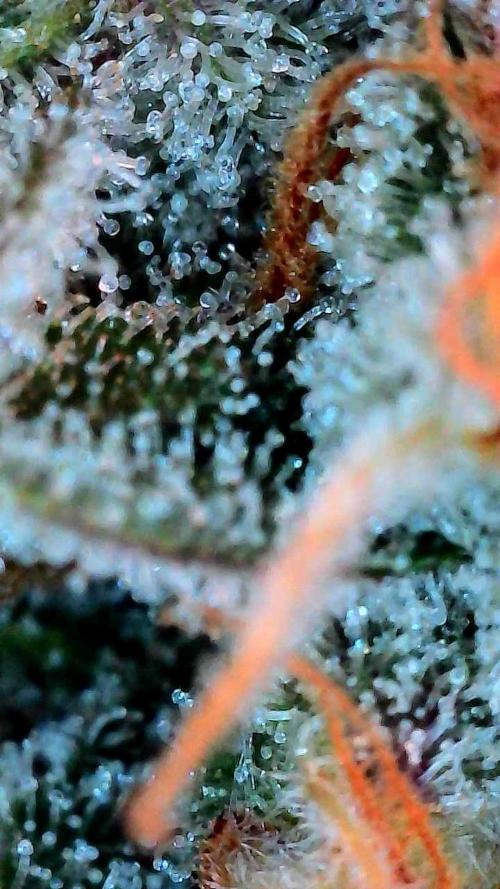
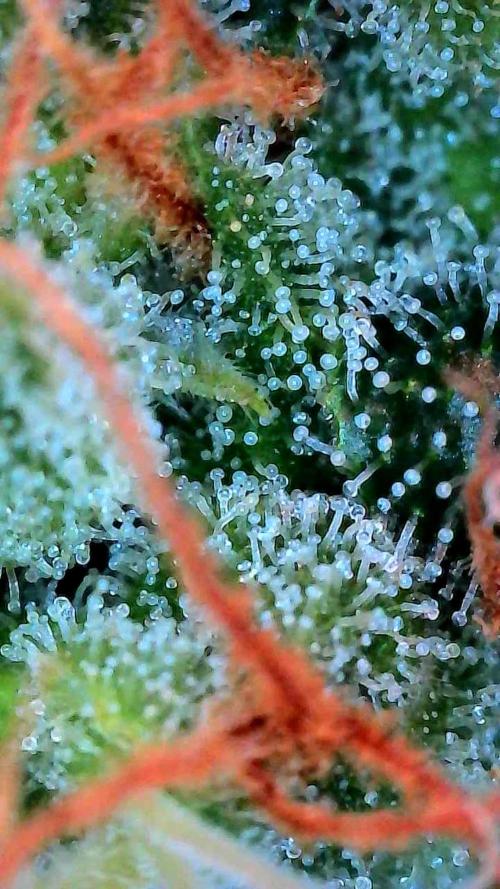
The trichome progression observed during the period strongly supported the decision to begin transitioning toward late-flower nutrition. Mid-week observations were as follows:
SC1:
Top (28% Clear / 72% Cloudy / 0% Amber)
Middle (33% Clear / 67% Cloudy / 0% Amber)
Overall (30% Clear / 70% Cloudy / 0% Amber)
SC2:
Top (20% Clear / 79% Cloudy / 1% Amber)
Middle (25% Clear / 74% Cloudy / 1% Amber)
Overall (22% Clear / 77% Cloudy / 1% Amber)
SD1:
Top (28% Clear / 70% Cloudy / 2% Amber)
Middle (33% Clear / 65% Cloudy / 2% Amber)
Overall (30% Clear / 68% Cloudy / 2% Amber)
SD2:
Top (18% Clear / 80% Cloudy / 2% Amber)
Middle (20% Clear / 79% Cloudy / 1% Amber)
Overall (19% Clear / 80% Cloudy / 1% Amber)
2 likes
comments
Share
Used techniques
LST
Technique
Defoliation
Technique
12-12
Technique
Four-Headed Monster
Technique
12
Week 12. Flowering2mo ago
111.76 cm
Height
12 hrs
Light Schedule
23 °C
Day Air Temp
6.2
pH
Strong
Smell
405 PPM
TDS
54 %
Air Humidity
19 °C
Solution Temp
17 °C
Substrate Temp
18 °C
Night Air Temp
11.4 l
Pot Size
2 l
Watering Volume
20.32 cm
Lamp Distance
MichaelTheBarnOwl Grow #6, Entry #13: Late Flower
Days Since Emergence: 84
Days Since Flip: 65
Days in Flower: 56
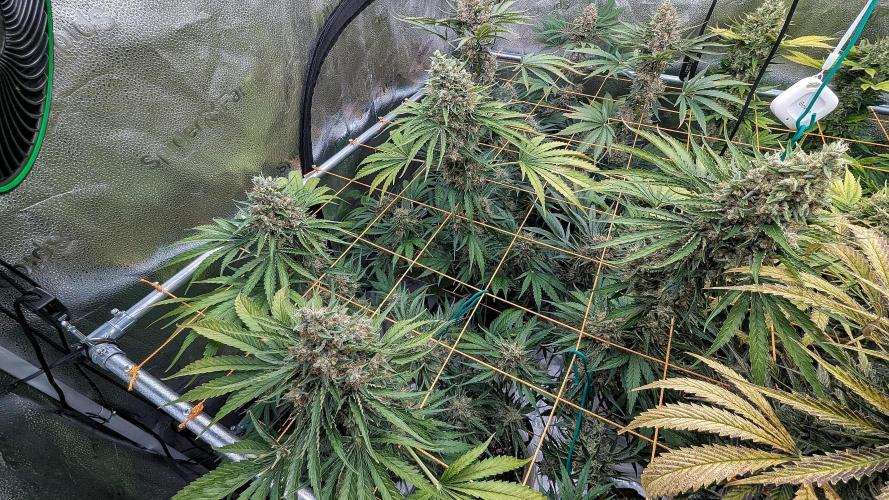
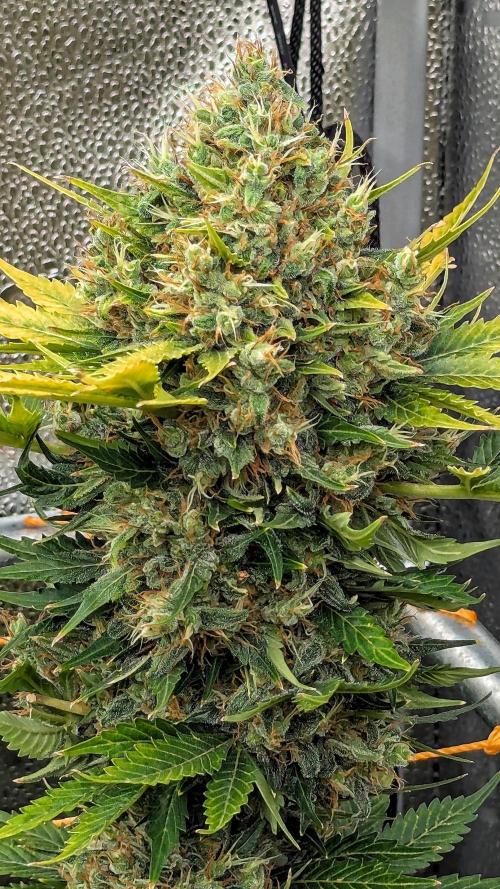
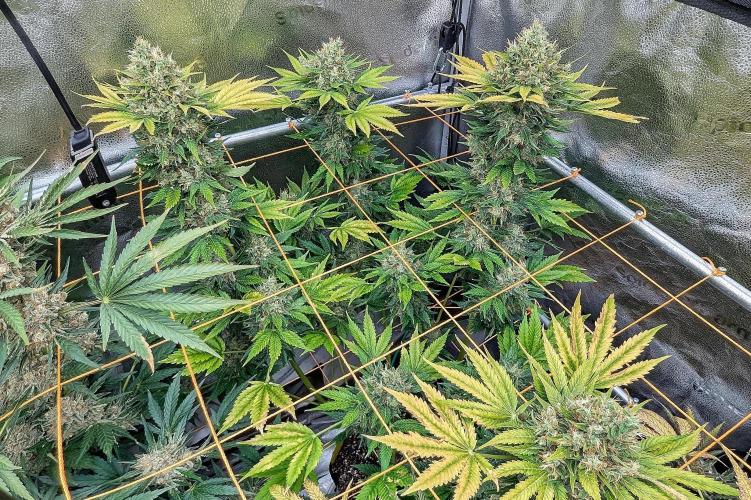
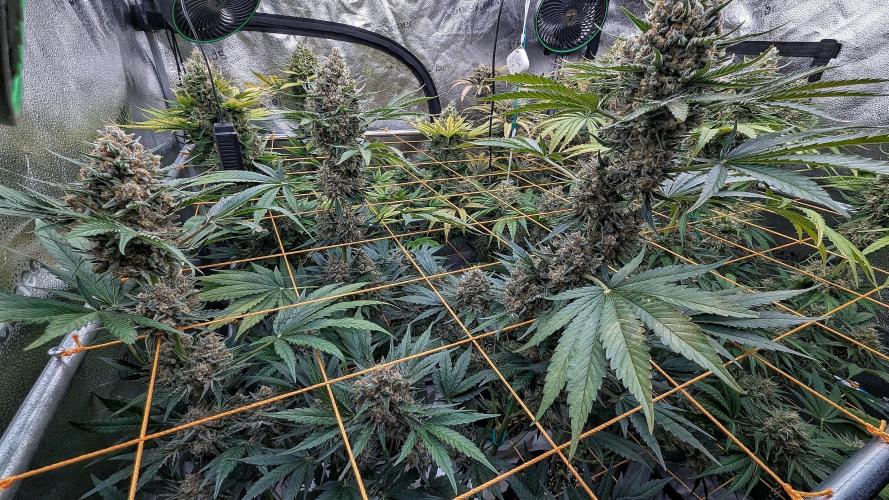
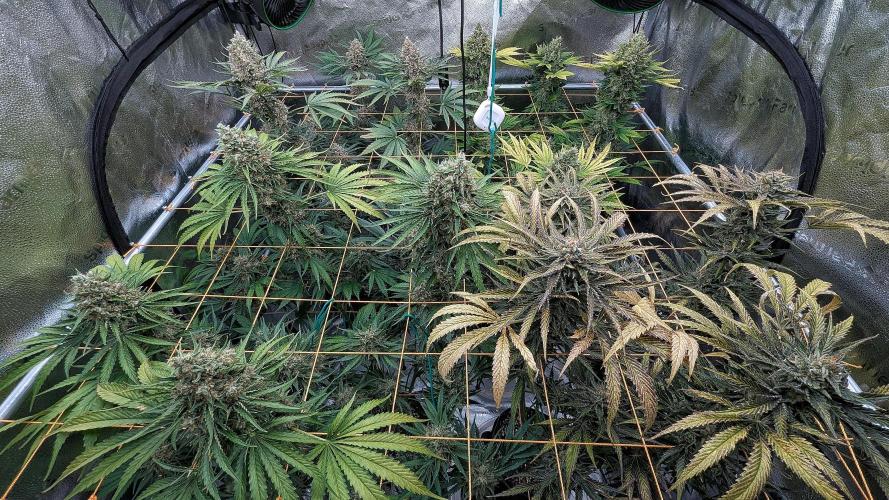
Light intensity was reduced from 65% to 60% during the period. Current canopy light levels were as follows:
SC1: 795–835 PPFD (tops); ~590 PPFD (mid)
SC2: 740–790 PPFD (tops); ~465 PPFD (mid)
SD1: 675–915 PPFD (tops); ~430 PPFD (mid)
SD2: 860–980 PPFD (tops); ~530 PPFD (mid)
UV-A supplementation was reduced from 90 minutes to 45 minutes per light cycle.
Irrigation continued with pH-adjusted water maintained at 6.2. During the week, Strawberry Cough completed the transition from the 50/50 Mid Flower/Late Flower blend to Late Flower nutrients before advancing to Ripening nutrients at approximately 485 PPM in preparation for harvest. Stardawg remained on Late Flower nutrients at approximately 655 PPM throughout the reporting period.
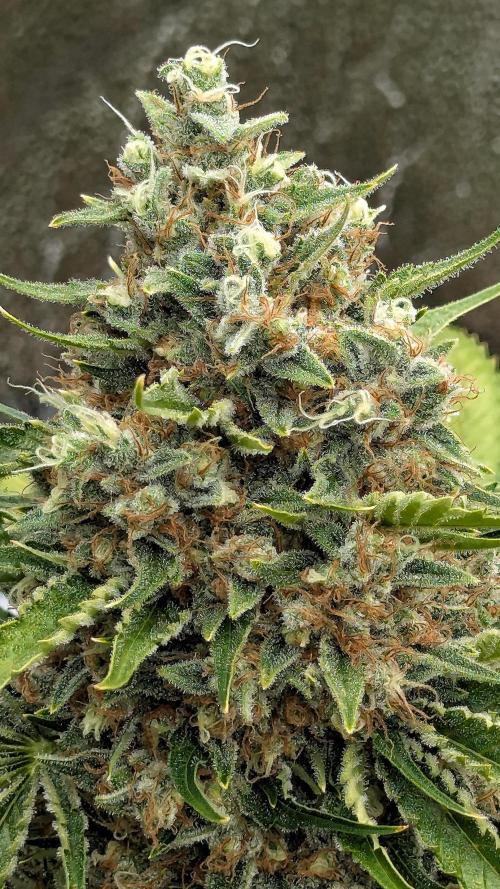
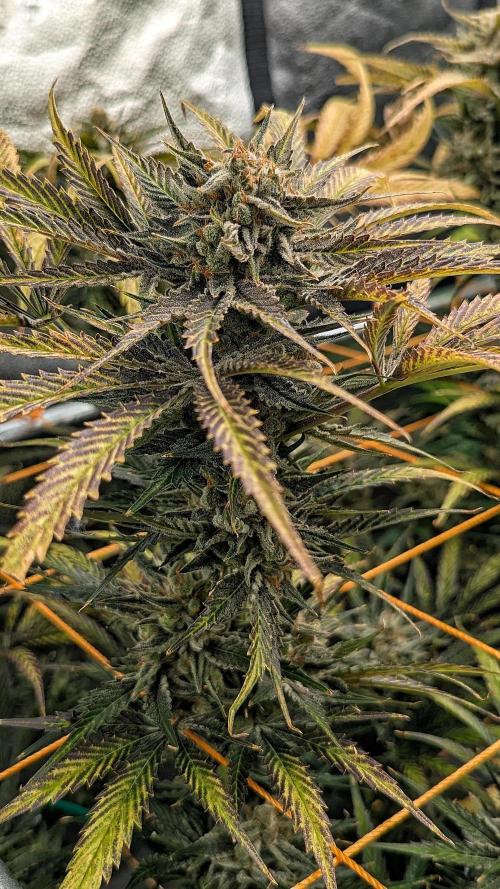
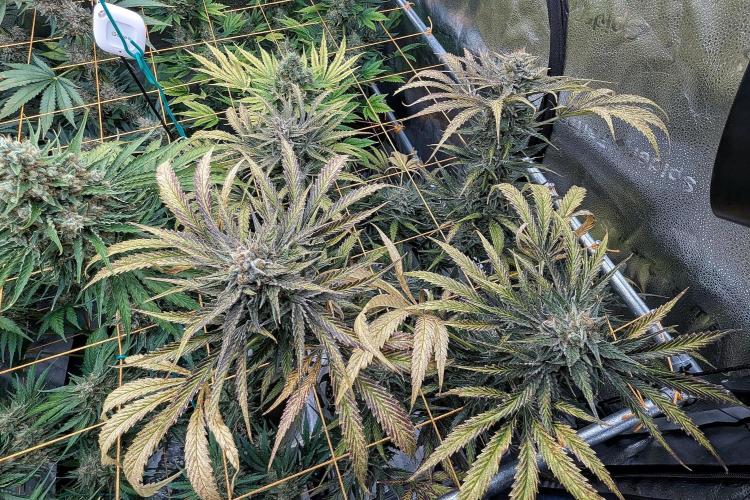
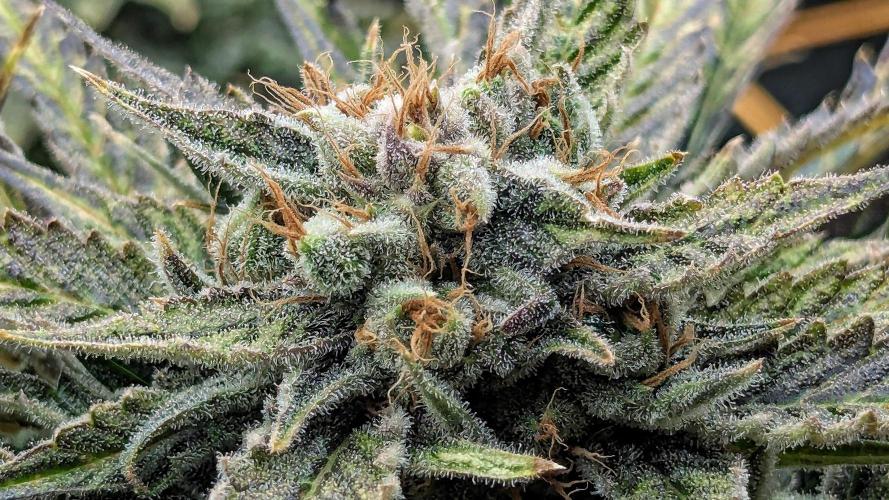
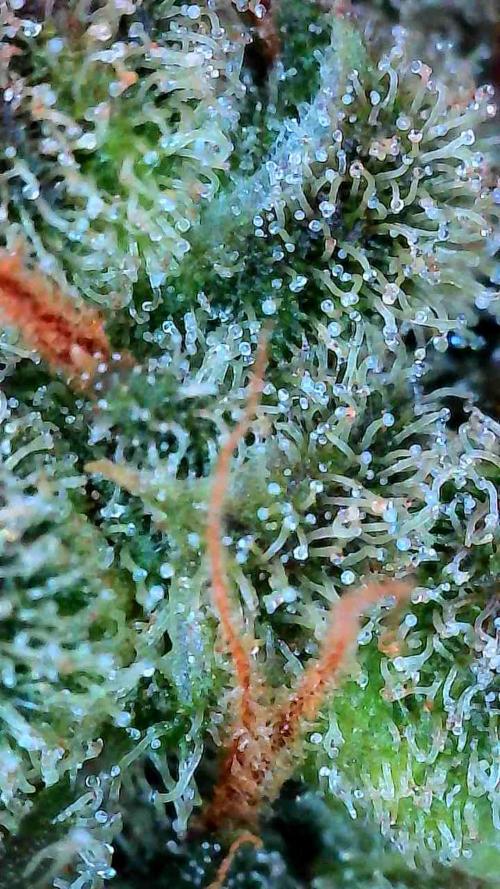
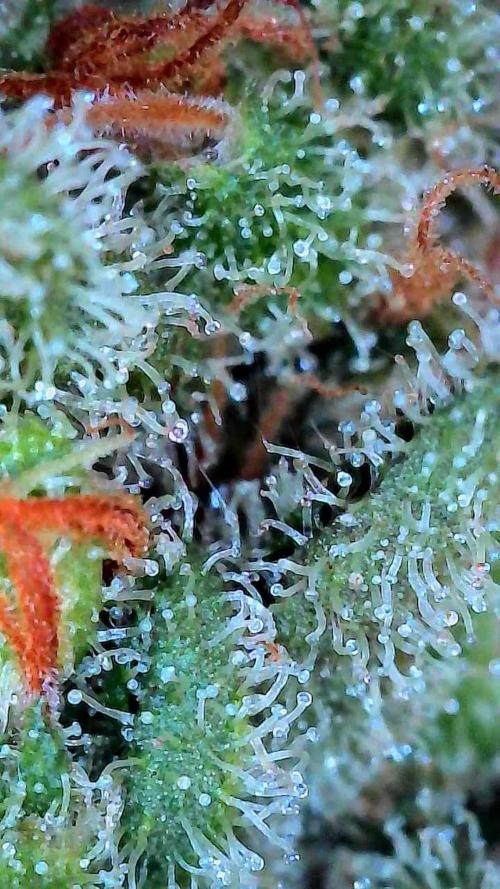
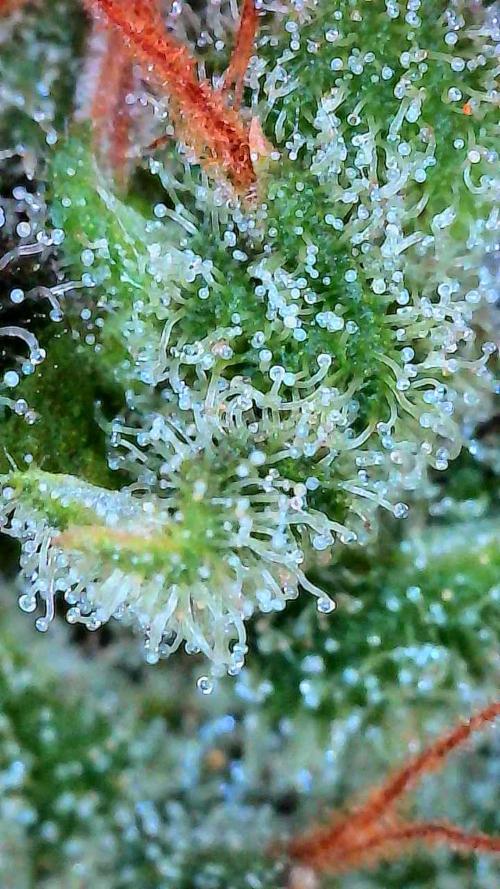
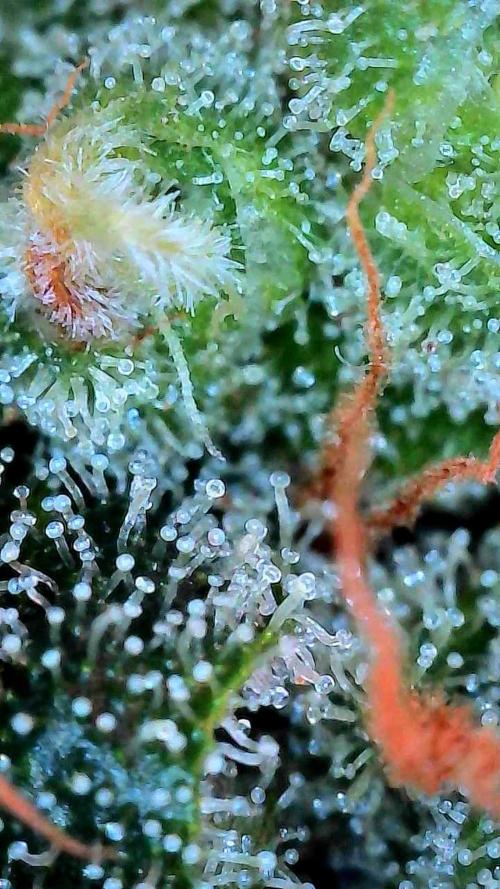
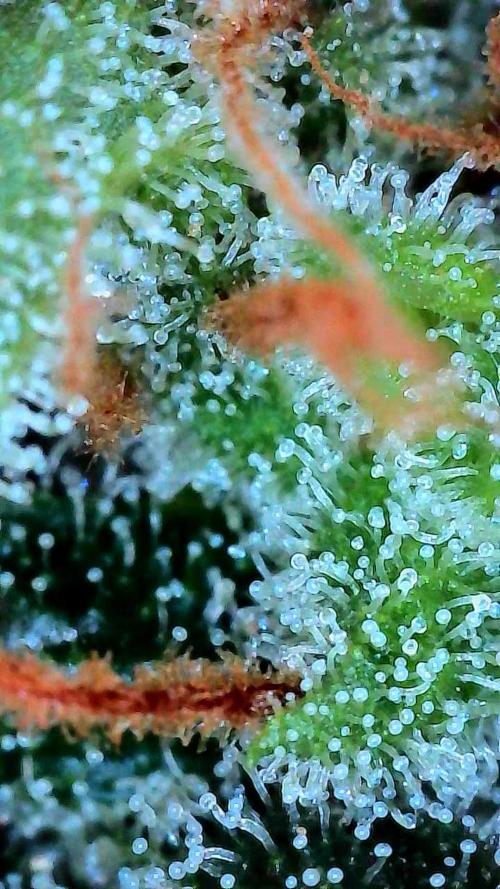
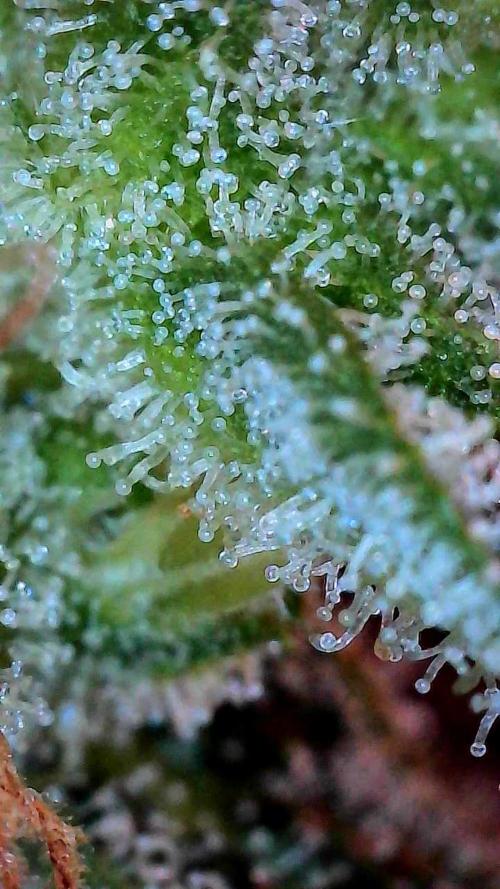
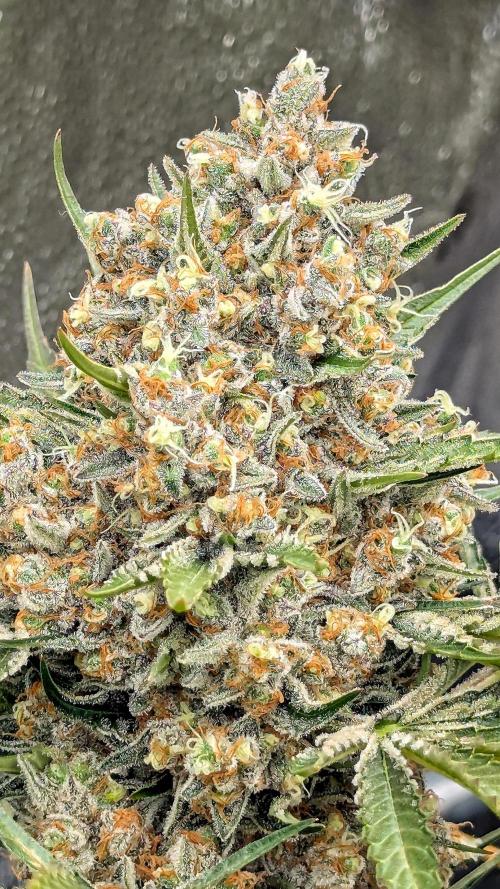
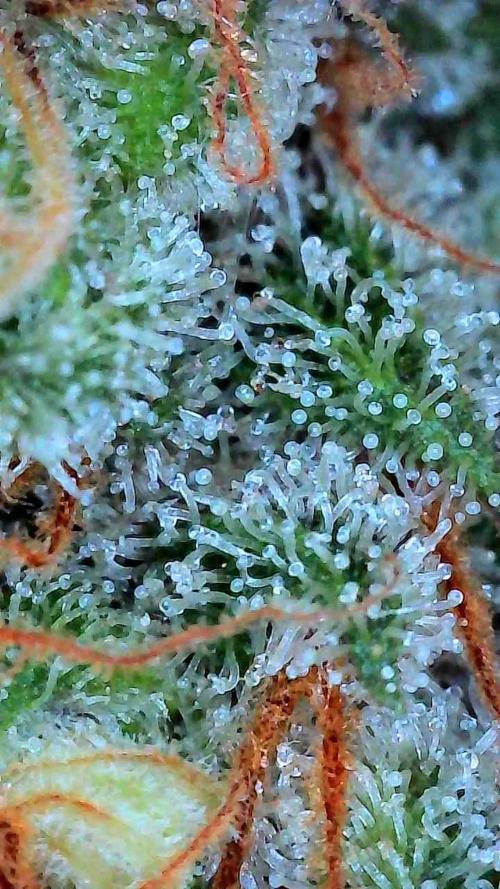
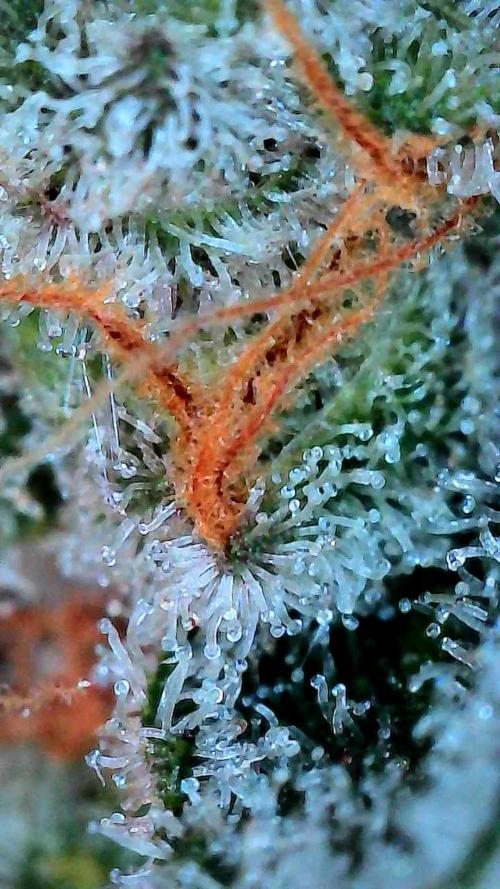
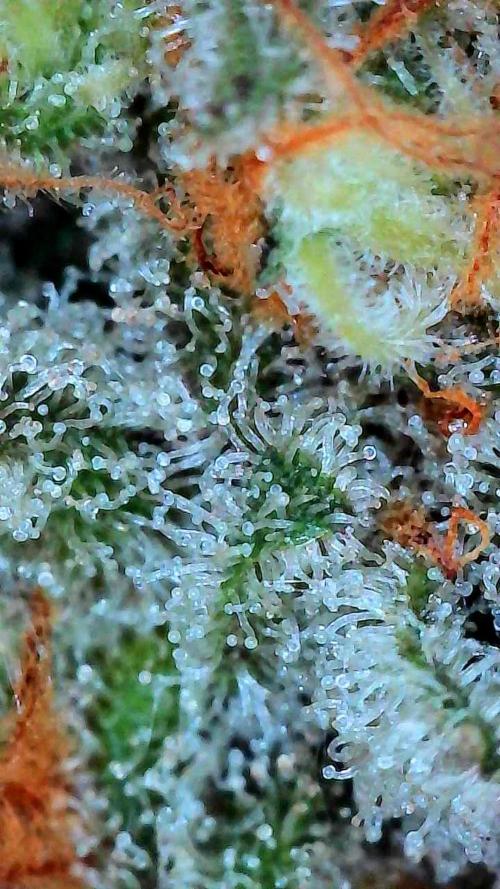
Natural fade accelerated noticeably in both Strawberry Cough plants during the week. Combined with rapid trichome maturation, the progression indicated the plants had entered their final ripening phase rather than exhibiting a nutritional deficiency.
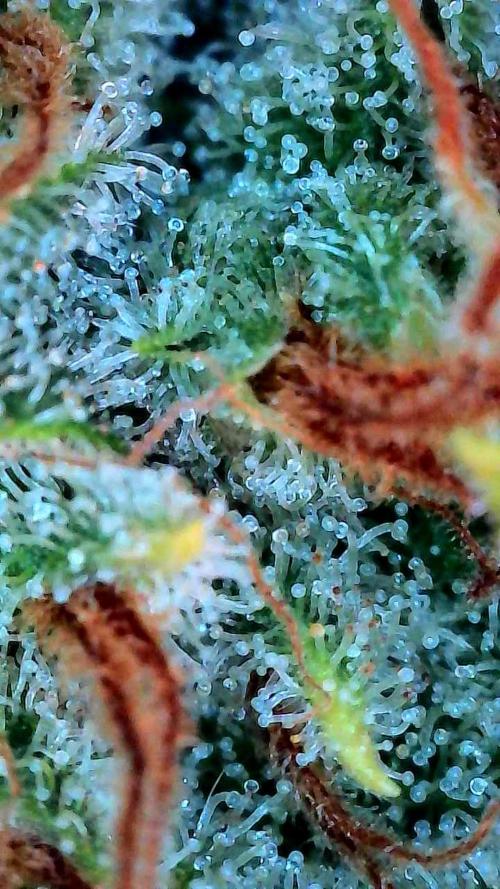
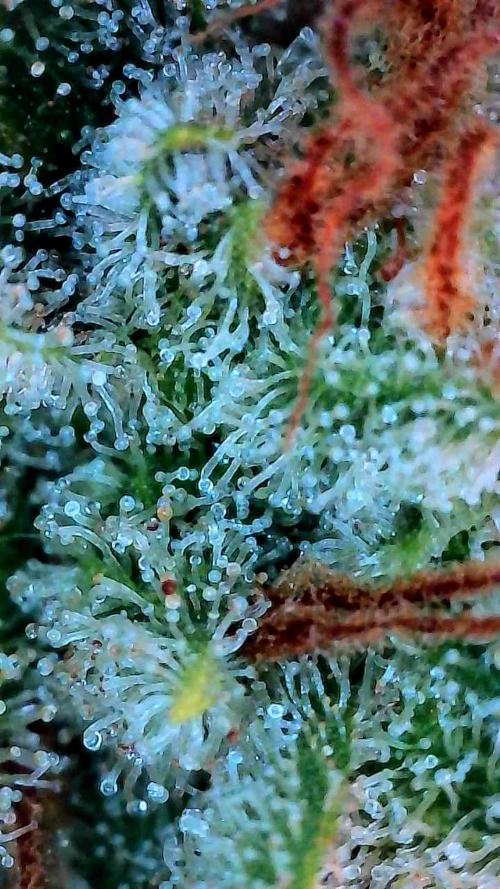
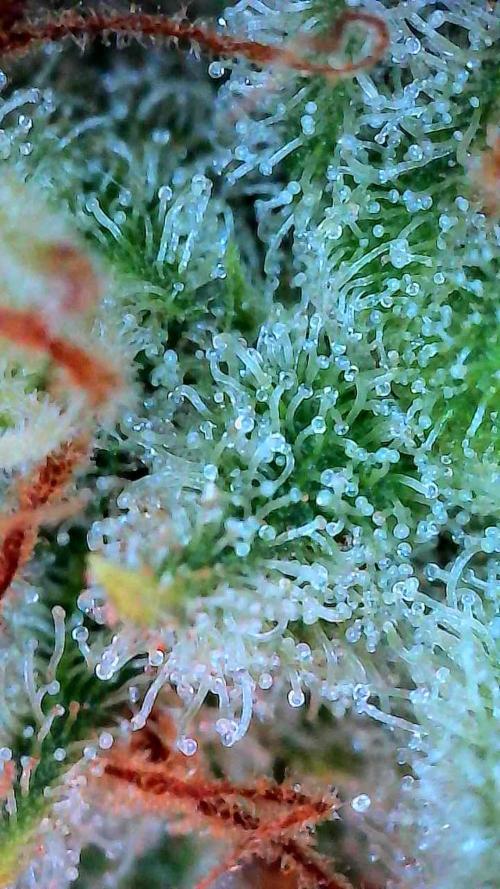
Overall Trichome Development
SC1: 6% Clear / 93% Cloudy / 1% Amber
SC2: 10% Clear / 88% Cloudy / 2% Amber
SD1: 12% Clear / 88% Cloudy / 1% Amber
SD2: 6% Clear / 93% Cloudy / 1% Amber
Based on plant appearance and trichome development, Strawberry Cough is expected to be harvested approximately one week after this entry. Ripening nutrients have been initiated and will be followed by several irrigations with plain pH-adjusted water prior to harvest.
Stardawg will remain on Late Flower nutrients for approximately one additional week before beginning its own ripening phase. Unlike Strawberry Cough, the harvest target for Stardawg is a modestly higher percentage of amber trichomes to encourage fuller expression of its earthy, fuel-forward profile.
1 like
comments
Share
Used techniques
12-12
Technique
Defoliation
Technique
LST
Technique
Four-Headed Monster
Technique
13
Week 13. Flowering1mo ago
111.76 cm
Height
12 hrs
Light Schedule
22 °C
Day Air Temp
6.2
pH
Strong
Smell
110 PPM
TDS
55 %
Air Humidity
19 °C
Solution Temp
17 °C
Substrate Temp
19 °C
Night Air Temp
11.4 l
Pot Size
2 l
Watering Volume
20.32 cm
Lamp Distance
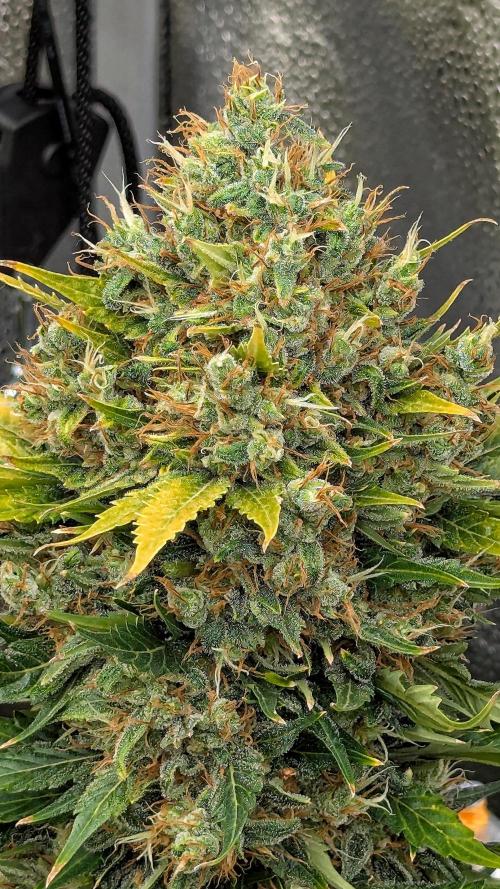
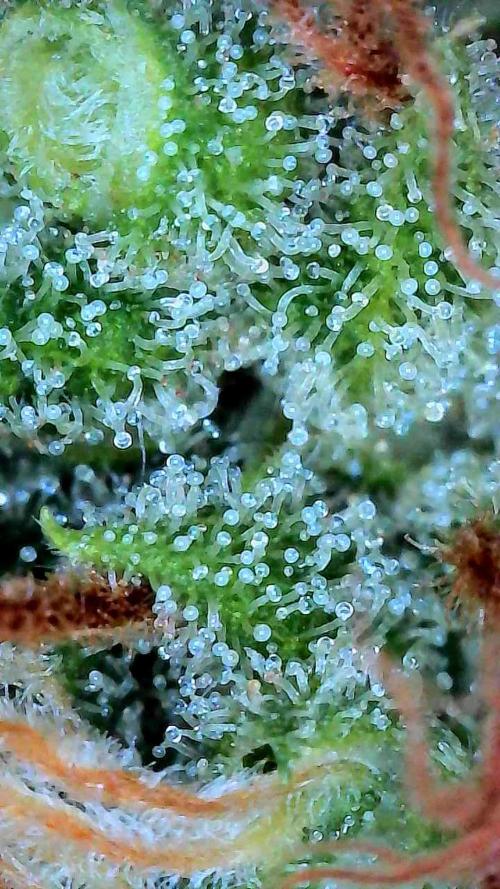
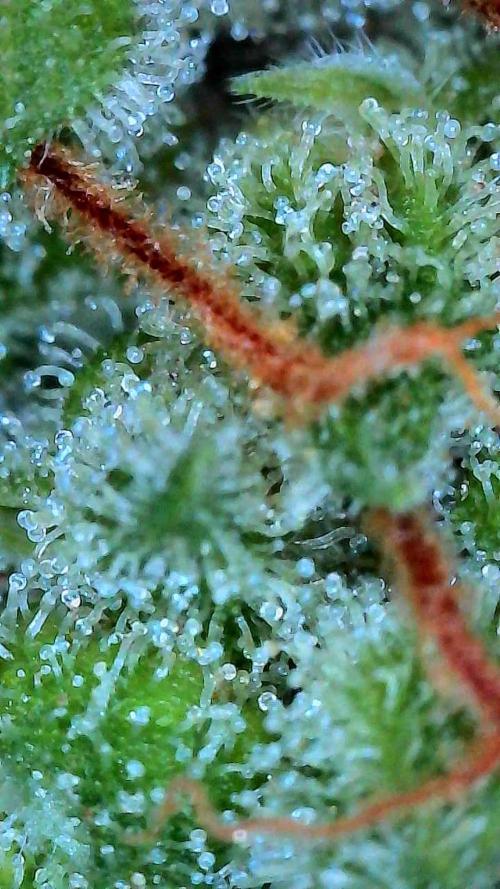
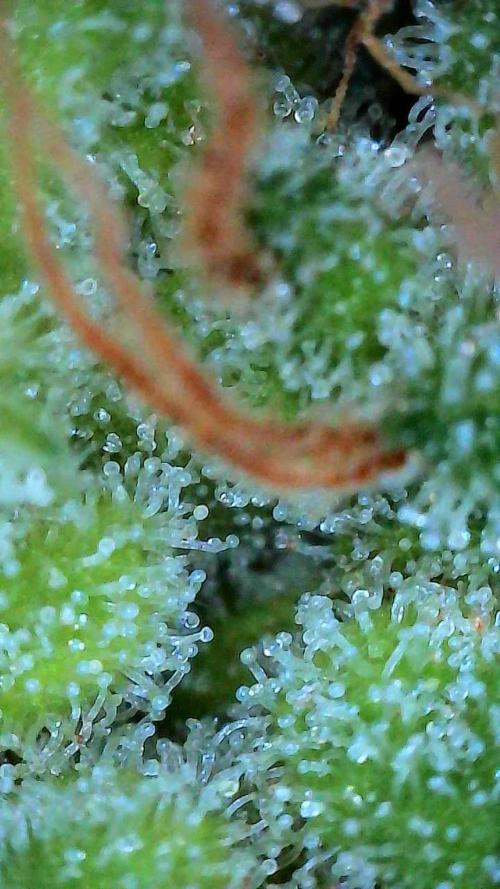
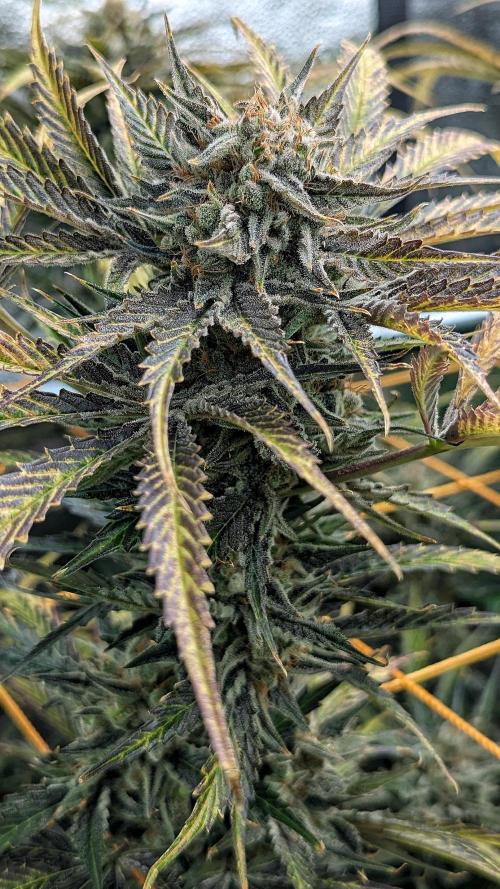
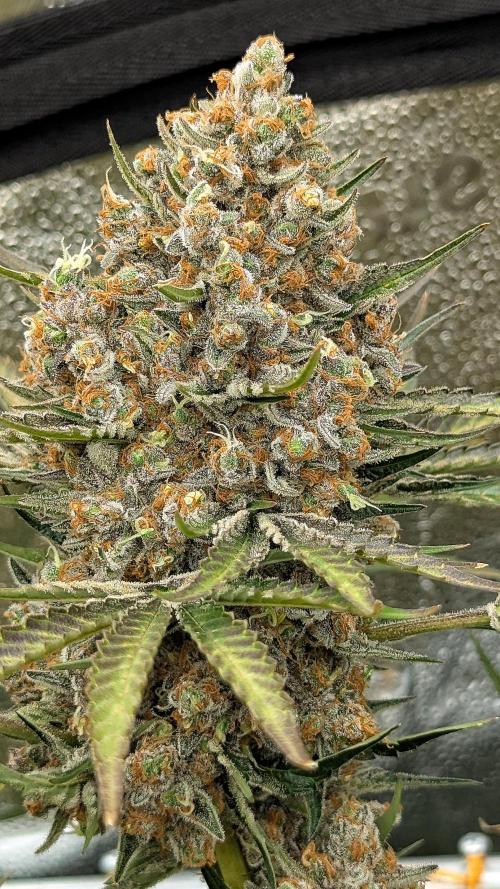
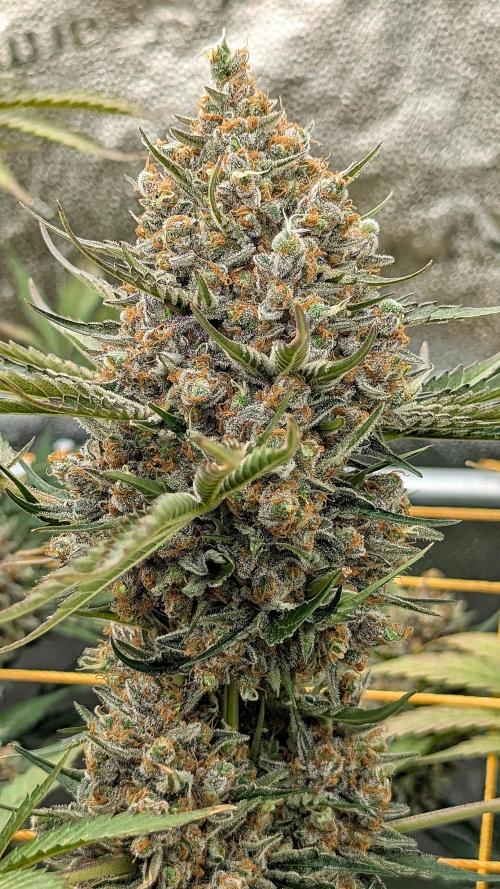
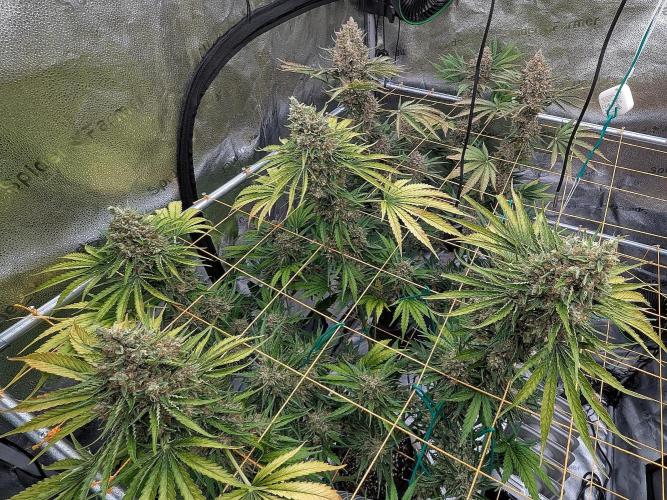
MichaelTheBarnOwl Grow #6, Entry #14: Strawberry Cough Harvest / Stardawg Ripening
Days Since Emergence: 91
Days Since Flip: 72
Days in Flower: 63
Light intensity was reduced mid-week from approximately 62% to 60%. Final canopy light levels were as follows:
SC1: 600–690 PPFD (tops); ~550 PPFD (mid)
SC2: 700–710 PPFD (tops); ~410 PPFD (mid)
SD1: 600–810 PPFD (tops); ~380 PPFD (mid)
SD2: 745–900 PPFD (tops); ~590 PPFD (mid)
UV-A supplementation was discontinued midway through the week.
Strawberry Cough began the week on Ripening nutrients. Nutrient concentration was gradually reduced (from 485 PPM to 405 PPM) before transitioning to plain pH-adjusted water (110 PPPM) during the second half of the week in preparation for harvest.
Stardawg remained on Aggressive Late Flower nutrients throughout the reporting period at approximately 655 PPM with 3 ml/gal CAL-MAG.
Irrigation continued every other day at approximately 1–1.5 gallons per plant, with input pH maintained between 6.1–6.2.
Natural senescence accelerated substantially in both Strawberry Cough plants during the week. Strawberry Cough was harvested on Day 90 since emergence / Day 71 since flip / Day 62 in flower.
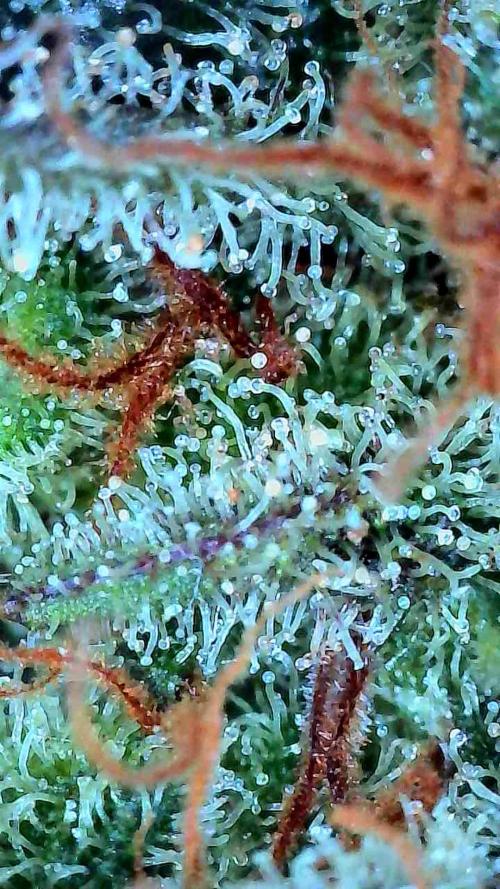
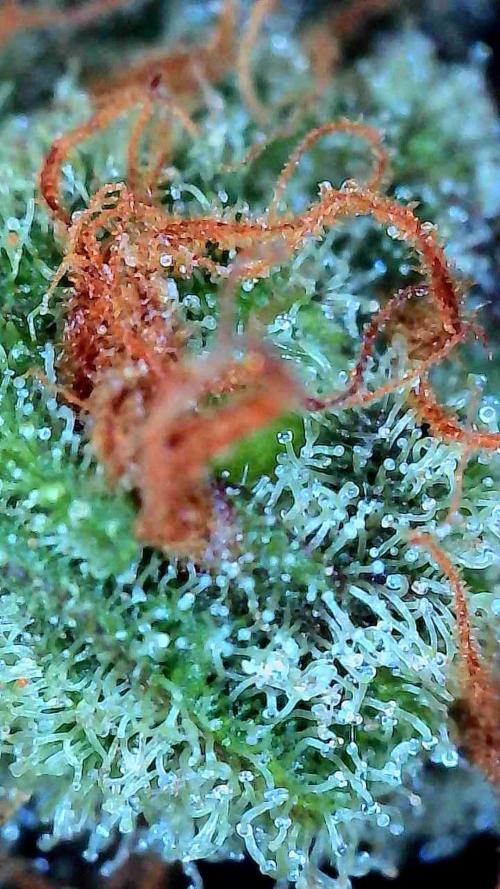
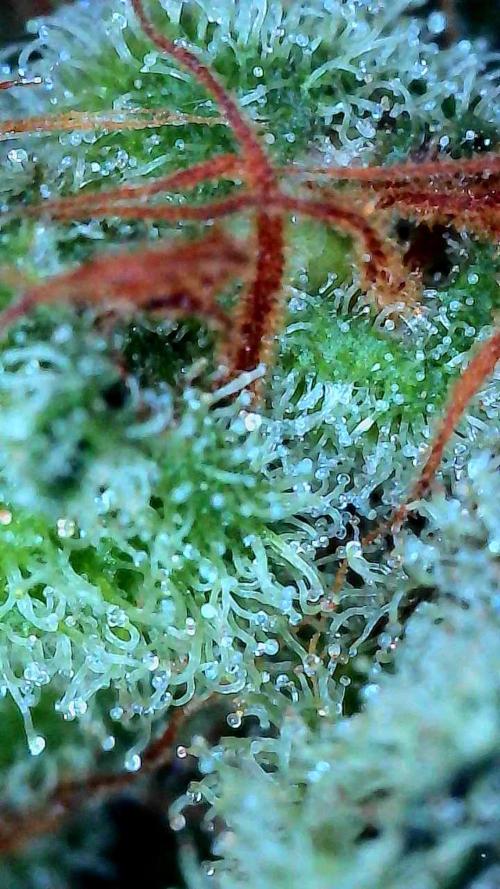
Final trichome analysis for Strawberry Cough was:
SC1: 15% Clear / 84% Cloudy / 1% Amber
SC2: 18% Clear / 80% Cloudy / 2% Amber
Plants were harvested progressively from the bottom of the canopy upward. A light wet trim was performed before flowers were transferred directly into the Cannatrol for a 4-day Dry, 4-day Cure, and 7-day Hold cycle. A separate harvest summary will be prepared once final dry weights have been recorded. Strawberry Cough was harvested with the objective of maximizing an uplifting, euphoric effect while minimizing sedative characteristics.
With Strawberry Cough complete, full attention now shifts to finishing Stardawg. Formal trichome analysis was not performed during the week. A small number of nanners were observed on several upper colas of SD2 and were removed immediately with tweezers. No evidence of pollination or seed development has been observed, and the plants remain on schedule to begin the Ripening phase during the coming week.
1 like
comments
Share
Used techniques
LST
Technique
12-12
Technique
Defoliation
Technique
Four-Headed Monster
Technique
13
Week 13. Harvest1mo ago
Happy Harvest Day!


10/10
Rated
Excellent experience with Dutch Passion's Strawberry Cough. I grew two plants from seed using an intentionally abbreviated cultivation cycle. These photoperiod plants were grown more like I would approach an autoflower, with only 20 days from emergence to flip. Each plant was topped early and reduced to two primary sets of branches, creating a very simple, compact structure with a minimal vegetative window.
Despite the abbreviated veg period, the two plants produced a combined 310.9 g, or just under 11 ounces, of dry flower.
Phenotypic variation between the plants was substantial. One phenotype developed massive, heavily stacked, baseball bat-like colas and produced 180.5 g dry. The second expressed a thinner, spindle-like structure with narrower, leafier flower formations and produced 130.4 g. Both produced excellent finished flower despite their dramatically different architecture.
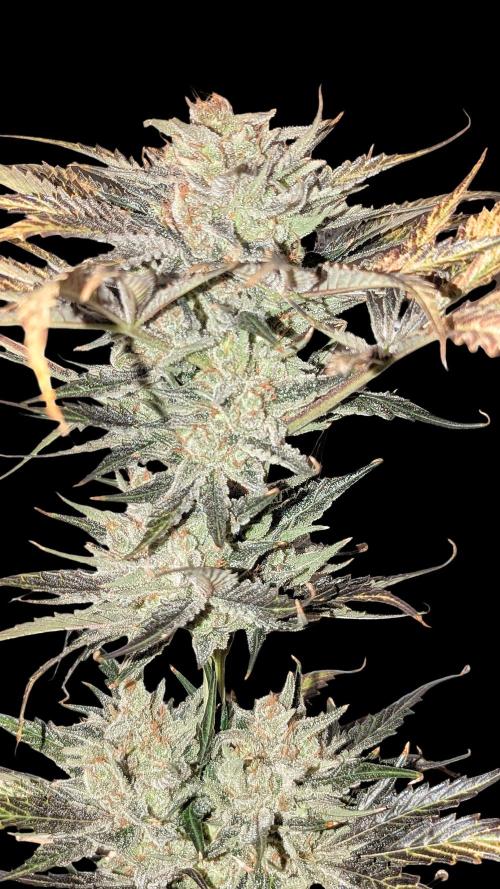
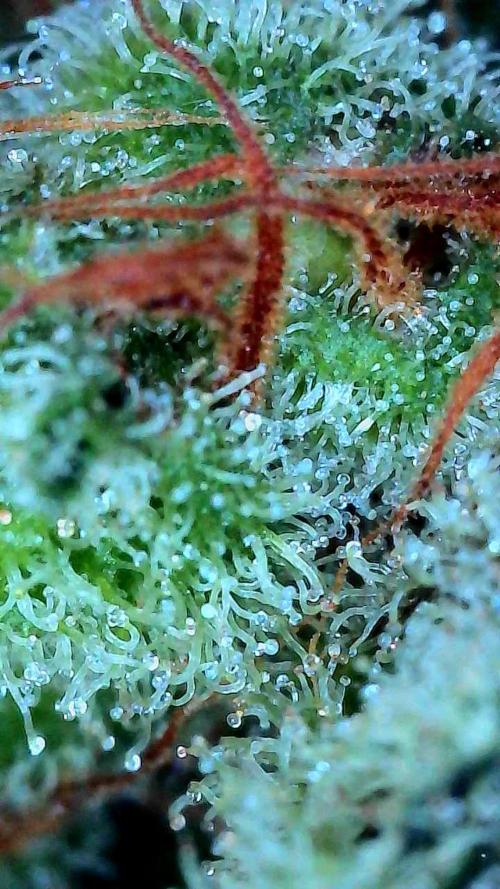
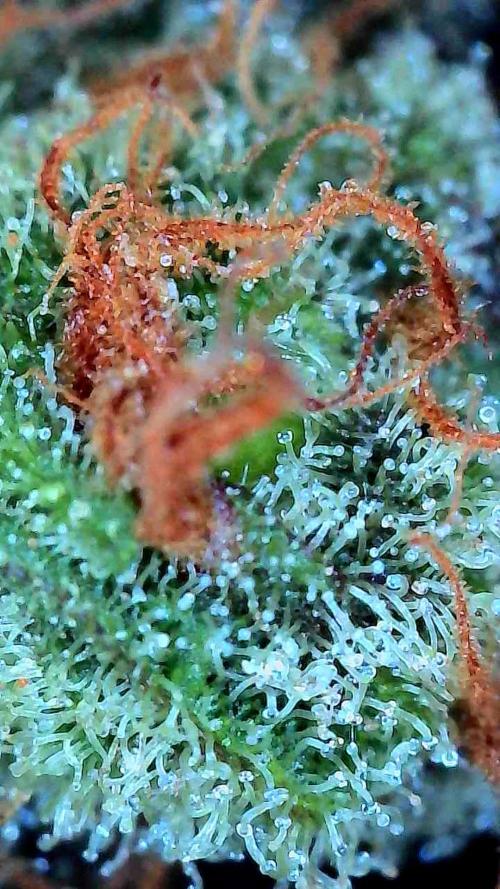
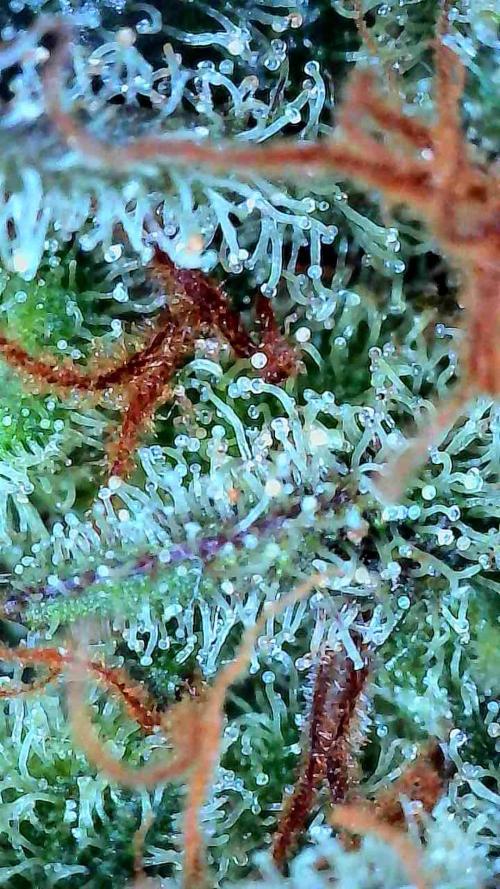
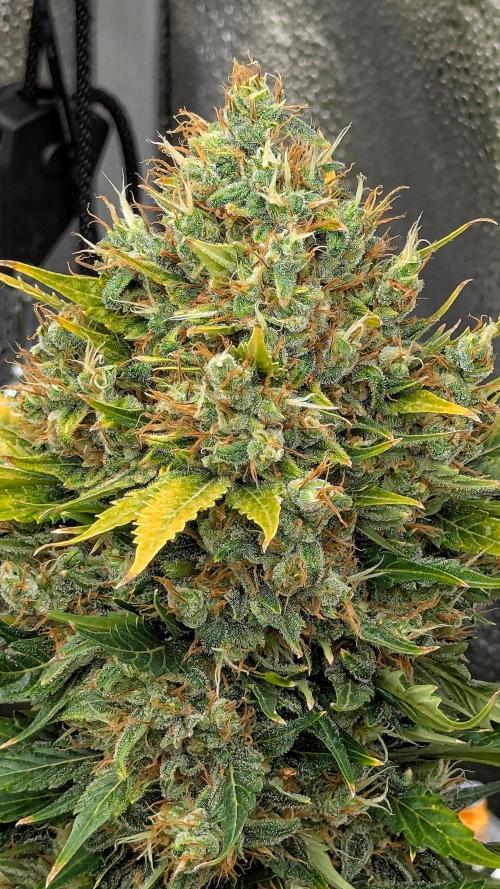
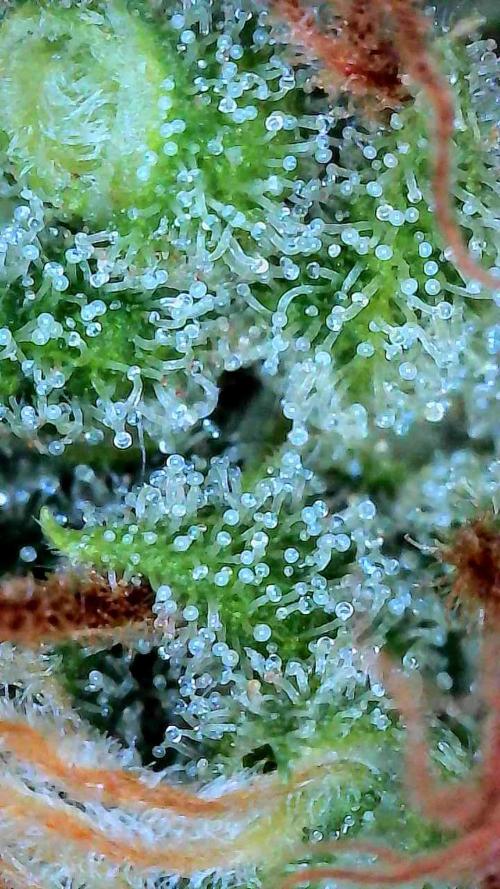
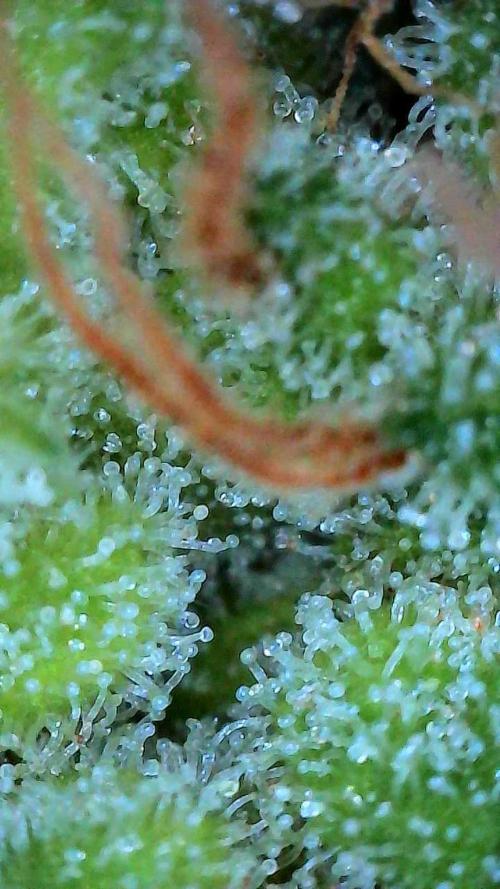
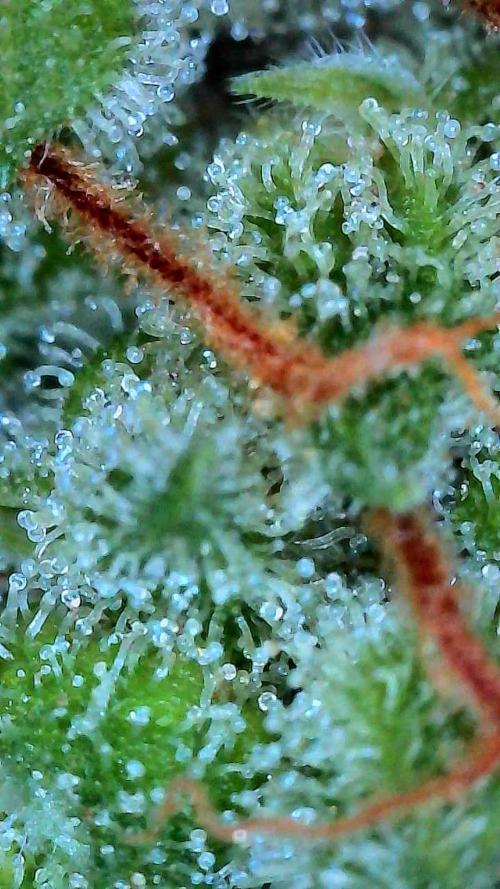
The flower is exceptionally resinous and among the stickiest I have grown. Aroma is explosive, with strong fruit upfront followed by pronounced skunk and spicy undertones.
Effects are where this strain really shines. Onset is remarkably fast, beginning with a heavy sensation behind the eyes before rapidly developing into intense euphoria. The high is strongly cerebral - focused, happy, introspective, and creative - with comparatively mild body effects. It is also exceptionally long-lasting and gradually gives way to solid sleep without feeling immediately heavy or sedating.
I harvested at 62 days in flower with predominantly cloudy trichomes and very little amber, specifically targeting a more uplifting and euphoric expression. The finished effects aligned extremely well with that goal.
Overall, an excellent strain and one I would absolutely grow again. Outstanding resin production, explosive aroma, excellent yield from a deliberately shortened grow cycle, and exactly the cerebral effect I was hoping to achieve. Highly recommended.
Show more
Translate
Spent 108 days
Ger Veg Flo Har
155.45 g
Bud wet weight per plant
155.45 g
Bud dry weight per plant
2
Plants
40.64 m²
Grow Room size
Normal
Difficulty

Euphoric, Creative, Uplifted
Positive effects

Anxiety, Stress
Medical effects

Flowery, Citrus, Berries
Taste
Height
Day air temperature
Air humidity
PPM
PH
Light schedule
Solution temperature
Night air temperature
Substrate temperature
Pot size
Lamp distance
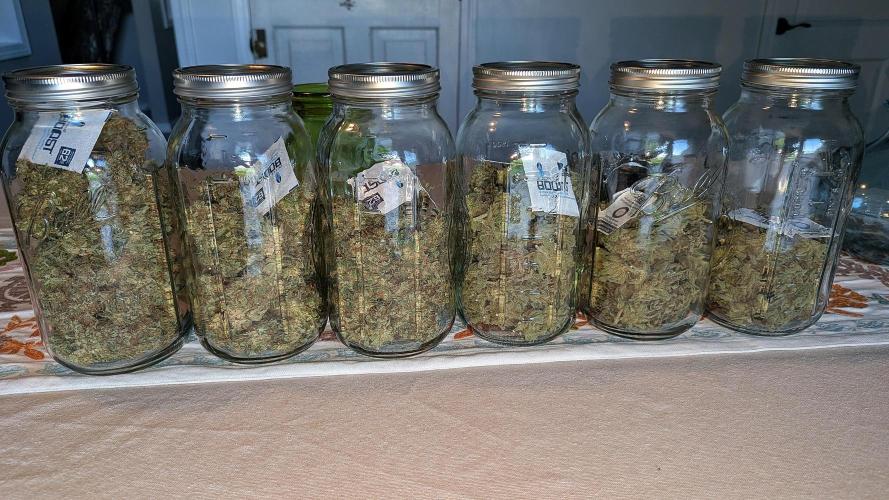
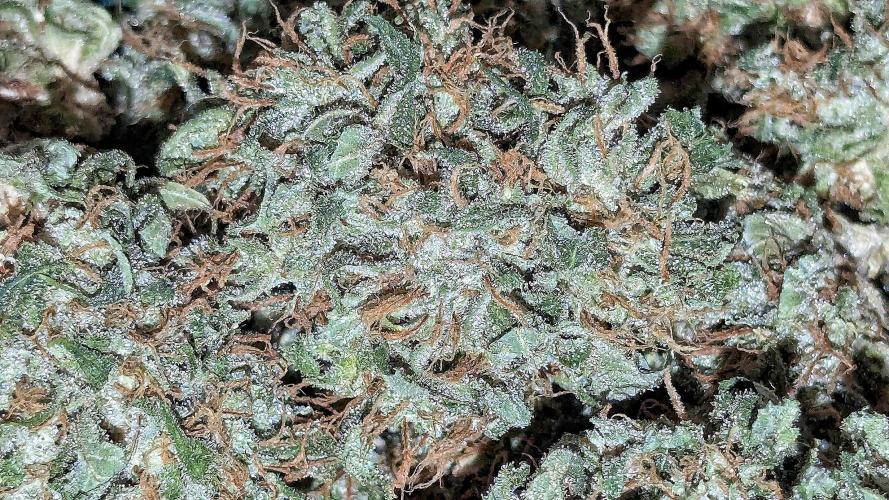
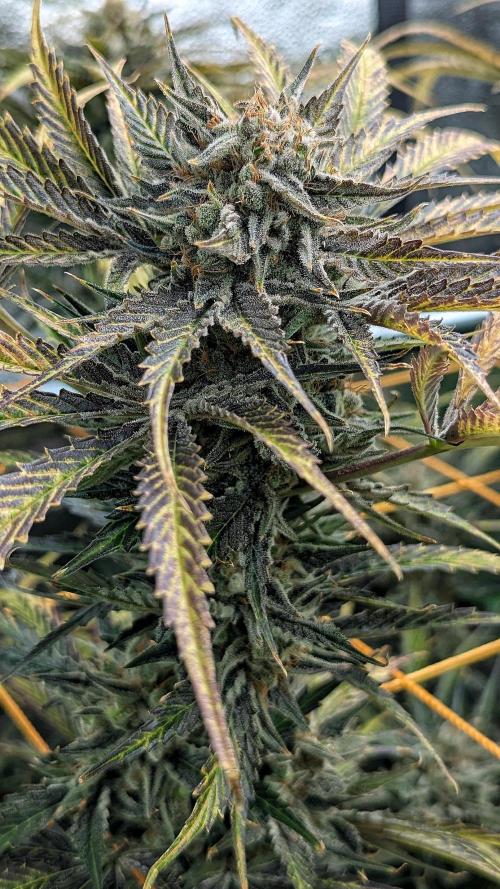
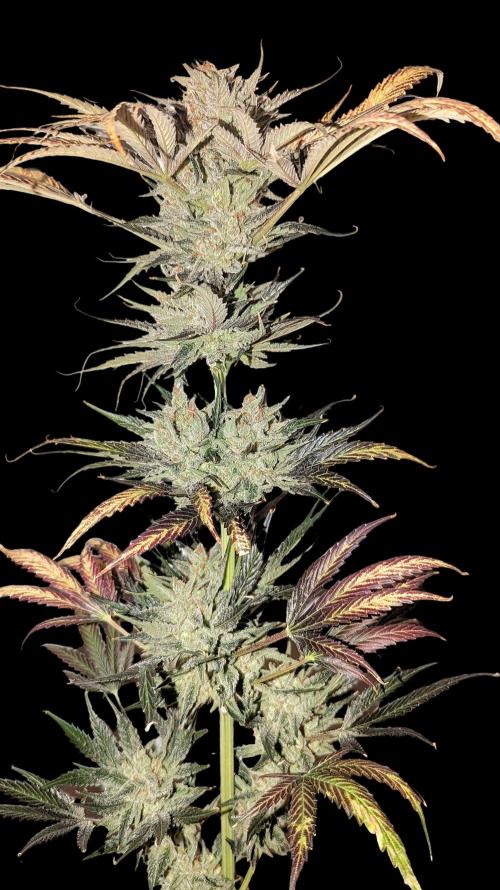
MichaelTheBarnOwl Grow #6: Strawberry Cough Harvest Summary
Days Since Emergence: 90
Days Since Flip: 71
Days in Flower: 62
Strawberry Cough was harvested on Day 90 since emergence, Day 71 since flip, and Day 62 in flower. For additional detail regarding final flower development and pre-harvest conditions, refer to Entry #14 (Week #13 of Flower).
Final trichome observations at harvest were recorded as follows:
SC1: 15% Clear / 84% Cloudy / 1% Amber
SC2: 18% Clear / 80% Cloudy / 2% Amber
Strawberry Cough was intentionally harvested with a predominantly cloudy trichome profile and minimal amber development. The objective was to maximize an uplifting, euphoric effect while minimizing heavier and more sedative characteristics.
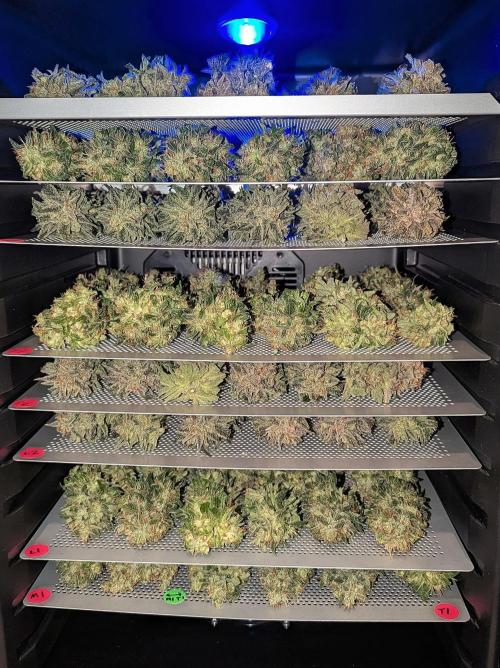
Harvest was performed progressively from the bottom of the canopy upward. Branches were removed individually, lightly wet trimmed, and transferred directly into the Cannatrol. Flowers were processed using a 4-day Dry, 4-day Cure, and 4-day Hold cycle before being transferred directly into mason jars with 62% two-way humidity packs for long-term storage.
Final Dry Weight:
Total: 310.9 g
SC1 (baseball bat phenotype): 180.5 g
SC2 (spindle phenotype): 130.4 g
The two Strawberry Cough plants displayed substantial phenotypic variation despite originating from the same seed line.
SC1 developed into the larger and significantly heavier-producing phenotype. Flower formation was dominated by long, thick colas with aggressive vertical stacking that produced several exceptionally large, baseball bat-like branches. Bud structure remained substantial throughout the canopy, and the plant ultimately produced 180.5 g of dry flower.
SC2 expressed a noticeably different growth pattern. The plant developed a thinner, more spindle-like structure with narrower flower formations and a leafier appearance around the buds. Although individual flowers remained well developed, the overall architecture produced less mass than SC1. Final dry weight was 130.4 g.
Aroma was explosive following drying and early cure, dominated by an intense fruity profile with strong skunk and spicy undertones. The finished flower is exceptionally resinous and among the stickiest I have produced to date.
Effects are characterized by a very fast onset, beginning with a heavy sensation behind the eyes and rapidly developing into intense euphoria. The experience remains strongly cerebral, producing a focused, happy, introspective, and creative headspace with comparatively mild body effects. The high is notably long-lasting before gradually giving way to solid sleep.
Overall, the finished profile aligns closely with the original harvest objective. Together, the two plants produced 310.9 g, or approximately 11 ounces, of finished Strawberry Cough.
Lifecycle Summary - Strawberry Cough:
Emergence: 2 days from seed
Seedling Stage: 8 days
Vegetative Stage: 11 days
Topped: Day 14 post-emergence
Flip to Flower: Day 20 post-emergence
Transition Period: 8 days post-flip
Flowering Stage: Began on Day 29 post-emergence; flowering lasted 62 days
Total Time (Seed to Harvest): 90 days
2 likes
2 comments
Share
Equipment Reviews


14
Week 14. Flowering1mo ago
111.76 cm
Height
12 hrs
Light Schedule
26 °C
Day Air Temp
6.1
pH
Strong
Smell
505 PPM
TDS
53 %
Air Humidity
21 °C
Solution Temp
21 °C
Substrate Temp
21 °C
Night Air Temp
11.4 l
Pot Size
2 l
Watering Volume
20.32 cm
Lamp Distance
MichaelTheBarnOwl Grow #6, Entry #15: Ripening
Days Since Emergence: 98
Days Since Flip: 79
Days in Flower: 70
Light intensity was reduced twice during the week. Final canopy light levels were as follows:
SD1: 470–630 PPFD (tops); ~320 PPFD (mid)
SD2: 580–700 PPFD (tops); ~390 PPFD (mid)
Irrigation continued every other day at approximately 1 gallon per plant. Both Stardawg plants remained on Aggressive Ripening nutrients throughout the reporting period at 505 PPM with 3 ml/gal CAL-MAG. Input pH was maintained between 6.0–6.2.
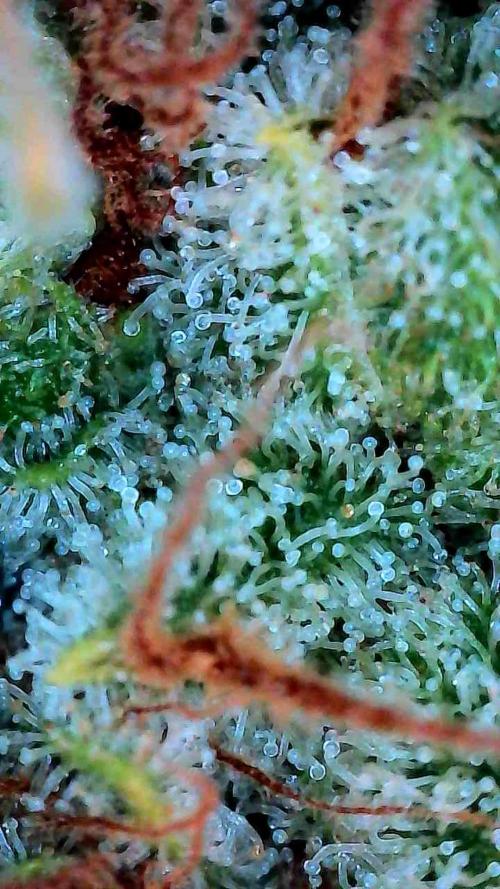
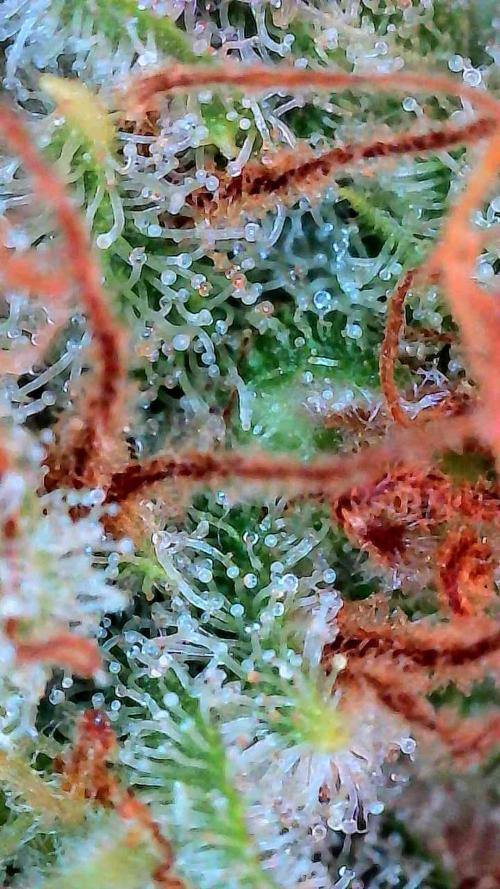
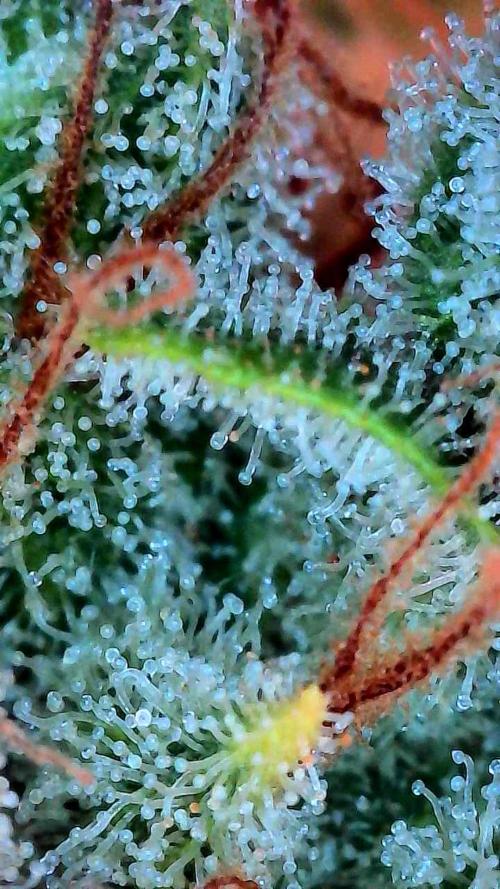
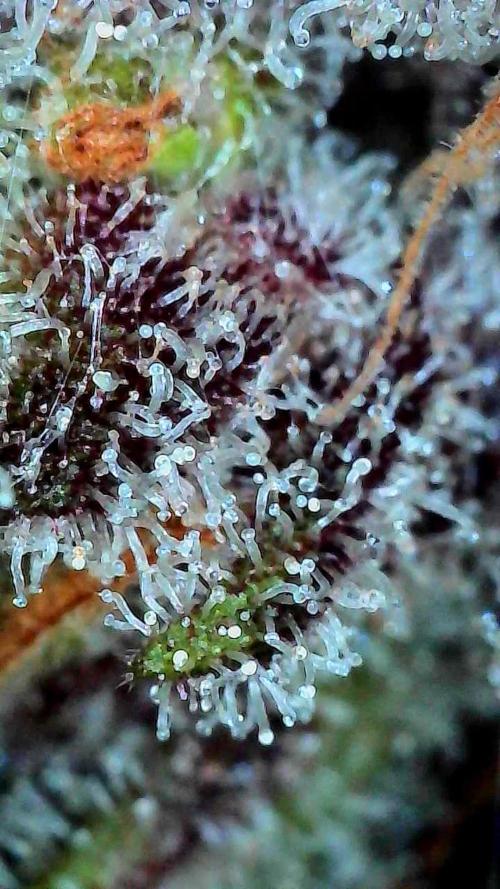
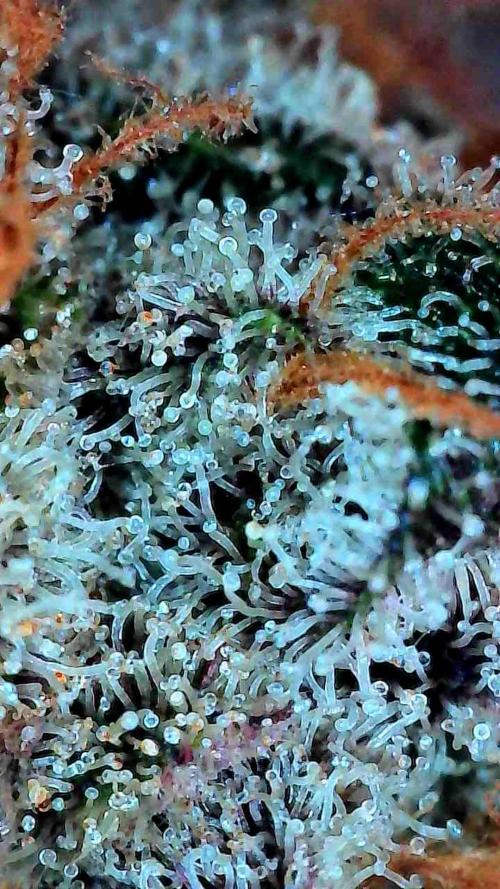
Formal trichome analysis was performed twice during the week. End-of-week results were as follows:
SD1
Top: 8% Clear / 87% Cloudy / 5% Amber
Mid: 11% Clear / 86% Cloudy / 3% Amber
Bottom: 15% Clear / 82% Cloudy / 3% Amber
Overall: 11% Clear / 85% Cloudy / 4% Amber
SD2
Top: 10% Clear / 87% Cloudy / 3% Amber
Mid: 9% Clear / 88% Cloudy / 3% Amber
Bottom: 15% Clear / 82% Cloudy / 3% Amber
Overall: 11% Clear / 86% Cloudy / 3% Amber
A small number of nanners continued to appear intermittently on SD2 and were removed as they were found. No nanners were observed on SD1. Several branches required additional support as flower weight continued to increase.
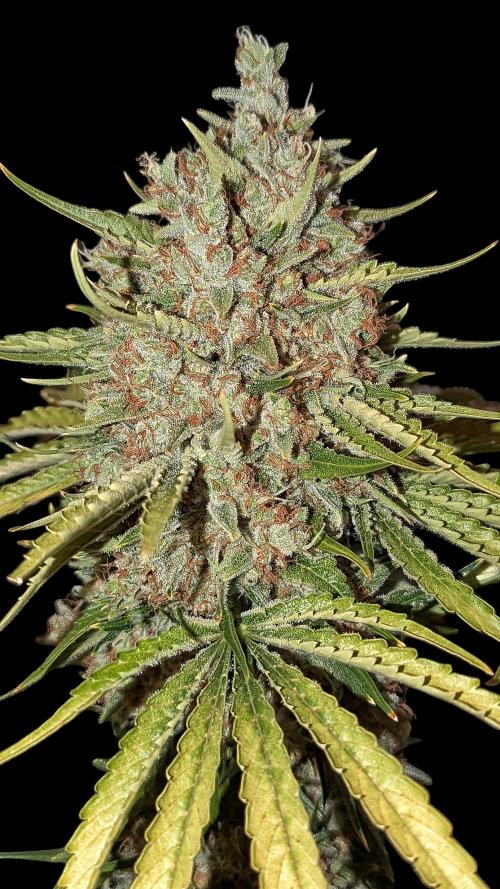
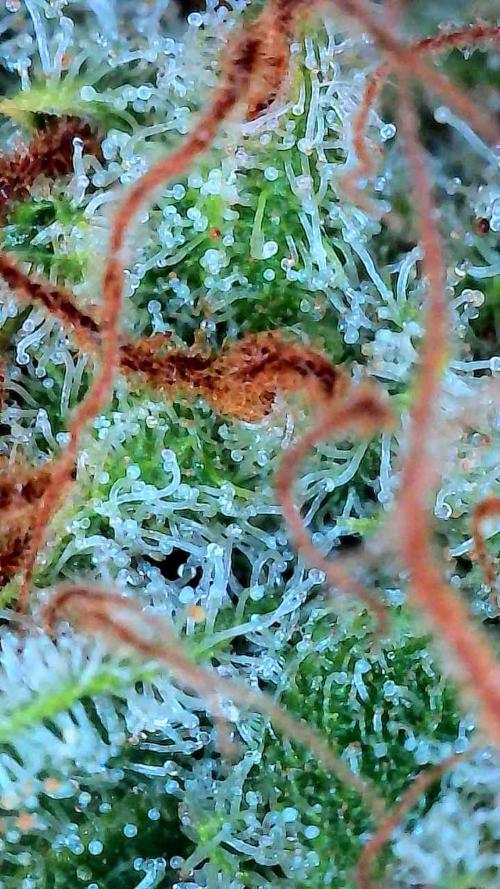
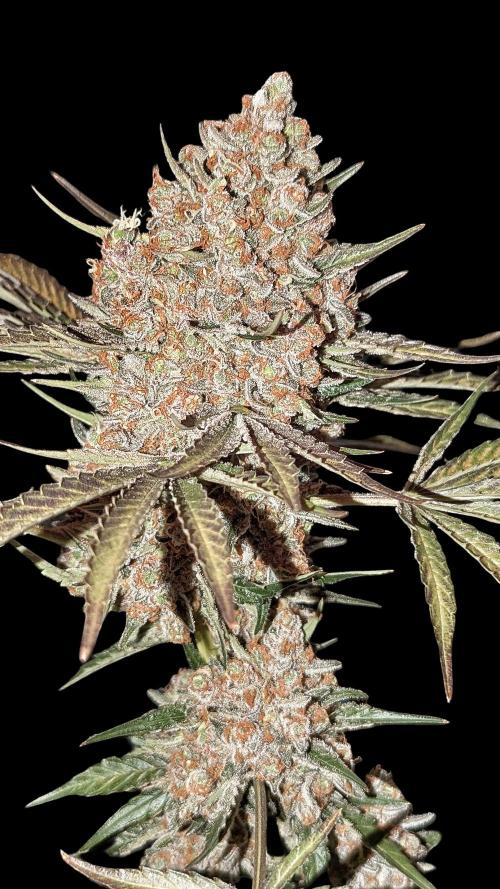
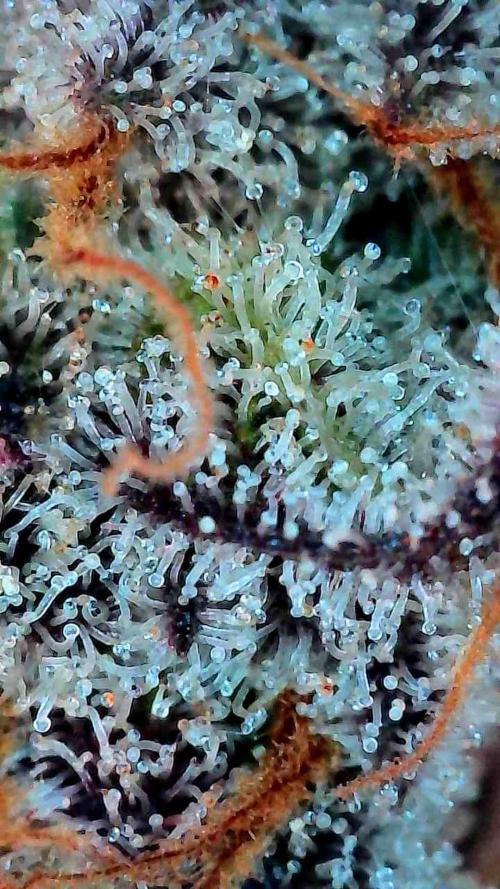
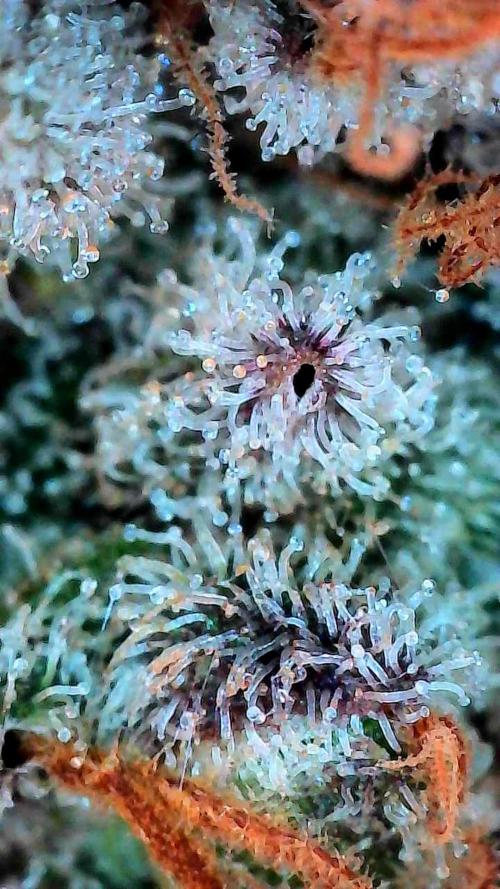
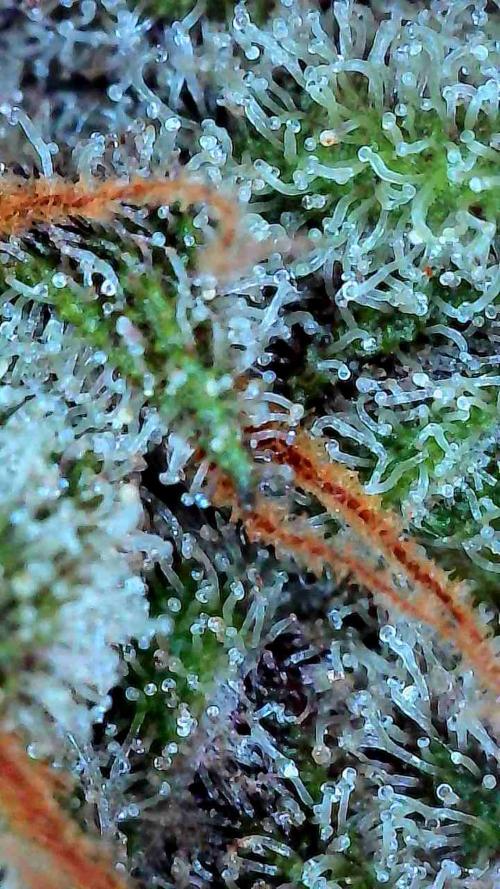
Natural senescence accelerated throughout the canopy during the week, with leaves continuing to fade into shades of yellow, purple, and red while aroma remained strong. Environmental conditions remained stable, with relative humidity maintained in the low 50% range, daytime temperatures in the low to mid-70s°F, and nighttime temperatures in the mid-60s°F.
Both plants remain on Aggressive Ripening nutrients while awaiting further trichome maturation. The harvest target continues to be a modest reduction in clear trichomes accompanied by a gradual increase in amber trichomes before harvest.
1 like
comments
Share
Used techniques
LST
Technique
Defoliation
Technique
12-12
Technique
Four-Headed Monster
Technique
15
Week 15. Flowering1mo ago
111.76 cm
Height
12 hrs
Light Schedule
23 °C
Day Air Temp
6.1
pH
Normal
Smell
105 PPM
TDS
51 %
Air Humidity
21 °C
Solution Temp
21 °C
Substrate Temp
19 °C
Night Air Temp
11.4 l
Pot Size
2 l
Watering Volume
20.32 cm
Lamp Distance
MichaelTheBarnOwl Grow #6, Entry #16: Stardawg Ripening
Days Since Emergence: 104
Days Since Flip: 85
Days in Flower: 76
Stardawg began the week on Aggressive Ripening nutrients before transitioning to plain pH-adjusted water toward the end of the reporting period. Plain water measured approximately 105 PPM at a pH of 6.1.
Light intensity was reduced mid-week, with the dimmer lowered from 50% to 45%. Final canopy light levels were as follows:
SD1: 385–540 PPFD (tops); ~280 PPFD (mid)
SD2: 290–600 PPFD (tops); ~305 PPFD (mid)
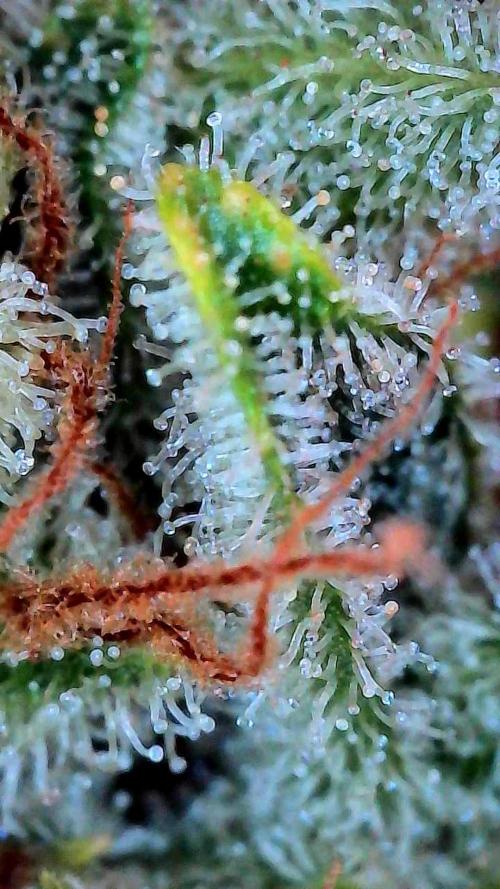
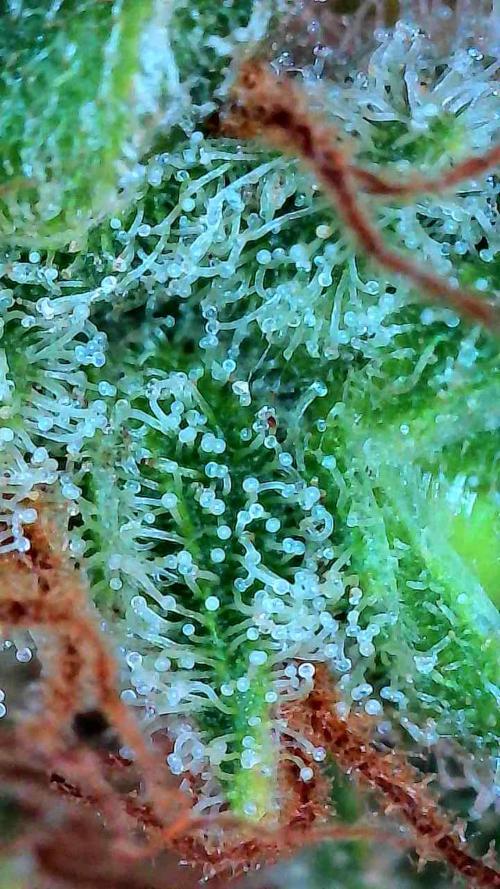
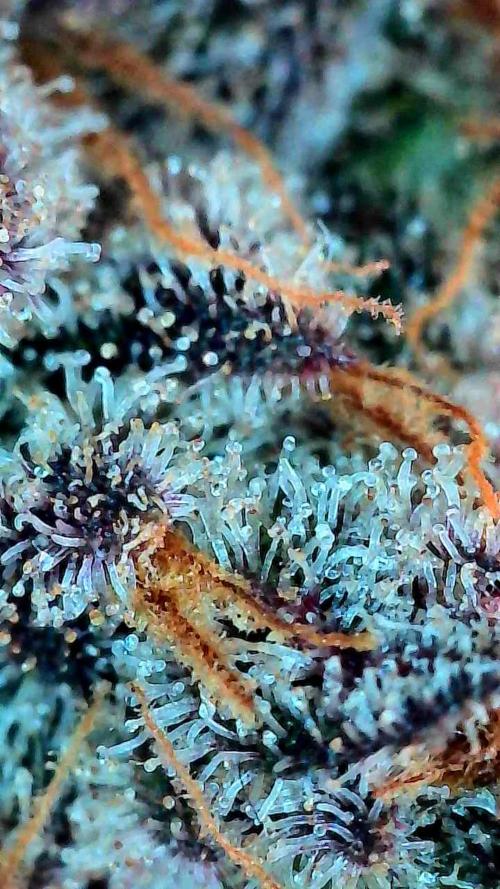
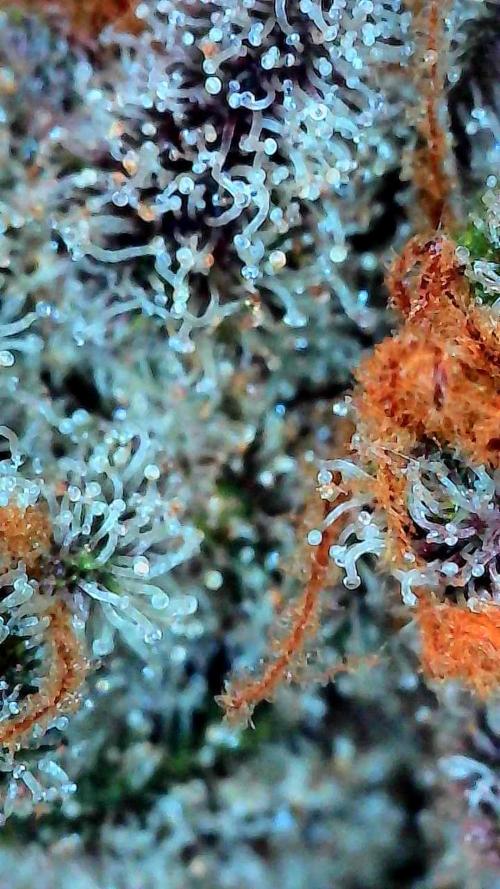
A formal trichome analysis was performed on the middle branch set of both plants. Results were as follows:
SD1: 8% Clear / 88% Cloudy / 4% Amber
SD2: 5% Clear / 87% Cloudy / 8% Amber
Trichome development continued to progress, with a meaningful reduction in clear trichomes and an increase in amber compared with the previous week's analysis. SD2 showed the greatest amber progression, while SD1 remained predominantly cloudy.
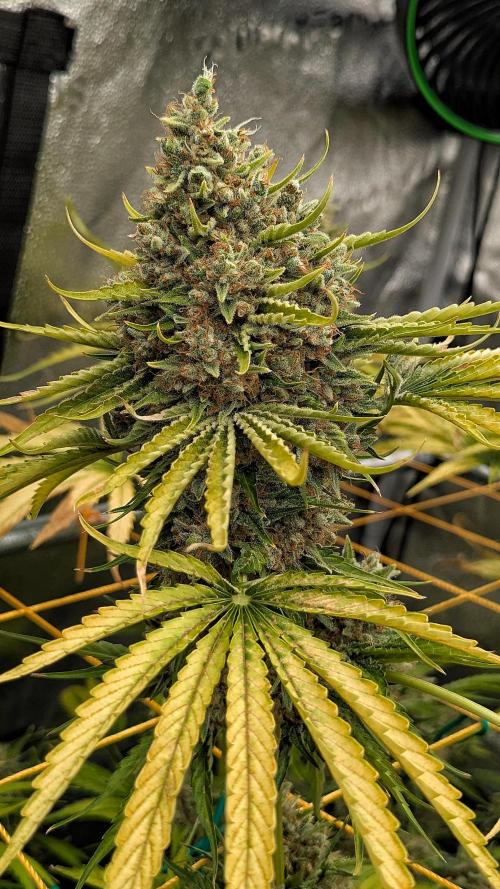
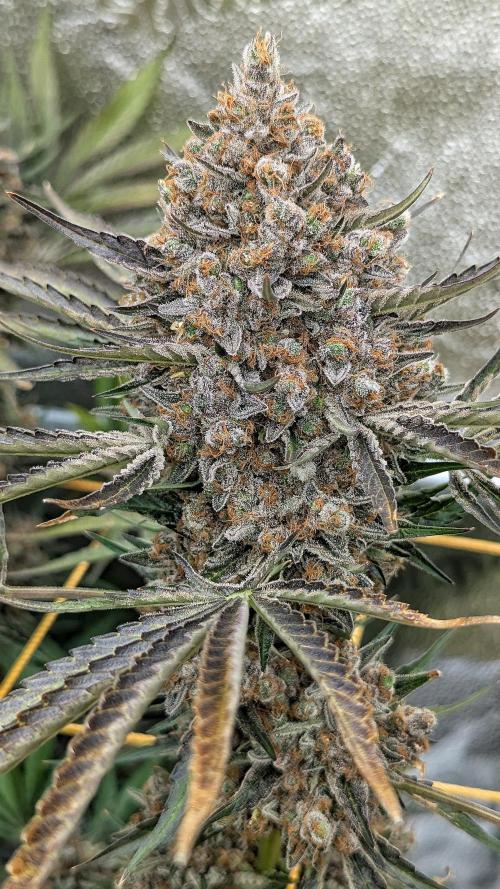
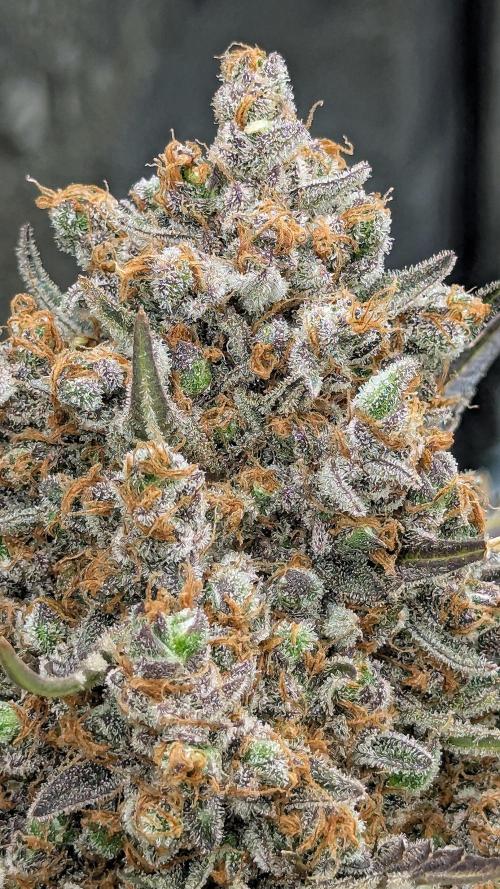
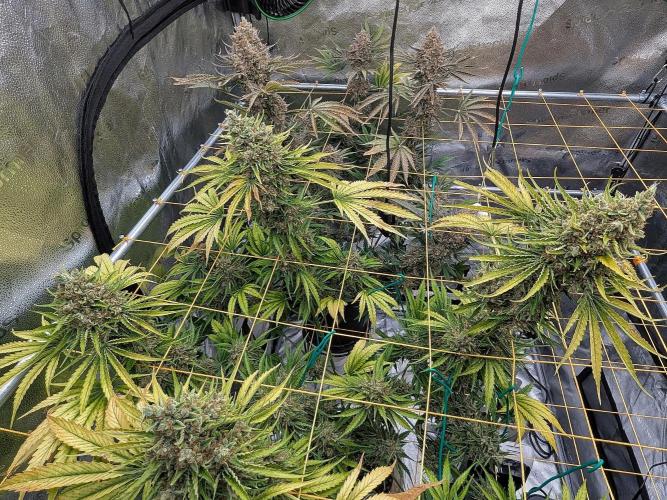
Aroma became noticeably more muted during the second half of the week, coinciding with the transition to plain water and the final stages of plant senescence. Visual maturation continued throughout both plants, with extensive fading and increasingly pronounced purple, red, and yellow coloration across the canopy.
Both Stardawg plants are now in their final days of flower. Light intensity remains reduced and irrigation will continue with plain pH-adjusted water through harvest. A final trichome analysis will be performed immediately before harvest to document the final distribution of clear, cloudy, and amber trichomes.
3 likes
comments
Share
Used techniques
12-12
Technique
Four-Headed Monster
Technique
16
Week 16. Harvest10d ago
Happy Harvest Day!

10/10
Rated
Stardawg is an exceptionally vigorous, productive, and potent cultivar, but it is one that rewards an attentive grower.
I have now grown Stardawg twice, and both experiences have shown remarkably strong growth and stretch. In this grow, the plants were flipped only 20 days after emergence following early topping and aggressive low-stress training. Despite the abbreviated vegetative period, they reached approximately 4.5 times their height at flip by Week #3 of flower. Training was essential for controlling the stretch and maintaining an even canopy.
Flower production is extremely heavy. Stardawg develops exceptionally dense buds with a structurally closed architecture, particularly in the primary colas. Because of that density, I would strongly recommend aggressive humidity management during late flower, along with excellent airflow throughout the canopy. This is not a cultivar where I would become complacent about environmental control as the flowers reach their final size.
Another characteristic worth mentioning is a tendency toward intersex expression. I have grown Stardawg twice, and during both grows I encountered pollen sacs at various points during early and mid flower, followed by scattered nanners in late flower. This occurred despite tightly controlled dark cycles and otherwise reasonable environmental parameters. Based on the consistency across both grows, I believe genetics are a meaningful factor and would recommend monitoring the plants carefully throughout flowering to prevent seeded buds.
Those characteristics contribute to what I would consider moderate cultivation difficulty. Stardawg is not particularly difficult to keep healthy or productive, but its aggressive stretch, extreme flower density, and tendency toward intersex expression mean it benefits from an observant, disciplined grower.
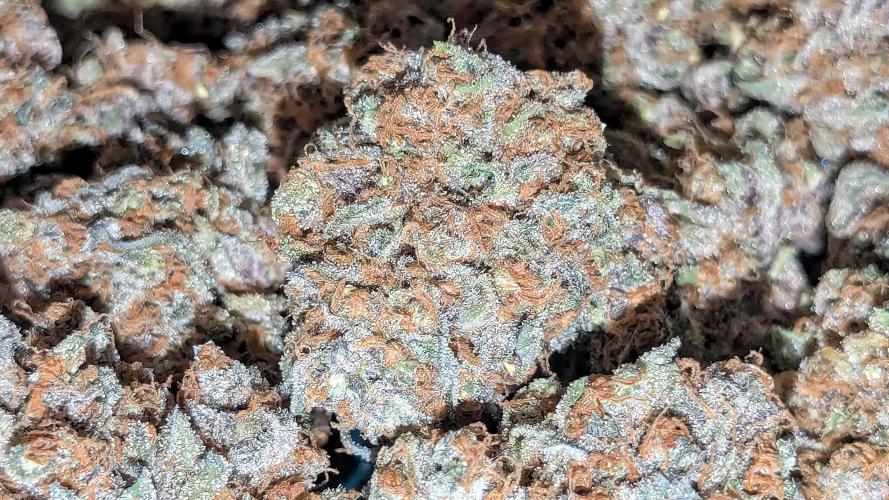
The reward is outstanding flower. Buds are extremely dense, resinous, and potent, with a powerful aroma dominated by skunk, citrus, and fuel. The profile becomes especially intense when the flowers are handled, producing the sharp, pungent gasoline-and-skunk character that the strain is known for.
Effects begin very quickly with intense euphoria and a strongly cerebral, deeply introspective headspace. Despite the strength of the initial experience, the high develops into a surprisingly balanced combination of cerebral and physical effects rather than becoming immediately sedating. As it progresses, the experience gradually becomes more relaxing and ultimately transitions into excellent sleep later in the evening.
Overall, Stardawg is a very worthy cultivar for growers willing to pay attention to it. It combines explosive growth, exceptional productivity, extremely dense resinous flowers, powerful skunk/citrus/fuel aroma, and an intense euphoric effect. Its stretch, closed flower structure, and apparent genetic predisposition toward intersex traits require some additional management, but an observant, careful, and disciplined grower can be rewarded with an exceptional finished product.
I will absolutely grow Stardawg again, although I would specifically plan around its characteristics: aggressive training for the stretch, close inspection throughout flowering, and particularly tight humidity management as the flowers reach peak density.
Show more
Translate
Spent 108 days
Ger Veg Flo Har
191.1 g
Bud wet weight per plant
2
Plants
40.64 m²
Grow Room size
Normal
Difficulty
Euphoric, Energetic, Creative
Positive effects
Anxiety, Stress, Pain
Medical effects

Diesel, Citrus, Pungent
Taste
Height
Day air temperature
Air humidity
PPM
PH
Light schedule
Solution temperature
Night air temperature
Substrate temperature
Pot size
Lamp distance
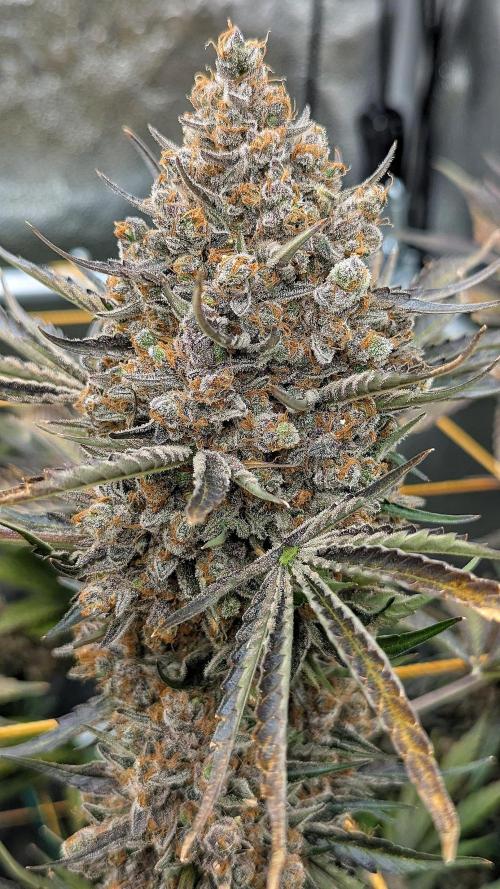
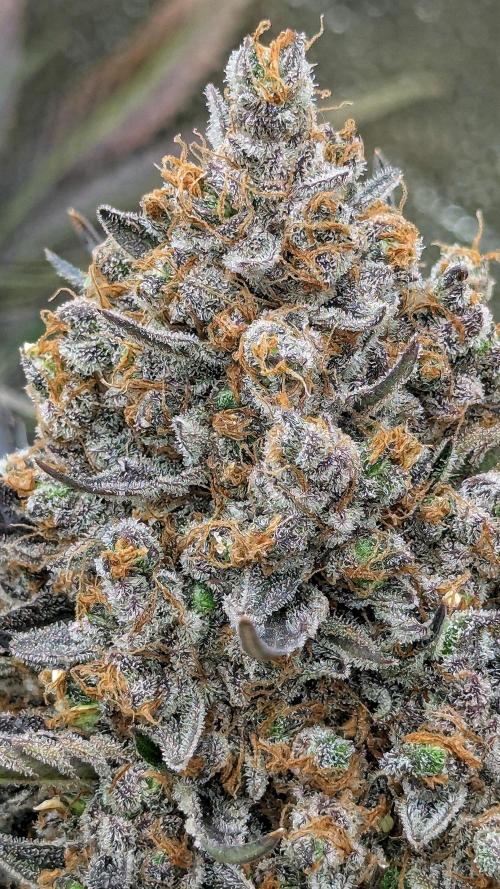
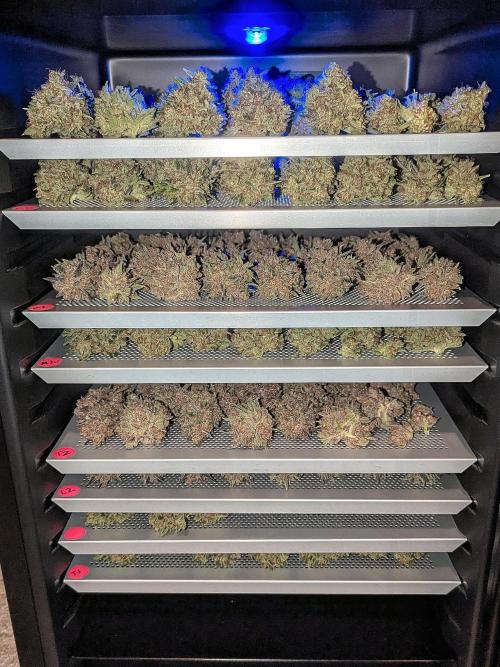
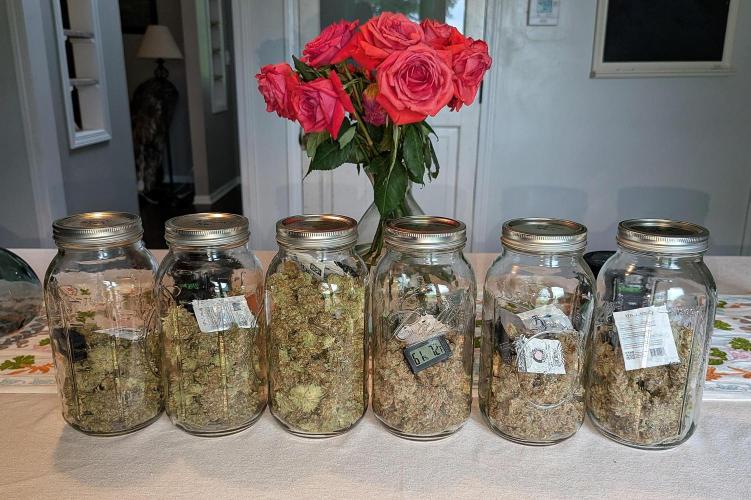
MichaelTheBarnOwl Grow #6: Stardawg Harvest Summary
Days Since Emergence: 109
Days Since Flip: 90
Days in Flower: 81
Stardawg was harvested on Day 109 since emergence, Day 90 since flip, and Day 81 in flower.
During the final days of flower, light intensity was held steady at the reduced levels established during the prior week. Irrigation consisted exclusively of plain pH-adjusted water at approximately 105 PPM through harvest.
Final trichome observations at harvest were recorded as follows:
SD1: 9% Clear / 86% Cloudy / 5% Amber
SD2: 11% Clear / 84% Cloudy / 5% Amber
Stardawg was harvested with a predominantly cloudy trichome profile and limited amber development. The objective was a balanced profile retaining strong cerebral and euphoric effects while allowing enough maturation to produce a substantial body effect and relaxing finish.
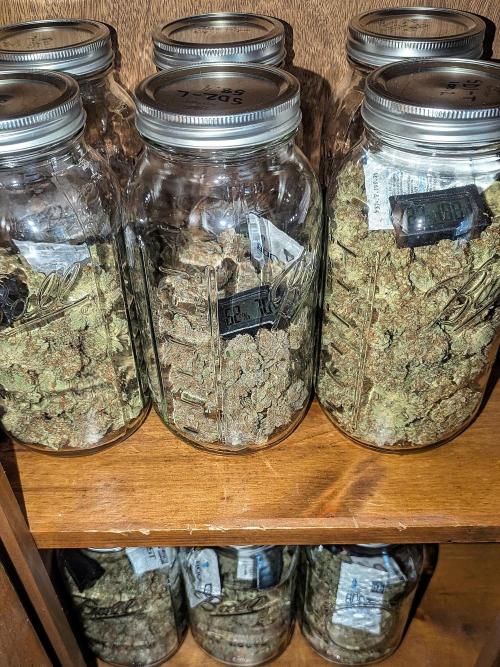
Harvest was performed progressively from the bottom of the canopy upward. Branches were removed individually, lightly wet trimmed, and transferred directly into the Cannatrol. Flowers were processed using a 4-day Dry, 4-day Cure, and 4-day Hold cycle before being transferred directly into mason jars with 62% two-way humidity packs for long-term storage.
During harvest, an important issue became apparent within the primary colas. Both plants produced four exceptionally large main tops, approximately the size of 1.5-liter bottles, characterized by extremely dense flower formation and a very closed internal structure. While dissecting these colas during my normal bottom-up harvest process, bud rot was discovered internally near the center of the flowers. All affected primary tops were discarded rather than attempting to salvage portions of them.
The loss was substantial because the affected flowers represented the largest and heaviest individual colas on both plants. However, Stardawg also produced considerable flower mass throughout the secondary branching. Numerous dense, golf ball-sized flowers developed along the branches below the primary tops, and this material remained separate from the affected main colas. After careful inspection and removal of the affected material, the retained harvest still produced a combined dry weight of 382.2 g.
Final Dry Weight:
Total: 382.2 g
SD1: 202.3 g
SD2: 179.9 g
Given that the four primary colas from each plant were discarded, the final retained yield demonstrates just how productive these plants were throughout the rest of the canopy.
The internal flower issue also highlighted an important characteristic of this particular Stardawg expression. Genetics, flower structure, and extreme density were significant contributing factors. The primary tops were extremely compact, with very little open space within the flower structure. My growing environment is a semi-indoor/outdoor space where temperature and humidity are actively managed through multiple methods, and it has performed very well with many cultivars. In this case, however, those controls were not sufficient for the combination of extreme flower density, closed architecture, and environmental conditions.
Based on this experience, I would recommend particularly aggressive humidity management when growing Stardawg under comparable conditions. Maintaining approximately 40–45% RH during late flower, combined with strong airflow through and around the canopy, would provide additional protection as the largest colas reach peak density.
Despite originating from the same seed line and being grown under identical conditions, SD1 and SD2 developed into noticeably different phenotypes.
SD1 was the taller and ultimately heavier-producing plant, yielding 202.3 g of retained dry flower. Its buds were somewhat less compact and slightly fluffier than SD2, with a leafier appearance. The finished structure and overall expression have a slight Kush-like character to them and remind me somewhat of the phenotypic variation I previously encountered while growing God's Gift.
SD2 remained shorter and developed striking purple coloration during late flower. Its flowers were significantly denser and more compact than those of SD1. Although the plant was smaller overall, it still produced 179.9 g of retained dry flower.
Aroma was powerful during harvest as the flowers were handled and rough wet trimmed. The profile was dominated by skunk, citrus, and gasoline, producing the sharp, pungent character.
The finished effects begin very quickly with a strong euphoric onset. The initial experience is highly cerebral and deeply introspective before gradually transitioning into a more balanced combination of mental and physical effects. As the experience progresses, the heavier relaxing qualities become increasingly apparent, eventually transitioning into a very good night's sleep. A noticeable reduction in aches, pain, and anxiety was experienced.
Overall, Stardawg produced exceptionally vigorous plants, enormous flower mass, extreme resin production, and a powerful finished product. The internal density of the primary colas presented the major challenge of the grow and resulted in the loss of a substantial amount of flower at harvest. Even after discarding all affected primary tops, however, the two plants produced 382.2 g, or approximately 13.5 ounces, of clean finished flower from the remaining canopy.
The experience reinforced the importance of matching environmental control not simply to the cultivar, but also to the physical architecture of the flowers it produces. Stardawg's combination of extremely dense primary colas and closed internal structure warrants substantially more aggressive late-flower humidity management than I could provide during a mid-Summer grow.
Lifecycle Summary - Stardawg:
Emergence: 2 days from seed
Seedling Stage: 8 days
Vegetative Stage: 11 days
Topped: Day 14 post-emergence
Flip to Flower: Day 20 post-emergence
Transition Period: 8 days post-flip
Flowering Stage: Began on Day 29 post-emergence; flowering lasted 81 days
Total Time (Seed to Harvest): 109 days
5 likes
comments
Share
Equipment Reviews

the end.
Enjoying this diary? Follow for more updates!
Prefer the old Diary view?
Go back to the old Diary view