


Granddaddy Purple (Blimburn Seeds)





Fan
AeroWave E6 Gen2, Grow Tent Clip Fan 6"


Cond
8,000 BTU Portable Air Conditioner
TOSOT


Indoor
Room Type
Topping
weeks 3
LST
weeks 3-11
12-12
weeks 4-14
Defoliation
weeks 4-11
11 liters
Pot Size
1.89 liters
Watering
Start at Harvest
G
Germination4mo ago
MichaelTheBarnOwl Grow #5, Entry #1: Germination and First Emergence
Days Since Emergence: 1
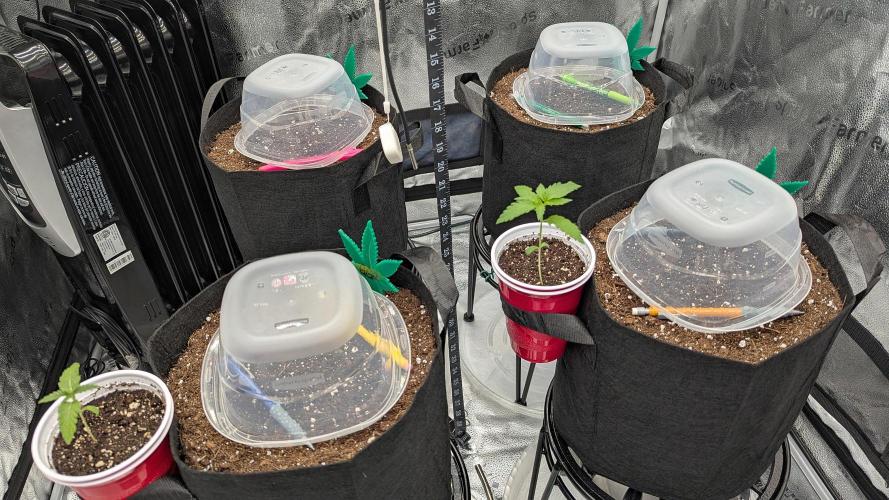
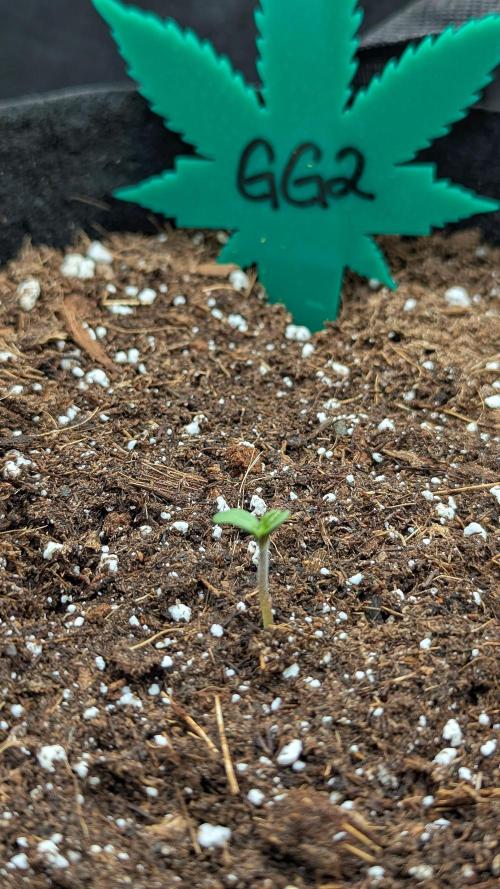
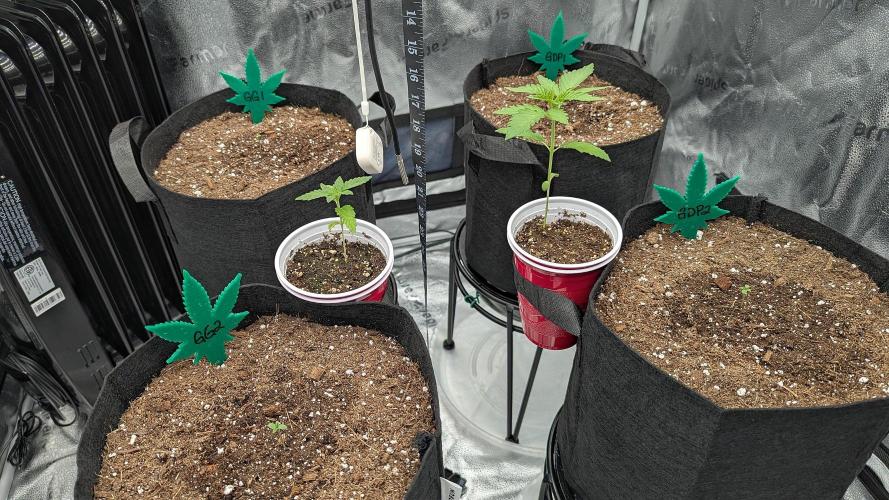
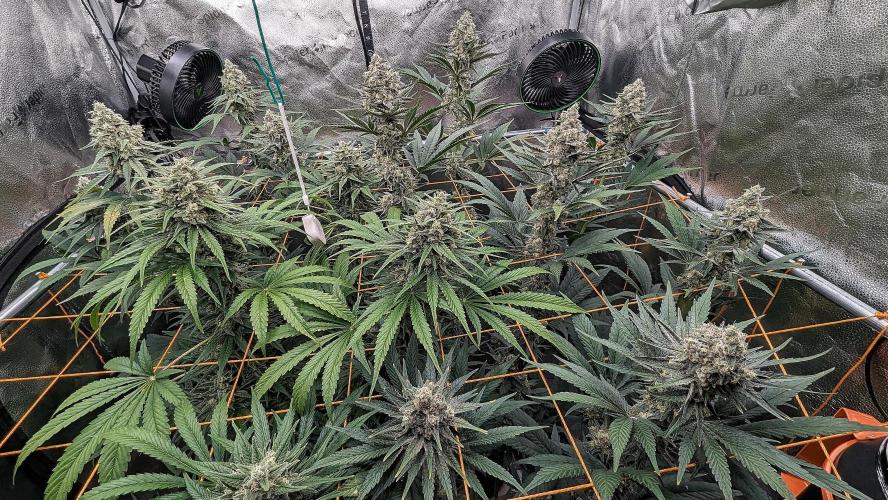
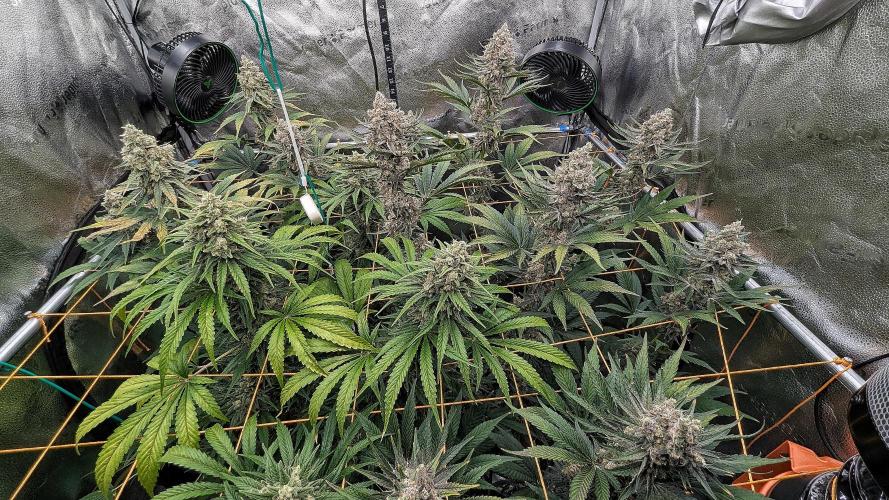
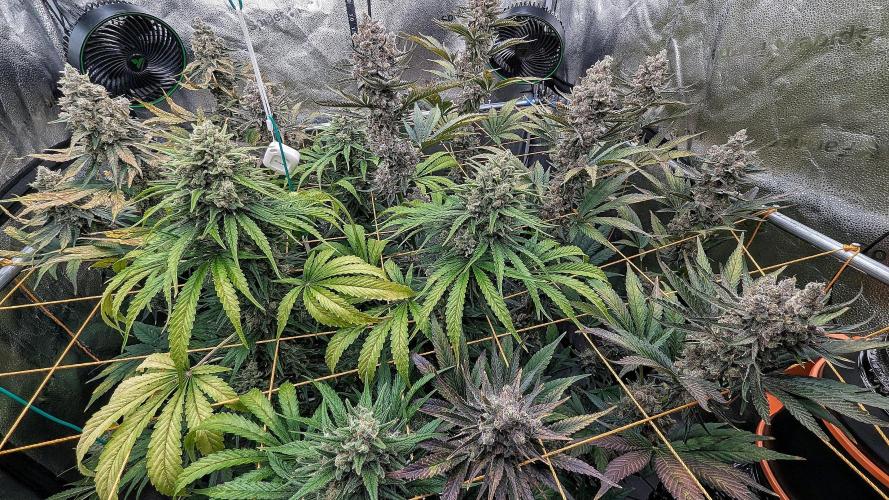
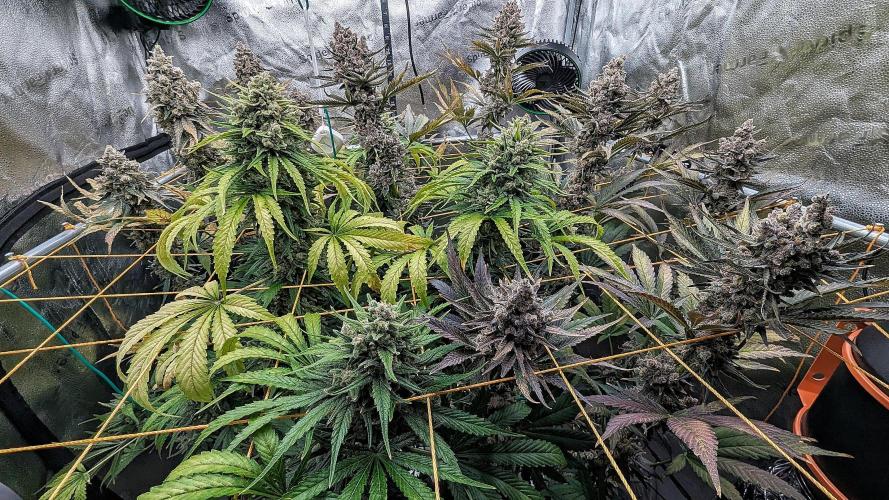
This grow consisted of four feminized photoperiod plants: two Grandaddy Purple (Blimburn) and two God’s Gift (Blimburn) established directly into final containers to avoid transplant stress later in development. Because both cultivars were grown together under a shared canopy, some wide-angle photographs throughout this journal will show both varieties. Unless otherwise noted, all observations, measurements, and grow-specific commentary documented within this diary refer specifically to Granddaddy Purple.
Seeds were soaked in distilled water for approximately 12–15 hours at 78–82°F before being planted approximately 0.25 inch beneath the surface into final containers. Plants were grown in 3-gallon fabric pots filled with lightly pre-moistened Pro-Mix HP with Mycorrhizae, selected for its high porosity, drainage characteristics, and root-zone oxygen availability while allowing complete control over nutrient delivery throughout the grow. No dry amendments or pre-amended soils were incorporated at planting.
Moisture management remained conservative during establishment. The medium was pre-moistened prior to planting and subsequent water applications were localized around the planting zone rather than fully saturating container volume, maintaining adequate hydration while encouraging early root exploration.
Environmental conditions during germination were maintained toward the warmer end of the target range to support rapid metabolic activity and promote uniform emergence. Lighting was provided continuously beginning at sowing so that seedlings emerged directly into their target environment without transition. The fixture remained positioned approximately 21 inches above the soil surface, delivering approximately 300 PPFD (DLI 19) at emergence - sufficient to encourage compact development while minimizing unnecessary transpiration before root establishment.
Humidity domes were used during germination to preserve surface moisture and encourage emergence but were removed immediately once seedlings broke the surface to maximize air exchange and unobstructed light exposure.
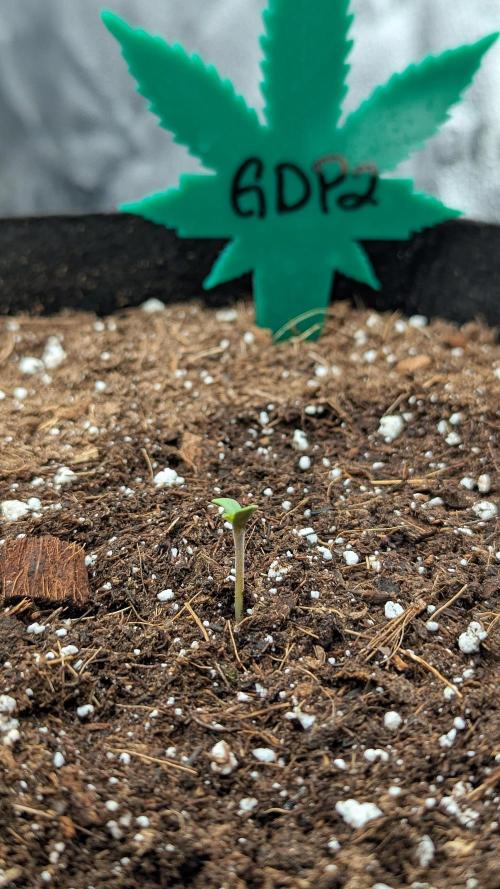
Emergence occurred rapidly and uniformly, with Granddaddy Purple seedlings breaking the surface within approximately 48 hours of sowing.
2 likes
4 comments
Share
Used method
Glass Of Water
Germination Method
2
Week 2. Vegetation4mo ago
9.53 cm
Height
18 hrs
Light Schedule
28 °C
Day Air Temp
5.9
pH
No Smell
Smell
440 PPM
TDS
58 %
Air Humidity
18 °C
Solution Temp
19 °C
Substrate Temp
23 °C
Night Air Temp
11.36 liters
Pot Size
0.19 liters
Watering Volume
41.28 cm
Lamp Distance
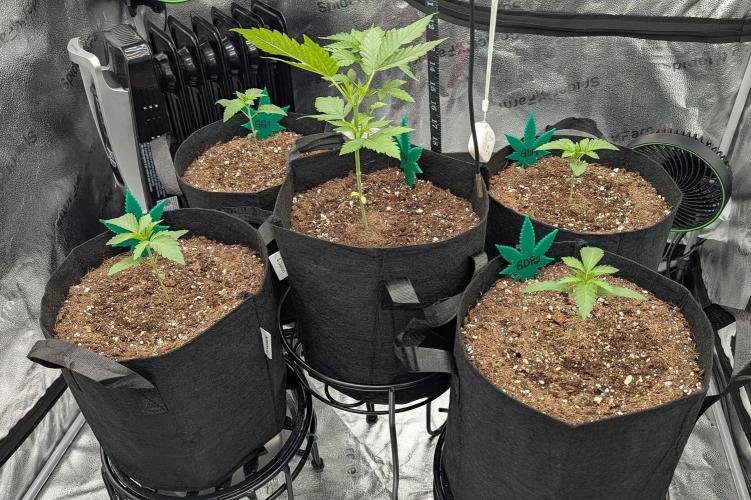
MichaelTheBarnOwl Grow #5, Entry #2: Entering Early Veg
Days Since Emergence: 11
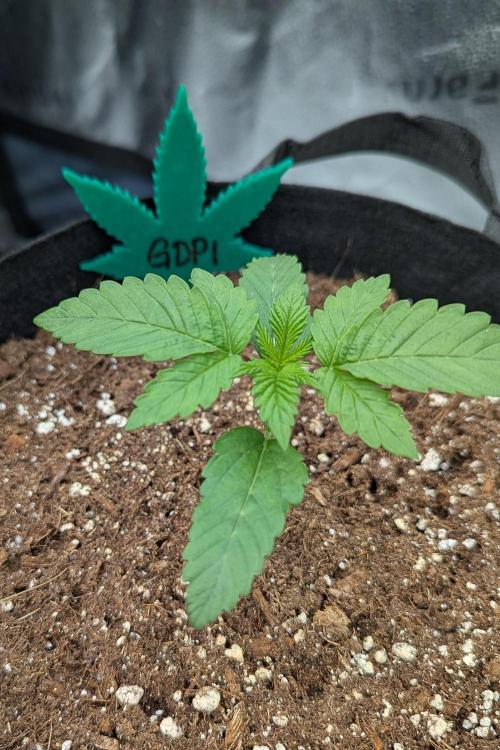
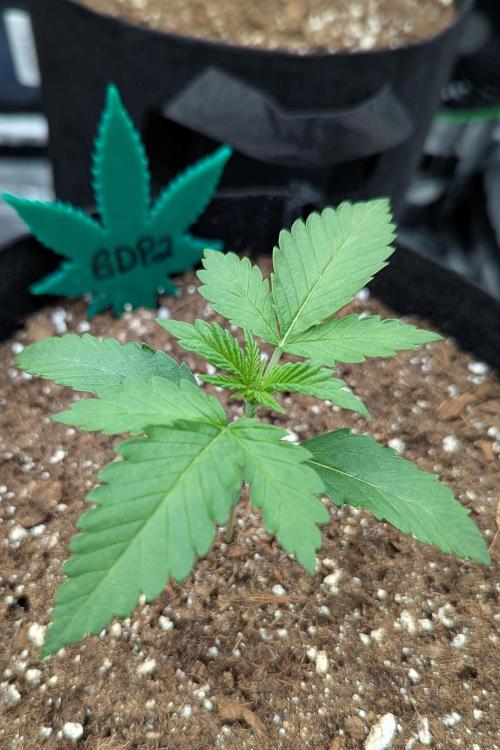
Granddaddy Purple transitioned into early vegetative growth during this period following 9 days in the seedling stage. By Day 11 post-emergence, both plants had established two fully developed nodes while a third node actively expanded. Vertical growth accelerated relative to the prior week, although plant structure remained compact with tight internodal spacing and controlled upward development.
Irrigation strategy shifted during this stage away from localized seedling hydration and toward establishing a broader active root zone. Because this grow utilized PRO-Mix HP-CC Mycorrhizae High Porosity, feeding was maintained with every watering event to provide consistent nutrient availability within the inert media profile. Irrigation continued to be applied in a circular pattern surrounding each plant rather than directly at the stem in order to encourage lateral root expansion and avoid concentrated root establishment beneath the crown.
Watering volume increased progressively in response to increasing transpiration demand and continued root development. At the beginning of the second week of growth, approximately 0.25 L per plant was applied on an every-other-day schedule. By Day 11, irrigation volume increased to approximately 0.33 L per plant per event. Water pH remained tightly controlled within a target range of approximately 5.8–6.0.
Nutrient strength continued increasing gradually as plants transitioned toward sustained vegetative growth. General Hydroponics Flora Series remained configured for Early Veg, with overall solution strength increasing from approximately 340 ppm on Day 7 to 440 ppm by Day 11. Supplemental CAL-MAG increased from 2 ml/gal to 3 ml/gal to support increasing metabolic demand and continued vegetative expansion. Silica supplementation had not yet been introduced during this stage.
Near-infrared supplementation remained incorporated at both the beginning and end of the photoperiod for a combined 30 minutes per light cycle, while UV-A exposure increased from 15 minutes earlier in the week to 30 minutes per light cycle.
Light intensity was increased incrementally throughout the period while fixture height remained fixed at approximately 20 inches above soil level, allowing canopy distance to decrease naturally through plant growth rather than repeated fixture repositioning. At the beginning of the week, measured light intensity remained near 370–385 PPFD (24–25 DLI). Fixture output was gradually increased from 50% to 55% power as plants demonstrated the ability to utilize additional intensity without undesirable stretch.
Day 11 Light Measurements:
GDP1: 460 PPFD (30 DLI)
GDP2: 460 PPFD (30 DLI)
Day 11 Plant Heights:
GDP1: 3.50"
GDP2: 3.75"
Final canopy distance narrowed to approximately 16.25 - 16.50 inches by the end of the period.
1 like
1 comment
Share
3
Week 3. Vegetation4mo ago
34.29 cm
Height
18 hrs
Light Schedule
28 °C
Day Air Temp
6.1
pH
No Smell
Smell
800 PPM
TDS
58 %
Air Humidity
18 °C
Solution Temp
19 °C
Substrate Temp
21 °C
Night Air Temp
11.36 liters
Pot Size
1.89 liters
Watering Volume
32.39 cm
Lamp Distance
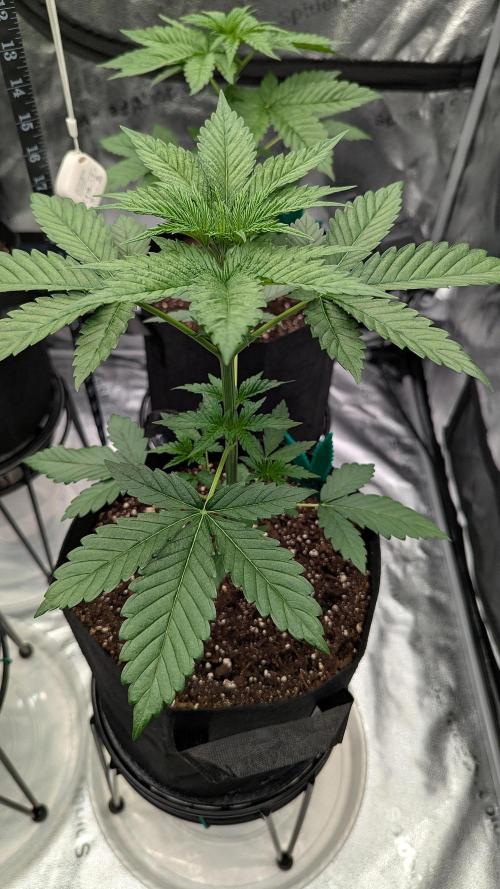
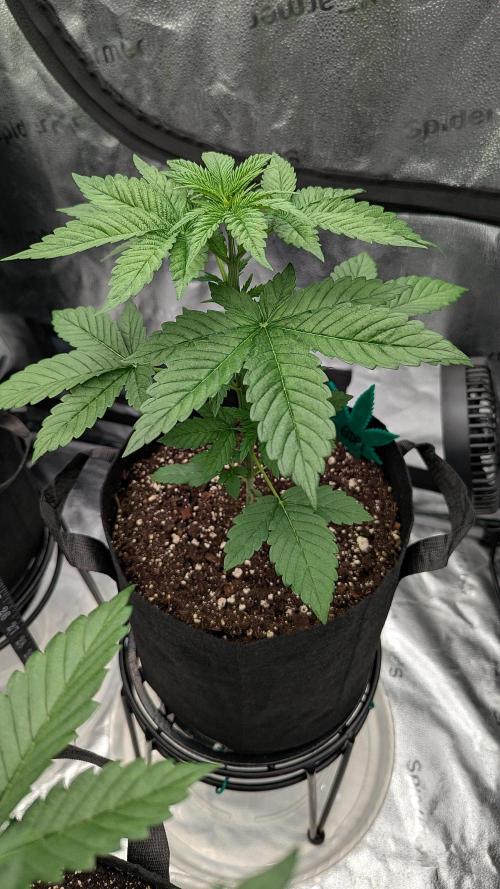
MichaelTheBarnOwl Grow #5, Entry #3: Vegetation, Topping, and Preparation for Flip
Days Since Emergence: 21
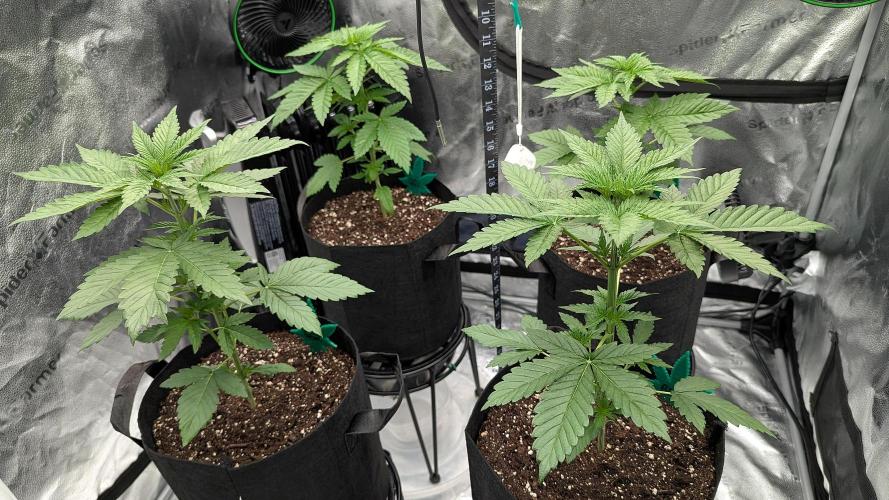
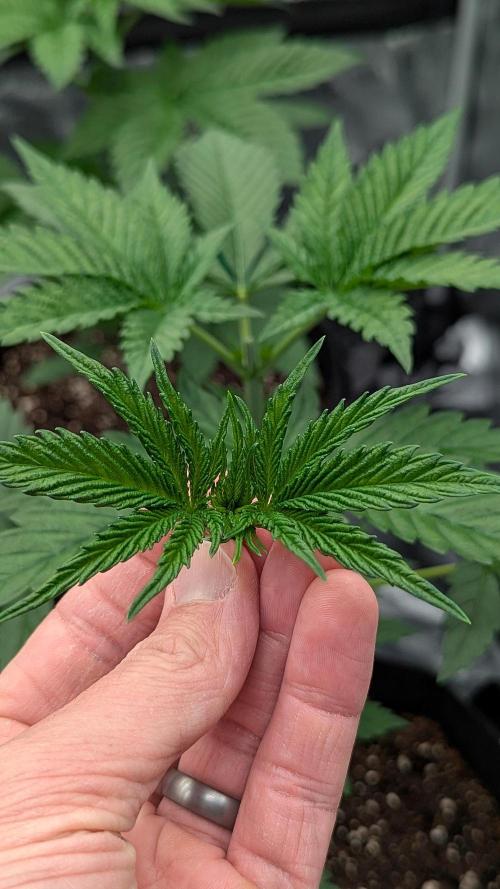
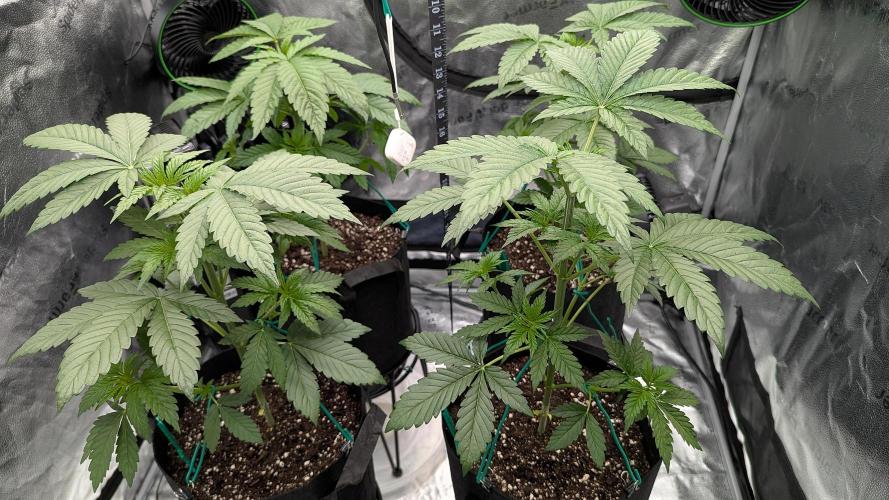
Granddaddy Purple progressed rapidly through vegetative growth during this period. At the previous entry (Day 11), plants had established two fully developed nodes with a third actively developing. By Day 12, the third node continued expanding with a fourth developing. By Day 15, all plants had established four nodes with a fifth developing. By Day 19, both plants had established five nodes with active sixth-node development.
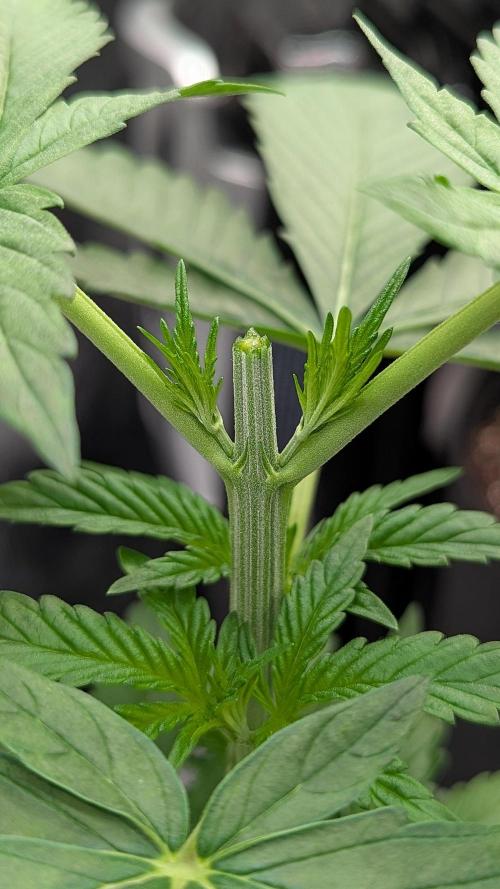
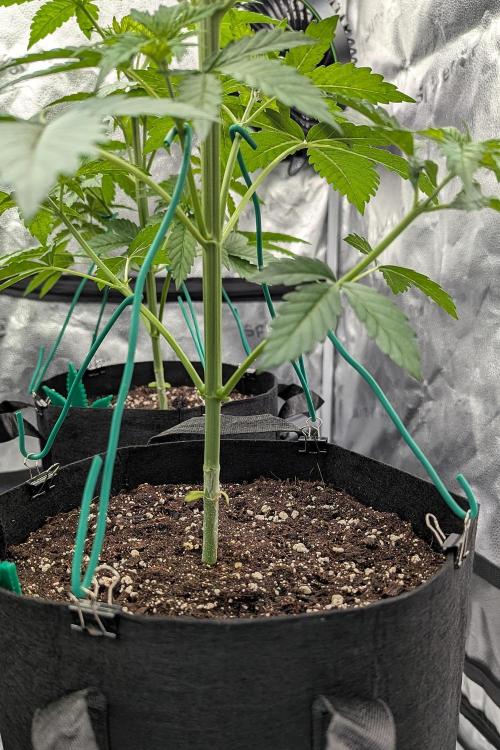
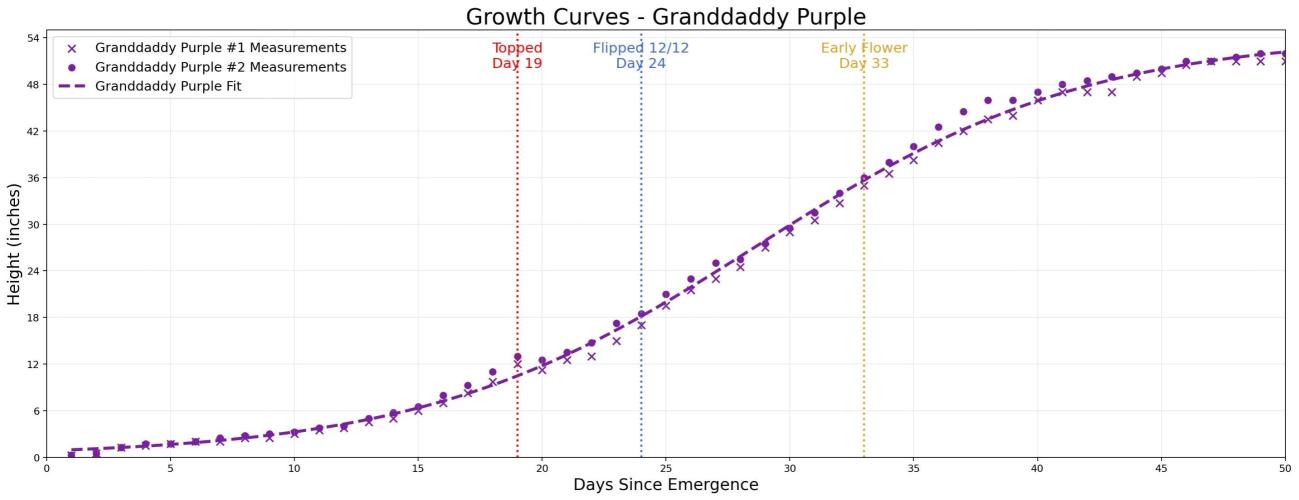
Day 19 marked the first structural training event of the grow. Plants were topped above Node 5 and Node 1 was removed, leaving four branch sets per plant as the intended structural framework moving forward. As of this entry, plants have been recovering from topping for approximately two days. Recovery appeared favorable and growth resumed quickly following the cut. Low stress training was now underway.
Pre-Topping Heights (Day 19)
GDP1: 12.00"
GDP2: 13.00"
This period also marked a transition in cultivation approach relative to prior grows. Previous runs had been performed in amended soil systems, while this grow utilized PRO-Mix HP as an inert medium. Nutrients therefore continued to be supplied with irrigation events throughout the period. Looking back, irrigation volume increased more aggressively than necessary early in the cycle as I adapted to the different watering behavior of the new media. The approach did not create observable issues, but this grow became an early lesson in adjusting irrigation strategy to the medium rather than carrying forward assumptions from previous runs. As a good friend of mine says: "experience is life’s greatest teacher."
Water volume increased from approximately 0.5 L per plant every other day on Day 11 to approximately 1 gallon per plant every other day by Day 21 as plant size and water demand accelerated.
Nutrient strategy progressed alongside growth stages, transitioning from Early Veg (Week 1) into Early Growth (Week 2) and finishing the period in Late Growth at Light concentration. Overall solution strength increased from approximately 440 ppm to 800 ppm. CAL-MAG increased from 3 mL/gal to 4 mL/gal, while silica was introduced during this period and increased gradually from 0.5 mL/gal to 2 mL/gal by the end of the week.
Lighting was adjusted upward to match increasing canopy demand while maintaining controlled structure. Fixture height increased from approximately 20 inches above soil to 23 inches mid-period, and later to 25 inches. PPFD began the period in the mid-400 range and increased to approximately 575–600 PPFD prior to topping. Following topping, dimmer output was briefly increased from 55% to 60% before returning to 55% to maintain a more appropriate post-training intensity range.
Day 21 Light Measurements
GDP1: 565 PPFD (37 DLI)
GDP2: 585 PPFD (38 DLI)
UV exposure remained unchanged at 30 minutes per light cycle throughout the period.
Day 21 Height Measurements
GDP1: 12.50"
GDP2: 13.50"
Looking back, this was also the grow that changed how I approached photoperiod structure management. At the time, I was applying techniques that had worked well in prior autoflower runs. In later grows, this experience led me toward earlier topping, earlier flowering transitions, and greater emphasis on structural training to maintain height control.
1 like
comments
Share
Used techniques
LST
Technique
Topping
Technique
4
Week 4. Vegetation4mo ago
64.77 cm
Height
12 hrs
Light Schedule
26 °C
Day Air Temp
6.1
pH
No Smell
Smell
900 PPM
TDS
55 %
Air Humidity
18 °C
Solution Temp
19 °C
Substrate Temp
22 °C
Night Air Temp
11.36 liters
Pot Size
1.89 liters
Watering Volume
24.13 cm
Lamp Distance
MichaelTheBarnOwl Grow #5, Entry #4: Transition Post-Flip
Days Since Emergence: 28
Days Since Flip: 5
Following topping on Day 19, plants were allowed approximately four days of recovery before initiating the transition to flower. The photoperiod was flipped to 12/12 on Day 24 post-emergence. This entry documents Day 28 post-emergence (Day 5 post-flip), capturing the beginning of transition growth and early stretch response.
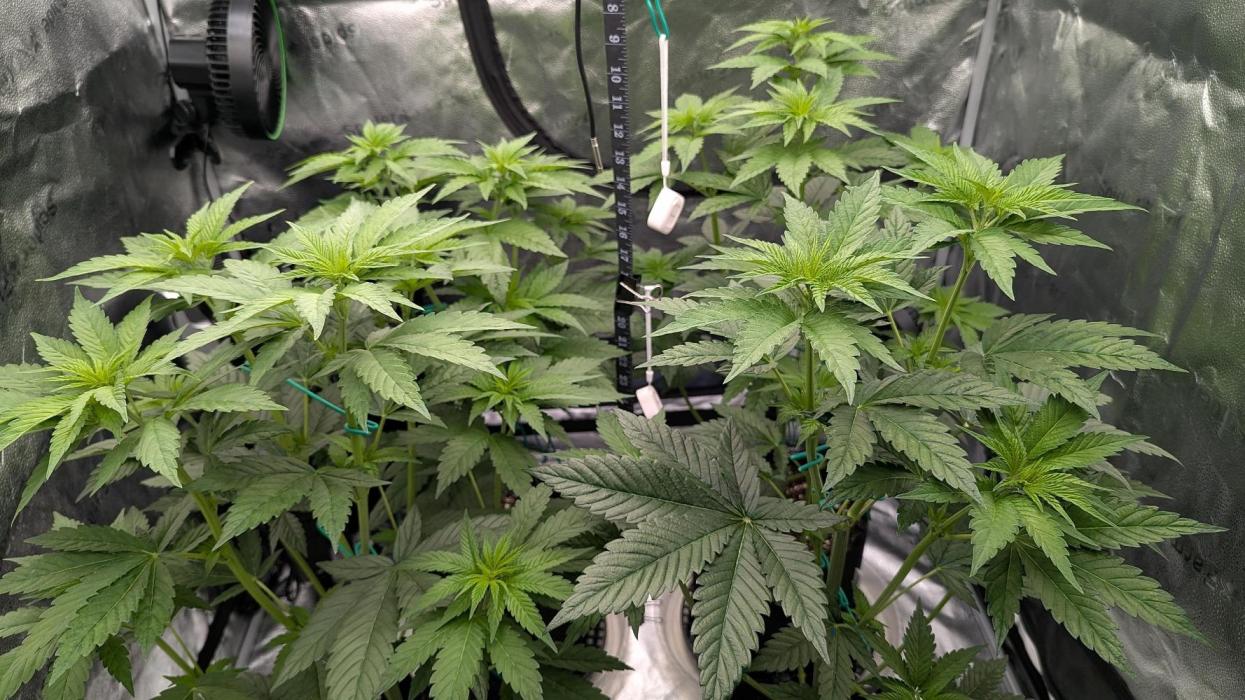
During this period, vertical growth accelerated substantially following the flip while structural training continued to maintain canopy control. Low stress training was deployed across all primary branch sets and selective removal of lower growth began intermittently to improve airflow and reduce congestion near the base of the canopy. To maximize available vertical space, plant stands were removed entirely from the tent.
Light intensity increased gradually in preparation for flower initiation while avoiding abrupt environmental changes. Measurements at the beginning of the period remained near 565 PPFD (GDP1) and 585 PPFD (GDP2). By Day 28, canopy measurements increased to 625 PPFD (27 DLI) for GDP1 and 650 PPFD (28 DLI) for GDP2. Fixture output increased from 55% to 60% during the week while plants entered rapid vertical expansion. To maintain appropriate canopy distance, fixture height was increased three times, raising the distance from soil to fixture from approximately 27.5 inches to 33 inches. Final canopy-to-light distance measured approximately 9.5–10.5 inches.
Nutrient strategy transitioned alongside the change in photoperiod. Feeding progressed from Late Growth at Light concentration into a 50/50 blend of Late Growth and Early Bloom at Medium strength. Overall solution strength increased from approximately 800 ppm to 900 ppm by the end of the period. CAL-MAG increased from 4 mL/gal to 5 mL/gal, pH remained tightly controlled between 6.0–6.1, and silica continued at 2 mL/gal every other feeding.
UV supplementation increased from 30 minutes to 45 minutes per light cycle during this period.
The transition response became increasingly apparent by the end of the week as plants continued stretching while recovering from topping and adapting to the new photoperiod.
Plant Height - Flip Day vs. Flip + 5 Days:
GDP1: 17.00" → 24.50" (+7.50")
GDP2: 18.50" → 25.50" (+7.00")
By Day 28, canopy expansion had accelerated enough that future structure management would increasingly depend on continued training and vertical space management.
1 like
comments
Share
Used techniques
Defoliation
Technique
12-12
Technique
LST
Technique
5
Week 5. Flowering4mo ago
101.6 cm
Height
12 hrs
Light Schedule
26 °C
Day Air Temp
6.1
pH
Weak
Smell
900 PPM
TDS
52 %
Air Humidity
18 °C
Solution Temp
19 °C
Substrate Temp
20 °C
Night Air Temp
11.36 liters
Pot Size
1.89 liters
Watering Volume
35.56 cm
Lamp Distance
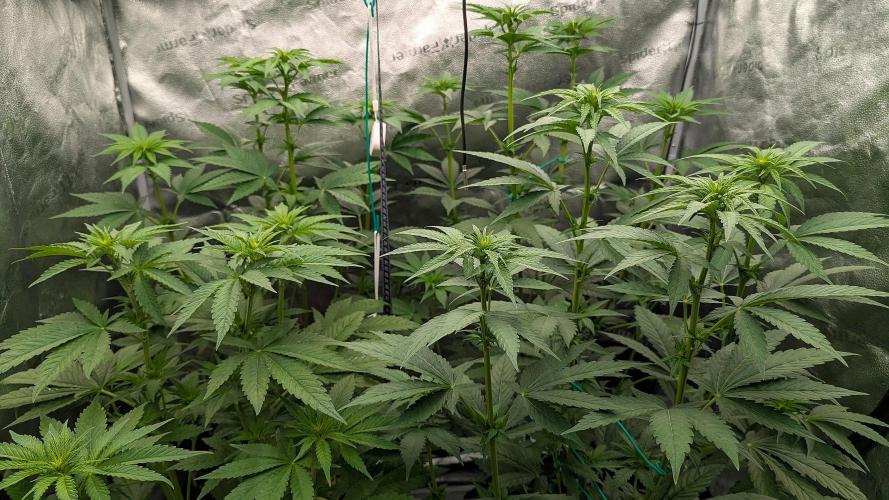
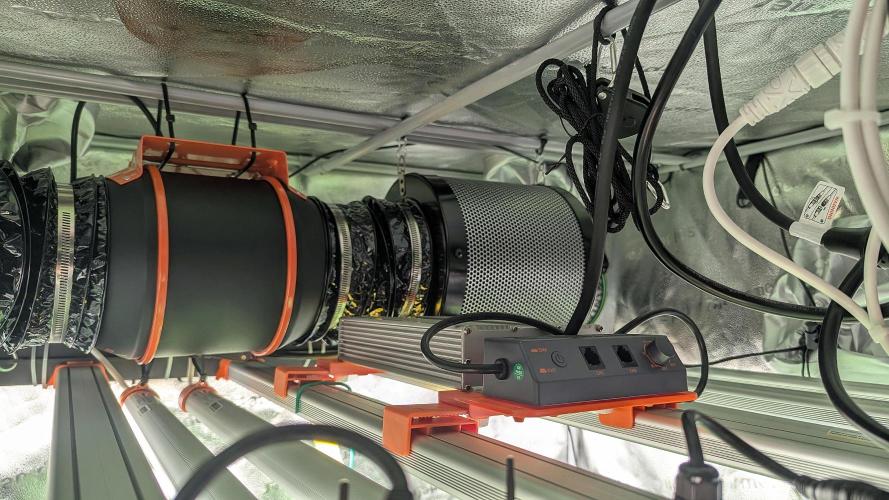
MichaelTheBarnOwl Grow #5, Entry #5: Transition Post Flip, Early Flower Begins
Days Since Emergence: 35
Days Since Flip: 12
Days in Flower: 3
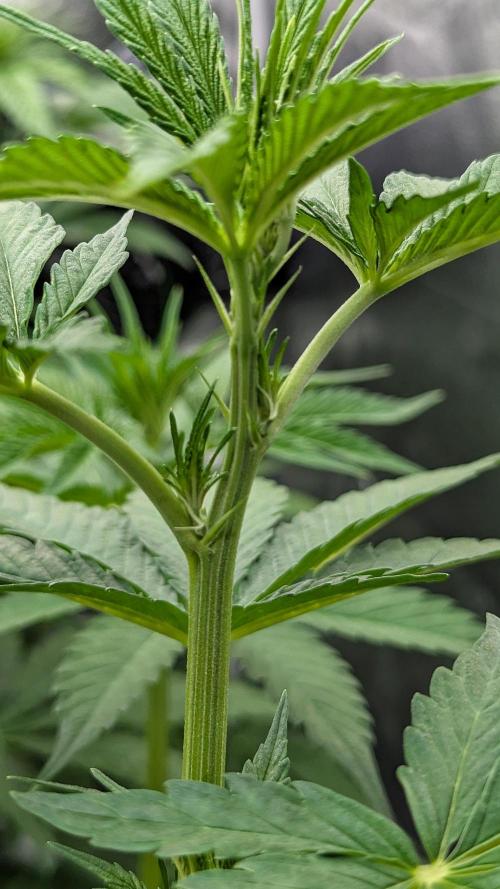
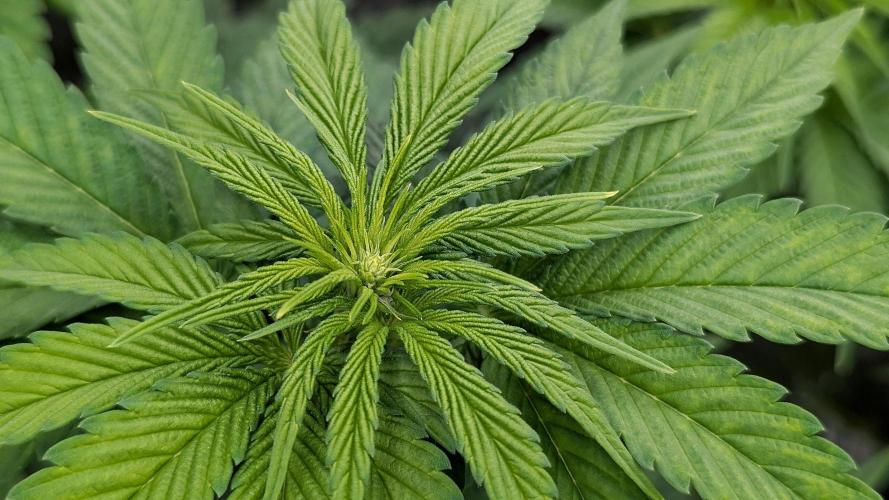
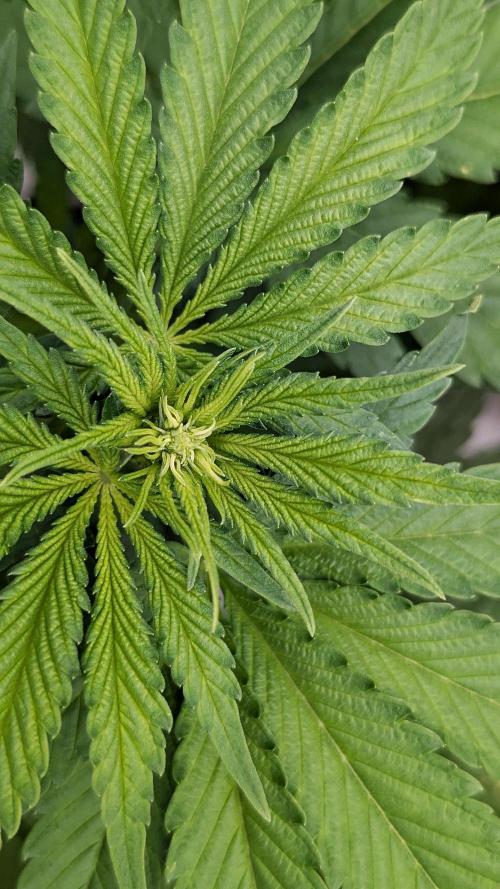
Granddaddy Purple completed the transition period and entered early flower during this stage. Pistils became established across multiple nodes and flowering activity became consistent enough to transition nutrition fully into bloom-oriented feeding. Vertical growth remained aggressive as stretch continued following the flip.
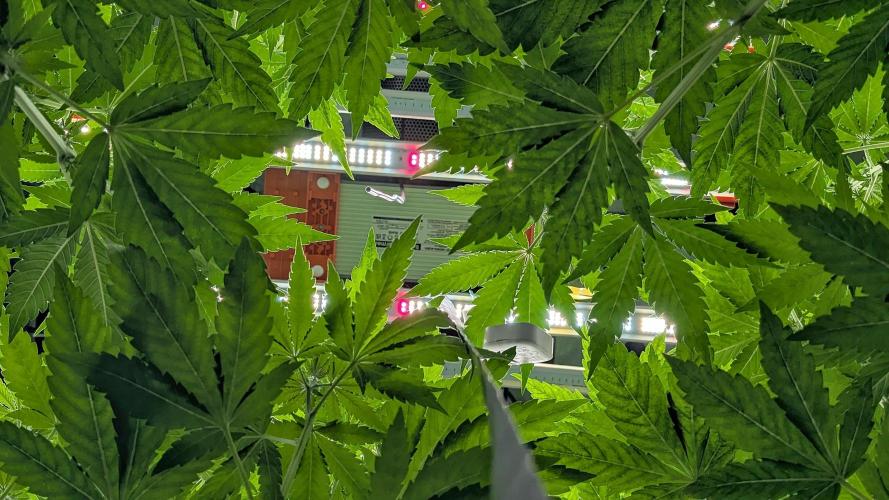
Light intensity increased steadily throughout the period in preparation for flower establishment while maintaining manageable canopy conditions. Measurements at the beginning of the period were recorded at 625 PPFD (27 DLI) for GDP1 and 650 PPFD (28 DLI) for GDP2. By Day 35, canopy measurements increased to 790 PPFD (34 DLI) for GDP1 and 860 PPFD (37 DLI) for GDP2. Dimmer output increased from 55–60% at the beginning of the period to 65% by the end of the period.
UV supplementation increased from 45 minutes to 60 minutes per light cycle.
Irrigation volume stabilized between 1–1.25 gallons per plant every other day. An attempt was made to extend irrigation frequency to once every three days; however, plants showed early signs of drought stress and watering returned to an every-other-day schedule. Input pH remained tightly controlled between 6.0–6.1 throughout the period.
Nutrient strategy continued progressing alongside flower development. Plants entered the period receiving a 50/50 blend of Late Growth and Early Bloom at Medium concentration (900 PPM) and transitioned fully into Early Bloom at Medium strength (900 PPM) after pistils became established and plants officially entered flower. CAL-MAG remained unchanged at 5 mL/gal, while silica continued at 2 mL/gal every other watering.
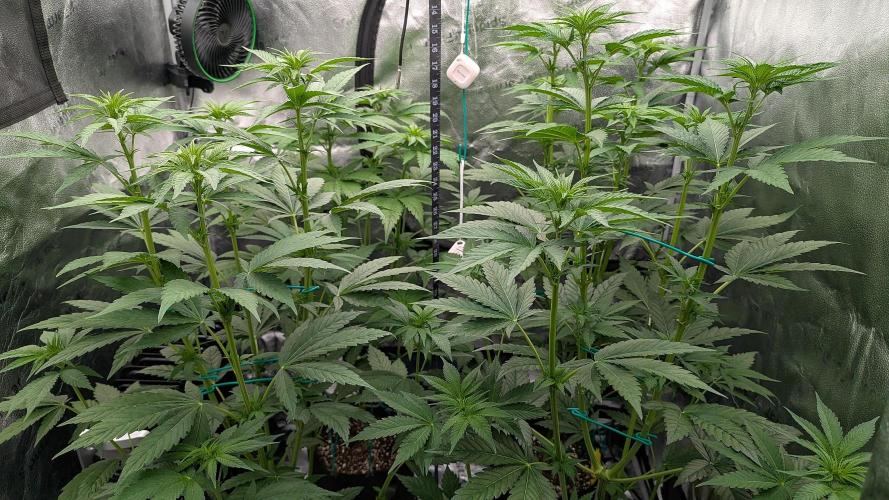
Structural management became increasingly important as stretch accelerated. Extensive low stress training continued throughout the canopy and selective defoliation focused primarily on leaves restricting airflow, contacting developing flower sites, and reducing congestion within the lower and middle canopy while minimizing removal from upper growth.
Plant height increased rapidly through transition and into early flower.
Plant Height - Flip Day vs. Day 1 of Flower (Flip + 10 Days):
GDP1: 17.00" → 38.25" (+21.25")
GDP2: 18.50" → 36.00" (+17.50")
Plant Height - Day 35 Post-Emergence:
GDP1: 38.25"
GDP2: 40.00"
Final canopy-to-light distance measured 14–15.75 inches.
By the end of the period, available vertical space was becoming a primary consideration. The fixture had already been raised to its maximum position and remaining expansion options were becoming limited to equipment relocation if additional headroom became necessary. Aroma became noticeable immediately following visible flower initiation.
1 like
comments
Share
Used techniques
LST
Technique
Defoliation
Technique
12-12
Technique
6
Week 6. Flowering4mo ago
123.19 cm
Height
12 hrs
Light Schedule
23 °C
Day Air Temp
6.1
pH
Normal
Smell
900 PPM
TDS
50 %
Air Humidity
18 °C
Solution Temp
19 °C
Substrate Temp
18 °C
Night Air Temp
11.36 liters
Pot Size
1.89 liters
Watering Volume
30.48 cm
Lamp Distance
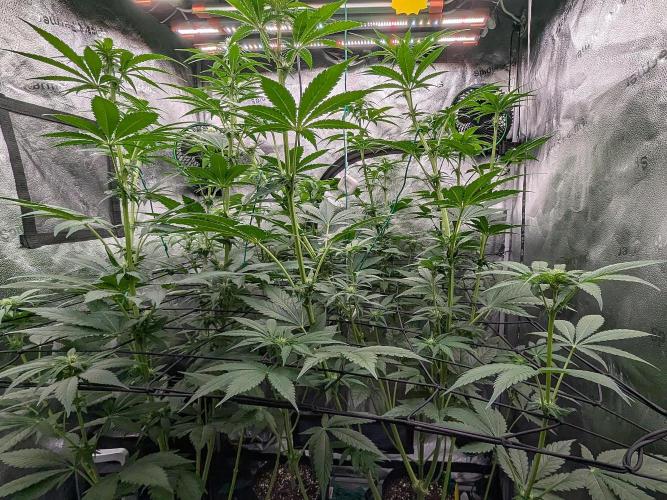
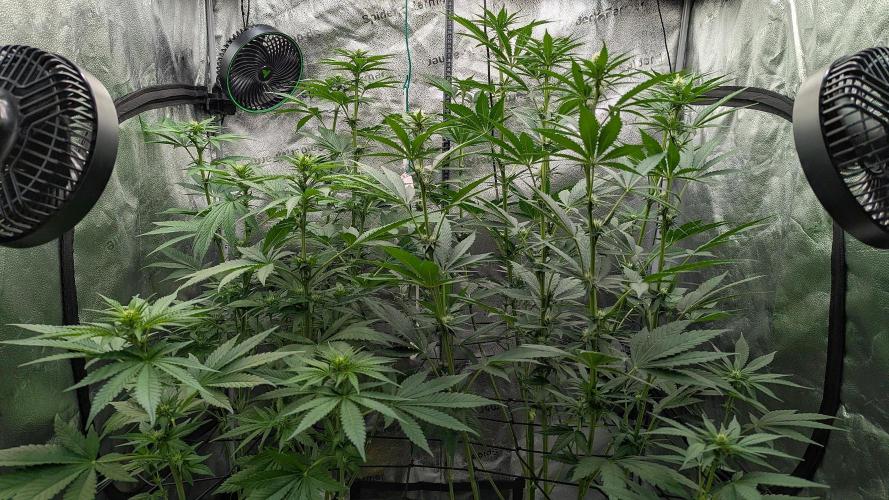
MichaelTheBarnOwl Grow #5, Entry #6: Early Flower
Days Since Emergence: 42
Days Since Flip: 19
Days in Flower: 10
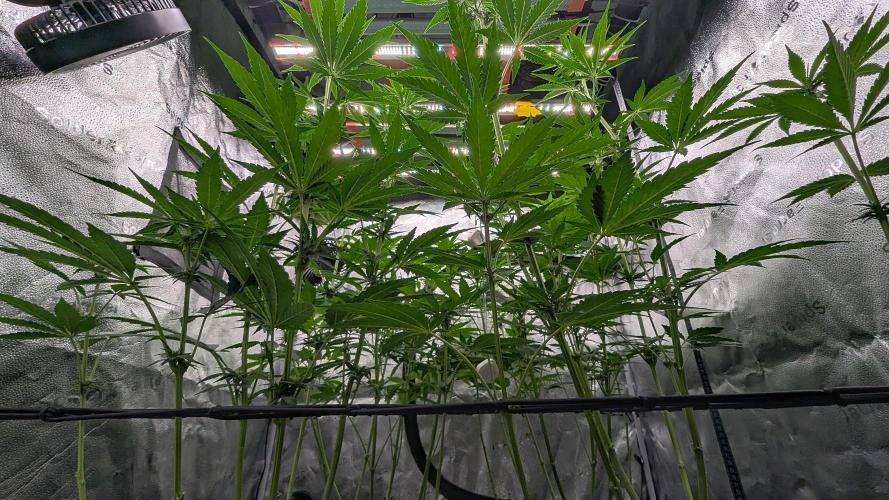
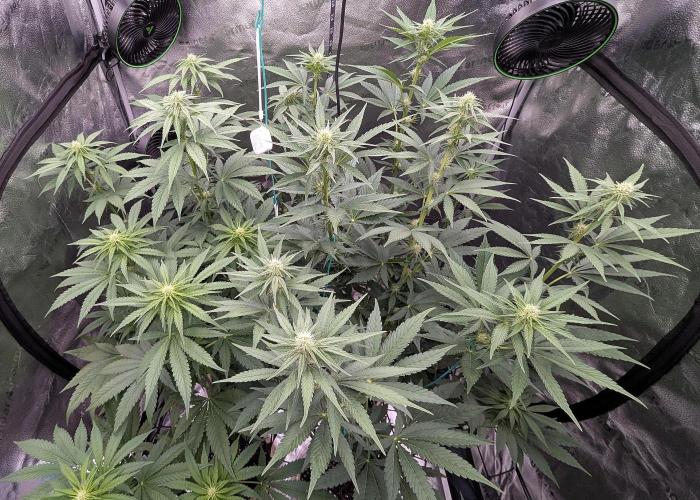
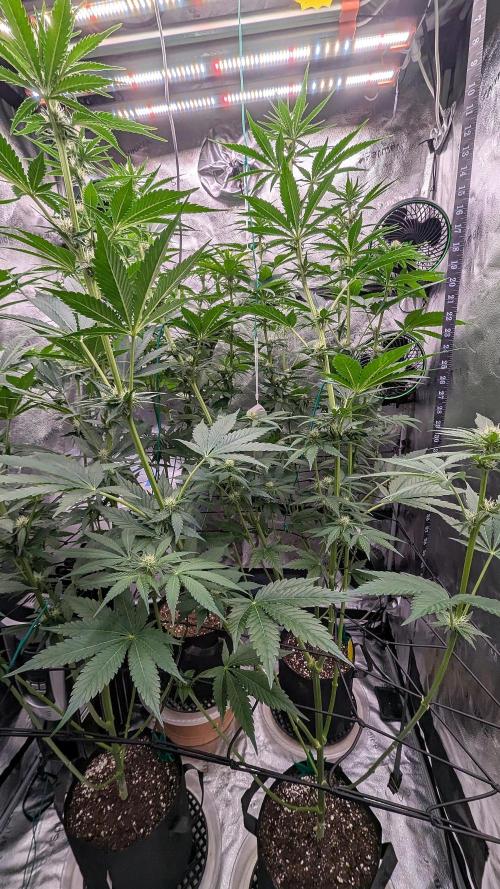
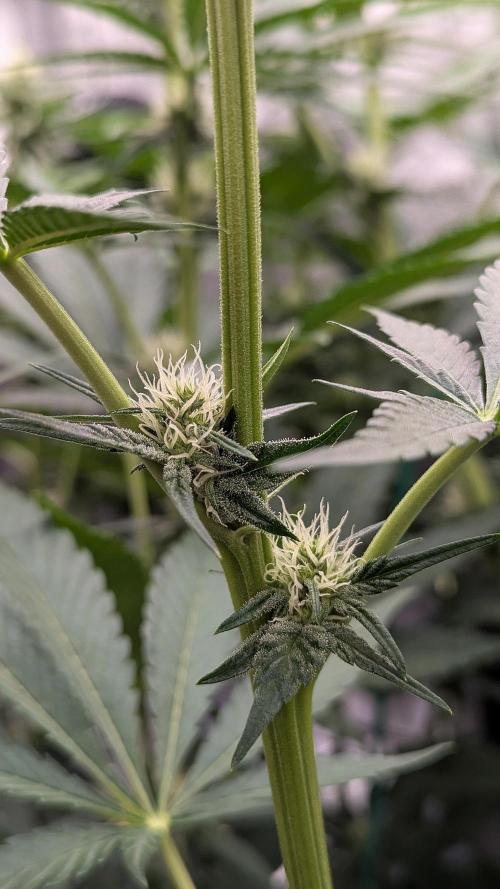
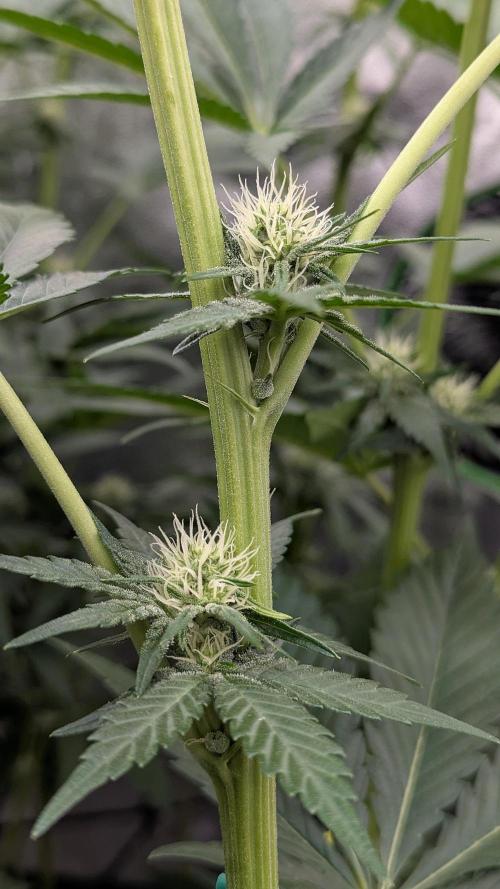
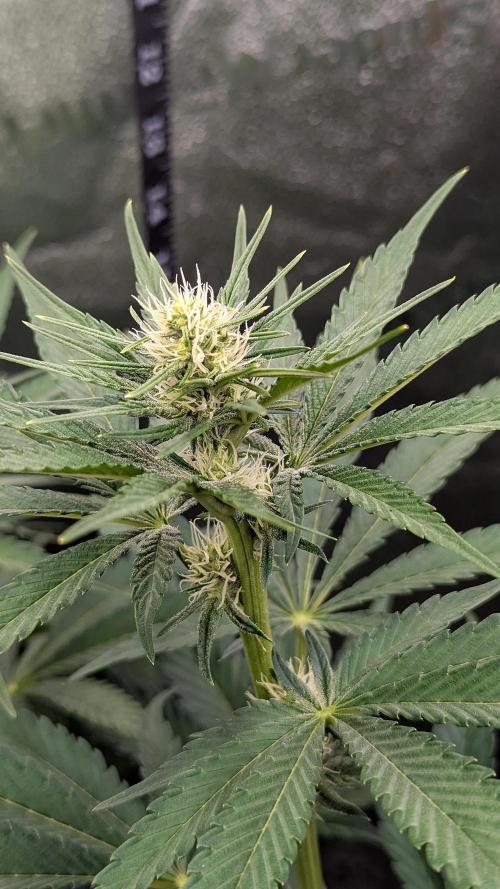
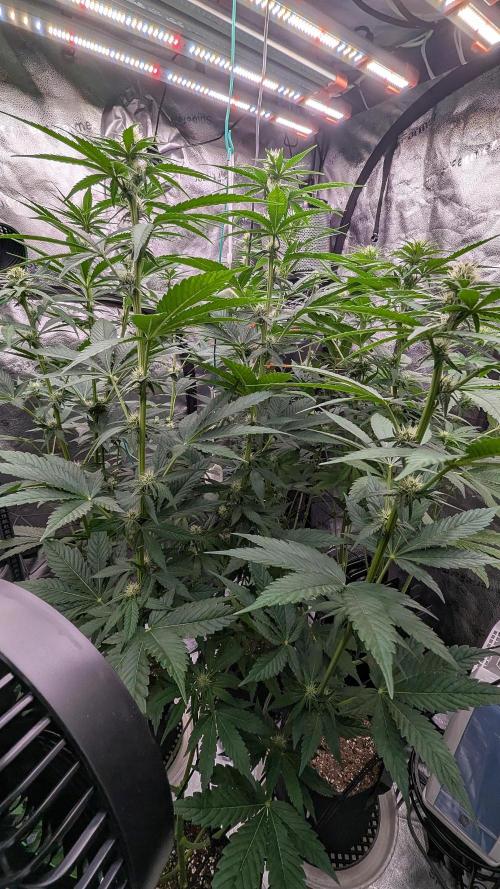
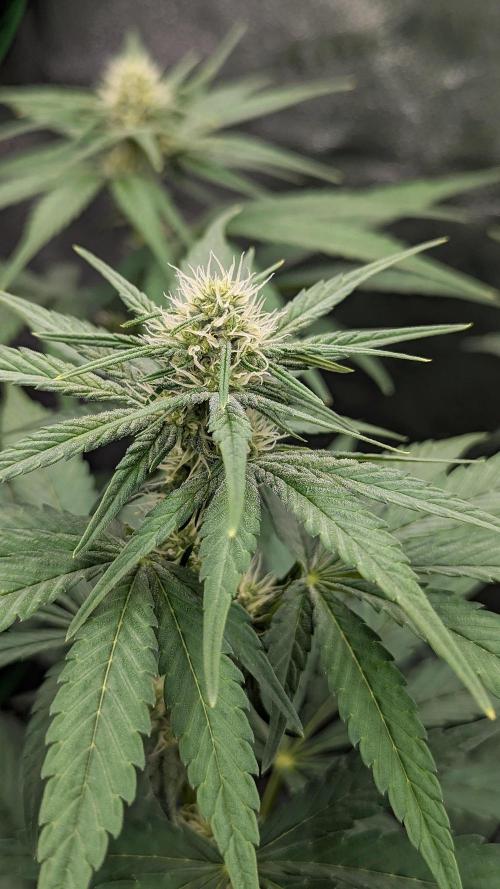
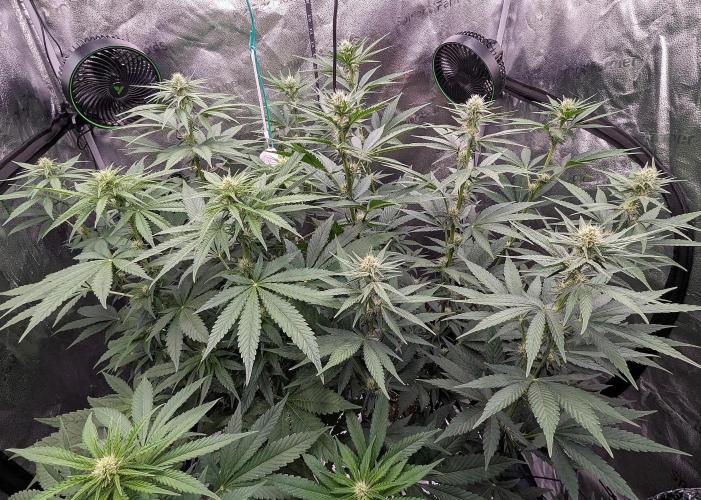
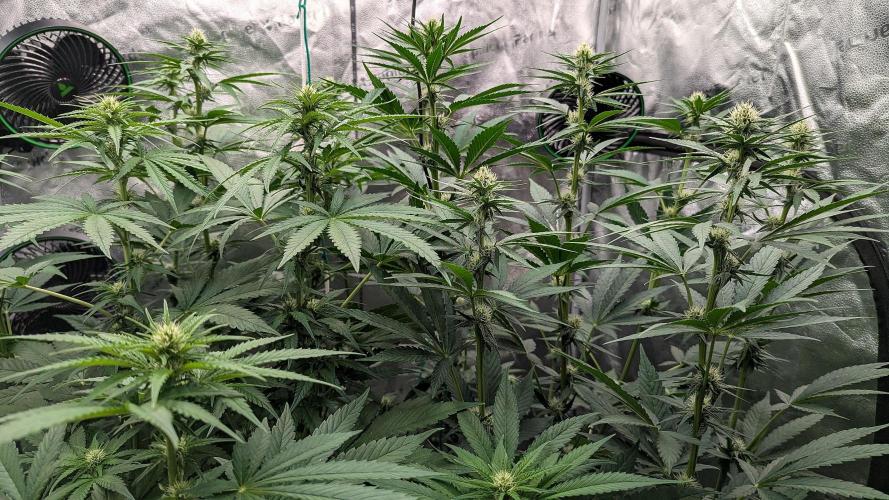
Granddaddy Purple progressed further into early flower during this period while continuing strong vertical expansion. Flower development became increasingly apparent across the canopy and structural management shifted further toward maintaining airflow, controlling height, and maximizing usable tent space.
Light intensity continued increasing to support expanding flower sites while remaining within target ranges for early flower. Measurements at the beginning of the period were recorded at 790 PPFD (34 DLI) for GDP1 and 860 PPFD (37 DLI) for GDP2. By Day 42, canopy measurements stabilized at 860 PPFD (37 DLI) for both plants. Dimmer output increased from 65% at the beginning of the period to 70% by the end of the period.
UV supplementation remained unchanged at 60 minutes per light cycle.
Irrigation remained steady at 1–1.25 gallons per plant every other day throughout the period. Input pH remained tightly controlled between 6.0–6.2.
Nutrient delivery stabilized during this stage with plants receiving Early Bloom at Medium strength (900 PPM) throughout the period. CAL-MAG remained unchanged at 5 mL/gal, while silica continued at 2 mL/gal every other watering.
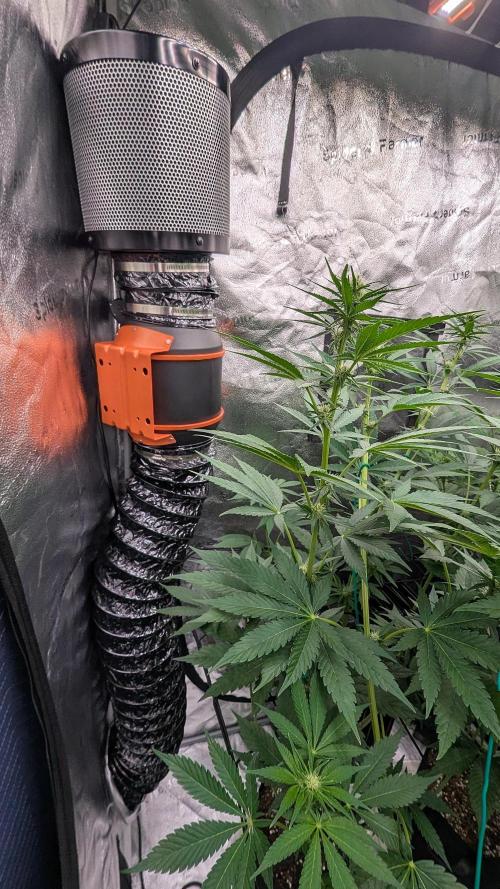
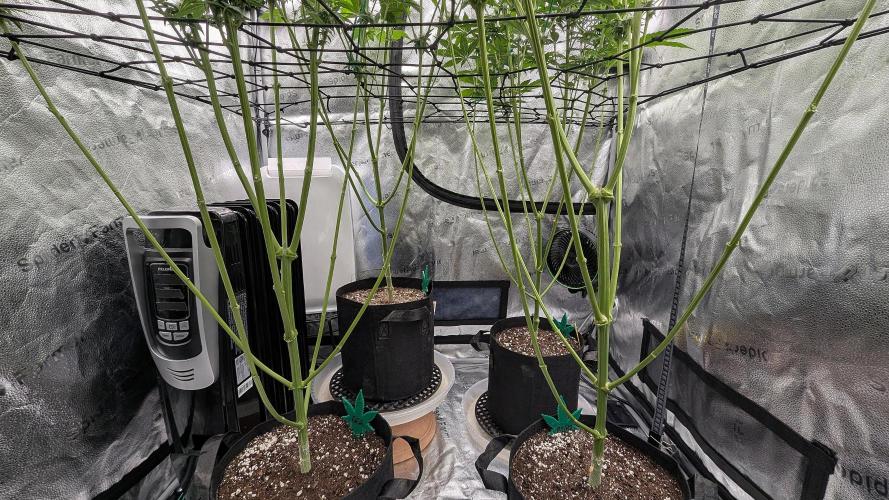
Structural management intensified as available vertical space narrowed. The exhaust system was relocated into the corner of the tent to recover additional headroom and preserve canopy distance. An AC Infinity trellis net was installed and tops were guided through the net to begin more active lateral control and height management.
Defoliation continued with emphasis on removing foliage from the lower one-third of each plant along with inward-facing, overlapping, and light-blocking leaves within the lower and middle canopy. Removal remained conservative in the upper canopy to preserve productive flower sites and maintain canopy momentum.
Plant Height - Day 42 Post-Emergence:
GDP1: 48.50"
GDP2: 47.00"
Final canopy-to-light distance measured 12.0–14.0 inches.
Aroma intensified noticeably during this period as flower development progressed. The tent environment developed a strong profile combining roadkill skunk characteristics with layered citrus and berry notes that became increasingly pronounced as flowers continued establishing.
By the end of the period, height management had become one of the primary operational constraints of the grow. The fixture had reached its maximum practical height and future adjustments would increasingly depend on canopy management rather than additional fixture movement.
1 like
comments
Share
Used techniques
LST
Technique
Defoliation
Technique
12-12
Technique
7
Week 7. Flowering4mo ago
132.08 cm
Height
12 hrs
Light Schedule
23 °C
Day Air Temp
6.1
pH
Normal
Smell
900 PPM
TDS
50 %
Air Humidity
18 °C
Solution Temp
19 °C
Substrate Temp
17 °C
Night Air Temp
11.36 liters
Pot Size
1.89 liters
Watering Volume
22.86 cm
Lamp Distance
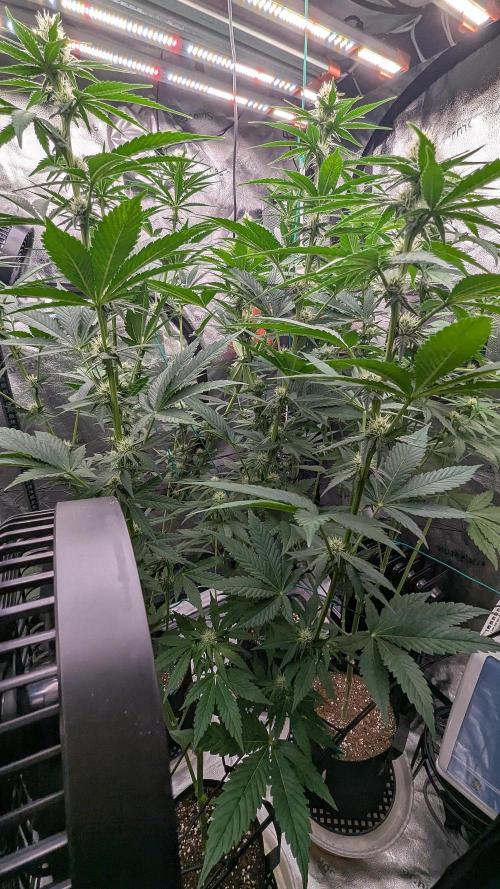
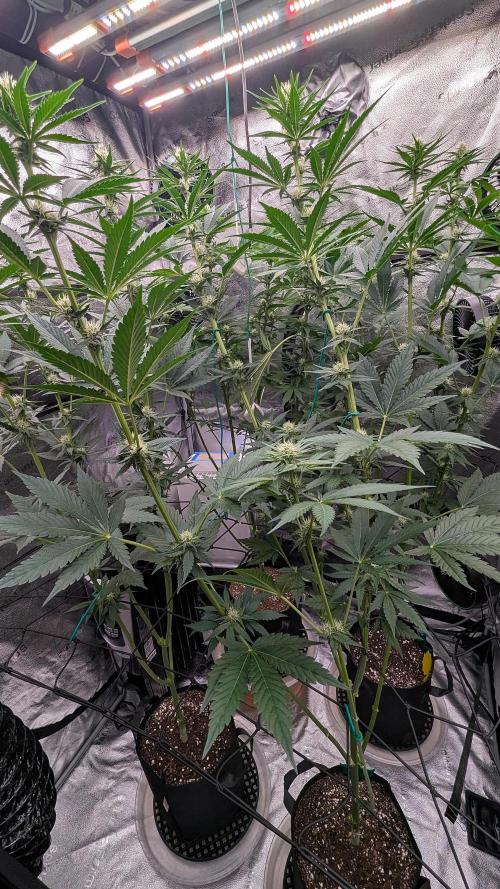
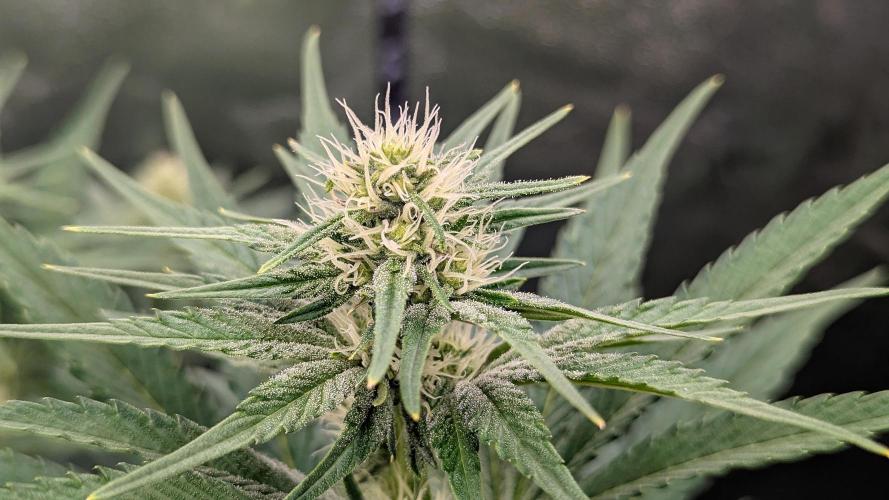
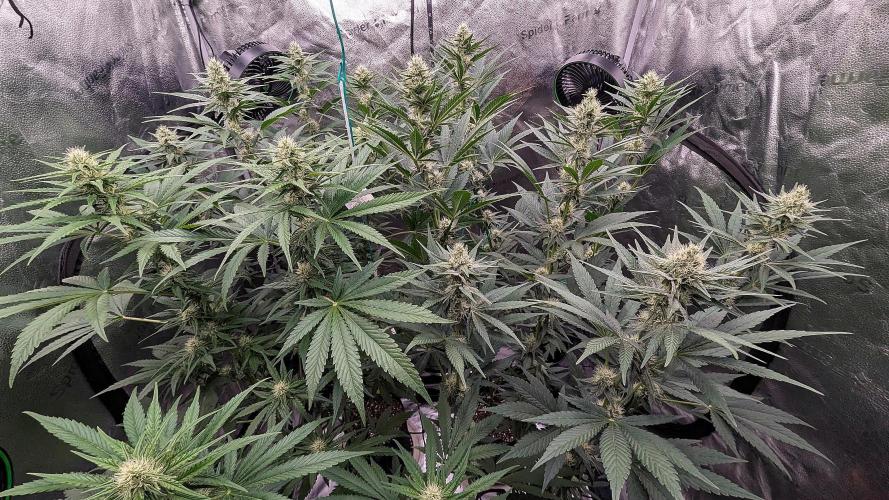
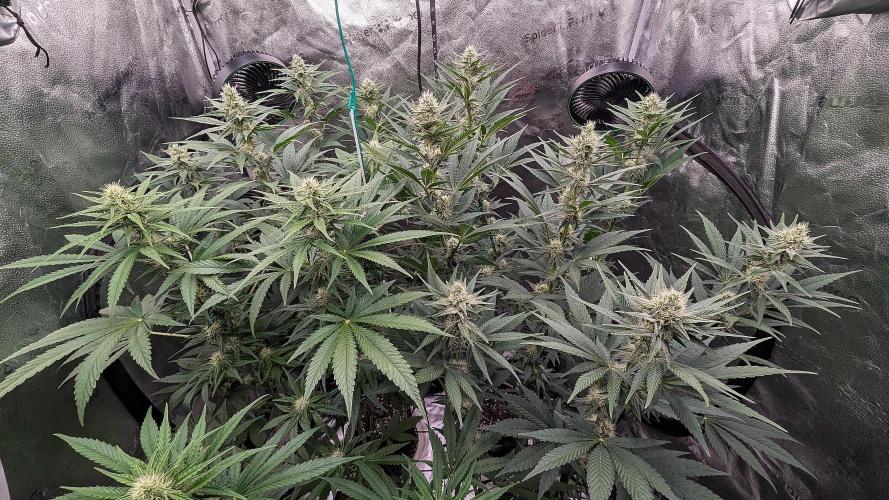
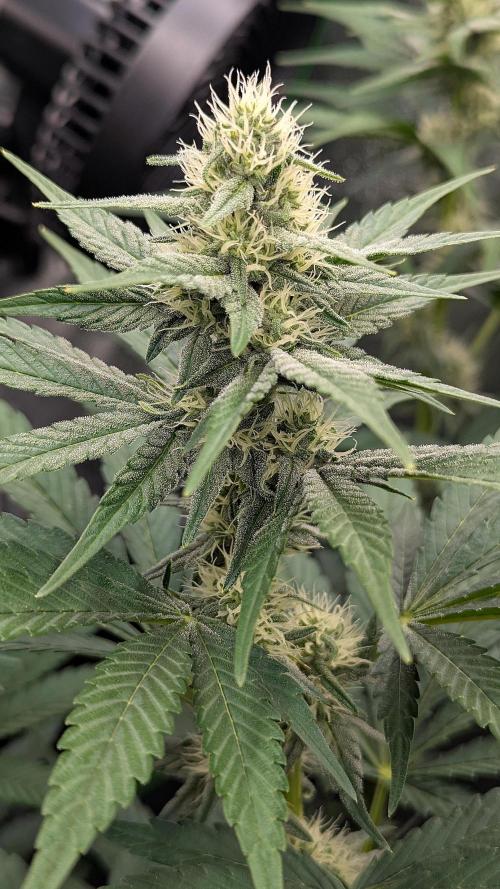
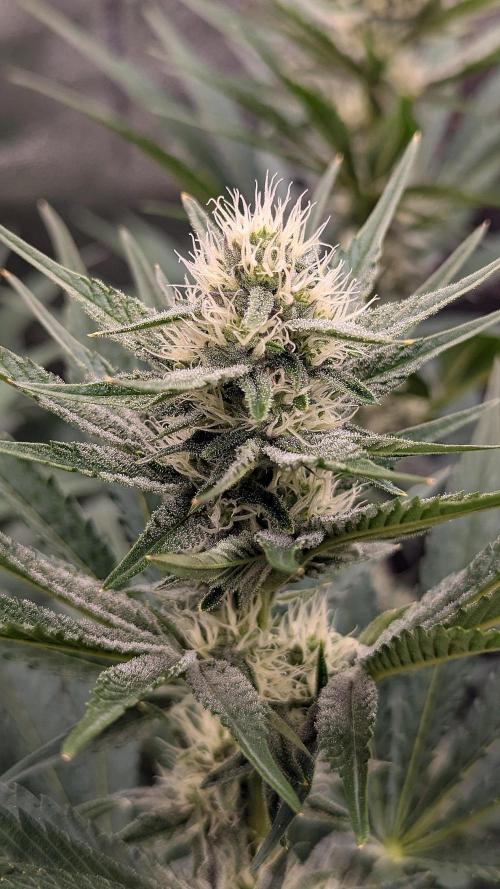
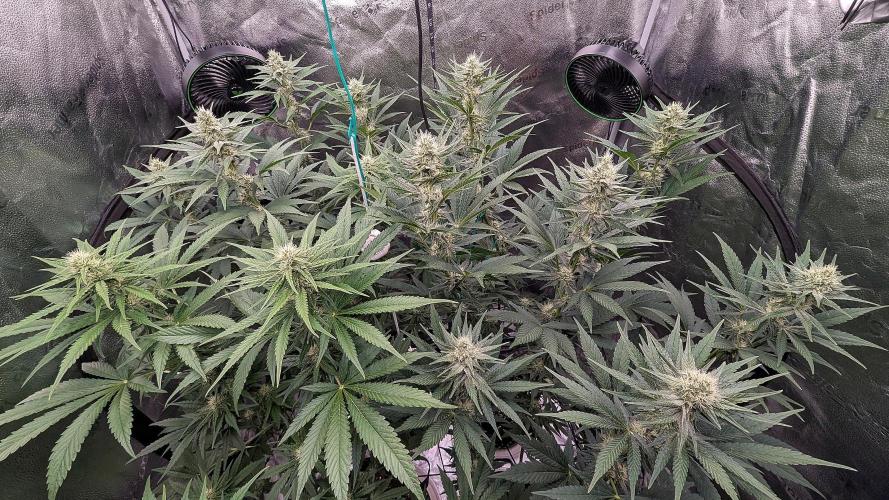
MichaelTheBarnOwl Grow #5, Entry #7: Early Flower, Stretch Ends
Days Since Emergence: 49
Days Since Flip: 26
Days in Flower: 17
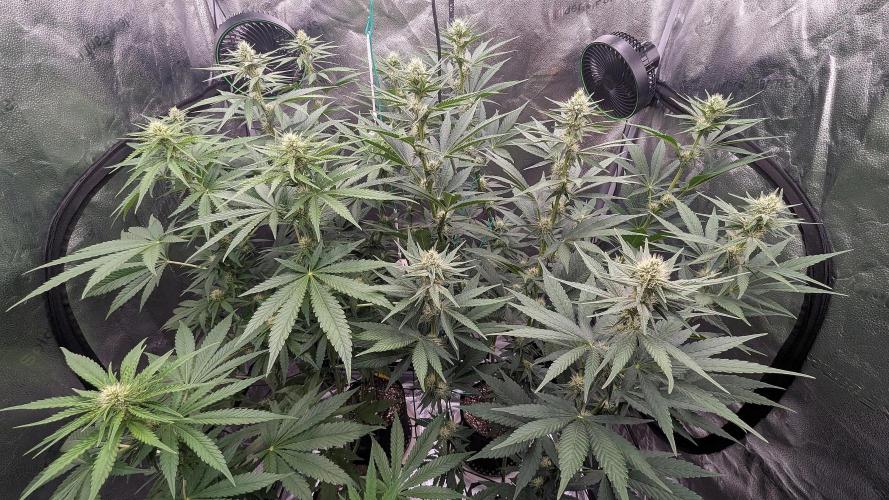
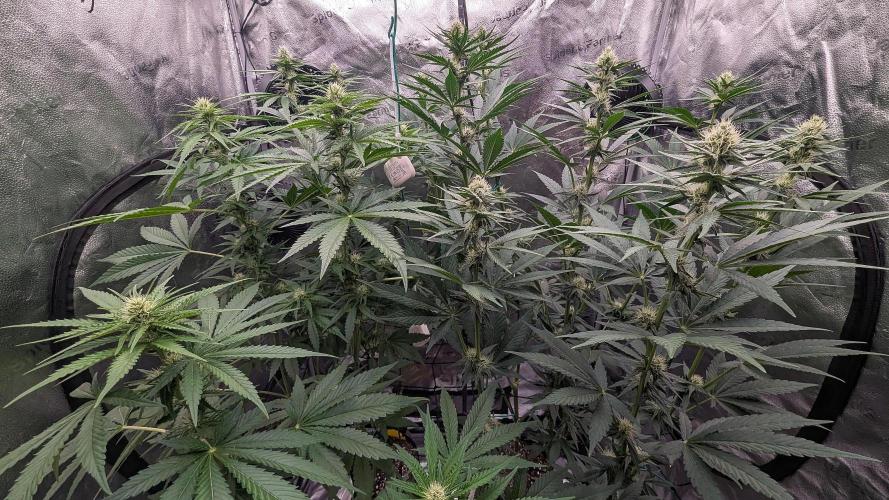
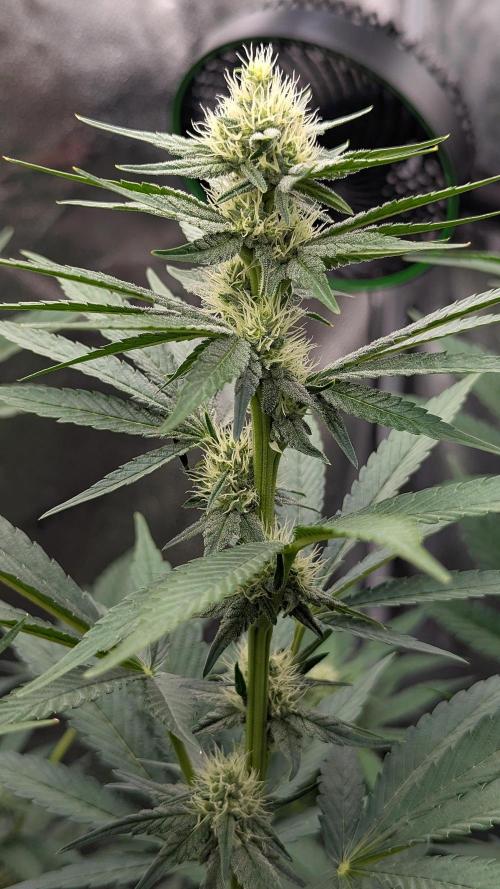
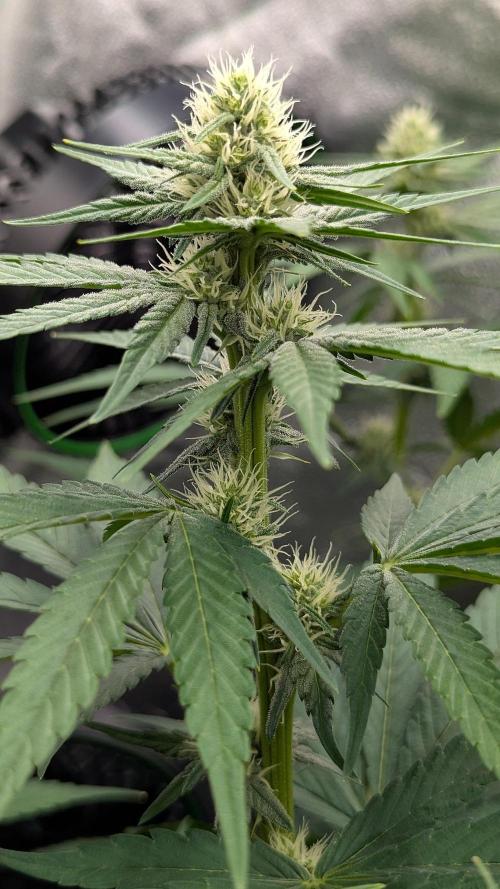
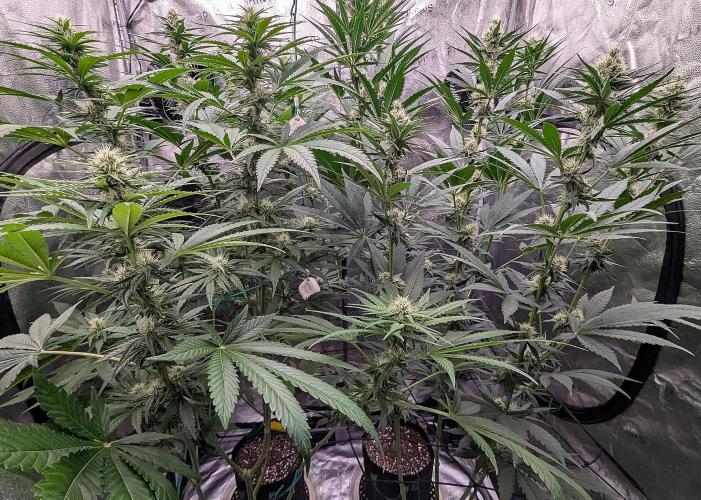
Although vertical growth had already begun slowing entering the week, measurements collected beyond Day 15 of flower showed no meaningful additional height gain and stretch was considered finished at that point. Management priorities shifted away from height control and toward optimizing light distribution, canopy structure, and directing energy into productive flower sites.
Light intensity increased further during the period to support continued flower development while remaining within target ranges for early flower. Measurements at the beginning of the period were recorded at 860 PPFD (37 DLI) for both plants. By Day 49, canopy measurements increased to 960 PPFD (41 DLI) for GDP1 and 970 PPFD (42 DLI) for GDP2. Dimmer output remained unchanged at 70% throughout the period.
UV supplementation increased from 60 minutes to 70 minutes per light cycle.
Irrigation remained steady at 1–1.25 gallons per plant every other day with input pH maintained between 6.0–6.2.
Nutrient delivery remained unchanged during this stage with plants receiving Early Bloom at Medium strength (900 PPM) throughout the period. CAL-MAG remained at 5 mL/gal, while silica continued at 2 mL/gal every other watering.
Canopy management became increasingly selective as final plant structure emerged. Lower branch removal was guided primarily by available light, with nodes receiving less than 250 PPFD being removed if they could not be repositioned into productive canopy space. This resulted in the removal of eight branches during the period.
Early assumptions about maintaining four branch sets per plant ultimately changed as the grow progressed. Internodal spacing and overall plant height resulted in lower branches falling too far below the productive canopy to develop into high-quality flower. By the end of stretch, practical structure had been reduced to the equivalent of 2–2.5 productive branch sets per plant, concentrating resources into better-positioned flower sites.
Using final heights recorded at the time of flip and final heights at the end of stretch, final stretch multipliers were calculated as follows:
Plant Height - Flip Day vs. End of Stretch:
GDP1: 17.00" → 51.00" (3.00×)
GDP2: 18.50" → 52.00" (2.81×)
Final canopy-to-light distance measured 9.0 - 10.0 inches.
1 like
comments
Share
Used techniques
LST
Technique
Defoliation
Technique
12-12
Technique
8
Week 8. Flowering4mo ago
132.08 cm
Height
12 hrs
Light Schedule
24 °C
Day Air Temp
6.1
pH
Strong
Smell
900 PPM
TDS
48 %
Air Humidity
18 °C
Solution Temp
19 °C
Substrate Temp
19 °C
Night Air Temp
11.36 liters
Pot Size
1.89 liters
Watering Volume
22.86 cm
Lamp Distance
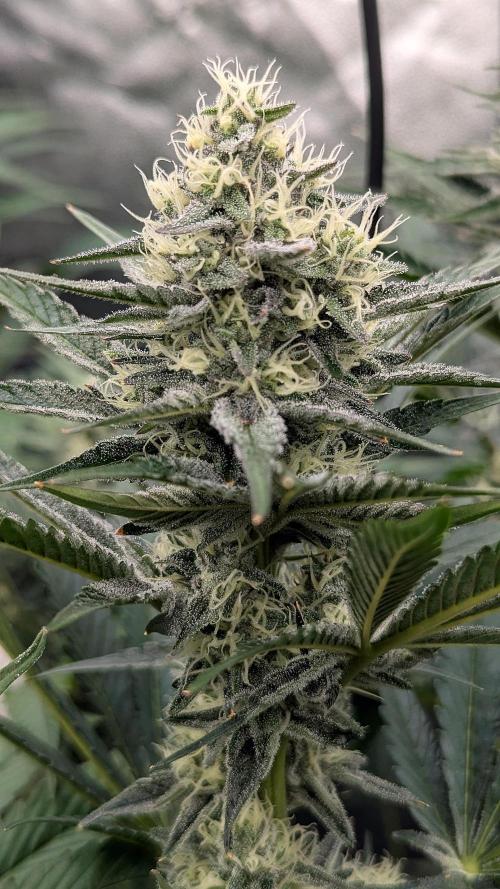
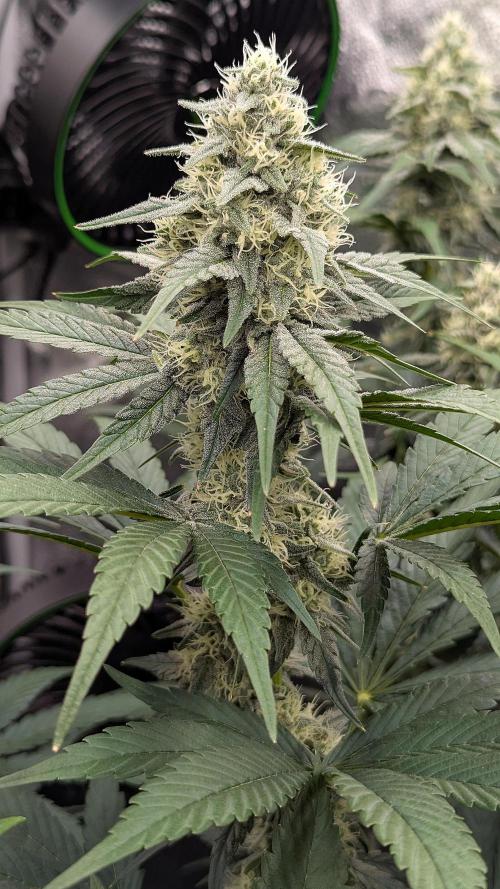
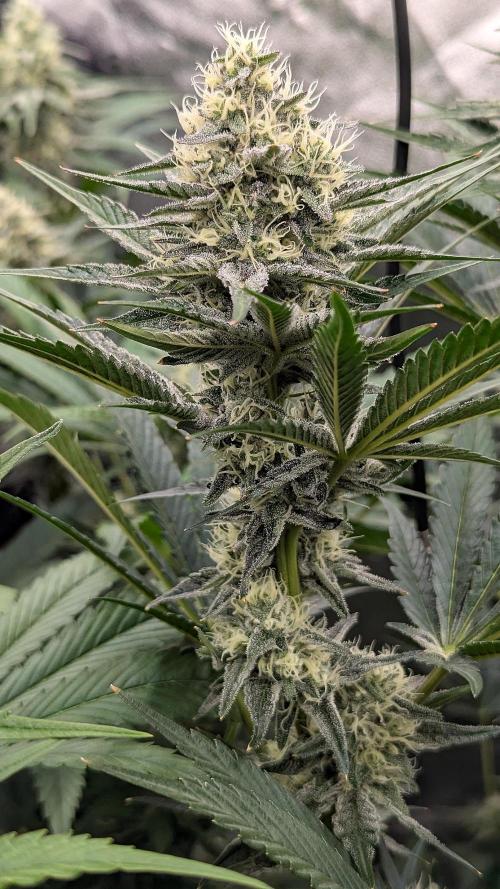
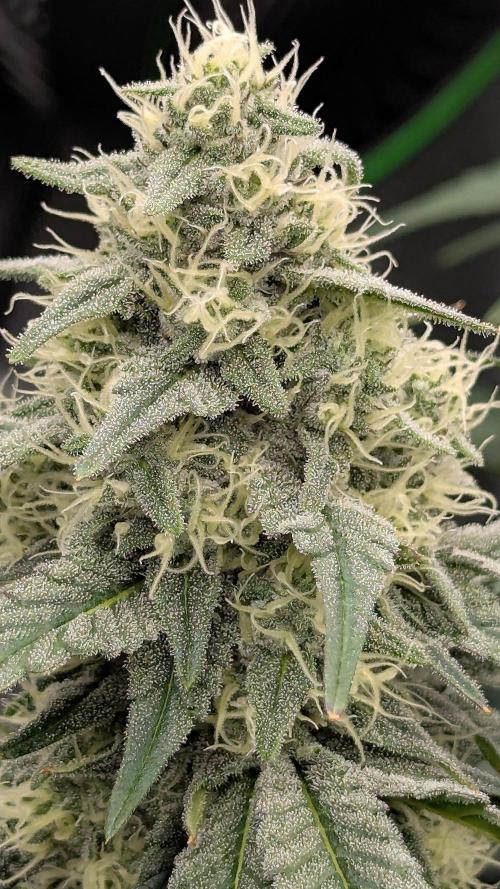
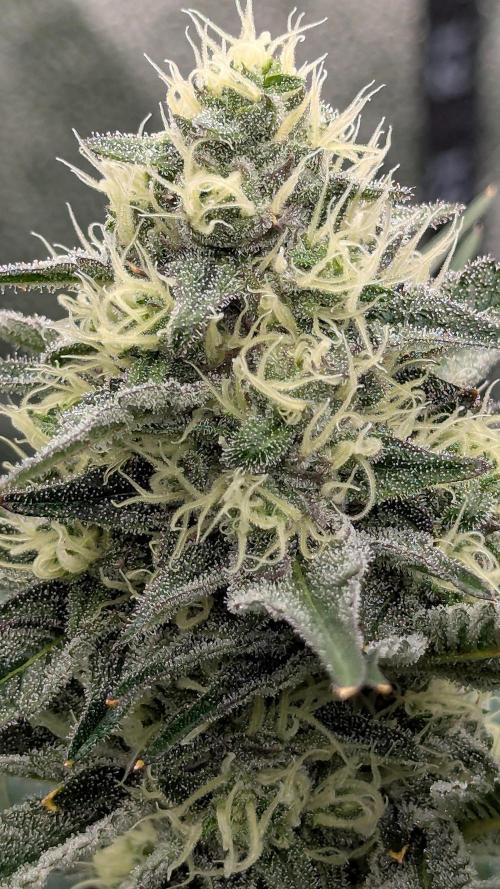
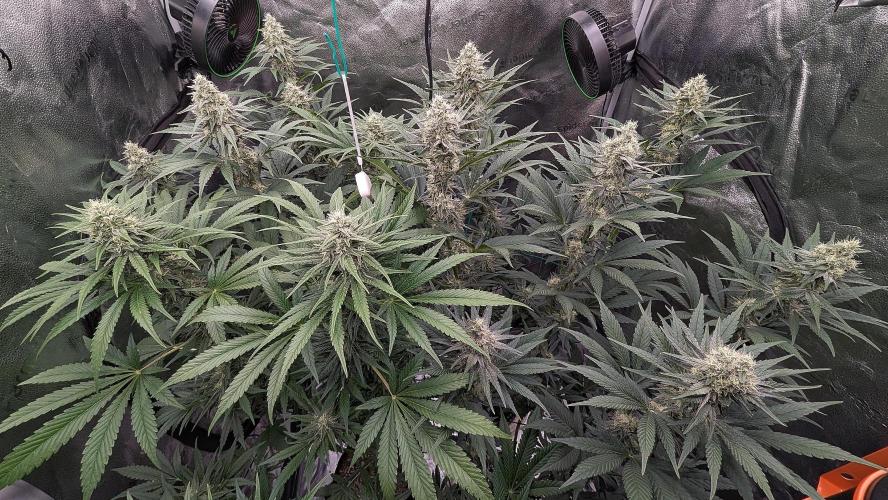
MichaelTheBarnOwl Grow #5, Entry #8: Mid Flower
Days Since Emergence: 56
Days Since Flip: 33
Days in Flower: 24
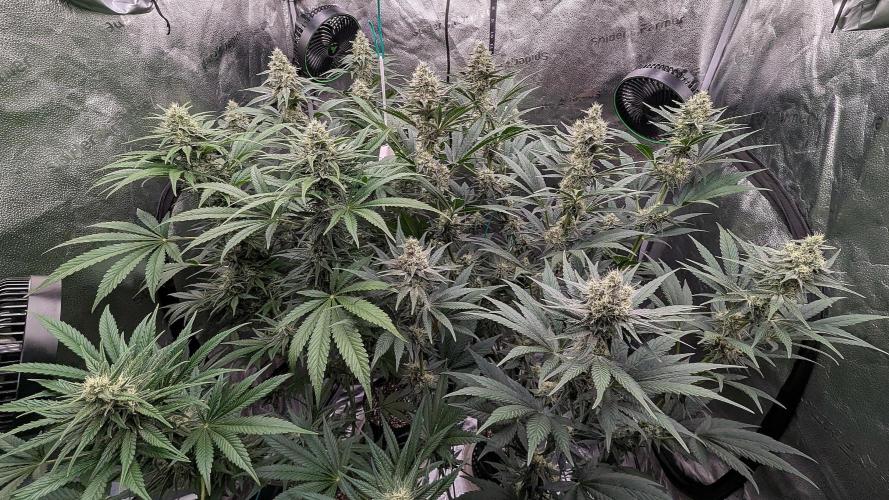
With stretch complete, management efforts focused on maintaining light distribution, preserving airflow, and supporting continued flower development.
Light intensity remained relatively stable throughout the period with only minor balancing adjustments across the canopy. Measurements at the beginning of the period were recorded at 960 PPFD (41 DLI) for GDP1 and 970 PPFD (42 DLI) for GDP2. By Day 56, canopy measurements measured 975 PPFD (42 DLI) for GDP1 and 945 PPFD (42 DLI) for GDP2. Dimmer output remained steady at 70%.
UV supplementation increased from 70 minutes to 120 minutes per light cycle.
Irrigation remained stable at 1–1.25 gallons per plant every other day with input pH maintained between 6.0–6.2.
Nutrient delivery transitioned gradually through bloom progression while maintaining stable solution strength. Plants entered the period receiving Early Bloom at Medium strength (900 PPM) before progressing into a 50/50 blend of Early Bloom and Mid Bloom at Medium strength, ultimately finishing the period receiving Mid Bloom at Medium strength. Solution concentration remained unchanged at 900 PPM throughout the period.
CAL-MAG remained unchanged at 5 mL/gal. Silica supplementation was reduced from 2 mL/gal every other watering to 1 mL/gal once per week.
Canopy work became lighter and more selective compared to prior periods. Small amounts of defoliation continued with emphasis placed on removing leaves wrapping around developing flowers, inward-facing leaves, and foliage reducing airflow through the canopy. Additional adjustments were made to improve light distribution across the outer canopy, with efforts focused on positioning edge colas into a target range of 550–650 PPFD where possible.
Plant Height - Day 56 Post-Emergence (unchanged since the end of stretch):
GDP1: 51.00"
GDP2: 52.00"
Final canopy-to-light distance unchanged and measured 9.0–10.0 inches.
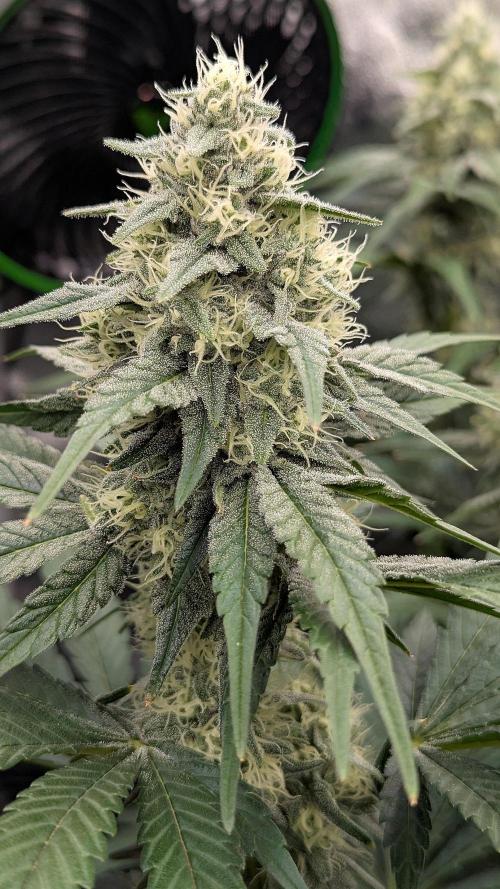
Aroma intensified noticeably during this period as flowers continued developing and filling in. With major structural work complete, the canopy entered a more stable phase where the emphasis shifted toward maintaining conditions, preserving penetration through the canopy, and allowing flower sites to continue maturing with minimal intervention.
1 like
comments
Share
Used techniques
LST
Technique
Defoliation
Technique
12-12
Technique
9
Week 9. Flowering4mo ago
132.08 cm
Height
12 hrs
Light Schedule
24 °C
Day Air Temp
6.1
pH
Strong
Smell
900 PPM
TDS
51 %
Air Humidity
18 °C
Solution Temp
19 °C
Substrate Temp
18 °C
Night Air Temp
11.36 liters
Pot Size
1.89 liters
Watering Volume
22.86 cm
Lamp Distance
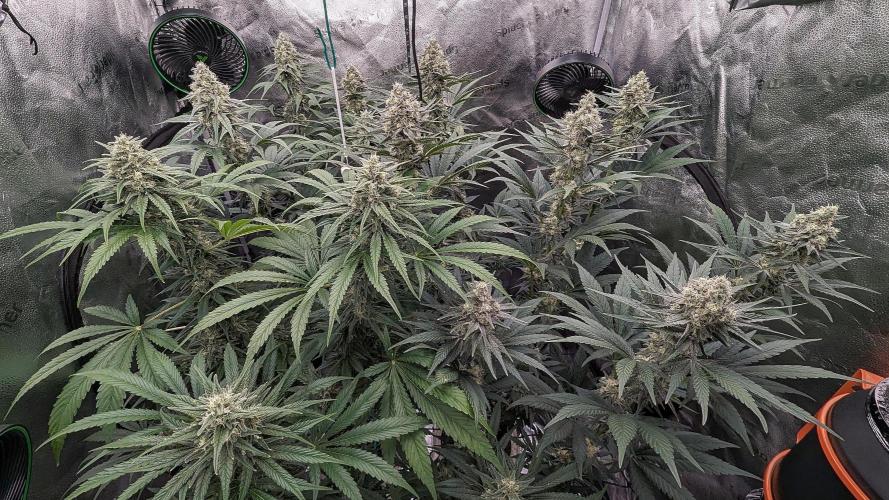
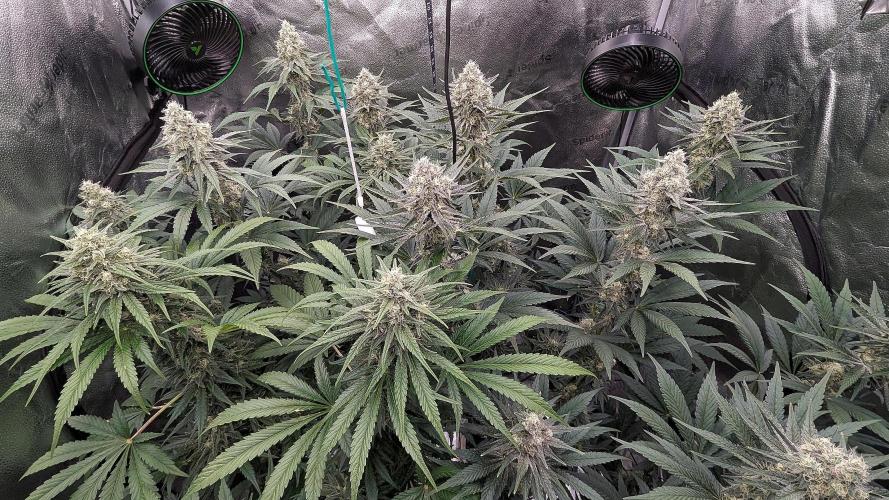
MichaelTheBarnOwl Grow #5, Entry #9: Mid Flower
Days Since Emergence: 67
Days Since Flip: 44
Days in Flower: 35
Light intensity increased modestly during the period while maintaining stable conditions across the canopy. Measurements at the beginning of the period were recorded at 975 PPFD (42 DLI) for GDP1 and 945 PPFD (42 DLI) for GDP2. By Day 67, canopy measurements increased to 1060 PPFD (46 DLI) for GDP1 and 1050 PPFD (45 DLI) for GDP2. Dimmer output remained unchanged until Day 63 post-emergence, when output increased from 70% to 75%.
UV supplementation increased from 120 minutes to 150 minutes per light cycle.
Irrigation remained stable at 1–1.25 gallons per plant every other day with input pH maintained between 6.0–6.2.
Nutrient delivery remained unchanged during this stage with plants continuing on Mid Bloom at Medium feed strength throughout the period. CAL-MAG remained at 5 mL/gal, while silica continued at 1 mL/gal once per week.
Canopy intervention became minimal compared to prior periods. No additional defoliation was performed beyond selective removal of a small number of leaves contacting or wrapping around developing flowers. Structural work shifted toward observation and support as flower mass continued accumulating.
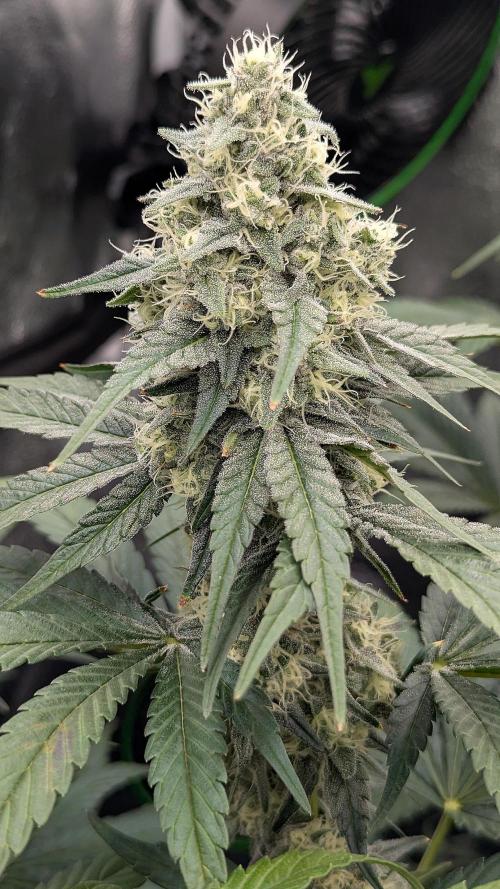
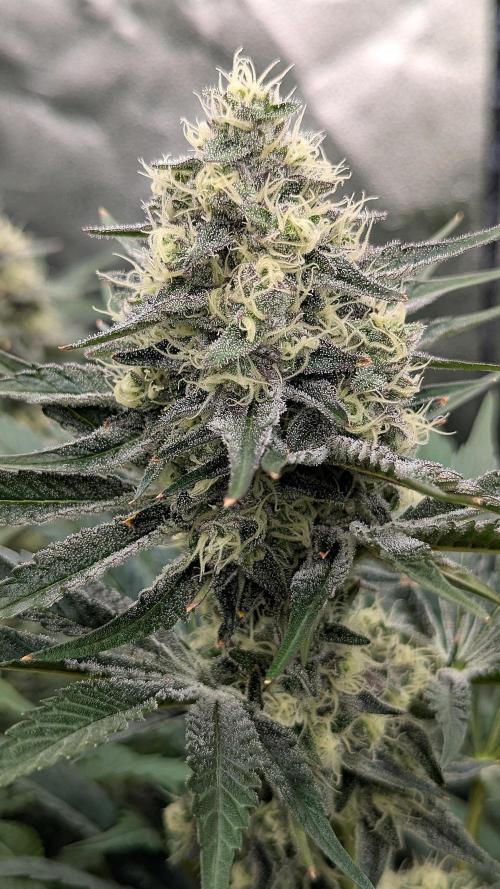
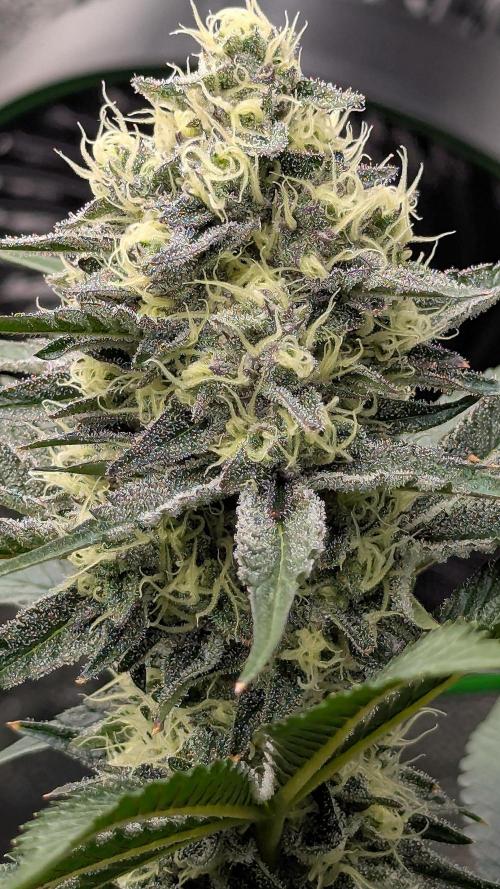
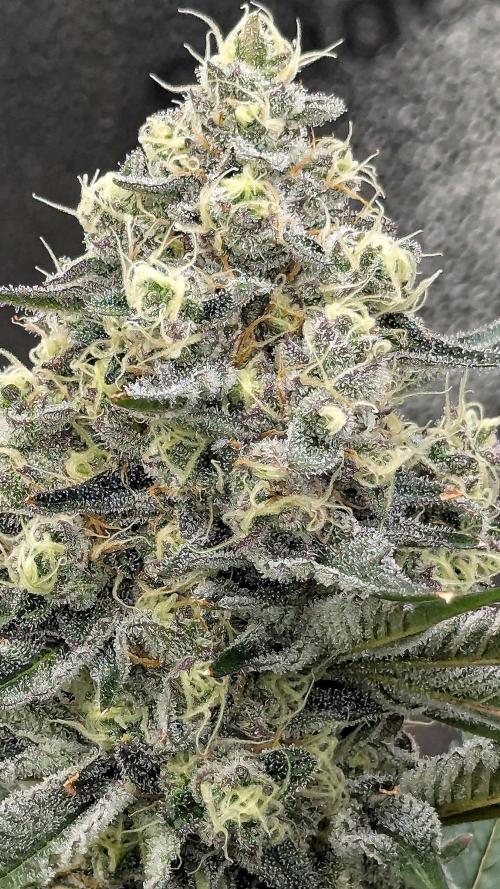
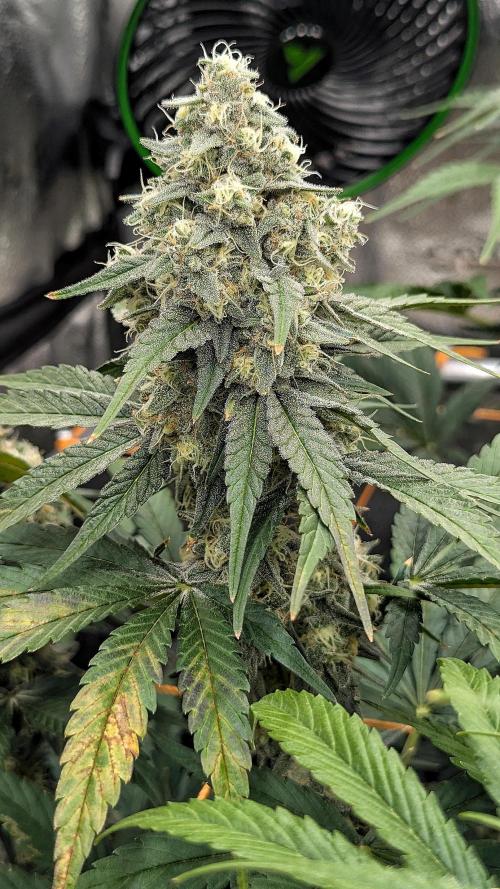
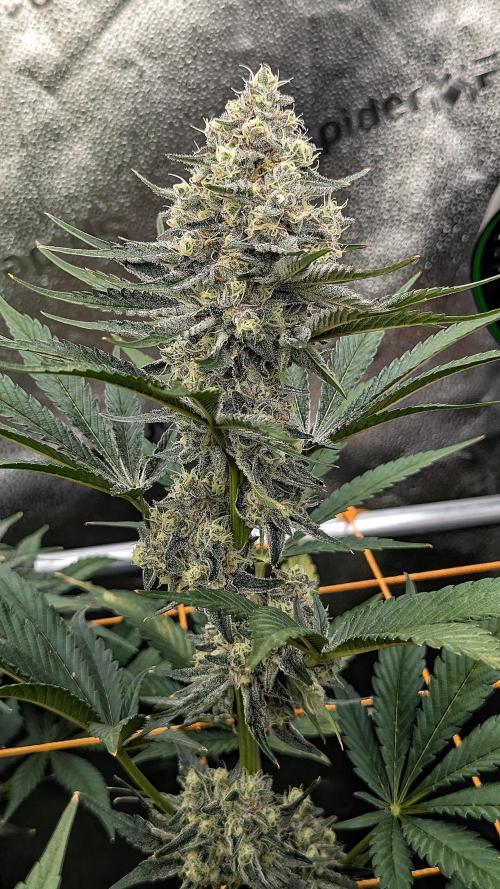
Flower mass is clearly building. Stems began leaning under accumulating bud mass.
3 likes
comments
Share
Used techniques
Defoliation
Technique
12-12
Technique
LST
Technique
10
Week 10. Flowering4mo ago
132.08 cm
Height
12 hrs
Light Schedule
25 °C
Day Air Temp
6.1
pH
Strong
Smell
900 PPM
TDS
48 %
Air Humidity
19 °C
Solution Temp
19 °C
Substrate Temp
19 °C
Night Air Temp
11.36 liters
Pot Size
1.89 liters
Watering Volume
22.86 cm
Lamp Distance
MichaelTheBarnOwl Grow #5, Entry #10: Mid Flower
Days Since Emergence: 74
Days Since Flip: 51
Days in Flower: 42
Light intensity remained unchanged throughout the period. Measurements at the beginning of the week were recorded at 1060 PPFD (46 DLI) for GDP1 and 1050 PPFD (45 DLI) for GDP2 and remained unchanged through Day 74. Dimmer output remained fixed at 75%.
UV supplementation remained unchanged at 150 minutes per light cycle.
Irrigation remained stable at 1–1.25 gallons per plant every other day with input pH maintained between 6.0–6.2.
Nutrient delivery remained unchanged during this stage with plants continuing on Mid Bloom at Medium feed strength throughout the period. CAL-MAG remained at 5 mL/gal, while silica remained at 1 mL/gal once per week.
Canopy intervention remained minimal. Only small amounts of leaf removal were performed as needed to prevent friction against developing flowers and maintain airflow through the canopy.
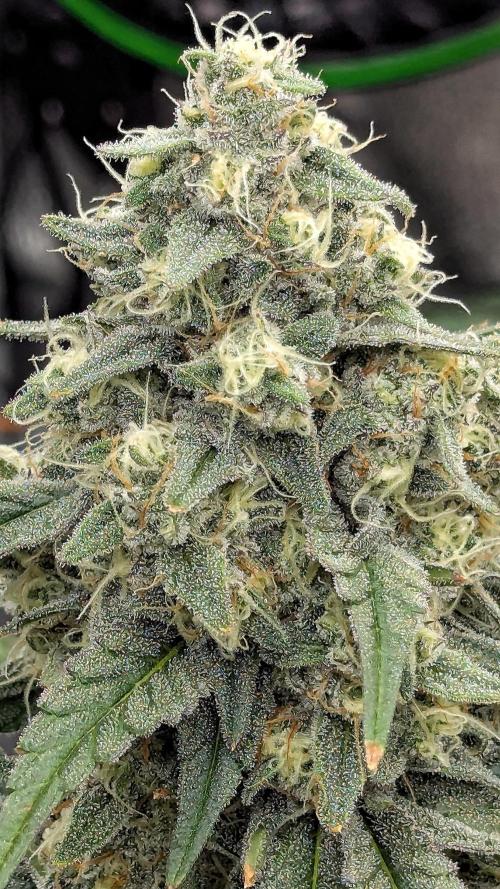
As flower mass continued accumulating, additional structural support became necessary. A secondary support screen was installed higher in the tent to assist branches that had begun leaning under increasing flower weight and branch length.
Early Trichome Analysis - Tops:
Clear: 35–40%
Cloudy: 55–60%
Amber: Trace
A wind storm caused a power outage lasting roughly one hour during the light cycle. Airflow was temporarily lost and humidity increased sharply; however, inspection following restoration showed no visible condensation on foliage, tent walls, or other surfaces and environmental conditions returned to normal without issue.
Aroma intensified further during this period with a strong berry and skunk profile becoming increasingly pronounced as flower development continued.
1 like
comments
Share
Used techniques
LST
Technique
12-12
Technique
Defoliation
Technique
11
Week 11. Flowering4mo ago
132.08 cm
Height
12 hrs
Light Schedule
24 °C
Day Air Temp
6.1
pH
Strong
Smell
800 PPM
TDS
51 %
Air Humidity
19 °C
Solution Temp
19 °C
Substrate Temp
18 °C
Night Air Temp
11.36 liters
Pot Size
1.89 liters
Watering Volume
22.86 cm
Lamp Distance
MichaelTheBarnOwl Grow #5, Entry #11: Mid-Late Flower Transition
Days Since Emergence: 84
Days Since Flip: 61
Days in Flower: 52
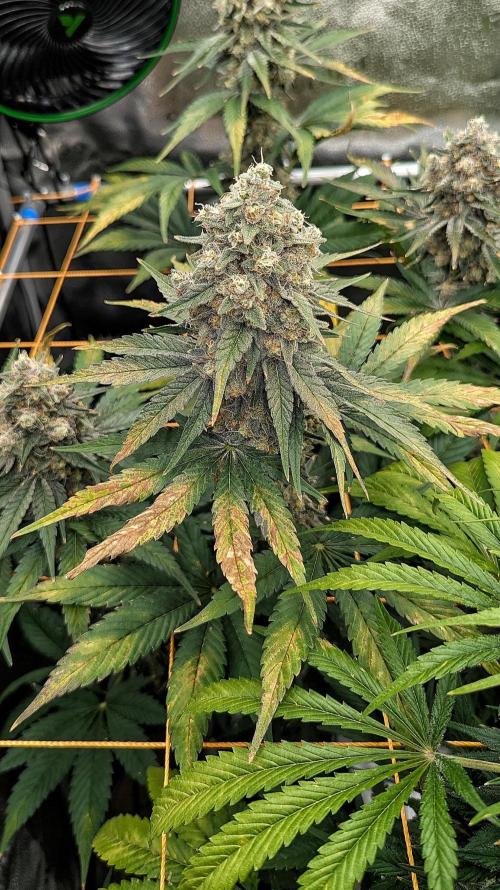
Granddaddy Purple continued progressing through mid flower during this period while showing increasingly visible signs of maturity and early senescence. Environmental conditions began shifting gradually toward late flower targets, with reductions in both light intensity and UV exposure introduced in response to advancing flower development and trichome progression.
Light intensity was reduced incrementally throughout the period in preparation for late flower. Measurements at the beginning of the period were recorded at 1050 PPFD (45 DLI) for GDP1 and 1060 PPFD (45 DLI) for GDP2. By Day 84, canopy measurements measured 925 PPFD (40 DLI) for GDP1 and 950 PPFD (42 DLI) for GDP2. Dimmer output decreased from 75% at the beginning of the period to 70% mid-period and 65% by the end of the period.
UV supplementation was reduced from 150 minutes to 90 minutes per light cycle.
Irrigation remained stable at 1-1.25 gallons per plant every other day with input pH maintained between 6.0–6.2.
Nutrient delivery remained largely unchanged through most of the period with plants receiving Mid Bloom at Medium feed strength (900 PPM) before transitioning into a 50/50 blend of Mid Bloom and Late Bloom nutrients at Medium strength (800 PPM) by period end.
CAL-MAG remained at 5 mL/gal, while silica remained at 1 mL/gal once per week.
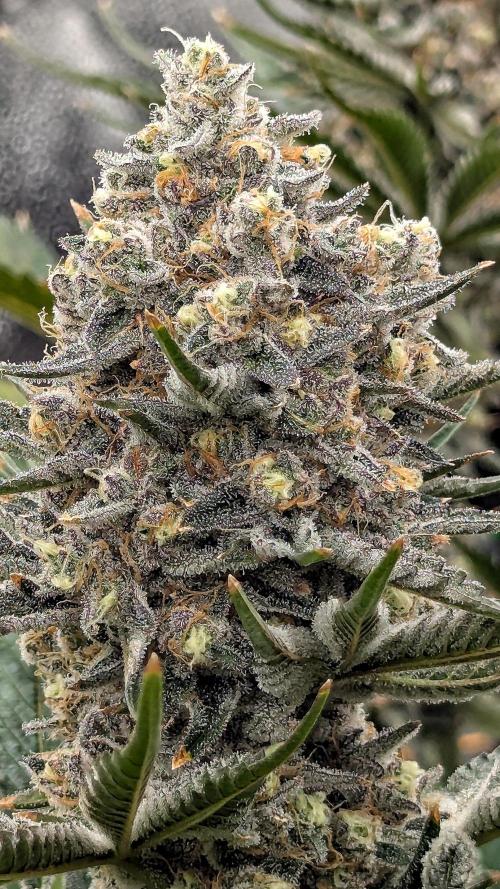
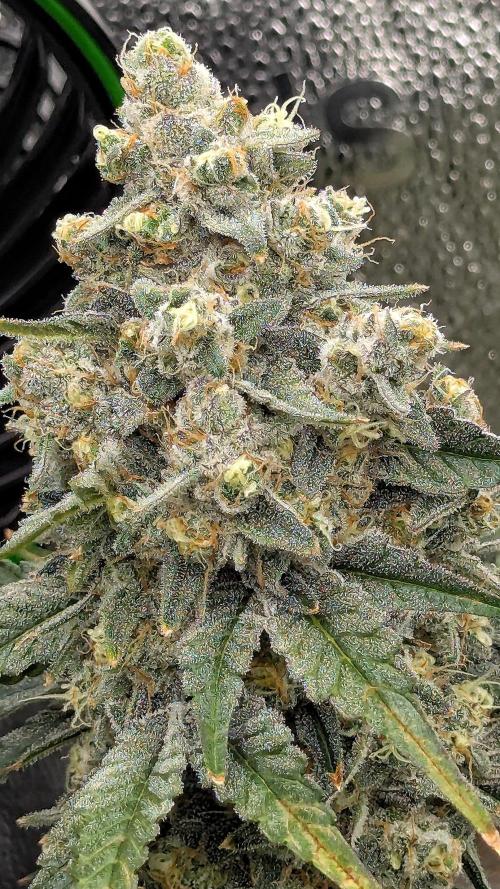
Trichome observations from upper flower sites continued supporting the transition toward late flower nutrition.
Trichome Analysis - Tops:
Clear: 15-20%
Cloudy: 75-80%
Amber: ~5%
Additional support work continued during the period as smaller branches were secured to trellis wire and primary stems to reduce stress from increasing flower weight.
Aroma continued evolving throughout the day. Evening observations produced a noticeably stronger skunk profile, while daytime aroma shifted toward a more berry-forward expression.
1 like
comments
Share
Used techniques
12-12
Technique
Defoliation
Technique
LST
Technique
12
Week 12. Flowering4mo ago
132.08 cm
Height
12 hrs
Light Schedule
24 °C
Day Air Temp
6.1
pH
Strong
Smell
640 PPM
TDS
43 %
Air Humidity
19 °C
Solution Temp
19 °C
Substrate Temp
18 °C
Night Air Temp
11.36 liters
Pot Size
1.89 liters
Watering Volume
22.86 cm
Lamp Distance
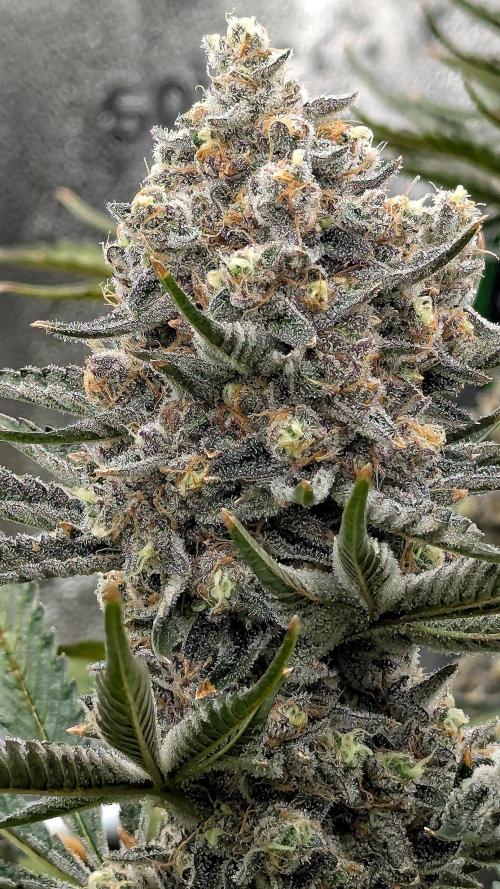
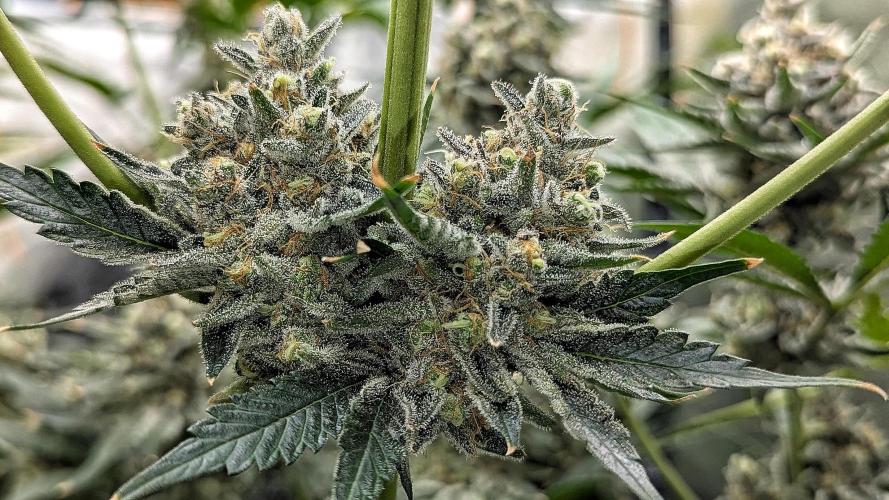
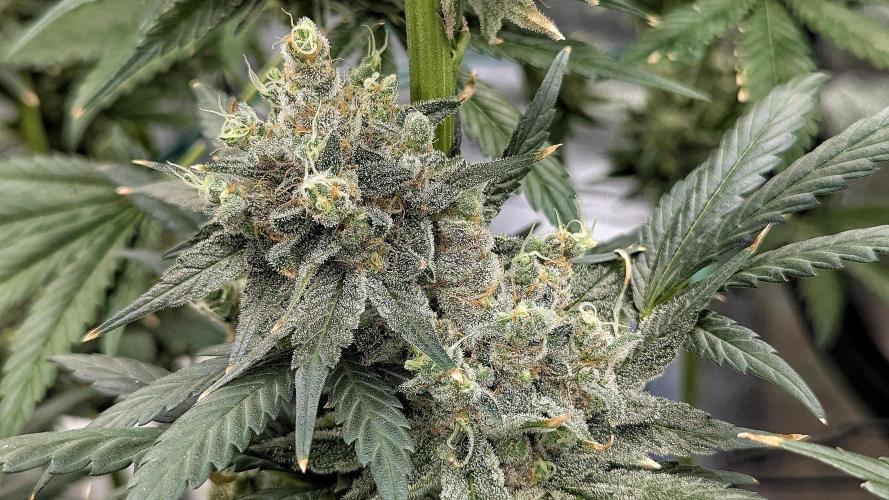
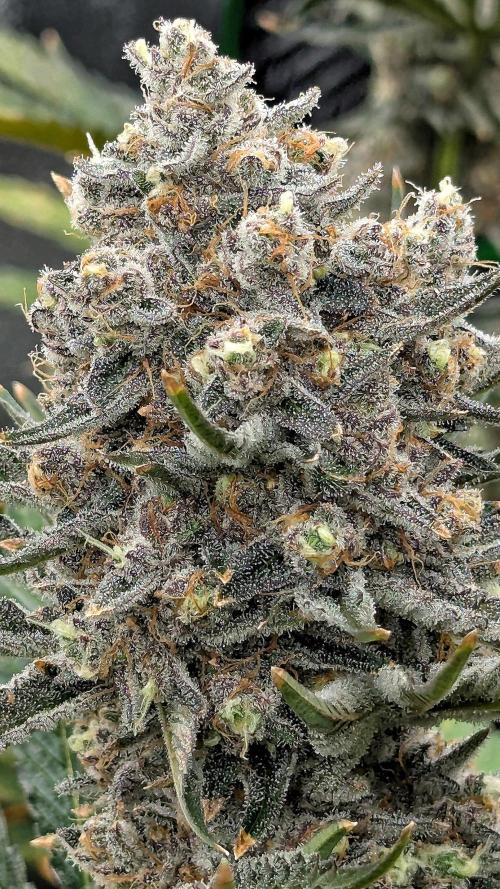
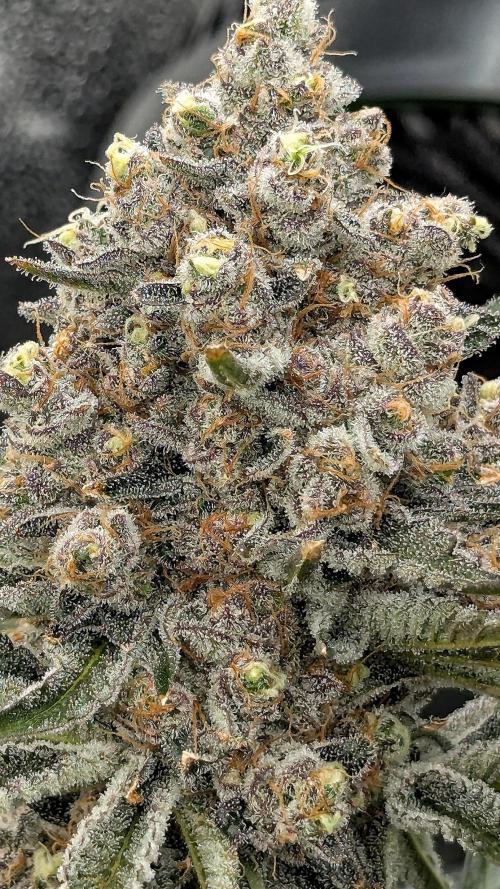
MichaelTheBarnOwl Grow #5, Entry #12: Late Flower
Days Since Emergence: 91
Days Since Flip: 68
Days in Flower: 59
Light intensity was reduced incrementally throughout the week. Measurements at the beginning of the period were recorded at 925 PPFD (40 DLI) for GDP1 and 950 PPFD (42 DLI) for GDP2. By Day 91, canopy measurements measured 825 PPFD (35 DLI) for GDP1 and 850 PPFD (37 DLI) for GDP2. Dimmer output decreased from 65% to 60%.
UV supplementation was reduced from 90 minutes to 45 minutes per light cycle.
Irrigation remained stable at 1–1.25 gallons per plant every other day with input pH maintained between 6.0–6.2.
Nutrient delivery transitioned fully toward late flower. Plants entered the period receiving a 50/50 blend of Mid Bloom and Late Bloom at Medium strength (800 PPM) before transitioning fully into Late Bloom at Medium strength (640 PPM). CAL-MAG decreased from 5 mL/gal to 3 mL/gal across the period. Silica supplementation was discontinued.
1 like
2 comments
Share
Used techniques
12-12
Technique
13
Week 13. Flowering4mo ago
132.08 cm
Height
12 hrs
Light Schedule
23 °C
Day Air Temp
6.1
pH
Strong
Smell
440 PPM
TDS
43 %
Air Humidity
19 °C
Solution Temp
19 °C
Substrate Temp
21 °C
Night Air Temp
11.36 liters
Pot Size
1.89 liters
Watering Volume
22.86 cm
Lamp Distance
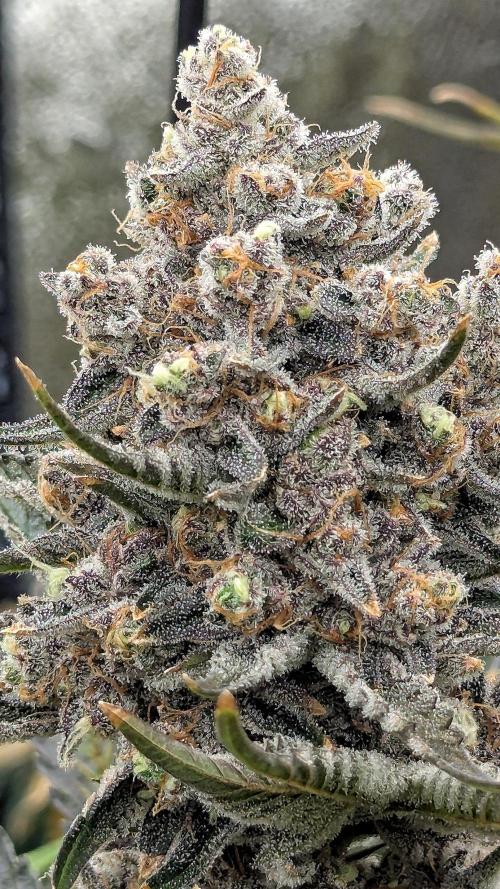
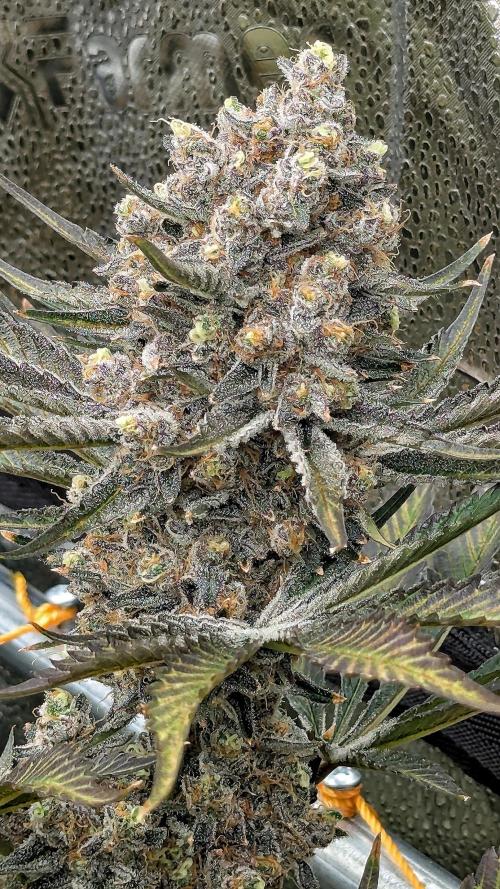
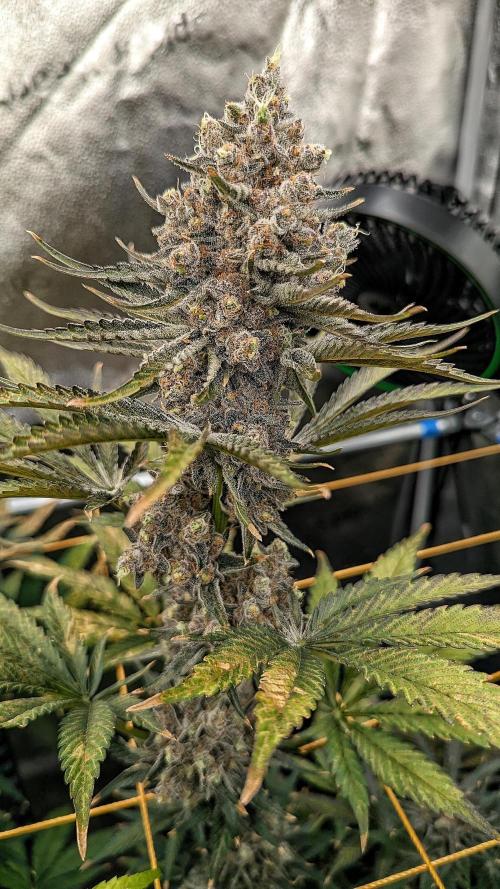
MichaelTheBarnOwl Grow #5, Entry #13: Ripening
Days Since Emergence: 96
Days Since Flip: 73
Days in Flower: 64
Light intensity continued tapering through the period. Measurements at the beginning of the period were recorded at 825 PPFD (35 DLI) for GDP1 and 850 PPFD (37 DLI) for GDP2. By Day 96, canopy measurements measured 730 PPFD (32 DLI) for GDP1 and 725 PPFD (31 DLI) for GDP2. Dimmer output decreased from 60% to 55%.
UV supplementation was reduced from 45 minutes to 30 minutes per light cycle.
Irrigation remained stable at 1–1.25 gallons per plant every other day with input pH maintained between 6.0–6.2.
Nutrient delivery transitioned from Late Bloom at Medium strength (640 PPM) into Ripening nutrients at Medium strength (440 PPM). CAL-MAG decreased from 3 mL/gal to 1 mL/gal across the period.
Trichome observations continued showing strong progression toward maturity.
Trichome Analysis - Top / Bottom Average:
Clear: 15%
Cloudy: 80%
Amber: 5%
1 like
comments
Share
Used techniques
12-12
Technique
14
Week 14. Flowering4mo ago
132.08 cm
Height
12 hrs
Light Schedule
23 °C
Day Air Temp
6.1
pH
Strong
Smell
115 PPM
TDS
41 %
Air Humidity
19 °C
Solution Temp
19 °C
Substrate Temp
20 °C
Night Air Temp
11.36 liters
Pot Size
1.89 liters
Watering Volume
22.86 cm
Lamp Distance
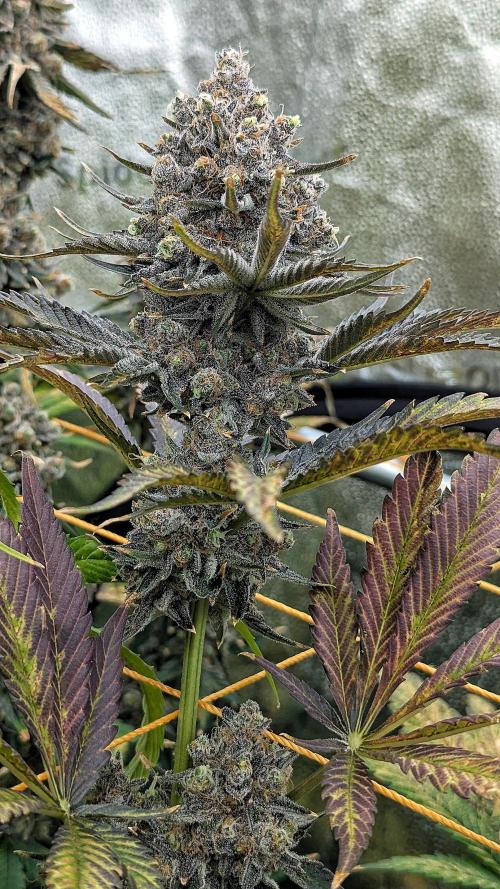
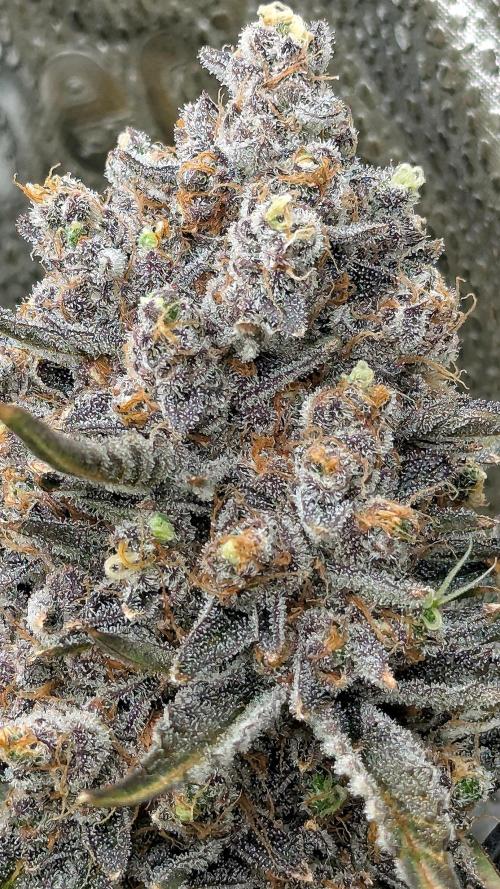
MichaelTheBarnOwl Grow #5, Entry #14: Ripening
Days Since Emergence: 105
Days Since Flip: 82
Days in Flower: 73
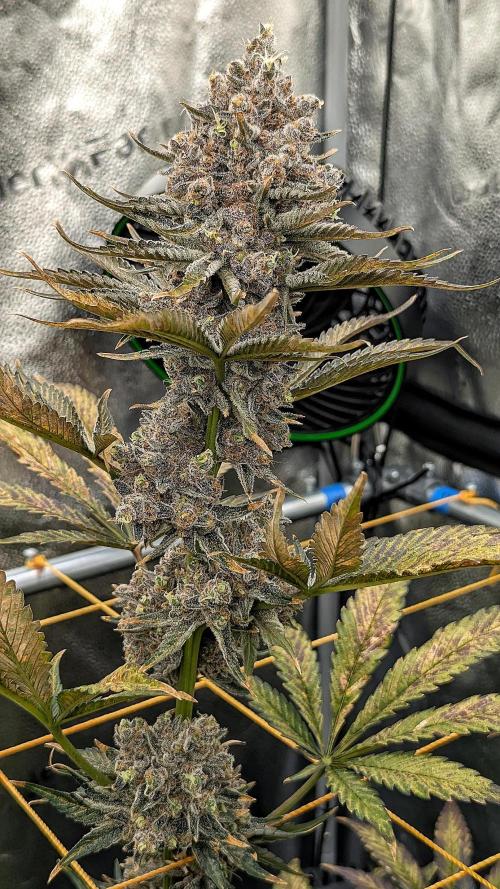
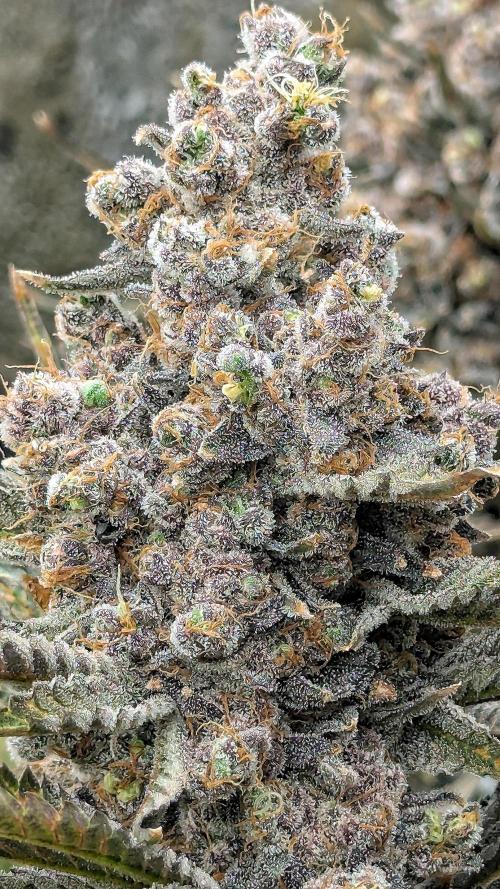
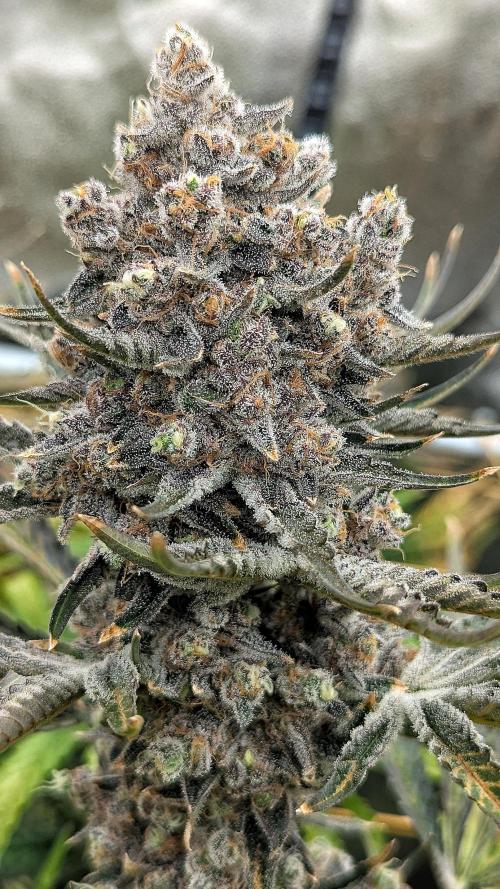
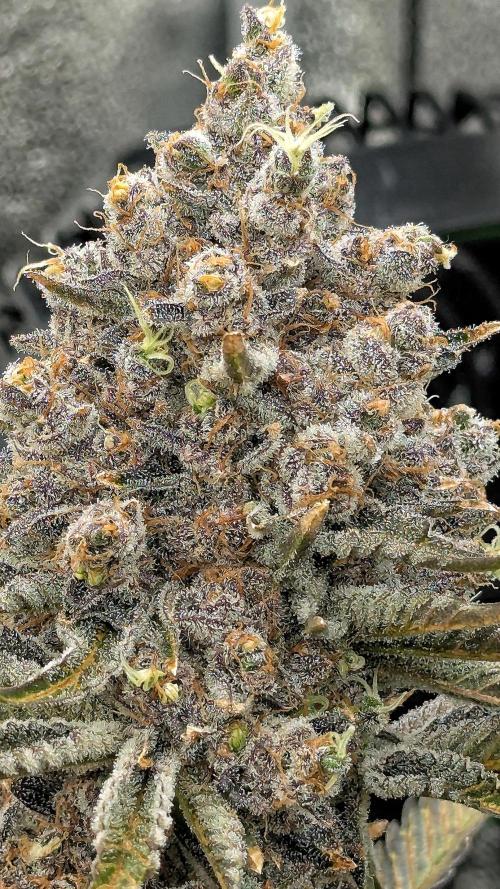
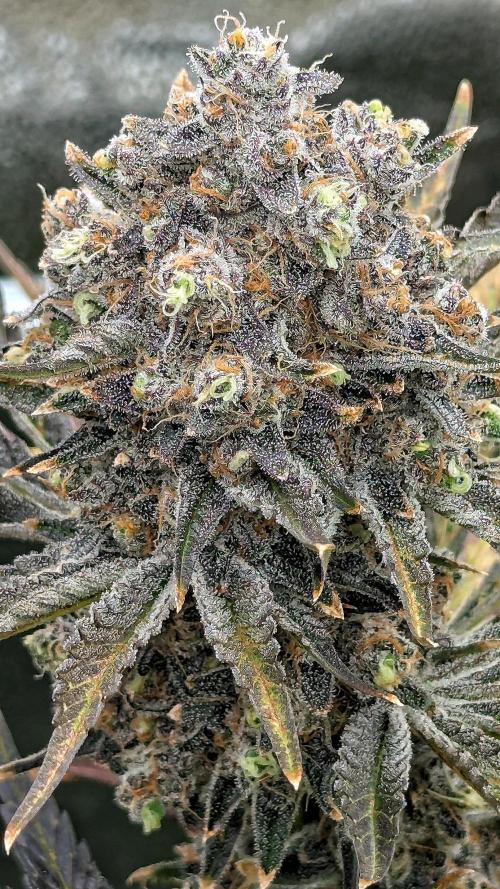
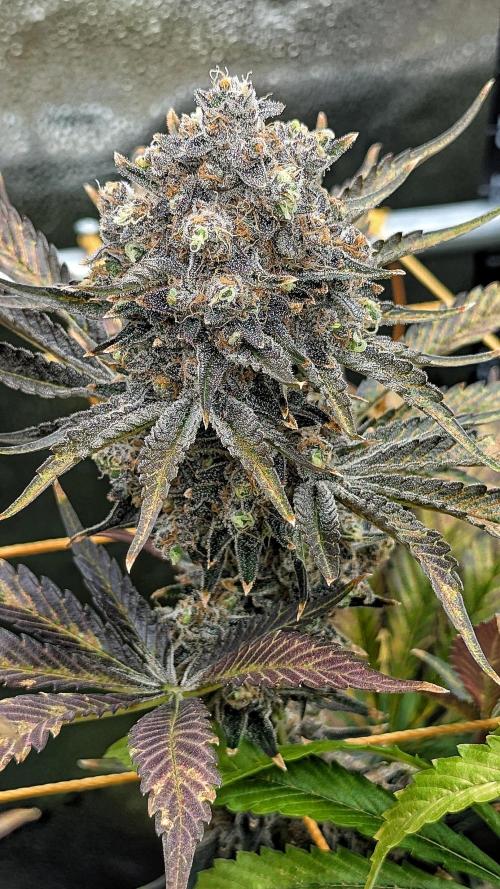
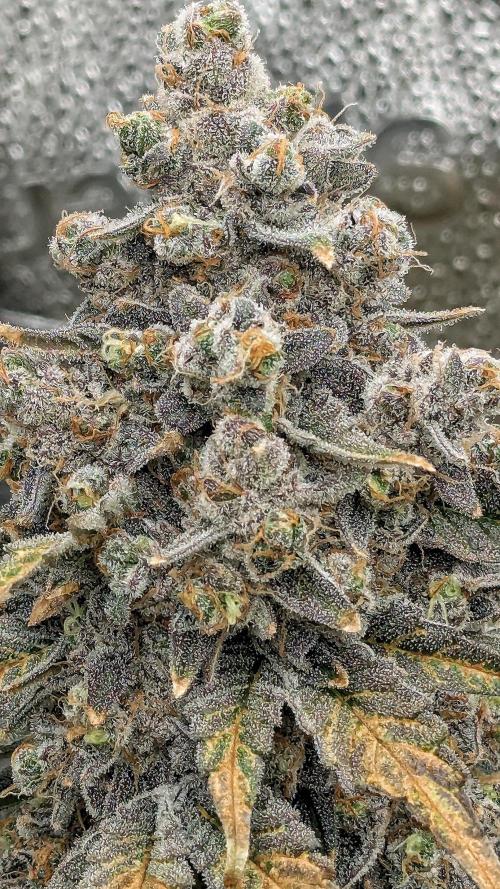
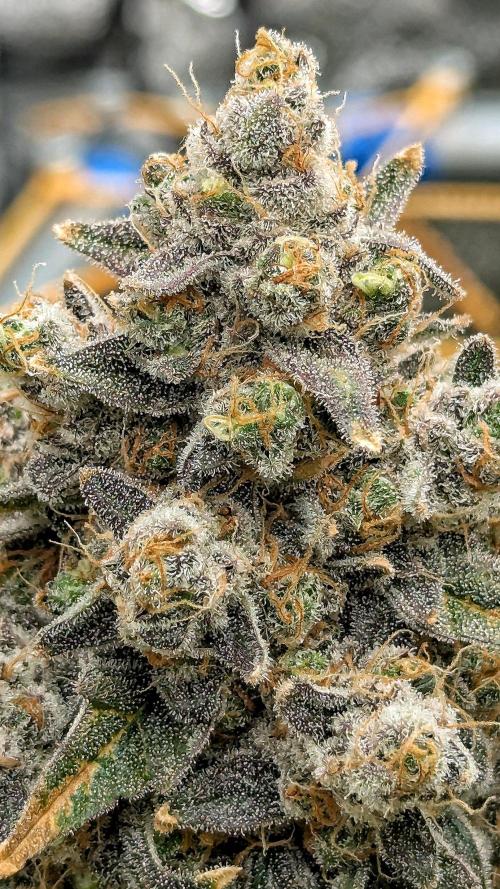
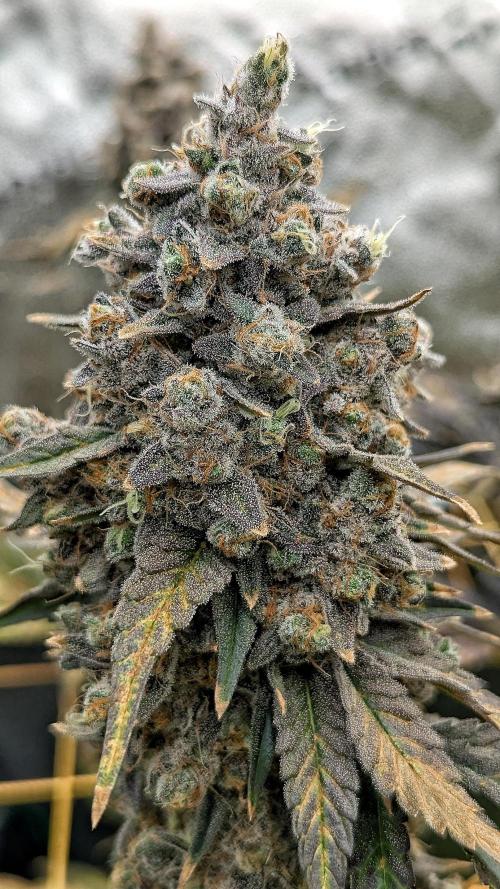
Granddaddy Purple completed its lifecycle during this period and was harvested in its entirety following final maturation assessment.
Light intensity remained unchanged through harvest with canopy measurements holding at 730 PPFD (32 DLI) for GDP1 and 725 PPFD (31 DLI) for GDP2. Dimmer output remained unchanged.
UV supplementation was reduced fully from 45 minutes to 0 minutes.
Irrigation remained stable with plants receiving plain pH-adjusted water only (115 PPM) throughout the final week. No flushing protocol was performed.
Final trichome observations at harvest were recorded as follows:
GDP1:
Top: 8% clear / 88% cloudy / 4% amber
Mid: 12% clear / 83% cloudy / 5% amber
Bottom: 20% clear / 75% cloudy / 5% amber
Overall: 13% clear / 82% cloudy / 5% amber
GDP2:
Top: 6% clear / 91% cloudy / 3% amber
Mid: 12% clear / 85% cloudy / 3% amber
Bottom: 22% clear / 73% cloudy / 5% amber
Overall: 13% clear / 83% cloudy / 4% amber
3 likes
comments
Share
Used techniques
12-12
Technique
14
Week 14. Harvest4mo ago
Happy Harvest Day!


10/10
Rated
Very impressed with the Granddaddy Purple genetics from Blimburn.
I grew two plants and both expressed extremely similarly - nearly identical height, structure, stretch behavior, and overall growth profile. Stability and consistency were excellent throughout the entire grow with no major issues or surprises.
The aroma was outstanding with strong berry notes that became more intense later in flower.
Effects were excellent as well and seemed surprisingly versatile depending on timing and amount. It could be uplifting and energetic while still helping take the edge off anxiety, but later in the evening it transitioned into a great nighttime smoke that made it easy to relax and wind down.
Overall, a very enjoyable cultivar to grow and one I’d absolutely consider running again.
Show more
Translate
Spent 93 days
Ger Veg Flo Har
175.8 g
Bud wet weight per plant
2
Plants
40.64 m²
Grow Room size
Normal
Difficulty
Height
Day air temperature
Air humidity
PPM
PH
Light schedule
Solution temperature
Night air temperature
Substrate temperature
Pot size
Lamp distance
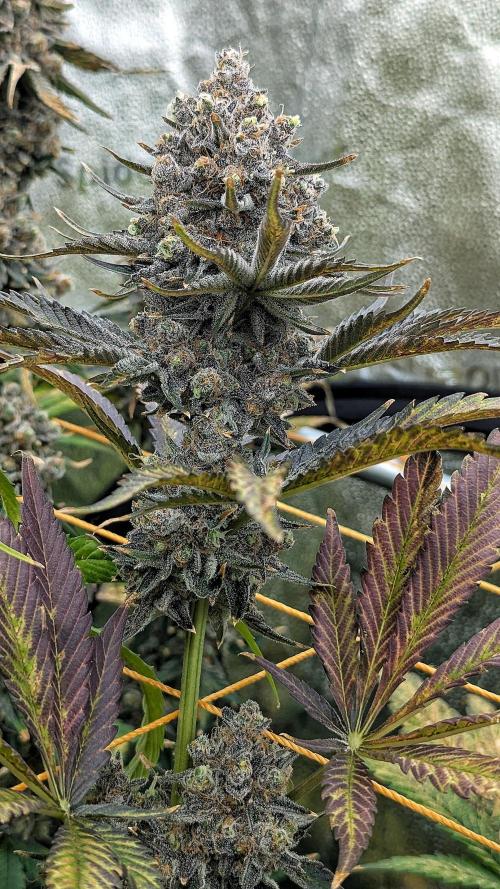
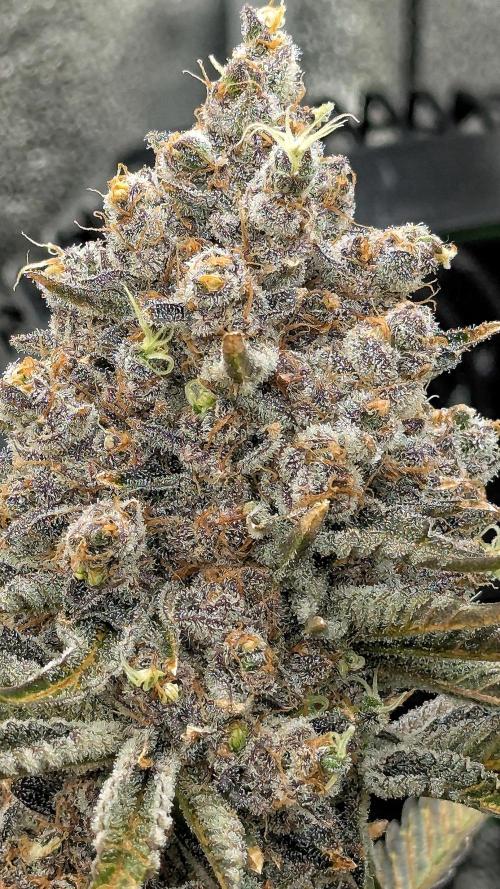
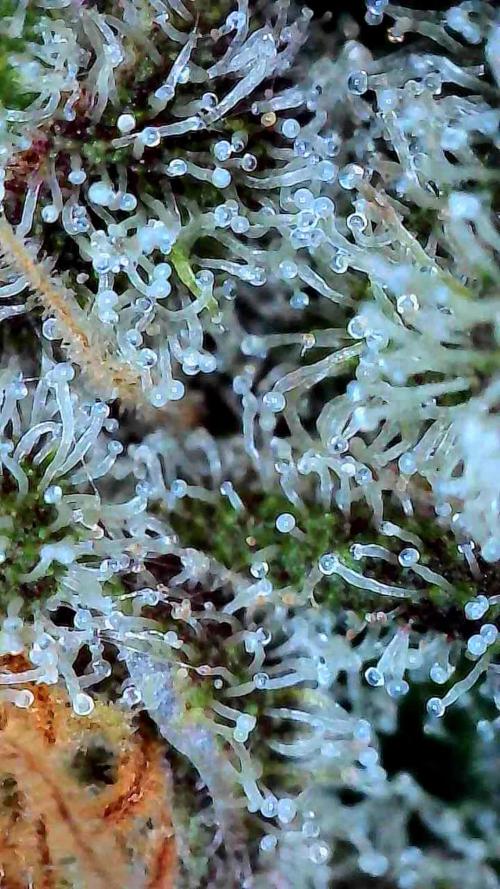
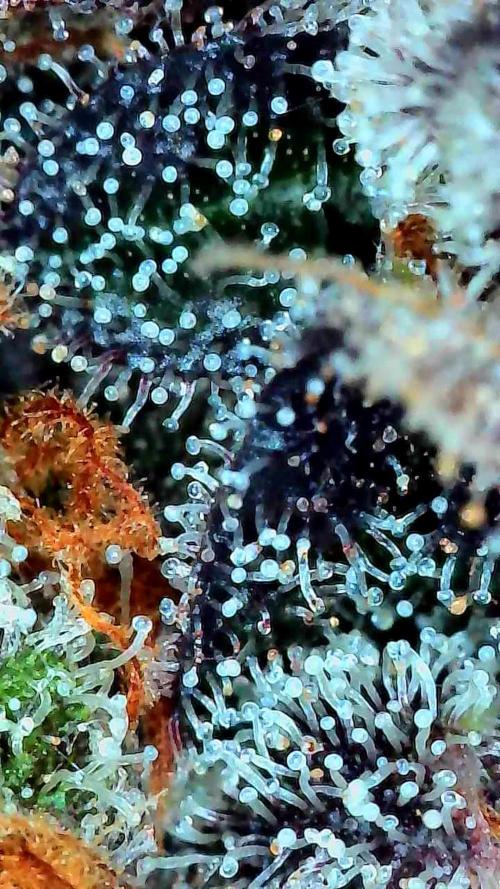
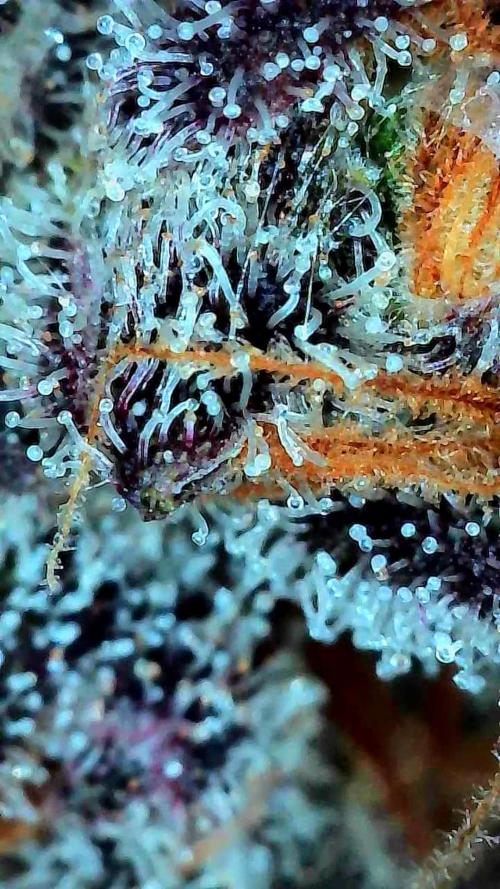
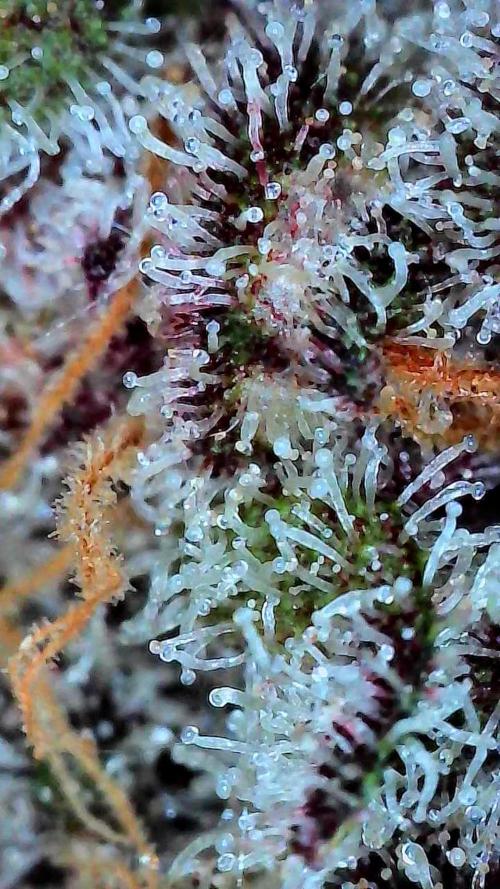
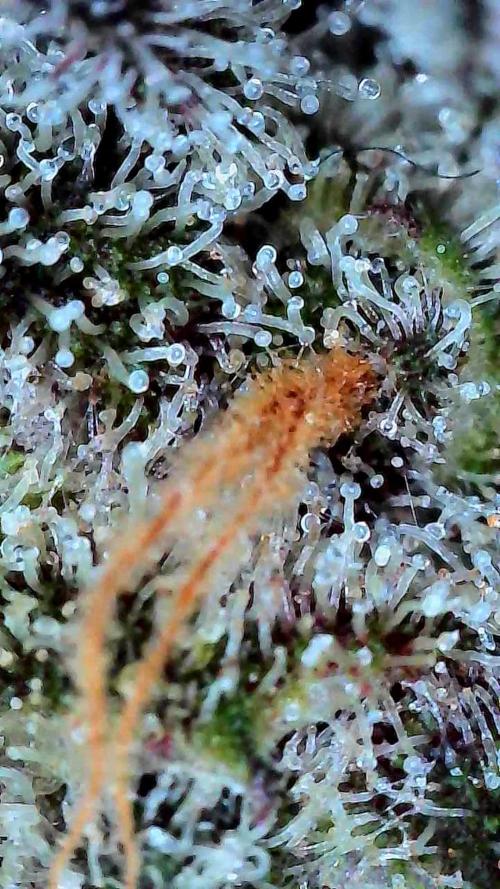
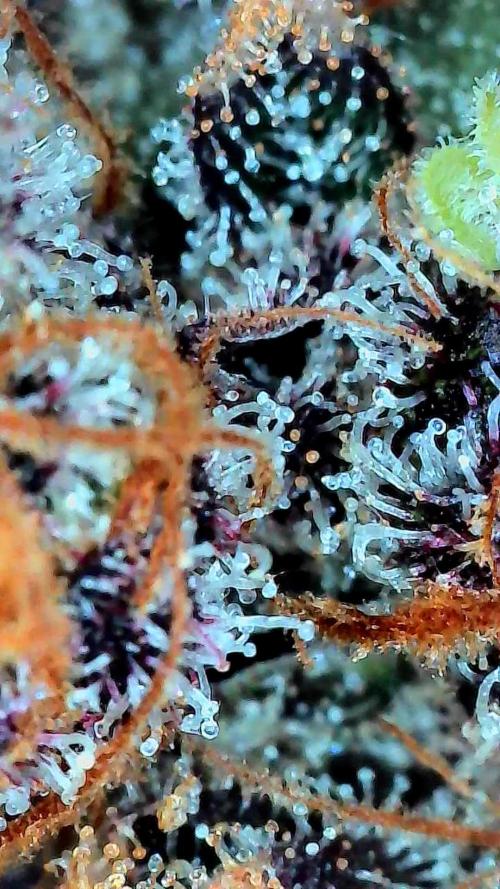
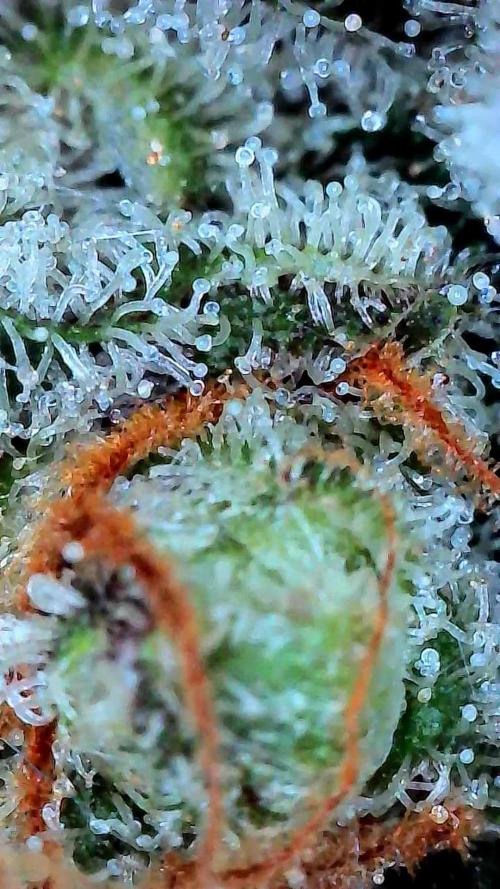
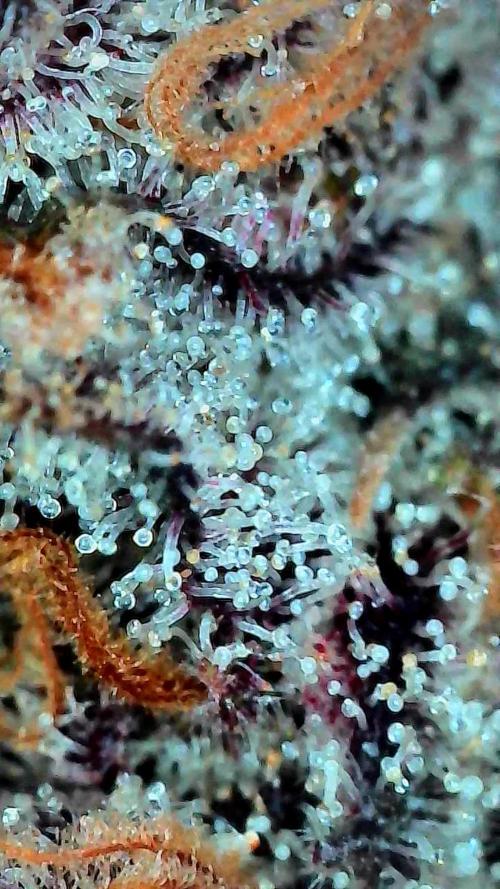
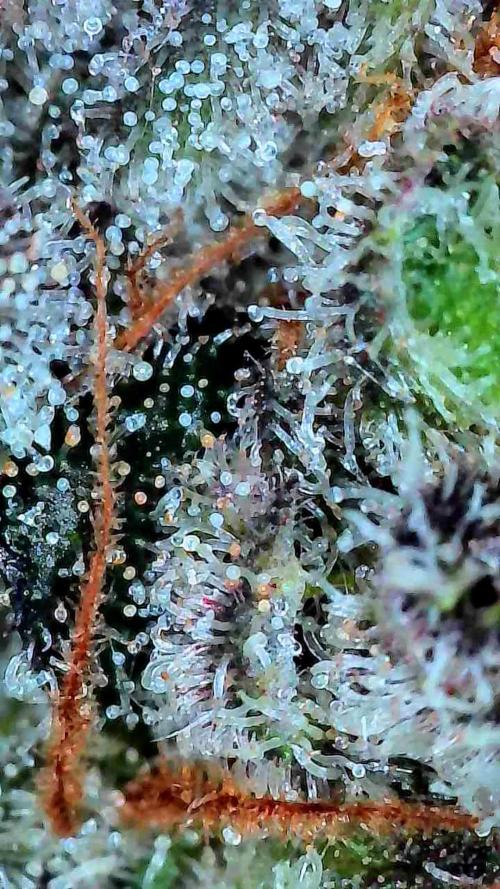
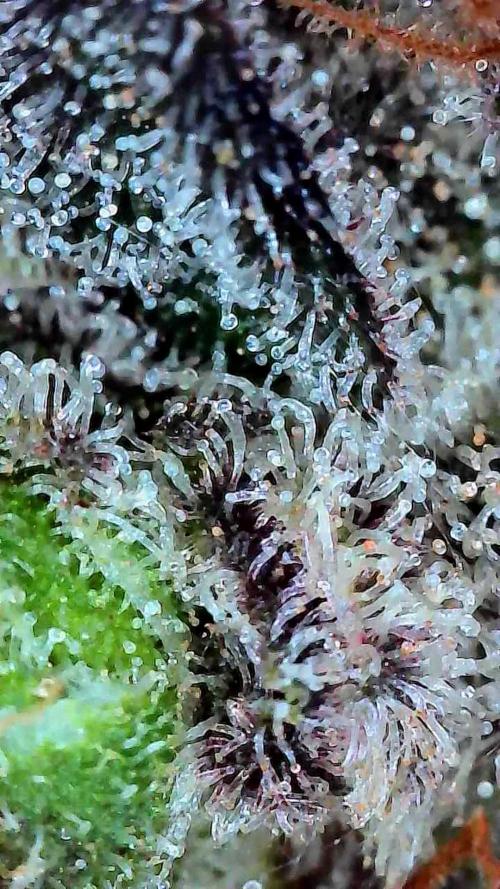
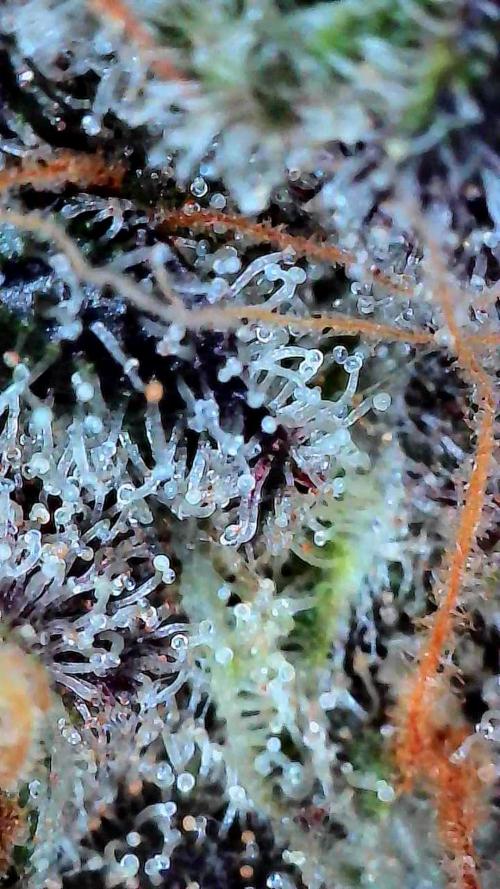
MichaelTheBarnOwl Grow #5, Entry #15: Harvest and Cure
Days Since Emergence: 105
Days Since Flip: 82
Days in Flower: 73
Final trichome observations at harvest were recorded as follows:
GDP1:
Top: 8% clear / 88% cloudy / 4% amber
Mid: 12% clear / 83% cloudy / 5% amber
Bottom: 20% clear / 75% cloudy / 5% amber
Overall: 13% clear / 82% cloudy / 5% amber
GDP2:
Top: 6% clear / 91% cloudy / 3% amber
Mid: 12% clear / 85% cloudy / 3% amber
Bottom: 22% clear / 73% cloudy / 5% amber
Overall: 13% clear / 83% cloudy / 4% amber
Harvest was performed methodically from the bottom up to maintain structural stability. Branches were removed individually, lightly rough trimmed, and buds reduced to manageable size prior to drying.
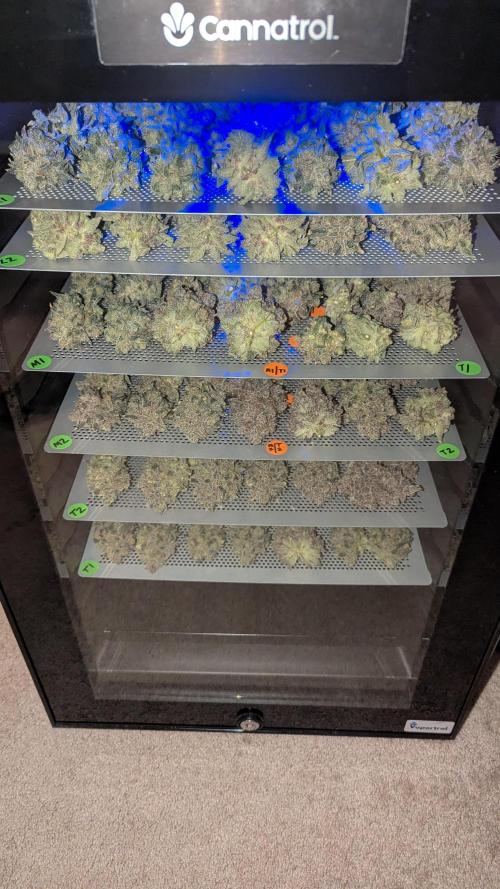
Flowers were processed in a Cannatrol using a 4-day dry, 4-day cure, and 4-day hold before being transferred to Grove bags with 62% two-way humidity packs for 3 weeks and later moved into mason jars for long-term storage.
Final Dry Weight: 351.6 grams
Lifecycle Summary - Granddaddy Purple:
Emergence: 2 days from seed
Seedling Stage: 9 days
Vegetative Stage: 13 days
Topped: Day 19 post-emergence
Flip to Flower: Day 24 post-emergence
Transition Period: 8 days post-flip
Flowering Stage: 73 days
Total Time (Seed to Harvest): 105 days
7 likes
3 comments
Share
Equipment Reviews


4 comments
Sort by
popularity
popularity
newest
oldest

ThomFoolery commented4mo ago
Nice start!
like 1

MichaelTheBarnOwl commented4mo ago
@ThomFoolery Thank you! I'm working on bringing over my previous grow diaries. I didn't know about this website when I started tracking my grows but I really like the layout!
likes
ThomFoolery commented4mo ago
@MichaelTheBarnOwl, it's easy enough to figure out. Grow guide is nice too but in an app format. And not free, but a lot more options. A lot more
like 1
MichaelTheBarnOwl commented4mo ago
@ThomFoolery, thank you for the info on that!
likes

DrGruen commented4mo ago
gute Reise😎
like 1

the end.
Enjoying this diary? Follow for more updates!

Prefer the old Diary view?
Go back to the old Diary view