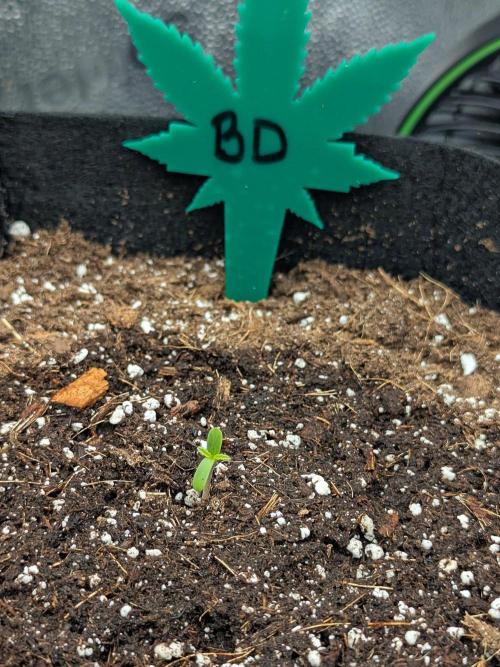
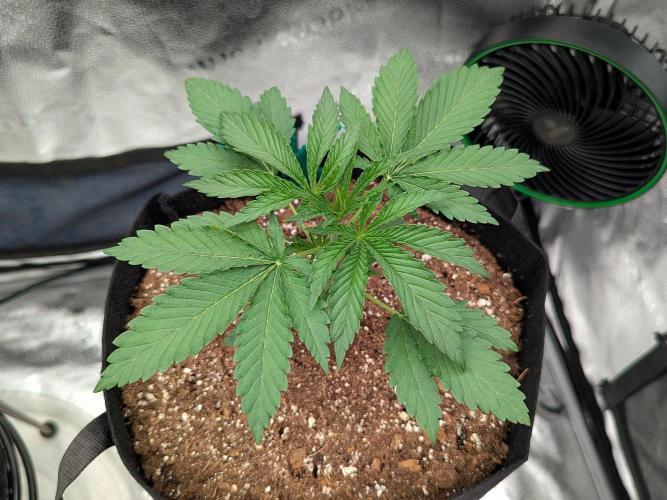
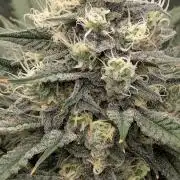
MichaelTheBarnOwl Seeds were soaked in distilled water for 14 hours prior to planting directly into the final containers and growing medium. Water temperature was maintained in the mid-to-upper 70s°F during the soak.
The medium was lightly pre-moistened before planting.
The light was positioned approximately 23 inches above the soil surface at planting, providing 305 PPFD.
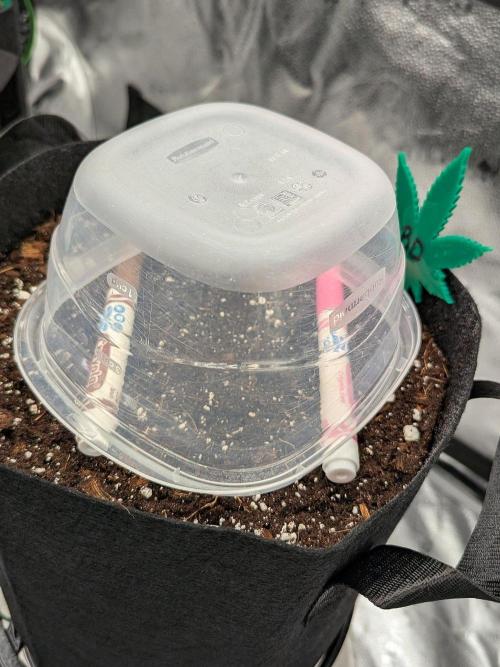
Humidity domes were used during germination with a small gap maintained for airflow and were removed immediately following emergence.
Seedling emergence occurred approximately 48–60 hours after planting.
4 likes
1 comment
Share
Used method
Glass Of Water
Germination Method
1
Week 1. Vegetation
2mo ago
1/2
5.72 cm
Height
18 hrs
Light Schedule
29 °C
Day Air Temp
6.0
pH
No Smell
Smell
485 PPM
TDS
59 %
Air Humidity
21 °C
Solution Temp
28 °C
Substrate Temp
27 °C
Night Air Temp
11.4 liters
Pot Size
0.5 liters
Watering Volume
50.17 cm
Lamp Distance
MichaelTheBarnOwl Blue Dream
Grow #7, Entry #2
Days Since Emergence: 8
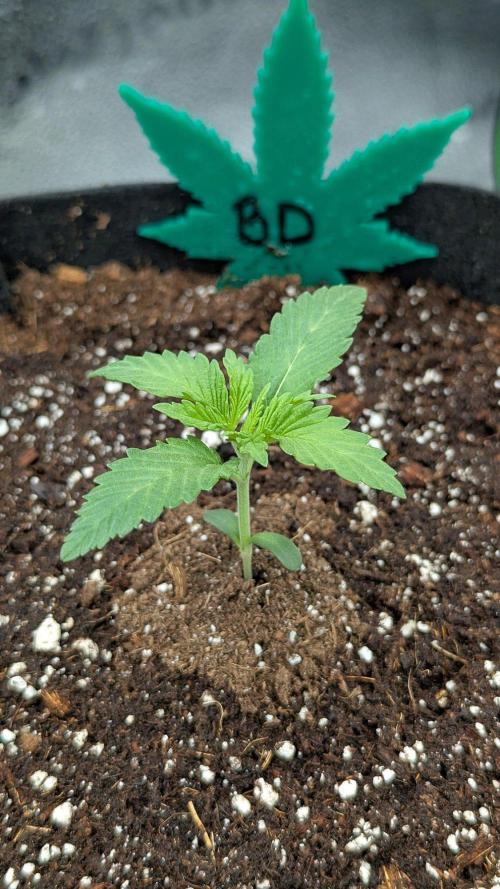
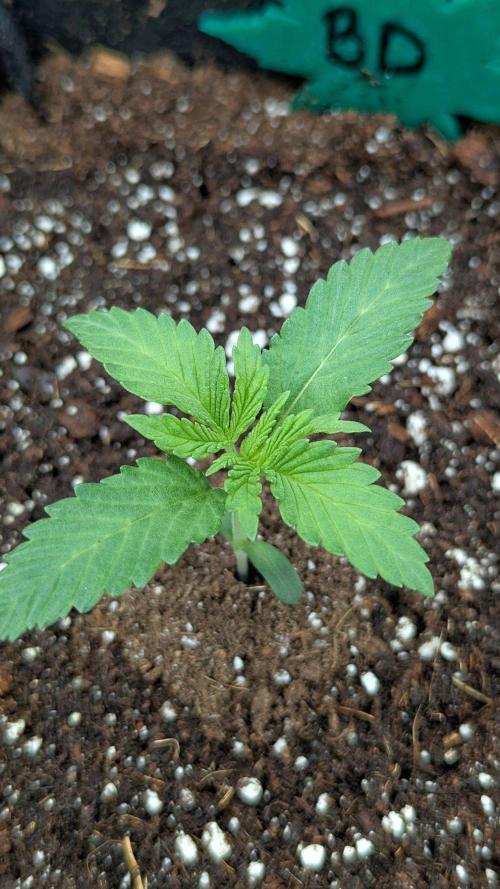
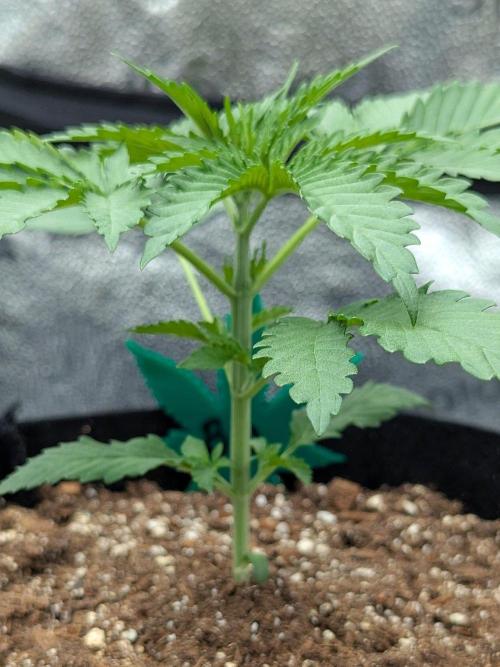
The first week focused on seedling establishment and the transition into early vegetative growth.
Light intensity increased from approximately 305 PPFD to 395 PPFD over the course of the week. Light height remained unchanged, and UVA has not yet been introduced.
Water volume increased from 0.25 L to 0.5 L per plant, while nutrient concentration increased from approximately 340 PPM to 485 PPM. Cal-Mag increased from 2 mL/gal to 3 mL/gal, and silica was introduced at 1 mL/gal by the end of the week.
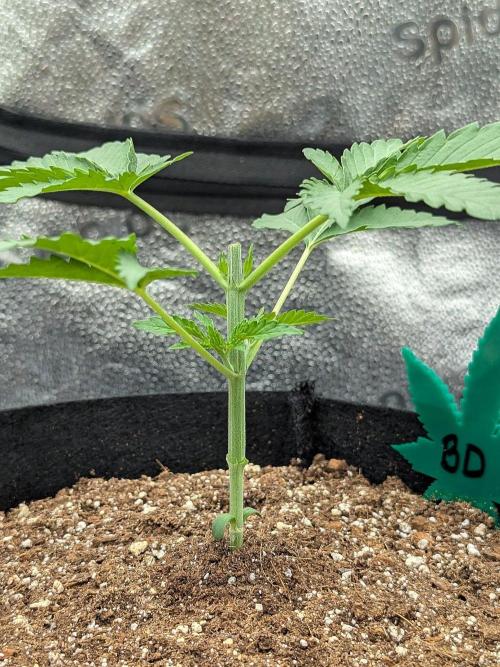
Plant height increased from approximately 0.50 inches to 2.25 inches. Approximately 1–1.5 inches of additional medium was added around the stem midway through the week to provide support and encourage rooting below the cotyledons. The final height measurement was taken after a portion of the stem had been buried and therefore understates total vertical growth during the week.
The first node is established, the second is expanding, and the third is emerging. Growth rate is increasing as the plant transitions into early vegetative growth.
Environmental conditions remained warmer and drier than optimal for this stage, but no associated issues were observed.
The first topping is expected within the next week, with a second topping planned during the following week prior to the transition to 12/12.
4 likes
comments
Share
2
Week 2. Vegetation
2mo ago
1/4
16.51 cm
Height
18 hrs
Light Schedule
32 °C
Day Air Temp
6.0
pH
No Smell
Smell
640 PPM
TDS
59 %
Air Humidity
21 °C
Solution Temp
28 °C
Substrate Temp
29 °C
Night Air Temp
11.4 liters
Pot Size
1 liters
Watering Volume
39.37 cm
Lamp Distance
MichaelTheBarnOwl Blue Dream
Grow #7, Entry #3
Days Since Emergence: 15
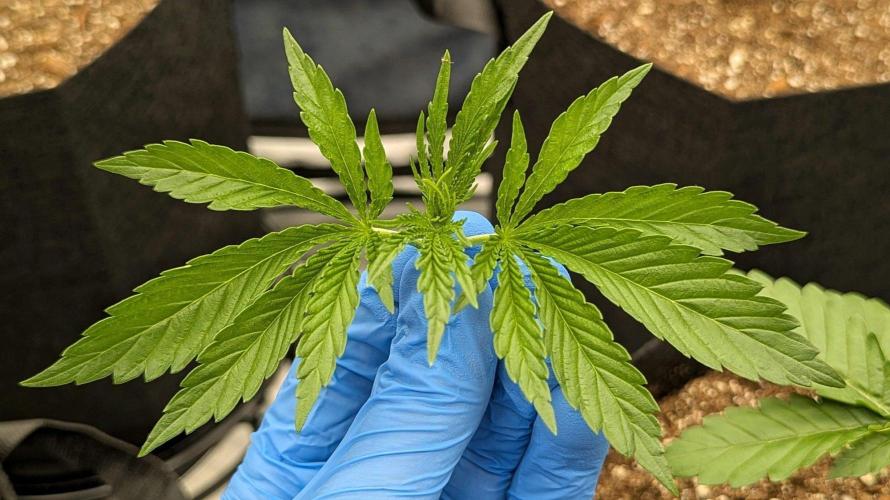
Height increased from 2.25" to 6.50" during the week. Vegetative growth accelerated with continued node and lateral branch development.
Light intensity was increased once from the mid-50% range to the upper-50% range without changing light height. PPFD increased from 395 to 450. UV was introduced early in the week at 15 minutes per light cycle.
Watering continued every other day, with volume increasing from 0.5 L to 1 L per watering. The nutrient mixture transitioned from early veg to mid veg. Cal-Mag increased from 3 to 4 mL/gal, and silica was introduced at 1 mL/gal every other watering. Nutrient concentration increased from 500 PPM to 640 PPM.
Pots were turned 90° every day.
Prior to training, 4 full nodes were established with the 5th developing. On Day 14 post-emergence, the plant was topped above node 3 and node 1 was removed, leaving two sets of branches and four primary growth tips.
The four branches will now be allowed to develop nodes before each is topped, creating eight main terminals. The second topping is expected within 3–4 days, followed by the transition to 12/12 in 1–1.5 weeks.
Temperatures remained warm, resulting in higher VPD than ideal, but growth remained healthy.
1 like
comments
Share
Used techniques
Topping
Technique
3
Week 3. Vegetation
1d ago
27.31 cm
Height
12 hrs
Light Schedule
28 °C
Day Air Temp
6.1
pH
No Smell
Smell
710 PPM
TDS
55 %
Air Humidity
21 °C
Solution Temp
25 °C
Substrate Temp
22 °C
Night Air Temp
11.4 liters
Pot Size
0.75 liters
Watering Volume
27.94 cm
Lamp Distance
MichaelTheBarnOwl Grow #7, Entry #4
Days Since Emergence: 23
Days Since Flip to 12/12: 1
Height increased from 6.5" to 10.75" during the period. Vegetative growth continued, with lateral branches developing following the first topping. Light intensity increased naturally as the canopy approached the light, with PPFD rising from 450 to 520 without adjusting the dimmer. Canopy distance from the light narrowed to 11" by the end of the period. UV-A exposure remained at 15 minutes per light cycle.
Watering continued every other day, with volume increasing from 1 L to 1.5 L per watering. Nutrients transitioned from mid veg (640 PPM) to late growth (710 PPM) by the end of the period. Cal-Mag remained at 4 mL/gal, while silica increased from 1 to 1.5 mL/gal every other feeding.
The second topping was performed on Day 18 post-emergence, following a three-day recovery period after the first topping. In the second topping, each of the four branches was topped above its first growth node, creating what will become eight primary growth tips originating from two sets of branches.
Low-stress training was introduced and adjusted daily to encourage lateral growth and maintain an even canopy. Following the second topping, a four-day recovery period was allowed before transitioning to 12/12 on Day 23 post-emergence.
The plant entered the flowering light cycle at approximately 10.75" tall, with eight primary growth tips established.
2 likes
comments
Share
Used techniques
LST
Technique
Topping
Technique
12-12
Technique
4
Week 4. Flowering
1d ago
31.75 cm
Height
12 hrs
Light Schedule
28 °C
Day Air Temp
6.1
pH
No Smell
Smell
915 PPM
TDS
55 %
Air Humidity
21 °C
Solution Temp
25 °C
Substrate Temp
22 °C
Night Air Temp
11.4 liters
Pot Size
1 liters
Watering Volume
43.18 cm
Lamp Distance
MichaelTheBarnOwl Grow #7, Entry #5
Days Since Emergence: 27
Days Since Flip to 12/12: 5
Height increased from 10.75" to 12.50" during the period despite continued aggressive low-stress training. Lateral growth continued as the plant adjusted to the flowering light cycle.
Light intensity was increased by adjusting the dimmer from 60% to 65%. Light intensity increased from 520 PPFD to 560 PPFD. Fixture height was raised several times to maintain a canopy distance of approximately 16–20" as the plants developed. UV-A exposure increased from 15 to 30 minutes per light cycle.
Watering continued every other day, with volume increasing from 1.5 L to 2 L per watering. Late Growth nutrients continued, transitioning from Light strength (710 PPM) to Aggressive strength (915 PPM). Cal-Mag increased from 4 to 5 mL/gal, while silica increased from 1.5 to 2 mL/gal every other feeding.
Low-stress training continued throughout the period, with regular adjustments to maintain an even canopy and encourage lateral branch development.
3 likes
comments
Share
Used techniques
LST
Technique
12-12
Technique
5
Week 5. Flowering
1d ago
1/2
68.58 cm
Height
12 hrs
Light Schedule
24 °C
Day Air Temp
6.1
pH
Normal
Smell
905 PPM
TDS
55 %
Air Humidity
21 °C
Solution Temp
21 °C
Substrate Temp
18 °C
Night Air Temp
11.4 liters
Pot Size
2 liters
Watering Volume
38.1 cm
Lamp Distance
MichaelTheBarnOwl Grow #7, Entry #6
Days Since Emergence: 36
Days Since Flip to 12/12: 14
Height increased from 12.50" to 27.00" during the period as the plant entered a period of rapid flowering stretch. Pistils emerged, accompanied by a significant increase in aroma. Low-stress training continued extensively to spread the eight primary branches, maintain canopy uniformity, and improve light penetration into the lower and middle canopy. Targeted defoliation was performed to improve airflow across and through the canopy.
Light intensity increased from 560 to 895 PPFD, with the dimmer raised from 65% to 85%. Fixture height was adjusted to maintain a canopy distance of approximately 12–18". UV-A exposure increased from 30 to 45 minutes per light cycle.
Watering continued every other day, with volume increasing from 2 L to approximately 1 gallon per watering. The nutrient program began with Late Growth at Aggressive strength (915 PPM), then gradually transitioned toward Early Bloom, progressing from a 75/25 Late Growth/Early Bloom mixture to a 50/50 mixture by the end of the period (905 PPM). Cal-Mag was maintained at 5 mL/gal, while silica continued at 2 mL/gal every other feeding.
Blue Dream was removed from its elevated plant stand to reduce the canopy height difference between the two plants as stretching accelerated.
By Day 14 following the transition to 12/12, the plant had reached approximately 27.00" tall, representing a 14.50" increase during the period. Flower initiation was evident, with particularly vigorous vertical development despite extensive training.
1 like
comments
Share
Used techniques
LST
Technique
Defoliation
Technique
12-12
Technique
6
Week 6. Flowering
1d ago
1/2
82.55 cm
Height
12 hrs
Light Schedule
24 °C
Day Air Temp
6.1
pH
Normal
Smell
875 PPM
TDS
55 %
Air Humidity
21 °C
Solution Temp
21 °C
Substrate Temp
17 °C
Night Air Temp
11.4 liters
Pot Size
2 liters
Watering Volume
38.1 cm
Lamp Distance
MichaelTheBarnOwl Grow #7, Entry #7
Days Since Emergence: 42
Days Since Flip to 12/12: 20
Height increased from 27.00" to 32.50" during the period as flowering stretch continued. Low-stress training was performed frequently to spread the primary branches, maintain canopy uniformity, and improve light penetration into the middle and lower canopy. Targeted defoliation continued to improve airflow and reduce overcrowding.
Light intensity reached 955 PPFD at the upper canopy and 525 PPFD at the middle canopy. The fixture dimmer remained unchanged at 85%, while fixture height was adjusted periodically to accommodate continued vertical growth. UV-A exposure increased from 45 to 60 minutes per light cycle.
Watering continued at approximately 1 gallon per feeding, with volume increased to 1.25 gallons every third feeding to achieve approximately 10–15% runoff. Nutrients continued transitioning from Late Growth to Early Bloom at Aggressive strength, with concentration decreasing from 905 to 875 PPM. Cal-Mag remained at 5 mL/gal, while silica continued at 2 mL/gal every other feeding.
2 likes
comments
Share
Used techniques
LST
Technique
12-12
Technique
Defoliation
Technique
7
Week 7. Flowering
19h ago
1/2
91.44 cm
Height
12 hrs
Light Schedule
24 °C
Day Air Temp
6.1
pH
Strong
Smell
850 PPM
TDS
55 %
Air Humidity
20 °C
Solution Temp
21 °C
Substrate Temp
18 °C
Night Air Temp
11.4 liters
Pot Size
2 liters
Watering Volume
30.48 cm
Lamp Distance
MichaelTheBarnOwl Grow #7, Entry #8
Days Since Emergence: 49
Days Since Flip to 12/12: 27
Flowering stretch concluded during the period, with final plant height reaching 36.00". Height at the transition to 12/12 was 10.75", resulting in a 3.35x stretch factor despite extensive low-stress training. Vertical growth slowed and eventually stopped as the plant progressed into midflower.
The light dimmer remained unchanged at 85%, although fixture height was adjusted several times as vertical growth concluded. Once stretching stopped, canopy distance was established at 10–12" from the upper flowers, with middle and lower flowers positioned 22–25" from the fixture. Light intensity readings across the upper canopy ranged from 570 to 1,010 PPFD, with 350 PPFD recorded in the middle canopy. UV-A exposure increased from 60 to 75 minutes per light cycle.
Watering continued at 1 gallon every other day, with periodic increases to 1.5 gallons every third or fourth watering to produce runoff and help prevent excess salt accumulation. Nutrients transitioned from Early Bloom at Aggressive strength (875 PPM) to Mid Bloom at Aggressive strength (850 PPM). Cal-Mag remained at 5 mL/gal. Silica supplementation was tapered from 1.5 to 1 mL/gal every other feeding at the beginning of midflower, then reduced to once weekly.
Low-stress training continued to improve light distribution across the canopy and expose developing flower sites. Selective defoliation was performed to improve airflow, eliminate abrasion points, and increase light penetration.
Despite inspections every day to every other day, several concealed pollen sacs and male flowers were discovered within the lowest third of the plant. Most were removed before releasing pollen, although a few released visible pollen when disturbed during removal. Following the discovery of multiple male reproductive structures, flower sites within the lowest quarter of the plant were removed to improve visibility. The plant will continue to be monitored for additional intersex expression and potential signs of pollination.
likes
comments
Share
Used techniques
LST
Technique
12-12
Technique
Defoliation
Technique
8
Week 8. Flowering
18h ago
91.44 cm
Height
12 hrs
Light Schedule
24 °C
Day Air Temp
6.1
pH
Strong
Smell
850 PPM
TDS
55 %
Air Humidity
20 °C
Solution Temp
21 °C
Substrate Temp
17 °C
Night Air Temp
11.4 liters
Pot Size
2 liters
Watering Volume
30.48 cm
Lamp Distance
MichaelTheBarnOwl Grow #7, Entry #9
Days Since Emergence: 52
Days Since Flip to 12/12: 32
Flower development continued through mid-flower, accompanied by a strong citrus and herbal aroma within the growing environment. Targeted defoliation was performed where foliage was overcrowded or making contact with adjacent growth, helping improve airflow and minimize abrasion.
Light intensity across the upper canopy ranged from 590 to 965 PPFD, with 430 PPFD recorded at the middle and lower flower sites. Canopy distance from the fixture remained at 10–12". UV-A exposure was maintained at 75 minutes per light cycle.
Watering continued every other day at 1 gallon per feeding. Mid-Bloom nutrients remained at Aggressive strength (850 PPM), with Cal-Mag maintained at 5 mL/gal and silica supplementation continuing at 1 mL/gal once weekly.
An Inkbird temperature controller was installed to operate a radiant heater in anticipation of cooler nighttime conditions. The controller was configured with a 72°F setpoint and a 2°F differential to reduce temperature drops during lights-off periods.
Air circulation was improved by replacing two oscillating fans that had stopped oscillating. The updated configuration consisted of three oscillating fans in the upper canopy, one oscillating fan in the middle canopy, and two stationary fans providing cross-breezes through the lower canopy.
Regular inspections for intersex expression continued following the discovery and removal of male reproductive structures during the preceding period. No additional pollen sacs or male flowers were discovered or removed during this entry.
1 like
comments
Share
Used techniques
LST
Technique
Defoliation
Technique
12-12
Technique
9
Week 9. Flowering
18h ago
91.44 cm
Height
12 hrs
Light Schedule
24 °C
Day Air Temp
6.1
pH
Strong
Smell
815 PPM
TDS
53 %
Air Humidity
20 °C
Solution Temp
21 °C
Substrate Temp
21 °C
Night Air Temp
11.4 liters
Pot Size
2 liters
Watering Volume
30.48 cm
Lamp Distance
MichaelTheBarnOwl Grow #7, Entry #10
Days Since Emergence: 65
Days Since Flip to 12/12: 43
Flower development continued through mid-flower as the nutrient program began transitioning toward late bloom. Aroma intensified substantially during the period, becoming among the strongest experienced in previous grows. The tent developed an exceptionally pungent, skunk-forward aroma with pronounced citrus and herbal notes resembling sage, thyme, and crushed lavender. The overall aromatic profile likely reflects the interaction of two contrasting varieties sharing the same environment: Lemon Tree, associated with sharp citrus, diesel, and skunk characteristics, and Blue Dream, associated with sweeter berry, fruity, floral, and herbal notes. The combined aroma was exceptionally loud, making it difficult to distinguish the individual contributions of each plant.
Light intensity remained unchanged, with upper canopy readings ranging from 590 to 965 PPFD and approximately 430 PPFD recorded at middle and lower flower sites. UV-A exposure increased from 75 minutes to a peak of 105 minutes per light cycle before gradually decreasing toward 60 minutes by Day 65.
Mid-Bloom nutrients at Aggressive strength (850 PPM) continued through most of the period before a gradual transition toward Late Bloom began. The transition followed a five-stage blending schedule of Mid-Bloom/Late-Bloom ratios: 100/0, 75/25, 50/50, 25/75, and 0/100. By Day 65, the nutrient mixture had reached a 50/50 blend at approximately 815 PPM.
Cal-Mag supplementation remained at 5 mL/gal. Silica continued at 1 mL/gal once weekly through Day 62 since emergence, after which supplementation was discontinued.
1 like
comments
Share
Used techniques
LST
Technique
Defoliation
Technique
12-12
Technique
10
Week 10. Flowering
7h ago
1/5
91.44 cm
Height
12 hrs
Light Schedule
25 °C
Day Air Temp
6.2
pH
Strong
Smell
740 PPM
TDS
48 %
Air Humidity
18 °C
Solution Temp
23 °C
Substrate Temp
21 °C
Night Air Temp
11.4 liters
Pot Size
2 liters
Watering Volume
30.48 cm
Lamp Distance
MichaelTheBarnOwl Grow #7, Entry #11
Days Since Emergence: 70
Days Since Flip to 12/12: 48
The transition from Mid-Bloom to Late-Bloom nutrients was completed during the period, with nutrient concentration decreasing from 815 PPM to 740 PPM at Aggressive strength. Cal-Mag supplementation remained at 5 mL/gal.
UV-A exposure was maintained at 60 minutes per light cycle. The fixture dimmer remained at 85% through most of the period before being reduced to 75% on Day 70.
Prior to the light intensity reduction, upper canopy readings ranged from 840 to 990 PPFD, with 430 PPFD recorded at the middle and lower flower sites. Following the reduction to 75%, upper canopy readings decreased to 805–940 PPFD, with 400 PPFD at the middle canopy.
Beginning on Day 67, Blue Dream began exhibiting visible signs consistent with the onset of late-flower senescence. Lower foliage began developing purple, red, and orange coloration, while leaves higher in the canopy showed early signs of purpling.