


Likes
Comments
Share


@Wackytabacky_420
Follow
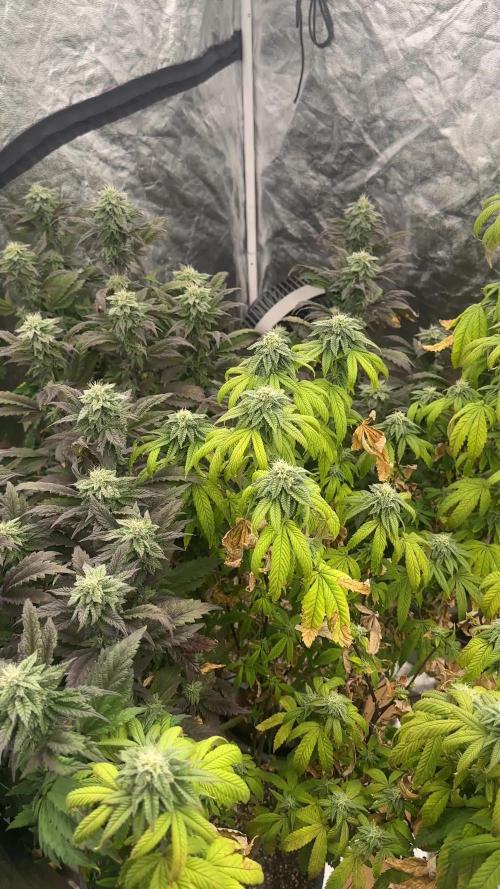
Hey fellow growers another week in the books! Not a lot going on this week except some leaf plucking! Total plant life is 77 days old( 10 days over Northern lights supposed to be harvest time). I'm in my harvest window now for pineapple auto. Neither plant is close to ready! Both could prob use another 2-3 weeks! I will start my 2 week flush today on these ladies. As I need this tent for drying. I would try to stretch these ladies a little longer but as fast as they are yellowing I'm not sure if I can even make it through the two week flush! These girls have started defoliating themselves and I'm running out of fan leaves. Thanks to my rookie mistake of defoliating all my fan leaves off both plants some weeks back! All the issues these plants have are my mistakes. Like I just found out that changing from blurple lights to white lights in flower could have stressed these ladies🤯💩🤬! Now that I think back and look back my girls were doing well up till light change! Live and learn is what this has become for me. Not a pro and prob won't ever be until I can figure out this nutrient feeding. I can look on all these different sites and everyone will tell you a different amount to feed and still have yet to find one single feeding suggestion chart for an auto flower using my nutrients. Well as u know from last week I did a 10 gal flush to correct dry pockets in my soil. It helped! Both plants will now hold a gal of Solution instead of a 1/4-1/2 gal. It didn't improve the yellowing of either plant. I was told to stop giving nitrogen as the plants themselves are passing maturity and are nearing the end of their lifespan. I thought when u stressed an autoflower it just set u back a week so u had to grow a week longer. What I was told is an autoflower is genetically designed to go a certain length of time and once it passes that time that's it! So losing a week to stress is a week lost of 🌸. Can anyone reassure me that this is the case because it is important to me to know that I'm putting out accurate info to others. So enough rambling...
10/27/21
3ml calmag
2ml micro
4ml bloom
1/2ml ph down
Ph 6.38
631ppm
Solution temp 70.4°F
10/31/21
Will begin flushing today!
So while the site was down for 2 almost 3 days🤬 I got bored and started an Instagram page for my grows! Now keep in mind I'm no instagrammer! I mainly did it so when I need to show someone pics of my plants it's faster on there than here!
I also became an affiliate for Viparspectra!! So excited to be a member of their team as I love my Viparspectra vs1000 lights! But if your in the market for grow items check them out for your grow needs! Here you can use these to help save u 💰! Who doesn't like to save💰?!
🤑 https://partners.viparspectra.com/?ref=Wackytabacky420 🤑
Or coupon code: Wackytabacky420
Well guys I'm ready to start flushing these ladies! Always work to be done in the garden of Wackytabacky420! I would like to give a shout out this week to 🌟legendaryseedthumb🌟 for helping and answering some of my questions while site was down this week. Thanks growers and viewer's for stopping by! Till next week Best of luck and Happy Growing!😎🌱💚💪💪 Don't forget to smash that 👎button!

Likes
14
Share


@dekss
Follow
*LOS FERTILIZANTES SON HACIA LAS OTRAS PLANTAS NO TERMINADAS NO LA QUE SE CORTO ESA SOLO AGUA*
*reemplazo bio bloom por monster bloom como los dos son PK la planta se sobrefertiliza*
semana 10 y se va de corte la primera
contento de terminar mi primer diario entero en esta plataforma
cogollos llenos de resina muy contento con la producción en 68 días desde germinación
*la planta en total creo un poco menos que el doble de lo que se corto pero fui sacándoselo de a poco antes*
ahora solo queda esperar secar
y las otras que vienen en camino
70.85 gramos en humedo contando tallos y una hoja de viento por rama
espero marcar unos 15 en solo cogollos y ya secos
LST en las dos ramas principales de una de las que viene siguiente muy compacta
en lo personal me gustan los cogollos con casi nada de hoja (de esto dependerá cuanto raspe en la garganta)
por lo que el humo entra sin dejar ninguna molestia muy suave y sativo

Likes
19
Share

@Flavors
Follow
Another week in the books! 📅 Red Hot Violet is still thriving — stacking leaves and holding strong 💪💚. The Amaretto Sour is still tucked in beside her, and while I haven’t separated them yet, both are adapting to the shared space surprisingly well 🤞🌿.Growth is steady, color is deep, and the canopy looks lush 🍃✨. I’m keeping an eye on root competition, but so far they’re coexisting like stubborn siblings sharing the same room 😅.Nutrients and watering schedule are locked in 🔒💧, and I’m continuing to prep for that upcoming flip to flower soon 🌸🚀.Patience and balance — that’s the theme this week. 🙏🌱

Likes
14
Share


@artems
Follow
1 week from switching to 1212. Plant looks good and deserved defoliation with little banding. Looks amazing! Watering with 1 liter of water in 2 days.


Likes
12
Share


@Grass_slinger
Follow
They have took to the flip to 12/12 straight away and have shot up 40cm each pistols are popping out everywhere .

Likes
2
Share


@kissrubb
Follow
Buenas, cultivadores.
Día 08708/2024: actualmente tienen 22 días de vida, hemos regado con fertilizante de crecimiento y también enzimas; utilizamos agua de osmosis con un pH de 5.9 y un EC de 0.9 en las siguientes semana le daremos su última semana de crecimiento y le añadiremos silicio para resistir estas altas temperaturas debido al verano, y mejorar paredes celulares, una variedad de sweet seeds ha tenido al principio de su germinación ha tenido un bloqueo nutricional, pero logramos solucionarlo en unos días seguramente hagamos una pequeñita defoliación para quitar hojas satélites y mejorar el reparto de luz entre los nudos

Likes
6
Share

@Brotanical
Follow
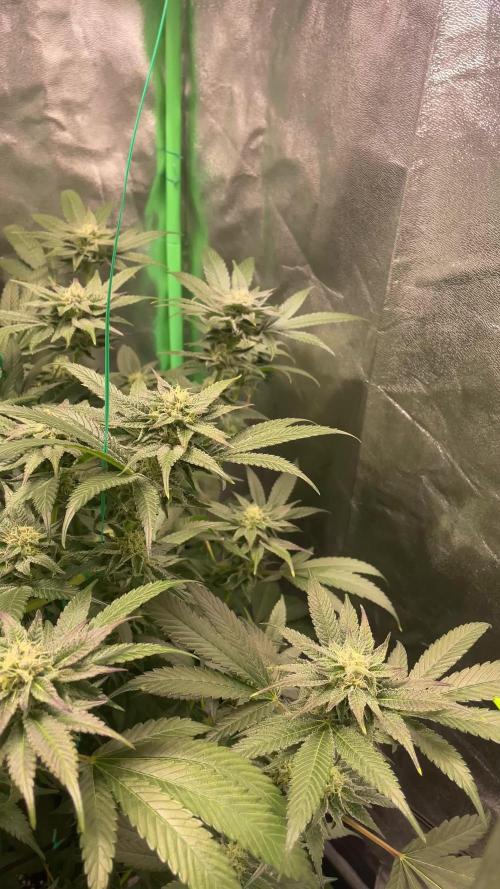
Starting Week 10, which marks the beginning of the 7th week of flowering. The buds are stacking nicely and the trichome production is ramping up. Tomorrow, I’m planning a defoliation to improve airflow and light penetration. I’ll also be tucking and organizing the canopy to keep everything tucked neatly within the 70x70 space.

Likes
16
Share


@the_medicine_grow_uk
Follow
So she’s a week into flush with only about 10% amber trichomes so has a few more days yet. The bud size isn’t moving but the density of the buds has definitely increased.
Let me know what you think. 🙌🏼🙌🏼


Likes
32
Share


@GrowingTime
Follow
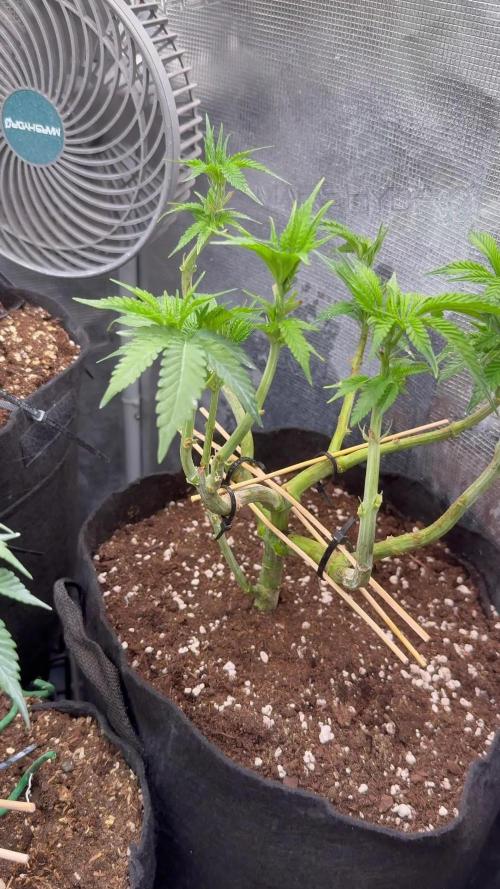
Guys shit happened at the end of week 9, my ph tester went off and i messed up.
my leaves looks soft as shit. now i am using the drop ph tester and brought in a decent level the ph, see if things will come back or will have to do something more




Likes
126
Share


@DogDoctorOfficial
Follow
And i think i got control back, i think hahaah since i actually also think that i dont control much them autos, they just do what the flirk they want and i am just here to give them what ever they ask for lol
Time to defoliate this tall lady as arrived, i defoliate the rest of them in the room so she went with the flow, i know its an auto, you dont defoliate autos, wel i did and now lets see how they react and do hihi fingers crossed hihihi
She seems happy with the defoliation and the new arrangements in the room, she is a prayer this one and her trichome production is moving way faster than she is, i believe this will be a packet with them in the en like snow flakes on a hard winter day , but lets see how she keeps evolving, all i know is that from the slowest of them all starting she is by far the one that is promising better medicine on the way, but again lets see how it all goes and keeps going
So far so good she looks like a happy girl , gave her some extra P , K and Flower Booster to help fruit production <3 <3 <3
As always thank you all for stoping by and for supporting me on this journey, i am super passion about growing and fell blessed to have you all with me on this new journey <3 <3 <3
Genetics - Fast Buds Banana Purple Punch
Ligth - LUMATEK ZEUS 465 COMPACT PRO
Food - APTUS HOLLAND
All info and full product details can be find in can find @
https://2fast4buds.com/
https://aptus-holland.com/
https://autopot.co.uk/
https://lumatek-lighting.com/
<3 <3 <3 Growers love to you all <3 <3 <3

Likes
4
Share


@KCChiefers
Follow
Day 58 Update: Watered both plants with 3/4gal until runoff. Water was dosed with Terpinator at 15ml/gal. I will start the flush on Plant #1 next watering. Added a stake and a plant yoyo to Plant #2 to support the heavier branches.
Day 62 Update: Starting flush on Plant #1. Watered both plants with almost a gallon until runoff. Plant #2's water was dosed with 3/4tsp of Big Bloom, 1/4tsp of Grow Big, and 1/4tsp of Tiger Bloom. Plant #1's water is just plain pH balanced water. I will start watering every 3 days now. I will start the flush on Plant #2 after one more nutrient watering.

Likes
5
Share


@therealgrowmie
Follow
Now this is where things get interesting.
According to the growth cycle of autoflowers, we’re now hitting the end of the vegetative phase, and the first flowers are starting to form. The plants have developed an even canopy and look relatively bushy. I reckon this favors an indoor setup, since the light comes straight from above with little to no diffusion—aside from reflections off the inner tent walls. I am aiming for a VPD between 0.7 and 0.8 kpa now to support plant growth!
I’ve adjusted the watering schedule to 1.5L per plant every third day from now on—bigger plants, bigger thirst!
Bonus: Tomatoes and an absolute Hulk of a parsley plant!
Likes
14
Share


@inhale_exhale
Follow
This week has been really hard.
Until this week the electricity was turned off on average once every two days, for 4 hours in the evening peak time. But the last 7 days the electricity is turned off twice or thrice a day also for 4 hours. I think that in this case it is better to reduce the light day and slowly started to reduce it at the beginning of flowering, and already reduced it from 18 to 16 hours, and that was a bad idea (((:
The temperature outside was already around 30 degrees in the shade, and it rained almost every evening, as a result, the air humidity up to 65-70% so it was impossible to leave the girls in a closed box without a working fan.
I had to cover the windows and work with my hands waving a piece of cardboard)))), adding back 30 minutes of evening sun outside the window each day.
Same story since morning, but this more positive, we meet the morning sun, and move around the whole apartment behind the light frame of the window, running away from the shadow))) the main thing is that the morning is sunny, because will have to continue working with a piece of cardboard until the light is turned on (((:
Also, as you can see in the first photo, I installed a large fan and removed the lower wall of the box, because the ventilation system did not help ((:
Looks crazy but I already like it, new challenges and new experiences all the time, big plus a good habit to wake up at dawn! So no matter what, we are happy and breathe deeper 😍
Likes
3
Share


@Organic473
Follow
Transplanted her to a 5 gallon pot. Gave her some root stimulator, fed her some nitrogen and just look how lovely they are taking off, my plans are to veg her for a very long time.

Likes
6
Share


@DogDoctorOfficial
Follow
🍒 Lemon Cherry Gelato — Week 4 Update
Autoflower · 12/12 from seed
Quick recap (for anyone joining here)
This Lemon Cherry Gelato has been grown 12/12 from seed, alongside photoperiod plants, under the same exact conditions.
At this stage, we’re still observing how modern autoflower genetics can blur traditional lines — and once again, this plant is behaving more like a classic photoperiod in structure and rhythm.
No rush. No force. Just observation.
⸻
🌿 Plant Development
She’s doing beautifully:
• Currently at 6–7 nodes
• Strong, even branching
• Internodal spacing is balanced
• Leaf color is a lush, healthy green
• Structure is open and expressive
No real training has been applied:
• Only very light leaf bending here and there
• No topping, no LST, no stress
• The plant is shaping herself naturally — and doing a great job at it
She looks calm, confident, and full of potential.
⸻
🌡️ Environment Log — Week 4 (Shared Conditions)
Same conditions as logged for all plants this week:
• Temperature: ~25.7 °C
• Relative Humidity: ~60%
• CO₂: ~666 ppm
• PPFD: 600–700 (adjusted naturally based on plant size and distance to light)
• Nutrition & watering: unchanged, consistent, identical across the room
This consistency is key — it allows us to clearly see genetic expression, not environmental noise.
⸻
🧠 Observations & Notes
What’s especially interesting here is how stable and photoperiod-like this autoflower appears:
• No sudden flowering push yet
• Vegetative structure continues to build
• Growth rhythm matches the non-autoflowers closely
At this point, labels matter less than behavior — and her behavior is excellent.
⸻
🙏 Thank You
A big thank-you to everyone following along, supporting, and appreciating the process.
This diary is about learning together, observing without ego, and letting the plant speak.
She’s shining — quietly, confidently, beautifully 💚
FOR DISCOUNT CODES AND MORE JUST FOLLOW THE LINK https://website.beacons.ai/dogdoctorofficial
📲 Don’t forget to Subscribe and follow me on Instagram and YouTube @DogDoctorOfficial for exclusive content, real-time updates, and behind-the-scenes magic. We’ve got so much more coming, including transplanting and all the amazing techniques that go along with it. You won’t want to miss it.
GrowDiaries Journal: https://growdiaries.com/grower/dogdoctorofficialInstagram: https://www.instagram.com/dogdoctorofficial/
YouTube: https://www.youtube.com/@dogdoctorofficial
⸻
Explore the Gear that Powers My Grow
If you’re curious about the tech I’m using, check out these links:
🔆 Lighting & Environmental Control
• Future of Grow — Advanced LED lighting technology
https://www.futureofgrow.com/
DISCOUNT CODE: DOG20
• Lumiflora — Under-canopy LED lighting
https://lumiflorade.com/
• TrollMaster — Environmental controllers and automation gear (past collaboration)
⸻
Genetics
• Zamnesia Seeds — Genetics used in this project
https://www.zamnesia.com/
⸻
🌱 Soil, Substrates, Boosters & Root Support
• Plagron — Substrates, bio mixes, and supportive products
https://plagron.com/en/
⸻
🎒 Storage, Curing & Preservation
• Grove Bags — Curing and storage solutions
https://grovebags.com/
⸻
📸 Photography Equipment & Tools
(Not sponsors, but part of my creative toolkit)
• Sony A6700
• Sony full-frame macro lens + few more
• Stacking photography workflow - learning
• iPhone (for behind-the-scenes shots)
We’ve got much more coming as we move through the grow cycles. Trust me, you won’t want to miss the next steps, let’s push the boundaries of indoor horticulture together!
As always, this is shared for educational purposes, aiming to spread understanding and appreciation for this plant. Let’s celebrate it responsibly and continue to learn and grow together.
With true love comes happiness. Always believe in yourself, and always do things expecting nothing and with an open heart. Be a giver, and the universe will give back in ways you could never imagine.
💚 Growers love to all 💚
📸 P.S. – The Eye Behind the Lens
All photos in this diary (for now — except for the ones showing the camera, which I took with an iPhone) are taken with a Sony A6700 paired with a Sony full-frame macro lens and a few more.
Photography is part of the story — it’s how we share the fine textures, the glow, and the quiet details that words can’t always capture.
I’ve also started experimenting with photo stacking — a technique where multiple images, each taken at a slightly different focus point, are layered together to create one perfectly sharp image from front to back.
It’s not digital enhancement or AI; it’s pure photography — a way to reveal the plant’s beauty in microscopic depth, from trichome to petal.
You’ll even see a few shots of "ghost me" capturing the shots — camera, lens, setup — because every grow deserves not just to be cultivated, but documented like art.
FOR DISCOUNT CODES AND MORE JUST FOLLOW THE LINK https://website.beacons.ai/dogdoctorofficial
NEW DISCORD - Official Server Invite Link : https://discord.gg/ksjAkA5T74
PS: A small heads-up — a few files didn’t make it into this update due to upload limits on Growdiaries (or simply her being a bit moody today 😄). We’ll try to upload the remaining photos next week. If possible, we’ll add them alongside the weekly update and clearly mark them as extra images.
Plenty of photos are already live though, so we hope you enjoy the update as it is. Thank you for your understanding and support.
Likes
68
Share


@I_and_I
Follow
I had fun with this barneys gorilla zkittlez, although it seems like it was ready around 7 weeks, its as if the plant has been in the early stages of self seeding when I've harvested on day 54~ of flower.. Can't think any other reason why this would've happened
Anyway overall the bud is 95% amazing, just a slight sadness at the miniscule seeds forming close to the stems in the centre of some buds that takes away from the taste a little


