


Likes
Comments
Share


@Hempy_The_Kid
Follow
01/12/22 irrigated 1 gallon water PH 5.85 TDS 403 gave 2 quarts recharge.
01/13/22 irrigated 1 gallon water PH 6.04 TDS 403. Topped 4 more spots. Growth has picked right back up after the PH mishaps.
01/14/22 re-potted to #5 nursery pot. Set up watering system. Now irrigating itself 1 time per day @ 50 gallons. Set PH 6.03 TDS 520.
01/15/22 adjusted TDS to 499 PH 6.0
Currently have 16 tops
01/16/22 PH 6.03 TDS 505
01/17/22 PH 5.93 TDS 520
01/18/22 PH 5.95 TDS 499 topped 4 more spots.

Likes
6
Share


@Moss420
Follow
First week of flowering went well. See pic descriptions for details or hit us up if you want to know more!

Likes
5
Share

@Shivashamboom1
Follow
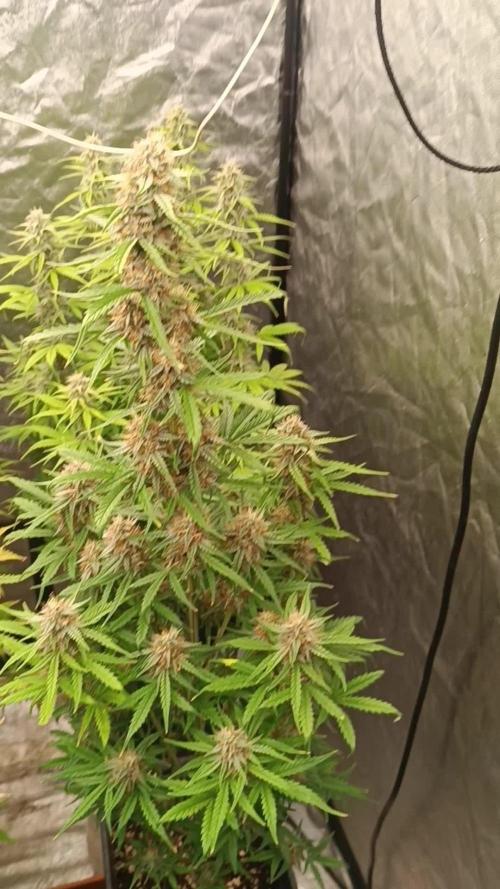
4 settimana di fioritura.belle piantine mie continuate a fare dei bei fiori grandi e terapeutici 😂🙏😉..........
questa è la settimana che iniziano a gonfiare le cime.che i bei fiori prendono forma e profumo...
adesso gli farò il lavaggio radici per un paio di settimane e via......
Likes
11
Share


@CocoLogic
Follow
Sept 6th: (F20)
Fertigation once a day with same recipe (1200 EC 6.1 PH) watered until 10-20% run-off
Sept 7th: (F21)
Fertigation once a day with same recipe (1200 EC 6.1 PH) watered until 10-20% run-off
Sept 8th: (F22)
Fertigation once a day with same recipe (1200 EC 6.1 PH) watered until 10-20% run-off
Sept 9th: (F23)
Fertigation once a day with same recipe (1200 EC 6.1 PH) watered until 10-20% run-off
Sept 10th: (F24)
Fertigation once a day with same recipe (1200 EC 6.1 PH) watered until 10-20% run-off
Had to supercrop 1 branch on the PE#2 since it was almost in the roof of the tent
Sept 11th: (F25)
Fertigation once a day with same recipe (1200 EC 6.1 PH) watered until 10-20% run-off
Sept 12th: (F26)
Fertigation once a day with same recipe (1200 EC 6.1 PH) watered until 10-20% run-off
Note: The PE#2 had a late stretch this week oO hope she is done stretching, dont got more height for it! Had to supercrop one branch on it this week since it was almost in the tent roof.
Its funny that the TUT who is 60-65 Flower days is way in advance in bud forming on the PE#2 who is supposed to be 45-50 flowering days


Likes
7
Share

@Selkot
Follow
.
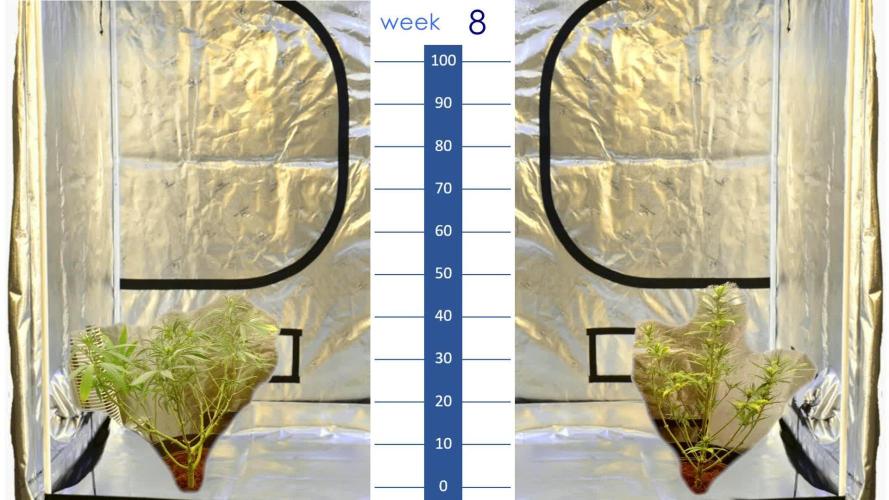
YEAR 5 - 1st quarter
----------------------
The 5th season begins with the same setup.
The novelty of this season is the substrate: from this point on, all my indoor grows will be done in coco coir.
Five Northern Lights plants, 2 from RQS indoor and 3 from Zamnesia outdoor, take up the first quarter.
With 5 plants, they will produce 212 g.
For the first time, one of them alone exceeds 100 g.
Second award on GD: 9th place in the DOTW 🙏
Likes
24
Share


@3lementa1
Follow
This is the 8th week. Thursday will be 9 weeks of 12/12. Some trichs are amber. They just added a good bunch of girth over the past few days, but most of the pistils are red now. The rest of them have been dropping leaves consistenly but the canopy remains full so they must be putting out more leaves.
I just flushed to 80% runoff and found out that I had 1200ppm. I just got an ec meter but my last reading said closer to 600 so idk what happened there.
I flushed until I had runoff ppm of about 150. Now they're back in the grow tent. I don't want to keep assaulting them with my microscope. I think they're ready. Just gonna let them settle another day or two to dry out a bit.
I took one small branch off the small Wedding Cake plant on Thursday and I've just been watching it dry on my counter. It's been 5 days and the stem snaps but still leaves a fiber connecting. I put it into a small jar with a 64RH thing. I just want to try it. It already smells amazing.
The leaves on the big CBD Blue Shark plant are going really yellow and some other colours are starting to come out as well.
The buds all fattened up and got more frosty again. I was worried they were foxtailing but they got more calyxes underneath the peaks and have been making more of a pyramid shape. They're really close to peak. Harvest day will be March 17 or 18.
March 17 1023pm chopped and hung after lights off all day. RH was 65% before I chopped and 50% after I closed the window and cut the plants off the saturated pots. I did a wet trim to prevent mold. The buds are sticky af. Gonna hang them to dry for 7-9 days before curing in jars :)
March 18 : checked the RH when I woke up and it's chilling at 45% 😎
March 19 : just checked to see how they were drying. There are seeds in every plant. RIP
I'll update when I put them in jars and again a few weeks later for final review. Overall it was a good grow despite the rocky start and a good introduction to the mainline technique and my new grow space. Next grow I should have everything pretty well dialed in.
March 23
They were hanging for 3 days. Rh was around 45, then spiked to 65 overnight when I forgot to turn the fans back on. Temp was high at around 26.they felt wet after 2 days, and bone dry after 4 days. The stems still didn't snap but I put them in jars anyway. A day later, jar RH was 50%. I burped all the jars and there was a smell from the new jars. I took all the weed out, washed out the jars, and did a dry trim on the weed.
One of the Wedding Cake plants must have gone hermie. I didn't see any bananas and didn't even realize there were seeds until the very end. The seed pods looked just like calyxes while the plants were growing. Many of the nugs are unusable. Under the sugar leaves are just layers and layers of seeds. Some weren't hit that badly. The CBD Blue Shark is much better off but still has some seeds.
I'm trying to stay positive. It's a bit of a shock though. I'm anxious to try the finished product. If the flowers at least taste good and have a good effect, all is not lost.

Likes
44
Share


@ILoVeThiSpLaNt
Follow
Day 35 bloom
Non so più quale pianta è in cima alle mie preferenze. Sono spaziali tutte. Forse quella con una marcia in meno è la Baker Delight ma ovviamente me lo aspettavo 😀
Rainbow Belts 🌈
lime/zkittlez/uva/og
Pink Gasoline #1 crema/zkittlez/pesca
Pink Gasoline #2 crema/gas
Barbara'Pie #1-#2 /frutta(ancora da capire)/gomma da masticare
Barbara'Pie #3 menta/spezie
Baker Delight frutta(ancora da capire) /crema
A settimana prossima e grazie dei commenti e dei Like 🙏 😊


Likes
16
Share


@Aircoholic
Follow
That's it, she's done. The buds didn't really fatten up towards the end, but the trichomes show enough amber heads to call it a grow. There's a lot of possible reasons for that, so I guess for the next grow I'll have to experiment a little to find out, what caused it.

Likes
6
Share


@DogDoctorOfficial
Follow
💙 Project Blue Tent – Week 13
🌿 Blue Waffle F1 – Pheno B
🌱 Same Genetics, Different Expression – A Beautiful Fade into Lighter Greens
Hello everyone, and welcome back to another chapter of Project Blue Tent! 💙🌱
My friends, we're back with another individual report, and this time it's all about our beautiful Blue Waffle F1 Pheno B!
And honestly, what can I say?
These girls are amazing! 😂💙
We've reached another interesting stage of flowering, and while all four plants are sharing the same environment, the same reservoir, the same irrigation system, and the same general cultivation approach, each one continues to show us her own individual characteristics.
Last week, we talked about the beautiful development of our Blue Waffle F1 girls and the incredible details we've been capturing through photography and focus stacking.
This week, we're continuing that journey.
The room is moving towards the final stage of flowering. We're gradually reducing temperatures, lowering the nutrient concentrations, and beginning to decrease the output of the overhead LEDs.
The two LumiFlora under-canopy fixtures remain part of the experiment, and the irrigation system continues supporting all four plants.
But today, we're not simply repeating the room update.
We're looking at what makes this particular girl different.
Because even when plants share the same genetics, that doesn't mean they will express themselves in exactly the same way.
And Pheno B is giving us a beautiful example of that.
Her structure is a little different from her sister's. Her flower development has its own character, and her colours are moving more towards lighter shades of green rather than the more pronounced blues, purples, and reddish tones we've been admiring on Pheno A.
She's still compact. She's still beautiful. And the aroma?
Absolutely incredible!
Let's take a closer look. 💙🌿
🌸 WEEK 13 – MOVING TOWARDS THE FINISH
We're now in Week 13 of flowering, and the entire room is gradually moving towards the final stage of the journey.
The major structural work has already been completed.
The plants have been trained, topped, managed through the stretch, and supported with the SCROG system. The second layer of support remains in place, and the under-canopy lighting experiment continues.
At this stage, we're concentrating on maintaining a stable environment and observing how each plant develops.
We're not looking to make unnecessary structural changes just because another week has passed.
Instead, we're watching the flowers, the changing foliage, the overall structure, and the characteristics each phenotype is expressing.
And this is where things become particularly interesting.
Pheno A and Pheno B share the same cultivar, but they aren't identical copies of one another.
They have their own morphology, their own individual appearance, and their own way of progressing through flowering.
Pheno B is now showing us a different side of Blue Waffle F1.
And I'm really enjoying seeing those differences develop!
🌿 SAME GENETICS, DIFFERENT MORPHOLOGY
One of the most interesting things about documenting individual plants is that it gives us the opportunity to observe differences that might otherwise be overlooked.
Our two Blue Waffle F1 plants share the same cultivar, but each comes from a different seed.
And although they share the same growing environment, their physical expression isn't identical.
Pheno B has a different overall structure from her sister.
The way her flowers are developing, the way the plant presents itself, and the colours she's expressing are all slightly different.
We're still seeing that compact appearance, but the overall morphology isn't exactly the same.
It's a reminder that a cultivar name doesn't guarantee that every individual plant will look identical throughout its life cycle.
Genetics provide the potential for particular characteristics, but individual plants can express that potential differently.
Environmental conditions can also influence how plants develop, so we shouldn't automatically attribute every difference to genetics alone.
And that's precisely why we document these plants separately.
We're not trying to force them into the same description.
We're observing what each one actually shows us.
Pheno A has her own personality.
Pheno B has hers.
And both deserve their own spotlight! 💙🌱
🌱 A DIFFERENT STRUCTURE, BUT STILL BEAUTIFULLY COMPACT
Let's talk about the structure of this girl.
Pheno B remains compact and beautifully developed, but when I compare her with Pheno A, I can see differences in the way the plants have expressed themselves.
The overall morphology is slightly different, and the flower formation isn't quite the same.
It's difficult to say exactly why those differences have developed.
It could be down to individual genetic expression, environmental influences, or a combination of factors.
Even though the plants share the same tent, they don't necessarily experience every condition in precisely the same way at every point across the canopy.
Light distribution, local airflow, and individual plant characteristics can all contribute to differences in development.
However, we don't have enough evidence to identify one specific cause here.
And that's perfectly fine.
We're documenting the observations rather than inventing an explanation.
What matters is that Pheno B has developed her own structure, and we're now able to appreciate that individual expression as flowering progresses.
She's looking beautiful, and I'm happy with what we're seeing.
🌸 FLOWER FORMATION – HER OWN WAY OF DOING THINGS
The flower formation is another area where I notice differences between the sisters.
Although both plants remain compact and are progressing through the same general flowering stage, their flowers don't present themselves in exactly the same way.
Pheno B has her own pattern of development, and this is something I'm particularly interested in following as we move closer to the finish.
Was it something about the environment?
Was it simply the individual expression of this plant?
Could it be a combination of factors?
At this point, I can't give you a definitive answer.
And I don't want to pretend otherwise.
Sometimes, when we're growing several plants together, we see differences that are easy to observe but much harder to explain with certainty.
That's part of the learning process.
We record what we see, compare the plants, and continue observing as they mature.
The important thing is that Pheno B is developing beautifully, and her individual characteristics are becoming increasingly clear.
Her sister might be showing a more colourful expression, but Pheno B has her own charm.
And that's exactly why I love keeping separate phenotype diaries.
🌿🌈 THE COLOURS – A DIFFERENT KIND OF BEAUTY
Now, this is where Pheno B really separates herself from her sister.
While Pheno A has been showing us a more pronounced mixture of blues, purples, reddish tones, and greens, Pheno B is moving towards lighter shades of green.
Her fade is different.
It's less about those strong contrasting colours and more about the changing green tones we're seeing throughout the plant.
And honestly, my friends, there's absolutely nothing wrong with that!
😂💚
Not every plant needs to develop the same colours to be beautiful.
Different phenotypes can express different pigmentation patterns, even when they share the same cultivar.
Genetics can influence those characteristics, while environmental conditions and the stage of maturity can also play a role.
We're seeing Pheno B move towards a lighter, greener appearance as she progresses through flowering.
That's what the plant is showing us, and that's what we're documenting.
I'm not going to claim that the cooler temperatures alone caused this particular fade, because we can't establish that from our observations.
Instead, we'll continue watching her colours develop alongside the other signs of maturity.
And I have to say, I really like seeing the contrast between the two sisters.
One is showing a more colourful palette.
The other is expressing herself through lighter greens.
Same cultivar. Same room. Different individual expression.
That's what makes this comparison so interesting! 💙🌿
❄️ COMPACT FLOWERS AND PLENTY OF DETAILS TO OBSERVE
Despite the differences in colour and structure, Pheno B remains compact and attractive.
The photographs give us a closer look at her flowering sites and the details developing across the plant.
And this is another reason I enjoy documenting each phenotype individually.
When we look at the whole tent, it's easy to concentrate on the general appearance of the canopy.
But once we start looking at individual plants, we can appreciate their particular characteristics much more clearly.
The flower structure.
The arrangement of the flowering sites.
The way the plant presents its foliage.
The changing colours.
And the small differences that make one phenotype distinct from another.
We're continuing to observe the flowers and the developing trichomes as the plant progresses.
The pistils are also changing as flowering advances, but their appearance alone doesn't tell us everything about maturity.
We'll keep looking at the overall development rather than relying on a single visual indicator.
For now, Pheno B is looking beautiful, and I'm excited to continue documenting her progress.
📸 PHOTO STACKING – LOOKING CLOSER AT THE DETAILS
Photography remains an important part of Project Blue Tent.
This week, we've continued capturing photographs of the plants and documenting the flowering sites through close-ups and focus stacking.
As many of you already know, focus stacking combines multiple images captured at different focus distances to create a final photograph with greater depth of field.
It's a fantastic technique for showing intricate details that can be difficult to capture in a single frame.
The process also takes time.
We need to set up the camera, choose the composition, capture the individual frames, and then process the stack.
And when we're working inside the grow room rather than in a dedicated studio, we have to work with the conditions available to us.
But that's part of the process, too.
The aim is to document the plants as accurately and clearly as possible, while giving everyone following the diary a closer look at what we're seeing.
For Pheno B, these photographs help us appreciate her individual flower formation and the differences between her and her sister.
They're not just pictures for the sake of taking pictures.
They're part of the record of this grow.
And I genuinely enjoy sharing that process with the community. 📸💙
🌡️ THE SHARED ROOM – LOWER TEMPERATURES FOR THE FINAL STAGE
Now let's return to the wider environment, because everything we've been doing in the room applies to Pheno B as well.
We're gradually lowering both daytime and nighttime temperatures as we move towards the final stage of flowering.
The current daytime air temperature is approximately 25°C.
During the night, when the plants are resting, the temperature drops to around 19–20°C.
We've also brought the solution temperature and substrate temperature down to approximately 21°C.
These adjustments are part of our approach to the finishing stage.
We're interested in observing how the plants respond as the environment changes and how their natural characteristics develop over time.
Cooler conditions can influence colour expression in some cultivars, but the response depends on the genetics and the overall environment.
We're not assuming that every plant will respond in the same way.
And Pheno B is a perfect example of why individual observation matters.
Despite sharing the same room with Pheno A, she's expressing a different colour pattern.
We'll continue watching both plants and documenting what happens as they approach the finish.
💧 HUMIDITY – UNDERSTANDING THE READINGS
Our normal relative humidity is approximately 55%.
You may notice that some photographs show higher readings, particularly when I'm working inside the tent.
When I'm moving around, taking photographs, checking equipment, and breathing inside the room, the humidity can rise temporarily.
Even with the air conditioning running, the readings can change while I'm working.
That's why it's important to distinguish between a temporary measurement during maintenance and the normal operating conditions we're aiming to maintain.
For this report, we're recording approximately 55% relative humidity under normal room conditions.
The aim is to keep the environment stable while monitoring the plants throughout this stage.
🌱 NUTRITION – LOWERING HYDRO A AND B
We've also started reducing the nutritional concentration as the plants move towards the final stage.
The new recorded recipe is:
PLAGRON Hydro A – 1.8 ml/L
PLAGRON Hydro B – 1.8 ml/L
PLAGRON Power Buds – 1 ml/L
PLAGRON pH Plus – as required
PLAGRON pH Minus – as required
The recorded pH is approximately 5.96, while the EC is around 1.86 mS/cm.
By reducing Hydro A and Hydro B, we've also reduced the overall nutrient concentration, which is reflected in the lower EC and TDS readings.
The pH can also shift as the composition of the solution changes, although its response isn't always predictable.
Our target is to keep the pH close to 6, allowing for small variations above or below that point.
As long as the reading remains within our intended range, we avoid unnecessary adjustments.
We're not chasing a perfectly fixed number every minute.
We're observing the solution, keeping the system stable, and making changes when there's a reason to do so.
The same nutritional program is being used across the shared reservoir, so Pheno B is receiving the same general solution as her sister and the two Pickle Lemon Haze F1 plants.
Keeping this consistent also helps us compare the plants without introducing unnecessary differences in the feeding program.
💡 LIGHTING – REDUCING THE OVERHEAD POWER GRADUALLY
The overhead LED output is now approximately 90%.
From here, we're planning to reduce the output gradually, by around one or two percentage points per day, as we move closer to the end.
We're not switching everything off or making a sudden change.
We're taking a gradual approach while observing the plants and maintaining the overall environmental balance.
The goal is to keep the lighting appropriate for this stage rather than simply running the equipment at maximum power.
Light intensity, temperature, humidity, and plant response all need to be considered together.
And that brings us to another interesting part of the project.
💡 TWO LUMIFLORA FIXTURES – LIGHT FROM BELOW
The two LumiFlora 150W full-spectrum under-canopy fixtures remain in place beneath the canopy, arranged in an X-cross configuration.
We're keeping their output around 90–95% for now, with the possibility of reducing it closer to the finish.
The overhead LEDs provide the main lighting, while the under-canopy fixtures supplement the lower portions of the plants.
We're interested in observing how the lower flowering sites develop under this arrangement.
One of our goals is to see whether this lighting balance helps the flowers across different parts of the plant progress more uniformly.
However, we won't assume that the additional lighting automatically produces that result.
We'll continue monitoring the plants and documenting what we see.
The lighting arrangement is part of the experiment, and the individual phenotype reports allow us to keep track of the differences between the plants as they develop.
💧 IRRIGATION AND DRAINAGE – THE SYSTEM CONTINUES WORKING
The automatic irrigation and drainage system remains an important part of the Project Blue Tent ecosystem.
All four plants share the same reservoir, and the system helps us maintain consistency throughout the room.
The recorded watering volume is approximately 1.6 litres per plant per 24 hours.
As always, the actual water requirements of an individual plant can depend on its development and the conditions around it, so we continue observing the system rather than assuming that every plant necessarily uses water at exactly the same rate.
The aim is to keep everything working smoothly while we concentrate on the plants themselves.
And that's one of the advantages of having an established system.
When the equipment is operating as expected, we can focus on observing, photographing, and documenting the plants without making unnecessary changes.
🌿 FOUR PLANTS, TWO CULTIVARS, ONE SHARED ENVIRONMENT
This is one of the most interesting parts of Project Blue Tent.
We have four plants sharing the same room, representing two cultivars: Blue Waffle F1 and Pickle Lemon Haze F1.
They share the same general environment, the same reservoir, and the same lighting setup.
Yet each plant has her own characteristics.
And when we compare Blue Waffle F1 Pheno A with Pheno B, those differences become particularly interesting.
Pheno A is showing more pronounced blues, purples, reddish tones, and contrasting colours.
Pheno B is moving towards lighter greens.
Their structures are also slightly different, and the flower formation isn't identical.
At the same time, both remain compact, both are progressing through flowering, and both are producing an aroma that I absolutely love.
The similarities are just as interesting as the differences.
Their shared genetics provide a starting point for comparison, but they don't mean that every characteristic will be expressed identically.
That's why these individual diaries are so valuable.
We're not trying to make the plants look the same on paper.
We're recording what makes each one unique.
And I'm really enjoying seeing these differences emerge as the girls approach the finish.
👃 THE AROMA – INCREDIBLE, AND VERY SIMILAR TO HER SISTER
Now, one thing that seems remarkably similar between the two Blue Waffle F1 girls is the aroma.
The whole room smells amazing!
😂🌸
Despite their differences in structure and colour, the aroma coming from these plants is very similar, and it's becoming increasingly noticeable as flowering progresses.
It's another interesting point of comparison.
Their visual expression differs, but the overall aromatic impression is remarkably alike.
I'm not going to assign a detailed terpene profile or invent specific aroma notes that we haven't documented.
For now, what I can say is that the smell is strong, beautiful, and very similar between the sisters.
And honestly, it's one of those things that makes spending time in the room such an enjoyable experience.
The photographs can show us their colours and structure.
The video can give you a closer look at the garden.
But the aroma?
You'll have to take my word for it!
😂💙🌿
🔭 WHAT I'M WATCHING NEXT
As we continue towards the end of flowering, I'll be paying particular attention to Pheno B's changing colours and overall development.
I'm interested in seeing how her lighter green fade progresses.
I'll continue observing the flower structure and the developing trichomes, alongside the overall condition of the plant.
I'll also keep comparing her with Pheno A, because their differences are becoming an increasingly interesting part of this project.
We're maintaining the same general environmental approach across the room, gradually reducing the overhead LED output, keeping the under-canopy fixtures in place, and lowering the nutrient concentrations.
Now we give the plants time to respond.
There's no need to rush to a conclusion or assume that the sisters will finish in exactly the same way.
We'll keep observing, photographing, and documenting their individual journeys.
And that's what this project has always been about.
💙 FINAL THOUGHTS – DIFFERENT EXPRESSION, EQUALLY BEAUTIFUL
My friends, Blue Waffle F1 Pheno B is looking beautiful.
She's compact, she's developing her own flower structure, and she's moving towards a lighter green expression as flowering progresses.
Her sister has been showing us more pronounced blues, purples, and reddish tones, while Pheno B is taking a different visual path.
And I love that.
We have the same cultivar, the same shared environment, and the same general cultivation approach, yet the individual plants aren't expressing themselves identically.
It's a great reminder that growing is about observing what actually happens rather than expecting every plant to follow exactly the same pattern.
We can make comparisons.
We can record measurements.
We can photograph the differences.
But we should also be honest when we don't know exactly why a particular characteristic has developed.
That's part of learning.
And it's one of the reasons I enjoy documenting the entire journey, including the weeks when the changes are subtle rather than dramatic.
The room is gradually getting cooler.
The solution and substrate temperatures are around 21°C.
The nutrient concentrations have been reduced.
The overhead LED output is now around 90%, with gradual reductions planned.
The under-canopy lights remain part of the experiment.
And the irrigation system continues supporting all four plants.
Meanwhile, Pheno B is showing us her own beautiful expression of Blue Waffle F1.
Different structure.
Different colours.
Very similar aroma.
And a beautiful plant continuing towards the finish.
I'm genuinely happy with what we're seeing.
Let's keep observing, keep learning, and see what the next chapter brings!
🌿💙🌈
💬 COME JOIN THE DOGDOCTOROFFICIAL DISCORD COMMUNITY!
Before we wrap things up, I want to invite everyone to join our Discord community.
If you're already a member, you know how much fun we have together.
And if you're new, you're more than welcome!
We have a fantastic community where growers can share experiences, exchange ideas, show their gardens, ask questions, and enjoy the hobby together.
No level required.
You don't need to be an expert.
You don't need the biggest setup.
Everyone is welcome.
We also organize giveaways and photo championships, with prizes for the winners.
It's a wonderful place to meet other growers, learn from one another, share photographs, and become part of a community that feels like family.
So come and join us!
💙 DogDoctorOfficial Discord:
https://discord.gg/dogdoctorofficial
Introduce yourself, share your garden, and say hello.
We'd love to see you there!
🙏 A HUGE THANK YOU
A huge thank you to Zamnesia for making Project Blue Tent possible and giving us the opportunity to document these beautiful Blue Waffle F1 and Pickle Lemon Haze F1 plants.
Thank you to PLAGRON for the Hydro nutrient line supporting the girls throughout this journey.
A massive thank you to Zamnesia for the Phytonaut LED lighting, curved scissors, and clip fans that have become important parts of this ecosystem.
Thank you to Mars Hydro for the irrigation and drainage equipment helping us maintain consistency throughout the room.
And a special thank you to LumiFlora for the 150W full-spectrum under-canopy fixtures that we're using to explore supplemental lighting beneath the canopy.
Thank you to GrowDiaries for giving us the platform to document the journey, share the photographs, compare the plants, and record what we learn along the way.
And, of course, thank you to everyone following Project Blue Tent!
Your support and your comments make these diaries even more enjoyable to put together.
We're continuing to observe, experiment, photograph, and learn, one week at a time.
Until next week, my friends...
More flowers.
More observations.
More photographs.
More learning.
And hopefully, even more beautiful details to share with you.
Growers Love, happy growing, and take care everyone! 🌱💙🌸

Likes
33
Share

@valiotoro
Follow
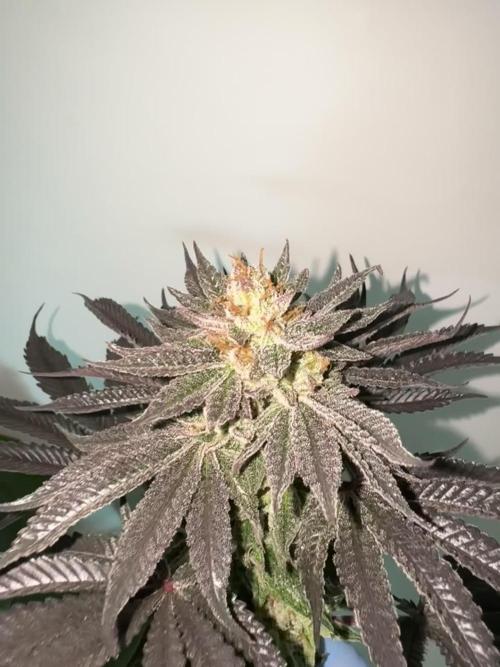
The buds are nice and compact, covered in resin. I can’t wait to try her after a good meal, like a dessert 🤤



Likes
62
Share


@masterofsmeagol
Follow
9/12 Sprayed 1 tbsp K Bicarb with 1/4tsp dawn. Only had time to use a half gallon. I've used more but with all the defoliation this seemed to work and I was in a hurry. I can't ask those watching my plants to do actual labor when I'm not home. I wouldn't want anyone working on my plants but me anyway. I defoliated dead stuff. Still have this rusty looking leaves dieing on my ice cream cake. I need to finish a little defoliating. Broke out my 100x scope and checked a few buds. Things are exploding. Another nice sunny day today. Beastie bloom had no negative effects. I'll use it again and I'll probably use cha ching as well. Went back down to defoliate a little more. I'm getting excited. Still a lot of work left but it's nice to see the progression. Had to cut out a small nug last night that looked like it might start to rot. It was probably fine but I wasn't taking chances. It's so dank and crystally. One of my mystery seeds in the 5 gallon will be done soon. Milky trichs and hard as a rock. Im hoping they will beef up a bit. Little to no amber but things are progressing so fast. I mean nights are in the 40°'s.
9/13 No need to water as it had rained so much the bags need to dry out. Sunny day today. Plants are doing great. Buds increase in bulk on the daily. Took a few pictures and defoliated what needed it. A dog was added to the grow for security. It hasn't gotten used to me yet but it's extremely loud and annoying. Nothing will get past it though. I tried to last night. I shut down the motion sensors informed the other growers (except the person who's shift it was to watch) and I couldn't make it down there on foot let alone a vehicle. Hope the dog liked me but it's certainly useful. It APPEARS we will be having some good weather so I'm excited. I think my plants will be able to finish properly. At least I hope. Either way if I have to harvest early do to the weather so he it but I'll cross that bridge when it comes. Plan to do a preventative BT spray this week.
9/14 FED TODAY. LOWERED GROW BIG TO HALF TBSP. AND AGAIN used 1/4 TBSP Beastie Bloom. Buds are swelling with the sunshine that we've had. I defoliated what needed it and found more dead foliage. It's so weird this damage. I'm pretty sure it's earwigs but the only bother new shoots so that's a good thing. Things are getting close and looking good. I need to do another app of BT. I heard a storm may be coming I'll need to check the weather.
9/15 After a few good days of weather we are in for some rain. Supposably a big storm but it looks like I won't get the worst of it. No water obviously. Something (probably earwigs or jpn beetles) eating or lollipopping lower things. They seem to leave flowers alone. It's just low shoots. Everything is flowering incredibly. I checked trichs on one of my mystery seeds and it looks done. I'm considering taking it. It's in my garage for 24 hrs of darkness and to avoid rain until I make my decision. I also took the two lowest branches off on DJ Short blueberry to taste test and see where I'm at. I probably shouldn't but o do this every year. It will be good to try the mystery bud before I harvest it all. It's just a little guy but the buds are rock hard and with the weather and pm and stuff I'm not sure what I'm going to do yet. UPDATE: APPARENTLY WE HAVE SEVERE THUNDERSTORMS WARNINGS WITH GOLF BALL SIZED HAIL. I can move the other little ones in the garage but everything else is firmly rooted and have taken a beating already. I pray things will be ok.
9/16 No damage from the ridiculous storm last night. I need to spray ASAP. I have a fungal infection with just a few weeks to go. Looks like PM but I know some is a different fungal issue. I'll probably use the k bicarb or citric acid. So far no bud damage or damage up top. The things the earwigs ate were low like the lollipoped lower limbs. It's getting so close. I've been checking trichs and they look great but the buds have some filling out to do.
9/17 DID K BICARBONATE TREATMENT THIS AM. I didn't even look to see if I needed to water. Fuck. buds were soaking wet though so it must've rained. I have to go back down anyway to add a couple strings and do a little more defoliating. Did a treatment with k bicarb this morning.. 1 tbsp with dawn in a half gallon sprayer. I also need to address this earwig problem. They are ravaging some secondary lower branches and Im sure they are spreading disease. I only have a few weeks left and I want the best quality I can possibly get. I plan to put gorilla tape on the outside of the grow bag (double width) and petroleum jelly on the stems. That way they can't climb the bag. If they are in the soil of the bag hopefully the jelly will stop them. I'll also try beer as I've heard that works. I really don't want to resort to borax. Oh and I may have had a visitor last night. I'll have to check the cams. Nothing on the ones I checked but I have some game cams at different angles I haven't checked yet. It was probably just a nocturnal animal. Great to know that the dog announces though. This was at like 12:30 and I was out quick. I only have a few more weeks. I hope the cannabis gods are with me.
9/18 Whatever is eating my plants (earwigs I assume) are progressing from lower secondary or tertiary branches and new shoots to small buds. Looking at trichs some plants look ready. One seedling and the blueberries. I'd like the blueberries to go longer but I'd risk losing them. Fungal and mold issues aren't the greatest either. I was hoping for a big swell but if the weather stays raining and foggy like this it might be better to harvest a little early. I got a second opinion this morning and I'm leaning on taking the seedling and at least the one blueberry with the worst damage that dropped most of its leaves. I'll see how the bottom branch smokes this afternoon and make my decision then. Didn't feed for fear of lockout or if decide to cut. UPDATE: After the second consult with a different local grower I decided to harvest the blueberry that was furthest along and dropping it's leaves. It was done. Luckily it had been flushed with all this sheet rain we've gotten. It rains hard as I speak. Last year I think I had two strings the length of the huge garage and that lasted me all year. This one plant took an entire string to itself. If the weather cooperates this will be a good day. I also flushed the mystery seed I was going to take hoping it might fill out but trichs are very Amber and the bud is DENSE. Not risking mold or insect damage or theft. This took hours to harvest this ONE Blueberry plant. I had to harvest limbs. This was when I could see damage best. I also am curing the buds from the lower branch I took earlier and the other bud that is done. I plan on testing it out tomorrow. I could smoke now but Im already burnt and tired and want to try this with a clear head. I can't believe how long this took. One Big and one little down 10 more to go. Phone died so I couldn't take any pictures.


Likes
1
Share


@pareto
Follow
Clearly got dominated by her pot mate. Looks and smells awesome though.
She got planted about a week after her pot mate. Maybe thats why she got the short end of the stick.
These plants are not mine. I am just documenting them.
--------------------------------------------------------------------------------------------------------------------------------------------------------------------------------
Set up cost (fixed costs)
-Lamp: 40€
-Timer: 3,5€
-Pot: 4€
-Total fixed costs: 47,5€
Given 5 years (or 15 grows) usage time translates to around 3,17€ per grow in materials.
Variable costs:
-Seeds: 13,17€
-Soil: 6€
-Fertilizer: 3,50€
-Power (100 days 18h/day): ~25,92€ (exact figure after harvest)
-Total variable costs: ~48,59€
-Total costs per grow: ~51,76€

Likes
12
Share


@GizaWRZ
Follow
I can recommend White Widow from seedsman. This auto plants gets loads of stress from LST, HST, topping, lollipoping, scrog And what's the most important think they finish on time! Great plants, great yeld, great stuff couldn't be better 💪

Likes
2
Share


Likes
14
Share


@Onlygrow99
Follow
Bien pues arrancamos hoy día 30/10/23 la 2º semana de crecimiento.
Las semillas se metieron en el táper el día 10/10/23 lo que quiere decir que llevamos 20 días desde que se empezaron a germinar.
Durante esta semana se quedaran todas trasplantadas y dejaremos la 3º semana de crecimiento para recuperar el stress. En la 4º semana haremos podas.
Planeo poner 1 malla de scrog a modo de guía, como si fuera los tutores a media altura de la planta.
**UPDATE 30/10** Trasplante avanza, mas fotos añadidas en esta semana.
**UPDATE 03/11** Trasplante finalizado. En cuanto terminemos esta 2ª semana de crecimiento podamos los bajos y hacemos pequeña defoliación.
Hay que decir que la gama orgánica de BOOM NUTRIENTS me ilusiona, se ven las plantas verdes, sanas y las raíces pues de locos.

Likes
67
Share


@Only4passion
Follow
Smells amazing 🤩 i havent trimm yet just take the big leaves with no trichromes on it as usual drying on custom 📦 box 👌💪💪💪💚💨💨💨

Likes
64
Share


taking it easy on the nutes.... once the roots Hit the water ....she's going to take off. I got a little too ambitious with the nutes.... and got some nute Burn... but she'll be okay... I flushed her ......very very light on the nutes now.... the new growth is green so she'll be alright.... (((patience young grasshopper))))
Likes
18
Share


@GUGU_choices
Follow
Hello to all the growers following along with another week of the Jack Herer journey. We’ve moved into the fifth week of flowering. The plants are gradually starting to increase their bud volume, so I'm starting to really enjoy photographing them. That's what I love the most! By the fourth week of flowering, a nice coating of trichomes can already be seen, so I'm looking forward to seeing how Hungry Jack performs in the coming weeks. So far I am extremely satisfied..
-
Zdravím všechny sledující growery u dalšího týdne cesty s Jackem Hererem. Přehoupli jsme se do pátého týdne květu. Rostliny začínají postupně navyšovat objem palic, takže si jejich focení začínám užívat na plno. To je to, co na tom miluji nejvíce! Na čtvrtý týden květu lze vidět už pěknou pokrývku trichomů, takže se v následujícíh týdnech těším na to, jak se hladový Jack předvede dále. Zatím jsem maximálně spokojený..

Likes
39
Share


@Mastr
Follow
Day 50 and they are so healthy and bushy I feed them.with
4ml bloom
4ml heaven
4m acti vera
4ml top max
Been done finally defoliation yesterday guy this time I cut all lower branches and just leave top branches just want see what different coz I been speaking to someone with experience he told me you need do defoliation very very aggressive I know you get low yield but its top shelf bud you get let see its work or no
Day 54 and she is in weeks 5 flowering but still bud wont get fatten up but I know mulost sativa start fatten up week 5 to 7 in flowering let see


