


Likes
Comments
Share


@MadeInGermany
Follow
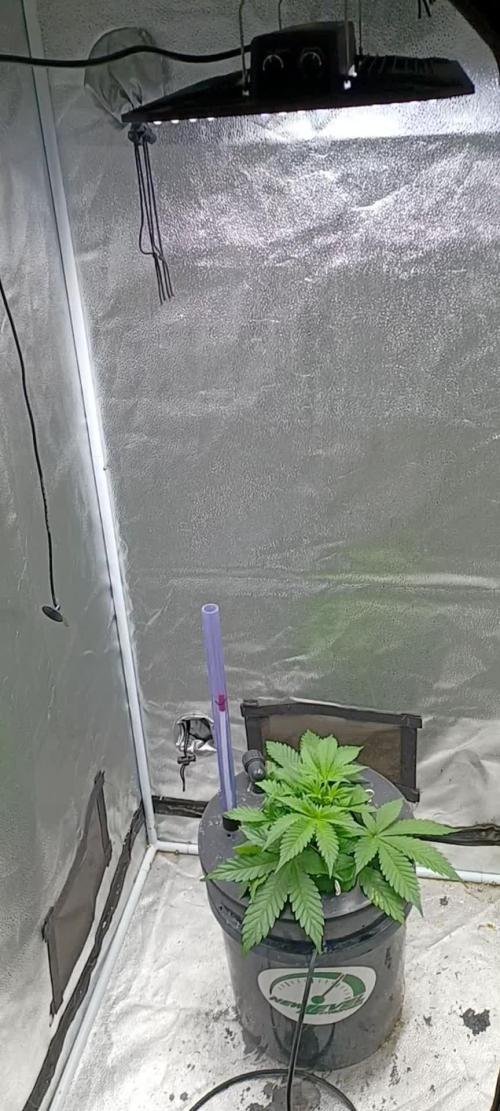
Flowering day 3 since time change to 12 / 12 h
Hey guys .
My cutting heating broke 3-4 weeks ago, which was fixed immediately and everything went wonderfully.
Now, 3 days ago, the central heating broke down in the entire room, so that at night I only have temperatures of around 13 degrees :-( .
One or the other lady is slowly starting to see a phosphorus blockage, as this can no longer be absorbed at temperatures below 15 degrees, like many other nutrients :-( .
A friend looked at the heating yesterday and came to the conclusion that a real company had to do it, which is by no means possible for a stranger to enter my room.
I quickly ordered heating mats for all the boxes so that the ladies could at least get warm feet.
That's all I have this winter full can do .
Let's hope everything will be fine 🙏🏻.
As soon as the heating mats are attached in the coming days, I will post them in the pictures.
Now for the update.
Despite the severe cold, the ladies are still doing well and have made good progres .
The ladies only had to be watered once this week, each time with 1 l, because it absorbs the water very slowly because of the cold and I don't want to overwater it.
I took every single plant in the pot to take a close look at their roots.
These are snow white and look very healthy 🙏🏻.
It was also the last time neem oil sprayed so that the last trips are finally gone.
Otherwise everything was checked and a lot of planning was done, like I do with the heating mats.
Since a friend had the same problem in one winter and the heating mats got 10 degrees plus on the pots, I am very confident that it will at least bring something for the last cold month 😃
🙏🏻.
I've started flowering even if some are still a bit small, but otherwise they'll get too wide from training and end up taking up space :-)
until then have fun and stay healthy 🙏🏻
👇🏼👇🏼👇🏼👇🏼👇🏼👇🏼👇🏼👇🏼👇🏼👇🏼👇🏼👇🏼
You can buy this Nutrients at :
https://greenbuzzliquids.com/en/shop/
With the discount code: Made_in_Germany you get a discount of 15% on all products from an order value of 100 euros.
👇🏼👇🏼👇🏼👇🏼👇🏼👇🏼👇🏼👇🏼👇🏼👇🏼👇🏼👇🏼
You can buy this strain at :
https://www.exoticseed.eu/de/hanfsamen/lemon-candy
Water 💧 💧💧
Osmosis water mixed with normal water (24 hours stale that the chlorine evaporates) to 0.2 EC. Add Cal / Mag to 0.4 Ec Ph with Organic Ph - to 5.8 - 6.4
MadeInGermany


Likes
7
Share


@Organic473
Follow
Sticky and smell with a couple of bud Roth due to high rain fall. With 3 weeks away from finishing and full moon just passing on 17th October I am hopeful the sun would shine for the next three weeks.

Likes
57
Share


@ThrashedTV_BakedByGlaze
Follow
Week 4 - 01/22 to 01/28 2021
Pictures from Days 25 + 26
TRANSPLANTED! Might have waited too long but hopefully the transplant and LST stress might slow the plant down since i think it's already flipping to flower like the Red Poison & Purple Lemonade in my other diaries 😱
Ended up more 50/50 ratio of Destiny Organic's Dark Matter Living Soil + ProMixHP since I had to make the Destiny last. Apparently they went out of business just after I decided it was my favourite/new soil :( Would rather stay away from Ocean Floor since I haven't had the best experiences with it (bugs/rust fungus etc) Feel free to drop some recommendations other than Fox Farms below 👍
The Dark Devil Auto is otherwise healthy and starting show hints of colour in the stems 😈
I raised the @ViparSpectraLED P1500 another eight inches after transplant and started basic LST. I really wanted to get these four under a ScrOG but if 3/4 are already flipping and the LSD is still runty I might have to wait it out again.
It already has a solid skunky/hash plant smell on the fingers after adjusting them and it looks like it might actually be a tripod mute with three flower sites per node. Hopefully I can stretch it out and take advantage of the extra bud potential 🙏
I have the @MarsHydroLED TSL2000 set up and ready to go once the girls settle into their new pots. Have the new surge protector/heavy duty power cords/power tool grade timers as mentioned in Week 3. Some of it shown in the pictures.
Threw some videos in this week as well with some Queen's Radio GaGa, Beastie Boys' Brass Monkey, and a little hint of Arkells ....COME TO LIGHT on the short @ViparSpectraLED ..GET IT.. 😓
--
Thanks for checking in! Throw down a like and/or follow so I can return the favour 🙌
Check out my Diary of the Year 2020 Entry for my Original Auto Sour Diesel: https://growdiaries.com/diaries/54258-fastbuds-original-auto-sour-diesel-grow-journal-by-glazedgrow
IG: @GlazedGrow
CannaBuzz: @GlazedGrow

Likes
9
Share


@420keef
Follow
Outcome was alright since i had a mite infestation for so long, still happy of what i got out of the plants! will update on dry weight and taste etc. Also that was the first time in grew with “decent” equipment, since i don’t have alot of money to spend i got these quantum boards off alibaba & i’m pretty impressed off what they are able to do!

Likes
5
Share


@Mr_nugs_lover_David
Follow
Very terpy smell, strong and very citric like a pure lemon, very lemony smell basically, nothing crazy but it's very nice, she's producing a lot of resin, you can see she's a good autoflower, not the bets I've grown but it's nice to have something to Harvey's fast. 100% organic grown
Likes
24
Share


@Jays_Not_Here_Man
Follow
The girls are starting to wrap up their cycle. I have been watching the trichomes closely, and we are getting very close..Trying to pick the best day for both of the strains I have going at the moment, the Apple Betty are a little closer than the cookies, but they are very similar in readiness…
I’ll be checking daily, I did get a wireless microscope for Christmas so it has become much easier to tell👨🔬 I’ve got mostly cloudy, with a few clear, but I am waiting for a bit more amber to give them the couch lock that I like when I smoke. Boxing Day was the end of week 8, so any day now! Happy Holidays Growmie’s! ❤️🇨🇦😎🎉


Likes
9
Share

@Roberts
Follow
Mintz Runtz automatic has been growing great up until the last 2 days she showed some spotting on the leaves. I did a solution change today. So that should be resolved. I will also be adding the Elufah Saturn 240 under canopy light when she starts stretching. I did lst the top several days ago. The plant is growing very compact at the moment. Hopefully she stretches out and fills the tent by the end. Thank you Spider Farmer, Spliff Seeds, and Elufah. 🤜🏻🤛🏻🌱🌱🌱
Elufah (Power by Growpros solutions) UAP1500,Die-cast radiator and featuring an optical lens design(Uniform PPFD),150W,PPE3.0μmol/J,PPFD1500umol/s/m²,Use the verified commercial-grade spectrum;Full/Epar Boost Spectrum adjustable,A very excellent grow light;
By entering the discount code, you can enjoy an additional 10% price reduction when making the purchase.
Amazon discount code:SAVEURCASH10
product Link:https://a.c1ns.cn/uap1500
Thank you grow diaries community for the 👇likes👇, follows, comments, and subscriptions on my YouTube channel👇.
❄️🌱🍻 Happy Growing 🌱🌱🌱
https://youtube.com/channel/UCAhN7yRzWLpcaRHhMIQ7X4g.

Likes
12
Share


@NONSENSE
Follow
Good harvest and excellent buds. Buds are loaded with a lot of THC, which provides a powerful multifaceted effect, combining daytime high and relaxing evening stone.
I like to smoke this kind and relax while watching TV or playing cards.
This strain is easy to grow and I have not had any problems or overdose of fertilizers.
In the fourth week, the plant has more than doubled its growth - up to 30cm.
I did not change the main indicators of the microclimate, but again slightly corrected the nutrition scheme: I added NESY KOKO 20ml to 5 liters of water.
The bush looked healthy, strong and the first signs of pre-blossom began to appear on it.
Flowering began on the 45th day.
The plant was stretched out at a frantic pace - almost 4 centimeters a day. Thus, by the end of the 7 week, its size was already 45 centimeters.
With the beginning of the eighth week, the elongation of growth stopped. The final height (along the center line) was 60cm. I decided to shorten the light period - now it was 12/12. I started use HESI PK 13/14
HESI BOOST.( once a week)
At 9 weeks, I started to gradually defoliation. The bumps were very heavy and dense, so I gently pulled them to the center cola, as the side branches might not be able to handle the weight.
From the 11th week on, I stopped feeding the plant, giving it exceptionally clean water for flushing.
The trichomes began to turn cloudy and signaled that it was time to harvest.
By this point, I had completely removed the foliage from the bush - everything was ready for harvesting.
I dry cut buds in the same grow box where they grew. I haven't tried these buds yet.
I was pleased with the quality of the strain. The center kola, as well as the side branches, gave me an excellent harvest.
As for growing, I did not experience any difficulties.
I recommend using a charcoal filter when growing - the variety is very aromatic.
After drying and curing, I will take a sample from the finished product.
On the way out, I got a first-class, top-quality IndiCA. The taste is dominated by pine woody notes.
The effect has a powerful relaxing effect and awakens a brutal appetite in me.
I like to smoke this kind and relax while watching TV or playing cards.
Thanks to sponsor HESI for nutrients I got this report.
I am very pleased with the result. The whole cycle I had no problems with the growth.
In the future, I ll sure to use their further line of fertilizers.
I added fertilizers according to the table from NESI.
1. The level of PPM is relatively low and it is large
2. The PH level was corrected automatic and I have a video about it.
3. Due to the content of B vitamins and natural sugars, the flowers grow naturally and fast.
4. NESI complex was enough for full grow cycle. I did not add any extra food.
5. The end product is easier to clean as the PPM level is low.

Likes
8
Share


@AutoCrazy
Follow
This plant is a Beast! Can’t believe how big she is for being in a 20 gallon pot. She is starting to fatten up now!
🍿😎
Dinafem nailed it with these genetics!

Likes
22
Share


@Top_Banana
Follow
This OG Zombie is turning out to be a super strong plant. The size difference 3 weeks ago when she showed her pistils for the first time to now is unbelievable.
Likes
9
Share


@Siriuz
Follow
Alright guys so last time we went from 1400 to 900 ppm only adding plain water
She is doing great, developing more new buds and fattening those small pop con buds you get below where lights wont get thru with that much intensity....
Smells wicked good and should taste awesome once its dried and cured
Im still going to week some more weeks
I dont know if is the region but my plants over here since is always spring and SuMMer they tend to produce and last longer i just noticed because even tho we at week 15 they still growing new buds which is kind of amazing
I still got one gorilla girl xl
This one is going to grow using only
LST / HST and defoliation at the latest
Otherwise it will slow down production
Learned the hard way with this strain
My first one died the second one got eaten by a worm go figure and this third seed made it so far and when she was flowering I accidentally main line her, good thing duct tape was near me so I could help her heal and with so much caring she was finally up again and did not lose any buds but that took too much energy while pre flowering did not create many spots but good dense fat buds full of crystal and at least you get to see those impressive colors
Thanks for giving me support
Likes and comments are always welcome
You can also suggest me things as well
I am all ears brothers happy growing
Follow me for more at the Instagram
@cannagrowersiriuz
Have fun
P. S.
ADDING MORE CONTENT AS IT GOES!
Enjoy the videos and my thoughts about
Gorilla Girl XL from sweet seeds
At week 15 from seed
Schedule 18/6
Likes
3
Share


@GoodTimesOrganics
Follow
Die Pflanze entwickelt sich wunderbar 😁
Durch das Supercropping geht sie schön in die Breite und entwickelt wunderschöne Blütenansätze.
Leider habe ich einen leicht Thripsbefall im Zelt und die Raubmilben plus Florfliegenlarfen sind schon unterwegs.
Pestkontroll gehört zum Biogrow eben dazu.

Likes
11
Share


@adam_pawloski87
Follow
Pre98 Bubba , oh how I’ve missed you for so many years! These ones came out absolutely gorgeous! Loving the the purple phenos 😍 ! These ladies liked to stretch quite a bit so you’re gonna want to use some LST on em but I also recommend topping at least 6 times to get a better bang on your yield ! Expect nice tight purple buds with a tremendous amount of frost covering, some of the frostiest Bubba I’ve ever had! Over all I give it 10 stars an would definitely over an over run this strain!

Likes
6
Share


@nonick123
Follow
Día 30 (10/06) Sigue creciendo. Tendrá un tamaño medio me parece
Día 31 (11/06) Sigue el stretch y empieza a florecer
Día 32 (12/06) Come on! Tendremos una planta más o menos decente
Las Autos deben germinar en Light Mix antes de que las raíces lleguen al Super Soil! (30% Light Mix - 70% SuperSoil)
Día 33 (13/06) Sigue creciendo
Día 34 (14/06) Riego 150 ml de H20 pH 6,5
Día 35 (15/06) Se ha quedado una planta de tamaño medio. Algo saldrá
Día 36 (16/06) 500 ml de Té de Floración con Healthy Harvest 8 ml/L + Insect Frass 16 ml/L + Melaza 1 ml/L
💦Nutrients by Lurpe Solutions - www.lurpenaturalsolutions.com
🌱Substrate PRO-MIX HP BACILLUS + MYCORRHIZAE - www.pthorticulture.com/en/products/pro-mix-hp-biostimulant-plus-mycorrhizae
Likes
299
Share

@Roberts
Follow
It is harvest day on my green crack by seedsman. She is a monster auto. Thanks again for the likes, follows, and subscriptions on my YouTube channel. I appreciate the support.😀🌱🌱🌱

Likes
11
Share


@CHILLING_RACOONS
Follow
Hi Dear Friends, 👨🌾 👩🌾
Now it is recovering good, but the start was a bit difficult :P
Week update, finally the plant is growing like a normal plant... until last week it seemed to be blocked..
Small internodal space, thick stems and nice structure
✅ VEGETATIVE week #7 (LAST WEEK)
30/12 SWITCH 12/12H
📅this week goes from 26/12 to 01/01.📅
💡💡💡Viparspectra XS2000 is working at 50% power.
💉🔍Fertilization schedule:🔍💉
26/12 3ml/lt TOP VEG
30/12 TOP MASS 0.2ml/L + 2.2 ml/L TOP VEG
31/12 SENSI CAL MAG EXTRA 2ml/L foliar spray
The first one is dead.. this is the second seeds, the third one died too...
WE ARE BACK!!!
We are back after a little pause.
We take a break because we were too busy to post high quality diaries. In the last diaries we tried to post as good as possible and we have to publish about 6 or 8 diaries (in addition to these that we will publish shortly). We opened also an educational Instagram page, we growed a lot in a short amount of time BUT, Instagram suspended our account and we lost all our posts, I was so sad and disappointed... a lot of work lost in a night....
Now we started a new grow with six awesome strains!!!!!
In this diary you will see our journey with Peanut Butter OKGB by Original Sensible 🤩, sit down and enjoy the show!
We are growing in a 15L Smart Pot with Light Mix soil by BioBizz
DATA SHEET:
Do-Si-Dos , Cherry Pie Kush, Secret Hybrid
Genetics: mostly Indica
Yield: 700g/m² indoor
flowering time: 50/55 days
THC: 25%
Aroma: buttery nutty
Effect: relaxed sedative power
💸💸💸💸💸 Here you can buy seeds of this top shelf strain: https://originalsensible.it/original-sensible-seeds-peanut-butter-ogkb-fast~21712
🔧💡OUR SET UP💡🔧
✔️ 💲💲💲VIPARSPECTRA 🚀🚀🚀🌕🌕
ViparSpectra®️ XS2000 240W Infrared Full Spectrum LED Grow Light:
Excellent ratio between wattage and ppfd, excellent light penetraton, perfect light spectrum (it also has IR 🤩) and it has the best build quality on the market. Until now, built quality is really awesome. You can touch that quality. Materials are really strong, excellent driver and the best leds on the market. Heat dissipation is perfect, the lamp is never too hot and it has a passive dissipator so you will have zero noise. It also has IP65 certification. I like that this lamp is bigger than others, so the 240w of power are well distribuited on the space. Viparspectra has an awesome customer service, and shipping was creazy fast!
This awesome brand also offers 3 years warranty.
This lamp has no rivals.
A special thanks to Emily of Viparspectra ❤️❤️❤️❤️
HERE YOU CAN BUY THIS PROFESSIONAL LIGHT: https://www.viparspectra.com/products/xs-series-xs2000 or https://amzn.to/3dyUoJl
and here you can buy other awesome stuff: https://www.viparspectra.com
✔️ 💲💲💲MARSHYDRO 🚀🚀🚀🌕🌕
📦120X120 GROW TENT: an awesome box, easy and fast to assembly. Made by strong materials, solid zips and it is totally lightproof. The position of holes is optimal and the two lateral windows will make easier the work inside the box. There is also a double end, so you are 100% sure that dirt or liquids will not spill out. You can find it here: https://www.mars-hydro.com/grow-tent/buy-mars-hydro-grow-tent-48x48x80-1680d-4-x-4-size-keeps-all-light-in-top-quality-1680d-canvas-is-tear-proof-and-double-stitched-light-blocking-fast-installation-for-sale
💡TS 600 FULL SPECTRUM 100W LED GROW LIGHT : with this light you will achieve excellent buds, you will not need anything more. This lamp replace a 150w HPS lamp, but, with this Led Light you will smoke bigger, harder and tastier buds because Led have a complete spectrum and a powerful light penetration, so your plants will work as much as possible to make you happy. Psssssss it it extremely cheap and it is only 100w, your bills will never be too high, YOU HAVE NO EXCUSES!! Here if you want this little beast: https://www.mars-hydro.com/led-grow-light/mars-ts-series-led-grow-light/mars-tsw-600-led-full-spectrum-hydroponic-led-grow-light
Thank you Eleen of Marshydro❤️❤️❤️❤️
💣Quantum board - 480w - 4x120w Boards by Zhoangshan Koray Opto-Electronic Ltd.
Samsung LM301B 288 led/board 3000K 0dB noise
+24led/board led Osram 660nm
Efficiency 2.6 umol/J 220 lm/w
Driver: Meanwell HLG-480H-36B
💣Quantum board - 240w - 2x120w Boards by Shenzen Yuanhui Led Ltd.
Samsung LM301H 504 led 3500K 0dB noise
+24led/board led Osram 660nm
Efficiency 2.7 umol/J 220 lm/w
Driver: Meanwell HLG-240H-48B
-ESTRACTION FAN:
Blauberg 125 Turbo Pro Series
Maximum air flow: 430-560 m³ / h 50W 32-44 dBA
-FANS:
A)OSCILLATING FAN D.15cm 2 speeds 20w
B) COMPUTER FAN Sunon DP200A – 230V 20w (Strong, reliable and quiet)
C)Cornawall Electronics Multifan Turbo, three speeds, can be used both on support surfaces and mounted on the wall. High capacity, about 740 m3 / h. High silence and reliability.
💊💉💊FEEDINGS:
We used BioBizz light Mix
TOP CROP:
-DEEPER UNDERGROUND: to stimulate roots system
-TOP VEG: for a excellent growth in the vegetative phase
-GREEN EXPLOSION: to promote creation of bud sites and to allow a faster growth
-MICRO VITA: bacterias for equilibrate the soil and to make the plant healty
-BIG ONE: to stimulate bud sites and to stimulate resin production
-TOP BLOOM: to achieve excellent big and hard buds
-TOP CANDY: to feed the buds with molasses for a tastier smoke and to gain weight
-TOP BUD: to enlarge buds and to gain weight
PLAGRON: PK 13-14 to have big and hard buds and to feed plants with lower effort
ADVANCED NUTRIENTS: Sensi Cal-Mag Extra-> for cal mag deficiency
GROTEK: CAL MAG for cal mag deficiency
HESI: PowerZyme to clean and balance the soil. It feeds the plant cleaning the soil.
GHE: - Final Part (ex Ripen) accelerate the final flowering phase, dissolves minerals in excess
- Flash Clean to flush the plant and to be sure that all excesses are out from plant and pot
These two products improve A LOT the smoke of our babies
-PURPINATOR to stimulate flavonoids and to have a better taste and smell.
____________________________________________________________________________________________
🙏❤️ THANK YOU FOR BEING HERE ❤️🙏
Please leave a comment with your opinions, it is very important to us to have a comparison.
If you like our job, tap the weed button and follow us. It will be really appreciated.🙏
We want to thank again everyone that help us in our project. You support us to support our dream. ❤️
SPREAD THE LOVE OF THIS PLANT ALL AROUND THE WORLD
🌿Thank you again🌿
❤️Sweet hugs❤️
👨🌾CHILLING_RACOONS👩🌾


