


Likes
Comments
Share


@R1pp3r
Follow
Una rama quebró por mucha tensión pero se recuperará.
Se regó de forma foliar con jabón potasico y tierra de diatomeas para reforzar la planta contra plagas y hongos

Likes
74
Share


@Ferenc
Follow
Hi! 3rd edition is on the way! Thanks for RQS /James/, Spliff Seeds, Emerald Triangle Seeds for these beans and support.
Thank you ViparSpectra providing me this outstanding quality XS2000 light.
16/09/2021:
Seeds are placed in the water and now I will leave them in it for approx 18 hours.
17/9/2021:
Hiiiiii!
They had been in the water for almost 18 hours. Tested them after several hours just a little push if they sink. They did so they supposed to be viable. Spliffs Strawberry was a bit more nasty the seed didn't want to submerge easy but it did.
Northen Light is crazy tap root is already out of it was a race she would have already won it lol.... less the 18 hours tap root out in the water nice...
Rest of them are normal nothing much to say!
So I placed them between damp paper towel and we waitin'
Let's gooooo
19/9/21:
The winner of the race is Northen Light tao root was out even the day when I placed in the water.
Cookies Gelato is the second and then Mastodon Kush and the Spliff kids.
Well, 2 of them coud not make it they submerged in the water but then that's all not sprouting at all. This 2 Afghani Gold and Spliffs Strawberry have been replaced with another try /seeds/.
So hopefully those will be alright.
Anyways, rest of them are planted with today.


Likes
17
Share


@Crumbles
Follow
Topped all the ladies at day 22
Starting to really stretch so should slow them down and grow out the bottoms
Day 24 thinking I might retop these in a few days
Day 25 looks like I’ll have to top the mandarin punch again
Going to be tall girls
Day 26 starting to go for it going to get two mothers one og kush and other mandarin punch
Day 27 two of above pheno s are way ahead of there girlfriends 😊
New rhino filter coming tomorrow, ready for the sweet smell of ……
Day 28 well end of week 4 could put into flower but will grow on and get decent strong branches and maybe re top them 😊


Likes
5
Share


@birdmountain
Follow
Es war Zeit für die Ernte, im Urlaub hatte sich an der Pflanze im Folientunnel Schimmel an der Hauptcola gebildet und auch etwas an der Pflanze auf der Terrasse. Es hatte in dieser Woche sehr viel geregnet. die Pflanze wurde geschnitten und zum Trocknen aufgehängt.



Likes
6
Share


@603grower
Follow
These girls didn’t give me any issues at all. They just screw themselves. I planted one seed and when I did the mainline, I cloned the top, which is how I ended up with two plants. I can’t believe how big the buds got all this girl trimming it was a nightmare. There was so many leaves, some of the buds are so big that I did a small amount rot in one of them It’s so happened to be the biggest bud. I was running the humidity kinda high about 60% the whole time. About this plant doesn’t have much of a nose on it but she looks great and Got over these two.

Likes
2
Share


@eldruida_lamota
Follow
Que pasa familia, vamos con la séptima semana de floración de estas Gorilla Melon feminizadas de fastbuds.
Vamos al lío, de las 3 plantas, me quede con 2 por espacio, siempre pongo alguna semilla de más por si no abriese alguna por no perder ese hueco del indoor.
Y ya superaron el shock provocado por el mismo trasplante.
El ph se controla en 6.2 , la temperatura la tenemos entre 20/22 grados y la humedad ronda el 50%.
Ya empiezan a formarse las flores y progresan a buen ritmo.
Hasta aquí todo, Buenos humos 💨💨💨

Likes
2
Share


@HIAZ_urbanbudfarmer
Follow
Back 2 are on week 5 day 34 of flowering & front plant Orange sherbet clone is week 8 day 54 & very close to harvest, changed her over & flushing with water & Rezin only. Awaiting delivery of a new 60x microscope lense to view trichomes but the buds look like their just about done. Calyx closed & swollen, amber pistils curling in, they are nice & dense buds.


Likes
10
Share


@DeepRootsGrowTrees
Follow
APRICOT GORILLA AUTO
/ GANJA FARMER
WEEK #13 OVERALL
WEEK #7 FLOWER
This week she continues to stack as her buds get bigger and more dense she's got great trichome coverage and has sweet gas like smell to her. Stay Growing!!
THANK YOU for stopping by and taking a look it's much appreciated!!
THANK YOU GANJA FARMER!!!
APRICOT GORILLA AUTO
GANJA FARMER


Likes
8
Share


@HazeGrowGang
Follow
Buds are looking hairy and pretty dense not the exact look I was going for but its looking kinda good but I don't think this will be my best grow I'm not exactly sure what went wrong. I'm looking to get that real nugget looking type of bud and less hairy and airy. Please Help!

Likes
9
Share


@pzwags420
Follow
On day 1 I transplanted 2 BB clones into 3 gal smart pots with coco coir. I watered them in with veg formula and set up my blumat watering system with week 1 flower nutes. I raised PPFD to 600-700.
On day 2 the reservoirs PH was adjusted from 6.4 to 6.0. The rez is 823 ppm. The tops are 16.5" from the grow light. The blumats have not started watering yet and I will monitor to ensure it goes smoothly. I have the blumats set at 1.25 carrots on left plant and 1 carrot on right plant. The average PPFD of my 16 tops is 703 PPFD. I increased temps to 85 day 81 night to get leaf surface around 80 f during day.
On day 3 the reservoirs PH is 6.2. The rez is 782 ppm. The blumats have started watering and I will monitor closely over the next few days.
On day 4 the reservoirs PH was adjusted from 6.3 to 6.1. The rez is 717ppm.
On day 5 the reservoirs PH is steady at 6.1. The rez is 706 ppm. The highest top is 15.25" from the light. I defoliated to bring in more air and light to deeper into the canopy. I increased the flow rate of blumat by .5 carrot on the right plant as it was a little to dry for my liking. The Clones are preforming well.
On day 6 the reservoir PH is going down so I adjusted up from 6.0 to 6.2. The rez is 730 ppm. The highest cola is 14.75" from the light. The left plant had a runaway so I reduced blumat by 1 carrot. I increased flow of blumat on right plant by .5 carrot as it is still drier than I would like.
On day 7 the reservoirs PH was adjusted from 6.3 to 6.0. The highest cola is 14.25". I reset rez with nutes.

Likes
7
Share

@PrinceOfHerbs
Follow
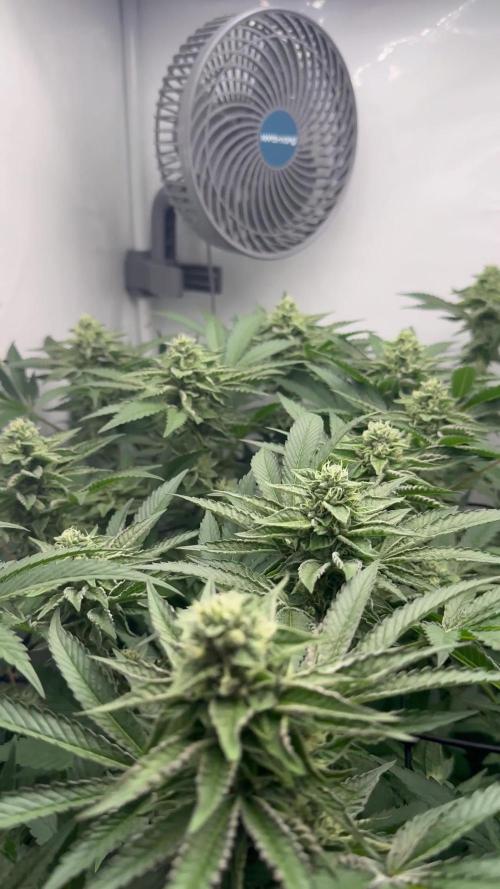
The plant is growing perfectly and is already getting very thick (the flowers).
Resin is constantly forming and the smell is like a candy factory.
There is still hope that the flowers will change color slightly, but it is difficult to get below 27 degrees during the day
Flowering day: 34

Processing
Likes
15
Share


@420Consinc
Follow
Week 5
----- Day 29 -----
Fed 1100ppm at 6.4ph 23 Liters
Everything's good.
No real updates. Front right Glookies stretched a bit but has stopped.
Plants are perfect, couldn't ask for a better beginning to week 5.
*Update*
Easy day, end of light cycle. 3 new pics.
---- Day 30 -----
Some fun photos today for this easy day.
Humidity in basement FINALLY hit 40% this morning. Within 5 days it should be 30-35% residual basement and 45% tent for a good residual humidity.
The hand shot has my fingers and palm forward from the bud tip, the bud tip is actually past my hand but it's nearly impossible to get a perfect shot with my arm in the tent and my other one far out trying to take a photo i can't see.
The Tropicanna Popcorn nugs are already bigger than my thumb... gonna be fun in 4 weeks to see bud finishing sizes
Wedding Cake - Cherry HubbaBubba smell
Tropicanna Glookies - Pink Bubblegum with a strawberry like hint peaking through.
Tomorrow is feeding.
Today is just emptying water from buckets from dehumidifier.
*knock on wood* it's easy streak from here on out... 35~ days roughly left. here we grow!!
*** Update ***
Took some measurements. Wedding cake is monstrous already. Upto 1.5 inch wide, 14inch long (it was longer than the 12" ruler). Popcorn nugs on Tropicanna Glookies already 1inch wide 3 inch long at the top.
Beaaautiful.
Slow and steady from here on out.
----- Day 31 -----
Beautiful as usual. Fattening up nicely.
1200 ppm 6.4 pH 23 Liters
If anyone is wondering why I switched to Blackstrap Molasses I put up the Nutrition Facts..
in 20 grams you have carbohydrates, potassium, Calcium, Iron, B6 Vitamin, Magnesium, Zinc.. and that's only the "significant" nutrients (Human based for that picture) It also contains micro traces of copper and more.
pH is quite nice too, with the nutrient regiment i'm on, it finishes itself at 6.4pH so I don't have to manipulate it with pH up/down...
Loving everything so far.
Humidity in basement was 39% today, SO damn close. Tent closed at lights on (highest residual humidity point) was at 48% ... woo hoo 3% more to go!!!
------ Day 32 ------
Wow. Wedding Cake larger buds I can't even wrap my hand around.. These buds are going to be mooooonstrous.
Humidity was under 40% in basement, tent was 48% this morning. Great news for me.
Easy day, pretty much standard operating procedures from here on out.. feed, drain dehumidifier, strengthen stems by shaking plants, open/close tents... rinse repeat.
Both plants are amazing, great genetics so far regarding bud structure building/plant size.
----- Day 33 -----
47.5% residual humidity
Fed at 1150ppm 6.4pH 23L
Everything's perfect, 30~ days left.
----- Day 34 -----
48% humidity in tent, i'm a happy camper.
Everything's perfect. Bulk has started, front right Tropicanna Glookies had double in thickness and diameter top buds of most stems.
Wedding cake 14 inch stem I've named Big Bertha. Excited to watch her fatten up on the couch so-to-speak.
I'm now on autopilot. Fed yesterday while half asleep, didn't even remember doing it. Thank god I take pics of ppm/pH before every feeding for data.
One more feeding this week before week 6 happens tomorrow.
This week Liquid Koolbloom ends, KoolBloom Dry begins for maximum bulk on week 6 first feeding (2 days into week 6)
----- Day 35 -----
Last day of week 5!!!
Fed at 1150ppm 6.4ph 23L
Plants are perfect, humidity is great.
Smell is RAMPED up now. Strong candy weed smell.

Likes
15
Share


@Siriuz
Follow
Yo guys what's up
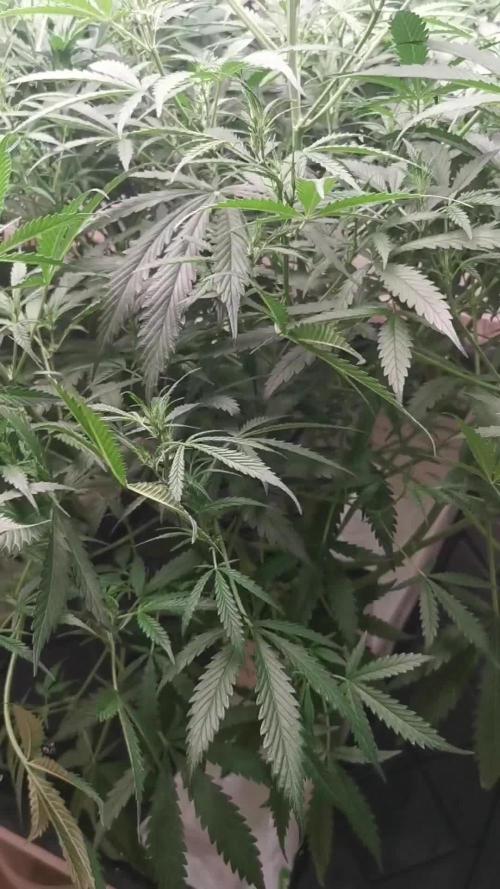
I added molasses for the very first time
Take a look, she's doing great
I'm happy for the training we've been giving her and now we are seeing some results
Alright guys let me know what's your advise
I think I'm going to be adding molasses after nutes every two days
********************************
UPDATED 08/03/2021
SHE IS DOING GREAT!
ID SAY SECOND WEEK OF FLOWERING ALREADY
WEEK 11 FROM SEED ' DAY 1 STARTS TOMORROW!
CHECK OUT THE VIDEOS AND PICS FOR BLOOM
TAKE CARE GUYS PEACE OUT!



Likes
18
Share


@growbville
Follow
Week 5
Flipped to Flower. Finally recovered from Light burn and spider mites. Closed up all my light leaks and added a little CO2 to the room. Will be adding more CO2 soon.
Added Trellis
Turned lights up to 75%