


Likes
Comments
Share


@hooolian
Follow
24/02: Colas again have become real heavy in places and have had to strap them together to prevent the stalks from falling and snapping. Over all blooming well have been on maximum dose of nutrients now for a few weeks. lots of orange hairs. water now for a week and then to harvest. the topping in this grow really paid off.

Likes
14
Share


@danwho
Follow
9/8/2024
Plant B showing signs of female with hairs coming from the pre-flower formations. Looks to be stretching and starting to push into flower as well. Plant A is growing insanely well! Continuing to defoliate daily by removing larger fan leaves here and there to continue to open up the canopies on both plants.
No complete water change yet since a few weeks ago. I have continued to add fresh nutrient water with an occasional pH-adjusted gallon of filtered water + cal mag.
9/10/2024
Both plants and stretching nicely and developing great canopies! Plant A is an absolute monster, plant B is small and compact but has really good node spacing already. I am expecting some nice flower development over the next few weeks!
Topping off the reservoir with about 1 - 1.5 gallons per day of nutrient water at this point. Continuing to prune a good handful of leaves and smaller growth from the plants to open up the canopy leading up to day 21 final trim. Trying to stay ahead of a huge stress event for the plants.
9/12/2024
Continuing to defoliate handful of leaves and prune smaller undergrowth. Cutting only 2-4 stems per day to avoid over stressing.
9/13/2024
Raised lights over plant A a few inches as it continues to stretch. Also trying to keep the lights low enough for plant B without burning the side branches of plant A.
9/14/2024
All week I have been adding nutrient water to the system. No water change or replacement. However today, I decided to introduce just pH-balanced water to drop the nitrogen concentration in the system as we transition into week 3 flower. Highest PPM throughout the week was around 900, average 800, low in the PM after pH water 700.
Had a minor flow issue with a root plug in one of the drain lines. Blew them out and flow returned.
Humidity in the tent has been slightly higher than ideal this week, although VPD has been around 1 - 1.4 with the lights on. Likely due to the volume of plant matter in the tent. Doing my best to keep up with defoliation and trimming. Day 21 flower will be much needed!

Likes
5
Share


@cookingwithninja
Follow
Week 2 day 7F. 2x bridal party on left, 2x queen on right. Added more lights day 7, now about 1000w.

Likes
16
Share


@PeppeItalia
Follow
Oramai non riesco a metterle più nella grow se non incanstradole una nell'altra.
Questo comporta che le piante prendono luce solo sopra, sto cercando di ovviare al problema mettendole al sole ogni volta che posso. Oggi 52 giorni dalla semina è il 6 marzo 2021.
Likes
21
Share


@MG2009
Follow
03/17/2022
9 weeks today 63 days
Time to break out my loupe to inspect for ripeness 😆✌️🏻seeds are loaded in tops l, so lower buds will be my focus.
Likes
12
Share


@Chubbs
Follow
FBA2510-week 1 of Veg
This week has been wild. Once the roots made a foundation the upper growth has been explosive the last few days. Really cool to watch and see the daily growth. I introduce calmag and grow nutrients this week starting at a 1/4 strength. All in all they've responded well showing no burn what so ever. Happy Growing
Likes
142
Share


@MadeInGermany
Follow
Hi people 🤗
A lot has happened this week 😄
The 3 Blue Cheese and 2 Kosher Tangie Kush which have been in the flowering tent for 1 week have become very bushy 👍
Unfortunately I just noticed that I completely forgot to take pictures of the Blue Cheese Phenotype # 3 🤦♂️🏻
The picture will be given later.
The rest of the Vegi tent is also progressing very well.
They are repotted in 11 liter pots this week, and then come to the flowering chamber die the following week
The next week there will be new pictures, until then I wish everyone a nice start into the new week 🙏🏻💪🏻
Let it grow 🍀🌱


Likes
29
Share


@Naujas
Follow
everything is going smoothly:) this week I did a haircut for my girlfriend, and a little LST, the girl has already recovered from the stress :) now I'm going on a short vacation, and I'll leave her alone for 4 days:) :) good luck to everyone.

Likes
4
Share

@jdean88
Follow
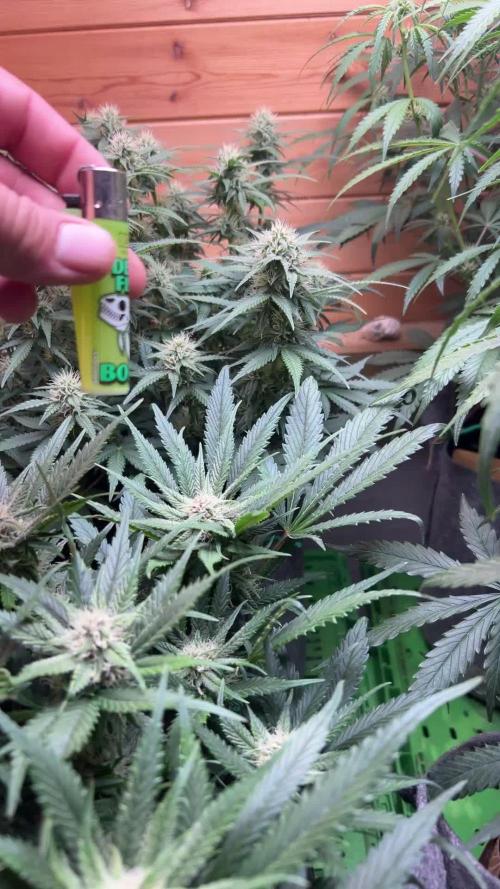
The blue dream and strawberry gorilla smell incredible I think the blue dream will put some nice weight on if she carry’s on this way the strawberry gorilla although a tiny plant she smells incredible like sweets haribo strawberry with a slight gas back note just wooow.the west coast and og are now huge they have stretch a lot but have so many buds sites forming iam expecting a monster yeild from both of this who might I add are feeding light photo periods and still want more incredible to think these are autos top genetics I hope it finish’s aswell as they started flower and iam going to have an amazing Christmas with lots of beau buds

Likes
4
Share


@DatGuyGrows
Follow
Soil level is a bit low after the transplant so getting ready to add some in. Took domes off and did first Nute feed on day 12. Using a FloraTrio mix with a touch of Cali-Magic and epsom salt

Likes
13
Share


@cheesensugar
Follow
noticed a little rust spotting on #2 and the purple so hit them with some epsom 1tsp/G in the resi...also top fed another dressing of Gaia Bloom 1tsp/G and watered in compost tea. They loved it ! Insane smells off #1 exactly what i want crazy candy lemon rindes terps...i get cakey / pie terps off #2 really sweet and the purple lemonade i get a pine nose and koolaid mix goin on ...blu-mats for the win too 💧💧💧light defo on blocked budsite and dead yellowing bottom leaf✌️
Processing
Likes
47
Share


@blazin_skywalker
Follow
This week I decided to recruit my husband to get a proper look at this girl's roots. She's gotten so damn big that it's impossible for me to get a shot otherwise.
Her root ball is massive. She's large and in charge. I went through and gave her another thorough round of defoliation.
What I removed was any droopy leaves in the underbrush, as well as any fan leaves that were casting shadows and blocking light from my bud sites.
When I was finished, I was able to stand over my plant, look down, and visibly see through to the base of my plant and grow media. Being able to do this suggests to me that my light source is also able to penetrate down throughout the plant as well. The removal of these leaves also contributed to improved air circulation and decreased humidity - both which are important as we progress through the flowering stage.
This week I also caught my first whiff of this plant's sweet aroma. I'm excited to see how her terps develop over the upcoming weeks! 😋😋😋
I cloned another branch off this plant. Baby Tester FF3s are slowly taking over my house. 😂
Thank you for following along! This has been so fun! ✌️ 💜 🌱

Likes
23
Share


@goeser
Follow
Now we are in week 8.
Plants stopped growing.
I will let them grow two more weeks and then I will at least harvest two of them.
Depending on the trichomes I will keep the other two for 4-5 weeks more, because I will be away ... traveling
lets hope that the sun is coming out again and that the buds get bigger and bigger in the last two weeks.
BTW I stopped giving any type of nutrients, just water.
Likes
8
Share


@ghost8782
Follow
girls are looking great i been following the advanced nutrients auto flower feeding chart im using 1/4 of what they say.This is the start of week 5 may 1st.I topped 2double grapes left the other 3 alone just lst opening her up to get more light
the smell is great the full tent photo is bottom left gelato auto fast buds behind that straw nuggets mephisto and the 3 others are double grape mephisto also defoliated every plant
Likes
29
Share


@gottagrowsometime
Follow
Welcome to my 🍋 🌳 diary. This is for the tiny/rare pot seedsman contest.
I have a .75ml cannacure bottle. Have a drainage hole at the end. And have it filled with light mix. Also, as I know its gonna be hard for the plant roots to breath I added my air pump I use for both my DWC buckets. I just made a hole and pushed the tube through a tight hole I made. So, o2/co2 will go straight into this mini little rare pot. Seed has been planted into the sub. I added a bit of dry soil in on top of the wet bioenhanced soil in the spray bottle. The root will then grow into the conditioned soil, I used bioenhancer from Green House feeding and I'll be using their mineral line as I said. I poured about 75-100ml of a 1g/1L of tap water. Didn't check ph as I know its 9.3. Maybe because it's light mix soil I should have PH'ed it. But it'll be fine. It'll take a few days before the root grows into it. And by that stage there'll be no shock to the young plant as it'll be somewhat stable. 3-5 days in. I'll start on a 2-300ppm feed including tap (that's 110ppm) so specs of grow powder will be used at the start to bring my ppm water up a little and as its light mix. She'll be begging for food come day 5, so if she goes off with a bang then I'll apply nutrients 3 days after she's up. Sadly she'll up going under a p1000 at full strength. But I'll have it in the corner and it'll be 100+cm away and I checked the lux and it's in the mid 10k-15k range so that's fine for a seedling. The temperature is perfect at 24/25c and with lights off 21.5-22.5. RH won't be up beyond 55 with lights on and 65 with lights off. As this is been added to 15 other grows. As None are in small pots. And I think this is somewhat rare. It has an injection of o2/co2 into a tight container on the lowest and middle level. Its pushed into the middle. (I made sure to make the push in with a stick 1st so the tube didn't block with soil) and when its turned on and you block the hole it expands. So airflow through the soil is very gentle but it flows great. I'm looking forward to this 1.
OCT/11TH Seedling Days 0-2. Took a little bit of an unwanted stretch. As its 100cm away from the light. It should of been closer. But, its doing well. There's no mutations or burnt looking tips so, only up from here.
Seedling Days 3-4 Good growth this week. Idk if its cause the way the roots are growing and don't have much to expand. And she's stretching a little. I decided to jump the gun a little earlier than I planned. So, I gave a very very light grow feed 250ppm (that's including 110ppm tap)Id like her to me at least 1/3 smaller (stem wise). I checked the lux and even though its nearly 100cm away. There should still be enough light so she should be trying to reach for it. Idk. I just can't move her closer as the light is doing 8 autos 4 every 24hrs and she also gets a 4hr rest by taking her out and into dark space. As I keep my 70cm2 tent running 24/7 as I wap out autos in it. So they get a 36-12 (24hrs under p1000) then when I turn on my FC 3000 they get put into it for 12 hrs, and I take the other autos coming off the 12hr rest the 100cm2 has. (Confusing I know) only way I can juggle so many plants that are different (autos&fems) and try make it work. And it is.
I'll update this week as soon as she's up out the ground.
Seedling Days 5-7 Plant is on course. But, I have a bad feeling. As my poxy AC intake failed to kick in when Temp went up to 30c and ran for that for 12hrs without venting. And I had the Air pumps turned on. So, she was getting 28-30c air blown into little bottle. So, sadly. I had to flush her with A h202 mix. GRRRRR. I know it was too long of high temp been pumped into it. That's gonna f..k it. Fingers, toes and nose hairs crossed I'm wrong. But I know this lady does not like hot conditions in small spaces. Let's see.
Maybe it could be the injection of the air pump maybe it's too early. I had to turn it off today anyways. Room temp was coming into 23c by so had to go off. But, hey if this is a by product of quick growth. Then I'll all for it. Let's roll onwards.
Seedling Day 5. Had to put a bit of tube in so I could tie the stem. Is it me or has she got even taller. I personally think..she's growing much faster than a normal fem. But it's early days and won't know true results till I reach day(s) 14-21. Then I'll get the measure of her.
Air pump has been turned back on. As room temp is back down to 21c. So, its safe to be used.
Shout out to my sponsor from barneysfarm who hooked me up with great beans. Much appreciated.
Likes
18
Share

@ZhulenejJohny
Follow
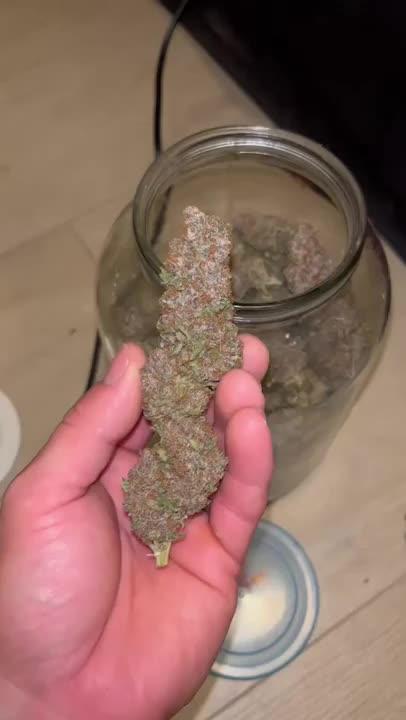
A je to konec dámy a pánové. Byl to náročnej grow skrz vedra, ale s výsledkem jsem spoko. Tak zase u dalšího dobrodružství! Peace 👽


Likes
24
Share

@MadeInGermany
Follow
Hi everyone :-)
This week it has developed really well 😍.
it was also topped for the first time. Like the Cup, I will not do an LST here either, just top it a few times 😃.
I wish you all a nice week, stay healthy 🙏🏻 and let it grow 🌱
Likes
1
Share


@CannaBreeze
Follow
Unfortunately, one of the two seedlings succumbed to the intense sunlight exposure of a single day and exhibited classic signs of stress and stem damage, succumbing within the first week. With only one seedling remaining, I decided to proceed by faithfully following the established nutrient schedule.
Here are the nutrients administered:
May 8th:
250ml of water
0.5ml of RootJuice
0.5ml of BioHeaven
0.5ml of Activera
EC: 450 nS
pH: 6.5
May 10th:
350ml of water
1ml of RootJuice
1ml of FishMix
1ml of BioHeaven
1ml of Activera
EC: 850 nS
pH: 6.5
Likes
7
Share


@Kushizlez
Follow
Day 84-91 (Day 3F-10F)
(Day 6F) I’m giving a final foliar spray of Velokelp tonight before I start to see buds develop.
Forgot to water today as I didn’t have any RO and bbb#1 was slumped and droopy. I decided to just water everything with tap water. I’ve been doing quite a bit of research on using city tap water with organics and it shouldn’t disturb the microbiology very much at all. And it will actually help smokability and ash color because of the extra CaCO3 in it. The higher 7.8 pH will also lockout heavy metals like aluminum as well.
(Day 7F) Plants look just fine and the pH fluctuation didn’t make any difference at all. I’m going to discontinue the use of RO water for the rest of my run and all subsequent runs.
(Day 8F) I’m defoliating small amounts of leaves and sucker branches but this thing is out of control. Every 12-18 hours I see noticeable growth. I want to do a heavy strip around day 21. Starting to see budlets and pistil clumps form! These plants don’t seem like huge stretchers but I’m still anticipating quite a jump in the next few weeks.
(Day 10F) Everything is looking just perfect. I’m surprised how fast these 10 gallon pots are drying out now. They go from soaked to light and airy within a few days. Hopefully I can make it the next 2 weeks without seeing any N or Mg deficiencies.
Likes
2
Share


@AestheticGenetics
Follow
6/24/25 Very stanky and gassy but not fuel. its got a very nice smell to it. Shes fading a little earlier than normal. but shes plumping very nicely. ill need to use a scrog or something else in the future to keep these thin branched top heavy nugs upright. shes leaning all the time from this way to that way. i have landscape staples placed in a triangle basically around the main stalk to keep it from deciding to lean a different way once I stake it
Likes
6
Share


@Thckaos
Follow
19-08-20 Se cambia de solución y se lava las raíces. Se baja 0.2 ms y PH 6.5. Luego se vuelve alimentar con una solución como hay en los datos de esta semana.
Se realiza los siguientes entrenamientos:
Planta 1: Supercroping, LST y scrog
Planta 2: Apical, Scrog y LST
Planta 3: LST y Scrog
21-08-20: PH: 5.8 Conduc: 1.35 ms
23-08-20: PH: 6.03 Conduc: 1.61 ms Sigo aplicando LST para intentar cubrir la mayor superficie
