


Likes
Comments
Share


Likes
19
Share


@MonroeGrow
Follow
Amazing strains! My favorite by far, that I have grown. I have lots of clones too, I’ll
Be keeping these around as long as I can! holler at me on Instagram

Likes
84
Share


@Mrs_Larimar
Follow
May, 18th
Amazing, thats the word that hits this Lady
No big talking , just doing AMAZING!!!
Started with additional Bloom Nutrients today

Processing
Likes
18
Share


@UKauto
Follow
Good week for her 👌🏻
Lights got flipped today after 24 hours dark.
Gonna switch to bloom nutes soon as She starts kicking out pistils.
Go time 😁

Likes
20
Share


@DreamIT
Follow
Sponsored by:
🎆ANESIA SEEDS🎆-💡VIPARSPECTRA💡-💐GREEN BUZZ LIQUIDS💐-🛠️WEDRYER🛠️
28/7 they grow monstrously well, next week they come into bloom
2/8 it took a few days of absence to discolor the leaves and dry out the soil. Today I will be watering properly with Green buzz nutrients fertilizers before sending them into bloom
__________________________________________
Personal advertising (contains affiliate links)
__________________________________________
🦄 The varieties of Anesia seeds all have an extremely high content of THC and cannabinoids. They were bred specifically for the effect and therefore find wide applications for medical purposes as well.
✅https://bit.ly/Anesiaseeds_
__________________________________________
Did you know that Green Buzz Liquids fertilizers are 100% vegan? A complete line of products ready to give the best to each of your plants! Visit the site and see my journals to see how they work 🦄
🤯 And with the code "dreami t" you will immediately receive a 15% discount on your purchases
✅https: //bit.ly/GreenBuzzLiquidsPro
__________________________________________
👀 Are you looking for a good lamp to start with? 👀
🌞Viparspectra has something more than the others, take a look at their site.
⏩ Use "GDVIP" for an extra discount on amazon or "DREAMIT3" for an extra 5 %% discount
👀 Search for it on Amazon
✅Amazon USA: https://amzn.to/30xSTVq
✅Amazon Canada: https://amzn.to/38udUVe
✅Viparspectra UE: bit.ly/ViparspectraUE
✅Viparspectra USA: bit.ly/ViparspectraUS
______________________________________________
🌈 Tired of blowing on your weed hoping it dries quickly? Check out the Wedryer website! You will find a well-made accessory that will help your weed dry in just 8-10 days without the annoying risk of finding mold or other annoyances! (no affiliate links)
✅https: //bit.ly/Wedryer_
______________________________________________
📷🥇Follow the best photos on Instagram 🥇📷
https://www.instagram.com/dreamit420/
Backup
https://www.instagram.com/dreamit4200/
🔻🔻Leave a comment with your opinion if you pass by here🔻🔻
🤟🦄💚 Thank you and good growth 💚🦄🤟

Likes
19
Share


@emeraldlabs
Follow
Time to move to flower tent; hopefully she fits!
Defoliating and topping the soil before moving her. Will continue defoliation for a few weeks.
Photos/video taken 77 days after breaking soil.

Likes
5
Share


@ROY4L_GU4RD
Follow
7/29/24 week 8. Flipping is around the corner. I have to defoliate before the flip. I added recharge nutrient this week to help the ladies have a quick recovery. I'm only feeding recharge with a 3 gallon res fill. I usually fill up by at least 6 gallons. What are yalls experiences using recharge?

Likes
3
Share

@sunshinegroww
Follow
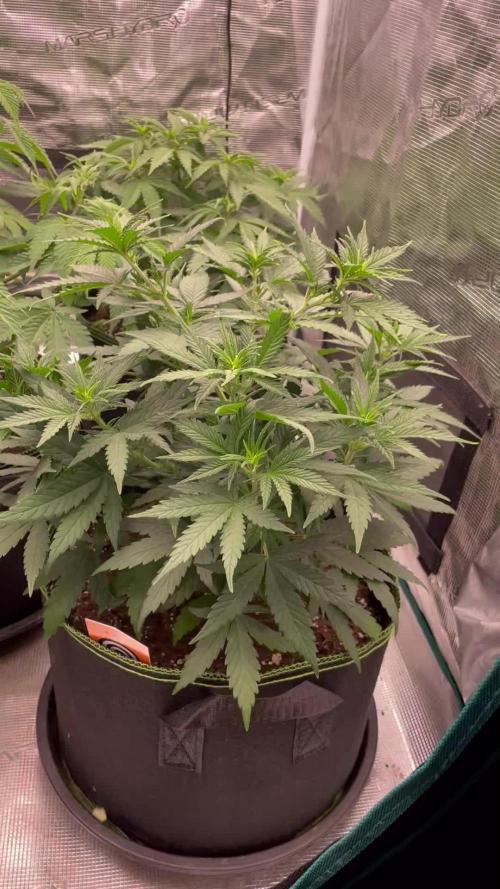
She had few leaves removed as had to battle RH but looking happy as ever so lets goooooo of to 12/12

Likes
26
Share


@DrRobeRt
Follow
Hello fellow Growers
Nancy had been droopy lately after her nute and light burn (Man she's had it tough) so I backed off on the nutes and she seems to be happier now - in fact, I think her buds are putting on weight now - slowly but surely.
Wendy, on the other hand, is Frikn bullet Proof! She's getting fatter and fatter by the day and I'm thinking that I will need to flush soon before the harvest.
Any tips at this point would be really appreciated - it's my first harvest and I wanna do it right ;-)
Peace oooot ;-)

Likes
46
Share


@valiotoro
Follow
Papaya is not the tastiest fruit BUT yes it smell papaya its subtle🤓
Purple Pheno : you know the grape sour candy?🍇🍬Thats the smell!
Green Pheno : its Papaya but Green Papaya Peel its hard to explain😝
Super frosty⚡️

Likes
33
Share


@Northern_Ent
Follow
June 7: she’s doing better but still not right after the frost a couple weeks ago.
Check out coyowolves howling on video.
June 8: removed frost damaged colas and composted immediately with coffee grounds, peat pot bottoms, some HP Pro-Mix from a couple of failed peat pots and LAB. Cannabis was assimilated almost immediately and it looked like good compost after about two days. This was my Coffee Canna Compost which was used for some autos.
June 10: gave it 2.5 mL/L of FPJ as a soil drench rather than just the usual 1 mL/L as a weekly foliar spray. Plant seemed to grow a lot in the next few days so maybe I should do that more often.
June 11: looking better since the frost damage setback. Not as strong in the cool weather as the two Quebec Cannabis Seed plants but as we move into summer this plant should be fine.
June 13: recovered the six inches of height lost when I removed the frost damaged colas.

Likes
3
Share


@Jay_thegr8
Follow
This is the week right before the 24 hour dark period and switch to 12-12 looking very healthy
Likes
12
Share


@another_grower
Follow
Final phase, just water and environment control.
A lot of damaged, stained and discoloured leaves. Not sure if related to the fert switching.
All in all, they are looking good. Harvest week incoming.

Likes
7
Share

@NSABND
Follow
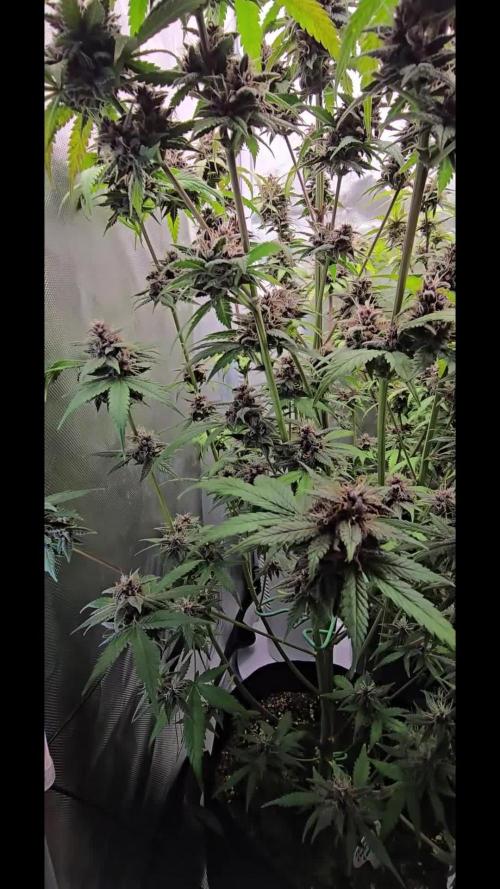
Day 64 the queens got some fertilizer 💪😃👍
Day 65 that massive smell and these juicy buds 😃👌
Likes
4
Share


@SuperGluedGrow
Follow
Number 2 pheno might herm on me so I have to watch but I have limited plants and I really want to keep these genetics so I need atleast one female. Number 3 the mutant stopped growing before I topped, or maybe not stopped but it threw out pistils at the apical meristem and not producing leaves so I topped to see if I could promote side growth but it hasn't worked; I'm going to keep her around just for the fun of it. 4 is my hope of producing female and a good clone.
Processing
Likes
27
Share


@Silverback_Guerilla
Follow
1/14:
This morning, I did a foliar application of big bloom and fulvic acid, then about 5 hours later I watered them with about a half-gallon of rainwater each and added armor si, humic acid, endoboost myco/tricho, liquid molasses, and a bunch of cal-mag. Today, I also I wired up and mounted my new samsung sun board strips (660nm/730nm) and my Solacure FlowerPower UVB fixture.
I'm running the deep red/far red bud boosters a few hours per day right now, but will run them for the entire photoperiod once I start flowering them. I'll run the UVB for 4 * 15-minute sessions a day for the full flowering cycle, and if they don't protest too much I'll increase each session by 5 minutes and evaluate again. Some strains are more forgiving than others and I've got 5 different strains in this space...so really not sure much time I'll get away with exposing them to the deadly rays without damaging them too much...😈
1/15:
I received one of the rapid led/growmau far red initiator pucks today. With the placement of my UVB light, I'm realizing I'll need another far red puck to have even and intense far red coverage, so I'm ordering another with Prime delivery and waiting to start flowering until I receive it.
I sprayed them down really well with ph adjusted rainwater tonight to rinse off nutrient build-up from foliar applications.
1/16:
I'm really excited to try flowering under 14/10. I grew photos indoors on an off for 15 years before I semi-retired. If I added up all the additional flowering time I could have done through the years if LED technology existed, I'd have had an extra truckload of bud to smoke.
I did another application of Axiom Harpin a|b Proteins this evening, right before dark. I'm expecting a big growth burst this week, leading up to the flower stretch. I really need them to trigger under 14/10 within 4 or 5 days🙏
...if not, I'll switch to 13/11 and wait a few more days🙏😟..if still no pistils are poppin, I'll go to 12/12 and chalk it up as bad luck or varietal indifference to Pr and Pfr manipulation.
1/17:
I fed each of them about 3/4 gallon of full strength veg nutes. This will be the last. I'll go with half-strength veg and half-strength bloom for a week, then go with full strength bloom nutrients until I start flushing them in 6-8 weeks.
1/18:
I installed the second far-red flowering initiator today and got all my timers configured for flowering:
=========================================
timer#1 - power strip with qb's and red boosters
10:00am -12:00am
timer#2 - (dual/independent setting)
sideA- 3-way cube with uva bars
10am - 3pm
7pm - 11pm
sideB- flowerpower uvb
1pm - 1:15pm
4pm - 4:15pm
7pm - 7:15pm
11pm - 11:15pm
timer#3 - far red pucks
11:00pm - 12:15am
timer#4 - sub-canopy tube
10am - 1pm
3pm - 6pm
8pm - 11pm
========================================
I also did some testing on the timers and sealed myself into the closet to check for any light leaks. All good.👌
1/19:
Looks like the FIM job didn't take on one of them..but she's got perfect symmetry. WIll probably have to just top her again next week...gonna be a tall one I think. Tonight is their first long night. It's ON!👍
1/20:
I watered them today with about a half gallon each. I'm seeing calcium and magnesium deficiences here and there, so added some boomerang and heavy cal-mag-Fe along with liquid molasses, humic acid, and endoboost myco. I also foliar fed with big bloom and fulvic acid.
That's it for week 4-

Likes
2
Share

@Colonel
Follow
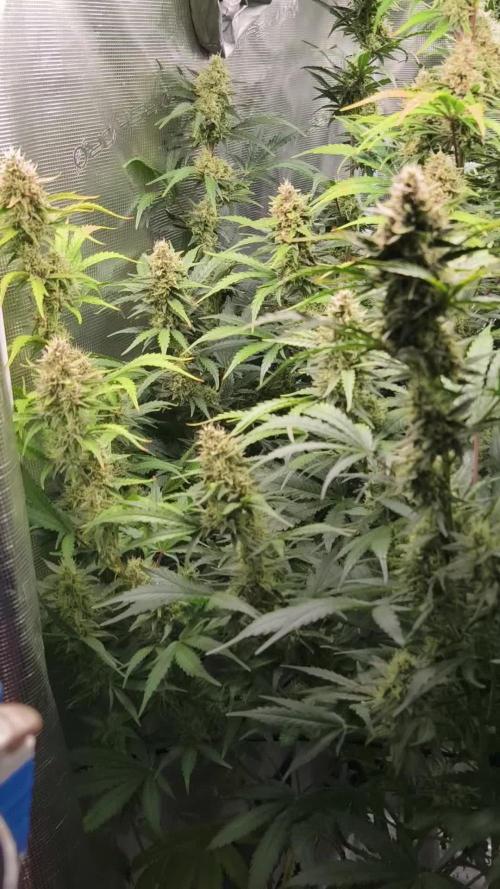
Сегодня я заметил нехватку магния и небольшую нехватку калия. Я добавил Plagron CalMag (0,4 мл), и в то же время начинаю постепенно вводить Plagron Green Sensation — начиная с 3 мл на 10 литров и увеличивая шаг за шагом.
Большое спасибо всем, кто следит за этим отчетом о выращивании.

Likes
15
Share


@DevelGrow
Follow
Hallo Freunde 👋 Frost Banger von Fast Buds ist 42 Tage Alt! Sie steht schön in Blüte und baut schön ihre Buds! ✌️🍀💚🍀


Likes
92
Share


@DogDoctorOfficial
Follow
Harvest Notes ✂️
• Harvest Timing: Papaya Zoap was harvested at day 63, with select buds taken earlier at day 56 due to mold concerns.
• Drying: After careful trimming, the buds were dried for 12 days. The quality and aroma during drying hinted at the stellar smoke to come.
• Density & Yield: Buds were rock-solid, delivering an excellent yield with perfect density for storage and enjoyment.
Terpene Profile & Aromas 🍋
• Primary Aromas: A tropical explosion with sweet papaya upfront, complemented by creamy, soapy undertones that make her truly unique.
• Complexity: As the buds cure, a hint of citrus zest and exotic fruit emerges, creating a full-bodied terpene profile that’s simply irresistible.
Cultivation Experience 💡
• Highlights: Her uniform growth, heavy trichome production, and response to super cropping made her a delight to grow. She thrived under careful spectrum adjustments and defoliation, showcasing her adaptability and vigor.
• Challenges: The dense bud structure made her more prone to mold, especially in a high-humidity environment. However, proactive monitoring and swift action mitigated the spread.
Verdict: 🌟🌟🌟🌟🌟🌟🌟🌟🌟🌟 (9.8/10)
Papaya Zoap is a strain that commands attention with her beauty, aroma, and unstoppable growth. While her susceptibility to mold required extra care, her overall performance, yield, and quality were nothing short of exceptional. A grower’s dream and a frosty masterpiece!
Stay tuned for their individual harvest reports, smoke reviews, and more as we wrap up this epic series!
Discount Codes so you can save big on your next check out 💚💚💚
Kannabia - DOGDOCTOR 30% off
SeedsmanSeeds - DOGDOCTOR 10% off
CannaKan- DOGDOCTOR 15% off
terpyz.eu - DOCTOR 15% off
The Neutralizer - PORKIT5-DOG 15% off
Fast Buds - DOGDOCT 15% off
As always thank you all for stopping by, for the love and for it all , this journey of mine wold just not be the same without you guys, the love and support is very much appreciated and i fell honored and so joyful with you all in my life 🙏
With true love comes happiness 💚🙏 Always believe in your self and always do things expecting nothing and with an open heart , be a giver and the universe will give back to you in ways you could not even imagine so 💚
Friendly reminder all you see here is pure research and for educational purposes only
Growers Love to you all 💚💚💚


