




Likes
21
Share


@Wicked_Stix
Follow
We are at 21 days from these girls breaking the surface and they are making progress. This little slurricane 7 had a rough start but looks like shes pulling through. I noticed at the beginning of the week that they were a little overdosed on nitrogen so I added 2 gallons of tap water to the reservoir and adjusted the ph to 6. They are still looking a little heavy on N but their growth rate is going great so I think it should balance out by the end of next week. I dont plan on doing a water change until I flower them. I left the plants alone most of the week. Tied most of them down to spread them out and defoliated a few lower leaves on day 20. The branches on most of these plants are thick and solid already. They don't budge easily. Bananasicle is looking pretty funky with uneven branch and node growth but we are just going to push forward. Still pumping nutrients and beaming light 24 hours a day. I'm thinking day 28 we will switch them to flower and see if any of these ladies can bring some❄️🔥💨

Likes
47
Share


@PEAKYPLANTERS
Follow
Respect for all of you, brother farmers! masters and beginners! thank you again for gathering on the pages of my diaries! we carry out our work with dedication and live on ambition! Come on guys!🙌👽🙌
WE WANTED TO CELEBRATE WITH YOU
OUR 3 YEARS OF AGRICULTURE ON THE PLATFORM.
GREETINGS TO THE FRIENDS OF @GROWDIARIES WHO MADE THIS POSSIBLE!


Likes
23
Share


@Mazgoth
Follow
I think a beginner can grow this plant easy because of its resistance and the fact that doesn’t need much care.If you make it to the end you will get incredible result for the first time.
Likes
10
Share


@40Plug
Follow
Hello everyone!
This might be the last week. Trichomes looking almost perfect. Now I stop feeding them with nutriens and just flush with water the last week.
Ig thats it for the week :D!
See you next week for the harvest :O



Likes
59
Share


@GMSgrows
Follow
Girls had a very tough week of rain everyday and very high winds a couple of those days. Took off a few spots of bud rot on one of the girls. Ripped out the bad and let the rest dry...Wow! Such a piny taste. In for a treat soon. Start taking them down after another week, especially if it is another week of rain..
Thanks to AMS and all my brownies out there...👍
1 plant down on the 26th. Over loaded the scales at 510 grams 4 times. Guessing at least 3000 grams wet trimmed..
Sept 27
2nd plant down. A little less than the first, but it is the smallest of the 4.

Likes
Comments
Share


@DaddyPrime2
Follow
9/4/24
shes got some sort of pests. believe its multiples but only small amounts that ive been able to keep back with different sprays but coming next week or so, i wont be able to. or at the very least, i prefer not spraying anything at all. i used my macro lens on my phone and was able to pick up some nice trichome shots. Goofiez has thick headed trichs that stand up quite well. Probably a good yielding hash strain.
9/9
shes still stretching. up to 32 inch

Likes
46
Share


@MrJones
Follow
OSS Sherbet Moonrocks
🔹⊱╮🔹╰⊰🔹 GROW Started 03.10.24 INFORMATION 🔹╰⊰´🔹⊱╮🔹
🌞Environment - Maintaining 80F and 65%Humidity
🌾Training - The girls are recovering from last week's Pruning and Defoliation,
⚱️2-Gallon 📊6.2 PH
💧 Feeding - Using Horti Bloom and Horti Cal 12-0-0
🌞Medic Grow Smart 8 760 Watts
🕷️ IPM - CannControl from Mammoth and Mosquito Bits as needed
🔹⊱╮🔹╰⊰🔹 PLANT UPDATES 🔹╰⊰´🔹⊱╮🔹
📝 Notes - I am still not getting the vertical growth that I want before I flip, so I changed my light cycle to 18/6 and will be doing another defoliation and pruning of a few side branching - remember, I am looking for tall plants with little horizontal growth.
Fertigation injects fertilizers into an irrigation system to supply dissolved nutrients to crops.
🗓️04.20.24 Today, I flipped the ladies into flower. I Have let them veg out as much as I feel the grow space can handle. I am sure there will be a bit of pruning and super cropping in the near future. These girls will grow untouched other than the 2x daily fertilization, but I am switching out the Horti-Grow with the Horti-Bloom, feeding at Hort-Bloom @ 2.7 GRMS Per Gal and Horti-Cal @ 2.5 GRMS Per Gal.
🗓️04.21.24 Today fed with Hort-Bloom @ 2.7 GRMS Per Gal, and Horti-Cal @ 2.5 GRMS Per Gal.
🗓️04.22.24 Today fed with Hort-Bloom @ 2.7 GRMS Per Gal, and Horti-Cal @ 2.5 GRMS Per Gal.
🗓️04.23.24 Today fed with Hort-Bloom @ 2.7 GRMS Per Gal, and Horti-Cal @ 2.5 GRMS Per Gal.
🗓️04.24.24 Today fed with Hort-Bloom @ 2.7 GRMS Per Gal, and Horti-Cal @ 2.5 GRMS Per Gal.
🗓️04.25.24 Today fed with Hort-Bloom @ 2.7 GRMS Per Gal, and Horti-Cal @ 2.5 GRMS Per Gal.
🗓️04.26.24 Today fed with Hort-Bloom @ 2.7 GRMS Per Gal, and Horti-Cal @ 2.5 GRMS Per Gal.
╰⊰🔹╰⊰´🔹⊱╮🔹╰⊰🔹╰⊰🔹STRAIN INFORMATION🔹⊱╮🔹╰⊰🔹╰⊰🔹╰⊰🔹⊱╮
Introducing our latest powerhouse, Sherbet Moonrocks, one of our strongest weed strains to date, setting a new bar for potency and effect. A combination of US genetics, Sherbet Cake, and Purple Moonbow create this potent sedative with THC levels above 30% that will take you to celestial bliss.
An exquisite terpene profile offers a tempting treat of sensational fruity tastes, flavors, and aromas that will seduce your mind and body and take you to a serene place of pure tranquility. Ocimene, Caryophyllene, and Limonene are the predominant terpenes; they produce an incredible array of sugary berry fruit flavors with floral hints and spicy undertones.
Growing these feminized seeds is effortless and straightforward regardless of your growing skills, and at harvest time, you will be generously rewarded. Plants will mature to a manageable height with a flowering period of 65 - 70 days and will develop thick, dense buds glossed in thick layers of THC resin crystals packed with indica power that will lure into a deep relaxation. Expect an indoor yield of 600 - 700 gr m2 and outdoor production of over 1 kilo per plant.

Likes
88
Share


@Kitties_and_Colas
Follow
~_~_~_~_~_~_~_~_~_~_~_~_~_~_~_~_~_~_~_~_~_~_~_~_~_~_~_~_~_~_~_~_~_~_~_~_~_~_~_~_~_~_~_~_~_~_~_~_~_~_~_~_~_~_~_~_~_~_~_~_~_~_~_~_~_~_~_~_~_~_~_~_~_~_~_~_~_~_~_~_~_~_
❤️💡🌱😽💨
It been a great week..Bud sites are prominent now and I love the node spacing, these should be some top heavy girls very soon lol.. we noticed some yellowing on some of the taller plants, we attributed this to our earlier PH drama but its likely light stress so we moved the fixture up a few more inches (no light meter 😞 ... ).. They're beginning to smell like citrus/ lemon but its mild atm.. not too much else to report but we'll update if anything changes, thanks as always for dropping by and happy harvests everyone!! ❤️🌱~_~_~_~_~_~_~_~_~_~_~_~_~_~_~_~_~_~_~_~_~_~_~_~_~_~_~_~_~_~_~_~_~_~_~_~_~_~_~_~_~_~_~_~_~_~_~_~_~_~_~_~_~_~_~_~_~_~_~_~_~_~_~_~_~_~_~_~_~_~_~_~_~_~_~_~_~_~_~_~_~_~_
01/31
We're still yellowing some but mostly on the larger plant..I'm not entirely sure what's going on.. I lifted the light a little more and raised PH to 6.8 for last watering, we'll see what happens
😺👍
~_~_~_~_~_~_~_~_~_~_~_~_~_~_~_~_~_~_~_~_~_~_~_~_~_~_~_~_~_~_~_~_~_~_~_~_~_~_~_~_~_~_~_~_~_~_~_~_~_~_~_~_~_~_~_~_~_~_~_~_~_~_~_~_~_~_~_~_~_~_~_~_~_~_~_~_~_~_~_~_~

Likes
8
Share


@Dmon013
Follow
The last week before cutting, I still fertilized for the last week, I focused on the expressway sugar and the loading of carbohydrates well.
Still No-till
Living soil
Microorganisms 💚

Processing
Likes
11
Share


@A1420
Follow
Plant is 6 weeks from seed tomorrow, I have upped nutes to 3ml per litre of both A +B Canna coco nutrients for a couple of waterings but she's soon started showing nute burn again so i've lowered to 2.75ml . Stretch has slowed right down and I'm hoping will stop very soon

Likes
6
Share


@Kardo
Follow
Sie wird ganz schön buschig hat Sehr viele Triebe und Wächst sehr gut die hat auch schon einen schönen Geruch
Likes
4
Share


@Fatbudz
Follow
week 11
75 days
according to the breeder this strain has 7-8 weeks of flowering.
with the possible stress that the plant has suffered maybe it has slowed down its growth a little. but since I'm not impatient and I have time is not a problem.
I like to let it mature on point so I let it roll for another three weeks.
As for the sample I took a week before... it was on a good track. I could already feel some notes and aroma but deep down. very heavy and harsh smoke, to remember that there was no flush or cure, just dry.
Now its waiting for the whole plant dry. 🤞🙏

Likes
14
Share


@SUMAN
Follow
All 3 plants are beginning to fade starting with the runtz muffin hopefully I can harvest at the same time 🙂

Likes
4
Share


@Staffedition
Follow
Привет друзья.✋
Наше знакомство продолжается с новым фотоцветущим растением от Smail_Seeds сорт TROPICANNA POISONZKITTLEZ XXL Regular F1 reg.
Сегодня растению 66 дней.
Перевёл на 12/12 1.10.2023
Перешло в активную фазу цветения
Растение очень хорошо развивается, ни каких сбоев в генетике не наблюдается😀
Сорт выводим сами.
Смотри мой профиль, у нас всегда есть что то интересное.
Не забудь поставить лайк❤️, если понравилась как прошла неделя
И читайте наш TELEGRAM: https://t.me/smail_seeds
#Smail_Seeds 😀
Likes
7
Share


@BIYEI
Follow
Vegetación (Tiempo estimado 28 días)
Quinta Semana de Vegetación
04/01/2024 - 5:00hrs y 22hrs: Se verifican parámetros básicos del agua, mantener cuidados específicos.
Agua de osmosis: Ph 6.0, PPm 1050-1300, Ec 2.1-2.5, Temperatura 20°C - 24°C, Humedad 75%
Ambiente: Temperatura 22 °C, Humedad 75%, Ventilación 15%, 18 hrs de luz , 6 hrs de obscuridad.
05/01/2024 - 5:00hrs y 22hrs: Se Hace cambio de solución nutritiva y se limpia el recipiente, se verifican parámetros básicos del agua, mantener cuidados específicos, el Ec y PPm Varean por los aditivos.
Agua de osmosis: Ph 6.0, PPm 1050-1300, Ec 2.1-2.5, Temperatura 20°C - 24°C, Humedad 75%
Ambiente: Temperatura 22 °C, Humedad 75%, Ventilación 15%, 18 hrs de luz, 6 hrs de obscuridad.
06/01/2024 - 5:00hrs y 22hrs: Se verifican parámetros básicos del agua, mantener cuidados específicos.
Agua de osmosis: Ph 6.0, PPm 1050-1300, Ec 2.1-2.5, Temperatura 20°C - 24°C, Humedad 75%
Ambiente: Temperatura 22 °C, Humedad 75%, Ventilación 15%, 18 hrs de luz, 6 hrs de obscuridad.
07/01/2024 - 5:00hrs y 22hrs: Se Hace cambio de solución nutritiva y se limpia el recipiente, se cambia la lampara en la madrugada por una de 1000 w, se empiezan a hacer pruebas a 50% de la potencia, pero el calor en la mañana estresa a la planta demasiado y evapora casi toda el agua, se hace cambio de agua por la tarde y de recipiente, se verifican parámetros básicos del agua, mantener cuidados específicos, el Ec y PPm Varean por los aditivos.
Agua de osmosis: Ph 6.0, PPm 1050-1300, Ec 2.1-2.5, Temperatura 20°C - 24°C, Humedad 75%
Ambiente: Temperatura 22 °C, Humedad 75%, Ventilación 15%, 18 hrs de luz, 6 hrs de obscuridad.
Likes
23
Share


@555ABKY555
Follow
HOW ARE YOU GUYS?
once again the temperatures drop drastically and the DROUGHT is always here.. the sandy and cracked soil indicates that this summer wants to continue.. Weekly impressions
🙀This week I dedicated myself to stabilizing the plants that were really suffering from the strange climate aversions. The leaves are yellowing at an exponential rate. Will there be anything left for the end of flowering? I'm afraid, unfortunately that heat wave really upset them.
😮😍FRISIAN DUCK
Note. if you let it grow without any pruning technique it will be much more abundant, the most spectacular and truly resistant to everything.
FRAKSHOW fantastic variety tastes just like monsters and sweets, it's a shame to have seen them suffer in geotextile containers.
Z strawberry I feel two phenotypes one mixes amsterdam oldschool and uses the other totally fruity uses fantastic strangely unstable? resistance is not a must. the yield favors a few high quality buds.
HONEY CREAM the undisputed queen goes from the lightness of the cream and sweet honey to traits with imperceptible mentholated notes. TOUGH like the resistant stone it does not become unbalanced with the weight that still remains in the xl we will see later..😵
SPAECIAL QUEEN the little bitch is HUGE she's losing a lot of leaves I hope I get to see the buds.


Likes
4
Share

@deseed_uy
Follow
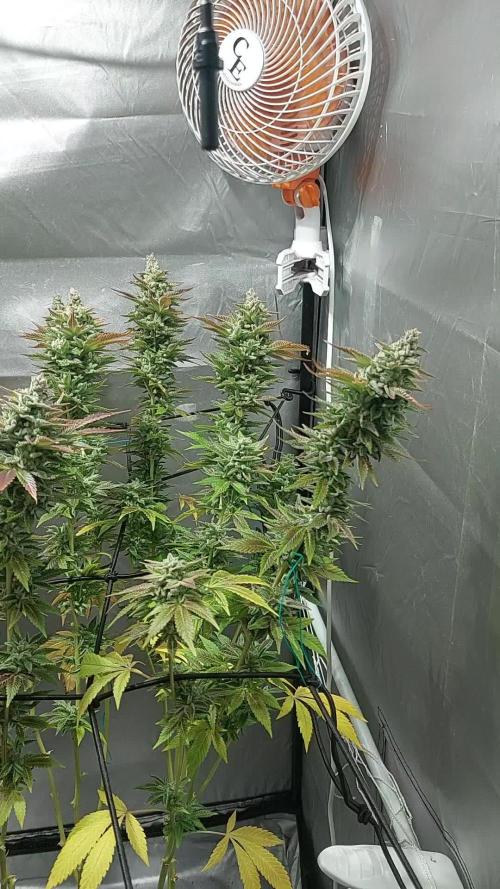
Esta semana solo agua, al fin cerraron los calices asiq ahora si, ultimo riego. Les alejé la luz hace unos dias tal vez eso ayudó, o capaz solo le faltaba tiempo. Hermosos colores, que maravillosa genetica
