


Likes
Comments
Share


@Jays_Not_Here_Man
Follow
18 weeks from seed to harvest. Love 34 street seeds, quality genetics for a fair price. These garlic cookies showed no disease or pest issues, no mold or powdery mildew. Easy enough to grow, no surprises, no super stretch in flower, but I would recommend training or SCROG to control them. Pungent Pine is what I am callling this smell, over 800 grams wet weight. They are hanging to dry in my tent as I write this, 60 %RH and about 71 degrees of freedom units! Can’t wait to try it out 🇨🇦❤️🌱😎💨

Processing
Likes
5
Share


@Ensign420
Follow
Week 02 Introduction
This week has been a bit of a struggle. Had my first experience dealing with slime and brown algae. But I think adding enzymes and increasing the beneficial bacteria helped to fix the issue. Also experienced nutrient burn for the first time. My nutrient solution strength got as high as 671 PPMs. So backed it down to about 430 PPMs during the end-of-week reservoir change. Also cut Hydroguard (expired?), CaliMagic, and Superthrive from this grow. Now she's still stunted, but is starting to recover. Hopefully...
[START OF WEEK 02]
Day 01 - Monday - 08/10/20 - Total Days: 008
-----------------------------------
- [0830]: Still looks a bit yellow. But getting larger!
--- Solution strength was at 248 PPMs.
--- Just topped off with a bit of distilled water
--- PH went up to 6.1 so PH'd down to 5.8
--- Ran the top feed for a bit to wet the hydroton.
- [2130]: She's looking even more yellow now.
--- Even the new leaves are really yellow.
--- Decided to add more base nutes.
--- Added 4ml of Sensi A
--- Added 4ml of Sensi B
--- Now at about
--- Solution Strength went up to 304 PPM.
--- PH was at 6,
--- Also raised the water level a bit more.
--- I really hope it's a nutrient deficiency and not an over-watering issue.
--- Please live!
Day 02 - Tuesday - 08/11/20 - Total Days: 009
-----------------------------------
- [0830]: Looking less droopy. But still yellow.
--- Decided to do a reservoir change.
--- 4.5gal of distilled water
--- 8ml of Sensi Grow A
--- 8ml of Sensi Grow B
--- 8ml of Voodoo Juice
--- 4ml of B-52
--- 4ml of CaliMagic
--- 4ml of Hydroguard
--- 4 drops of Superthrive
--- PH'd down to 5.8
--- Solution strength: 302 PPM
--- Since I didn't want to risk over-watering the rockwool, I did not to do a top feed, may do one tonight after the sleep cycle (lights are still set to go off at 10am and back on at 4pm).
--- As I was doing a reservoir change, I noticed that the tubes and bucket were a bit slimy. Didn't really stink or anything. Is this normal? Maybe due to the Hydroguard and Voodoo Juice?
--- I hope she gets better soon!
- [2215]: Getting larger! But still yellow.
--- Also can see a root growing through the net pot! Tiny little thing but it's there! Will have to start dropping water once more appear.
--- After looking over a few DWC diaries using AN nutes, seems like my solution strength is still too low. Most around this stage average around 500 PPMs with about 4ml per gallon.
--- Top fed for a minute to wet the top of the hydroton.
--- Solution strength went down to 263 PPM.
--- Added 8ml more of Sensi A
--- Added 8ml more of Sensi B
--- Now base nutes are at 16ml for 4.5 gal of water.
--- PPMs went up to 411.
--- Still lower than 500 PPMs, but that's okay.
--- PH was at 6. Not sure if I should adjust PH using AN nutes. So going to not ajdust unless PH goes above 6.1.
Day 03 - Wednesday - 08/12/20 - Total Days: 010
-----------------------------------
- [0830]: Looks like more root growth!
--- She still looks yellow. But leaves are perky.
--- PH was at 6.2 so lowered down to 5.8.
--- Solution strength was at 394 PPMs
--- Since roots are still growing, I decide to lower the water level a bit. Now water level is a bit below the net pot.
- [2200]: Root is getting longer!
--- Slime is returning. Not sure why.
--- Solution strength: 357 PPMs
--- PH: 6.1
--- Decided to add an enzyme along with more beneficial bacteria to hopefully cure the slime.
--- Added 16ml of Sensizym
--- Added 5ml of Hydroguard
--- Added 8ml of Voodoo Juice
--- New solution strength: 430 PPMs
--- New PH: 6.1
--- Top fed for a minute.
--- This slimy residue is really freaking me out! I hope the added enzymes will help eliminate the slime.
--- Going to do a full reservoir sterilization/nutrient change over the weekend. Please survive until then girl!
Day 04 - Thursday - 08/13/20 - Total Days: 011
-----------------------------------
- [0930]: I think the enzymes worked! There is little to no slime now!
--- Although I think the root was also dissolved in the process. It's now just a little stub sticking just below the net pot. The enzyme is also suppose to dissolved dead roots too but guess that root was too weak? Not sure what happened there. But I think the slime is cured!
--- Solution strength went down to 395 PPMs. Decided to add more base nutrients.
--- Added 8ml of Sensi A
--- Added 8ml of Sensi B
--- Added 4ml of B-52
--- Solution strength went up to 598 PPMs.
--- PH was at 6.1
--- As long as the PH is between 5.5 and 6.3, I'm not going to use PH Up or Down. But still will monitor PH levels.
- [1715]: Checked up on her after her nap and shes looking alive but stunted. But no slime!
--- Decided to add some sugars to help maintain the enzymes and beneficial bacteria.
--- Solution strength was at 587 PPMs.
--- PH was at 6.2
--- Added 8ml of Bud Candy
--- Solution strength went up to 671 PPMs.
--- PH also went up to 6.3
--- Lowered water level a bit to hopefully promote more root growth.
--- Top fed for a minute.
--- She is getting bigger, but still looks yellow.
Day 05 - Friday - 08/14/20 - Total Days: 012
-----------------------------------
- [0915]: Leaves look a little burnt on the tips. Still no slime.
--- Going to back off on the PPMs to hopefully fix the nutrient toxicity.
--- Solution strength was at 632 PPMs
--- PH was at 6.3
--- Added/Removed water until PPMs were at 536.
--- PH was still at 6.3
--- Raised water up a bit, then top fed for a minute.
- [2200]: Looking better. Still yellow though.
--- Solution strength: 514 PPMs
--- PH: 6.5
--- Added PH down.
--- New solution strength: 518 PPMs
--- New PH: 5.2
--- PH was kind of high. So decided to PH down. Had to use quite a bit to bring it down. But eventually got it to drop down to 5.3. A little low, but so far, the PH has always gone up so wanted to start it really low.
--- Ran the top feed for a minute to re-saturate the top of the hydroton.
Day 06 - Saturday - 08/15/20 - Total Days: 013
-----------------------------------
- [0830]: She looks stunted. leaves are still yellow.
--- Solution strength: 514 PPMs
--- PH: 5.6
--- Top fed for a minute.
--- Not sure what to do at this point. Going to do another reservoir change soon. Hoping she lives until then.
- [2145]: Looking pretty much the same.
--- A bit of slime has returned. Since I've been diluting the nutrient solution, the enzyme ratio has dropped. So I guess this is expected.
--- Also noticed that slime build up was on the air-stones. Never really checked the stones so not sure how long that has been there. Looks brown too, which can't be good.
--- Going to do an H202 sterilization of the system (minus the net pot) tomorrow so did not add anything.
--- Lowered the water level to below the net pot.
--- Then top fed for a minute.
Day 07 - Sunday - 08/16/20 - Total Days: 014
-----------------------------------
- [0900]: STERILIZATION DAY!
--- Decided to skip today's night cycle for a deep clean.
--- I'm hoping that skipping a night cycle won't be too stressful.
--- Temporarily moved her to a new bucket.
--- Used about a half of gallon of straight distilled water to flush out the net pot.
--- Drained the system and wiped up all the brown sludge. Also removed the air stones and cleaned up all the goo.
--- Filled the system with 2 gallons of distilled water and at least 30ml of food grade hydrogen peroxide (35% strength).
--- Yea its a lot, but since I'm not going to sterilize the system overnight, I went with a really high doseage. Basically I kept adding until I started to see little bubbles start to form.
--- Then I ran the water pump.
- [0915]: Boiled the air stones in tap water for about 10 min. Then reconnected them to the airlines.
--- I let the air stones and hose soak in the sterilization solution for about 5 minutes so the peroxide can absorb into the stones. Then ran the air stone to help mix and agitate the solution.
--- Occasionally, I'd repeat the process of turning the air pump off for a few minutes to let the stones soak.
- [1000]: Covered the top two row of holes of the net pot with some aluminum tape. Hopefully this solves the light leaking in through the hydroton.
- [1200]: Used an old toothbrush and scrubbed the pump clean. Then drained the system.
--- Refilled with more distilled water and peroxide. Again added a lot.
--- Ran system again to sterilize even more.
- [1530]: Drained the system and refilled with distilled water to rinse.
--- Ran the system for a few minutes, then drained and rinsed again.
--- Did this a few more times over about an hour.
- [1630]: Added 4 gallons of fresh distilled water.
--- Added 15ml Sensi Grow A
--- Added 15ml Sensi Grow B
--- Added 12ml of B-52
--- Added 16ml of Voodoo Juice
--- Added 16ml Sensizym
--- Solution strength was at 430 PPMs
--- PH was at 5.6
--- I was going to add Hydroguard, but I think the bottle is expired. Since 2017 or 2018!? I think Hydroguard is good for up to 2 years from the date on the bottle or 6 months after opening. So not going to use from now on. I wonder if this could have contributed to the slime build up.
--- Also removed the CaliMagic and Superthrive too. Going to only use AN products to eliminate the chance of incompatible nutrients.
--- Placed her back in the bucket and top fed for a minute.
--- Here's hoping for the best. Going to let it ride until morning! Please feel better!
[END OF WEEK 02]

Likes
9
Share


@Scilef
Follow
Daily report:
Day 1.
Watering: NO
Notes: I am concerned that I've got a photoperiodic strain, not an autoflower.
Day 2.
Watering: Morning: 5.8 pH 1030 ppm (4.0 l 0.75% of Base + CalMag) => 6.0 pH 2120 ppm (0.65 l)
Notes: I set up a 12/12 light schedule. I want Heracles to blow.
Day 3.
Watering: Night: 5.8 pH 1210 ppm (4.5 l + CalMag) => 6.0 pH 2160 ppm (0.75 l)
Notes: Since today I'll feed Heracles according to the bloom feeding schedule. I forget to take a photo of Day 46, sorry.
Day 4.
Watering: NO
Notes: I hope that it is a beginning of blooming.
Day 5.
Watering: Morning: 5.9 pH 1160 ppm (4.0 l + CalMag) => 6.0 pH 2400 ppm (1.25 l)
Day 6.
Watering: Night: 5.8 pH 1030 ppm (4.5 l + CalMag) => 5.9 pH 2450 ppm (1.55 l)
Day 7.
Watering: NO

Likes
13
Share


@Leanback
Follow
Doing not much… checking the vpd und water that’s it. Ladies looking good so far.

Likes
3
Share

@MerekKutil
Follow
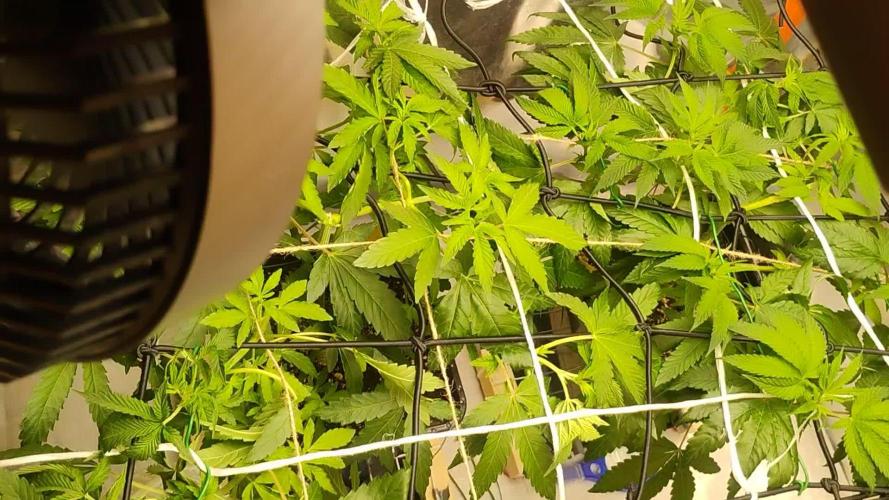
Ahojte máme krásnu slnečnú nedeľu 2 deň Flower. Dnešný ranný nápoj James Bond obsahuje vodu 1,8L s Ph 6 , Rhino skyn 1ml, Senzi Bloom 2ml A+B, B52 0,5ml, šťava vodoo 1ml. Zalial som kitky,moje veľké uši počujú ako mľaskajú. James Bond koktail im veľmi chutí,oproti minulému kolu som urobil zmenu. Nechám tam vždy aspoň 100ml rezervu nejdem preschnúť na kosť. Pozerám do kútika štastia endorfíny mi stúpajú. Čakám na 5 dní Flower, keď to vybuchne hore ako ohňostroj a budú rásť rýchlejšie. Pridal som sa na spodok ventilátora, ktorý fúkal do stredu stien v boxe nastavené hore.Odtokové mieriežky sú veľmi super, som spokojný lebo mi to veľmi pomáha pri zalievaní. Svetlo a tie rozostupy na rastline som urobil školácku chybu, keď som menil odťahový ventilátor mal som si všimnúť, že svetlo už môžem konečne lepšie nastaviť, ale táto chyba je opravená, flower Room 100% vyriešené len následky si ponesú kitky, teraz už to svetlo a rozostupy vidím .Zatiaľ ma teší, že tie kitky sú zdravé a bez nedostatkov. 6 deň máme teplotu už 26,7 °C a vlhkosť 51% svetlo Full 150w Max výkon.Dnes bola ďalšia zálievka opäť rovnaká ako predtým vidím mierne tmavé okraje tých nových listov. Nech sa Vám darí a na konci ste Happy ✌️.

Likes
6
Share


@Back_woods_buds
Follow
Other than my humidity and my temperature Dropping more than I would like but everything else been doing OK


Likes
14
Share


@ConspiracyFly
Follow
Last week
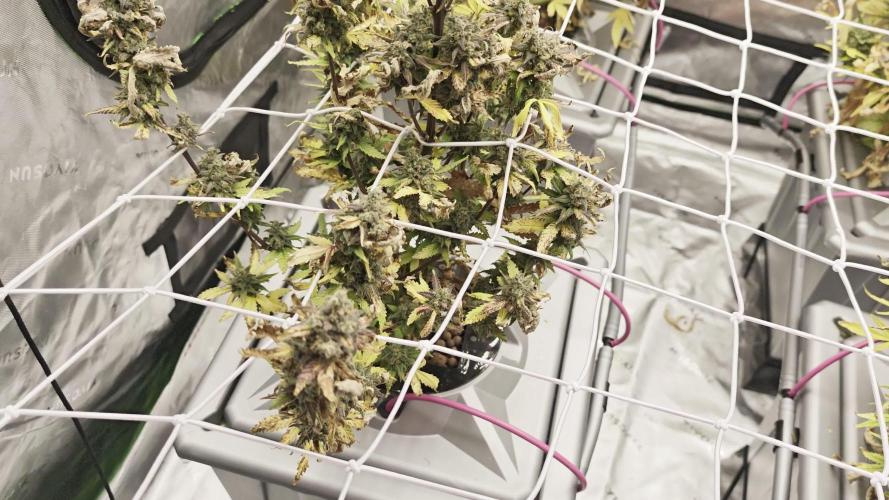
Sunday - I washed the plant with just tap water to remove the crystals that the nurientes had accumulated.
I cut 1 branch to dry until (Thursday)
Gorilla Glue Auto Day 97
I placed the LED 20 centimeters away from the plant
Tasks of the last week I stopped the nutrients
Monday - Without watering
Tuesday - Without watering
Wednesday - I watered with 1,5L water
Thursday - Smoked (tested the flower)
Friday - Without watering
Trichomes have larger heads 80% cloudy 20% clear 0% amber
Saturday - I cut another branch again to experiment...
Next week I will cut the plant....
Gorilla Glue #4 Week 11
It continues to grow....




Likes
9
Share


Likes
16
Share


@Stinkfox
Follow
The stretch is done, and it’s time to start packing on buds. She’s not super smelly, like her older sister before her. 5 or so weeks to go. I just made the last ounce from the last plant into butter. Incredible stuff

Likes
5
Share

@edenminded
Follow
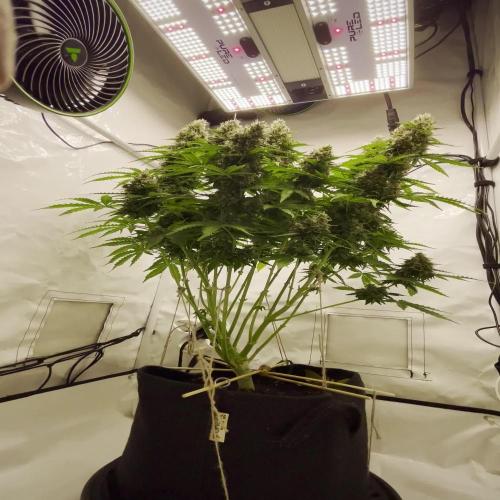
Week 12 Update: Solo Tent, Heatwaves, & GG Curing!
Hey everyone! I almost completely missed the Week 12 with all the excitement going on, and I also forgot to snap photos this week, so I'm dropping a video instead to show you the current state of the tent.
Here is what's happening:
The Gorilla Glue is officially out of the tent! The chop was a success, and after navigating some tricky humidity levels during the dry, she is now safely in jars. The curing process is going perfectly with Integra Boost packs holding a steady 60% RH. I will be making a separate, detailed Harvest Post for the GG very soon with all the final weights and macro shots, so stay tuned for that!
With GG gone, Crystal Candy now has the entire tent, all the airflow, and the 150W light entirely to herself. As you can see in the video, she is taking full advantage of it. She is flowering beautifully, the buds are swelling up nicely, and she is marching steadily toward her own harvest window.
The biggest struggle right now is the weather. Summer is arriving early here, and the ambient temperatures are pushing my tent up to 32°C (89.6°F) during the day. I am trying my best to counteract it and cool things down, but without much success so far.
Despite the heat, CC seems to be taking it like a champ. I'm keeping the fans on max to ensure massive airflow and prevent any mold issues like the minor scare I had with GG.
Fingers crossed the heat doesn't cause any foxtailing. She is getting closer every day! ✌️
Likes
11
Share


@Konisko66
Follow
Started smell,but I think is so small what do you think ? Maybe I do something wrong? It's my first lst in my life let me now what I can do better;)

Likes
7
Share


@HookahCli
Follow
La Kosher Kush de la derecha abajo, tiene las hojas más finas y es más alta, las otras 3 Kosher Kush tienen las hojas más gruesas, la del medio abajo tiene un poco de color morado en el apical.
Las Kandy Kush se parecen bastante, un poco más altas la de los laterales, pero se las ve bastante bien.
Las Lemon Krystal son pequeñas y no se nota mucho, pero la del centro izquierda, tiene las hojas un poco más anchas. Si os fijáis en la de abajo izquierda, tiene una planta pequeñita al lado que es la anterior 1024 que se quedo una ahí en la tierra y la otra la saqué y la puse en una maceta de cactus, que también ha germinado, pero les ha costado, por eso están fuera y tenemos las Lemon Krystal, en el próximo trasplante, la sacare y la pondré en alguna maceta por el patio.
Se han trasplantado a maceta de 6L.
Likes
4
Share


@JeyGanesha
Follow
Anche queste albicocche crescono molto bene.....sempre complimenti a fast buds e a me🤣😂💪.sono robuste e anche lei con tanti punti dove fiorire....
Likes
15
Share


@Wizzel420
Follow
Watered after 7 days, was looking a bit limp so may add a small water mid week. LST on main stem to expose other bud sites to light.
Increase nutes to 340PPM, will be last vege nutes as moving onto flowering nutes next week. Smell is nice, like a slight warm cheddar smell.
Light switched onto bloom mode.
This one looks to have a more sativa structure, leaning more to it White Widow genetics, have another of the same strain and presents more of the indica, short, stocky, bushy and smell like blueberries. Even has the slight manure smell of when you first sniff an actual blueberry.


Likes
4
Share


@Masshysteria
Follow
Quick Summary: moved and transplanted around day 18 into 5 gal. airpots with fresh ocean forrest, flowering began around day 24, thought I maybe had some nutrient burn, more likely cause is phosphorous and/or cal/mag deficiencies, three plants in the home stretch, O has a bit longer
Day 50 Update: Watered and took some pictures last night. Not much new. Pretty sure they have massive deficiencies instead of any burn. I may chronically underwater/underfeed my plants. I'm still learning. This is my fourth grow ever so there's still lots to learn.
Day 51 Update: Meant to water today but didn't.
Day 52 Update: I spent a while with each plant and took some pictures/video when plant O was out of the tent. You can see some pretty clear brown spots on a fair bit of the shorter two plants. S is all kinds of ugly, but who knows, maybe still put out a decent weight. I fed twice in a row now and added some CaliMagic (forget the company name) this time. I read about how when there are stronger lights or MORE lights, the plants can burn through phosphorous rapidly, so maybe that's the issue I had. Either way, about day 40 seems like when the nutrients can be more steadily increased. The shorter two, V and P, have about 2ish weeks so that will likely be their last feeding. S too probably. O, on the other hand, has several weeks left but is looking otherwise really solid. Hopefully I got enough nutrients in early enough in that plant's flowering that it won't show any deficiencies. It's a monster too! 38 inches to the top of the spire. The other three are 25, 21, and 19 inches still so likely their final heights. I kept the tallest as the plant height for the diary because the top end is good to know for other indoor growers.
Day 53 Update: No news.
Day 54 Update: No news.
Day 55 Update: S, V, and P are the three shorter plants. They are all starting to take water a bit slower. They didn’t *need* water tonight, so I’ll give them another day. O, on the other hand, is a monster! Probably needed water yesterday. Filtered tap, about 2 gal for O tonight. Food next time for O also. Others are in the wind-down so we’ll see. Pics added from tonight.
Day 56 Update: Nothing to report.
