The Grow Awards 2026 🏆
Likes
Comments
Share
@6ix6ix6ix
Follow
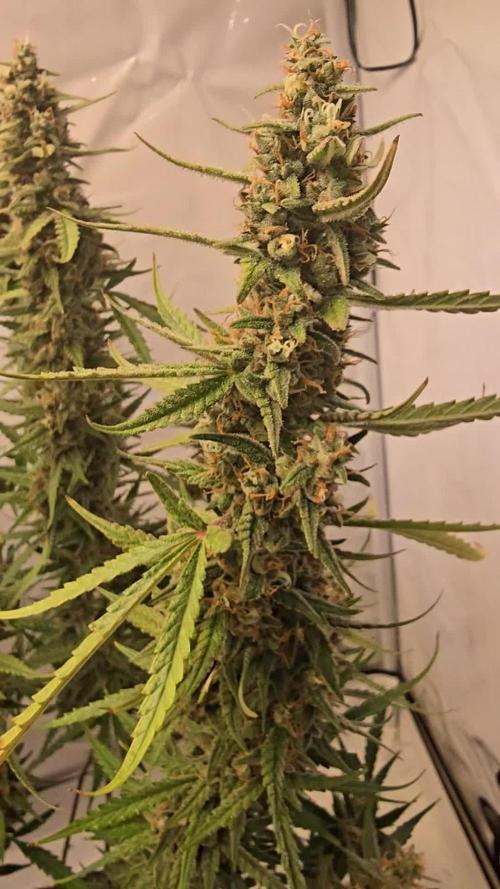
Halo shalom buenas dias! All week been strugling witg the nitrogen overload that my soil in giving my poor plants. Tried washing out, but no significant results. However, adding PK (half of the recommended dose) gives really positive results, i see the buds develop more, however the leaves are also there. I’m really confused by the way the three plants are completely different on rip ess stage, bud formation and growth overall. They get absolutely same treatment and sit in the same tent. My feeling is that i have around a week with 2/3 plants and around two weeks with the “flagship” Today is 56 days since germination. Any suggestions how to dry plants during an active grow? Will the light somehow interfere?
Likes
17
Share
Lovin her so far. Fingers crossed but i havent had a problem with her yet. Did my math wrong on the nutes so i fixed that this week. Spread out leaves so shes easy to defoliate and she doesnt really need it much cause all the parts still get light. She just started showing pistils which im super happy happy about The stems smell super dank but still a pretty weak smell so far. 3 days later and shes even taller and the pistils are starting to look like buds. She dried up already so i gave them an extra litre of water this time so i adjusted the nutes a bit. I plucked a lot of the big leaves again. IDK if that was a good idea or not but it felt right because so many of the lower branches werent getting that much light. I didnt go too crazy and left some leaves. She bounced back fine last time so im not worried. Cant wait to see some buds!!
Likes
55
Share
What's in the soil? What's not in the soil would be an easier question to answer. 16-18 DLI @ the minute. +++ as she grows. Probably not recommended, but to get to where it needs to be, I need to start now. Vegetative @1400ppm 0.8–1.2 kPa 80–86°F (26.7–30°C) 65–75%, LST Day 10, Fim'd Day 11 CEC (Cation Exchange Capacity): This is a measure of a soil's ability to hold and exchange positively charged nutrients, like calcium, magnesium, and potassium. Soils with high CEC (more clay and organic matter) have more negative charges that attract and hold these essential nutrients, preventing them from leaching away. Biochar is highly efficient at increasing cation exchange capacity (CEC) compared to many other amendments. Biochar's high CEC potential stems from its negatively charged functional groups, and studies show it can increase CEC by over 90%. Amendments like compost also increase CEC but are often more prone to rapid biodegradation, which can make biochar's effect more long-lasting. biochar acts as a long-lasting Cation Exchange Capacity (CEC) enhancer because its porous, carbon-rich structure provides sites for nutrients to bind to, effectively improving nutrient retention in soil without relying on the short-term benefits of fresh organic matter like compost or manure. Biochar's stability means these benefits last much longer than those from traditional organic amendments, making it a sustainable way to improve soil fertility, water retention, and structure over time. Needs to be charged first, similar to Coco, or it will immobilize cations, but at a much higher ratio. a high cation exchange capacity (CEC) results in a high buffer protection, meaning the soil can better resist changes in pH and nutrient availability. This is because a high CEC soil has more negatively charged sites to hold onto essential positively charged nutrients, like calcium and magnesium, and to buffer against acid ions, such as hydrogen. EC (Electrical Conductivity): This measures the amount of soluble salts in the soil. High EC levels indicate a high concentration of dissolved salts and can be a sign of potential salinity issues that can harm plants. The stored cations associated with a medium's cation exchange capacity (CEC) do not directly contribute to a real-time electrical conductivity (EC) reading. A real-time EC measurement reflects only the concentration of free, dissolved salt ions in the water solution within the medium. 98% of a plants nutrients comes directly from the water solution. 2% come directly from soil particles. CEC is a mediums storage capacity for cations. These stored cations do not contribute to a mediums EC directly. Electrical Conductivity (EC) does not measure salt ions adsorbed (stored) onto a Cation Exchange Capacity (CEC) site, as EC measures the conductivity of ions in solution within a soil or water sample, not those held on soil particles. A medium releases stored cations to water by ion exchange, where a new, more desirable ion from the water solution temporarily displaces the stored cation from the medium's surface, a process also seen in plants absorbing nutrients via mass flow. For example, in water softeners, sodium ions are released from resin beads to bond with the medium's surface, displacing calcium and magnesium ions which then enter the water. This same principle applies when plants take up nutrients from the soil solution: the cations are released from the soil particles into the water in response to a concentration equilibrium, and then moved to the root surface via mass flow. An example of ion exchange within the context of Cation Exchange Capacity (CEC) is a soil particle with a negative charge attracting and holding positively charged nutrient ions, like potassium (K+) or calcium (Ca2+), and then exchanging them for other positive ions present in the soil solution. For instance, a negatively charged clay particle in soil can hold a K+ ion and later release it to a plant's roots when a different cation, such as calcium (Ca2+), is abundant and replaces the potassium. This process of holding and swapping positively charged ions is fundamental to soil fertility, as it provides plants with essential nutrients. Negative charges on soil particles: Soil particles, particularly clay and organic matter, have negatively charged surfaces due to their chemical structure. Attraction of cations: These negative charges attract and hold positively charged ions, or cations, such as: Potassium (K+) Calcium (Ca2+) Magnesium (Mg2+) Sodium (Na+) Ammonium (NH4+) Plant roots excrete hydrogen ions (H+) through the action of proton pumps embedded in the root cell membranes, which use ATP (energy) to actively transport H+ ions from inside the root cell into the surrounding soil. This process lowers the pH of the soil, which helps to make certain mineral nutrients, such as iron, more available for uptake by the plant. Mechanism of H+ Excretion Proton Pumps: Root cells contain specialized proteins called proton pumps (H+-ATPases) in their cell membranes. Active Transport: These proton pumps use energy from ATP to actively move H+ ions from the cytoplasm of the root cell into the soil, against their concentration gradient. Role in pH Regulation: This active excretion of H+ is a major way plants regulate their internal cytoplasmic pH. Nutrient Availability: The resulting decrease in soil pH makes certain essential mineral nutrients, like iron, more soluble and available for the root cells to absorb. Ion Exchange: The H+ ions also displace positively charged mineral cations from the soil particles, making them available for uptake. Iron Uptake: In response to iron deficiency stress, plants enhance H+ excretion and reductant release to lower the pH and convert Fe3+ to the more available form Fe2+. The altered pH can influence the activity and composition of beneficial microbes in the soil. The H+ gradient created by the proton pumps can also be used for other vital cell functions, such as ATP synthesis and the transport of other solutes. The hydrogen ions (H+) excreted during photosynthesis come from the splitting of water molecules. This splitting, called photolysis, occurs in Photosystem II to replace the electrons used in the light-dependent reactions. The released hydrogen ions are then pumped into the thylakoid lumen, creating a proton gradient that drives ATP synthesis. Plants release hydrogen ions (H+) from their roots into the soil, a process that occurs in conjunction with nutrient uptake and photosynthesis. These H+ ions compete with mineral cations for the negatively charged sites on soil particles, a phenomenon known as cation exchange. By displacing beneficial mineral cations, the excreted H+ ions make these nutrients available for the plant to absorb, which can also lower the soil pH and indirectly affect its Cation Exchange Capacity (CEC) by altering the pool of exchangeable cations in the soil solution. Plants use proton (H+) exudation, driven by the H+-ATPase enzyme, to release H+ ions into the soil, creating a more acidic rhizosphere, which enhances nutrient availability and influences nutrient cycling processes. This acidification mobilizes insoluble nutrients like iron (Fe) by breaking them down, while also facilitating the activity of beneficial microbes involved in the nutrient cycle. Therefore, H+ exudation is a critical plant strategy for nutrient acquisition and management, allowing plants to improve their access to essential elements from the soil. A lack of water splitting during photosynthesis can affect iron uptake because the resulting energy imbalance disrupts the plant's ability to produce ATP and NADPH, which are crucial for overall photosynthetic energy conversion and can trigger a deficiency in iron homeostasis pathways. While photosynthesis uses hydrogen ions produced from water splitting for the Calvin cycle, not to create a hydrogen gas deficiency, the overall process is sensitive to nutrient availability, and iron is essential for chloroplast function. In photosynthesis, water is split to provide electrons to replace those lost in Photosystem II, which is triggered by light absorption. These electrons then travel along a transport chain to generate ATP (energy currency) and NADPH (reducing power). Carbon Fixation: The generated ATP and NADPH are then used to convert carbon dioxide into carbohydrates in the Calvin cycle. Impaired water splitting (via water in or out) breaks the chain reaction of photosynthesis. This leads to an imbalance in ATP and NADPH levels, which disrupts the Calvin cycle and overall energy production in the plant. Plants require a sufficient supply of essential mineral elements like iron for photosynthesis. Iron is vital for chlorophyll formation and plays a crucial role in electron transport within the chloroplasts. The complex relationship between nutrient status and photosynthesis is evident when iron deficiency can be reverted by depleting other micronutrients like manganese. This highlights how nutrient homeostasis influences photosynthetic function. A lack of adequate energy and reducing power from photosynthesis, which is directly linked to water splitting, can trigger complex adaptive responses in the plant's iron uptake and distribution systems. Plants possess receptors called transceptors that can directly detect specific nutrient concentrations in the soil or within the plant's tissues. These receptors trigger signaling pathways, sometimes involving calcium influx or changes in protein complex activity, that then influence nutrient uptake by the roots. Plants use this information to make long-term adjustments, such as Increasing root biomass to explore more soil for nutrients. Modifying metabolic pathways to make better use of available resources. Adjusting the rate of nutrient transport into the roots. That's why I keep a high EC. Abundance resonates Abundance.
Likes
99
Share
@BudXs
Follow
Wonderful looking grow to date. Environment is on point, nutes at just the right level. 15 more days of veg and then the mothers will be cloned, the best BB and Slurry phenos chosen for pollination, a few mothers donated, and the autos under a dedicated qb. Nothing else to report. Except that bitch Carol fucking Baskin did it
Likes
Comments
Share
This was a great weed to grow very robust would recommend any strains from barnys farm they are one off the best still got alot off learning on to nxt grow my trimming has got alot to answer but it's going in a bong or vape
Likes
21
Share
@FatYappas
Follow
Welcome back all, following a week that has been a fairly straight forward seven days or so in Fat Yappa's Garden, as the older Bruce Banners reach day 51, day 44 for the runt of the sisters, planted on the same day but that took a week longer to germinate, and day 42 for the two Wedding Cheesecake's, one growing in Coco Coir, the other in the same living soil as her Bruce Banner Fastbuds cousins. The week began with last weeks humidity issues brought well and truly into hand with the addition of the new 20L dehumidifier from Meaco, specifically designed for the UK weather. However a shift in the aforementioned from the falls dawn of an early spring, to a return to more usual climate conditions for this time of year through things off kilter once again. Despite pulling around 6L of water out the air a day, she was struggling to keep the RH down to around 50% with my central heating returned to its usual position of 18c, but an increase to 20c has taken things back in line, and the humidity has returned to the mid 40's I was aiming for. Humidity concerns during this off period however, and a subsequent inspection below the top layer of the canopy, which resulted in the discovery of quite a lot of whitish, moist growth, prompted a mass defoliation, mostly of the Bruce Banners. I had been performing very light defoliation up until this point, only removing dead/almost dead leaves, and very select leaves from the top of the canopy that were blocking what looked like bud sites, but the lack of light and air getting through past the top layer, together with the fact that now bud sites are far clearer to a novice such as I, lead me to the conclusion that the time was right. Besides the runt, all these plants have not even skipped a beat. The runt has been a bit droopier in her leaves than the others all in all, but I have looked in on them and seen her with leaves pointing up and praying a few times since so I trust all is well. Following the defoliaton on day 47, the plants stuck to their two day watering schedule, but di threatened to need an increase to daily, as day 50 saw waterings a mere 24hrs after the previous day, but feeling the weight of the pots yesterday I elected to wait til 48 hours to water again. The water amounts per plant has also become more erratic than previously, so I have been watering more carefully. Other than that the week has been pretty much plain sailing, and what look like to be some big looking flowers coming up all over the canopy, as all bar the Wedding Cheesecake in living soil are now fully in flower, but she will be there by next week. The Bruce banner I accidentally snapped the top off from the second node down doing LST a few weeks ago seems to be about half a week ahead of the other two of the same age, and trichomes have began to appear on the leaves around the buds. The biggest plant in the tent is still the wedding Cheesecake in Coco coir, as she now stand a metre tall and her top is the same level as the light now. Her size is a concern because it has caused me to neglect her in favour of the other plants, certainly in terms of light, but she doesn't seem to have any more bud sites than the other plants, and for the time being at least, her older cousins are leaving her to shame in this department, but she still has a week to catch up. Lastly, day 39 saw another compost tea feeding, the same recipe as last time. Happy growing everyone, and I will catch you all again next week.
Likes
Comments
Share
@BIYEI
Follow
Vegetativo 13-12-2024 al 19-12-2024 13-12-24 Se nota demaciado la evolucion de la planta y se ve sana solo que empezo a manifestar un problema investigare el tema. 16-12-24 Quite la red ya que la planta se estiro mas, y tambien me informe mas sobre el tema LST Y ScrOG lo andaba aplicando de manera incorrecta, Se requiere poda y enredar la planta las primeras semanas de vegetacion entre la red, ademas sigo notando ese problema en las hojas que manifiestan algun problema, yo creo que es por sobrefertilizar, tratare de disminuir la dosis de nutrientes en el siguente cambio de solucion nutritiva. Se agrega agua (7500ml) solamente sin abonos bajando el EC a 1.1 y el PH se ajusto de 6.4 a 6.0. 17-12-24 Investigando un poco note una ligera pigmentacion en los tallos de color morado, pense que era normal pero investigando a fondo es una manifestacion fisica de la planta para pedir un poco mas de fosforo, tambien las hojas se empezaban a picar con pequeños puntos como si se oxidaran de color cafe, espero se corrija esta deficiencia, la tonalidad de las hojas amarillas disminuyo un poco., agrego 3 ml de FLORABLOOM 19-12-24 Se empieza a ver mejoria en las hojas, probablemente fue exceso de algun fertilizante, la proxima semana tratare de regular mas el ph y los nutrientes. Parametros Utilizados Temperatura del ambiente 23 C° Extraccion de aire 4 pulgadas Humedad 65% Potencia de la lampara 100% Ec Original 0.4 Ec Nutriente 1.8 Ph 6.0 Horas de Luz 18/6 VPD Range 1.0 kPa
Likes
10
Share
------------------------------------------------- Day 15 Water: N/A Humidifier: 60% (LOW-MIST) Fan Speed: High Light on @ 19:00 (24.5° celsius @ 62% RH) Light off @ 13:00 (22° celsius @ 64% RH) ------------------------------------------------- Day 16 Water: 150ml RO water Humidifier: 55% (LOW-MIST) Fan Speed: High Light on @ 19:00 (24.5° celsius @ 59% RH) Light off @ 13:00 (21.5° celsius @ 60% RH) ------------------------------------------------- Day 17 Water: N/A Humidifier: 55% (LOW-MIST) Fan Speed: High Light on @ 19:00 (24.5° celsius @ 59% RH) Light off @ 13:00 (22.0° celsius @ 61% RH) ------------------------------------------------- Day 18 Water: N/A Humidifier: 55% (LOW-MIST) Fan Speed: High Light on @ 19:00 (24.7° celsius @ 59% RH) Light off @ 13:00 (20.9° celsius @ 61% RH) ------------------------------------------------- Day 19 Water: N/A Humidifier: 50% (LOW-MIST) Fan Speed: High Light on @ 19:00 (23.6° celsius @ 57% RH) Light off @ 13:00 (22.9° celsius @ 57% RH) ------------------------------------------------- Day 20 Water: 0.5 gallon RO water Humidifier: 45% (LOW-MIST) Fan Speed: High Light on @ 19:00 (26.2° celsius @ 49% RH) Light off @ 13:00 (22.5° celsius @ 59% RH) ------------------------------------------------- Day 21 Water: N/A Humidifier: 45% (LOW-MIST) Fan Speed: High Light on @ 19:00 (26.5° celsius @ 50% RH) Light off @ 13:00 (22.9° celsius @ 58% RH) -------------------------------------------------
Likes
10
Share
@L1lium
Follow
Es ist soweit! Am Freitag habe ich die fünf Easy Buds nach knapp 11 1/2 Wochen abgeschnitten und geerntet. Leider musste ich feststellen, dass eine Pflanze ziemlich stark befallen war. Ich vermute eine Milbenart oder möglicherweise Fliegeneier. Unterhalb der Blätter waren etliche dunkelgelbe und dunkelbraune Eier, die man auf den ersten Blick kaum erkennen konnte. Bei genauerem Hinsehen sieht man jedoch, dass sich der Befall auf die ganze Pflanze ausgeweitet hatte. Glücklicherweise blieben die vier anderen Pflanzen verschont. Aus diesem Grund trockne ich die Pflanzen auch getrennt voneinander. Die befallene Pflanze wollte ich nicht direkt wegwerfen, sondern erstmal trocknen lassen. Im Nachhinein werde ich schauen, wie ich mögliche Schadensbegrenzung betreiben kann. Die vier gesunden Pflanzen werden in einem geschlossenen Zelt in einem Trocknungsbeutel getrocknet. Die befallene Pflanze habe ich in dem Folienzelt aufgehängt und mit einer Plane abgedeckt. Nach wenigen Tagen der Trocknung sieht soweit eigentlich alles gut aus. Die Eier scheinen nicht mehr zu schlüpfen, sondern fallen von der Blüte ab oder verschrumpeln zu Kompost. Ich hoffe, dass es dabei bleibt. Der Geruch hat sich nach dem Abschneiden deutlich verändert. Schon nach der kurzen Trocknungszeit kann ich einen intensiveren Geruch feststellen, der sich noch nicht so richtig beschreiben lässt. Die Blüten waren stark mit den sogenannten "Sugar Leaves" verwachsen, weshalb ich sie grob getrimmt habe, um sie zum Trocknen aufzuhängen. Nachdem die Blüten vollständig getrocknet sind, werde ich die Buds noch einmal einzeln trimmen und durch meine Trimm-Maschine von Vevor jagen. Der Ernteprozess hat zu zweit circa eine Stunde gedauert. Die Pflanzen waren zum Zeitpunkt der Ernte noch sehr gesund und kräftig. Die Verwurzelung war trotz des geschlossenen Topfes sehr gut. Die schönste Bud hat definitiv die zentrale Pflanze, Greta, ergeben. Nass hätte ich den Bud auf mindestens 12 g geschätzt. Ein Gesamtgewicht des nassen Pflanzenmaterials habe ich nicht ermittelt. Sobald alles trocken und fertig beschnitten ist, werde ich das Tagebuch um den trockenen Betrag ergänzen. Stand jetzt würde ich schätzen, dass der Ertrag aller Pflanzen bei circa 40-50 g liegt, was mich für meinen ersten Grow ziemlich zufrieden stellt, besonders in Anbetracht dieser wirklich sehr simplen Strain. Mehr Infos und Fotos folgen in Kürze, wenn das Curing beginnt. Bis bald! :)
Likes
27
Share
Likes
5
Share
@Lazuli
Follow
I grew in cold , the max temperature was 20 celcius day and 14 at night.
Likes
55
Share
So she got the chop 2 weeks prior to what I wanted, but I did not lollipop enough doing this Scrog and suffered high humidity, lack of airflow and as a result lost 4 tops... Out of 16 big ones. But I have harvest, wet trimmed and left to hang dry in a room on clothes drier. Room circulation fan on low, and temp is 22c with 51% humidity. Aiming for a 10day dry it maybe sooner. Then we will smoke test and cure then re test 🙌💚 Thank you all for following along this LONG and heartbreaking breaking Journey
Likes
6
Share
Likes
19
Share
@AsNoriu
Follow
Day 50. Tallest Kush chopped by breeders recommendations, but in my conditions like a week at least away. Had max 20% milky, most clear, plant suffered some deficiency and was faiding slowly, still. Instead of Christmas flowers - 5 colas surprised my friends, colours and crystals are amazing. She was watered last 4 rounds with water and i will compare taste and effect , but i think it's a loosing tactics - such early crop. Not more than 40 expected from what left ;))) 5 out of 17 colas was taken away. I will add a third of weight, for real feel in totals. Day 67. After 24 hours of darkness all girls are chopped. Will make review and update in a week or so.
Likes
9
Share
2025-11-30 shes doing well, pistils start to change- so i think 10 more days for her. 🌿 Soil Preparation Base Medium: 35L Terrapreta soil Nutrient Integration: Mixed according to Aptus Living Soil Schedule Method: Nutrients pre-mixed into soil for optimal distribution 📋 Growing Schedule Phase 3:Flowering Final Home: 35L Smart Pots Location: Main grow room alongside comparison studies (documented in separate diary) xxxxxxxxxxxxxxxxxxxxxxxxxxxxxxxxxxxxxxxxxxxxxxxxxxxxxxxxxxxxxxxxxxxxxxxxxxxxxxxxxx BREEDERS INFO 🌟 Strain Profile: Permanent Marker 🏆 Award Excellence Recognition: Leafly's Strain of the Year 2023 Genetics: Premium award-winning lineage ⚡ Potency Profile THC Content: Up to 31% - Extreme potency levels Effect: High-impact experience for seasoned consumers Breeder Heritage Master Breeder: JBeezy @ Seed Junky Genetics Reputation: Industry-leading genetic specialist 🌸 Aromatic Signature Base Notes: Lingering floral foundation Unique Accents: Distinctive soap & gas undertones Profile: Complex, memorable terpene expression
Likes
10
Share
Day 36 flower. The tent is on auto, just need another watering in the morning. Patient 2 is developing yellowing leaves in the lower canopy. Patient 3 is right behind them. Day 37. Good smell the tent the buds have a clear to cloudy Trichome. Day 41 flower. And still not ready. So I added 2000ml of bloom and some Gaia to help get through the last few weeks. I trimmed the plants up. Overall just looking at organic the Gaia is great to get to flower but I feel maybe I fed the others a lil to early bloom when they weren’t ready. Another lesson of following the plants not a chart.
Likes
1
Share
No topping, no lst just a trellis net. Unlike her neighbors she will get cal-Mag during veg to prevent cal mag issues. New gravity fed watering system just installed!
Likes
12
Share
They're surviving, and the flowers are perfects, only the plant is suffering now, but I think that the bio-bloom will do his work. We noticed some peaks where mold had developed, due to the very high humidity of the last few days, so we removed the infected part.