The Grow Awards 2026 🏆
Likes
Comments
Share
Likes
32
Share
@AsNoriu
Follow
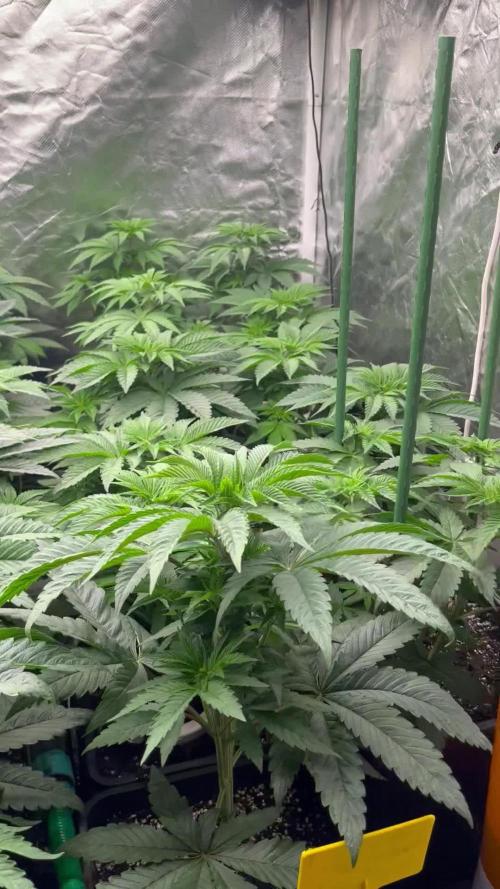
Day 64. All is good, one Mimoza ( off course biggest ) didn't liked new house ... Maybe after this one she will bounce back. The rest of the girls are going, think it's 10 days max left for two smallest plant in a week few more will be ready, the rest - around the floor .... Too croudy, no love, hope extra lightning will hurry them up, . I'll have Mars SP3000 soon to add. Gave full feed today, other two waterings will be plain water. Some selective defoliation here and there ... Day 69. Second day after few girls went outdoors. I need more light, but I will get it in a week only. Happy Growing !!!
Likes
34
Share
Start of week 8. Week 7 went very well for the Do-si-dos, she also filled in her buds, very dense and lovely smell! She's got crazy trichomes and is almost as sticky as the Glueberry OG.
Likes
10
Share
So she look good for now even with low humidity 😄 i try to spray water as often as possible and i can get around 45% humidity. I hope low humidity wont make her grow too slow
Likes
10
Share
In this week, the Acapulco Gold, GMO, and Glookies successfully germinated and grew into little seedlings, while the first "anonymous" germination attempt failed.
Likes
6
Share
@valiotoro
Follow
Hello everyone week 5 of flower has passed for this Mint Jelly auto ❄️ For the feeding schedule i stopped feeding Power Roots and Pure Zym and started feeding Green Sensation 0,5/l Mars hydro FC-E6500 75% have a great day and wish you all happy growing 😎👨‍🌾🏻
Likes
43
Share
@Eyeduno
Follow
Just giving them water waiting for them to fade out more
Likes
9
Share
Da oltre venti anni che coltivo e sono sempre più felice della qualità proposta da queste magnifiche banche semi! Complimenti di cuore a chi ha selezionato e creato queste varietà autofiorenti. Crescono rapidamente,resistono agli afidi e alcune sfiorano il metro di altezza, tutte insieme sembrano una mini foresta! Iniziano a fiorire gradualmente ed essendo molto diramate tutte è spettacolare nel vederle! Appare la prima resina e sono in ottima salute. Sono felice fino ad adesso perché se guardate foto e video vi rendete conto che qui nel centro Italia in outdoor biologico abbiamo il migliore clima che si possa desiderare anche se questo 2023 fino a metà maggio ha piovuto tantissimo e ci sono stati sbalzi di temperatura, ciò non è stato un problema per queste varietà così forti e abbondanti! Adesso la magia è iniziata, il caldo è arrivato e non vedo l'ora di vederle piene di infiorescenze tutte! Si procede felicemente, un abbraccio a tutti!
Processing
Likes
41
Share
My tent is full!....my crude tie back seems to be keeping everything away from the light....not able to get good pics.... we are at day 70 and still drinking a half gallon a day.... seeing nice swelling
Likes
3
Share
I just wanted to let the people know about topping and the benefits and when I did my research there was not much for documentary purposes very great results super cropping is a must and topping to create more nodes
Likes
1
Share
Un verdadero pastel, es una variedad con un excelente aroma, con notas bien marcadas a un dulzor que te vuela la cabeza, excelente apariencia de las flores, se ven realmente compactas y cubiertas de resina que te volara la cabeza!
Likes
10
Share
Voltage, also known as electric pressure, electric tension, or (electric) potential difference, is the difference in electric potential between two points. In a static electric field, it corresponds to the work needed per unit of charge to move a test charge between the two points. In the International System of Units (SI), the derived unit for voltage is named volt. The voltage between points can be caused by the build-up of electric charge (e.g., a capacitor), and from an electromotive force (e.g., electromagnetic induction in generators, inductors, and transformers). On a macroscopic scale, a potential difference can be caused by electrochemical processes (e.g., cells and batteries), the pressure-induced piezoelectric effect, and the thermoelectric effect. Since it is the difference in electric potential, it is a physical scalar quantity. A voltmeter can be used to measure the voltage between two points in a system. Often a common reference potential such as the ground of the system is used as one of the points. A voltage can represent either a source of energy or the loss, dissipation, or storage of energy. Dropping the temps will slightly raise the humidity, air holds less % water the colder it is. Lights on 25-35rh% the same water content will spike to 50rh% + at night just by dropping the temps. At night all the juice photosynthesis has been storing up is mashed and mixed up to make all the goodies we need for bud, water is used to transport all these things everywhere, like little solvent transport devices, once a nutrient/protein has been delivered to destination the plant needs to get rid of all this excess water molecules it was using to transport. The only solution at night is to spit it back out into the air at night. During the peak of flower, this can catch a grower unaware, with a 4x4 full tent it can be a challenge to control all that moisture exhaust overnight especially if you're really pushing the limits. We live in a water world, above or below, our misconception is we live on dry land, we don't live in less watery conditions than above or below. We fit into a very narrow band of moisture that just so happens to be full of lots of air and everything else required for life. Got my first full whiff of the smell of purple lemonade, always surprises me how accurately the smell fits names, the dominant terpenes in the Purple Lemonade weed strain are carene, linalool, limonene, and myrcene. Carene gives this strain its sweet, citrus flavor and some woody notes, whereas the linalool I recognize so well from Granddaddy Purp. Myrcene has been shown to have sedative qualities while bringing musky, earthy elements to the flavor profile. Trichome production started to ramp up, and the plant that grew taller/closer to UV showed noticeably thicker coatings. The taller plant shows slight yellowing of lower leaves, and the smaller plant is green and lush but the buds are slightly less progressed, interesting. I super-cropped the main stem of the tall one just over a week ago (clean). I expected it to be the one slightly behind in development. The plant has roughly 10-15% "Total resources" that it keeps in case emergencies arise. Reserves if you will. My rationale behind breaking anything goes hand in hand with slowing things down as production is lost due to the time it takes to repair damage. I recall watching a YouTube video, where a curly hair gentleman would super crop in a manner to damage but not disrupt using a twisting method, using fingers and thumbs placing them close together one goes clockwise other counter clock this varies a lot depending on the thickness of stem but what you wait for is a tiny snap, it may take several rolls to weaken if walls are tough I found. No snapping or bending of the stem, you want just to fracture it but not puncture this way the xylem and phloem channels remain flowing,the damage is repaired almost instantly and the 10-15% is dispatched with very little repair time. Everything in the general vicinity of the stress will now grow stronger so as to prevent further similar damage. This is why I had expected the tall one to lag behind in development once I had cropped it but low and behold it worked and the tall one has slightly more developed buds. The effects of birdsong on plant life may at first glance be far-fetched. Nigh on ten years ago an article appeared in Nexus Magazine on the discovery or invention of a method of growing plants using bird sounds. Christopher Bird and Peter Tompkins describe the development of Dan Carlson’s Sonic Bloom in their book The Secret Life of Plants. Many others have, it seems, recognized the role of birdsong in the growth of plants, and influenced or directly helped Carlson to develop his invention. Dan Carlson’s desire to see that no one need be hungry through shortage of food sought to understand the optimum growth of plants. He discovered that plants also feed from ‘the top down’ as well as the roots. Underneath all leaves are pores called stomata which open to take in nutrients and moisture from the air. Carlson’s observation that the more bird life there is on the farm, the more abundant is plant life, has been echoed by farmers throughout history, except in modern times. Where there is little bird life, plants are stunted, and dwarfed. Nature has the birds sing at dawn and dusk, which dilates the stomata, and so feeds the plants. One can immediately see the importance of trees. The development of Sonic Bloom was to create birdsong, which is played to the plants, while a foliar nutrient is sprayed onto the plants at the same time as they are being stimulated by the sound, to enhance their growth. This method produced fantastic results in the amount of abundantly nutritious produce from one plant, often in poor soils and in drought conditions. Carlson showed that the breathing leaves of plants are the source of the nutrient intake for growth. This of course is also true for humans—the breath is food. We shall discourse on this on another occasion. Plants transfer nutrients to the soil via this breathing, and Carlson showed that his plants improved the soil and helped earthworms proliferate. The secret of Sonic Bloom was the development of the music of the same frequency as the dawn chorus of the birds. With the help of a Minneapolis music teacher, Michael Holtz, a cassette was prepared. It seems that both birds and plants found Indian melodies called ragas delightfully suitable. This is actually quite profound, although the American farmers, especially women, who had to endure this music whilst it was played to the plants, found it irritating. Holtz found the “Spring” movement of Vivaldi’s The Four Seasons appropriate and concludes: “I realized that Vivaldi, in his day, must have known all about birdsong, which he tried to imitate in his long violin passages. Holtz, it is related by the authors Bird and Tompkins, also realized that the violin music dominant in “Spring” reflected Johann Sebastian Bach’s violin sonatas broadcast by the Ottawa University researchers to a wheat field, which had obtained remarkable crops with 66 percent greater yield than average, with larger and heavier seeds. Accordingly, Holtz selected Bach’s E-major concerto for violin for inclusion on the tape. “I chose that particular concerto,” explained Holtz, “because it has many repetitions but varying notes. Bach was such a musical genius he could change his harmonic rhythm at nearly every other beat, with his chords going from E to B to G-sharp and so on, whereas Vivaldi would frequently keep to one chord for as long as four measures. That is why Bach is considered the greatest composer that ever lived. I chose Bach’s string concerto, rather than his more popular organ music, because the timbre of the violin, and its harmonic structure, is far richer than that of the organ. Birdsong has long been loved but also studied with reference to the musical scale and harmonics. As Holtz deepened his study he said, “I began to feel that God had created the birds for more than just freely flying about and warbling. Their very singing must somehow be intimately linked to the mysteries of seed germination and plant growth. The spring season down on the farms is much more silent than ever before. DDT killed off many birds and others never seem to have taken their place. Who knows what magical effect a bird like the wood thrush might have on its environment, singing three separate notes all at the same time, warbling two of them and sustaining the others. Tree and bird life are essential to Earth's existence, which Carlson, Holtz, and others have shown, but indeed others see and feel. “Plants”, says Steiner, “can only be understood when considered in connection with all that is circling, weaving, and living around them. In spring and autumn, when swallows produce vibrations as they flock in a body of air, causing currents with their wing beats, these and birdsong, have a powerful effect on the flowering and fruiting of plants. Remove the winged creatures, Steiner warns, and there would be stunting of vegetation. Nothing more needs to be added here. It has been said that you cannot hurt the humblest creature or disturb the smallest pebble without your action having a reaction upon something else...You cannot think of an evil thought, no matter how private, without it having an effect upon somebody else. Whatsoever you do in life sets up some form of resonance. When I say the morning chorus of the birds awakens the earth I mean that the characteristic song of the birds sets in motion a series of vibrations which react upon other forms of life. Remember, the soil of the earth is full of living microorganisms. The plants are also living organisms. You, yourselves, are living organisms. Now, this is the beauty and wonder of it all—when one aspect of nature has been moved into a state of resonance it immediately relays its vibrational motion to something else. So when I say the dawn chorus awakens the earth I literally mean what I say. I do not suggest that the earth would come to a standstill without the bird song, but I do mean that life on earth would be sluggish and ineffectual without that first instigating outburst of vibrational power poured forth at just the right pitch and tone to set off a chain effect. I know some of you will say, what happens in those parts of the world where there are no birds? Well, what does happen? Very little, I assure you. The hot deserts and the polar regions where there are few, if any, birds are not renowned for their wonders of nature. It is as though they are asleep. Nothing grows, few things live. Little resonates and there is a great stillness over everything. You see, that outburst of sound just before dawn is like the little lever that works the bigger lever which turns the wheel which moves the machine…and so on. Never underestimate small things. Animals are blessed with instantaneous and unthought-out wisdom. They are in direct contact with God and they act and live as though they are fully aware of it. Men are also in contact with God, but most of them act as though they have never heard of God because they are largely veiled from their divine center by their own thinking minds of which they are so proud.
Processing
Likes
13
Share
Likes
2
Share
Edito 25/10/2025: He subido ya las fotos de los cocos secos, au00fan no lo he probado, ahora luego me haré uno con polen del trim para así probarla y tal, pero en sí el trim que habran salido como 15/20 gramos, eso no lo he pesado, lo tengo congelado para hacerle una extracción en el futuro.Por otro lado los cogollos tienen muuuuy buena pinta, ha sido un manicurado muy facil ya que han secado bien, y 88 gramacos secos y manicurados jajajajaja está de putisima madre, mi mayor producción hasta la fecha por planta, y mira que esta era mas pequeña que la Papaya Zoap que corté, me ha dado bastante mas!Contento con el resultado aunque insisto en que no sabru00eda que opinar respecto a la resistencia Ale, cortada. Me gustó la planta sobre todo el vegetativo ya que fue muy bien sin mostrar problemas y tal... Ahora, cuando llegó la floración ahí si arrancó todo, igual que la otra, la hyperion, con oidio y araña roja. Recalco que tenía dos plantas mas bien grandes y hermosotas que también lo sufrieron, pero a modo chiste... Una hoja pocha por bichos, alguna con un poquito de oidio.. pero en general resistieron muy bien eso, las otras. En fin, esta planta si que es hermosa, el cogollo central es precioso, una lastima que mi movil haya jodido la mayoria de las ultimas fotos antes de cortarla, por eso alguna se estas últimas fotos se ven mal, miradlas de lejos, mejoran jajajajajaja Bueno, les hice bud washing, o lavado de cogollos y subí las fotos para que se vea, no es video... Quizás en un futuro haya algo con YouTube, pero eso, es basicamente 3 cubos, como no tengo cubos cogí una garrafa, la corte, y le eché 7 litros de agua y 100ml de agua oxigenada (peroxido al 3%), cogí dos tappers grandes, los llene de agua y heche media cucharada sopera en cada uno de bicarbonato de sodio y medio limón exprimido igual, entre los dos tappers y lo mezclé todo bien. Finalmente cogí una olla porque no tenía mas tappers grandes disponibles xD y agua osmotizada (o de botella) pero fria. -Paso 1: enjuaga el cogollo, rama, o lo que quieras limpiar, unos 20/30 segundo en la garrafa con el agua oxigenada. -Paso 2: sacudes un poco lo que hayas enjuagado y lo metes a enjuagar a uno de los tappers con bicarbonato y limón (puedes usar 3, 4 tappers, o un cubo.. al fin y al cabo es cantidad para no hacerlo todo en 3 litros y que acabaes limpiando mierda con mierda :) ). Aquí pues otros 20/30 segundos. -Paso 3: finalmente enjuagas en el ultimo tapper, barreño, lo que sea, con agua LIMPIA (de ahí osmotizada o embotellada) y fria, para que arrastre mejor los ultimos restos. Ya finalmente lo pones a secar unas 3/4 horas en un tendedero o donde mejor pilles, pero con ventilación para que el agua termine de irse, o al menos lo gordo. Ya una vez pasado ese tiempo y que veas que los cogollos gordos, en la parte de abajo (en la cabeza si están boca abajo) están secos, sin agua sobrante vamos, los llevas a donde vayas a secar, en mi caso al armario, que por ese motivo les voy a dar un poco mas de tiempo fuera para evitar subir mucho la humedad ya que tengo la Papaya Zoap secando y le quedará unos 4 o 5 dias aún. Cuando seque, subiré los resultados y fotos del manicurado y todo... Yo creo que va a salir una buena producción y además como la alargué bastante, espero que tenga efecto soporífero que ademas de sabor y aromas, es el efecto que busco en la hierba, que ayude a dormir. Aclaro: el peso en humedo es inventado jajajaja sinceramente, además de que no iba a pesarla en humedo, osea, recien cortada xD, tampoco la iba a pesar teniendo en cuenta que sumergí los cogollos en soluciones para limpiarlos, por lo que pesarían como 4 o 5 veces mas que el peso de recien cortado xD.
Likes
15
Share
These flowers are exploding in size, still the most vigorous plant of the bunch
Likes
15
Share
@AllieO
Follow
1/12: impatiently waiting for lemon auto to finish up. Still not sure what the northern lights is trying to do, but..the little buds are slowly growing. S l o w l y... 1/14: things are getting out of hand in here. Northern lights is bushy AF again but the budlets appear to be increasing in size. Lemon is getting closer every day. Looks like I've got milky trichomes and the pistils are darkening. Still a bit early, but I'd be lying if I wasn't anxious for the space.. 1/15: I've accepted that I have at least a week ish left on Lemon auto,but she's getting there! I did some rather risky defoliation on northern lights and holy shit, she's got potential. I'm hoping she's just a slow grower and those buds will really fatten up! Perhaps lemon is just a really fast growing plant? I've also decided that since space is limited, my best bet is to probably rotate the plants every other day to allow all bid sites an opportunity for direct light. I'm reigning myself in. Once lemon auto is harvested I need to NOT immediately plant another. I've got some mephosito seeds I want to get going, but I've learned my lesson. This tent fits two 5 gallon mature plants... Uncomfortably. Three is too many 😂 1/17: wondering if northern lights has is it her to fatten up. Gave her a good flush &feed. Popcorn buds or not, I'm invested (#forscience). Lemon auto is still finishing up. Can't get good enough pics with phone to see trichomes. Clearly, I have a minimum of a week left, but I got a digital microscope so I can keep track! Should be here for next update.
Likes
28
Share
My pictures seem to have re organized themselves, just give me a few here and I'll get the full rundown . So this week ( day 21-23) was MAJOR defoliating. What my first step is to start taking the largest fan leaves . My next step is about halfway through the canopy I'll stop and then I'll start working on the very bottom of the plant now at this stage in the game anything that doesn't even have a nice Bud site so a nice white hair sticking bud at the very bottom like shoots I'll just cut them right off. This is the first steps of a main line but I don't complete the actual full main line I probably will try it sometime soon just not this time. So you take off anything that is a small shoot coming off the main stems and then your next step is . STOP. It might be a minute it might be 10 minutes, 20 min , it might be an hour or more ( my tip is don't wait a full day I try and do it within the first 12 hours of starting it) but I always stop just to look at what I've done sometimes if you get going too quickly you can end up doing way too much. Stand to talk to canopy and look what sites are getting hit by light what places are these families beneficial to use for photosynthesis. Anything that is not doing as much good will be taken off and at that point I'll probably do another you know 5-10 minutes of defoliation maybe take one or two more shoots at the bottom to ensure what's left there is a huge fat cola that's going to give you those huge buds . After this you're going to want to do your best to support those stems that are going to hold a lot more weight as if the plant would have been with all the shoots so you're going to want to just make sure that you have staking in place or some sort of support system to keep them from flopping over a breaking them in the future because that's one thing yeah it's great but then it'll get to a point where oh no stuff falling over and then it's just more hassle than it is helpful. I got alot more pictures to follow this week so stay tuned !!!
Likes
15
Share
Chopped all plants down on October 18th. Will report back soon with final harvest pics and dry weight for each plant. I have multiple grows coming down around the same time and I'm still backed up with the outdoor harvest but will update with final numbers asap!