The Grow Awards 2026 🏆
Likes
24
Share
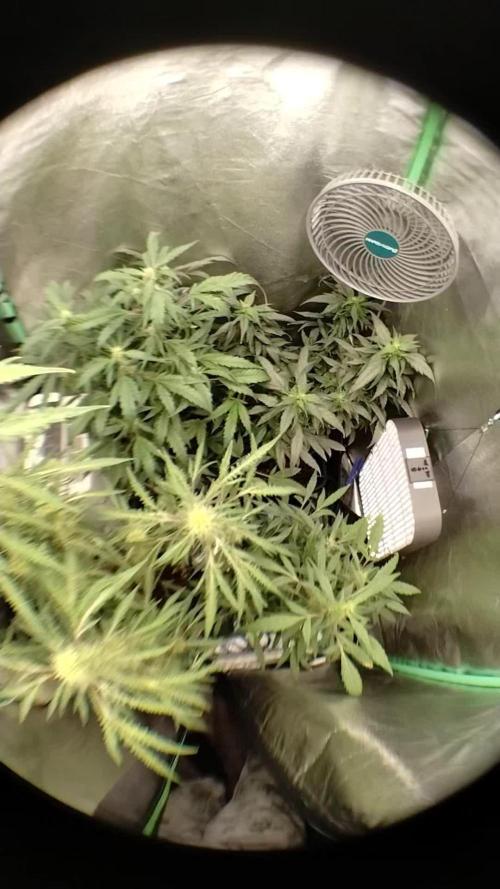
Update: Day 1 of week 11 - Thursday 29th October I am soooooo fucking pissed! I don’t know whether watering the girls from the bottom has made the girls more thirsty or just that they are generally more thirsty due to needing more Nutes during flower but one of the ladies has wilted quite terribly. The other girls seem ok, slightly more thirsty and the leaves slightly droop a little more than usual at feeding time but one girl has defo been through the thirst wars.. She’s bounced back after a good water but the buds looks shrivelled and feeling very sorry for them selves. I’m not sure she will be as good a smoke now if she makes it at all.. Other than that moved the LED up slightly more to keep a good distance between the light and the girls.. I really haven’t got anymore space now so fingers crossed this all works! Super vex this has happened in the final weeks. UPDATE: Day 2 of week 11 - Friday 30th Oct The wilted lady has made a great recovery but the buds still seem a little dishevelled. But considering what’s happened to her I’m happy so far.. Let’s see how she goes🤞🏼 UPDATE: Day 3 of week 11 - Saturday 31st Oct All looking good and buds seem to be fattening up a little now ❤️ Nutes in as normal and happy the wilted lady has made a good recovery.. UPDATE: Day 5 of week 11 - Monday 2nd Nov Nutes in and all looking good.. They don’t seem to be stretching much now and I’m hoping that means the buds will fatten up nicely from here on in.. UPDATE: Day 7 of week 11 - Wednesday 4th Nov Nutes in and another week done.. Come on ladies it’s time to fatten up for me please 🤞🏼🙏🏼 Happy Halloween everyone 🎃 👻
Likes
120
Share
@StarLorr
Follow
Welcome to my Strawberry Pie 🍓🥧diary. In this Diary: Seeds: [420 Fast Buds]from my growmie Tropicannibis_Todd 👊🏻😎 Media: Pro~Mix HP Open Top Grow Bag, Connect. Nutrients: Green Planet Nutrients, 2 Part Dual Fuel starter kit. RealGrowers: Recharge. Diablo nutrients: Ripping. Feeding : Tue 19Mar: 2L Nutes/Recharge pH'd 6.5 Thu 21Mar: 2L Nutes/Recharge pH'd 6.5 Sun 24Mar: 2L Monster K pH'd 6.5 ___________________________ Nice chunky buds on this gal!!😋... i can see the finish line🏁👀a couple more laps😎 ___________________________ Thanks for stopping by, likes and comments are appreciated.👊🏻😎 Keep on growin! Keep on tokin!!! 😙💨💨💨💨💨
Likes
5
Share
These two Boofy's were harvested on the 73rd day.
Likes
27
Share
@WestOzzie
Follow
Flower growth
Processing
Likes
18
Share
Buenas tardes familia, actualizamos la semana de las northern light xL, e de decir que es la más lenta del proyecto, aún así se ven como se forman unas buenas flores, por lo general compactas, iremos viendo por que todavía las va quedando. PH Muy controlado , a estas alturas por encima del 6,2. Ya les quitamos productos y pronto lavaremos raíces.
Likes
16
Share
Week 8: What can I say about this lady? The beefy colas are now gaining the resin that gives this strain it's name. Super thick and dense. I pulled lowers on the cola away from the stem to avoid the possibility of bud rot(see video) It smells like honey and berries... maybe a touch of grape in there. Super smooth smelling!! Can't wait to smoke it!!!!
Likes
63
Share
@Roberts
Follow
Strawberry Amnesia is growing well. She had a solution change today. She is gonna get some defoliation come next week. Everything is going great. Thank you Herbies seeds, Athena, and Spider Farmer. 🤜🏻🤛🏻🌱🌱🌱 Thank you grow diaries community for the 👇likes👇, follows, comments, and subscriptions on my YouTube channel👇. ❄️🌱🍻 Happy Growing 🌱🌱🌱 https://youtube.com/channel/UCAhN7yRzWLpcaRHhMIQ7X4g.
Likes
17
Share
@nerdz
Follow
F15 to 21 Tuesday Big big big. Humidity was getting hard to handle especially during lights out so I had to do a mid stretch cleanup. I mostly did a lollipop to get air flowing through the plant. I didn't go too hard even though it looks like I did. I will do the last one in a week. ~1000ppm 3/4-full bloom @ ~5.8-5.9 Lights 100% @ 7-12" 25-26c / ~53rh
Likes
2
Share
This plant is beautiful, wish I had taken a clone! Reaching peak flower now so added PK into the mix for extra Potassium and Phosphorous over the next 10 days or so. Never had plants soak up this much nutrients without any burn (touch wood) so I'm really impressed with the Vitalink range. This plant is at the front left of the tent, and to the rear of the screen in the timelapse. Heavily defoliated for the final time this week, allowing for the light to reach as many bud sites as possible.
Likes
28
Share
Finally getting her dialed in, guess I better mentally prepare for flowering. *slaps face* All week I kept bending further down, any stem that shot up past a point where it could reach the next square across in any direction that needed to be filled, nice and easy. Tweak tweak tweak all week. Break Apical dominance In botany, apical dominance is the phenomenon whereby the main, central stem of the plant is dominant over other side stems; on a branch the main stem of the branch is further dominant over its own side twigs. Resonance transfer occurs because the energy waveforms coming out of a vibrating substance have nearly identical waveforms. The phase relationships of a resonating system can be defined in terms of the angular separation that exists between adjacent molecules. The six molecules that form one hexagonal ring, when in resonance, will vibrate or broadcast its energy on a wave that has a particular frequency. The first molecule will vibrate influencing the second molecule; the second will affect the third, and so on. The time intervals between successive broadcasts will result in a phase delay which can be converted into a phase angle. Successive waves coming from an oscillating system have successive phase angles that equal the angular separation that exists between members of the system. The phase angle within the vibrating ring of water molecules is 60 degrees (360 divided by 6). If there were 7 molecules in the ring the phase angle would be 360/7 or 51.43 degrees. This is the principle phase angle of quartz. Most of the internal angles of water and quartz are either fractions of this angle or multiples of it. It is the interlattice resonance between the quartz microstate and the lyotropic mesophase that is the determining factor in the formation of the lyotropic mesophase in water. It is the reason that water can be structured by spinning it around a tuned quartz crystal. It does not require large amounts of energy to accomplish this. As an example of resonant transfer, one can imagine a series of dominoes being placed across the United States. from San Francisco to Washington. Each successive domino would be slightly larger and heavier than the previous piece. By the time we reached Washington, the final domino might be as large as the Washington monument. By applying a slight push to the first domino, less than one pennyweight, each domino would be knocked over until the final piece was toppled. Through the introduction of a very small energy to a system the result is the production of enough energy to knock over the final very large and heavy domino.
Likes
8
Share
Week #9 Baby Boom/Kannabia Seeds Week #9 Dec.23rd-Dec.30th Baby Boom Week #9 plant is looking good buds are continuing to grow and get dense thricomes have started to become more visible. She's just a nice looking plant. She grows like a sativa with her stretch and bud structure. Thank you for taking a look!! Stay growing great Medicine this year!!
Likes
27
Share
Here we are, ready, after a week of really fruitful germination we have 20 beautiful plants all marked with the Z of Zamnesia. They are a strain in test. Super secret because from the start it seems explosive, but we are only on day nine and we are not used to talking too early, so we keep quiet and work hard we have learned to enjoy the results at the end, only when they are obtained. ---- New Home - The ladies have almost all been transplanted into 11-liter pots which is my favorite size to get the best ratio presence of plants in the grow box / yield. Especially if you do not have to do exaggerated topping or you have to grow the plants straight with main cola as I do for catalog needs as I do, 11 liters guarantees you to make excellent plants. Topping with 11 pots is recommended up to a maximum of 16 tops (4 main crops) - The pots are square plastic and canvas pots branded Zamnesia - The soil used is Plagron Promix with peat and worm castings but not fertilized - --- Start feeding program - A very serious feeding program branded Plagron has begun. We have created our own personalized table based on the chosen soil (Plagron Promix 100% organic) that you can all do at the link https://plagron.com/en/tools/grow-schedule-calculator and I started to give: - Power Roots - 1ml/l - Alga Grow - 2 ml/l - Pure Zym - 1 ml/l - Sugar Royal - 1ml/l - Vita Race - 1 ml/l - The 100% Organic pack by Plagron can be found on Zamnesia at the link: https://www.zamnesia.io/it/11457-plagron-easy-pack-natural.html We are giving a lot of humidity with a humidifier and we oscillate between 65% and 70%. // Strain Description // New Strain testing coming soon… - - Get a seed of this fantastic strain --- new strain coming soon get some others on - https://www.zamnesia.io/ - Soil and Fertilizers entirely organic --- https://plagron.com/en buy on www.zamnesia.io - Growbox and air sistem --- https://www.secretjardin.com/ - Light - Sp3000 - https://marshydro.eu/ - Music and sound --- I made my girls listen to 432hz frequencies and music from www.radionula.com - Z --- You can find these seeds, much more from the world of cannabis, mushrooms and an incredible series of accessories and gadgets on the reference site not only mine but of many growers ---- https://www.zamnesia.io
Likes
13
Share
No nutrients this last watering I did today. Flushing for 2 weeks then harvest time! I've done the last of my defoliating and looking forward to starting a new batch in a few short weeks.
Likes
15
Share
Gave the girls banana tea that sat for 28 hours and they seemed to love it. Will do another in a few days. They look very healthy and beautiful 💖
Likes
52
Share
Lacewings seemed to have mostly killed themselves by flying into hot light fixtures. I may have left the UV on which was smart of me :) Done very little to combat if anything but make a sea of carcasses, on the bright side its good nutrition for the soil. Made a concoction of ethanol 70%, equal parts water, and cayenne pepper with a couple of squirts of dish soap. Took around an hour of good scrubbing the entire canopy. Worked a lot more effectively and way cheaper. Scorched earth right now, but it seems to have wiped them out almost entirely very pleased. Attempted a "Fudge I Missed" for the topping. So just time to wait and see how it goes. Question? If I attached a plant to two separate pots but it was connected by rootzone, one has a pH of 7.5 ish the other has 4.5. Would the Intelligence of the plant able to dictate each pot separately to uptake the nutrients best suited to pH or would it still try to draw nitrogen from a pot with a pH where nitrogen struggles to uptake? Food for stoner thought experiments! Another was on my mind. What happens when a plant gets too much light? Well, it burns and curls up leaves. That's the heat radiation, let's remove excess heat, now what? I've always read it's just bad, or not good, but when I look for an explanation on a deeper level it's just bad and you shouldn't do it. So I did. How much can a cannabis plant absorb, 40 moles in a day, ok I'll give it 60 moles. 80 nothing bad ever happened. The answer, finally. Oh great........more questions........ Reactive oxygen species (ROS) are molecules capable of independent existence, containing at least one oxygen atom and one or more unpaired electrons. "Sunlight is the essential source of energy for most photosynthetic organisms, yet sunlight in excess of the organism’s photosynthetic capacity can generate reactive oxygen species (ROS) that lead to cellular damage. To avoid damage, plants respond to high light (HL) by activating photophysical pathways that safely convert excess energy to heat, which is known as nonphotochemical quenching (NPQ) (Rochaix, 2014). While NPQ allows for healthy growth, it also limits the overall photosynthetic efficiency under many conditions. If NPQ were optimized for biomass, yields would improve dramatically, potentially by up to 30% (Kromdijk et al., 2016; Zhu et al., 2010). However, critical information to guide optimization is still lacking, including the molecular origin of NPQ and the mechanism of regulation." What I found most interesting was research pointing out that pH is linked to this defense mechanism. The organism can better facilitate "quenching" when oversaturated with light in a low pH. Now I Know during photosynthesis plants naturally produce exudates (chemicals that are secreted through their roots). Do they have the ability to alter pH themselves using these excretions? Or is that done by the beneficial bacteria? If I can prevent reactive oxygen species from causing damage by "too much light". The extra water needed to keep this level of burn cooled though, I must learn to crawl before I can run. Reactive oxygen species (ROS) are key signaling molecules that enable cells to rapidly respond to different stimuli. In plants, ROS plays a crucial role in abiotic and biotic stress sensing, integration of different environmental signals, and activation of stress-response networks, thus contributing to the establishment of defense mechanisms and plant resilience. Recent advances in the study of ROS signaling in plants include the identification of ROS receptors and key regulatory hubs that connect ROS signaling with other important stress-response signal transduction pathways and hormones, as well as new roles for ROS in organelle-to-organelle and cell-to-cell signaling. Our understanding of how ROS are regulated in cells by balancing production, scavenging, and transport has also increased. In this Review, we discuss these promising developments and how they might be used to increase plant resilience to environmental stress. Temperature stress is one of the major abiotic stresses that adversely affect agricultural productivity worldwide. Temperatures beyond a plant's physiological optimum can trigger significant physiological and biochemical perturbations, reducing plant growth and tolerance to stress. Improving a plant's tolerance to these temperature fluctuations requires a deep understanding of its responses to environmental change. To adapt to temperature fluctuations, plants tailor their acclimatory signal transduction events, specifically, cellular redox state, that are governed by plant hormones, reactive oxygen species (ROS) regulatory systems, and other molecular components. The role of ROS in plants as important signaling molecules during stress acclimation has recently been established. Here, hormone-triggered ROS produced by NADPH oxidases, feedback regulation, and integrated signaling events during temperature stress activate stress-response pathways and induce acclimation or defense mechanisms. At the other extreme, excess ROS accumulation, following temperature-induced oxidative stress, can have negative consequences on plant growth and stress acclimation. The excessive ROS is regulated by the ROS scavenging system, which subsequently promotes plant tolerance. All these signaling events, including crosstalk between hormones and ROS, modify the plant's transcriptomic, metabolomic, and biochemical states and promote plant acclimation, tolerance, and survival. Here, we provide a comprehensive review of the ROS, hormones, and their joint role in shaping a plant's responses to high and low temperatures, and we conclude by outlining hormone/ROS-regulated plant-responsive strategies for developing stress-tolerant crops to combat temperature changes. Onward upward for now. Next! Adenosine triphosphate (ATP) is an energy-carrying molecule known as "the energy currency of life" or "the fuel of life," because it's the universal energy source for all living cells.1 Every living organism consists of cells that rely on ATP for their energy needs. ATP is made by converting the food we eat into energy. It's an essential building block for all life forms. Without ATP, cells wouldn't have the fuel or power to perform functions necessary to stay alive, and they would eventually die. All forms of life rely on ATP to do the things they must do to survive.2 ATP is made of a nitrogen base (adenine) and a sugar molecule (ribose), which create adenosine, plus three phosphate molecules. If adenosine only has one phosphate molecule, it’s called adenosine monophosphate (AMP). If it has two phosphates, it’s called adenosine diphosphate (ADP). Although adenosine is a fundamental part of ATP, when it comes to providing energy to a cell and fueling cellular processes, the phosphate molecules are what really matter. The most energy-loaded composition for adenosine is ATP, which has three phosphates.3 ATP was first discovered in the 1920s. In 1929, Karl Lohmann—a German chemist studying muscle contractions—isolated what we now call adenosine triphosphate in a laboratory. At the time, Lohmann called ATP by a different name. It wasn't until a decade later, in 1939, that Nobel Prize–-winner Fritz Lipmann established that ATP is the universal carrier of energy in all living cells and coined the term "energy-rich phosphate bonds."45 Lipmann focused on phosphate bonds as the key to ATP being the universal energy source for all living cells, because adenosine triphosphate releases energy when one of its three phosphate bonds breaks off to form ADP. ATP is a high-energy molecule with three phosphate bonds; ADP is low-energy with only two phosphate bonds. The Twos and Threes of ATP and ADP Adenosine triphosphate (ATP) becomes adenosine diphosphate (ADP) when one of its three phosphate molecules breaks free and releases energy (“tri” means “three,” while “di” means “two”). Conversely, ADP becomes ATP when a phosphate molecule is added. As part of an ongoing energy cycle, ADP is constantly recycled back into ATP.3 Much like a rechargeable battery with a fluctuating state of charge, ATP represents a fully charged battery, and ADP represents a "low-power mode." Every time a fully charged ATP molecule loses a phosphate bond, it becomes ADP; energy is released via the process of ATP becoming ADP. On the flip side, when a phosphate bond is added, ADP becomes ATP. When ADP becomes ATP, what was previously a low-charged energy adenosine molecule (ADP) becomes fully charged ATP. This energy-creation and energy-depletion cycle happens time and time again, much like your smartphone battery can be recharged countless times during its lifespan. The human body uses molecules held in the fats, proteins, and carbohydrates we eat or drink as sources of energy to make ATP. This happens through a process called hydrolysis . After food is digested, it's synthesized into glucose, which is a form of sugar. Glucose is the main source of fuel that our cells' mitochondria use to convert caloric energy from food into ATP, which is an energy form that can be used by cells. ATP is made via a process called cellular respiration that occurs in the mitochondria of a cell. Mitochondria are tiny subunits within a cell that specialize in extracting energy from the foods we eat and converting it into ATP. Mitochondria can convert glucose into ATP via two different types of cellular respiration: Aerobic (with oxygen) Anaerobic (without oxygen) Aerobic cellular respiration transforms glucose into ATP in a three-step process, as follows: Step 1: Glycolysis Step 2: The Krebs cycle (also called the citric acid cycle) Step 3: Electron transport chain During glycolysis, glucose (i.e., sugar) from food sources is broken down into pyruvate molecules. This is followed by the Krebs cycle, which is an aerobic process that uses oxygen to finish breaking down sugar and harnesses energy into electron carriers that fuel the synthesis of ATP. Lastly, the electron transport chain (ETC) pumps positively charged protons that drive ATP production throughout the mitochondria’s inner membrane.2 ATP can also be produced without oxygen (i.e., anaerobic), which is something plants, algae, and some bacteria do by converting the energy held in sunlight into energy that can be used by a cell via photosynthesis. Anaerobic exercise means that your body is working out "without oxygen." Anaerobic glycolysis occurs in human cells when there isn't enough oxygen available during an anaerobic workout. If no oxygen is present during cellular respiration, pyruvate can't enter the Krebs cycle and is oxidized into lactic acid. In the absence of oxygen, lactic acid fermentation makes ATP anaerobically. The burning sensation you feel in your muscles when you're huffing and puffing during anaerobic high-intensity interval training (HIIT) that maxes out your aerobic capacity or during a strenuous weight-lifting workout is lactic acid, which is used to make ATP via anaerobic glycolysis. During aerobic exercise, mitochondria have enough oxygen to make ATP aerobically. However, when you're out of breath and your cells don’t have enough oxygen to perform cellular respiration aerobically, the process can still happen anaerobically, but it creates a temporary burning sensation in your skeletal muscles. Why ATP Is So Important? ATP is essential for life and makes it possible for us to do the things we do. Without ATP, cells wouldn't be able to use the energy held in food to fuel cellular processes, and an organism couldn't stay alive. As a real-world example, when a car runs out of gas and is parked on the side of the road, the only thing that will make the car drivable again is putting some gasoline back in the tank. For all living cells, ATP is like the gas in a car's fuel tank. Without ATP, cells wouldn't have a source of usable energy, and the organism would die. Eating a well-balanced diet and staying hydrated should give your body all the resources it needs to produce plenty of ATP. Although some athletes may slightly improve their performance by taking supplements or ergonomic aids designed to increase ATP production, it's debatable that oral adenosine triphosphate supplementation actually increases energy. An average cell in the human body uses about 10 million ATP molecules per second and can recycle all of its ATP in less than a minute. Over 24 hours, the human body turns over its weight in ATP. You can last weeks without food. You can last days without water. You can last minutes without oxygen. You can last 16 seconds at most without ATP. Food amounts to one-third of ATP production within the human body.
Likes
4
Share
June 8: planted out first seedling into 7 gallon bag. Using peat pots as intermediate container because it is too cold here to start seeds outdoors and I don’t have room for final containers inside. After about one week roots are coming out the bottom. It was pretty cool in May with some frost nights so I’m glad I waited until June to start these.
Likes
10
Share
End of week 8 and mid way through week 9. Already put nutrients in and already finished first flush. Will be flushing from now on, trying to get 6.5 everytime. Room is 24 degrees at 55 percent Rh sometime 45 or 65. Smell starting Ng coming from no where, good bud smell coming from them.