


Likes
Comments
Share


@Stickygreens420
Follow
Overall I was happy with this strain and I did not have many problems growing. Plant was healthy for the entire grow with little to no signs of deficiencies. The only issue I had with the plant was it started sprouting a good amount of nanners the last few weeks of flower. I was able to pull them all off with tweezers, so now I just need to hope they didn't pollinate any of the other plants. Still need to dry for another two weeks, so I will provide a smoke report at that point. The plant is loud and still has that sweet funk. Excited to smoke it. I will be drying at 60° and 60% RH for 12 to 16 days.
12/28/2022: day 10 of drying at 60° and 60% RH. Smallest branches are starting to snap, but most of the main branches are not providing a noticable cracking sound yet. Buds are a little on the airy side, from what I can tell, but I'll provide a final update once trimmed.
1/2/2023: started trimming today, which is day 15 at 60° and 60% RH
1/4/2022: finished trimming and totaled 84 grams, so just under 3 oz. I know I said earlier the bud was a little airy, but I must have grabbed some lowers. Not the densest ever, but pretty nice nugs. Found some additional nanners I missed, but no seeds so far. Pretty happy with the results.

Likes
40
Share


@MadeInGermany
Follow
Info:
Unfortunately, I had to find out that my account is used for fake pages in social media.
I am only active here on growdiaries.
I am not on facebook instagram twitter etc All accounts except this one are fake.
Have fun with the update.
Hey everyone 😊.
The lady was repotted 4 days ago and has developed very well since then :-).
I let them take root for a few more days before I start training (topping) and add their GHSC Powder Feeding bio Grow 👍.
Otherwise, as always, the tent was cleaned and the humidifier refilled :-).
I wish you all the best ☺️ stay healthy 🙏🏻
You can buy this Strain at :
https://sweetseeds.es/de/cream-caramel/
Type:
Cream Caramel
☝️🏼
Genetics:
Blue Black
x
Maple Leaf Indica
x
White Rhino
👍
Vega lamp:
2 x Todogrow Led
Quantum Board 100 W
💡
Bloom Lamp :
2 x Todogrow Led
Cxb 3590 COB 3500 K 205W
💡💡☝️🏼
Soil :
Bio Bizz Coco
☝️🏼
Fertilizer:
Green House Powder Feeding
☝️🏼🌱
Water:
Osmosis water mixed with normal water (24 hours stale that the chlorine evaporates) to 0.2 EC. Add Cal / Mag to 0.4 Ec Ph with Organic Ph - to 5.8 .

Likes
4
Share

@Mr_Santos
Follow
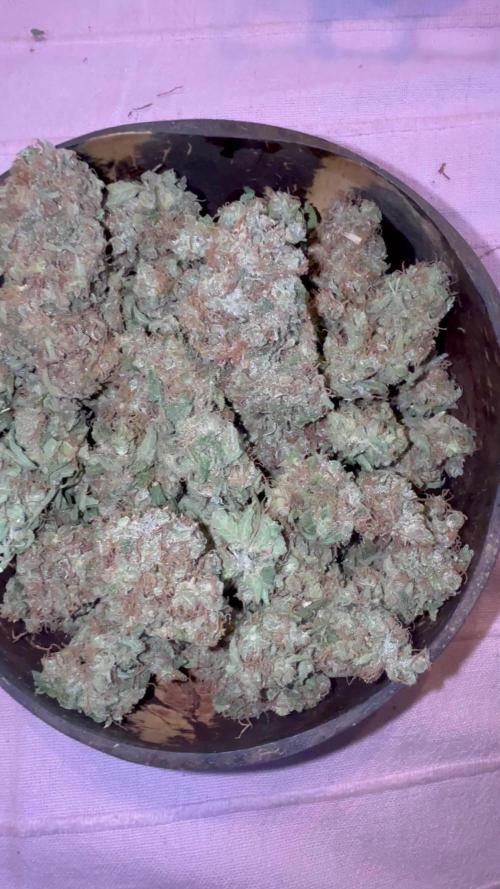
Jetzt wird erstmal getrocknet 5-7 Tage und danach kommt die veredelung. Zu Terpenprofil und Effekt kommen noch Infos, da die Sorte auch neu für mich ist. Vorallem der Ertrag wird interessant da Hydro Anbau erstes Mal😎
Zusatzinfo: Getrocknet wurden jetzt offiziell 2 1/2 Tage Kopfüber aufgehangen bei leichter Umluft und ca 60-70% RLF und 24 Grad.
Die erlaubte Menge an Buds wurde von den Ästen getrennt und in die Groove Bags mit 62% Humidity Bags gepackt. Ich wollte diesmal nicht das die Blüten zu schnell trocknen (wegen zu hoher Lufttemperatur im Zelt), deshalb werde ich jetzt jeden Tag die Tüten öffnen und das angebaute Chlorophyl abdampfen lassen.
In den nächsten Tagen kommt noch der Feinschliff (dry trim).
Geruch: Riecht wirklich jetzt schon sehr fruchtig und einfach lecker.
Blütenstruktur: Harzige jedoch etwas luftigere Blüten. Jedoch werden sie ja jetzt erst veredelt von Konsistenz bis Terpenprofil 😎😍
Info: Laut deutschem Recht wurde das Material welches über die erlaubte Menge lag vernichtet 🤝
Jetzt habe ich auch Bilder und Videos von den fertig getrimmten Buds hochgeladen. Der fruchtige süßliche ageruvh steigt sofort in die Nase und der Rquch ist Sqnft angenehm.
Die Worte bekommt von mir 8,5/10 Punkte!


Likes
8
Share

@PPFDaddy
Follow
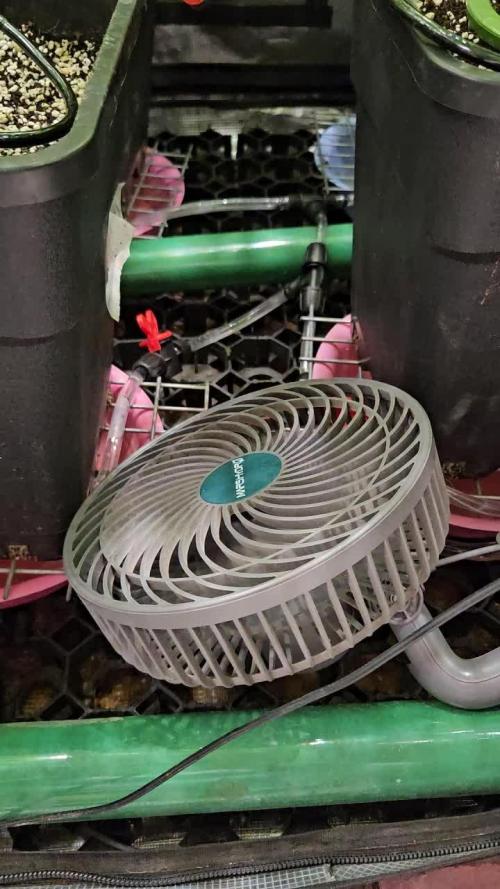
Another smooth week. I did some light defoliation and a bit of lollipopping to tame the jungle, mainly removing leaves that were shading bud sites or blocking airflow through the canopy.
I’m hoping the Hyperion stretch is finally done, because I’m right at the space limit. I had to run the light at 80% to manage height and keep the main tops around 50k lux (and under 60k) to avoid stressing them.
I bumped feed strength up to 2.0 EC. I also added another fan down low to improve air circulation and I’m trying to keep VPD above 1.0 kPa. It’s not easy all day, especially when lights go off, so I’ve been compensating a bit by running temps higher. Not ideal to be above 27°C at this stage, but the dehu can’t always keep up.
That’s it for this week. Hope you all had great holidays and a Merry Christmas. As always, tips are welcome. Good luck everyone!

Likes
22
Share


@OutdoorRookie
Follow
In the third week it was still very cold. at night 5-9°C during the day up to 23°C. 1 time completely filled with rain sewage
Likes
8
Share


@NuttyYeti
Follow
She's growing a little funky but hopefully she'll come around. Probably because the pot is so small my other, bigger pots are stealing it's light

Likes
35
Share


@ThatoneAKguy
Follow
Cruising right along. This is technically day 6 of week one and they are performing as I had hoped they would. Already splitting off and I upped my nutes to try and get as much as I can in the vegetative weeks as possible. I know it’s pushing it but no guts no glory as I’m running 1064ppm.
Added some photos from day 10. What a change.

Likes
12
Share


@gr3g4l
Follow
esta semana es su última semana de crecimiento a 18/06h.
Por lo que parece las plantas después de la última poda dejaron de crecer a lo alto tal como lo venian haciendo y se han dedicado más a crecer a lo ancho tal como queriamos.
A mitad de semana a los 31 dias volví a podar algunas hojas de la parte superior del tallo que ya habian crecido lo suficiente. De esta manera miro de seguir retardando el crecimiento del apical y reforzar el resto de ramas.
Y me deshice también del primer par de nudos de todas las plantas.
también se ha seguido con el tratamiento con solabiol como preventivo ,
Dia 33 se quitaron los calefactores porque ya estan subiendo las temperaturas en el exterior y se añadió un par de ventiladores laterales. Aprobeché también para poner los tutores antes de que crezcan mucho más y así dejarlo preparado para la floración.
Dia 34, un dia antes de final de semana cambio de fotoperiodo a 12/12h. El tamaño de las plantas y los 9 dias que llevan en estas macetas me parecieron suficientes y es que el armario es pequeñito y no puedo abusar.
Likes
21
Share


@Cardiffgrown
Follow
Soaked in straight urb for 45mins Into paper towels then 3 days later almost all were ready they’re almost a week old and the only strawb ban not to germ is now showing its head, so hopefully come threw, hit me up on insta grownincardiff420 thanks for reading and hope you come back to see more / speak soon 💪🤟


Likes
6
Share

@MadeInGermany
Follow
Flowering day 77
since time switch
to 12/12 h.
Hey guys :-)
Finally the time has come .
The lady was harvested and hung upside down in the dry tent 😍.
Before that, she stood in the drying tent in complete darkness for 2 days and the large leaves were removed.
The small leaves stay attached during the drying process so that they protect the buds and allow them to dry more slowly and evenly :-) .
In the dry tent, the temperature is 18-19.5 degrees and the humidity is 54-58% 👍.
In this environment they are now allowed to hang for 10-14 days before they are fine-tuned and trimmed clean by hand.
then after trimming they come to ferment for 6-12 weeks in dark jars with bobeda packs 62% to keep the perfect humidity.
After a few weeks, the Boveda packs 58% are used so that they can slowly dry out :-) .
Of course there is one last update after trimming.
Until then, I wish you a lot of fun with the update.
Stay healthy and let it grow 💚🙏🏻
👇🏼👇🏼👇🏼👇🏼👇🏼👇🏼👇🏼👇🏼👇🏼👇🏼👇🏼👇🏼
You can buy this Nutrients at :
https://greenbuzzliquids.com/en/shop/
With the discount code: Made_in_Germany you get a discount of 15% on all products from an order value of 100 euros.
👇🏼👇🏼👇🏼👇🏼👇🏼👇🏼👇🏼👇🏼👇🏼👇🏼👇🏼👇🏼
You can buy this Strain at
https://pcg.international/shop/pcg-int/
Water 💧 💧💧
Osmosis water mixed with normal water (24 hours stale that the chlorine evaporates) to 0.2 EC. Add Cal / Mag to 0.4 Ec Ph with Organic Ph - to 5.8 - 6.5
MadeInGermany

Likes
26
Share


@BrMarijuana
Follow
Devido a Rega a cada dois dias, resolvi fracionar a dosagem semanal de fertilização para toda Rega, sendo assim, rego a cada dois dias da semana, totalizando três regas semanais, com isso fraciono a dosagem para 2ml líquido e 0,16g de mineral a cada litro d'água, totalizando 6ml líquido e 0,50g de mineral por semana.

Likes
8
Share

@eldruida_lamota
Follow
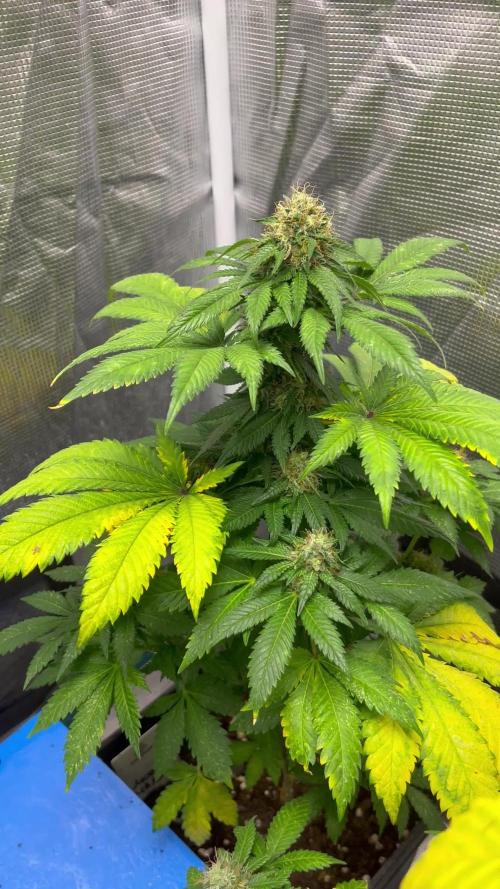
Que pasa familia, vamos con la séptima semana de floración de estas Monster Maker feminizadas de Sweetseeds.
Vamos al lío, las plantas se trasplantaron a macetas de 7 litros.
El ph se controla en 6.5, la temperatura la tenemos entre 24/21 grados y la humedad ronda el 50%.
El ciclo de crecimiento puse 12h de luz, el foco está al 100% de potencia.
Tengo visitantes, trips que combatiremos con control biológico.
Me gustaría estar más encima este cultivo pero la salud me está impidiendo un poco este 100% con el proyecto.
- os dejo por aquí un CÓDIGO: Eldruida
Descuento para la tienda de MARS HYDRO.
https://www.mars-hydro.com
Hasta aquí todo, Buenos humos 💨💨💨
Likes
5
Share


@Jays_Not_Here_Man
Follow
The girls are starting to wrap up their cycle. I have been watching the trichomes closely, and we are getting very close

Likes
38
Share


@trelorny
Follow
Day 29, 08.05.2024
1730
- Gave ladies a drink of 500ml water incl. fertilizer each
- added two fresh yellow cards
- removed my old DIY VPD controller unit (boy I learned a lot - for example that mechanical relais are not as durable as I thought - more on that later maybe)
- Both girls look fresh & healthy - I am looking forward to this week!
Day 30, 09.05.2024
- No action at all today. They are growing fast!
Day 31, 10.05.2024
1000
- Raised the lights by ~5cm again.
- thinking about installing a net that holds down leaves and lets the buds (which are uneven in their distance to the light) receive an even amount of light
- Today after the "night" there will be a round of drinks again as both of the ladies let their leaves hanging
1700
- gave 500ml water incl. fertilizer
2115
- got the ladies out of the tent to give them an inspection. Both look good (from what I can tell anyways...). Removed 2-3 lower leaves and one smaller bud which do not receive enough light (again: from what I can tell - I don't know what I am doing, just following my gut feeling :D )
- and the biggest change: I installed a SCROG Net / trellus net! I was already able to stretch out the branches and it helps me organize the branches and buds towards a much more even canope. It is currently at about 35cm above the pots with the tops of the first branches poking through
Day 33, 12.05.2024
- one round of drinks inkl. Fertilizer: 500ml each. Cheers, drink up!
- also rearranged the buds to better fill the net
Day 34, 13.04.2024
- another slow day while approaching end of week 5
- installed a 3D printed LED display holder - fit light a charm
- soil is bone dry - there will be an early drink tomorrow morning
Day 35, 14.05.2024
- Cheers - drink up ladies! Decided to give a tap more: ~600ml each, inkl. Nutrition
In the end of week 5 both ladies look healthy and good to go. There are a lot of buds visible - I am curious to see how many of those will not evolve into popcorn buds. The height in the end of the week is ~38cm with Erika II being 1 cm taller than Erika I (who would have thought...)
Likes
25
Share


@PrairieFrostGrow
Follow
*********Week 6 (Flower week) - January 14 to 20, 2020 (Days 36 to 42 from germination)
The week went by pretty quick and overall and started to show more positivity. She finally set her buds 👍 and has taken off with more growth😃.....stretching. Wrestled with the idea that she might be a photo rather than an auto, had that one before, and wanted to ensure she was not. Moved her into the veg tent and with the lower light intensity and temperature she seemed to relax and finally set her bud sites......she is an auto......so why the heck so long to flip? Genetic issue or normal growth pattern??? Again, happy to see the growth but she will not be a producer of quantity so hoping the quality will be there😯😕😯
Have done some further cleaning on the bottom and removed a couple of small growing nodes. The branches were tiny and I want to keep her focused on the thicker branches she already has. Introduced Massive this week for bud density. She has become tall and lanky over the last two weeks. Not at all the growth pattern I was expecting.......would have definitely bent her top over had I known she would go like this😩 Wondering if I should bend over SW2 or not now😕
Keeping wet and happy is a balance. She was good with 2L last week and by the end of the week now she wants close to 3L. I also bumped up the CalMag on one of the feedings a bit to help ensure she doesn’t show issues. Won’t be using CalMag much longer as we are getting later in flower.
Not sure how much longer to feed......will go another full 2 weeks for sure. I suspect she will run a full 10 weeks, then if allowing a 2 week flush you only go through week 8. Really don’t know what she is going to do at this point😕😕
Going to be interesting if her sister follows everything in the same manner.......she is in a 1 gal pot...downsides from 3 gal........live and learn Baby!!!👏👍
Little more detail:
Jan 14/20 - Day 36
- only given 1L of plain water, pH 6.1
- no nutrients.
- thinking she maybe a photo period......if so then I need to back up her medium to and end of veg state and get ready to run her in 12/12 to flip her.......had happen with a Dinafem pack before.
- that would suck.....another 7 weeks to go if she is.
Jan 15/20 - Day 37
- 2L water - Dual Fuel & CalMag @ 0.5ml/L - 450ppm & pH to 5.7
- She is now 18" tall!!!!! A little odd compared to other diaries for this strain??
- Side branches firming up but the low ones are still soft.
- Her Main stem is still soft as well.....more of what you expect in veg not flower......as a comparison.
- Nodes growth is still odd, some nodes have four fan leaves for example?
Jan 16/20 - Day 38
- 1L plain water only today.
- She did not drink a lot yesterday.
- SW1 & SW2 moved to veg tent under T5.
- ThinkIng I will shock them a bit and see what happens. If a photo she should calm down and show signs of new growth.....too many hairs popping but grasping at straws here.....if she is an auto she should form buds in a couple of days???
- Set the temp in the tent to 82 degrees and humidity to 55%.
- Moved light to 14” off top cola.
Jan 17/20 - Day 39
- Nothing given today. No water.....dry out day.
- She looked good this morning.....perky and happy
- Leaves opened up and exposed buds........give her another day or so.......she is an auto......just really slow consistently through all stages.
Jan 18/20 - Day 40
- 2L full feed plus 1L plain water added to reduce the ppm and not shock her.........740ppm and 6.1pH.......total watering 3L
- nothing in PM.....pot still wet.
- concerned about bud sites not getting enough light so moved her back into the flower tent in evening.
- replaced CO2 in tent.
- Very happy today and good growth with leave up.
- 22” tall and 24” wide..
Jan 19/20 - Day 41
- 3L feeding again today. Full strength again but added Piranha and Voodoo Juice at 2ml/L as well.....975 ppm 5.9 pH.
- full strength was 1275ppm so added plain water to bring down a bit.
- runoff: 1130 ppm and 5.7 pH.....Start bringing up the pH now to 6.1.
- Cut off two more low bud sites with tiny branches.
- Tied her down more now to help make her wider. Reached up to a couple of the higher nodes I had left alone previously.
- Seeing a Kush style long branches. She is now the tallest in the tent!
Jan 20/20 - Day 42
- Awesome night after stripping. She is taller again and looks happy, more vibrant!
- 2L plain water 6.2 pH in AM.
- 2L plain water Sensyzime @ 2ml, LW8 & Rezin @ 1.5ml = 75 ppm 5.9 pH. In PM.
- She seems happy. Filling out more on the side branching.
- Bud sites are getting larger but still small overall........if like everything else with girl.......just give her time......patience😩😩😃👌
Have a great week fellow growers.......

Likes
3
Share


Likes
30
Share


@GoodTimesOrganics
Follow
Hi liebe Community und Willkommen zurück im Sensi Seeds Wettbewerb! 💚
Chocolate Rainbow 🍫🌈
Nach der 14 Wachstumswoche insgesamt ist nun die achte Blütewoche vorbei. Nach dem Trichomchrck kommen wir in die finale Blütewoche!
🌱(Wachstumstag 103 | 🌷Blüte Tag 49)
Die Blütenausbildung ist richtig stark ausgeprägt. Eine unfassbar kompakte Sorte mit dicken schweren Buds!
Die Blütenstände zwischen 4cm und 5cm breit.
Die Trichome färben sich milchig und allmählich Bärensteindarben ein.
Der Geruch erinnert an diesen Sanostol Saft aus der Kindheit. Leicht nach Orange, etwas säuerlich.
Die Höhe liegt nun insgesamt bei knapp 88cm.
Technisch wird bei der Pflanze nun nichts mehr gemacht.
Es gibt jetzt nur noch Wasser bis zur Ernte!
Wird knapp mit der Beendigung vor dem Ablauf.
Die Bedingungen im Growschrank sind für die Blütephase top!
Die Videos findet ihr nun auch bei Insta und YouTube!
________________________
🌡️ Temp: 26
🌚 Temp: 18°C bis 19°C
💧 RH: 58%
🌬️ VPD: 1,07 kPa
☀️ ppfd: 830 mpm
________________________
Grüne Grüße 💚🍀

Likes
7
Share


@Famtreez
Follow
crazy week found drain gnats which explains the green hue of some of my plants the larve are attacking the roots raising the p.h. and the diffecencies are showing in the leaves being lighter and or brown dots on the leaves. using mosquito dunks and spraying neem oil washing the roots to help these ladies out. also im doing things different with the soil vs dwc, i havent done much if any defoliating with potted plants just letting them grow only mainlined once and since in flower very light if any defoliating. any questions comments information feel free to ask or inform im open to critque
