Likes
6
Share
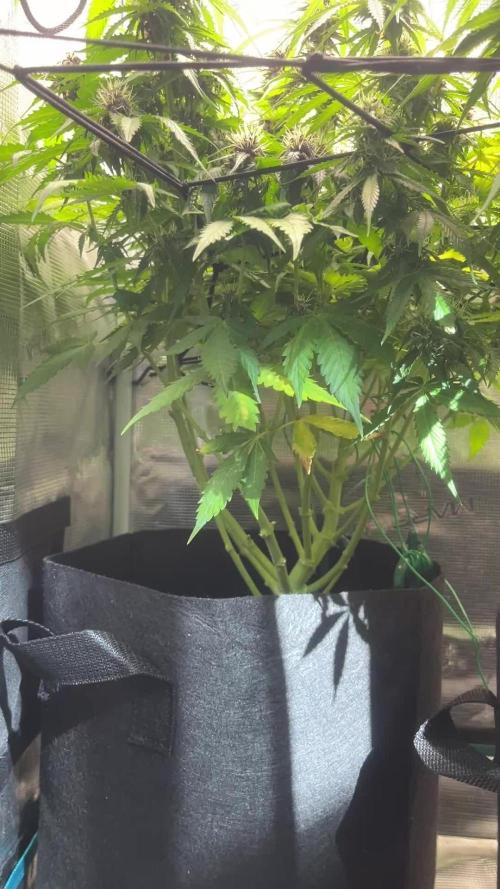
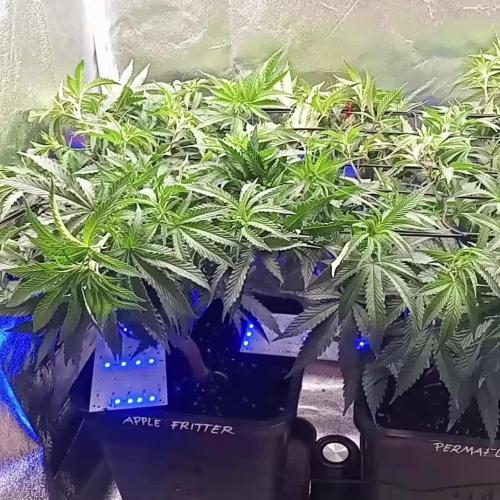
Gorilla Girl XL Auto - A 6th Generation autoflowering strain. A tall, “Super Strong” marijuana strain produced by crossing two of most powerful varieties in the Cookies family: Gorilla Girl®️ x Sweet Gelato Auto®️ (SWS74 x SWS76). 10.7 - 10.13 ----------------------------------- 10.6 - 2 CM+, 2 M, 4 B, .25 Flp, .25 EW 1 & 2 10.9 - 2 M, 4 B, .25 Flp, .25 EW, .5 Molasses 1 & 2 10.12 - 2 M, 4 B, .25 Flp, 1 FS, .5 Molasses #1 10.13 - 2 M, 4 B, .25 Flp, 1 FS #2 ----------------------------------- 3 Gallon Fabric Pot 67% Cana-Coco 33% Perlite - Sta-Green Green Clips ------------------------- Tent: 2’x4’x5’ GA Tent 600D 1 Gal Humidifier 1x 6” Clip Fan 1x 28” Oscillating Fan 1x 4” Carbon Filter with 2x 200 CFM ------------------------------------------- 3 Gallon Tall Fabric Pots Spider Farmer SF1000 LED - Spider-Farmer Optic 1 54W 3500k - opticledgrowlights Optic 1 XL 100W 3500k – opticledgrowlights Optic 1 XL 100W 3500k (Dimming) – opticledgrowlights Cana COCO - Coco Brick Perlite - Sta-Green Filtered Water – Everest Machine Botanicare Cal-MAG Plus General Hydroponic – Flora Series General Hydroponic – pH Up, pH Down Blue Planet Nutrients - Root Magic Mycorrhizae+ Real Growers – Recharge Fish Head Farms – Fish Shit Brer Rabbit – Blackstrap Molasses Zelda – Terpenez Essential Oil Intensifier -------------------------------------------- Variety: SWS82 Indica: 42,1% Sativa: 57,5% Ruderalis: 0,4% THC: 18-25% CBD: 0,1% Indoor Yield: 450-550 g/m² Outdoor Yield: 50-160 g/plant Indoor/Outdoor Harvest: 9 weeks from germination Height: 60-120 cm Effects: Stimulating, Psychoactive Taste: Cypress, Fruity, Citrus, Earthy, Woody, Sweet
Likes
19
Share
@Mo_Powers
Follow
she is doing really well. the buds are getting thicker and the smell is also getting a bit more intense. unfortunately it rained a lot last week and the humidity was very high. i hope that no mould has formed in the budss. the next week will be really sunny and she should still enjoy it. and i think i will harvest her in a week's time.
Likes
3
Share
@Aut0mac24
Follow
I cut of some of the bigger leaves off as they we're creating a lot of darkness inside the plant.
Likes
21
Share
@Roberts
Follow
The plant grew pretty well. She smells of pine and oranges. Very frosty colas on her as well. The last Blue Dream I grew was a awesome smoke. Thanks again Medic Grow, Athena, and Spliff Seeds. 🤜🏻🤛🏻🌱🌱🌱 Thank you grow diaries community for the 👇likes👇, follows, comments, and subscriptions on my YouTube channel👇. ❄️🌱🍻 Happy Growing 🌱🌱🌱 https://youtube.com/channel/UCAhN7yRzWLpcaRHhMIQ7X4g.
Likes
21
Share
Not as good of a week that it has been they shot up about foot and got lil stressed and light bleached bud stop growing under the optic 6 not smelling as good had to throw the net away so couldn’t lower the plant due to net shoot up so fast maybe I learn and I’ll try do it better next time
Likes
8
Share
Just perfect harvest thanks to Platinium for their great fertilizer and to barney's farm for this strain that I recommend a just incredible taste🤤🤤🙏
Likes
15
Share
LST is going very nice and #2 has taken the topping well. As you can see, the auto flowers aren’t the only plants I have. I have a strawberry cough that will be flowering soon, meaning that the strawberry pie and GSC will be finished under 12 hours of light.
Likes
3
Share
VARIEDAD EN FASE DE TEST. NO DISPONIBLE COMERCIALMENTE. RESULTADOS EN EVALUACIÓN POR KANNABIA. Empezamos a fertilizar nuestras plantas con abonos líquidos BIO. Ya se pueden apreciar diferencias significativas entre las distintas cepas. Alturas diferenciadas entre las variedades, anchura de las hojas etc... La potencia de las luminarias está ajustada al mínimo.
Likes
371
Share
D78. The second LED strip light arrived today, and I installed it to cover the right side of the tent. No clue if these sidelights will contribute much, but it's at least noticeably brighter in the lower canopy now. ------------------------------ D80. It looks like my campaign against the pesky thrips is successful. A few days ago, I could find both adults and larvae within seconds when scouting, but today it took me over five mins to find one single larva. Good riddance! ------------------------------ D83. Almost at the end of week six of flower, the girls are rocking it in the tent, getting fatter and smellier daily. I still haven't been able to find any thrips, so it looks like the lacewings were effective. The predatory mites that I also added are probably not necessary, but I wanna be sure all those pesky thrips are dead. There isn't anything to do in the tent now, and everything is running on autopilot, which is excellent as I'm going out of town tomorrow. I gave each girl 2.5 liters of water @ pH 6.3, with humic acid and FFJ. That'll hold them over until I'm home again in a couple of days. ------------------------------
Likes
1
Share
Remember that, however you are played, or by whom, your soul is in your keeping alone. Even though those who presume to play you be kings or men of power, when you stand before God, you cannot say, 'But I was told by others to do thus,' or that virtue was not convenient at the time. This will not suffice. Remember that. Day:18 84°F and 65% RH (VPD) for the vegetative stage. Approximately 1.15kPa(assuming leaf temperature is about 2°F cooler than the air), which falls right into the ideal vegetative sweet spot (0.8kPa to 1.2kPa). At 1.15kPa, plants can draw water and nutrients efficiently without risking stress or wilting. It keeps the leaf pores (stomata) open, allowing for ideal carbon dioxide intake and maximizing vegetative growth. VPD is determined by the leaf's temperature, not just the ambient air. Because leaves usually run 1° to 3°F cooler than room air under bright grow lights, my actual VPD will be slightly lower, closer to the 1.0kPa mark. As she transitions from vegetative growth to flowering, one can gradually lower the humidity (to around 45–60%) and drop temperatures slightly to prevent disease from settling inside dense buds when they appear. Night:6 At 70°F and 60% relative humidity, Vapor Pressure Deficit (VPD) is 0.86 kPa. This is right on the cusp of whats optimal for the vegetative stage. During the nighttime, plants generally close their stomata and undergo cellular respiration rather than photosynthesis. Transpiration slows to a near stop, making VPD less critical at night than during the day. However, maintaining a nighttime VPD between 0.8 and 1.0 kPa is highly beneficial in that it ensures the air is dry enough to prevent powdery mildew or bud rot, but moist enough to keep the plant from undergoing unnecessary stress. This range keeps the environment comfortable for cellular processes and prevents large atmospheric swings. Keeping it all flowing. (Not pushing them yet, these are photoperiods) The optimal soil (root zone) temperature for cellular root respiration and nutrient uptake in cannabis is between 68F & 72F This narrow range balances biological energy production (cellular respiration) with the dissolved oxygen levels in the soil, maximizing plant growth and health. Warmer soils hold significantly less dissolved oxygen. When soil temperature exceeds 74F oxygen depletion occurs, inhibiting cellular respiration almost entirely, At 68-72F root cells generate optimal adenosine triphosphate (ATP) via respiration to power root-tip elongation and the active transport of water and nutrients. Too Hot (Above 78F) Root respiration increases, demanding more oxygen, while the water's oxygen-carrying capacity drops. This creates a prime environment for anaerobic pathogens and Pythium (root rot). Too Cold (Below 60F) Root metabolism and cellular respiration slow to a crawl. This severely impairs nutrient and water absorption, leading to yellowing, wilting, and phosphorus deficiencies. A lot depends on whether it's automatic or photoperiod; with photoperiod, there is not as much of a need to push "hard" as the real countdown only begins once the flower is initiated. Automatics, on the other hand, the chronological "clock" begins ticking the moment the seed germinates. It is of critical importance that the seedling growth gets off to the races, understanding that early growth is like compound interest, which will pay off come harvest. This reality is why getting autoflowers "off to the races" early on yields such exponential benefits. The "compound interest" is directly related to the surface area of the leaves. Larger, faster-growing seedlings process more light and build bigger root networks early on, which translates into an explosion of vertical and lateral growth during their short vegetative window. The margins for error are so thin with autoflowers; this early-stage momentum depends on several critical practices. Seedlings exposed to increased atmospheric CO2 levels early in life will develop at an increased rate. To effectively "extend" or optimize the capacity of Photosystem II (PSII) for increased photosynthetic efficiency. In standard oxygenic photosynthesis, Photosystem II (PSII) is naturally limited to the red-light spectrum, peaking at 680nm. Extending its light-harvesting capacity past 700nm into the far-red region requires bypassing the natural limits of standard chlorophyll a. Adding 730 nm (far-red) LEDs alongside standard red/blue lights has been shown to increase canopy photosynthesis by 20–30% in several crops by acting synergistically with shorter wavelengths. However, the limitation is that excessive, pure IR/Far-red light (without accompanying red light) can trigger the "shade avoidance response," causing plants to grow tall, weak, and spindly rather than robust. Utilizing infrared light (specifically the 700-750 nm far-red range) is a viable method to boost photosynthetic efficiency. It acts as a bridge to allow PSII to utilize a broader spectrum of light, breaking the traditional 700 nm barrier. UVR8-mediated signaling (often in conjunction with CRY proteins) triggers protective mechanisms that maintain the stability of the photosynthetic apparatus (including LHCII and reaction center proteins), thus ensuring that the efficiency of Photosystem II remains higher in UV-B-exposed plants compared to plants lacking this receptor. ΦPSII indictates the rate of electron transfer from water to plastoquinone, which drives the production of ATP and NADPH. There is a close link between ΦPSII and the true rate of CO2 fixation (Φ*co2). ETR stands for Electron Transport Rate. It measures the speed at which electrons are moved through the thylakoid membranes in a plant's chloroplasts during the light-dependent reactions of photosynthesis. Infrared light (particularly Near-Infrared or NIR) improves cellular energy by interacting directly with the electron transport chain (ETC) in mitochondria. This process boosts adenosine triphosphate production, which acts as a metabolic coefficient multiplier by accelerating enzyme activity dramatically. Extend then multiply. Far-Red photons interact with plant photoreceptors to accelerate the plant’s biological "clock" or trigger a shade-avoidance response. Autoflowers don't use the plant's biological clock, although the IR will initiate a shade avoidance and make them stretchy. You can just add equal measures of 660nm-680nm to negate the shade avoidance effect. Replacing nights' "darkness" with a combination of IR+ and 660nm. Because autoflowers don't require a dark period to flower, many growers just blast them with light. 18/6 24/0. However, this ignores the plant's metabolic rhythms, where daytime photosynthesis (light reactions) must be perfectly balanced with nighttime carbon fixation and assimilation (Calvin cycle) to avoid bottlenecking plant development. Cellular respiration is a 24/7 process, but it can only function while the plant has the free oxidative capacity to do so. A 100% photosynthetically active leaf cannot perform cellular respiration. The viral trend of defoliation of every leaf that isn't "getting enough light" is of great detriment overall, putting 100% of the cellular respiratory "workload" and responsibility on the 0/4/6 hours of darkness in sub-optimal conditions for enzymatic activity. Photosynthesis captures nearly 100% of the initial energy as carbon, while cellular respiration is the process that unlocks 90% of that captured energy into usable ATP so the plant can use it. Respiration is considered roughly 30% to 40% efficient. It captures enough of the potential energy in glucose to synthesize around 30 to 38 ATP molecules per glucose molecule. The remaining 60% to 70% of the energy in the sugar is not captured in ATP; instead, it naturally escapes into the environment as heat, which helps regulate plant temperature. In plants, the primary enzymes of the Electron Transport Chain (ETC) and the ATP synthase complexes are typically adapted to function optimally in warmer temperatures (roughly 25°C to 35°C depending on the specific plant strain). As temperatures rise within this physiological range, molecular collisions increase, speeding up respiration and ATP production. The cannabis plant has a branched respiratory pathway. During heat or cold stress, plants activate Alternative Oxidase (AOX). AOX burns sugars to dissipate energy as heat rather than coupling it to ATP production. This pathway actually functions optimally at elevated temperatures to help protect the cell from the damaging build-up of Reactive Oxygen Species (ROS) during heat stress. Enzyme activity generally scales with heat; there is a strict biological limit. If canopy temperatures in a grow room exceed 40°C, the enzymes and their supporting lipid membranes lose stability. Not saying you need to go crazy, just optimize nights the same as we optimize days. Phosphorus is the driving force behind early seedling development. It acts as the "energy hub" of the plant, directly driving cell division, robust root growth, and the creation of DNA. Without an adequate, easily accessible supply early on, the plant's overall growth potential and final yield can suffer permanently. E=MC2 looks like a simple multiplication problem; it describes a fundamental physical truth: mass and energy are the same thing. The equation doesn't just calculate a value; it reveals that mass is effectively "congealed" energy. Energy is just numbers. Energy isn't a physical "substance" you can hold or touch. It is essentially an abstract, calculated number that we assign to a system to predict how it will change, interact, or move. A numerical label we attach to matter to track how it behaves. Because the universe runs on laws of symmetry (specifically, that the laws of physics don't change over time), a single global number must be conserved. We call that number "energy". We don't grow; we facilitate energy conversion. How well a seedling grows is essentially down to how much knowledge one can acquire to increase the level of conversion to occur. Applying knowledge effectively requires intuition, which comes from hands-on experience. A seasoned stoner learns to read subtle signs—like a slight change in leaf turgor (stiffness), subtle color shifts, or the specific texture of the soil—before a textbook diagnosis can be made. Ultimately, growing is the application of botanical science blended with active observation. Knowledge dictates your potential, but adaptability and attentiveness to the plant's immediate environment determine your results. 1.618 nature mathematically optimizes quantum energy transfer and light absorption efficiency within the photosynthetic machinery, as it naturally dictates energy scaling hierarchies and resonance dynamics. External vibration or electromagnetic wave that perfectly matches a plant's natural frequency directly influences plant growth. Low-frequency sound waves and targeted electromagnetic fields stimulate cellular processes and boost photosynthetic efficiency Does it produce better yields? How long is a piece of string? As long as you cut it. But isssss the juice worth the squeeze? The quantum framework of the IVM seems to think so. Good enough for the quantum firmware, good enough for the DNA software. Genetics are not dictated; they are expressed; the rate of that expression is dictated by the environment in which growth occurs. Quantum Coherence in Photosynthesis occurs When a photon of sunlight strikes a leaf, the energy it carries must travel to a reaction center to be converted into chemical energy. This process operates at nearly 100% efficiency. If the energy moved in a traditional "bunching" or random hopping manner, a large portion of it would be lost as heat. Instead, plants utilize quantum superposition. The energy particle (exciton) doesn't just take one path; it exists in a wave state and explores multiple pathways simultaneously. It essentially "chooses" the most efficient route to the reaction center simultaneously. Research shows that molecular vibrations and the specific network arrangements of chlorophyll molecules (like the naturally evolved Chlorophyll A & B ratios) actively protect against energy overflow, optimizing light capture across different light intensities. Enzymes are the biological catalysts that speed up chemical reactions within a plant's cells, allowing them to grow, metabolize, and repair. Rather than relying solely on the classical kinetic energy of molecules colliding, plants use quantum tunneling. Subatomic particles like electrons and protons (hydrogen ions) can literally "teleport" through energy barriers that they normally wouldn’t have the energy to climb over. This makes vital metabolic reactions happen far faster than classical physics could ever explain. Chloryphyll b has peak absorption at 460nm (Blue) and at 647nm(Red). If we take the blue peak wavelength 460nm and a UV-B, UVR8 peak absorption wavelength 285nm, Tryptophan-285 (W285) Sensing protein. 460/285=1.618 Φ If we take chlorypyhll b's Red absorption peak 647nm and a UV-A of 400nm, we get 647/400=1.618 Φ. "Structure of light". The cryptochrome photoreceptor (CRY) is a UV-A/blue light receptor that shares this dual sensitivity with several other biological structures and functions, including significant sequence similarity and a common evolutionary ancestor with DNA photolyase enzymes. These are light-activated enzymes that use blue/UV-A light to repair DNA damage caused by UV-B radiation in plants. Synergistic. But Shhh, it's a secret. Effective quantum efficiency of photosystem II, often denoted as ΦPSII, represents the proportion of light absorbed by Photosystem II (ΦPSII) that is actually used in photosynthetic electron transport. It is a key indicator of how efficiently a plant is using light for photosynthesis, as opposed to losing it as heat or fluorescence. ΦPSII (effective quantum yield of photosystem II) functions primarily as a "multiplier" (a coefficient of efficiency) rather than an additive factor when estimating the overall photosynthetic electron transport rate (ETR). Multipliers are considered far more beneficial than additions because they generate exponential growth, leverage existing resources to their full potential, and create sustainable, self-multiplying capacity, rather than just incremental, linear increases. This fascinating observation is rooted in the intersection of subatomic geometry, fractal scaling, and quantum dynamics. In specific molecular arrangements—such as in conjugated polymer networks or biomolecular architectures—the Golden Ratio (PHI) naturally dictates energy scaling hierarchies and resonance dynamics. Mathematically tied to the fine-structure constant, which defines the strength of the electromagnetic interaction. The Golden Ratio can be mapped geometrically as the Golden Angle (137.5 degrees) in atomic structures, linking the charge of the electron to fundamental quantum constants like Planck's constant. Electromagnetic. The Golden Angle (137.5): This angle is derived from the Golden Ratio (1.618). It is the smaller of two angles created when a circle is divided such that the ratio of the arcs equals the Golden Ratio.
Likes
13
Share
Starting to take off super fast. Will need to train her or flip to flower now for pollination
Likes
3
Share
Been a good week no signs of shock at all. I have only been watering them with Mills Vitilize silica supplement , i think ive been doing 1 mls per gallon, slowly increasing the dosage. topped 2 plants in here , now am i wishing i did it for some of the others . Day 1 for all of these was the 03-08-24
Likes
5
Share
Ich bin nebenher immer noch viel mit anderen Projekten beschäftigt, daher werden ab und zu ein paar Wochen übersprungen. Allerdings habe ich auch vorgehabt aus der einen Pflanze zeitweilig eine Mutterpflanze zu ziehen um mir ein paar Stecklinge daraus zu machen. Mit Erfolg.💚🍭
Likes
18
Share
@Canna96
Follow
Hey now, I hope everyone is having a safe weekend. The ladies are still doing well, and starting to pack on some weight. The Sundae Driver, Bubble Runtz, and Durban Nights still look like they will be the biggest yielders, with the Green Crack 2.0 and Red Hot Cookies being on the lower end in yield, but I am definitely looking forward to having so many strains to sample and to share with friends. The Bubble Runtz looks like it will have the most dense nugs and smells absolutely amazing already and we are still probably 3 weeks out or so. I am thinking 2 weeks to ripen , then another week MAX to flush in the Coco Coir. I am still feeding silica, cal mag, maxi bloom, and liquid kool bloom. I will switch to the dry kool bloom this week week then I will flush with plain water for about 5-7 days before harvesting them around mid December. I am running two full size dehumidifiers outside the tent currently just to keep the relative humidity in the tent right around 50% or slightly below. I also have two very powerful fans blowing one above and one below the canopy to keep the air moving as well as an 8" inline fan keeping fresh and cool air into the 5X5. I am still taking a few fan leaves here and there but mostly just keeping the reservoir full, and cleaning it once per week which only takes 10-15 minutes. I mix one 5 gallon bucket of nutes per day and dump it in the reservoir and then they auto feed 4 times per day. I hope everyone has a great rest of your weekend, Thanks for stopping by, Stay Safe and Blaze On!!! 💪 Website: https://medicgrow.com/ https://growdiaries.com/grower/medicgrowled
Likes
18
Share
@poloq
Follow
_Environment I got the VPD to 1.3 - rather by luck (watering less frequently + ambient temp. rising/ ambient RH dropping (spring around the corner)). _Flower Gorilla Z starts to develop it's trichom stalks, showing that the plant is pretty much done (I'm literally just waiting for the heads to turn milky/ amber). Besides that, the structure is really airy (foxtail). Mimosa Cake on the other hand has still mostly transparent trichomes; it's stucture is much more what you'd expect. The smell also started to increase to a point where you can definitly sense it within the whole room. _Harvest I expect Gorilla Z to be done around early week 15; Mimosa Cake should need 1 week extra, so I'll try to hit the sweet spot in between. _Fertilization On day 88, I gave about 2 tbl spoons (10 ml) of selfmade calciumacetat-suspension (mixed with 2 l of water) to the plants. This was the only watering they got during this week. [1 cleaned eggshell, sterilized at 180 °C (oven) for 20 minutes, then ground into powder, added about 50 ml of 5% apple cider vinegar, left standing until the reaction is complete (no more bubbles rising), mixed with water 1:200 ratio] This is rather an experiment to see if 1) this works and more importantly 2) the plants need/ can take more calcium in their current stage (anaerobic, dense soil). _Plants At first, Gorilla Z shedding all its leaves (sun sails) seemes like a problem, but it's turning out to be an absolute stroke of luck! The leaves literally fall off by themselves (video), which means that a) I have little to no trimming to do, and b) there's almost no chance of mold. *Gorilla Z Auto was 46 cm tall, Mimosa Cake Auto 27 cm.
Likes
11
Share
@BudBeezy
Follow
Welcome to week 9 of my grow diary. The weather has been very changeable this week. But it doesn't seem to have had a negative effect on the plant. Due to the rain showers I didn't have to water often. I defoliated again this week. From now on I think I'll let it grow as nature intended. I have tied the longest shoots further down. The growth height hasn't changed as a result. See you next week ✌️
Processing
Likes
6
Share
3 Plants. 3 citrusy phenos! #1 : First to sprout rapid rooter. TASTE: Pure Lemon front end into hashy cakey afghani. refer to this as the "lemon hashcake" phenom very dense, beautiful nug structure. Yielded 24.5 dry grams of primo smoke. Uplifting more cerebral sativa high with some punch in body as well. happy stress reliever for sure! has some "gassy" or fuel notes to it but very subtle #2 Tangerine pheno: I orginally thought sour 76 was sour diesel x 76 Afghan til i read hso marks post on uk420 forums saying its cali sour d x 76 afghan. cali sour d is cali orange x sour d x mexican sativa. and it shows in this pheno which smell and taste pretty similar to tangie my friend grows which is cali orange x skunk 1 (mexican sativa x Colombian sativa x afghan indica) pretty similar genetics roots! Smell: Sweet tangerine 🍊 Taste: Just like tangerines 🍊 Medical Effects: Hybrid feeling effects felt both in body and mind.  Stimulating mentally, relaxing in the body.  Mild pain relief generally with amazing relief improving feeling in joints (reduced swelling or irritation in otherwise aching areas, loosened tension at joints) Notes: After breaking up or grinding the sweet tangerine open jar/bud smells turns more sour tangerine with very subtle gas aroma. This one is scary strong! I am an all day regular smoker of the most potent buds I can find, and I never make it thru 1 bowl of this without long breaks after each hit.  Starts off strong and creeps to EXTREME psychoactivity.  Not for the faint of heart this one might not be best for "new smokers" 😎🔥🔥🔥 yielded 26.1 grams if id have taken clones this woulda been the keeper of the batch, but I got more to check out in future run :) and I got a cloner and veg chamber to start keepin the keepers now I know i like the strain! #3 Lime Fuel pheno: Smell: Lime🍈 and gas ⛽ Taste: lime Medical Effects: Cerebral uplift. Creeper. thought it was weakest on initial smoke but 10 minutes in it end up being strongest high of all 3.  super wicked sativa, buzzy uplifting all similar to Cinderella 99 or strong jack herers this has almost a "scary high"  first few times but once you get used to it or microdose, it is a super fun creative medicine.  Helps my arthritis pains and gives me the clean up the house kind of high Notes: Foxtailed, lowest yield of 3 sour 76's likely because its place directly under the light (perhaps didnt like too intense direct light) but is the most potent of the 3 as well. yielded 22.5 grams of dry