





Likes
33
Share


@Happygrowing
Follow
Grandissima, 70 cm di diametro , incominciano i tricomi, incominciano gli odori di 🍋 .
Tante soddisfazioni...ha molta fame...
Likes
68
Share


@Hawkbo
Follow
This is 10 days after the first video in week one, 2 days since running the co2 and they started to take off in the 5x9. BTW the floraflex nute dosages are grams per gallon since its dry. ALSO notice the no calmag, have seen multiple growers using floraflex with zero calmag and ZERO ISSUES they have even told me personally that they seem to have healthier plants without the calmag which is wild to me (another reason to switch to floraflex). The 4x8 were just transplanted within the past 3 days, no co2 yet. Obviously isn't perfect I wish I had everything at the same exact stage but I had an issue with some of the clones and couldn't wait to start them over so I just transplanted some mothers I had hanging around in solo cups from a few runs ago. The small ones are the new clone strains cherry kush mints frosted apricots and Platinum Gushers. Might have some issues feeding everything evenly as the smaller ones won't be eating as much as soon as the rest. Maybe I'll stop the co2 in the 5x9 and only run in 4x8 to get everything to even out as much as possible before the flip. Next run I'll have to be more organized and prepared but I'm hopeful I can pull off some decent results on this one. The co2 in the tents is a little tricky, would like to hear how some other growers run theirs. Constant exhaust on lowest setting? Exhaust on a timer? No exhaust? Today I'm trying no exhaust at all and see what happens like a sealed room essentially but im thinking of having the exhaust on a timer to run every 2 hours for 15 mins just to refresh the air or every hour for about 5 mins. Got alot of cleanup left to do so don't mind the God damn mess mf.


Likes
52
Share


@Ultraviolet
Follow
Lacewings seemed to have mostly killed themselves by flying into hot light fixtures. I may have left the UV on which was smart of me :) Done very little to combat if anything but make a sea of carcasses, on the bright side its good nutrition for the soil.
Made a concoction of ethanol 70%, equal parts water, and cayenne pepper with a couple of squirts of dish soap.
Took around an hour of good scrubbing the entire canopy.
Worked a lot more effectively and way cheaper.
Scorched earth right now, but it seems to have wiped them out almost entirely very pleased.
Attempted a "Fudge I Missed" for the topping. So just time to wait and see how it goes.
Question?
If I attached a plant to two separate pots but it was connected by rootzone, one has a pH of 7.5 ish the other has 4.5. Would the Intelligence of the plant able to dictate each pot separately to uptake the nutrients best suited to pH or would it still try to draw nitrogen from a pot with a pH where nitrogen struggles to uptake?
Food for stoner thought experiments!
Another was on my mind.
What happens when a plant gets too much light?
Well, it burns and curls up leaves.
That's the heat radiation, let's remove excess heat, now what?
I've always read it's just bad, or not good, but when I look for an explanation on a deeper level it's just bad and you shouldn't do it.
So I did.
How much can a cannabis plant absorb, 40 moles in a day, ok I'll give it 60 moles. 80 nothing bad ever happened.
The answer, finally. Oh great........more questions........
Reactive oxygen species (ROS) are molecules capable of independent existence, containing at least one oxygen atom and one or more unpaired electrons.
"Sunlight is the essential source of energy for most photosynthetic organisms, yet sunlight in excess of the organism’s photosynthetic capacity can generate reactive oxygen species (ROS) that lead to cellular damage. To avoid damage, plants respond to high light (HL) by activating photophysical pathways that safely convert excess energy to heat, which is known as nonphotochemical quenching (NPQ) (Rochaix, 2014). While NPQ allows for healthy growth, it also limits the overall photosynthetic efficiency under many conditions. If NPQ were optimized for biomass, yields would improve dramatically, potentially by up to 30% (Kromdijk et al., 2016; Zhu et al., 2010). However, critical information to guide optimization is still lacking, including the molecular origin of NPQ and the mechanism of regulation."
What I found most interesting was research pointing out that pH is linked to this defense mechanism. The organism can better facilitate "quenching" when oversaturated with light in a low pH. Now I Know during photosynthesis plants naturally produce exudates (chemicals that are secreted through their roots). Do they have the ability to alter pH themselves using these excretions? Or is that done by the beneficial bacteria?
If I can prevent reactive oxygen species from causing damage by "too much light".
The extra water needed to keep this level of burn cooled though, I must learn to crawl before I can run.
Reactive oxygen species (ROS) are key signaling molecules that enable cells to rapidly respond to different stimuli. In plants, ROS plays a crucial role in abiotic and biotic stress sensing, integration of different environmental signals, and activation of stress-response networks, thus contributing to the establishment of defense mechanisms and plant resilience. Recent advances in the study of ROS signaling in plants include the identification of ROS receptors and key regulatory hubs that connect ROS signaling with other important stress-response signal transduction pathways and hormones, as well as new roles for ROS in organelle-to-organelle and cell-to-cell signaling. Our understanding of how ROS are regulated in cells by balancing production, scavenging, and transport has also increased. In this Review, we discuss these promising developments and how they might be used to increase plant resilience to environmental stress.
Temperature stress is one of the major abiotic stresses that adversely affect agricultural productivity worldwide. Temperatures beyond a plant's physiological optimum can trigger significant physiological and biochemical perturbations, reducing plant growth and tolerance to stress. Improving a plant's tolerance to these temperature fluctuations requires a deep understanding of its responses to environmental change. To adapt to temperature fluctuations, plants tailor their acclimatory signal transduction events, specifically, cellular redox state, that are governed by plant hormones, reactive oxygen species (ROS) regulatory systems, and other molecular components. The role of ROS in plants as important signaling molecules during stress acclimation has recently been established. Here, hormone-triggered ROS produced by NADPH oxidases, feedback regulation, and integrated signaling events during temperature stress activate stress-response pathways and induce acclimation or defense mechanisms. At the other extreme, excess ROS accumulation, following temperature-induced oxidative stress, can have negative consequences on plant growth and stress acclimation. The excessive ROS is regulated by the ROS scavenging system, which subsequently promotes plant tolerance. All these signaling events, including crosstalk between hormones and ROS, modify the plant's transcriptomic, metabolomic, and biochemical states and promote plant acclimation, tolerance, and survival. Here, we provide a comprehensive review of the ROS, hormones, and their joint role in shaping a plant's responses to high and low temperatures, and we conclude by outlining hormone/ROS-regulated plant-responsive strategies for developing stress-tolerant crops to combat temperature changes.
Onward upward for now.
Next!
Adenosine triphosphate
(ATP) is an energy-carrying molecule known as "the energy currency of life" or "the fuel of life," because it's the universal energy source for all living cells.1
Every living organism consists of cells that rely on ATP for their energy needs. ATP is made by converting the food we eat into energy. It's an essential building block for all life forms. Without ATP, cells wouldn't have the fuel or power to perform functions necessary to stay alive, and they would eventually die. All forms of life rely on ATP to do the things they must do to survive.2
ATP is made of a nitrogen base (adenine) and a sugar molecule (ribose), which create adenosine, plus three phosphate molecules. If adenosine only has one phosphate molecule, it’s called adenosine monophosphate (AMP). If it has two phosphates, it’s called adenosine diphosphate (ADP).
Although adenosine is a fundamental part of ATP, when it comes to providing energy to a cell and fueling cellular processes, the phosphate molecules are what really matter. The most energy-loaded composition for adenosine is ATP, which has three phosphates.3
ATP was first discovered in the 1920s. In 1929, Karl Lohmann—a German chemist studying muscle contractions—isolated what we now call adenosine triphosphate in a laboratory. At the time, Lohmann called ATP by a different name. It wasn't until a decade later, in 1939, that Nobel Prize–-winner Fritz Lipmann established that ATP is the universal carrier of energy in all living cells and coined the term "energy-rich phosphate bonds."45
Lipmann focused on phosphate bonds as the key to ATP being the universal energy source for all living cells, because adenosine triphosphate releases energy when one of its three phosphate bonds breaks off to form ADP. ATP is a high-energy molecule with three phosphate bonds; ADP is low-energy with only two phosphate bonds.
The Twos and Threes of ATP and ADP
Adenosine triphosphate (ATP) becomes adenosine diphosphate (ADP) when one of its three phosphate molecules breaks free and releases energy (“tri” means “three,” while “di” means “two”). Conversely, ADP becomes ATP when a phosphate molecule is added. As part of an ongoing energy cycle, ADP is constantly recycled back into ATP.3
Much like a rechargeable battery with a fluctuating state of charge, ATP represents a fully charged battery, and ADP represents a "low-power mode." Every time a fully charged ATP molecule loses a phosphate bond, it becomes ADP; energy is released via the process of ATP becoming ADP.
On the flip side, when a phosphate bond is added, ADP becomes ATP. When ADP becomes ATP, what was previously a low-charged energy adenosine molecule (ADP) becomes fully charged ATP. This energy-creation and energy-depletion cycle happens time and time again, much like your smartphone battery can be recharged countless times during its lifespan.
The human body uses molecules held in the fats, proteins, and carbohydrates we eat or drink as sources of energy to make ATP. This happens through a process called hydrolysis
.
After food is digested, it's synthesized into glucose, which is a form of sugar. Glucose is the main source of fuel that our cells' mitochondria
use to convert caloric energy from food into ATP, which is an energy form that can be used by cells.
ATP is made via a process called cellular respiration that occurs in the mitochondria of a cell. Mitochondria are tiny subunits within a cell that specialize in extracting energy from the foods we eat and converting it into ATP.
Mitochondria can convert glucose into ATP via two different types of cellular respiration:
Aerobic (with oxygen)
Anaerobic (without oxygen)
Aerobic cellular respiration transforms glucose into ATP in a three-step process, as follows:
Step 1: Glycolysis
Step 2: The Krebs cycle (also called the citric acid cycle)
Step 3: Electron transport chain
During glycolysis, glucose (i.e., sugar) from food sources is broken down into pyruvate
molecules. This is followed by the Krebs cycle, which is an aerobic process that uses oxygen to finish breaking down sugar and harnesses energy into electron carriers that fuel the synthesis of ATP. Lastly, the electron transport chain (ETC) pumps positively charged protons that drive ATP production throughout the mitochondria’s inner membrane.2
ATP can also be produced without oxygen (i.e., anaerobic), which is something plants, algae, and some bacteria do by converting the energy held in sunlight into energy that can be used by a cell via photosynthesis.
Anaerobic exercise means that your body is working out "without oxygen." Anaerobic glycolysis occurs in human cells when there isn't enough oxygen available during an anaerobic workout. If no oxygen is present during cellular respiration, pyruvate can't enter the Krebs cycle and is oxidized into lactic acid. In the absence of oxygen, lactic acid fermentation makes ATP anaerobically.
The burning sensation you feel in your muscles when you're huffing and puffing during anaerobic high-intensity interval training (HIIT) that maxes out your aerobic capacity or during a strenuous weight-lifting workout is lactic acid, which is used to make ATP via anaerobic glycolysis.
During aerobic exercise, mitochondria have enough oxygen to make ATP aerobically. However, when you're out of breath and your cells don’t have enough oxygen to perform cellular respiration aerobically, the process can still happen anaerobically, but it creates a temporary burning sensation in your skeletal muscles.
Why ATP Is So Important?
ATP is essential for life and makes it possible for us to do the things we do. Without ATP, cells wouldn't be able to use the energy held in food to fuel cellular processes, and an organism couldn't stay alive.
As a real-world example, when a car runs out of gas and is parked on the side of the road, the only thing that will make the car drivable again is putting some gasoline back in the tank. For all living cells, ATP is like the gas in a car's fuel tank. Without ATP, cells wouldn't have a source of usable energy, and the organism would die.
Eating a well-balanced diet and staying hydrated should give your body all the resources it needs to produce plenty of ATP. Although some athletes may slightly improve their performance by taking supplements or ergonomic aids designed to increase ATP production, it's debatable that oral adenosine triphosphate supplementation actually increases energy.
An average cell in the human body uses about 10 million ATP molecules per second and can recycle all of its ATP in less than a minute. Over 24 hours, the human body turns over its weight in ATP.
You can last weeks without food.
You can last days without water.
You can last minutes without oxygen.
You can last 16 seconds at most without ATP.
Food amounts to one-third of ATP production within the human body.

Likes
37
Share


@rhodes68
Follow
12/2 Week Ten Blondie comes of age 😏
She has twice the light now and plenty of room, color it girl
12/5
To help you with perspective on Blondie she is about at week two of full flower just past the stretch.
Seemed to go into hibernation when sick so clock does not seem affected as she had a good veg run after recovering.
Just about a 2 week pause in her so looking at 3-4 weeks for her harvest.
So about week 7 growth
Increasing Koolbloom to 2.5ml/g she is in the fast building phase give her all she wants
12/6
We are adjusting all the diaries to end weeks on Sunday, this is for our convenience as really this grow with Blondie being behind somewhat doesn't really matter.
Thanks

Likes
4
Share


@MistaOC
Follow
17.04. Day 36
Grow Diary Entry – Day 36 (Flower Day 16)
Strain: Sour Frootz by Karma Genetics
Plants: 4 clones
Training: HST + SCROG
Today is Flowering Day 16, and the Sour Frootz ladies are officially deep into the early-to-mid bloom stage. Bud sites are now well-defined, and the pistils are stacking up nicely. The stretch phase has slowed down slightly, giving a good window for structural management.
To keep the canopy even and under control, I applied high-stress training (HST) by bending and tucking the taller tops through the SCROG net. I also reduced overall plant height by about 25 cm, evening out the top layer across all four plants. This should help maximize light penetration and bud development across the entire canopy.
The plants handled the stress well—no signs of wilting or shock so far. With this structure locked in, the SCROG net is now fully supporting the horizontal spread, allowing more light to reach secondary bud sites. The aroma is intensifying slightly, a sweet, fruity tang starting to build up when brushing against the leaves.
Everything is on track. From here on, the focus shifts to flower bulking, maintaining stable environmental conditions, and avoiding excess humidity as the flowers start to pack on mass.
*******************************************
6L RO Water // ph 6,4 // 0,6ml Aptus Regulator // 12ml BioBizz CalMag // 6g Greenhouse Feeding BioEnhancer // BioBizz ph-
*******************************************
Likes
10
Share


@FlavoursUk
Follow
Day 30 for this girl, shes doing pretty well. Very nice structure due to plant training early in veg, a little bit of HST to keep the height down. Shes smelling quiet a bit now but has undergone a lot of stress although she is not showing it. Growing daily and cant wait to see what this girl has to give me. Very happy with her overall growth. I'll be back with an update soon. Stay tuned for now. FlavoursUK
If you're not already following my Instagram and youtube give me a follow and SUBSCRIBE. Loads of content to come. Thanks again.


Likes
11
Share

@Paying_Customer
Follow
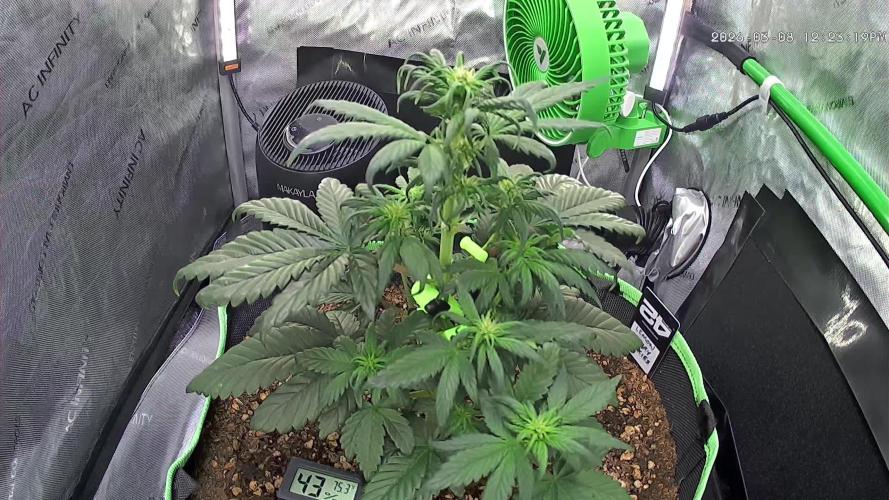
Remove two big fan leaves blocking bud sites below it, added some LST clips to encourage branches to grow outwards a but more. Still can't get rid of the stupid downward curling leaf tips, had it since about week 2 veg I only water when soil is completely dry as you can see from time lapse videos. I have the lights exactly where they’re supposed to be and actually have them turned down a bit more than where they’re supposed to be according to my PAR meter. I guess I’ll just ride it out this way till the end and see how she goes, might increase light intensity another notch later on in the flowering stage, we’ll see. I'm averaging about 625-675 ppfd from top of the plant. I use filtered tap water through a Berkey gravity filter that removes all fluorides and other unwanted chemicals and with the Advanced Nutrients mix it balances out the PH to around 6.0-6.1 every single time, these next few waterings I'll only use plain filtered water PH to 6.0 and see if maybe its a Nitrogen toxicity which is what I suspect is causing the curling and deep dark green color.
Likes
8
Share


@Growin_Ish
Follow
I learned a lot this grow. The plant survived which lends to its resilience. It smells mostly skunky with some hints of rubber.
Mistakes:
1. Overwatered seedlings
2. Ran unfamiliar nutes
3. Ran an unfamiliar feed method (fertigated instead of top dressed)
4. Gardened based on web description instead of what the plants were communicating to me.
5. Got a seed
Successes:
1. They didn't die!
2. Got climate dialed in well
3. No fungus gnats or other pests!
4. Got 2oz total of good dry bud!

Likes
12
Share


@Kakui
Follow
Estuve un tiempo sin actualizar el diario porque me contagie de COVID, ahora un poco mejor vuelvo a actualizar.
Flower14, las plantas crecen bien, se cambió el LED de 480w por 3 LED de 240w, para un total de 720w y mejor distribución de la luz.

Likes
Comments
Share


@Earthsower
Follow
At the beginning of week 4 of bloom the blackberry feminised is doing well. The hasn’t been much of a stretch as she has gained 8cm in hight in the last 2 weeks. Her leaves are stable and she is conspicuously showing signs of bloom. The white stigmas are filling up the internodes.

Likes
237
Share


@1Right_Angle
Follow
Sept 12
- into week 6 of Flower for most of the strains, like Congo #3, Ford pink kush etc
- LSD is heading into week 7 of Flower, with a prediction of 9 weeks needed. Getting close...
- Russian Tzar Bomba is now in week 8. Big dinner Tomorrow, how do you say, The Last Meal w/ nutes. Flush follows
- Green Planet buffet + Amino Acid + Silica + Calimag, like the other two
13th
- russian tzar bomba is in great shape. Here at the start of her Last week in Flower; week 8 as per Nukeheads, she been fed and will be flushed for the next week. Clipped a small bud mid-plant and will scope it this aft. Def Amber, Def Cloud, still clear ones all over. Bloody gorgeous
- her trichomes show a lot of Amber presence and right now its about flushing her. She is ready. Let her dry a bit and flush Thursday and follow-up accordingly. Sunday maybe = CHOP. These buds are real firm and becoming irregular
- picture 13 is from one of the higher concentration spots where amber was found... nice to see, I'm ready at this end
14th
- tomorrow the Soil will be Amended for the Final application: Worm Castings: Bat Guano: Kelp Meal: Bloom Boost fert: Azomite. Scratched-in and Watered through. Volumes are directed at a 15-20 gal pot for the Soil Amendments
- Microbe / Enzyme Tea scheduled for Saturday. Hope to get a bit o rain in between
- turns out the Congo #3 has really gobbled up alot of moisture and she is recovering well from an overwatering
15th
- honduras x Panama, Panama Red, LSD and Black Tunas each had their Soil Amended, after they were fed.
- Panama Red is pushing red/pink hairs all over the entire plant. So beautiful to have 2 pink pistil covered plants, right beside each other. Decadent
- LSD is consuming Overdrive instead of Rezin, and has been for a couple meals. One more on the 17th then thats it.
16th
- its been decided to go and photograph these plants early tomorrow morning. Tirednof the high-noon stuff. Soft light and some Canna-porn ooh aah
17th
- actually got face to face with (Ford) Pink Kush x Vanilla Frosting plant. Its producing a really nice string if Medium-sized Nugs. Looks great and she’s strong and solid
- LSD given her last Nutrient packed meal… end of week 8 tomorrow. Flush is coming in a series of fresh-water rinses… (tues/wed = lites-out. Make the best use of this sun)


Likes
5
Share

@Whodeletti
Follow
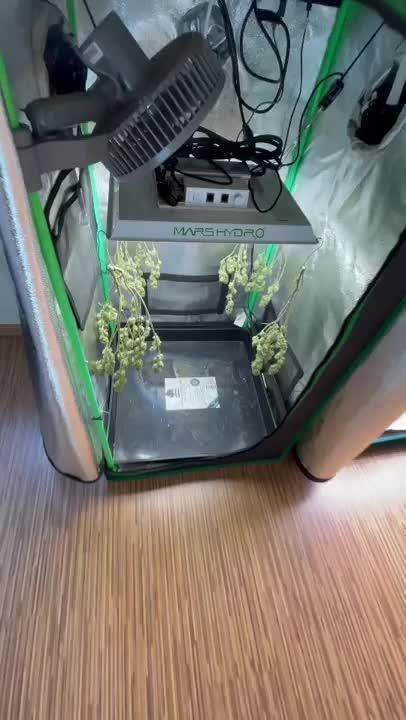
Ernte an Tag 66, weil genug Trichome Bernsteinfarben waren.
Nach 5 Tagen waren die Buds durchgetrocknet und kam in Terplockbags.
80,6 g Dryweight


Likes
36
Share


@pifflestikkz
Follow
Day 144
23/09/24 Monday
(Start of week)
De-chlorinated tap water pH 6 with calmag today.
Seeing her starting to really take shape now, buds forming well, trichomes now flooding in. She's looking good 😍
Day 146
25/09/24 Wednesday
De-chlorinated tap water pH 6 today with Plagron PK13-14.
Day 148
27/09/24 Friday
Feed again today using de-chlorinated tap water pH 6 with calmag.
Picture and video update 😎
Day 150
29/09/24 Sunday (End of Week)
De-chlorinated tap water pH 6 only today.
She is now exploding with bud sites 🤤
Will lollipop at end of week to allow better focus on tops. I know it's late in the game but there are some wispy strands that have re emerged so I'll take care of them tonight.
Picture update 😎
Likes
14
Share


@Dunk_Junk
Follow
Growing well for her first week of life.
Planted straight into her 20L airpot with new compost. No perlite added.

Likes
10
Share

@TrickzCutz
Follow
Servus Moin!
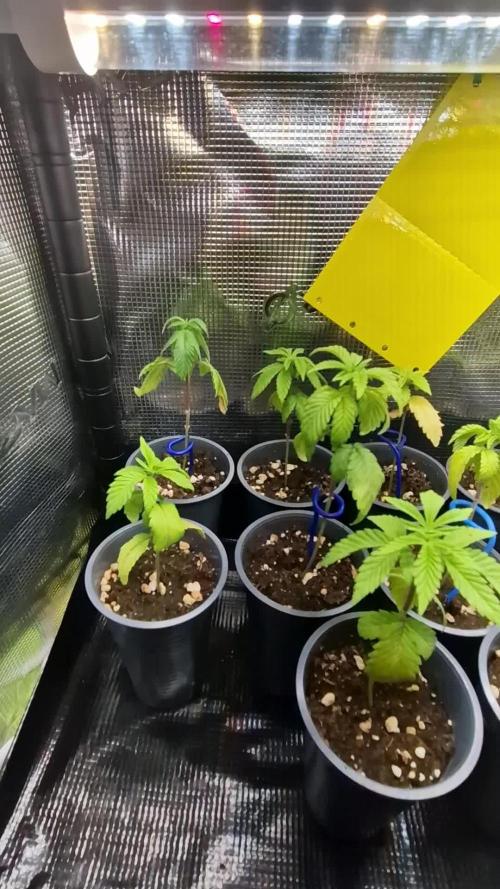
Die Sweat Bean OG schreien nach Nährstoffen, deswegen gab es diese Woche das erste mal Dünger. Mal schauen ob alles klappt.