Likes
Comments
Share
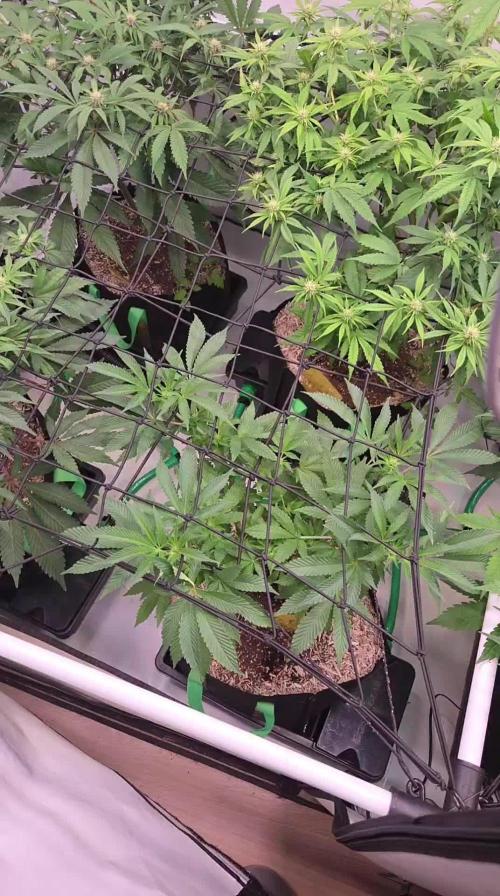
All stretching at different rates so the canopy is all over the place , blue og smells like kalimist! All really hungry at the moment and feeding well
Likes
37
Share
Week 07 and the heat wave is behind us. Didn’t update last week but not much to report. Some serious damage was a result of the heat, causing the lights and everything else to become too much for the girls. #2 took it the best and is still growing nicely packing on weight and some serious frost! Finishing much faster then the others. I might re veg her the smell is so nice. The two larger #1 & 4 have been hungry forever awhile and I never applied anymore Gaia:(
Likes
4
Share
Today It Rain, in Italy they said May Is Crazy moth The weather for all the week Is not good....
Processing
Likes
5
Share
Sorry for the late video post.. I was assaulted and 2 of my 23 year old cats passed away 2 days ago.. So it's been a rough few weeks. Transplanted and flipped to 12/12 6-18-2020
Likes
44
Share
@RakonGrow
Follow
150-200PPFD 20/4 Mein Grow Stuff Messen : + Messgerät - X-Sense WLAN Hygrometer 1 Basis SBS50 + 4 Sensoren + + Basis + + 4x WLAN Sensoren RH und Temp + Amtra Digital PH Tester + Amtra Digital TDC&EC Tester + Photone App (android Samsung S21 5G werkscallibriert (geprüft mit lichtreferenz)) + GEHE ph-Wert 500 Testkit + + Testflüssigkeit + + Pimpette + + Probenröhrchen + + Propfen + Pimpette 10ml Zelt : + Keimung und Vegetative Phase + + Growbox - DiamondBox Silver Line SL60 (60x60x160cm) (hohe luftfeuchtigkeit) + Blütenphase + + Spider Farmer 70x140x200cm Indoor Grow Tent Licht : + SpiderFarmer SF1000 (100Watt) Dim (hohe luftfeuchtigkeit) (Vegetativ) + Sanlight EVO 1.5 3-60 mit Bluethoot Dimmer (niedrige luftfeuchtigkeit) (Blüte) Abluft / Filter / Rohr: + 2x Abluftset - PrimaKlima PKEC-125-TC Set + + PKEC-125-TC Abluft + + PrimaKlima Aktivkohlefilter K2601 Flat (bis 70%rH) + Staubschutz + + Luftschlauch Aluflexrohr (Ummantelt), 3 Meter, ø 127mm + + Verbindungschelle 50mm (Metall mit Schaumstoff mit Aufhängemöglichkeit) + + 1x Universal-Schlauchschelle, 60-165mm Samen : + 3x Royal Dwarf Automatic (RQS) (buy from Zamnesia Seeds) Töpfe : + Nothers GZjiyu 6 Stk Pflanzsack Pack 2 Galonen = 8 Liter Stofftöpfe Medium : + BioBiz LightMix + + Urgeisteinsmehl für Ergänzungsstoffe + Vulkangranulat (Aquabedarf , drenage) Ventilator : + pro Zelt + + 2x Ventilator - Spider Farmer Grow Ventilator (EC 10Watt) PH Korrektur: + 500ml Plagron PH- + 1000ml Canna PH+ Dünger : + Dünger - Canna Terra Kit + + 1000 ml Terra Vega + + 1000 ml Terra Flores + + 500 ml Rhizotonic + + 500 ml PK13/14 (wird nicht genutzt , da unnötig) + + 1000 ml Cal-Mag Agent (fals ich den mal brauche) Entfeuchter : + Entfeuchter - MeacoDry ABC 10Liter Zubehör : + 1L Nanoprotect Isopropanol 99,9% (Reinigungsmittel) + 1x Topfuntersetzer 30x30cm + Grießkanne 5 Liter + Pflanzendrath 1mm x 5m + Sprüflasche 0.7L + Drucksprühflasche 2L + Messbecher + + 1L + + 0.5L + + 0.25L + Eimer 10L + Gartengießkanne + + 5L + + 10L + Plastikabdeckung mit löchern fürs Sämlingstadium (ehemals Kuchenabdeckung) + Luftschlauch Aluflexrohr, 3 Meter, ø 127mm + GrowPRO Schere Curved + Gardo Gartenschere GDGSB 180 + GrowPRO Pflanzendraht für Low Stress Training, 5 mm, 4,9 Meter + Dosierspritze, 5ml + 2x Universal-Schlauchschelle, 60-165mm + LIMITADA 15 Stücke Pflanzenbieger Verstellbar + 6er Steckdose + 2x Zeitschaltuhr (mechanisch) + Müllsack (umbau zur Trockenkammer) + Pappe + 2 x Gafa-Tape (Rolle) + Klettband 3m + Airpump Kit + + Air-Pump + + Luftschlauch silicon + + Air-Stone Trychome analyse : + Samsung S21 5G optical Zoom + DIGIMICRO Mobil + + x300 optical zoom + + HD Video + + 12MP photo + GrowPRO Mikroskop 40x mit LED CureBox : + CASO VacuBoxx E-Set Vakuumbehälter-Set aus Borosilikatglas mit Tritan Deckel + + 145x60x105 + + 170x65x125 + + 200x80x150 + + 220x80x165 (about 40-50g dry buds space) + + manual vacuumpumpe + + adapter für automatische vaccumpumpen VideoSystem: + GoPro Hero3+ Black + + Zeitraffer : 1 Bild pro Minute , gerendert in H.265 60fps . + + 12MP Bilder + + 1 Sekunde Film entspricht 1 Stunde Real . + + Ohne Dunkelzeiten. + Bild/Videoprogramme + + Photoshop (Bildsequenze render Video, Ausschnitt und Beschriftung) + + XMedia Recode (H.265 Neucodierung)
Processing
Likes
12
Share
This batch of seedsman was a disappointment in general. first all the 10 sweet mango didn't germinate, then from all freebies all I got is a stunted plant (this one) and a NL that's going great. Lesson learned, will cultivate more "mainstream" strains as they seem to be fresher and easier to grow. Back to this one, hope at least the smoke is good, as I always loved amnesia. Wondering about the outcome if she didn't stressed, as the smell, the trichomes, all looks very nice. Waiting for it to finish drying and cure a little before do the smoke report.
Likes
6
Share
Likes
21
Share
@OGTrauma
Follow
DAMN SHAWTY THE EXPERIMENT IS GOING GOOD EXCEPT FOR THE PALE AUTOFLOWERING ONE AS I THINK IS A BIT WEAKLING AT THIS POINT OF DATE DAY 24 of flower, that's why i try to match the flower inducing with the start of the month, thats my preach as it will ease you some dark souls shit tike counting flowering days, because that also make me conclude that the plants are at least on a patched health, above average plants, because a good vegging time and a speeded inert coco start made my day as it's very demanding in food and showing carencies with the tremendous sugar boosts from previous week , cheers. Regarding to plants, im sticking to this will be my last day to doze both barrier and cal mag through foliar spray as floral mass could mold if not doing with caution or can ever fuck up things here too. Noticed that spraying water affected the side project of vertical lighting as more mid low branchs if are too humid from previous day spray can prone light burns. So,that made me tidy a bit the space, through defoliation, and entry level lollypoping / defoliati9n in this wild jungle as it involucration in this project is still can be a positive outcome as i didn't see burnt bud and these leds arent that heated , IF they arent see a good outcome as vertical complementary light , at least it is nice to see they totally CAN WORK IN VEGETATION. And yup, im sticking on paperclips as a total valid form of control to have decent plants as they can aid to aim the perfect position / angle that might help to develop better regardless of what type of light do you use, i luv it, better results than the improvized net , that's useful now but at the time of ripe it will be quite a nuissance the unmounting of that bondage shit, so that ... the expense here is not money is the time to find & try the shit that works on you. Love u Homies Big gas leaks forever bitches â•®(. âť› á´— âť›.)â•­
Likes
2
Share
@Gabarram
Follow
Whoa this one is very strong and grows a lot, and I fear she may stretch like hell as soon as she starts flowering. She's already in transition, so I'll see if I dont have to take on any severe measure to prevent her from reaching beyond-the-lights heights 🙏 Since I use this grow room for early vegetation and autoflowering plants, She's having a 24 /0 light schedule in this way: 18 hours 400 W, 6 hours 100 W. I hope this one starts to flower soon and that she won't take over the room before stopping flowering stretch. With these autoflowering plant I did almost all techniques together (Except FIMming and ScroG)
Likes
26
Share
As you can see i had alot of growth over the week. i put my net up to see how it looked.
Likes
9
Share
This girl has been topped twice and is loving life. Really strong growth. She wants to stretch. She isn't far behind the amnesia. Tapering up the ferts gently as I've read she can be a bit sensitive. Hard to believe she was incredibly stressed as a young 'un.
Likes
1
Share
@Blucha
Follow
In the video you have Casey's Rollex OG on your right and Maltezerz on your left. Easy to grow I must admit.
Likes
31
Share
They looking good, but temp is a little too high. It is what it is One of the plants (In front to the left) is more frosty, with less amber pistils. But overall the trichomes are starting to go from crystal to cloudy. Which is my timing for start flush. 24/7 -Temp 23-26day/21-24night -47%RH (2+-) 25/7 Water day* start of flush Gave them till run through with plain ph balanced water, and topped it off with some light nutrients-mixed water. -Temp 23-26day/21-24night -49%RH (2+-) 26/7 -Temp 23-27day/21-24night -47%RH (2+-) 27/7 -Temp 23-26day/21-24night -47%RH (2+-) 28/7* Water day / flush -Temp 23-27day/22-24night -47%RH (2+-) 29/7 -Temp 24-27day/22-24night -47%RH (2+-)
Likes
47
Share
All content on this diary is for inspirational and educational purposes only. The ideas shared are not a substitute for professional advice. This diary/account is not officially affiliated with Alan Watts or his estate. All materials are used under the principles of fair use. I honor the legacy of Alan Watts by sharing his wisdom respectfully and with the intention of inspiring awareness and self-understanding. 2nd net is up. Early bud formations are promising. holding up to the extremes pretty well, some leaves taking minor damage, but overall, she is holding up, gave her 1 night at 50F see how she would react, stressful. Not advised as it messes with her metabolism, but I want to see if it triggers any anthocyanin response. Love to see her purp up but no signs yet. Remember, For every molecule of glucose produced during photosynthesis, a plant needs to split six molecules of water. This process provides the hydrogen needed for synthesizing glucose and other organic compounds, while oxygen is released as a byproduct. Homework. If Rubisco activity is impaired and it cannot properly function or regenerate its substrate, the plant's leaves are likely to turn a pale green or lime green, a condition known as chlorosis. Essentially, Rubisco activity is highly regulated and susceptible to various environmental and metabolic factors that can cause it to become inhibited, leading to an apparent failure in RuBP regeneration due to a lack of consumption. Rubisco regeneration is intrinsically linked to nitrogen supply because Rubisco is a major sink for nitrogen in plants, typically accounting for 15% to over 25% of total leaf nitrogen. The regeneration phase itself consumes nitrogen through the synthesis of the Rubisco enzyme and associated proteins (like Rubisco activase), and overall nitrogen status heavily influences the efficiency of RuBP regeneration. RuBisCO is a very large enzyme that constitutes a significant proportion (up to 50%) of leaf soluble protein and requires large investments in nitrogen. Insufficient nitrogen supply limits the plant's ability to produce adequate amounts of RuBisCO, thereby limiting the overall capacity for photosynthesis and carbon fixation. Maintaining the optimal, slightly alkaline pH is crucial for the proper function and regeneration of Rubisco. Deviations in either direction (too high or too low) disrupt the enzyme's structure, activation state, and interaction with its substrates, leading to decreased activity and impaired RuBP regeneration. (Lime/yellowing) Structural Component: Nitrogen is an essential building block for all proteins, and the sheer abundance of the Rubisco protein makes it the single largest storage of nitrogen in the leaf. Synthesis and Activity: Adequate nitrogen supply is crucial for the synthesis and maintenance of sufficient Rubisco enzyme and Rubisco activase (Rca), the regulatory protein responsible for maintaining Rubisco's active state. Nitrogen deficiency leads to a decrease in the content and activity of both Rubisco and Rca, which in turn limits the maximum carboxylation rate, Vmax, and the rate of RuBP regeneration Jmax, thus reducing overall photosynthetic capacity. Nitrogen Storage and Remobilization: Rubisco can act as a temporary nitrogen storage protein, which is degraded to remobilize nitrogen to other growing parts of the plant, especially under conditions of nitrogen deficiency or senescence. Nitrogen Use Efficiency (NUE): The allocation of nitrogen to Rubisco is a key determinant of a plant's photosynthetic nitrogen use efficiency (PNUE). In high-nitrogen conditions, plants may accumulate a surplus of Rubisco, which may not be fully activated, leading to a lower PNUE. Optimizing the amount and activity of Rubisco relative to nitrogen availability is a target for improving crop NUE. Photorespiration and Nitrogen Metabolism: Nitrogen metabolism is also linked to the photorespiration pathway (which competes with carboxylation at the Rubisco active site), particularly in the reassimilation of ammonia released during the process. To increase RuBisCO regeneration, which refers to the process of forming the CO2 acceptor molecule Ribulose-1,5-bisphosphate (RuBP) during photosynthesis, the primary methods involve optimizing the levels and activity of Rubisco activase (Rca) and enhancing the performance of other Calvin-Benson-Bassham (CBB) cycle enzymes. Biochemical and Environmental Approaches: Optimize Rubisco Activase (Rca) activity: Rca is a crucial chaperone protein that removes inhibitory sugar phosphates, such as CA1P (2-carboxy-D-arabinitol 1-phosphate), from the Rubisco active site, thus maintaining its catalytic competence. •Ensure optimal light conditions: Rca is light-activated via the chloroplast's redox status. Adequate light intensity ensures Rca can effectively maintain Rubisco in its active, carbamylated state. •Maintain optimal temperature: Rca is highly temperature-sensitive and can become unstable at moderately high temperatures (e.g., above 35°C/95F° in many C3 plants), which decreases its ability to activate Rubisco. Maintaining temperatures within the optimal range for a specific plant species is important. •Optimize Mg2+ concentration: Mg2+ is a key cofactor for both Rubisco carbamylation and Rca activity. In the light, Mg2+ concentration in the chloroplast stroma increases, promoting activation. •Manage ATP/ADP ratio: Rca activity depends on ATP hydrolysis and is inhibited by ADP. Conditions that maintain a high ATP/ADP ratio in the chloroplast stroma favor Rca activity. Enhance Calvin-Benson-Bassham (CBB) cycle enzyme activity: The overall rate of RuBP regeneration can be limited by other enzymes in the cycle. •Increase SBPase activity: Sedoheptulose-1,7-bisphosphatase (SBPase) is a key regulatory enzyme in the regeneration pathway, and increasing its activity can enhance RuBP regeneration and overall photosynthesis. •Optimize other enzymes: Overexpression of other CBB cycle enzymes such as fructose-1,6-bisphosphate aldolase (FBA) and triose phosphate isomerase (TPI) can also help to balance the metabolic flux and improve RuBP regeneration capacity. Magnesium ions, Mg2+, are specifically required for Rubisco activation because the cation plays a critical structural and chemical role in forming the active site: A specific lysine residue in the active site must be carbamylated by a CO2 molecule to activate the enzyme. The resulting negatively charged carbamyl group then facilitates the binding of the positively charged Mg2+ion. While other divalent metal ions like Mn2+ can bind to Rubisco, they alter the enzyme's substrate specificity and lead to dramatically lower activity or a higher rate of the non-productive oxygenation reaction compared to Mg2+, making them biologically unfavorable in the context of efficient carbon fixation. The concentration of Mg2+ in the chloroplast stroma naturally increases in the light due to ion potential balancing during ATP synthesis, providing a physiological mechanism to ensure the enzyme is activated when photosynthesis is possible. At the center of the porphyrin ring, nestled within its nitrogen atoms, is a Magnesium ion (Mg2+). This magnesium ion is crucial for the function of chlorophyll, and without it, the pigment cannot effectively capture and transfer light energy. Mg acts as a cofactor: Mg2+ binds to Rubisco after an activator CO2 molecule, forming a catalytically competent complex (Enzyme-CO2-Mg2+). High light + CO2) increases demand: Under high light (60 DLI is a very high intensity, potentially saturating) and high CO2, the plant's capacity for photosynthesis is high, and thus the demand for activated Rubisco and the necessary Mg2+ cofactor increases. Mg deficiency becomes limiting: If Mg2+ is deficient under these conditions, the higher levels of Rubisco and Rubisco activase produced cannot be fully activated, leading to lower photosynthetic rates and potential photo-oxidative damage. Optimal range: Studies show that adequate Mg2+ application can enhance Rubisco activation and stabilize net photosynthetic rates under stress conditions, but the required concentration is specific to the experimental setup. Monitoring is key: The most effective approach in a controlled environment is to monitor the plant's physiological responses e.g., leaf Mg2+ concentration, photosynthetic rate, Rubisco activation state, and adjust the nutrient solution/fertilizer to maintain adequate levels, rather than supplementing a fixed "extra" amount. In practice, this means ensuring that Mg2+ is not a limiting factor in the plant's standard nutrient solution when pushing the limits with high light and CO2. Applying Mg2+ through foliar spray is beneficial to Rubisco regeneration, particularly in alleviating the negative effects of magnesium (Mg) deficiency and high-temperature stress (HTS). While Mg can be leached from soil, within the plant it is considered a mobile nutrient, particularly in the phloem. Foliar-applied Mg is quickly absorbed by the leaves and can be translocate to other plant parts, including new growth and sink organs. Foliar application of: NATURES VERY OWN MgSO4 @ 15.0g L-1 in a spray bottle. For those high-intensity workouts when 1 meal a day is just not enough! Foliar sprays are often recommended as a rapid rescue measure for existing deficiencies or as a supplement during critical growth stages, when demand for Mg is high. Application in the early morning or late evening can improve absorption and prevent leaf burn. The plant was getting a little limey yellow in the centre. Shortly thereafter, she was back in business, green mostly regenerated. The starting point [of creativity] is curiosity: pondering why the default exists in the first place. We’re driven to question defaults when we experience vuja de, the opposite of déjà vu. Déjà vu occurs when we encounter something new, but it feels as if we’ve seen it before. Vuja de is the reverse—we face something familiar, but we see it with a fresh perspective that enables us to gain new insights into old problems. Confidence is evidence... nothing more. You are confident because you have driven 10,000 times, you are confident because you have spoken 10,000 times. People think confidence is a feeling, but it's not. If you want more confidence, then you need to create evidence, take more shots, collect more data, build more experiences, take more risks; fail, confidence doesn't come first; it is the reward you get for doing the work. no one else wants to do.
Likes
2
Share
This plant is growing well, I transplanted them this week into 3 gallon pots from 1 gallon pots. Structure on this plant is pretty nice and visually pleasing to the eye lol.
Likes
8
Share
@Mo_Powers
Follow
the weather is really great. she's not growing any taller. the buds are getting fatter though. she's changed to her autumnal colours in the last week. the smell is getting more intense, like lemon. she looks beautiful.
Likes
1
Share
Happy this grow cycle is over. I will give more attention and focus next time I work with these