


Likes
Comments
Share


@Vcashout
Follow
Plants are growing! But so is my mold problem I recently got a hygrometer and noticed that my humidity was ranging from 64-70 percent which I realize is too high and maybe that is where my mold is coming From im starting to see it coming from the drain holes on the bottom of my pot. I’m going to get a dehumidifier and see how that works. Also I attempted lst to both plants . The doc og is a week older and definitely bigger than the apples and bananas but but are coming along nicely.


Likes
16
Share


@cheetah844
Follow
She's starting to show me why she's called Sherbet... getting some orang-ish throughout the buds & leaves are starting with a hint of deep purple.
Using dirty aquarium water has been going great through flowering so far, no nitrogen toxicity.
3/11/22 - Defoliated for the last time!
Defoliated so there's no moisture buildup between leaves, preventing PM. There were so many leaves, it looked pretty like a beautiful bush - but my intuition told me that those are going to hold too much moisture. Now there is enough space for the buds to fill out with even airflow throughout.
They don't look as beautifully full after defoliation but they'll be cleaner & easier to trim come the end of flower.
Aquarium water before nutrients:
6.82pH
395 PPM
73.4⁰F
Nutrients added:
5Tbsp unsulphured molasses
¼tsp raw potassium
¼tsp raw phosphorus
2Tbsp concentrate Seaweed
1tsp mycorrhizal fungi powder
Aquarium water after nutrients:
5.83 pH
787 PPM
73.4⁰F
Likes
18
Share


@TheGreenLeopard
Follow
It’s a nice grow so far in terms of expectations reality on the seed breeders. Great stuff again. I had a real germination nightmare this time around though - lots of strains failing at seedling so the numbers and strains became more 😂. So the tents are mixed up again to auto on one side and photoperiod on the other. In this tent as well as Afghan and a red gorilla - there is sweet zensation , banana krumble and red hot cookies and a peyote skittlez. Water in using ro solely through the grow. There has been one issue. I tried a “pro” substrate from biocanna this time and I have those little fleas. Really annoying and my aphids are late so kind of annoying - takes the pleasure off a bit. Any good organic solutions let me know please on comments

Likes
29
Share


@eldruida_lamota
Follow
Venga familia que ya viene la cosecha, que ganas que tenia ya de darles machetazo.
No veas que pinta que tienen estas plantas.
No son grandes pero si están bien gordas.
No soy de plantar autoflorecientes pero e de comentar que con este cultivo e hasta disfrutado. Pronto la cataremos 💨💨💨.
Agrobeta:
https://www.agrobeta.com/agrobetatiendaonline/36-abonos-canamo
Mars hydro:
Code discount: EL420
https://www.mars-hydro.com/
Hasta aquí es todo , espero que lo disfrutéis, buenos humos 💨💨.


Likes
103
Share


@JuanHaze_Arg
Follow
Descubrí que le pasaba. Le faltaba fertilizantes. Le eche un día el top auto y apenas se seco el sustrato le metí el monster bloom. Y la planta se levantó de maravilla y freno el amarillo un poco. Arranca la 5 semana de floración. Se empiezan a formar los coquitos.
15/05 se riega con 2 litros de agua
Agua de riego PH: 6.5 EC: 0.5
Agua de drenaje PH: 7.2 EC: 1.194
De sales estamos bien pero no está bien el ph. Próximo riego con 5.8 para tratar de llevarlo a 6.5
17/05 se riega con 1litro de agua con 0.4 ml de top auto + 0.3 ml de big one a un ph 5.8 para bajar el ph al sustrato. EC 0.6
18/05 los cocos parecen engordar aunque la planta se este amarillando toda.
Se dimmerizo la luz a un 80% tengo una sensación que la está quemando.
19/05 se riega con 2 litros de agua + 6ml de Detox. Para lavar las raíces por si hay algún bloqueo. Apenas se seque el sustrato empiezo a aplicar top bloom.
Agua de riego PH: 6.04 EC: 0.333
Agua de drenaje PH: 6.88 EC: 1.268
Made in Argentina 🇦🇷

Likes
241
Share


@Tropicannibis_Todd
Follow
💩Holy Crap We Are Back💩
Well i took the summer off to do some outdoor but thats all done so , we are back indoors and at it again 😁
So super happy to be trying this one out , can't wait😝 .....I'm really interested to see what kind of terps and colors we may get ..👍
We are 7 days from seed and everything is good to go .. 👌
Lights being readjusted and chart updated .........👍rain water to be used entire growth👈
👉I used NutriNPK for nutrients for my grows and welcome anyone to give them a try .👈
👉 www.nutrinpk.com 👈
NutriNPK Cal MAG 14-0-14
NutriNPK Grow 28-14-14
NutriNPK Bloom 8-20-30
NutriNPK Bloom Booster 0-52-34
I GOT MULTIPLE DIARIES ON THE GO 😱 please check them out 😎
👉THANKS FOR TAKING THE TIME TO GO OVER MY DIARIES 👈

Likes
31
Share


@bybil
Follow
Ниагара зацвел раньше Рок машин с разницей в неделю, у Ниагары структура растения не требует подвязывания, головки гонит самостоятельно вверх даже подвязывание необходимость появилась только при переселение в бокс большего размера

Likes
142
Share


@MadeInGermany
Follow
Hey everyone 🤗.
This week was harvested properly 😍.
All of them are harvested, except for the two Tropicanna Banana (they will be on tomorrow).
All finished crop images follow little by little as soon as they have dried enough and have got their actual bud structure 😃.
I wish you much fun with the diary, stay healthy Ges and let it grow 🌱


Likes
32
Share


@Sadhus
Follow
Difficile à tenir les niveaux de pH ( descend en flèche)et ec (grimpe en flèche ) ,plante très saine apart deux ou trois fleurs qui ont l'extrémité des pistil blanc qui sont comme brûler, changement du réservoir dans 2 jours pour essayer de stabiliser les valeurs, en tout cas plante très robuste qui résiste parfaitement a mes erreurs et qui mange tout ce que je lui donne sans discuter ! Peace ✌️🕊️ sådhũs


Likes
24
Share


@Aleks555
Follow
Hello everyone. We're doing well, we've been growing for 7 weeks and we're blooming, the binge has gotten stronger, the bumps are getting more and more. We've added more of these supplements from Xpert Nutrients.
Bloom Booster Sticky Fingers .

Likes
15
Share


@MorangoTango
Follow
As altas temperaturas arruinaram a colheita, as plantas estão sem cheiro a WW#1 foi a mais resistente ao calor, ainda exala um aroma muito bom, porem as outras plantas sofreram mais, a C99xBB#1 perdeu totalmente o cheiro, e nasceram novos pistilos diminuindo a densidade das flores.


Likes
35
Share


@XperencdGmanXG
Follow
I should have more room for this one in the next 2 to 3 weeks, then I can start growing her. I am flexing my gro knowhow muscles by keeping this one as small as possible for as long as I need it to without killing it. Sometimes this technique will come in handy so it is good to practice it.
Likes
12
Share


@QueenBZA
Follow
As an Auto she has been the most finicky plant ive ever grown. EXPERIENCED GROWERS ONLY!!!!


Likes
24
Share


@Dingle
Follow
No feed this week just continuing to flush.
Seeing more and more amber trichomes starting to appear now so it’s lights out from tomorrow for 48 hours before harvesting to dry.
The buds have bulked up nicely over the week and are smelling really tasty!
All going well the next update will be the final harvest. 🙌
🍪🍧🍪
Likes
10
Share


@PolezGardn
Follow
week seven flower everything looks crazy so far :D
buds are filling out & terps going crazy!!
the fade comes through!!
I water them with 1.5l every 48h
the light I use was set to 100% and it hangs 80cm away from the tops
Gelato 1: smells creamy
Gelato 2: smells creamy and sweet a bit like candy

Likes
118
Share


@Grow3rPT
Follow
👉 ( Vegetação ) 👈
📅 Total de Dias 8 - 10/08/2021
📅 Total de Dias 9 - 11/08/2021 / Crescimento normal, ainda não utilizei nenhum nutriente, talvez só na próxima semana.
📅 Total de Dias 10 - 12/08/2021 / 💦 Rega
📅 Total de Dias 11 - 13/08/2021
📅 Total de Dias 12 - 14/08/2021 / 💦 Rega
📅 Total de Dias 13 - 15/08/2021
📅 Total de Dias 14 - 16/08/2021 / Fim da segunda semana. :)
👉 MARSHYDRO
👉 CODIGO PORMOCIONAL : Grow3rPT
👉 Em marshydro.eu 3% de desconto em qualquer produto

Likes
4
Share

@DogDoctorOfficial
Follow
# 💙 Project Blue Tent – Week 12
## 🥒 Pickle Lemon Haze F1 – Pheno B
### 🌸 Another Girl, Another Story, Another Ridiculously Frosty Week! ❄️📸
Hello everyone, and welcome back to another chapter of Project Blue Tent! 💙🌱
And honestly, my friends...
WHAT IS HAPPENING INSIDE THIS TENT?! 😂❄️
Every week, I think we're going to run out of ways to describe how beautiful these girls are becoming.
And every week, they prove me wrong.
The flowers are developing beautifully, the frost is becoming increasingly impressive, and the whole ecosystem is looking absolutely fantastic.
This week, we're giving Pickle Lemon Haze F1 Pheno B her individual spotlight.
And she certainly has something worth showing!
We spent some time behind the camera again, creating three detailed photo stacks from hundreds of individual photographs. We ended up with stacks containing 299, 299, and 333 photographs respectively.
That's 1,931 individual frames across the three stacks.
Yes, my friends, that's a lot of photographs for one girl! 😂📸
We also made a few environmental adjustments this week. We've brought the temperatures down slightly and increased the output power across the lighting setup.
The overall approach remains the same: observe, adjust when necessary, document the results, and give the plants the stability they need to continue developing.
So, let's take a closer look at Pheno B and see what she's showing us this week!
## 🌸 WEEK 12 – PHENO B IS LOOKING OUTSTANDING
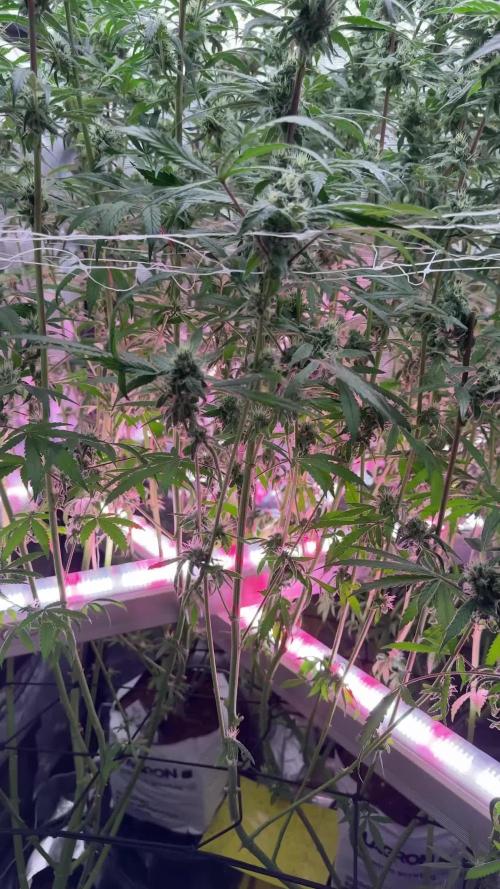
Pickle Lemon Haze F1 Pheno B continues to impress.
She's approximately 145 cm tall, and the plant structure we've established over the previous weeks is now supporting the flowering development beautifully.
The major training work is behind us. The canopy is established, the SCROG nets are providing support, and the flowering sites are developing throughout the plant.
We're no longer in the stage of trying to build the structure.
We're watching the structure do its job while the flowers continue to develop.
And that's one of my favourite transitions in a grow diary.
You spend weeks working on the plant's architecture, making decisions about topping, training, canopy management, and defoliation.
Then you reach a point where you can step back and appreciate the result.
That's where we are now.
The plant is looking beautiful, the canopy remains organized, and the flowers are giving us plenty of reasons to keep the camera close.
And the frost?
Oh, the frost! 😂❄️
## ❄️ THE FLOWERS ARE STEALING THE SHOW
Let's get straight to the obvious.
These flowers are becoming seriously photogenic!
The close-up photographs reveal the intricate details of the developing buds, the prominent pistils, and the trichomes covering the flowers and surrounding sugar leaves.
There's something special about reaching this stage of flowering.
From a distance, you can appreciate the plant's overall structure and how the flowering sites are distributed throughout the canopy.
But when you get close enough to examine the flowers properly, there's an entirely different level of detail to appreciate.
And that's precisely why I enjoy macro photography.
It lets us document the small details that are easy to miss when we're simply looking at the whole plant.
Pheno B is giving us some beautiful subjects to work with, and I wanted to capture that as clearly as possible.
So, instead of taking a handful of photographs and moving on, we spent more time creating detailed photo stacks.
And I think you'll understand why when you look at the results.
😂📸🌸
## 📸 THREE PHOTO STACKS – 931 PHOTOGRAPHS IN DETAIL
This week, we created three separate photo stacks of Pickle Lemon Haze F1 Pheno B.
Here's the breakdown:
- Photo stack 1: 299 photographs.
- Photo stack 2: 299 photographs.
- Photo stack 3: 333 photographs.
That's a combined total of 931 individual frames!
Each stack represents a considerable amount of work, both behind the camera and during post-processing.
And this is where patience becomes essential.
Focus stacking involves combining photographs taken at different focus distances to increase the depth of field in the final image.
When working with macro subjects, the area in focus can be extremely narrow. A small change in focus can bring one section of a flower into sharp detail while leaving another section outside the focus plane.
By combining multiple frames, we can capture more of those details in a single final image.
Of course, the results depend on the source photographs and how well the stacking process handles them.
But when everything comes together, the finished image can reveal a remarkable amount of detail.
And that's what I wanted to achieve with Pheno B this week.
Three stacks.
Hundreds of frames.
One very photogenic girl.
And plenty of frosty details to appreciate! 😂❄️
## 🌿 SAME TENT. SAME ECOSYSTEM. HER OWN STORY.
One of the defining features of Project Blue Tent is that we're documenting the plants individually while keeping their shared growing environment consistent.
The plants share the same tent, reservoir, irrigation system, lighting environment, nutritional program, and general cultivation approach.
That gives us an opportunity to observe their development side by side.
And the similarities remain fascinating.
The plants have developed remarkably similar structures, and their flowering progression has been impressively consistent.
But that doesn't mean the individual diaries are interchangeable.
Each plant deserves her own record, photographs, observations, and development history.
That's why we're documenting Pheno A, Pheno B, and the other cultivars separately.
Even when the plants look remarkably similar, their individual details remain worth recording.
For Pheno B, this week's story is about her continued flower development, the close-up photography, and how she looks following the latest environmental adjustments.
She's sharing the same ecosystem as her sisters, but she's still the star of this particular report.
And today, we're giving her the attention she deserves!
💙🥒🌸
## 💡 LIGHTING – INCREASING THE OUTPUT
We made another adjustment to the lighting setup this week, increasing the output power across the lighting equipment.
The main LEDs continue to provide the primary illumination from above, while the two LumiFlora 150W full-spectrum under-canopy fixtures supplement the lower portions of the canopy.
The under-canopy bars remain arranged in the X-cross configuration beneath the plants.
With the structure now established, this arrangement gives us another aspect of the growing environment to observe as flowering progresses.
We're interested in how the different parts of the canopy develop under the combined lighting arrangement.
At the same time, we've increased the lighting output, so we're keeping an eye on the overall environment and the plants' response.
It's important to remember that increasing light output doesn't automatically guarantee a particular result. The response depends on the conditions around the plants and how they develop over time.
That's why we're documenting these adjustments rather than assuming what the outcome will be.
We make a change, monitor the conditions, and observe.
And Pheno B will continue to be part of that story.
## 🌡️ ENVIRONMENT – SLIGHTLY COOLER CONDITIONS
Alongside the increase in lighting output, we reduced the temperatures slightly this week.
It's a small but meaningful part of the latest environmental adjustments.
Lighting and temperature are connected, so whenever we change the lighting setup or its output, we need to consider the wider environment rather than looking at each setting in isolation.
We're keeping an eye on the day and night temperatures, relative humidity, solution temperature, and substrate temperature while the plants continue flowering.
The idea isn't to keep changing everything for the sake of it.
It's to make deliberate adjustments and then observe how the environment settles.
The latest readings have been updated in the GrowDiaries record, so the conditions listed there are the reference for this week's report.
And that's another reason I appreciate keeping detailed records.
When we look back at the end of the project, we'll be able to see not only how the plants developed, but also which environmental changes took place along the way.
## 🕸️ SCROG AND CANOPY STRUCTURE – THE FRAMEWORK IS THERE
The SCROG structure continues to provide support as the flowering branches develop.
The first net helped us distribute the canopy, while the second net provides additional support to the established structure.
The earlier topping, training, and defoliation also remain important parts of this plant's story.
Those interventions helped us create the architecture we're looking at today.
And now, we're allowing that structure to do its job.
We don't need to keep moving branches simply because we can.
We don't need to keep reshaping a canopy we've already established.
The important thing now is to monitor the plant, observe how the flowers develop, and make adjustments only when there's a genuine reason.
Sometimes the most satisfying part of cultivation is seeing the results of work you completed weeks earlier.
You train the plant, give her time to respond, and eventually you get to appreciate the structure that training helped create.
That's exactly what we're seeing with Pheno B.
## ✂️ DEFOliATION – LETTING THE EARLIER WORK SPEAK
The substantial defoliation performed in the earlier weeks also remains part of this story.
At the time, opening the dense canopy made a dramatic difference to the plant's appearance.
Now, we can appreciate the structure that remained after that work and how the plant has continued developing.
The flowering sites are visible throughout the canopy, the branches are supported, and the plant has had time to respond to the earlier interventions.
This is why I believe it's important to think carefully about timing.
There is a time to train.
There is a time to remove foliage.
There is a time to provide support.
And there is a time to stop interfering and observe.
For Pheno B, the major structural work has already been done.
Now we're concentrating on the flowering development and the way the plant responds to the environment we've established.
## 🌬️ AIRFLOW – SUPPORTING THE ENTIRE CANOPY
The airflow arrangement remains an important part of the shared ecosystem.
With a substantial canopy, we want air moving through the upper, middle, and lower portions of the plants rather than allowing stagnant pockets to develop.
The earlier canopy management helped open the structure, while the circulation equipment supports air movement throughout the tent.
The under-canopy lights also make it important to keep the lower portion of the growing space in mind when assessing the overall environment.
We're looking at the complete picture.
Lighting, temperature, humidity, and airflow all interact.
The goal is to maintain a balanced environment rather than focusing on one parameter in isolation.
And as the plants continue developing, we'll keep monitoring those conditions and making adjustments when needed.
## 💧 IRRIGATION AND DRAINAGE – KEEPING THINGS CONSISTENT
The irrigation and drainage systems remain part of the established setup.
The recorded watering volume is approximately 1.6 litres per plant over 24 hours.
Because the plants share the reservoir and irrigation system, maintaining a consistent approach across the tent is an important part of this project.
We continue observing how the plants are responding and monitoring the system's operation.
The idea is simple: maintain the established setup, record what happens, and avoid unnecessary changes when everything is working as intended.
Good equipment should make our lives easier.
It should help us maintain consistency while allowing us to concentrate on the plants themselves.
And that's exactly the approach we're continuing with this week.
## ⚗️ NUTRITION – THE CORRECT PLAGRON RECIPE
The nutritional program remains unchanged this week.
We're using the PLAGRON Hydro line, with Green Sensation included in the current recipe.
The previous reports are also being corrected where necessary to ensure that Green Sensation is recorded accurately instead of Hydro Roots.
For this week's report, the recipe is:
- PLAGRON Hydro A — 2.2 ml/L
- PLAGRON Hydro B — 2.2 ml/L
- PLAGRON Power Buds — 1 ml/L
- PLAGRON Green Sensation — 1 ml/L
- PLAGRON pH Plus — 0.03 ml/L, as recorded
- PLAGRON pH Minus — 0.03 ml/L, as recorded
The recorded pH is 6.01, and the EC is 2.24 mS/cm.
As the recipe has remained unchanged, we're continuing to record the measurements and observe the plants rather than inventing an explanation for every variation.
The important thing is to document what was actually used, keep the record accurate, and monitor how the plants develop.
That's what makes these diaries useful when we eventually look back at the complete project.
## 🌡️ CURRENT BLUE TENT CONDITIONS
The GrowDiaries record for this week has been updated with the latest environmental readings.
The reference measurements shown in the current record include:
- Cultivar: Pickle Lemon Haze F1
- Phenotype: Pheno B
- Flowering: Week 12
- Height: Approximately 145 cm
- Light schedule: 12/12
- Day air temperature: 27°C
- Night air temperature: 27°C
- Relative humidity: 59%
- pH: 6.01
- EC: 2.24 mS/cm
- Solution temperature: 25°C
- Substrate temperature: 24°C
- CO₂: Approximately 666 ppm
- Pot size: 8 litres
- Watering volume: Approximately 1.6 litres per plant per 24 hours
- Under-canopy lighting: 2 × LumiFlora 150W full-spectrum fixtures
- Under-canopy arrangement: X-cross configuration
- Nutrient line: PLAGRON Hydro
- Green Sensation: 1 ml/L
The temperatures have been reduced slightly, and the lighting output has been increased for this week's update.
The values above reflect the updated record rather than the older Week 11 measurements.
## 🔬 FOUR PLANTS, FOUR STORIES
This is something I want to keep emphasizing throughout Project Blue Tent.
Yes, the reports share some common elements.
That's intentional.
The plants share the same ecosystem, so it makes sense that their reports will cover the same environmental systems, lighting arrangement, irrigation setup, and nutritional program.
But the individual reports are not simply copies of one another.
Each one focuses on a different plant and documents her own development.
For Pheno B, we have the three photo stacks, her individual flower development, and her response within the shared growing environment.
For her sisters, we'll continue documenting their own characteristics and the details that make each plant worth following.
The shared conditions provide context.
The individual observations give each diary its purpose.
And that's what makes the project interesting.
We're not trying to manufacture differences where there are none.
We're documenting what we actually see.
Sometimes that's variation.
Sometimes it's remarkable uniformity.
And sometimes it's a tent full of plants that look so similar you have to remind yourself that they're not clones!
😂💙
## 🔭 LOOKING AHEAD – MORE TO OBSERVE
As we continue through flowering, I'm particularly interested in watching how the flowers develop under the updated lighting arrangement and slightly cooler environmental conditions.
We'll keep observing the canopy, the flowering sites, and the details that become visible through the macro photography.
We'll also continue recording the environmental measurements and maintaining the shared nutritional program.
The next stage will bring more opportunities to document the plants and compare their development over time.
But we're not going to rush ahead.
We have the structure.
We have the established ecosystem.
We have the equipment in place.
And now we have the time to observe the results.
That's what we're here for.
## 💙 FINAL THOUGHTS – ANOTHER BEAUTIFUL WEEK FOR PHENO B
My friends, Pickle Lemon Haze F1 Pheno B is looking absolutely outstanding.
The flowers are beautiful, the frost is impressive, and the close-up photography has given us another opportunity to appreciate the intricate details of her development.
We created three photo stacks from 931 individual photographs, made some environmental adjustments, increased the lighting output, and continued maintaining the established ecosystem.
Nothing about this week required us to reinvent the entire setup.
Instead, we made deliberate adjustments, updated the records, and continued observing.
And that's an important part of cultivation.
You don't need to make dramatic changes every week to make progress.
Sometimes you simply need to understand what you're seeing, record it properly, and give the plants time to respond.
Pheno B is sharing her environment with her sisters, but her individual story is still unfolding.
And I'm looking forward to documenting every step of it.
The canopy is established.
The flowers are developing.
The trichomes are giving us plenty to admire.
The photography is looking beautiful.
And the whole ecosystem continues to be the foundation of this project.
So, for now, we're going to keep doing what we've been doing.
Observe.
Measure.
Document.
Adjust when necessary.
And appreciate the beautiful plants we're fortunate enough to follow.
💙🥒🌸❄️
## 🙏 A HUGE THANK YOU
A huge thank you to Zamnesia for making Project Blue Tent possible and giving us the opportunity to document these Pickle Lemon Haze F1 cultivars individually.
Thank you to PLAGRON for the Hydro nutrient line supporting the project, including Green Sensation as part of the current nutritional recipe.
Thank you to Mars Hydro for the irrigation and drainage equipment helping us maintain consistency throughout the tent.
A massive thank you to Zamnesia for the Phytonaut LED lighting, curved scissors, and clip fans that continue playing important roles in the project.
And a special thank you to LumiFlora for the under-canopy lighting that we're exploring as another part of our cultivation setup.
Thank you to GrowDiaries for providing the platform where we can document the experiments, share the photographs, and record the lessons we learn along the way.
And finally, thank you to everyone following Project Blue Tent! 💙
Your support makes sharing these individual chapters even more enjoyable.
Pickle Lemon Haze F1 Pheno B is looking beautiful, and I'm delighted to have another week of her journey documented.
Until next week...
Keep growing.
Keep learning.
Keep observing.
And keep appreciating the details!
Growers Love, happy growing, and take care everyone! 🌱💙🥒❄️

Likes
18
Share


@DogDoctorOfficial
Follow
Week 2 Report: The White OG - The Solo Survivor Shines 🌟
She may be the solo survivor, but The White OG is already proving she’s a beauty in the making! With her third set of leaves emerging, she’s entering Week 2 of veg and starting to find her stride. This week has been all about supporting her early growth with balanced nutrition, a perfect environment, and plenty of love. Let’s dive into why Week 2 is such a game-changer and how the Aptus Holland line is setting her up for success.
Why Week 2 Veg Is Vital 🌱
This is a pivotal time for any grow. The foundation laid in Week 2 determines how well your plant will perform later. It’s about encouraging root development, strengthening the stem, and building the resilience she’ll need for the big stages ahead. The third set of leaves is a sign that she’s transitioning from her seedling phase into a true vegging plant, which means she’s ready for a little extra care in the form of feeding.
Feeding with Aptus Holland: A Total Game-Changer
This week, I introduced the Aptus Holland organic-mineral line, and wow—this stuff is incredible! It combines the best of organic and mineral worlds for balanced, healthy growth.
What’s Organic-Mineral Nutrition?
• Organic Benefits: Enriches microbial health and enhances soil vitality, building a strong biological base.
• Mineral Benefits: Offers immediate, direct nutrient uptake for steady, balanced growth.
• Why It’s Awesome: Plants get the best of both worlds, growing stronger, healthier, and more resilient.
This Week’s Feeding Schedule
• Regulator (0.15 ml/L):
A silica-based product that toughens plant structure, helps manage stress, and boosts nutrient uptake. Think of it as your plant’s personal trainer—keeping her sturdy and stress-free.
🌟 Why It Matters: Stronger stems = better support for future growth.
• CalMag Boost (0.25 ml/L):
Essential for developing robust cell walls and producing lush chlorophyll. Calcium and magnesium are like the bricks and mortar of your plant’s structure.
🌟 Why It Matters: Ensures vibrant, lush leaves and steady early growth.
• All-in-One Liquid (1 ml/L):
A perfectly balanced nutrient blend that provides everything she needs in one feed. Ideal for ensuring no deficiencies as she picks up the pace.
🌟 Why It Matters: Simplifies feeding while delivering complete nutrition.
• Start Booster (0.25 ml/L):
Packed with root-stimulating microbes and essential nutrients, this is the secret weapon for explosive root growth.
🌟 Why It Matters: Strong roots = a stronger plant overall. She’s ready to soar!
Tent Conditions: Consistency Is Key
The tent setup remains steady, providing the ideal environment for healthy growth:
• Temperature: Warm and stable—perfect for vigorous vegetative growth.
• Humidity: High RH ensures tropical vibes and keeps her roots hydrated as she develops her third set of leaves.
• Lighting: The Future of Grow (FOG) LED at 200 PPFD delivers just the right intensity to keep her compact and growing strong.
Why Aptus Holland?
I’ve been a true believer in Aptus long before any sponsorship—it’s a brand that builds strong, healthy plants from the ground up. Their organic-mineral approach gives your plants the resilience and energy they need to thrive. The results speak for themselves: happy plants, lush growth, and vibrant health at every stage. It’s a system I trust completely. 🌱💪
Shoutouts and Community Love 🌟
Massive love to everyone making this journey possible:
Breeders, LED brands like Future of Grow, and, of course, all the amazing growers and followers here on Grow Diaries. 🌱 Don’t forget to check out more updates on IG and YouTube (links in profile). Let’s grow strong together!
DISCOUNT CODE - SeedsmanSeeds - DOGDOCTOR 10% off
As always thank you all for stopping by, for the love and for it all , this journey of mine wold just not be the same without you guys, the love and support is very much appreciated and i fell honored and so joyful with you all in my life 🙏
With true love comes happiness 💚🙏 Always believe in your self and always do things expecting nothing and with an open heart , be a giver and the universe will give back to you in ways you could not even imagine so 💚
Friendly reminder all you see here is pure research and for educational purposes only
💚Growers Love To you All and remember to keep that smile big and alive 💚