The Grow Awards 2026 🏆
Likes
Comments
Share
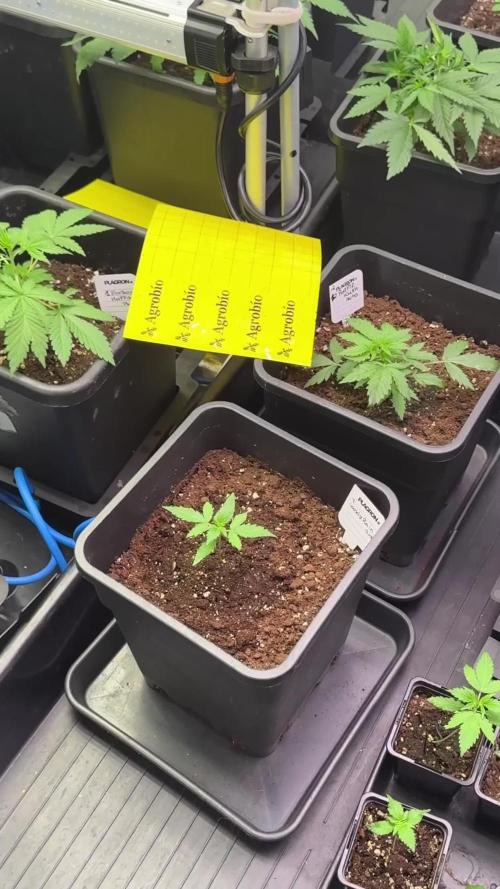
It still looks like there humming along gonna give one more week of veg after transplanting them so the roots can settle in. I don't want to stress them with to much after repotting them as the roots were air pruning though the 3 gal pots. My freaking camera stopped taking pictures at day 4 of week 4 not sure why, then today the power went out in my neighborhood it happened around the dark cycle so I hope with that and the transplanting it would not stress them to much. Another VEG feeding this week with extra (N) I hope the pale ones benefit from that. I diluted the food per the advice of you all to 500 ppm @ 6.0 ph will see how it goes this week I will post more at the end of the week as always. Thanks Drewbie
Likes
6
Share
@Jbreezy
Follow
Still taking about 2-3L of water each day, feeding ucann bloom every two weeks with worm castings. A little bleaching on the gelato but I just raised the light a few more inches, hoping it’s enough to prevent more. The Coco Melon is short but the buds are looking very compact.
Likes
13
Share
The Bruce Banner girls are growing strong and full of energy this week.đŸ’ȘđŸ”„ They’re all at slightly different stages, but overall doing great: #2 is the most advanced one, she’s already done stretching and started to produce trichomes early in the week.✹ #1 is still the biggest plant in the tent and finished her stretch around mid to late week, also showing the first trichomes by now.🌿 #3 kept stretching until the end of the week and is a bit behind in flower development, but she’s almost as tall as #2 now and catching up nicely.🚀 All three plants look healthy, rich green, and well-balanced, no signs of any issues. They were watered as usual with RO water + CalMag, and got one feeding of Orgatrex this week.💧 Environment stayed on point: 24.8°C, 55% RH, and PPFD around 900–1000 ”mol/mÂČ/s under the Spider Farmer SE5000, controlled by the AC Infinity AI system đŸŒĄïž. The stretch is almost over, trichomes are forming everywhere, and the tent is starting to smell amazing, everything’s moving in the right direction 😎✹
Likes
34
Share
@Salokin
Follow
Hello Growmies, Entering the sixth week of flowering with our vibrant Watermelon Candy F1 Hybrids by Zamnesia, it's evident that our decision to opt for low-stress training over topping is yielding fruitful results. The plants have gracefully embraced the SCROG network, with a well-distributed canopy that's maximizing both light absorption and airflow, fundamental factors for their sustained well-being. The Watermelon Candy's display of luscious green foliage and resilient stems is a clear indicator of their prosperous journey through the vegetative stage and into flowering. The environment within the tent has been fine-tuned to near perfection during the daylight hours thanks to the Tent-X system. The Prima Klima EC blue fan's anticipated arrival next week is expected to iron out the nighttime VPD inconsistencies, ensuring a consistently optimal environment for the critical flowering stage ahead. Despite being introduced a week later than their tent companions, these F1s are displaying a remarkable growth spurt, currently about 10-14 days ahead in development compared to the photoperiod strains sharing their habitat. It's a testament to their vigorous genetics and the efficacy of our environmental controls and nutrient regimen. The weekly feed includes a meticulously measured concoction of Alga Bloom, Sugar Royal, Power Roots, and Orca, administered every four days to sustain their accelerated growth. We've encountered our fair share of challenges with equipment integration, but it's the resilient spirit of these Watermelon Candy plants that keeps us motivated. Their rapid development and the advent of dense floral sites suggest we're on the path to an abundant harvest. In the latest images, you can see the substantial pre-flower stretch, with plants #2 and #3 particularly standing out with their robust stature and symmetrical growth. It's a joy to witness the fruits of our labor coming to such a vivid life. As we adjust our PPFD levels from 250-350 to a more intense 450-500, we're steering our lush green sea towards a future of dense, resinous buds, all while ensuring our environmental parameters are tightly regulated. The TrolMaster's data logs reveal our success in maintaining VPD within range, with occasional deviations promptly corrected—often just a matter of fine-tuning our fan settings between day and night cycles. Our community's wisdom has been invaluable, and we look forward to more shared experiences as these F1s reach their full potential. Stay lifted, Salokin
Likes
11
Share
Mise en route des graines pour ce test Jour 1 : mise en pot 24/09/24 13graines ont germer Recette du living soil pour 10l 5litre terreau compost Ă©quin bovin ovin vĂ©gĂ©tal 5litre terreau intĂ©rieur 500gr biochar 900gr lombric 50gr luzerne 5gr micro granulĂ©e it45 5gr pollen d’abeille 5gr levure de biĂšre 50gr tourteau karanja 10gr bactĂ©rie soluble 200 zeolith chabasit 10gr Levures Saccharomyces Cerevisiae 2gr Endomycorhizes RHIZOPHAGUS IRREGULARIS 2gr Bacillus IT35 Amyloliquefaciens Il est actuellement en maturation depuis 2semaine j’attends que les graines germes et dĂ©veloppe bien leur racines Ensuite je rempoterai dans des pots de 300/400ml que je garderais pour une vĂ©gĂ©tation de 3/4/5 semaines le temps que je rĂ©colte ce qui a dans la tente Ça s’annonce beau ! Le terreau Terralba ou terre 4 composts est un terreau naturel exceptionnel. Il s'utilise tel quel en extĂ©rieur pour stimuler la vie de vos sols, planches de cultures, grands pots... Augmente le stock d'humus dans le sol, la rĂ©tention d'eau et d'air. De la germination Ă  la rĂ©colte. Sans risque de brĂ»lure. Ce terreau universel peur s'utiliser dans tous les cycles de cultures extĂ©rieures. Nous vous conseillons un mĂ©lange Ă  50/50 avec notre terreau Horticole INNT pour une base de culture durable et rĂ©utilisable en intĂ©rieur. Composition : composts Ă©quin, bovin, ovin et vĂ©gĂ©tal maturĂ©s 24 mois minimum. Composition : 1% (N) total 0,7% (P205) 0,9% (K20) 0,5% (MgO) 3,6 (CaO) 24% de MO C/N : 11 PH : 8 Le terreau Terralba est un terreau universel exceptionnel. Ce terreau innovant trĂšs drainant avec innovation fibre de mousse et fibre textile recyclĂ©es est comparable Ă  un substrat de type fibre de coco. Il est aussi enrichi en compost. Il peut servir de la germination jusqu'Ă  la rĂ©colte. Nous vous conseillons un mĂ©lange Ă  50/50 avec notre terreau 4Xcomposts EXT&INT pour une base de culture durable et rĂ©utilisable. Écologique, restructurant, la terreau enrichie et aĂšre le sol durablement - notamment les sols argileux - tout en lui redonnant jeunesse ! Composition : ‱ 1,2% (N) total ‱ 0,4% (P205) ‱ 0,8% (K20) ‱ 49% de MO ‱ C/N : 22,4 ‱ PH : 7,3 Le charbon vĂ©gĂ©tal actif est capable d’absorber jusqu’à cinq fois son poids propre en eau ainsi que les Ă©lĂ©ments nutritifs qui s’y trouvent. Il joue ainsi le rĂŽle de catalyseur et d'amplificateur pour les fertilisants traditionnels, qu'ils soient d'origine organique ou minĂ©rale. Ce pourquoi il est idĂ©al pour activer un sol et pour les thĂ©s de compost oxygĂ©nĂ©s. Le charbon vĂ©gĂ©tal amĂ©liore la diffusion et la disponibilitĂ© des Ă©lĂ©ments nutritifs dans le sol et offre des conditions propices au dĂ©veloppement des micro-organismes. Le Biochar peut ĂȘtre introduit dans une grande variĂ©tĂ© de sols. Il est particuliĂšrement efficace dans les sols pauvres, difficiles et acides. Pour faire agir rapidement et efficacement sa capacitĂ© d’amendement, le charbon vĂ©gĂ©tal est enrichi et biologiquement activĂ© avec des micro-organismes. Le Biochar se comporte ainsi comme un structurateur et un activateur dans le but de valoriser les sols. Composition : ‱ Charbon vĂ©gĂ©tal actif 31% ‱ MatiĂšre organique 33% ‱ MatiĂšre sĂšche 75% ‱ C/N : 17 ‱ PH : 7,2 ‱ Azote (N) : 2,1 % dont 1,2 % azote organique ‱ Phosphore (P205) : 0,74% ‱ Potassium (K20) : 1,18% ‱ Calcium (Ca) : 6,8% ‱ MagnĂ©sium (MgO) : 0,65% Le lombricompost apporte Ă  la plante des Ă©lĂ©ments nutritifs tels que l'azote, le phosphore et le potassium, qui sont essentiels Ă  sa croissance. En outre, il contient de nombreux oligo-Ă©lĂ©ments et micro-organismes qui peuvent ĂȘtre bĂ©nĂ©fiques pour la plante. Le lombricompost a Ă©galement une forte capacitĂ© de rĂ©tention d'eau et peut amĂ©liorer la structure du sol, ce qui peut ĂȘtre bĂ©nĂ©fique pour les plantes. En utilisant du lombricompost, vous pouvez ainsi favoriser la croissance de vos plantes de maniĂšre naturelle et Ă©cologique. Le lombricompost est un fertilisant, amendement organique Ă  la formule haut de gamme. Totalement naturel, il rĂ©sulte de la digestion de fumier bovin et Ă©quin par des vers de terre. Les lombrics transforment ces dĂ©chets en un compost riche en nutriments et en micro-organismes bĂ©nĂ©fiques pour les plantes. Le lombricompost prĂ©sente une texture fine et friable, regorgeant de nutriments essentiels tels que l’azote, le phosphore, le potassium et d’autres micro-organismes bĂ©nĂ©fiques pour les plantes. Son utilisation amĂ©liore la qualitĂ© du sol, favorise la croissance des plantes et contribue Ă  la conservation de l’environnement en rĂ©duisant les dĂ©chets organiques. Le lombricompost est donc une source naturelle de nutriments et de matiĂšre organique pour les plantes, et peut ĂȘtre utilisĂ© comme engrais ou comme amendement du sol. Il surpasse ainsi le compost, grĂące au travail du lombric (E. Foetida) qui transforme le fumier en un super compost ! 10kg de fumier sont nĂ©cessaire pour obtenir 1kg de lombricompost. Composition : ‱ MatiĂšre sĂšche 65,3% ‱ MatiĂšre organique 48,7% ‱ Ph 7,9 CE 5,98dS/m ‱ Azote (N) 2,4% dont NO3 0,28% ‱ Phosphore (P205) 3,2% ‱ Potasse (K2O) 3,8% ‱ Acides Humiques 6,2% ‱ Acides Fulviques 0,9% ‱ C/N 11,8 La luzerne fait un excellent paillis, c'est un inoculum de bactĂ©ries et de champignons ! Elle contient des niveaux Ă©levĂ©s de protĂ©ines. Elle fournit de nombreux minĂ©raux importants, dont l'azote, le potassium, le calcium, le fer, l’acide folique, etc. Elle stimule la croissance saine des racines et elle contient des hormones naturelles qui aident Ă  prĂ©venir les maladies des racines. IdĂ©al pour les thĂ©s de compost oxygĂ©nĂ©s (TCO) ProtĂ©ines : 16%. Naturellement riche en protĂ©ines, minĂ©raux, vitamines, enzymes et acides aminĂ©s. Micro granules it45 Amendement calcaire, dolomie et gypse avec prĂ©paration microbienne Ă  base de Bacillus Amyloliquefaciens IT45 et Saccharomyces cerevisiae LYCC6420 Formulation : micro granulĂ©s (1 – 1,6 mm) Ă  base de rhizobactĂ©ries favorisant la croissance des plantes qui se multiplient et colonisent rapidement la zone des racines, et de levures Saccharomyces cerevisiae souche LYCC ayant un effet probiotique. Les PGPR produisent des enzymes qui solubilisent le phosphore Ă  partir de complexes inorganiques et organiques dans le sol et stimulent la croissance des racines efficaces augmentant ainsi la zone d'interception des Ă©lĂ©ments nutritifs. Les levures LYCC permettent une occupation de la rhizosphĂšre par une flore bĂ©nĂ©fique. Composition : ‱ MatiĂšre sĂšche : 96,8% ‱ MatiĂšre organique : 91,5% ‱ N total : 6,6% dont N soluble dans l'eau 0,17% ‱ P total : 2% ‱ K total : 1,7% Micro-granulĂ©s : ‱ Oxyde de calcium (CaO) total : 30% ‱ Oxyde de magnesium (MgO) total : 7% ‱ Anhydride sulfurique (SO3) : 13% Le pollen d’abeille est l'ingrĂ©dient de base de la fabrication du miel par les abeilles. Riche en vitamines et minĂ©raux, il est qualifiĂ© « d'aliment parfait », y compris pour les plantes ! La levure de biĂšre est une matiĂšre vivante qui permet un meilleur fermentation pour les thĂ©s de compost oxygĂ©nĂ©s notamment conseillĂ© pour accompagner les croissances ou apporter un gros coup de pousse pendant la floraisons. La levure de biĂšre stimule la vie des sols Ă©galement Ă  l'arrosage direct en apportant tout aussi bien que dans le TCO sa population l'espĂšce micro-bactĂ©rienne positive pour votre sols ainsi que des oligo-Ă©lĂ©ments et diverse vitamines. Composition : ‱ 2,8% (N) total dont 1% (Norg), ‱ 2,3% (P205) ‱ 1,6% (K20) ‱ 35% de MO ‱ C/N : 8. PH : 8,4. Le tourteau de Karanja est un complexe absorbant (argilo humique) qui renforce et stimule la vie microbienne du sol. Riche en Ă©lĂ©ments fertilisants, il permet une assimilation lente et progressive de l'Azote et donc une rĂ©gularitĂ© de l'apport. Composition : ‱ 4,3% (N-Azote) ‱ 5,2% (P205-Phosphore) ‱ 2% (K2O-Potasse) MatiĂšres Organiques : 67,3% Carbone Organique : 33,7% Les bactĂ©ries solubles sont utiles pour enrichir les sols, activer le processus de compostage et favoriser la crĂ©ation d'humus. Avec plus de 55 Ă©lĂ©ments nutritifs, ce produit concentre un mĂ©lange de vie microbienne bĂ©nĂ©fique Ă  tous types de sols. VĂ©ritable concentrĂ© de matiĂšres vĂ©gĂ©tales et minĂ©rales, et d'une sĂ©lection de vĂ©gĂ©taux naturels compostĂ©s, nos bactĂ©ries solubles permettent une libĂ©ration immĂ©diate des nutriments. ‱ 2,8% (N) total dont 1% (Norg), ‱ 2,3% (P205) ‱ 1,6% (K20) ‱ 35% de MO ‱ C/N : 8. PH : 8,4. Une zĂ©olithe se comporte comme une « Super Argile » permĂ©able qui retient l’Azote et les Ă©lĂ©ments minĂ©raux nutritifs au voisinage des racines et les relĂąche lentement en fonction des besoins de la plante. Cela se traduit par une croissance constante mais rapide du vĂ©gĂ©tal. La zĂ©olithe permet de rĂ©duire Ă  la fois le nombre d’arrosages et la consommation en fertilisants car ces derniers sont moins soumis aux effets du lessivage et de l’évaporation. AmĂ©liore durablement la fertilitĂ© fonciĂšre des sols. Peut s’utiliser en mĂ©lange Ă  tous types de substrats. RĂ©colte les surplus d’eau et rĂ©agit Ă  la chaleur en suintant. Diffuse lentement les Ă©lĂ©ments minĂ©raux nutritifs et l’azote retenus dans l’eau (Ă©vite l’acidification des sols. Riche en oligo-Ă©lĂ©ments, permet un dĂ©veloppement racinaire soutenu. Retiens les pollutions des sols (nitrate, mercure). Se mĂ©lange Ă  tous types de substrats et toutes les cultures. IdĂ©al bonsaĂŻs, plantes arides Accroit la capacitĂ© d’échange globale du « complexe argilo-humique ». Agit comme anti-mottant. AllĂšge les sols lourds et bloquants trop argileux en amĂ©liorant le drainage et le ressuyage en surface. Volume poral de 47%. AmĂ©liore la structure des sols en s’opposant Ă  l’acidification de ceux-ci par son effet tampon et par le retard de la nitrification de l’azote ammoniacal. Apporte des oligo-Ă©lĂ©ments. Augmente la rĂ©sistance au piĂ©tinement. Diminue la frĂ©quence des rempotages. EmpĂȘche le pourrissement des racines. Favorise la ramification. ModĂšre le dĂ©veloppement des mousses. Permet des Ă©conomies d’eaux et d’engrais. RĂ©siste au dessĂšchement et diminue la formation de « feutres ». Retient l’eau sans changement de volume. Sert de support aux microorganismes, ce qui contribue Ă  la dĂ©gradation des dĂ©chets de coupes. Les zĂ©olithes sont des roches cristallines, prĂ©sentant des capacitĂ©s d'adsorption particuliĂšrement importantes vis Ă  vis des polluants que l'on rencontre dans l'eau et dans certains liquides, ainsi que dans l'air et les gaz. Elles sont extrĂȘmement poreuses comme les charbons activĂ©s et elles peuvent ĂȘtre chargĂ©es Ă©lectriquement pour opĂ©rer comme des Ă©changeurs d'ions. La zĂ©olithe est un produit naturel qui respecte notre environnement. UtilisĂ© dans le milieu industriel depuis de longues annĂ©es dĂ©jĂ , ce minerai aux propriĂ©tĂ©s filtrantes particuliĂšres commence Ă  se vulgariser dans le domaine de la piscine privĂ©e, de l'aquariophilie, des bassins d'agrĂ©ment, de la rĂ©cupĂ©ration des eaux de pluie, ou encore de la culture des bonsaĂŻs et autres plantations diverses par exemple... 4 points techniques majeurs : - GrĂące Ă  leur propriĂ©tĂ© hydrophile, les zĂ©olithes peuvent adsorber l'eau jusqu'Ă  30% de leur poids total et sans aucune variation de volume : pas de gonflement en prĂ©sence d'eau ni de craquement en cas de dĂ©shydratation comme certaines argiles. Les zĂ©olithes sont d'ailleurs de puissants agents anti-mottant (anti-agglomĂ©rant). Cette propriĂ©tĂ© est trĂšs apprĂ©ciĂ©e dans le cas des terrains de golf et autres aires de jeux. - Les zĂ©olithes ne captent pas l'eau de façon irrĂ©versible, elles se comportent comme une rĂ©serve au voisinage des racines. Celles-ci peuvent capter l'eau en fonction de leur besoin. Les zĂ©olithes permettent ainsi de rĂ©duire les besoins d'arrosage jusqu'Ă  35 %. - Une zĂ©olithe se comporte comme une "Zone de Stockage" qui retient l'azote et les Ă©lĂ©ments minĂ©raux nutritifs au voisinage des racines et les relĂąche lentement en fonction des besoins de la plante. Cela se traduit par une croissance harmonieuse mais rapide du vĂ©gĂ©tal. - La capacitĂ© d'adsorption et l'Ă©norme rapport surface/volume des zĂ©olithes, vont permettre Ă  la fois la rĂ©tention de la solution du sol et une bonne oxygĂ©nation au voisinage du systĂšme racinaire. Les zĂ©olithes favorisent donc l'organisation biologique des sols en contribuant au dĂ©veloppement de la micropopulation. L'apport en nutriments (N, P, K) est rĂ©duit de 20 Ă  25 %. Ces derniers, adsorbĂ©s par la zĂ©olithe, sont beaucoup moins sensibles au lessivage et Ă  l'Ă©vaporation. Composition minĂ©ralogique : Chabasite 70 % Phillipsite 2 % Feldspath 5 % Augite 3 % Illite - Mica 2% Analyse atomique: Sio2 52 % AL2o3 17 % CaO 5,7 % K2O 6,1 % MgO 2 %, Na2O 0,6 % Fe2O3 3,6 % Cerevisiae Souche LYCC 6420 STIMULE LA VIE DU SOL PAR DÉCOMPOSITION 100% naturel, sans OGM et sans additifs, il a une action rapide qui permet la libĂ©ration d'Ă©lĂ©ments nutritifs et la stabilisation des agrĂ©gats. ConsĂ©quences ? Les besoins de la plante sont synchronisĂ©s, meilleur rendement et qualitĂ© Ă  la clĂ© ! ‱ Stimule les population de micro-organismes « dĂ©composeurs » : +32% de population 24 heures aprĂšs apport ‱ LibĂšre les Ă©lĂ©ments nutritifs fixĂ©s sur la matiĂšre organique : 40 Ă  50 U d’N, 5 Ă  15 U de P, 15 Ă  30 U de S libĂ©rĂ©es 1 Ă  3 mois aprĂšs apport ‱ AmĂ©liore la structure du sol : stabilisation des agrĂ©gats ‱ RĂ©duction de la fertilisation minĂ©rale et prĂ©servation de l’environnement Sous forme de poudre mouillable. Il contient des spores du champignon mycorhizien Rhizophagus Irregularis MUCL57891 avec des levures inactivĂ©es spĂ©cifiques. 2000 spores/gramme d’endomycorhize Rhizophagus Irregularis MUCL57891 et Saccharomyces Cerevisiae LYC6420 inactivĂ©e. Se connecte efficacement au systĂšme racinaire et forme un vaste rĂ©seau souterrain de filaments, qui agissent comme des extensions pour atteindre les nutriments et l’eau au-delĂ  de la rhizosphĂšre La bactĂ©rie Bacillus Amyloliquefaciens se fixe dans la rhizosphĂšre en se nourrissant des exsudats racinaires. En contrepartie, elle stimule la croissance racinaire en sĂ©crĂ©tant des mĂ©tabolites de croissance et solubilise le phosphore en sĂ©crĂ©tant des phytases (enzymes). Effet probiotique consistant en l’utilisation de micro-organismes bĂ©nĂ©fiques pour la nutrition et la santĂ© des plantes.
Likes
23
Share
Bueno, le saliĂł la radĂ­cula en las primeras 24h, pero quise esperar a que se desarrollara mĂĄs antes de transpartarla al sustrato, tras pasar mĂĄs de 48h me quedĂ© sorprendido que siguiera (aparentemente) igual, la pase a la tierra(💩mojada en el centro con 100ml del agua que utilicĂ© para germinarla), se me hizo eterno esperar a que sacara la cabeza, tremenda alegrĂ­a al 4 dĂ­a â€ïžđŸ™ŒđŸŒ±, al ver el sustrato relativamente seco volvĂ­ a mojar💩(esta vez con la mitad, 50ml aprox.). DecidĂ­ comer hummus (como ella jijiji) y ponerle el plĂĄstico de invernadero con la idea de manter la humedad alta💩💩💩
Likes
3
Share
Our Calmag arrived on day 28. All the ladies were immediately cast. On day 30, the plants looked better, but were still lacking. We therefore applied a foliar fertilizer which hopefully helped as an immediate solution.
Likes
29
Share
@Prilyfe13
Follow
March 1, 2024 Day 15 A new week and a lot of changes. We are talking watering, nutrients, lighting and RH. First, let's discuss the look of these girls. They have extremely broad leaves and the yellowing was definitely a nutrient deficiency. The tops started turning a very light yellow. A sure sign of a deficiency. I'm not sure what it is though. Nitrogen or Cal/Mag? On of those. I think. They are both 3" tall now and are starting to really stretch. This leads me into the next topic. Nutrient regimen. Today started the Advanced Nutrients 3 part base at 2 ml/gal each and Advanced Nutrients Sensi Cal/Mag extra 2 ml/gal. They also got another dose of Recharge. That being said, out next topic is watering. I have changed up the watering to 500 ml every other day starting today. I'll keep a close eye throughout the day for any over watering issues, but I don't think there will be any. I have the moisture spread well throughout the entire container. No runoff so that's good as well. It means I haven't over watered for such young plants. Now for lighting. The light was dropped last week from 29" to 27.5" but this morning I made some changes. I increased the light intensity up from 30% to 40%. I also raised the light to 28" from the little baby plants. This all increased the light intensity to a happy level. DLI: 22.7 mol/mÂČ/d PAR: 350 ppfd Distance: 28" Finally we are looking at RH. The goal for this week is 60%. With the higher light power level the temp will increase. In turn, the humidity should hover around 60% to 62% with the temp closer to 78°. However, I would like to keep it at 77° for the whole veg stage. That's all for today. Grow System Environment: Temp: 73° RH: 60.3% VPD: 1.09 kPa March 2, 2024 Kind of running into an issue with feeding and watering. The containers aren't as moist as I would have hoped and I'm starting to think the nitrogen levels are still low. I think I'll increase the whole regimen by 50% and double the Cal/Mag. I'm also considering feeding 250 ml on off days. For this week, I'll use nutrient water and no plain water. I'll switch to every other watering, next week. Just until I can get them to catch up. They are both still very yellow. As for lighting, it's perfect. They are both reaching just right. Perfect praying. I will most likely increase the power level to 60% next week to match the middle/ late veg stage. I'd really like to be at 100% power by the middle of flowering. Other than the yellow leaves they look healthy as can be. Super broad leaves and strong stalks. I have fans running in the tent for circulation but nothing is directly hitting the plants. That will hopefully keep the stalk malleable for training which will start when they can reach the edge of the containers without folding the plant in half. I would like to see maybe 5" of standing stalk from the base. Much easier to water when the soil is free of too low hanging branches. This time around, I will do my best to keep these well defoliated. However, I don't want to go overboard. According to FastBuds, the buds are super dense and the branches need to be supported and spread out for air flow. They didn't say anything about leaf coverage. I'm guessing they will be super busy as it goes with most indicas. We shall see though. I may ask for help from the community for defoliation. I'm no good at it. At least not with autoflowers. I feel I'll have a lot more control with photoperiod, but I like the autoflowers. I have plenty of photoperiod seeds, just haven't had the space to grow them. Some day, I'll grow some. Probably a better idea to grow them sooner rather than later. Maybe I'll run them after my Sour Diesel/Blue Dream run. That will be after the competition I'm joining around 4/20. Those will be autos as well, so it should go pretty quickly. Update: I decided to water in 250 ml after all. I didn't water at the base though. I feel that is crucial in not overwatering the young plants. When I water the 500 ml tomorrow, I'll water the base. It seems to be working. Also, I am wondering if I should do a foliar spray with the nutrients just to help speed up the nitrogen intake. I'll have to research if I should or not. Grow System Environment: Temp: 74.1° RH: 60.9% VPD: 1.10 kPa March 3, 2024 So I realized that I need to compensate for the complete lack of nutrients in the soil and bumped the feed from 2 ml to 3 ml for all the nutrients except for Recharge. They got their 500 ml watering today. The bases were watered as well. A tiny bit of drooping, but they were just fed and the water needs to seep in. Plus the lower half of the containers are still fairly dry. So that should certainly spread down and even the soil out. They also haven't recovered from the nitrogen deficiency completely, but I'm sure that will come with time. They aren't slow, at least not that I can tell. They seem to be growing at a decent rate. They are both the same size and nearly identical. Even down to the nitrogen deficiency. What's interesting is the 2 Banana Purple Punch's don't seem to be as hungry as these two and they didn't show signs of it until just yesterday. But I'm pretty sure I caught it in time. Nothing to worry about... I hope. Lol... Anyway, I had to raise the light and inch. They are starting to stretch and I'd like to keep the DLI at 22.7 mol/mÂČ/d for the rest of the week. But I may also mess with the light mid week and increase the power up to 50%. I'll probably have to raise the light, but then next week I can move right into 60% and increase the DLI. I'll decide over night. Might be a good idea. Getting the extra power down to the plants so they can grow like mad. The environment has been nearly perfect for the last couple days. The RH is spot on and hasn't really moved much at all. The temps have been comfortable at 77° during the day and 70° for lights out. I plan to keep it that way for the rest of this week. Next week, I'll decrease the temp a bit and drop the RH to 58%. Grow System Environment: Temp: 75.5° RH: 62.1% VPD: 1.11 kPa March 4, 2024 Lots to do today. Let's start with watering. Both plants got their 250 ml where I don't water the base of the plants. They are still pretty yellow, so I may increase the Grow base nutrient a bit. I really need the nitrogen deficiency to catch up now. This time is absolutely crucial for growth and I know they aren't growing at their fullest potential. Hopefully the boost from tomorrow's feeding will show improvement overnight. I may even do a light foliar mist as well. Something to get more nitrogen in the leaves. Maybe I'll do it with just the base grow nutrient. Reservoir instillation is coming next week. So I really need the containers to have a bit of runoff when I install them. I may have to do another 500 ml after tomorrow as well. The containers just aren't moist enough yet. Hopefully it will be fine by the end of the week. As I mentioned yesterday, I messed with the light today. I increased the power level up to 50% and dropped the light about an inch for a new intensity. DLI: 27.2 mol/mÂČ/d PAR: 420 ppfd ( totally on purpose đŸ€Ł) Power: 50% Distance: 27" This is prep for next week as the light power will be increased to 60% and DLI increased. The goal is to get the light down to between 24" and 26" from the canopy. Grow System Environment: Temp: 76.0° RH: 62.0% VPD: 1.14 kPa March 5, 2024 Both plants are looking really nice. They are both still a bit light green though. I'm sure in time, they will both be growing like mad in no time. They are getting close to the edge of their containers. Right on que. In 2 days, they should be big enough to install the basins. Hopefully the roots will be close to the bottom where the wicks can work their magic. I watered in 500 ml today. I decided that I needed to increase the nutrients as we are coming to the end of week 2. So now I have all nutrients at 4 ml/gal except the Recharge of course. I may increase that for next week. I'm not sure that I've caught up to the nitrogen issue though. That's still a concern. I really want to do a foliar spray, but I don't know if Advanced Nutrients are foliar compatible. I had to move the light up a half inch today. It's not much, but I'm keeping the PAR at 420 ppfd until next week. The environment is spot on for the week so far. 78° and 60.5% humidity for the day so far. As for last night, temp at 70.7° and 62.5% humidity. Grow System Environment: Temp: 76.1° RH: 61.9% VPD: 1.14 kPa March 6, 2024 Both plants got watered 450 ml today. That's what was left in the jug, so that's what they got. I did end up watering the bases as well. I need moisture throughout the soil ASAP. The light green is still there. So I'm not sure they have enough nitrogen yet. I'll definitely be increasing the nutrition dose again at the start of next week. I didn't mess with the lighting today. I'll check it tomorrow and adjust as necessary. The environment is looking great as well. It's a bit warm out today, so the tent is hovering at 78°, but the RH is still at 61% wonderful! Grow System Environment: Temp: 75.9° RH: 61.7% VPD: 1.15 kPa March 7, 2024 Boh ladies got their watering today. I started with 250 ml and waited an hour to add the other 250 ml. I also increased the base grow nutrient to 8 ml from 4 ml as well as Recharge. That was increased from a quarter teaspoon to a half teaspoon. Both plants are still showing signs of nitrogen deficiency. So the increase in grow nutes should do it. I'll also be able to water in a liter pretty soon. It won't be tomorrow, but maybe the next watering after that. We shall see how things go. Lighting is fine still. I didn't move anything. The plants aren't tall enough for the intensity to increase. Either way, tomorrow I'll be increasing the power and intensity. They should love the change. Especially at this age. The environment is also spot on still. I'll be decreasing the humidity down to 58% tomorrow and will keep the temp the same around 77°. It should be perfect for week 3 of veg. I expect the flowering stage to start in a couple of weeks. Maybe a week and a half. At least that's what I should be expecting according to FastBuds. I'd also like to note that both plants have been rotating all on their own. It's intriguing how they are doing that. I'll have to start rotating in a couple weeks when they get bigger. Unless I have to run a net, then no rotation obviously. Still super interesting. Grow System Environment: Temp: 75.5° RH: 61.6° VPD: 1.13 kPa
Likes
8
Share
@RFarm21
Follow
10 março - 16 março 12 março - feeding 16 março feeding: bio heaven 1.5ml; sílica 0.1ml; bio grow 1ml
Likes
1
Share
@GrowFunMD
Follow
I did an extended vegetation on these girls and I topped them a couple of times, to which they responded well. It is day 127 (18 weeks total), but only end of Week four of flowering. They are looking beautiful and very nice size, considering they are only about half way through flowering.
Likes
13
Share
@reirrac1
Follow
Been off here for a while, thought I’d update. She’s been battling some calcium and N deficiencies lately, so I’ve topdressed her with some dolomite lime and started giving her full strength feeds. She’s been thickening up quickly and nicely, and she’s smelling like cheesy BO but in a good way.
Likes
2
Share
Whorled Phyllotaxy is the arrangement of leaves on a plant stem, three in this case. I never noted it until the buds started to form in threes on the stem instead of twos on just opposite sides. Plant also has 11 finger leafs that are ginormous I hack them off every other day. bud sides are forming well faster than I expected HPS in veg was a good option to keep the plant short and bushy.
Likes
7
Share
Likes
4
Share
ESTA SEMANA ES LA ULTIMA APLICACION DE BIG ONE, Y EMPEZAMOS A PONERLE ADEMAS DEL CANDY Y EL BLOOM EL TOP BUD CON MINIMA CONCENTRACION. ES INCREIBLE LA CANTIDAD DE RESINA QUE ESTAN LARGANDO LAS NENAS!!!
Processing
Likes
3
Share
Stinks... Haven't done much but water it. definitely forming some bigger buds but taking so long. As for the leaf, curling let me know if anyone has an idea. 2 weeks left. Will flush with flawless next week,
Likes
127
Share
đŸ’©Holy Crap Growmies , we are outdoors and in the GroundđŸ’© 👉It's been another full week and she's doing great , very nice Growth, considering shes been up against the wind and rain 👈 No problems 😊 so far so good 👍 She's in her preflower faze and shes leading the pack so cool 👈 I GOT MULTIPLE DIARIES ON THE GO đŸ˜± please check them out 😎 👉THANKS FOR TAKING THE TIME TO GO OVER MY DIARIES 👈 👉NutriNPK NUTRIENTS USED FOR FEEDING 👈rain water to be used entire growth👈 👉www.nutrinpk.com right now get 10% off using SPRING2022 as the coupon code👈
Likes
8
Share
@FairyFarm
Follow
Still Hot AF! We’re at 100F everyday. All except the jelly rancher seem fine with it. The banana mango isn’t bothered. It’s interesting the heat difference on strains. All were planted the same time July 24, for the first time high today will be 90! Not 100! Shooting up like rockets! July 27th - supercropped the banana mango and it’s crazy wide and like a huge solar array! It rained yesterday! Real, soaking, non-drought rain. The plants loved it

Likes
16
Share
I'm about to harvest. All of these have been maintenance free.
Likes
6
Share
@Mr420
Follow
Day 50 little defoliation not much plant is nice and healthy. Raised light again. Day 51 nothing done buds are getting bigger. Still nice and healthy. Day 52 plant is budding very nicely. All is good forgot pics for d52 so you have video. Day 53 refilled refill tank 920ppm ph'd 6.2 plant is doing great. Day 54 plant is green tips of leafs are great and she is bud building. Day 55 all is good. Day 56 plant is so beautiful I can't stop taking pictures of it.