Likes
Comments
Share
Likes
15
Share
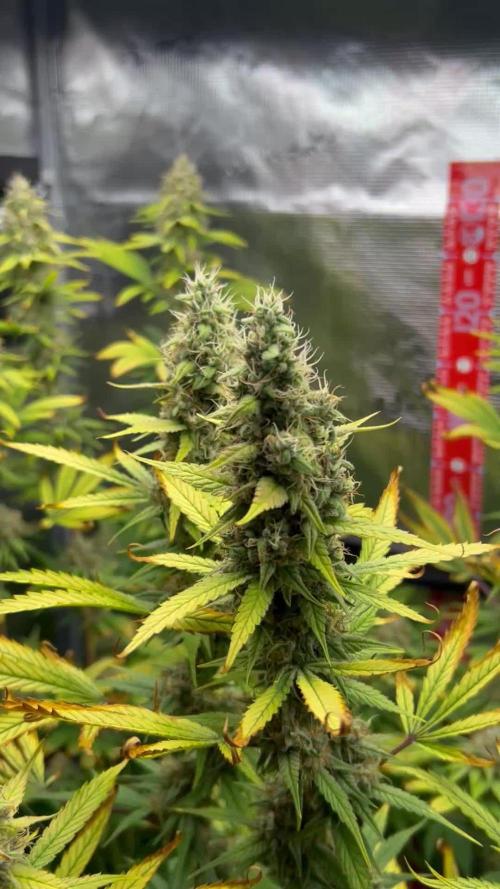
Estupendas, estoy muy contento con los resultados que voy observando, me tienen enamorado con el olor a frutas variadas, la resina que tiene es impresionante brillan como una cucharada de azúcar, y tiene 67 dias. El proveedor dice que con 70 dias pero alguna le queda un poquito mas de de lo recomendado si que otras están muy bien echas pero otras no. llevo toda la semana lavando la raíz con agua.
Likes
18
Share
📆 Semana 7 El cultivo continúa avanzando en el engorde, con los cogollos aumentando de tamaño y los cálices apilando cada vez con más fuerza a lo largo de las puntas. La resina sigue ganando presencia y las flores empiezan a verse más compactas, mientras la canopia mantiene un trabajo uniforme aprovechando bien la luz. Los aromas del armario se vuelven más intensos y complejos a medida que la planta centra su energía en densidad y producción de terpenos. Seguimos creciendo fuerte 💪!
Likes
72
Share
@Stinkfox
Follow
She smells incredible! Same as last time. She’s starting to bulk up. I’m probably going to harvest this one a week earlier than last time, for more of a rush/energetic high. I’ll start flushing after the next ful week of flower.
Likes
32
Share
Likes
8
Share
Week 18 Septembre 6 Flowering plants (a&b) are entering week 6 of flowering and still in peak bulking so for today's feed : - 0-52-34 ~ 18gr / 20L - 0-0-50 ~ 18gr/ 20L - Cal-Mag 3gr each. - 6 tbsp molasses/20L - Ph 6.3 & TDS 1600ppm As for the third plant (plant c) -Flush with plain water Performed a little mid flower defoliation on Plant C only and removed popcorn buds to open up the canopy.
Likes
22
Share
@sealeater
Follow
just waiting for the clone to root now and give it away then we can beggin flowering added sea algae composte for the first time in a while to the feeding schedule lets see if it does anything i did some defoliating hoping for a quick recovery and am posting photos of that in a few hours update later day 1 of week 8: as seen from the photo i did i slight defoliation by removing some bigger shaded lower laying fan leaves
Likes
22
Share
@Trip614
Follow
So I harvested on day 70, Pretty excited, I started with 12 seeds, 1 never popped, 2 got messed up in shell, but I hoped they would make it, they did, but they are embarrassing, I one the root system barley existed the other got so bushy and I didn't stay on top of it so it was all frost, no actual buds, pfff. THE OTHER GIRLS more than made up for it, I changed the light cycle to 10 on, 14 off for the last 4 days of light, and then the last 2 days no lights at all. Super happy so far, oh, I did not water at all the last 4 days, I thought that may help my rh during the dry, starting the dry a little on the plant, nope, my rh is high. still happy
Likes
Comments
Share
🌸 Pink Rosay Auto by Zamnesia | Pheno B | Week 8 (Flower Week 5) 🌱 The Tiny One That Refused To Give Up If I were growing only two or three plants, I'm going to be completely honest... I probably wouldn't have kept her. Pink Rosay Pheno B is tiny. Not small. Not compact. Tiny. She's easily among the smallest plants I've ever grown. And that's exactly what makes her so interesting. Because this is the whole point of the 8×8 Adventure. I'm growing twelve different genetics side by side, and instead of selecting only the plants that immediately impress me, I'm giving every phenotype the opportunity to tell me who she is. And this little lady? She's definitely telling us. She isn't going to produce the biggest harvest in the tent. She probably won't even come close. But she's healthy. She's flowering. She's developing beautifully. And she's still here. Sometimes that's enough reason to keep watching. 🌸 Week 5 Flower – Tiny, But Still Building The stretch is essentially behind her now, and her personality couldn't be clearer. Pink Rosay Pheno B has remained incredibly compact throughout the entire grow. Her nodes are tightly packed. Her branches remain short. Her entire structure feels almost miniature compared with the plants surrounding her. But when you look closely... There are flowers everywhere. Those tiny branches are carrying developing buds, and the white pistils continue appearing across the flowering sites. She's slowly turning this miniature framework into a miniature flowering plant. And there's something strangely beautiful about that. She isn't trying to become something she's not. She's simply doing what her genetics told her to do. ✂️ Defoliation – Opening The Little Lady Up Just like her sister, Pink Rosay Pheno B also received a selective defoliation this week. Again, this wasn't because she was unhealthy. Quite the opposite. She's looking beautiful. The reason was simply that her extremely compact architecture creates a very dense little package of foliage and flowers. With so much plant compressed into such a small vertical space, selectively removing some unnecessary leaves helps open the structure. The goal isn't to strip the plant. It's not about removing healthy leaves just because we can. And it's certainly not about making the plant look pretty for a photograph. The idea is to create a little more space between foliage, flowers, light and moving air. I removed leaves that were contributing to congestion and cleaned up portions of the lower and interior structure where development was unlikely to justify keeping excessive foliage. But I didn't remove everything. There are still flowers down there. And I'm leaving some of them. Because this is an experiment. I want to see what this tiny phenotype can actually do. 💡 Let The Photons Move With a plant this compact, light management becomes particularly interesting. The Future of Grow Black Series provides the primary light from above, while the Lumiflora under-canopy system adds another source of illumination deeper in the room. But there's an important distinction here. Adding light doesn't automatically mean every flower needs to be exposed directly to it. The plant still has its own architecture. Leaves overlap. Flowers sit underneath other leaves. Some areas naturally receive less light. By selectively opening the canopy, we're simply allowing more of the available photons to travel through the structure rather than being intercepted immediately by layers of foliage. It's not about making the plant brighter. It's about making the light distribution more useful. And with a plant this tiny and dense, every little opening makes a difference to the way light and air move through her. 🌱 The Smallest Plant With A Big Lesson This is probably the part of her story I appreciate most. If you only looked at her height, you could easily conclude that something went wrong. But nothing went wrong. She simply expressed herself differently. That's one of the reasons growing multiple phenotypes is so valuable. Put two sisters next to each other and suddenly the differences become impossible to ignore. One can stretch. One can stay short. One can develop large branches. Another can produce a miniature architecture. Same genetic family. Completely different personalities. And instead of asking: "Why isn't she like her sister?" I prefer asking: "What can she show me if I let her finish?" That's the experiment. And that's why she's still here. 🌼 Flowers, Pistils & Personality Despite her size, the flowering development is genuinely beautiful. The flowers are becoming more defined, with fresh white pistils continuing to emerge from the developing calyxes. The deep green foliage provides an incredible contrast against those bright white hairs. And the more I look at her, the more I realise that her size is actually part of her charm. She's almost like a miniature version of a full-sized flowering plant. Everything is there. Just compressed. Tiny branches. Tiny leaves. Tiny flowers. Tiny structure. But the same biological process is happening. She's still capturing light. She's still producing energy. She's still moving water and nutrients. She's still building flowers. And she's still telling us what her genetics are capable of. ❄️ She's Still Getting Frostier Another thing that keeps this little plant interesting is the resin development. She's beginning to show that frosted appearance across the flowers and surrounding sugar leaves, adding another layer to what is already an incredibly attractive little plant. I don't expect her to suddenly turn into a giant producer. But I do think she could produce something interesting in terms of flower quality. And if the final amount ends up being very small? That's okay too. I've already been thinking that her eventual harvest may make more sense as a small personal extraction project rather than trying to treat her like a traditional high-yield plant. Something like an ice-water wash could give those flowers another purpose. But that's a decision for much later. For now... She's growing. And that's what matters. 💧 Consistency Is Still The Strategy The beauty of this phenotype is that she hasn't needed special treatment. She's been receiving the same general cultivation philosophy as the rest of the room while being observed individually. Hand watering gives me the opportunity to assess her every day and make sure her needs are being met without forcing her into a feeding strategy designed around a larger plant. The important thing isn't trying to make her bigger at this point. That chapter is over. Now the objective is simply to allow her to finish as strongly and naturally as possible. She's healthy. She's flowering. She's producing resin. So we keep the environment stable and let her do the rest. 🌡️ Environment The room continues providing a remarkably stable environment for all these different phenotypes. Current conditions remain around: Day temperature: 29°C Night temperature: 25°C Relative humidity: 60% Solution temperature: 21°C Root-zone temperature: 21°C CO₂: approximately 639 ppm This is one of the things I love most about this project. Twelve different plants. Twelve different personalities. One environment. And every phenotype gets to show us how she responds to the same cultivation philosophy. 👀 Looking Ahead – Let's See What She's Got At this point, I'm not expecting miracles from Pink Rosay Pheno B. And I don't mean that negatively. I mean that realistically. She's tiny. Her total flower mass will naturally be limited by the amount of plant she's carrying. But that's okay. The goal now isn't to turn her into something she's not. It's to see how beautifully she can finish as herself. The flowers should continue swelling. The pistils will eventually begin their transition toward maturity. Resin production should continue increasing. And that little compact canopy should slowly transform from a collection of tiny flowers into a finished miniature harvest. Maybe she'll surprise me. Maybe she won't. Either way... She's already taught me something. ❤️ Final Thoughts – The Little Lady That Stayed Pink Rosay Pheno B is probably never going to win a competition for plant height. She isn't going to dominate the canopy. She isn't going to produce a mountain of flowers. And honestly? That's okay. Because this project was never only about growing the biggest plant. It's about observing genetics. It's about giving different phenotypes the room to express themselves. It's about learning that sometimes the plant you would have removed from the garden is the one that ends up teaching you something you wouldn't have learned otherwise. If I had only been growing a couple of plants, I might have looked at this tiny Pink Rosay early in the grow and decided that her journey wasn't worth the space. But I didn't. I gave her a chance. And now she's standing there, covered in flowers, getting frostier every week and quietly proving that she still has a story to tell. She may be the smallest plant in the room. She may produce the smallest harvest. She may eventually become a tiny jar of flowers... Or perhaps an even tinier ice-water experiment. But before any of that happens, she deserves exactly what every other phenotype in this project receives: Time. Time to grow. Time to flower. Time to express herself. And time to show us what she can do. A huge thank you once again to Zamnesia for these wonderful genetics, Plagron for supporting the nutrition throughout this journey, Future of Grow for the incredible Black Series lighting, Lumiflora for bringing additional light beneath the canopy, TrolMaster for maintaining environmental control and everyone following this crazy 8×8 Adventure here on GrowDiaries. Every plant doesn't need to be the biggest. Every phenotype doesn't need to be a winner. Sometimes... the smallest ones simply need someone willing to let them finish their story. And this little lady isn't finished yet. 🌸 Until next week... Tiny plant. Big personality. Still here. Still shining. 🌱✨ Growers Love and happy growing! 💚
Likes
371
Share
D71. Week five of flower and the girls are simply doing their thing. I scouted the plants today and found thrips on the second girl. I was hoping the lacewings would have gotten them all by now, but no such luck. I'll give them a week before ordering another batch. For some reason, the thrips avoid the first girl. Visually, there's also a clear difference between the two girls, with the first girl being darker and having more buds. ------------------------------ D73. I brewed a short (6 hours) compost tea today consisting of worm castings, kelp meal, neem meal, humic and fulvic acid, rock dust, biochar, and molasses. After the brew, I added homemade Bokashi juice, which lowered the pH of the tea to 6.6. Each girl got 2.5 liters of tea (5% of pot volume.) I also did another light round of defoliation, down low on the plants. ------------------------------ D75. Each girl got 2.5 liters of water @ pH 6.5, with 5 ml of FFJ. The plants stretched SO MUCH after flipping them into flower that it's challenging for the light to penetrate the canopy, and it's pretty dark further down. I bought some LED grow light strips and installed them in the tent to provide additional side lighting. It's only 36 W of extra lighting, but I hope it will help to develop the numerous buds down low. I put the lights on the left side of the tent, around the first girl, since she has a lot more buds, but now that it looks like the concept works, I might get another set of lights for the right side of the tent. ------------------------------ D77. We've reached the end of the fifth week of flower, and all is well in the tent. Ahem, almost all since I still have the thrips to contend with, BUT I just put a bunch of Cucumeris predatory mites in the tent, so the war rages on. A friend suggested adding white cloth below the plants to reflect more light toward the lower buds. Sounds plausible, but I didn't have any fabric, so I went all ghetto by simply putting strips of kitchen paper on top of the scrog net. Not the most fantastic reflector material ever, but it's what I had at hand. Plus, it's easy to work with and costs next to nothing. I doubt it will make a big difference, but even a slight increase is still an increase, and I could see a visible difference in the amount of light hitting the lower canopy. Finally, each plant got 2.5 liters of water @ pH 6.3, with FFJ and Bokashi Juice. ------------------------------
Likes
2
Share
Fattening up nicely, and smelling like citrus...I'm impressed
Processing
Likes
3
Share
The temperature had some fluctuations, and the plant got a bit more humidity a little bit of mold on a few fan leaves.. a bit too much water consumption
Likes
7
Share
@wascanna
Follow
👹 Oni Seed Co. 🍭 Dub Trop BX1 // Dubble Trop x Tropicanna Cookie F1 🍓 Straw-Picanna // Strawberry Bananna x Tropicanna Cookies 🌿 Tropicanna Kush // SFV OG x Triangle Kush 🔥 Sunburn // TKT (Triangle Kush x Tangie) x Tropicanna Cookies 🍁 BLOOM WEEK 3 📅 Day 1 - They're drinking lots now, in full speed. - Going to top dress tomorrow. 📅 Day 2 - Final lollipop, felt dirty doing it, but from experience they ° would be wasting time on these lowers. - Top dress with SW-Bloom 📅 Day 3 - Bloomin' 📅 Day 4 - Bloomin' 📅 Day 5 - Watered in EM-1 microbes from StepWell. Not sure why I waited so long. 📅 Day 6 - Watered. Super impressed so far! 📅 Day 7
Likes
2
Share
Not much to update. Buds stacking nicely.
Likes
17
Share
📆 Semana 7 La floración continúa avanzando con fuerza y los cogollos entran en una etapa de intenso engorde. Las flores siguen aumentando su volumen y densidad, mientras los cálices comienzan a hincharse y apilarse, dando una estructura cada vez más compacta. La producción de resina aumenta progresivamente y los aromas empiezan a ganar intensidad y complejidad. Los pistilos permanecen todavía mayoritariamente blancos, aunque comienzan a aparecer los primeros signos de retraimiento. La planta mantiene un consumo elevado de agua y nutrientes para sostener el desarrollo de las flores y afrontar las últimas semanas de engorde. ⚡ EC: 1.8–1.9 💧 pH: 6.2–6.5 🌡️ Agua: 20–22°C 🌫️ Humedad: 45–50% 💡 PPFD: 950–1050 µmol/m²/s 🌡️ Temp ambiente: 24–27°C 🔥 Nota: Mantener una nutrición equilibrada y unas condiciones ambientales estables durante esta fase permite maximizar el engorde y la densidad de los cogollos, favoreciendo al mismo tiempo una elevada producción de resina y una excelente expresión de los terpenos. ¡Seguimos creciendo fuerte! 💪