The Grow Awards 2026 🏆
Likes
Comments
Share
Fat Bastard sure looks pretty fat👍 I'll try drying for at least a week with both temp and humidity between 55-60. I may go check the wet weight, but😕 I'm curious to see how fat bastard turns out. Smells skunky/sweet-fruity, can't wait. Hung a wet towel in the closet to help keep the humidity up there and it seems to be working.
Processing
Likes
20
Share
The ladies are sucking down lots of water. So much so that the ppm's got a little high and some burn set in. Topped off the reservoir with ro water and calmag only to bring ppm down. No worries, looking pretty good I think and will finish up strong. These are the biggest girl scout cookies from fast buds I have ever grown. I have defoliate lots and snipped tiny bud sites down a bit to let the energy go into the bigger buds. I am very susceptible to PM so it's crucial I have air flow and light penetration. Everytime I let defoliation go the PM starts to set in and it's so hard to eradicate 100%. Prevention, prevention, prevention.
Likes
63
Share
@EasyName
Follow
Welcome to week4!🤠 Fixed her discoloured leafs, it was due to frequent watering🌊 She entered vegetative stage only after 4 weeks of growing, which is way sooner then last time!😯 And I'm using a humiditor to keep the air at 60%😋 See you very soon!🤠❤️
Processing
Likes
58
Share
Day 43- i have beautiful girl with many crystal young buds... I see changes every day and it's amazing!) She is short but very fat) It will be very good staff as for me. Nutrients are working very good☝️👍So I am very expecting harvest day) Peace you ✌️ my brothers and sisters!)
Likes
20
Share
Venga familia que ya viene la cosecha de estas Apple Fritter de RoyalQueenSeeds, que ganas que tenia ya de darles machetazo. No veas que pinta que tienen estas plantas. Las flores aparte de prietas se ven bien resinosas. a sido una genética con la que disfruté mucho cultivarla, es algo complicada cultivarla pero merece la pena si eres cultivador con experiencia no te será problema cosechar. Agrobeta: https://www.agrobeta.com/agrobetatiendaonline/36-abonos-canamo Mars hydro: Code discount: EL420 https://www.mars-hydro.com/ Hasta aquí es todo , espero que lo disfrutéis, buenos humos 💨💨.
Likes
11
Share
La planta le encantó la nueva luz y empezó estirarse demasiado tanto que para controlar su altura apliqué una poda apical la cual respondió muy bien y empezo a sacar 2 puntas principales
Processing
Likes
12
Share
@Tazard
Follow
We have a very full tent! Taz’s jungle 😂🤣. Check out the purple purple photos from day 20!!! Everyone looks absolutely beautiful I’m hoping that the white critical will be ready in 4-5 weeks. She’s going to have some fat colas!
Likes
12
Share
Day 29 (Second Grow): "Hey everyone! Starting a new week with some exciting plans! 🌿 We've got about one more week before we transition the plants to the flowering phase. Just to recap last week's updates for those following along: We’ve named all the plants in both grows. This makes it easier to identify and keep track of each one, especially if they get moved around. It should also help you all follow along more easily with the pictures we post. We've built a SCROG (Screen of Green) net for the plants. A SCROG net helps train the plants to grow horizontally, which maximizes light exposure to all parts of the plant and promotes more even growth. We're using it to ensure all plants get plenty of light and develop a uniform canopy. We’ve placed a hygrometer among the plants to measure the humidity between the leaves. We've noticed that the humidity sometimes exceeds 70% in those areas. We're considering whether we need more fans, an intake ventilation system, or if a dehumidifier would be a better option. We're leaning towards adding more fans to improve air circulation, but we'd love to hear your thoughts and suggestions! Stay tuned for more updates as we continue to watch both grows progress and prepare for the flowering phase!" Day 33 (Second Grow): "Hey everyone! Exciting news for our second grow: we’ve added a new member to the grow tent – a praying mantis! 🦗 Her species is Timor shield mantis, and she still needs a name. We got her to help with pest control naturally. Praying mantises are excellent predators and can help keep unwanted insects away from our plants. Feel free to suggest a name for her! Any tips or fun facts about keeping a mantis in the grow tent are also welcome!" Day 34 (Second Grow): "Hey everyone! Big update today: we’ve switched the timer to a 12/12 light cycle to initiate the flowering phase! 🌸 Our second batch of plants, just like the first, has developed well and we believe they’re ready to start blooming. This change should encourage them to shift their energy towards producing buds. For those following along, here’s a quick recap: We've implemented a SCROG net to manage the canopy and ensure even light distribution. We've introduced a Timor shield mantis for natural pest control. The plants have responded well to all adjustments and are looking healthy. Now that the flowering phase is starting, we’re excited to see how they develop over the next few weeks. Any tips or advice for optimizing this phase? Let us know in the comments!"
Likes
8
Share
Week 21 Daylight 12h20 - 7h45/20h05 Unstable weather, alternating heavy rain and wind quasi every days and sunny afternoons. Moderate temperatures around 14°C min / 23°C max. Plants are safe in the veranda; the sun is lower on the horizon now and the angle of the light is now perfect for a good finish. I need to test the humidity level in the room but it seems reasonable. No signs of diseases or moisture. Last weeks were hard with multiple aggressions: plants are like War Veterans with some damage and scars. The flowering process look not affected by this episode and harvest is approaching. Brake Pad Breath: almost ready. Pistils are rusty colored, buds are thick and dense, firm and sticky. Subtle fruity aroma: tonic and stimulating. Most advanced plant: will be the first harvested soon. 2L watering / 2 days flowering booster finish + water flawless finish + water Flash Back #2: ending the flowering cycle and starting maturation. Last plant infested by insects, may be the plant is reacting by accelerating the flowering: buds are not so dense compare with the previous plant. Pretty spicy smell and good resin production. flowering booster finish + water flawless finish + water GMO x Zombie Kush: starting the last flowering stage. Recovering good and was less injured by caterpillar than the others. Pistils are long and the flowers will enlarge soon: need almost 3 or 4 weeks to be ready. Grower master flo + bud XL enzyme + pk 13/14 Royal Moby is tall and late flowering but seems producing lot of flower. With the stress the plant become hermaphroditic, I discovered some bag of males flowers. I hope there is no pollination between the other plants. Grower master flo + bud XL enzyme + pk 13/14
Likes
9
Share
@Atalant
Follow
28.7 D78 1.1L watering PH 7.0 EC 0.4 Return PH 6.1 EC 1.5 D81 31.7. ✂️ I wanted to harvest her with slightly not mature trichomes. Compare to other plants of this strain. Flush of pot after harvest. PH 6.5 EC 0.4 1L return PH 5.7 EC 0.8 5L return PH 6.5 EC 0.7 16.32g.
Likes
2
Share
Likes
51
Share
Esa familia, traigo la última semana de floración de las cookies gelato, increíble lo prietas que están , son flores muy compactas y llenas de tricomas. Un híbrido increíble, ya se ve productor y además se aprecia potencia en su flor. Ya deseando pegar machetazo y en unas semanas podré apreciar los resultados. . La humedad esta al 45% la temperatura está entre 21/25 grados , y como siempre el ph , ya que es de lo más importante,está en 5,8/6,0. . AgroBeta: Ya tenemos el lavado de raíces realizado, hemos retirado los nutrientes y finalizamos con un estrés hídrico. . Hasta aquí todo familia 🕸️ , un saludo y buenos humos fumetillas💨💨💨.
Likes
7
Share
Ende ersten Woche Flower und Start der Zweiten, ich hatte wieder ein Problem mit Trauermücken und habe diese jetzt mit Neemöl bekämpft und die erste mit Sand bedeckt. Dadurch trocknet diese nicht so schnell aus und die Mücken können ihre Eier nicht in die Erde setzen, ich hoffe mal, das hilft. Die Pflanzen haben einen mächtigen Schub gemacht und sind min. 10 cm gewachsen, man erkennt schon kleine anzeigen von Härchen. Tag 4 von Woche 8: Heute habe ich das Netz gespannt und stark erlaubt sowie triebe raus genommen die nicht mindestens durchs Netz gingen oder kein Licht bekamen. Ich bin gespannt wie gut die anderen jetzt davon Profitieren werden .
Processing
Likes
10
Share
End of week 4 and all is going well, had a slight calcium issue on a couple of leaves, but it was corrected and all is good again. This girl is responding well to the nutes, but my run-off is getting a little high, that should change when I cut out the Flora Micro and just feed calmag, Dnectar and KoolBoom for the next couple of weeks. Any comments or suggestions? Wish me luck.... just a few weeks to harvest now.
Likes
78
Share
@Hou_Stone
Follow
👌It’s progressing, slowly but surely for my 4 young banana krumble 👶🍌 For this grow, I plan to let each plant grow with a large main bud, without topping. Next week I will cut the lower branches closest to the ground. ----------------------------------------------------------- 💧Watering: 1L on day 9 and 0.5L on day 12 I use tap water, adjust the ph to around 5.8 and water ------------------------------------------------------------ 🤩Equipment of the week : Light FC3000 Mars hydro. power 80% at 50cm Extractor 6 inch Mars Hydro. power 1/10. ON 24/24h 2 fans to circulate the air inside the tent. Each on for 30 minutes then off for 1 hour. this rhythm repeats itself in a loop Heating mat Romberg 95x95cm. ON 45 minutes. OFF 30minutes. In a loop I am adding anti-midge bird stickers 🐦 ------------------------------------------------------------ Thank you for your visit and your support with the likes, comments. It's always nice to see you!💚 ------------------------------------------------------------ My Instagram 🌱❤️️ : https://www.instagram.com/hou_stone420/
Likes
15
Share
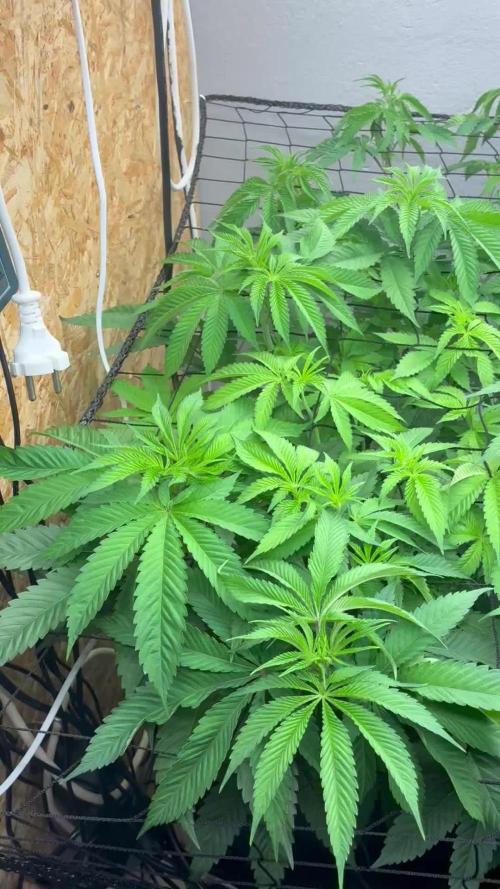
Happy to have her in the flower tent! Photos/video taken 49 days after breaking soil, day 7 of flower.
Likes
18
Share
Green light is radiation with wavelengths between 520 and 560 nm and it affects photosynthesis, plant height, and flowering. Plants reflect green light and this is why they appear green to our eyes. As a result, some growers think that plants don’t use green wavelengths, but they actually do! In fact, only around 5 – 10% of green light is reflected from leaves and the rest (90 – 95 %) is absorbed or transmitted to lower leaves [1]. Green wavelengths get used in photosynthesis. Chlorophyll pigments absorb small amounts of green wavelengths. Light that doesn’t get absorbed is transmitted to leaves that are shaded out from direct light. This means that leaves at the bottom of the canopy get more green light than leaves at the top. A high proportion of green wavelengths compared to other colors tells lower leaves that they are being shaded out, so they are able to react accordingly. Lower leaves may react by opening or closing their stomata or growing longer stems that help the leaves reach brighter light [1, 2, 3]. When it comes to growing cannabis, many cultivators are interested in the quality of light used for the flowering stage. In many plants, flowering is regulated by two main photoreceptors: cryptochrome and phytochrome. Both photoreceptors primarily respond to blue light but can also respond to green, although to a lesser extent. Green can accelerate the start of flowering in several species (although cannabis has yet to be tested) [1, 4, 5]. However, once flowering has begun, it’s important to provide plants with a “full spectrum” light that has high amounts of blue and red light, and moderate amounts of green, in order for photosynthesis to be optimized. Green light mediates seed germination in some species. Seeds use green wavelengths to decide whether the environment is good for germination. Shade environments are enriched in green relative to red and blue light, so a plant can tell if it is shady or sunny. A seed that senses a shaded environment may stay dormant to avoid poor growing conditions [1]. Some examples of plant species where researchers have documented this response are: ryegrass (a grass that grows in tufts) and Chondrilla (a plant related to dandelion) [1, 6]. Although green wavelengths generally tell plants NOT to germinate, there are some exceptions! Surprisingly, green wavelengths can stimulate seed germination in some species like Aeschynomene, Tephrosia, Solidago, Cyrtopodium, and Atriplex [1, 6, 7]. Of course, light is not the only factor affecting seed germination – it’s a combination of many factors, such as soil moisture, soil type, temperature, photoperiod, and light quality. When combined with red and blue light, green can really enhance plant growth [1, 8]. However, too much green light (more than 50% of the total light) can actually reduce plant growth [8]. Based on the most current research, the ideal ratio of green, red, and blue light is thought to be around 1:2:1 for green:blue:red [9]. When choosing a horticultural light, choose one that has high amounts of blue and red light and moderate amounts of green and other colors of light. Not many studies can be found about the effect of green light on cannabis growth or metabolism. However, if one reads carefully, there are clues and data available even from the very early papers. Mahlberg and Hemphill (1983) used colored filters in their study to alter the sunlight spectrum and study green light among others. They concluded that the green filter, which makes the environment green by cutting other wavelengths out, reduced the THC concentration significantly compared to the daylight control treatment. It has been demonstrated that green color can reduce secondary metabolite activity with other species as well. For example, the addition of green to a light spectrum decreases anthocyanin concentration in lettuce (Zhang and Folta 2012). If green light only reverses the biosynthesis of some secondary metabolites, then why put green light into a growth spectrum at all? Well, there are a couple of good reasons. One is that green penetrates leaf layers effectively. Conversely red and blue light is almost completely absorbed by the first leaf layer. Green travels through the first, second, and even third layers effectively (Figure 2). Lower leaf layers can utilize green light in photosynthesis and therefore produce yields as well. Even though a green light-specific photoreceptor has not yet been found, it is known that green light has effects independent from the cryptochrome but then again, also cryptochrome-dependent ones, just like blue light. It is known that green light in low light intensity conditions can enhance far red stimulating secondary metabolite production in microgreens and then again, counteracts the production of these compounds in high-intensity light conditions (Kim et al. 2004). In many cases, green light promoted physiological changes in plants that are opposite to the actions of blue light. In the study by Kim et al. blue light-induced anthocyanin accumulation was inhibited by green light. In another study it has been found that blue light promotes stomatal opening whereas green light promotes stomatal closure (Frechilla et al. 2000). Blue light inhibits the early stem elongation in the seedling stage whereas green light promotes it (Folta 2004). Also, blue light results in flowering induction, and green light inhibits it (Banerjee et al., 2007). As you can see, green light works very closely with blue light, and therefore not only the amount of these two wavelengths separately is important but also the ratio (Blue: Green) between these two in the designed spectrum. Furthermore, green light has been found to affect the elongation of petioles and upward leaf reorientation with the model plant Arabidopsis thaliana both of which are a sign of shade avoidance symptoms (Zhang et al. 2011) and also gene expression in the same plant (Dhingra et al. 2006). As mentioned before, green light produces shade avoidance symptoms which are quite intuitive if you consider the natural conditions where the plants grow. Not all the green light is reflected from the highest canopy leaves in nature but a lot of it (50-90%) has been estimated to penetrate the upper leaves at the plant level ((Terashima et al., 2009; Nishio, 2000). For the plant growing in the understory of the forest green light is a signal for the plant of being in the shade of a bigger plant. Then again, the plants growing under unobstructed sunlight can take advantage of the green photons that can more easily penetrate the upper leaves than the red and blue photons. From the photosynthetic pigments in higher plants, chlorophyll is crucial for plant growth. Dissolved chlorophyll and absorb maximally in the red (λ600–700 nm) and blue (λ400–500 nm) regions of the spectrum and not as easily in the green (λ500–600 nm) regions. Up to 80% of all green light is thought to be transmitted through the chloroplast (Terashima et al., 2009) and this allows more green photons to pass deeper into the leaf mesophyll layer than red and blue photons. When the green light is scattered in the vertical leaf profile its journey is lengthened and therefore photons have a higher chance of hitting and being absorbed by chloroplasts on their passage through the leaf to the lower leaves of the plant. Photons of PPFD (photosynthetic photon flux density) are captured by chlorophyll causing an excitation of an electron to enter a higher energy state in which the energy is immediately passed on to the neighboring chlorophyll molecule by resonance transfer or released to the electron transport chain (PSII and PSI). Despite the low extinction coefficient of chlorophyll in the green 500–600 nm region it needs to be noted that the absorbance can be significant if the pigment (chlorophyll) concentration in the leaf is high enough. The research available clearly shows that plants use green wavelengths to promote higher biomass and yield (photosynthetic activity), and that it is a crucial signal for long-term developmental and short-term dynamic acclimation (Blue:Green ratio) to the environment. It should not be dismissed but studied more because it brings more opportunities to control plant gene expression and physiology in plant production. REFERENCES Banerjee R., Schleicher E., Meier S. Viana R. M., Pokorny R., Ahmad M., Bittl R., Batschauer. 2007. The signaling state of Arabidopsis cryptochrome 2 contains flavin semiquinone. The Journal of Biological Chemistry 282, 14916–14922. Dhingra, A., Bies, D. H., Lehner, K. R., and Folta, K. M. 2006. Green light adjusts the plastic transcriptome during early photomorphogenic development. Plant Physiol. 142, 1256-1266. Folta, K. M. 2004. Green light stimulates early stem elongation, antagonizing light-mediated growth inhibition. Plant Physiol. 135, 1407-1416. Frechilla, S., Talbott, L. D., Bogomolmi, R. A., and Zeiger, E. 2000. Reversal of blue light -stimulated stomatal opening by green light. Plant Cell Physiol. 41, 171-176. Kim, H.H., Goins, G. D., Wheeler, R. M., and Sager, J. C. 2004.Green-light supplementation for enhanced lettuce growth under red- and blue-light emitting diodes. HortScience 39, 1617-1622. Nishio, J.N. 2000. Why are higher plants green? Evolution of the higher plant photosynthetic pigment complement. Plant Cell and Environment 23, 539–548. Terashima I., Fujita T., Inoue T., Chow W.S., Oguchi R. 2009. Green light drives leaf photosynthesis more efficiently than red light in strong white light: revisiting the enigmatic question of why leaves are green. Plant & Cell Physiology 50, 684–697. Zhang, T., Maruhnich, S. A., and Folta, K. M. 2011. Green light induces shade avoidance symptoms. Plant Physiol. 157, 1528-156. Wang, Y. & Folta, K. M. Contributions of green light to plant growth and development. Am. J. Bot. 100, 70–78 (2013). Zhang, T. & Folta, K. M. Green light signaling and adaptive response. Plant Signal. Behav. 7, 75–78 (2012). Johkan, M. et al. Blue light-emitting diode light irradiation of seedlings improves seedling quality and growth after transplanting in red leaf lettuce. HortScience 45, 1809–1814 (2010). Kasajima, S., et al. Effect of Light Quality on Developmental Rate of Wheat under Continuous Light at a Constant Temperature. Plant Prod. Sci. 10, 286–291 (2007). Banerjee, R. et al. The signaling state of Arabidopsis cryptochrome 2 contains flavin semiquinone. J. Biol. Chem. 282, 14916–14922 (2007). Goggin, D. E. & Steadman, K. J. Blue and green are frequently seen: responses of seeds to short- and mid-wavelength light. Seed Sci. Res. 22, 27–35 (2012). Mandák, B. & Pyšek, P. The effects of light quality, nitrate concentration and presence of bracteoles on germination of different fruit types in the heterocarpous Atriplex sagittata. J. Ecol. 89, 149–158 (2001). Darko, E. et al. Photosynthesis under artificial light: the shift in primary and secondary metabolism. Philos. Trans. R. Soc. B Biol. Sci. 369 (2014). Lu, N. et al. Effects of Supplemental Lighting with Light-Emitting Diodes (LEDs) on Tomato Yield and Quality of Single-Truss Tomato Plants Grown at High Planting Density. Environ. Control Biol. 50, 63–74 (2012).
Likes
26
Share
Harvest 2 of 3 plants and everything was very good. I will updated soon with pics of the 3rd I harvest later than the two. Thanks to Barney’s Farm and Advanced Nutirents, to the love of the plant first of all and to all growers here and in the world. 🙏🏻💚 Updated: harvest all 3 plants for 100g/plant 💪🏻
Likes
97
Share
@CANNASIM
Follow
GENERAL COMMENT The SKR is dry and starting the cure in jars, and the NL is done. RQS NORTHERN LIGHTS AUTO COMMENT. This is the final week, next time will be the harvest, this girl just got mature from a day to the other, lost 70% of the top bud due to rot i haven t seen. So i could get virtually 30-40% yield from this girl Without the locks or rot, anyhow still looking ok as far as harvest, quality will be a bit compromise, not the end of times though lol! 🙃👊🏻👍🏻