


Likes
Comments
Share


Likes
4
Share


@hinterhofgrower
Follow
🌱:
💧 : 8l, switch to 0,5ml/l Pk 13-14 on day 59
💡 : Dli: 45 mol/m²/d
🤔:

Likes
10
Share


@I_Identify_As_A_Dan
Follow
Week 10 for White widow by Greenhouseseedco,
She finally got her transplant into 25L of fairly good soil mix of biobozz light mix/coco mix + a good feed of @bokashibiochar + a feeding of BioGrow by greenhousefeeding
I think a few days of adjusting and she will start to explode.


Likes
49
Share


@masterofsmeagol
Follow
6/23 Due To The Two 8 Day weeks this week will only consist of five days to get me back on track. SEE LAST WEEK FOR DETAILS. I DID ANOTHER EIGHT DAY WEEK. I'LL DO THIS WEEK AS SIX DAYS. THAT WAY IM BACK ON SCHEDULE. WATERED 6/22. WENT BACK AT NIGHTCAND WATERED ANOTHER GALLON WITH 1/3 TSP Armor Si. I mixed the solution with kelp you kelp me but I dumped it out. I've mixed silica with other nutes before but I had read something earlier about bioavailability issues and I didn't want to risk it. My plants are the healthiest I've ever grown. I'm considering transplanting the large 10th planet that I'm light depping. I also need to develop my ipm and my nute schedule. Still gonna have to keep an eye onvthe water situation. Luckily I have a buddy in my corner that's co tinualkt Bern a great help.
WENT BACK OVER AROUND NOON. BEAUTIFUL OUTSIDE AND THE PLANTS WERE LOVING THIS SUN. I DEFOLIATED SOME BURNED LEAVES AND MIXED A SOLUTION IF KELP ME KELP YOU THAT I PLAN TO FEED TO THE GARDEN TODAY. IM HAPPY WITH HOW THINGS ARE GOING. WE HAVE SOME RAIN AND THINDERSTORMS COMING. I NEED TO GET MY IPM UP AND RUNNING AND THE NUTES ONLINE. I ALSO NEED TO DECIDE IF IM GOING TO TRANSPLANT THE LIGHT DEP 10th PLANET. Went back over to put the girls to bed at six and if was still 90 degrees. The water from yesterday had dissipated. The tops were dust dry. I mixed two gallons of kelp you kelp me and fed it to the garden. Afterwards I pointed qbd found a couple plants that were more open to the wind were a little lighter. I know tomorrow will be very hot. Maybe quarter inch of rain. However after that it will rain (showers) off and on for days. I wanted to make sure the girls had what the needed to make it through tjis heat wave until they get that rain. I had another gallon mixed up and I'm thinking I should've given it to them. Oh well. I'd rather underwater than overwater any day. I did notice a burnt top on the plant furthest from the tarp that the sun JUST BARELY TOUCHES when the rest are in shade. I'll just raise the tarp a little. These are tiny problems. Can't upload video until tomorrow.
6/24 Good thing u gave the plants that water. I know it wasn't much but we didn't get any rain. Suppised to get a qtr in today and another qtr in tomorrow. Then rain a couple more days. It's working our really good for my watering schedule lol. Yesterday the girls got there first dose of a bottled nute. They got two gallons of kelp me kelp you (1/3 tsp per gallon) and another gallon of just phed water. I was going to do another gallon but held off due to the threat of syring rain. Didn't get it bur it looks like the plants loved the kelp. It had reached 90 yesterday. They look better today. It's 70 at 9 today. I LST the 10th planet in the 3 gallon. It's getting huge. I should start a separate diary for those three light dep plants. Its cool as hell watching this. One of the purple punches is flowering pretty good. I probably should start another diary for them. I'll be starting to feed my plants soon. Wondering if I should pinch plants again. TUCKED THE LITTLE GIRLS IN AT SIX AND SHOT A VIDEO AND TOOK SOME PUCTURES. PLANTS LOOKED PHENOMINAL! GOT HOME AND AROUND SEVEN IT JUST STARTED RORREBTIAL DOWNPOURS! THE TYPE OF RAIN THAT BREAKS STEMS. I SHOULDVE PUT MY OTHET TARP UP BUT I DIDNT. I WISH I HAD. IM A LITTLE NERVOUS. I KNOW THESE GIRLS ARE STRONG THOUGH! TOMORROW. ILL ROLL THE RARP UP AND SECURE THE BOTTOM FOR FAST ACCESS. IM ALSO GOING TO KOOK INTO FINDING A TOP FOR MY CAGE I CAN USE IN INCLIMENT WEATHER.
6/25 That little qtr in of rain we were supposed to get turned into torrential downpours and high winds. Luckily no REAL damage. If you watch the video you'll see what I mean. I'm going to havecto be cognizant moving forward. Noticed a few chunks from leaves butvplants are still healthy. I'm surprised how well these girls withstood this storm. They are certainly resilient. The 2 purple punch 1 10th planet that I'm light depping are flowering nicely now. They missed all the commotion from the storm as they were inside. It's smelling good. I'm happy.
6/26 It's what a friend would say is "maineing") out. That mistcthe plants love. I'm surprised the plants are doing as good as they have been considering the wind. Will be adding nutes soon. Need to add extra supports too. Light dep
6/27 Brief periods or torrential downpours. Light depped 3 gallon 0lants are under an overhanfcwhete the hatsxrain can't hurt them but they still get sun. They are really starting to flower now! I'm going to begin feeding with a base nute and a flower nute I think. I'm thinking about giving the light dep some open sesame or something similar. I need to set up a nute program soon but the plants ALL look so healthy! And it's been raining! I've only watered like once or twice since they've been in the big pots. I've seen zero pests aside from a chunk missing from a grasshopper. Usually by now I'd have battled half a dozen things and be battling another half dozen. However I was posing from clones. These are seeds and boy don't I see the difference!

Likes
Comments
Share

@tea420
Follow
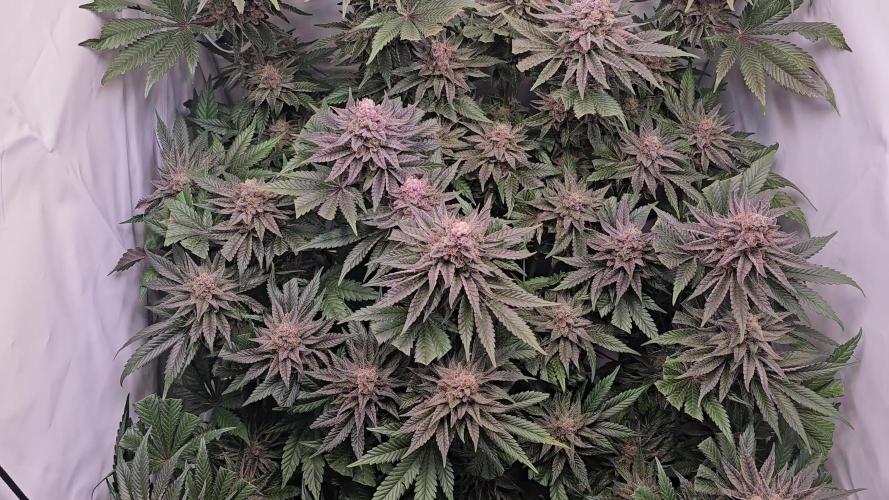
Fertilizer second and last week on maximum. Later water only with Enzymes and FZB42

Likes
2
Share

@Colonel
Follow
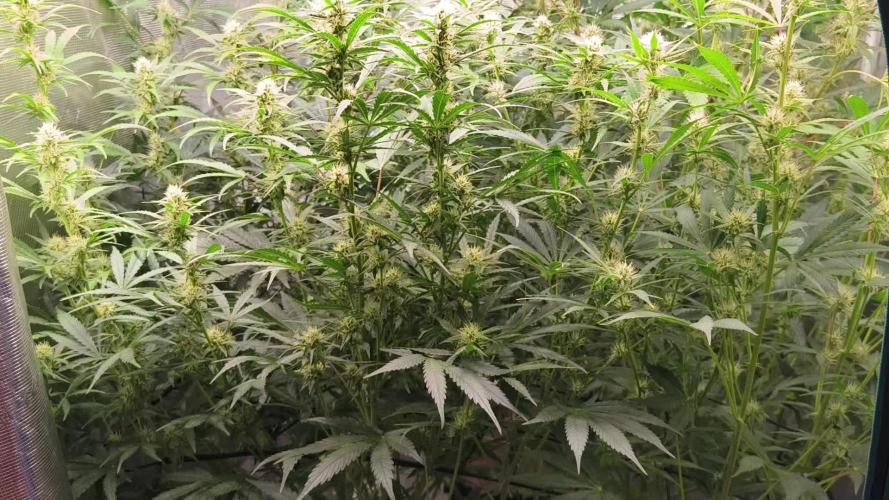
The smell is very strong up close, even with two inline fans and two carbon filters running.
The plant on the left side started showing light burn. I checked the light levels above those leaves and it was around 75 DLI — looks like that spot is where the beams from my two “suns” overlap.
I reduced the overall light output by about 5%, measured again and now it’s around 65 DLI in that area.
That should be enough, I figured, otherwise the other shoots might end up starving for light.

Likes
2
Share

@PharmaZ
Follow
Tuesday 4th August (day 38) 2-4am
Heavy flushing EC keeps rising PH hasn’t come down below 2 after heavy watering and light feeding. I’m resorting to a reset flush now put roughly 15L of 1.0EC nutrient mix just Calmag and A&B through each pot and finished off with a Balanced feed for day 38
0.5ml/L - Calmag
1ml/L - Canna A&B
1ml/L - Big Bud
2ml/L Clean fruits
PH5.6 EC
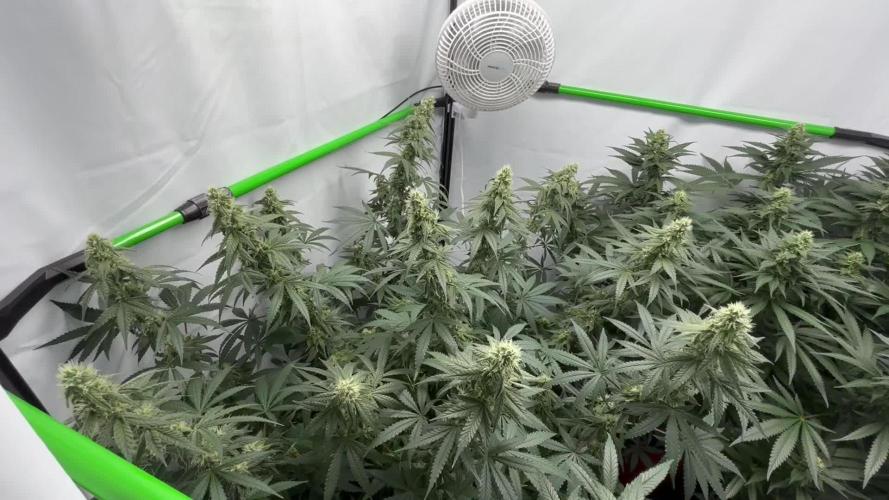
Have removed the plant stands so I can bottom feed them extra when the lights are off, or if I can’t be home in time for watering. I’ve reduced light intensity when it’s too hot, battling high humidity.
As you can see they are surviving they are a dark green colour and bud development has been super slow due to all the issues when growing in summer.
I shouldn’t have had dry backs early flower should have just soaked them and worked with the humidity. Lessons learned as always with growing it’s never just plain sailing.
I might knock the pure coco on the head and start adding perlite again in the winter.
May get the autopots out haven’t decided yet.
Likes
13
Share


@DreamIT
Follow
Sponsored by:
🏡GANJA FARMER SEEDS🏡-💡VIPARSPECTRA💡-💐GREEN BUZZ LIQUIDS💐-🛠️WEDRYER🛠️
8/7 After several days of Growdiaries making it difficult for me to write and respond to comments, I found that I can still update the journals. I apologize to everyone for the non-replies but I have replaced the main email and the email to confirm the account never arrives, and Growdiaries' customer service seems to be non-existent
10/7 everything is going well, nothing special to add🤘🦄
12/7 everything goes perfectly, one week before cutting
__________________________________________
Personal advertising (contains affiliate links)
__________________________________________
🦄 Huge collection of exquisite genetics since 2009! Anonymous shipping!
✅https: //bit.ly/Ganjafarmer
__________________________________________
Did you know that Green Buzz Liquids fertilizers are 100% vegan? A complete line of products ready to give the best to each of your plants! Visit the site and see my journals to see how they work 🦄
🤯 And with the code "dreamit" you will immediately receive a 15% discount on your purchases
✅https: //bit.ly/GreenBuzzLiquidsPro
__________________________________________
👀 Are you looking for a good lamp to start with? 👀
🌞Viparspectra has something more than the others, take a look at their site.
⏩ Use "GDVIP" for an extra discount or "DREAMIT3" for an extra 5 %% discount
👀 Search for it on Amazon
✅Amazon USA: https://amzn.to/30xSTVq
✅Amazon Canada: https://amzn.to/38udUVe
✅Viparspectra UE: bit.ly/ViparspectraUE
✅Viparspectra USA: bit.ly/ViparspectraUS
______________________________________________
🌈 Tired of blowing on your weed hoping it dries quickly? Check out the Wedryer website! You will find a well-made accessory that will help your weed dry in just 8-10 days without the annoying risk of finding mold or other annoyances! (no affiliate links)
✅https: //bit.ly/Wedryer_
______________________________________________
📷🥇Follow the best photos on Instagram 🥇📷
https://www.instagram.com/dreamit420/
Backup ig
https://www.instagram.com/dreamit4200/
🔻🔻Leave a comment with your opinion if you pass by here🔻🔻
🤟🦄💚 Thank you and good growth 💚🦄🤟


Likes
10
Share


@barlobruz
Follow
7/19/2021
- Fed her with a mix of veg + bloom + worm castings + insect frass. We're 'bout to flip her. Unsure of the rate of application, going with feel.
- Irrigated with a mix of water, coconut water, and unsulfured black strap molasses.
- Decreasing the light timer by an hour each day to gently bring her into the flowering stage.
- Defoliated again, she gets bushy fast.
7/24/2021
- Been defoliating this one every other day, she get's bushy reaaally fuckin' fast.
- Lights finally reach 12/12 tonight.
7/25/2021
- First day of 12/12, gave her ANOTHER trim loll

Likes
20
Share


@CzAlmighty
Follow
Hello growers,
beautiful strong plant .No problematic flower.💚
Skvělá vůně. Květy vypadají nádherně . Občasné prokyseleni půdy . Ph 6.3
Likes
18
Share


@420DeepGrow
Follow
Gracias al equipo de Fast Buds, XpertNutrients y Marshydro, sin ellos esto no seria posible.
💐🍁 Gorilla Melon:
La Gorilla Melon crece más hacia fuera que hacia arriba, lo que resulta en una planta tupida y manejable. Produce cogollos pequeños, sólidos como rocas y muy pegajosos, que envolverán sus ramas al final del ciclo de cultivo. Esta variedad desarrolla muchas colas, así que no te preocupes por el rendimiento: te cubrirá con un suministro de flores agridulces de primera calidad. Al fumarla, mostrará sus terpenos de melón, heredados de nuestra cepa keeper cut of Melon, con los toques de un sabor clásico heredado de GG#4 (Murdock GG Strains). Otra cosa que hereda de sus padres es su fuerza de gorila, que le permite resistir a cualquier tipo de estrés. Puedes hacer toda la defoliación que consideres necesaria, o coger todos los clones que quieras, y verás cómo se recupera casi instantáneamente y vuelve más fuerte que antes.
🚀 Consigue aqui tus semillas:
https://2fast4buds.com/es/seeds/gorilla-melon
💡FC6500: Eficiencia líder en el mercado: la lámpara de cultivo LED FC-E6500, que ostenta un estatus líder en el mercado, es una solución rentable con un PPE de 2,8 µmol/J y un rendimiento máximo de 2,5 g/vatio. Ofrece un PPF alto de 2026 umol/S y es adecuada para una cobertura de vegetación de 1,50 m x 1,50 m y una cobertura de flores de 1,20 m x 1,20 m.
Iluminación versátil y uniforme.
https://marshydro.eu/products/mars-hydro-fc-e-6500-730w-commercial-led-grow-light/?gad_source=1&gclid=Cj0KCQjw1qO0BhDwARIsANfnkv9IIrYSbmJqz8PqpJOIyWwJfp5bc3SGJgUV68USLQ4tjmXDYwoBuAsaAue3EALw_wcB
🚥 MarsHydro ADLITE UV/IR/RED:
Para lograr un crecimiento óptimo de las plantas y maximizar los rendimientos es un arte simple que depende en gran medida de las condiciones ambientales adecuadas. Reconociendo las limitaciones de la iluminación natural y las soluciones de iluminación tradicionales para satisfacer estas necesidades únicas, lanzamos ADLITE. Estas luces especiales UV, IR y roja están diseñadas para llenar áreas del espectro, proporcionando las altas longitudes de onda que las plantas necesitan para un crecimiento y desarrollo óptimos.
🚀 Consigue aqui tu Adlite:
https://marshydro.eu/collections/adlite-supplemental-lights/
🏠 : Marshydro 1.50 x 1.50 x 1.80, carpa 100% estanca con ventanas laterales para llegar a todos los lugares durante el grow
https://marshydro.eu/products/diy-150x150x200cm-grow-tent-kit
🌬️💨 Marshydro 6inch + filtro carbon para evitar olores indeseables.
https://marshydro.eu/products/ifresh-smart-6inch-filter-kits/
🍣🍦🌴 Xpert Nutrients es una empresa especializada en la producción y comercialización de fertilizantes líquidos y tierras, que garantizan excelentes cosechas y un crecimiento activo para sus plantas durante todas las fases de cultivo.
Consigue aqui tus Nutrientes:
https://xpertnutrients.com/es/shop/
📆 Semana 14:
Última semana, los cogollos han quedado superiores, muy olorosos y llenos de resina. Uno de los fenotipos tiene un color rosado que es una delicia visualmente.
XpertNutrients y Marshydro han hecho su trabajo como de costumbre, nunca fallan.
Likes
29
Share


@TheCannaProphet
Follow
------------------------------------
~SEEDSMAN PEYOTE GORILLA~
------------------------------------
Peyote Gorilla is a cross of Gorilla Glue #4 (Chem Sister x Chocolate Diesel) and Peyote Purple, a colorful pheno-type of Bubba Kush. The potent, medicinal effect of the Gorilla meets the stimulating and uplifting high of the Peyote Purple.
With a flowering time of around 70 days Peyote Gorilla has a typically Indica structure, medium-sized with large, broad leaves. Yields are exceptionally good; indoors growers can expect to yield between 500 - 650 gr/m2 while outdoors as much as 1500 gr/m2 can be realized. Resin levels are very high and this means that it is very suitable for making extracts and concentrates with.
This strain's scent is sour with lemon, petrol, earthy and woody notes and these properties are reflected back in the taste. THC production is very high at between 22 - 26% with CBD at just 1%. The effect is a very potent, uplifting high which gradually evolves into a physically relaxing state that will be almost certain to ease any aches and pains.
__________________________________________________________________________________________________________________________________________________________________________________________________________________________________________________________________________________________________________________________________________________________________________________________________________________________________________________
-Strain Characteristics-
BREEDER/BRAND: Seedsman
PRODUCT TYPE: Seeds THC
GENETICS: Gorilla Glue #4 (Chem Sister x Chocolate Diesel) x Peyote Purple (Bubba Kush purple pheno)
VARIETY: Mostly Indica
FLOWERING TYPE: Photoperiod
SEX: Feminised
THC CONTENT: 22 - 26%
CBD CONTENT: 1%
YIELD: Indoor: 450-600 g/m2; Outdoor: 1500 gr/plant
PLANT HEIGHT: 80-160 cm
GROWS: Indoors, Outdoors
FLOWERING TIME: 70 days
HARVEST MONTH: September
MEDICAL CONDITIONS: Fatigue, Insomnia, Pain, Stress
TASTE / FLAVOR: Berry, Earthy, Fruity, Petrol, Sweet
EFFECT: Euphoric, Powerful, Relaxing, Uplifting
_________________________________________________________________________________________________________________________________________________________________________________________________________________________
_________________________________________________________________________________________________________________________________________________________________________________________________________________________
THE SETUP:
~Planted into Jiffy Peat Pellets that were hydrated with de-chlorinated water with SuperThrive added then ph'd to 6.0 @ 80℉
~Grown 100% organic in 10g fabric pots with Mother Earth 70/30 Coco/Perlite medium amended with 2tbs/g of Down To Earth 4-4-4 / 2 cups/g of Earthworm Castings / 1tbs/g of Dr. Earth Flower Girl 3-9-4, 1tbs/g of Dr. Earth Bat Guano, 3/4 cup of Down To Earth Azomite and 1 tsp/g Down To Earth Fish Bone Meal.
~24hr light cycle during Germination / 19/5 light cycle for Vegetation and 12/12 for Flower
~Straight water ph'd @ 6.2-6.8 when needed and weekly Compost Tea's.
__________________________________________________________________________________________________________________________________________________________________________________________________________________________________________________________________________________________________________________________________________________________________________________________________________________________________________________
Weekly Updates:
9/13- With approx. 10 weeks of growth behind her now she's going into her 5th week of flower now and let me tell you the pictures don't do her justice... This is one phenomenal cultivar! 😍
She was given Compost Tea yesterday and today was still fairly heavy so I skipped watering and just removed a few leaves to maintain light penetration, turned her pot and sat and chatted with her awhile!
9/15- Well she really must have liked that last batch of Compost Tea as she looks exceptionally vibrant today!
She's continuing on her mission of stacking her flowers, which are developing beautifully and have a delicious sweet citrus aroma to them right now.
I did not water yesterday, so today I watered with 1.5g of straight de-chlorinated water that was ph'd to 6.5 @ 72℉ and rotated her pot... Damn she is looking great! 🤩💖
9/17- Yesterday I top dressed her with 1/2 cup of Down To Earth Bio-Fish then watered it in with 1.5g of straight de-chlorinated water that was ph'd to 6.5 @ 72℉.
Her flowering is continuing beautifully and she's smelling stronger every day it seems! I'm staying on top of tucking leaves blocking light and turning her pot daily as well.
9/19- Five weeks of flower on the books! We're halfway there now, she's stacking her flowers tightly going into Week Six and she's looking phenomenal! 🤩
When I watered her today I added 1 tbsp/g each of Kelp Extract and Fish Emulsion (both liquid) to the 1.5g of straight de-chlorinated water she received, which was ph'd to 6.2 @ 74℉.
~Thanks for stopping in! Things should be getting a lot more interesting in the coming weeks...Stay lifted and be Blessed! 😎🙏~

Likes
Comments
Share


Likes
19
Share


@sirstickyfingers
Follow
Day 28 from sprout, these girls are looking healthy and loving life...as far as I can tell. Topped them back on Monday 1-22 and then did my first top dressing today with some gaia green all purpose 4-4-4. some glacial rock dust and alittle mineralized phosphorus. Been staying at 6.5ph for all waterings


Likes
27
Share


@Stigghiola
Follow
Questa settimana ho deciso di montare una lampada di supporto a LED per poter far arrivare a tutte le piante abbastanza luce, le piante continuano a crescere e i fiori sembra che stiano maturando per bene spero di raccogliere almeno 4/5 piante entro 2/3 settimane,perché alcune sono molto indietro rispetto ad altre.

Processing
Likes
16
Share


@GRow_M8s
Follow
Day 45 --> Restart some light LST for the final weeks of Flowering.
🍇 Really intense aromas from stomper n GWK (like sour,sweet grape tannins).
⚠️ In this project we experimented with a super soil like mixture.
Biobizz all mix was 65% of the mixture which 1/3 of it was placed on the bottom of the pot and the rest 2/3 was mixed with 35% Canna terra. About 10% perlite was added on the mix and it was sprayed with EM microorganisms (Soil activator).
🏁 The target is a tasty organic flower fed only with tap water and a slow release organic fertilizer(6-3-18) which being applied on the end of the 3rd week and, becomes available to the plants 7 days after. In our case which we transplanted on day 9, we used it on day 30(9+21) from seed.
ℹ️ Facts
Until the 3rd week plants were growing under LST with no problem (Day 17-19) was when preflower started).
In the 4th week development slowed down and initially we though that was due to
some drop of temp like midway veg in ➡️ (RQS fem induction). After days were passing and the development of the plants was not satisfying (even though the plants didn't show any symptoms of deficiency or environmental stress) we noticed shiny leaves and dark green colour starting from Stomper#1 which was the smallest plant and was the only one that had some visible burned tips on the leaves.
GWK#2 was the only one that did not appear dark green colour or shiny leaves (like SS#1,#2 and GWK#1) but had drooping leaves without having overwatered her or noticing any issues.(Conditions on week 5 and 6 were a bit unstable as the weather got weird and we had high humidity and low temps).
Reaching 7th week plant development continues to be average, stems of the most plants became dark red without having low temps inside the tent even though plants look a bit better after they were let to dry a bit more.
🔬 Symptoms
1)Dark shiny leaves
2)Slow growth
3)burn tips
4)Drooping leaves
5) Dark Red stems
Matching the pieces of the puzzle we assume that we had NITROGEN TOXICITY and knowing that we do not use any liquid fertilizers it seems that our problem was that our super soil was too "hot" for our baby mephs.
If our rooting system of our plants reached the final layer of soil( Biobizz all mix on the bottom of the pot) in the 4th week, it was when it had the highest availability of nitrogen. Availability that seem to be "too hot" for Sour stomper and Grape walker kush in early Flowering.
Also in the last weeks we had cold weather so we had an electrical heater on increasing the temp of the room which led to higher temp and transpiration inside the tent.That being said it is likely that due to higher transpiration our plants let higher amount of N to enter the plant and that forced the plants to show us signs of it's toxicity.
For a start we let the pots dry to reduce the nitrogen availability and then in Day 45 we water with 6,5 ph tap water + EM microorganisms (700ml each pot).
ℹ️ Day 48 : Ideal humidity + temps and the plants have started to drink and eat a lot better the last days.
After the second water (700ml) of the week yesterday (D47) with microorganisms only, we find the first signs of deficiency on Sour stomper #2 today.
We were expecting this cause our dry fert has only (6-3-18) --> 3 phosphorus (slow release), so our leaves look like having phosphorus and calcium deficiency, we are thinking that the roots locked calcium too with the deficiency of P as these too are collaborating.
- So we are going to feed all the plants with organic liquid fert. from Plagron - green sensation PK (9-10) starting with stomper#2.
* Every plant in tent has its private watering schedule as the maturity and needs, have changed over the last week.
- If the problem continues we'll consider a cal mag solution.
* Will be appreciated any comments or same experiences!!
Last updated --> Day 49 end of the week.

Likes
7
Share


@Rabidreject
Follow
UPDATE - Thurs 4th March
The week has been fine. I am going there today so you may get an update this evening.
Iv been posting on TheWeedTube also so I have much more videos explaining what’s going on.
Plants are looking great.
I got paid today so I bought an online fan to plug into the thermostat and pull fresh air in through a duct from a cooler part of the flat. In summer it won’t be as useful but to be honest I’ll probably just duct tape the sucky end of the duct to a small ac or Friday type thing, iv not really looked into it yet. Even a hillbilly cooking system would be better than nothing. ( filling a bucket up with ice, water and salt and put the end of the duct into that so it sucks in the cold air). We’ll see!
Update - Monday 8th March
All is well, I just want the buds to start swelling now. I found some awesome supports in Aldi. They are metal rings that the plant weaves through and has spikes that go into the pot rather than a scrog net being fixed in place. Therefore I can still move them and drain the run off.