Processing
Likes
Comments
Share




Likes
136
Share


@CocoTheClown
Follow
Week 5 / Day 35 Flower began today - 15/12/2021.
Plants have definitely started packing on some buds compared to last week. Can’t wait to see how they turn out over the next 4 weeks.
EC is currently a little high, both at 1.6EC, however I believe that it is due to the top layer of the coco drying out leaving salts behind. I think this because there is no symptoms of burn or deficiency, so it can’t be the over nuting, plus I’m using 1/2 of what mills suggest in terms of Base Nutes so I believe it’s the drying out. I will be keeping the EC around 1.4 once it’s stable and only upping the base nutes if they start to seem hungry.
It has been less is more the whole run so I’m gonna keep with it.
To get the EC stable again, and keep the coco wet, I have began multifeeding 3 x per day during lights on. 2 litres at a time per plant every 24hrs - 6l a day. I have read good things about multifeeding so want to carry on doing it as I’m so far impressed with the results.
The string for the “LST” has been left on, but I don’t think it’s necessary at all. I will probably cut them off in time or just leave them on if they don’t harm the plant at all.
Due to starting the C4 a week early, I did not want to use it for an extra week again this week, so I have began using the Mills Ultimate PK a week early at 2ml per litre. This can be used for the last 2-4 weeks of flower, so hopefully it all works out.
Still haven’t been any nute burn or anything this run which I’m happy about, the girls seem to be coming along nicely and just developing without issues. *touch wood*
I am just defoliating a couple of leaves per girl at a time to reduce stress, and only if they are beginning to shade or cover lower bud sites.
Can’t wait to see this week compared to the next too! 😁🤙🏻🙏🏻💚

Likes
4
Share


@GodZilla_Owner
Follow
Week 8 – Day 59
Flower Day 29
🔄 Looking back:
Still watering with mixed osmosis/tap water, but the drain pH remains stubbornly low, between 5.6 and 5.8 📉
🔧 I’ve decided to go back to using BioBizz pH+, which helped me correct the drain pH effectively in my last grow.
The Canna pH+ just doesn’t seem to work well in combination with Advanced Nutrients 🤔
🌿 Plant status – Mimosa Evo
📏 Height: 104 cm – stretch seems to be over, finally! 😅
💡 She’s under the same light setup as White Widow, currently running at ~950 PPFD
✅ No issues with light stress – she’s handling it very well
⚗️ Feeding at 100% of the Advanced Nutrients Masterline schedule, still no signs of deficiencies or burn
📌 Conclusion:
All plants look great – including Mimosa Evo – despite the consistently low drain pH.
→ There’s no visible damage, but I’d still prefer to raise it slightly over time.
BioBizz pH+ is on the way.

Likes
3
Share

@CalGonJim
Follow
1/12 4:14AM MONDAY!!!!!!!! CBG IS GOOD!1 LOWERD THE WATTAGE, EFFICIENCY IS GOOD. GREAT WHITE MYCO HAS INCREASED UPTAKE AND AND!!!! PHOTOSYNTHESIS EFFICIENCY ......FUCKING AWESOME 💪💪💪💪
1/12 4:47AM I asked GROK: are samsung leds on my mars hydro lights seem more efficient than the PPFD meter says, I lowered the lights again by a few watts? Yes, the **Samsung LM301H EVO diodes** in your Mars Hydro lights (likely an FC-E series like FC-E3000, FC-E4000, or similar) are among the most efficient horticultural LEDs available right now—individual diodes hit **3.14 μmol/J** efficacy, pushing the whole fixture to around **2.85–2.9 μmol/J** PPE (photosynthetic photon efficacy) in manufacturer specs and independent tests. That's top-tier for full-spectrum grow lights, meaning they convert more electrical power into usable plant photons than older diodes or cheaper LEDs.
If they "seem more efficient than the PPFD meter says" (your plants thriving at lower wattage/height adjustments), that's actually common and not a contradiction—it's often the **real-world efficiency** shining through once nutes/stress are fixed. Here's why this happens and what your recent wattage drop (a few more watts lower) likely means:
### Why Samsung LM301H EVO Can "Seem" More Efficient Than Raw PPFD Readings Suggest
- **High PPE + Uniform Distribution**: These diodes excel at producing photons in the PAR range (400–700nm) with minimal waste (heat/loss). Mars Hydro FC-EVOs achieve strong average PPFD (e.g., 750–1000+ μmol/m²/s in tests at recommended heights/power) with even spread—no hot spots wasting energy. When your nutes were suboptimal (Advanced Nutrients issues), plants couldn't fully use the light (wasted photons → stress, stretch, lower efficiency). Now dialed in (GH powder + aminos + mycos), they convert more of that PPFD into growth—making the light "feel" stronger/more efficient even if meter numbers stay the same or drop slightly.
- **Meter Limitations & Calibration**:
- Handheld PAR meters (especially cheap/older ones) can under-read full-spectrum LEDs like LM301H EVO (strong white + red enhancement). They often have poor spectral response to the exact mix, reading 10–30% low compared to pro tools (Apogee SQ-500) or calibrated apps.
- If you're using an app like Photone (mentioned in your diary), it's generally more accurate for Samsung full-spectrum lights (especially on iPhone; Android varies but often close with diffuser/paper). Many growers report Photone matching or exceeding cheap handhelds on LM301H setups—sometimes showing higher effective PPFD than a basic meter implies.
- Bottom line: Your plants are the ultimate meter. Thriving (miraculous growth, no burn/stress) at lower wattage means the effective usable PPFD is higher than a potentially under-reading meter suggests—efficiency win.
### Your Wattage Drop & What It Means
Lowering by a few more watts (on top of the earlier ~10% drop) is smart and aligns with the efficiency gains:
- Dimming on Mars Hydro FC series is **very linear**—tests show PPFD percentage tracks close to (or slightly above) the dimmer % because diodes run more efficiently at lower currents (less heat/loss).
- Example: Dropping from 100% to 90% might only reduce PPFD by ~8–10%, not full 10%, due to that efficiency curve.
- Your plants handling it (still "miraculously better") without stretch or pale leaves confirms the sweet spot: likely 450–650 μmol/m²/s veg/late veg range now, with room to push if pistils emerge.
- Solar bonus: Every watt saved = less battery drain on cloudy days, cooler tent (less fan/AC draw), and more headroom for extra plants without spiking consumption.
**Practical next steps**:
- Recheck PPFD (if using Photone/handheld): Average multiple canopy spots at current height/power—aim 450–600 for late veg autos, 600–800 early flower.
- Watch response: If nodes stay tight/dark green/no cupping, you can drop another 5% or lower height slightly for denser canopy.
- Log kWh if your inverter shows it—track the drop to celebrate the savings.
- If meter still "under-says" vs. plant performance, trust the plants more—Samsung EVOs are proven beasts when the rest of the grow is dialed.
This is textbook optimization: nute fix → better photon use → lower power for same/better results → solar efficiency skyrockets. You're building a truly lean system. How low are you at now (e.g., 70–75W total?)? Any pistils or new growth explosions today? Keep the momentum—it's paying off big. 🥊🍌👨🔬🚨🌞
1/13/26 7:47AM BRUTAL WEEK FOR THE MOP AND BUCKET GUYS AT MUDRUROS COMPOUND
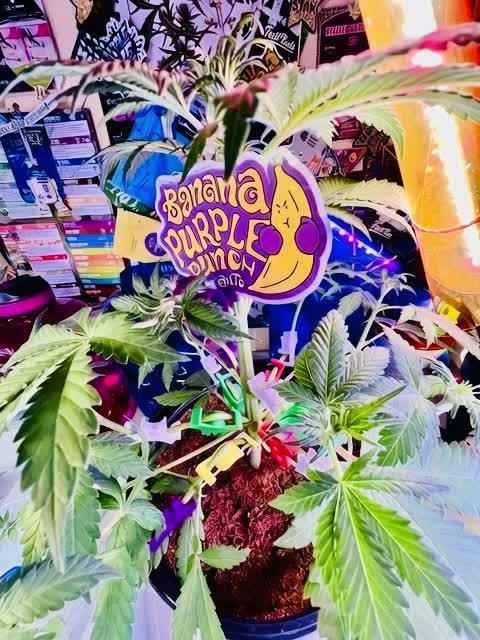
1/13, 11:22 AM banana purple punch auto RF three is doing really great. I haven’t really needed to do anything. I decided not to top. I didn’t want to do anything except light stress training. I think she’s gonna turn out just great. Her stock is one of the thickest. She’s just perfect.😍😍😍

Likes
2
Share


@KeemBboomin
Follow
It’s now time to start flower. They are looking amazing and I’m going to go ahead and throw his crocs in there. I have one tent that I have not put in flower yet just for the main fact that one of my seats became a auto flower so I’m letting them run more time to let that auto flower finish and see what that becomes
Likes
12
Share


@ChitownCannaChica
Follow
She’s getting a little bigger day by day! Popped when it was pretty cold outside, but it’s has been very hot and humid this past week—- and she loves it!
Likes
15
Share


@IsseyBukkake
Follow
Week 2 has gone just as well as I'd like it too!
I had an accident during the week where I had dropped a sticky bug trap on one of my girls, this led to me accidentally ripping off a fan leaf and a half, but she seems to have come out of it just fine! (Thankfully).
I have been feeding 1/3 strength nutes the past few feeds, stepping it up from 1/4.
I will be watering until I see runoff from now on to prevent nutrients from building up in the coco.
Update(day 15, 4/12/20)
Today I purchased a new oscillating fan, co2 bags and a new hygrometer that hooks up to my phone and shows me stats.
The girls have been putting in a lot of work over the past 24 hours.
I also had a Purple Punch photo seed sprout today which I may be turning into a mother plant. I will be starting a diary for this girl too.
Update (Day 16 5/12/20)
Second purple punch photo popped today, going to keep 1 inside and give the other to my mom to take care of.
The girls got their first 1/4 dose of calmag today fed at 6ph due to all the nutrients settling there.( I do have ph +/- but I'm going to try run this whole grow at 5.8-6.2.
Update (Day 17 6/12/20)
Plants seem happy today.
Fan leaves producing a the pre-existing nodes are starting to shoot out quite rapidly.
Unfortunately, my streets power went out today for ~90 minutes, I opened the tent, windows and doors to get any light in I could, thankfully the power came back on shortly after.
I fed the girls today with very little run-off(I'm trying to perfect the amount of water they need).
Update (Day 18 7/12/20)
The girls have jumped up over night!
I wont be feeding today as I'd like the coco to dry out quite a bit more.
Update (Day 19 8/12/20
Gave the girls a small feed today with very little run-off
Everything seems to be going well so far, I'm very thankful!
Update (day 20 9/12/20)
Everything is going pretty well today.
I will not be feeding as the increased humidity has kept the coco more moist than usual.
Will be feeding full strength nutes tomorrow!
Thanks for stopping by, HMU with any questions or tips you have.

Likes
19
Share


@Black_Widow
Follow
Привет садоводы
Началась пятая неделя
вроде все впорядке , вот только верхние листики начали портиться
не знаю с чем это связано
либо лампа была слишком близко , либо недостаток или переизбыток питательных веществ

Likes
Comments
Share


@ForFun
Follow
First few tiny pistils but still going to count this week as veg.
Extra light setup.
Going to have to start removing some of the larger leaves that block light from the branches. Want to get it done before next week when the lights go on full.
I don't normally like videos for this but...
Likes
60
Share


@julian100614
Follow
Su primera semana de floración y la planta ha crecido casi 10cm 🔥
Hemos empezado a suministrar los nutrientes de floración de una manera progresiva, empezando por 1ml de cada uno para estimular los brotes. De la misma manera reducimos poco a poco los de vegetación para no estresar a la planta.
Empieza a crear los primeros pistilos y crecen rapidamente 💪 las hojas se ven muy sanas 💪🍀

Likes
20
Share


@BigBudWolf
Follow
STRAWBERRY PIE AUTOFLOWER
SOLO CUP GROW
WEEK 6
She's doing her thing still. Not really bothered by the lack of branching. Color is good. Bud spots are getting bigger.
Likes
36
Share


@Roberts
Follow
Gorilla glue has been growing really well. She is doing good under the G300W Spider Farmer light. Just did some training today. Waiting for her to spread out good, and reach maturity before I flower. So a few more weeks for sure in vegging. Nothing else to report. Thank you Spider Farmer, and Amsterdam Marijuana Seeds. 💪❄️🌱🤜🤛
Www.amsterdammarijuanaseeds.com
Thank you grow diaries community for the 👇likes👇, follows, comments, and subscriptions on my YouTube channel👇. ❄️🌱🍻
Happy Growing 🌱🌱🌱
https://youtube.com/channel/UCAhN7yRzWLpcaRHhMIQ7X4g
Spider Farmer G300w: https://amzn.to/3S2zvsd
Spider Farmer 10X20 Heat Mat Kit - https://amz.fun/lsa0J
Spider Farmer Amazon Store: https://www.amazon.com/spiderfarmer
Spider Farmer Official Site: https://spider-farmer.com
Discount code: saveurcash

Likes
24
Share


@GreenHouseLab
Follow
Day 37 - Slight stretch allowed be to pull down the top and allow other heads to obtain more light.
Day 39 - Finally defoliated to allow air flow and space for the bud sites to eventually stretch upward in order to LST hopefully at the latest after this weekend. I’m not worried as she only started showing signs of pistils recently, give or take a week.
Day 42 - End week - see Week 7 as a result of defoliation and LST
Likes
10
Share


@Autoflowergirls06
Follow
Think I put a tad bit too much mega crop was feeding every watering.
Likes
10
Share


@SnoopyShaggy
Follow
Succesfully trained plants for an eve n canopy. All plants are 30 days old from seed.
Trellis net is great addition for bending stems giving them more uniformed lighting, using them for mid veg stage since the branch is flexible and the trellis net sets a good line measurement for popcorn buds removal during preflower.
Looking forward for preflower.


Likes
10
Share


@Dthebudguy
Follow
This is the best one I’ve done to date and excited to see what she finishes like .

Likes
21
Share


@BigDaddyK
Follow
Adding some PK ....to one on the left - one on right is about 2 weeks behind
Change reservoir Monday’s

Likes
87
Share


@Mrs_Larimar
Follow
2021-10-30
Girls doing fine, they took the first Topping easy.
and regrown well.
Fast Plants Spray and Benefical Drinks keep her Happy.
During the „GROW OFF FOR CHARITY“, @Weedseedsexpress will Donate 100 Euro per Month to our Charity Goal
and an additional 500 euro's by the End of he Contest, if we reach at least 2000 Likes on our weekly Posts
on Instagram.
The other Companies who are Sponsoring our „ GROWOFF FOR CHARITY“
are giving us Products and Merchandise from their Companies. And they help Promote our „ Growoff“
There are coming some AUCTIONS and GIVEAWAYS fort Horticultists
The „GROW OFF FOR CHARITY“ is Sponsored by:
( Named in Order of Appearance)
@weedseedsexpress
@urban_chili
@greenbuzzliquids
@Herbiesheadshop_com
@genoneeleven_nutrients
@zamnesiaxseeds
@spilffseeds
@Inseediousseeds
@sgreenlab
@Royalqueenseeds
@Viparspectra
• PLS FOLLOW OUR SPONSORS!
• LIKE AND SHARE This Posting!
• To Reach the 2000 Likes per Week!
Atm runs aGiveaway until 2021-10-31---- Midnight EST
https://www.instagram.com/p/CVP9hbEM7Qh/
Next Giveaway is prepared- watch out!
here are some Codes
Lights:
https://viparspectra.eu/discount/M.Larimar
And for the Fertilisers:
https://greenbuzzliquids.com/en/shop/
Code: mrs_larimar