


Likes
Comments
Share


Likes
7
Share

@Enki_Weed
Follow
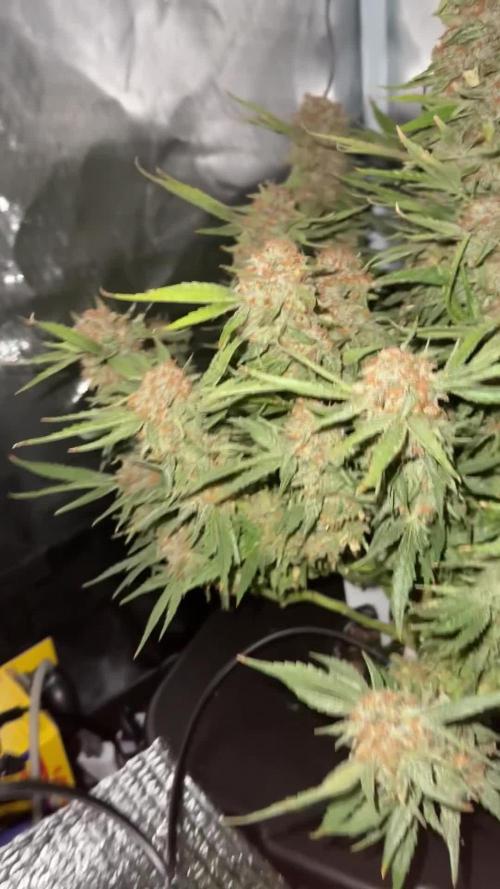
In den letzten ein bis zwei Wochen hat sich unsere Pflanze weiterhin prächtig entwickelt und zeigt nun deutliche Anzeichen einer fortgeschrittenen Blütephase. Es gab keine dramatischen Veränderungen, sondern eine stetige Reifung, die uns dem Erntezeitpunkt näherbringt.
Die Pflanze präsentiert sich sehr buschig und vital, mit zahlreichen dichten Blütenständen, die sich gut ausgebildet haben (siehe Gesamtansicht der Pflanze). Die Buds sind kompakt und haben in den letzten Wochen an Volumen und Gewicht zugelegt. Man kann deutlich sehen, wie die Blütenkelche anschwellen und sich zu reifen Blütenständen formen.
Trichom- und Stigmen-Reife:
Ein genauerer Blick auf die Buds (wie im ersten Nahaufnahme-Bild der Trichome und im weiteren Nahaufnahme-Bild der Buds mit orangenen Stigmen ersichtlich) zeigt den Fortschritt der Reifung. Die weißen, harzigen Trichome bedecken die Blütenstände in Hülle und Fülle, was auf eine intensive Produktion von Cannabinoiden hinweist. Bei den Trichomen ist nun eine gute Mischung aus milchig-trüben Köpfen zu erkennen, die auf die volle Potenz hindeuten. Erste bernsteinfarbene Trichome beginnen ebenfalls aufzutreten, was ein Zeichen dafür ist, dass der Erntezeitpunkt bevorsteht.
Parallel dazu haben sich die Stigmen (die feinen Härchen auf den Buds) von Weiß zu einem satten Orange-Braun verfärbt. Dies ist ein weiteres starkes Indiz für die Reife der Blüten und die nahende Ernte.
Blattwerk und Nährstoffbedarf:
Das Blattwerk der Pflanze ist größtenteils weiterhin gesund und grün, was auf eine gute Nährstoffversorgung schließen lässt. Einige der größeren Fächerblätter können in dieser späten Blütephase leichte Anzeichen von Vergilbung zeigen, da die Pflanze ihre Energie nun primär in die Blütenentwicklung steckt und Nährstoffe aus den Blättern zieht. Dies ist ein natürlicher Prozess, der oft als "Herbstfärbung" bezeichnet wird.
Wir werden die Reifung der Trichome weiterhin genauestens beobachten, um den optimalen Erntezeitpunkt zu bestimmen, der je nach gewünschtem Effekt variieren kann. Auch die allgemeine Gesundheit der Pflanze wird weiterhin im Auge behalten, um sicherzustellen, dass sie bis zur Ernte optimal versorgt ist.

Likes
64
Share


@SmokingTiki
Follow
This is the last week 💀 There are less pictures than usual but nothing special happened except the yellowing of the plants due to the nutrients cut. Wait for the "Harvest" week for the final photo shoot 😎

Likes
12
Share


@Jerma_grow
Follow
I will mainline the first, only top once de second, and only low stress train the last.
Processing
Likes
103
Share


@CaliGrown
Follow
DAY 65- started to back off the nutrients a bit. Smells like oranges more and more each day. Swelling up nicely now and stacking those triches. Yippie this one is going to be a grower and a show-er 😉


Likes
43
Share


@Hashy
Follow
********************************************
Week 16 Fading (flower week 10)
********************************************
Light cycle=12/12
Light Power=100w 42%
Extractor controller settings
High temp= Day 26c, Night 20c
Low temp= c
Temp step=0c
High Rh= Day 50%, Night 55%
Low Rh= %
Rh step=0%
Speed max=10
Speed min=2
Smart controller settings (during lights on).
Lights on=9.00am
Top fan on=+22.5c
Top fan off=-22.0c
Dehumidifier on=+50% and -26c
Dehumidifier off=-50% or +26c
Smart controller settings (during lights off).
Lights off=9.00pm
Dehumidifier on=+55% and -20c
Dehumidifier off=-55% or +20c
VPD aim=0.6-1.3
DLI aim=30-45
EC aim=0.2-0.5
PH aim=6.0-6.5
NPK(0/0/0)
💧💧💧💧💧💧💧💧💧💧💧💧💧💧💧💧
Method= Autofeed 6 drippers.
Feed=water
Volume=8L
Easy Ph down= 0.02ml/L ( 4 drop total)
Ec=0.2 PH=6.5/6.5
Runs=16
Run times=5min (250ml each)
Gap times=15min×14, 45min×2
Total runtime=80mins (4.0L each)
Total flowrate= 100ml/min (50ml/min each)
Auto start time=10.00am
Auto stop time=4.05pm
💧💧💧💧💧💧💧💧💧💧💧💧💧💧💧💧
********************************************
********************************************
📅1/9/24 Sunday (day 106, day 64 flower)
📋H=99cm D=16cm Dli=38.9 Ppfd=900
📅2/9/24 Monday (day 107, day 65 flower)
📋
📅3/9/24 Tuesday (day 108, day 66 flower)
📋 a few issues through lack of light to some lowers. Plodding along nicely.
📅4/9/24 Wednesday (day 109, day 67 flower)
📋 where she's fading at the top a leaf has died, possible cause bud rot. Will investigate at the end of the week.
📅5/9/24 Thursday (day 110, day 68 flower)
📋 I'm not happy with a main cola, may have got rot because the buds have got so dense and close together, or could be because that particular cola is right near the light and its burned the leaves, I'll chop the top off that cola and inspect it. After inspection there a 8 very dense buds all clustered together and some inside leaves have died and the rot had started to form inbetween 3 buds, only a slight bit of rot but I'm discarding the whole top. Was 52g wet. Because of this and a few other colas have dense buds I'm only going to let her go for a few more days. Had a joint got paranoid and cut 3 more tops off, they was ready and no sign off rot 136g wet from those 3 tops.
Total weight so far 188g
💧
Method= automatic
Feed=water
Volume=10L
Ec=0.2 PH=6.1/6.5 (PH D=0.02ml/L) 5d
Volume left=1L
Volume used=9L (112ml/min)
Volume each=4.5L (56ml/min)
Runoff.
Total runoff=0.8L
Ec=2.4 PH=/6.5
💧
📅6/9/24 Friday (day 111, day 69 flower)
📋 Now in the tent on her own for a short while.
📅7/9/24 Saturday (day 112, day 70 flower)
📋 incrased light power to 125w
********************************************
Weekly roundup.
📋 Obviously I had the issue with rot starting to form on my main top and lost that which I'm gutted about, I could have chopped that off last week really. I'm just letting the lowers mature a little bit longer.
I gave her 3 more days after this week before harvest so next update is harvest. I encoded some pics from those 3 days.
Take it easy.
Back soon with harvest report.
********************************************


Likes
32
Share


@BigBadLion
Follow
Week 9 and 4th of flower! And holy 👽, we're getting there fast!
My girls are growing well and they seem to be taking the nutrients reeeeally well! So once again I'm increasing the strength of Silver PK and White monster!
I also noticed something quite interesting... it's only the 4th week of flower and some trichomes are turning amber! That should not be happening unless the lights are too close to the plant or perhaps, this girl is just fast and I should chop her soon? 😱 No idea. I'll probably around and see what people think and if I should do it or not.
I trimmed some leaves and for the first time in like ever I did not touch the LST!
Anyway, see you all next week! 👋
Likes
14
Share


@Lol_You_Looked
Follow
Feb 7th - pH 6.2, PPM 920, 1.8 EC, Temp 78f, Humidity 57% - Water Changed, 3 gals!
Feb 8th - Unable to get data for this day.
Feb 9th - Unable to get data for this day.
Feb 10th - Unable to get data for this day.
Feb 11th - Unable to get data for this day.
Feb 12th - pH 6.1, PPM 900, 1.8 EC, Temp 82f, Humidity 55% - Water Changed, 3 gals! Followed aggressive week 6 feed schedule, went back on the CalMag to 6ml/gal, and upped Sweet Berry back to 8ml/gal. The bihh is heavy, making it hard to get root shots these days. :(
Feb 13th - Unable to get data for this day.

Likes
42
Share


@MadeInGermany
Follow
Hey everyone 😀.
Another veggie week goes by and they are developing surprisingly well 😃.
Both phenotypes look very nice and have a perfect leaf green.
Both were topped again.
I wish you lots of fun with the update, and stay healthy 🙏🏻🍀
You can buy this Strain at :
https://sweetseeds.es/de/cream-caramel/
Type:
Cream Caramel
☝️🏼
Genetics:
Blue Black
x
Maple Leaf Indica
x
White Rhino
👍
Vega lamp:
2 x Todogrow Led
Quantum Board 100 W
💡
Bloom Lamp :
2 x Todogrow Led
Cxb 3590 COB 3500 K 205W
💡💡☝️🏼
Soil :
Canna Coco Professional +
☝️🏼
Fertilizer:
Green House Powder Feeding
☝️🏼🌱
Water:
Osmosis water mixed with normal water (24 hours stale that the chlorine evaporates) to 0.2 EC. Add Cal / Mag to 0.4 Ec Ph with Organic Ph - to 5.5 - 5.8 .

Likes
Comments
Share

@PapaTerps
Follow
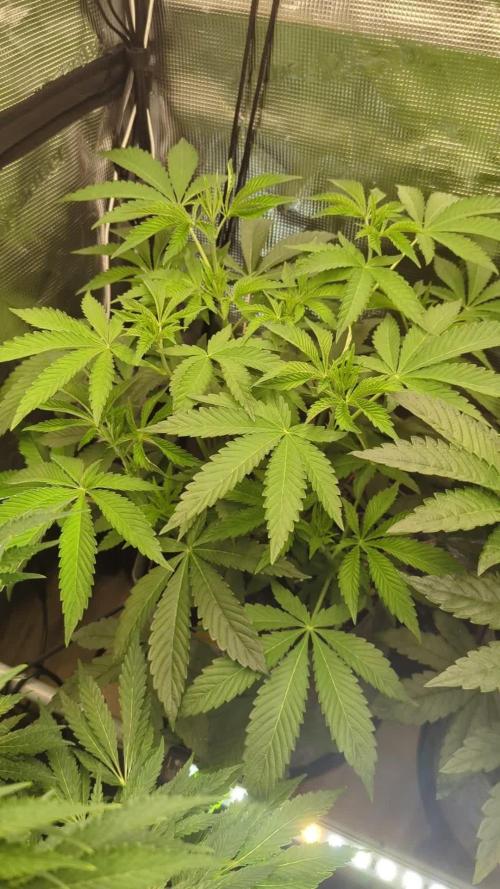
Wizard Fuel - Wizard Trees
Day 48 - Watered with 2L of RO tap water with nutrients mixed individually and in order, then finally pH'd to 6.3, watered over three phases to allow the water to penetrate the soil slowly.
She is still in her stretching phase, so I haven't done anything with her just yet. The topping I performed on her a week or so before I put her into flower, has allowed her to grow a nice even canopy with six distinct stems. When she finishes her stretch, I will lollipop her and defoliate to improve both light penetration and airflow 👍🏻


Likes
6
Share

@HowtoBubatz
Follow
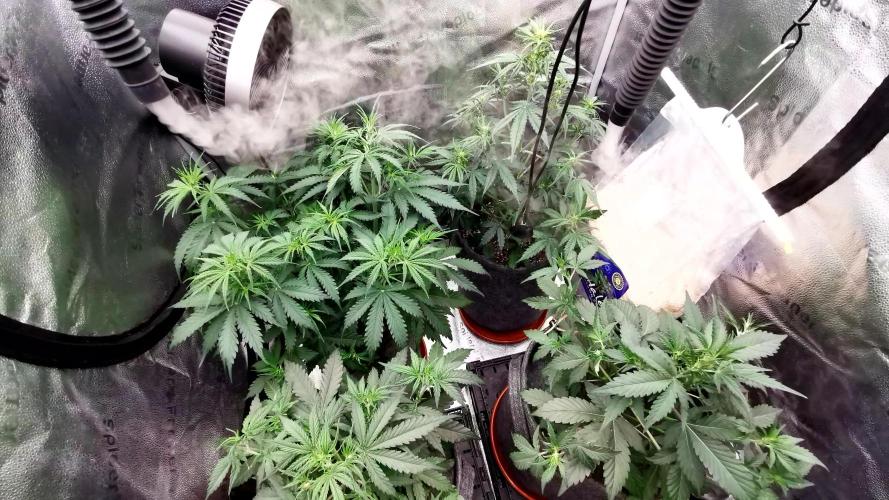
The Bruce Banner girls had a strong week! 💪
#1 is still the biggest plant in the tent and looks super happy. She handled the LST perfectly and keeps stretching nicely 🔥.
#2 is catching up and growing more balanced now.
#3 has finally found her rhythm and started growing normally 🙌.
Both #2 and #3 are now showing their first pistils, so they’ve officially entered the flowering stage 🌸.
This week all three received a watering with Green House Bio Enhancer, and aside from that, just RO water + CalMag (Advanced Nutrients) 💧.
No issues or signs of deficiency, leaves are lush green and healthy across the board 🌿.
They’re growing in the 90×90 tent with the AC Infinity AI setup and Spider Farmer SE5000, keeping everything dialed in: 25–26 °C, 60 % RH, and around 500–600 µmol/m²/s PPFD 🌡️.
Overall, #1 remains the queen of the tent 👑, while #2 and #3 are catching up as they ease into early flower. Excited to see them start stacking buds soon! ✨
Likes
15
Share


@RBK2023
Follow
Patiently waiting for all of the buds to get bigger and stack on that weight, still happy with how they are growing
Likes
Comments
Share

Likes
40
Share


@valiotoro
Follow
easy trim✂️
The buds are Absolutely perfect,exactly what i was looking for🤩
Green pheno : cookie,diesel & gelato🍪⛽️🍦
Purple pheno : flower,sweet & honey🌸🍯
After 7 days on the dry rack she was ready for the jar to start the curing process.😋


Likes
1
Share

@TopNugCultivator
Follow
The chop has arrived! This was a really long but fun grow! I do see why people don't like growing sativas it does take forever and is a difficult process! I will do another one for sure though! I will update one more time with the full harvest and weight once drying has finished. 11/21/2025 is when I started the dry in my tent! Currently 62F and 60% humidity
Processing
Likes
13
Share


@Trailblazers_Farm
Follow
Week Two:
The seedlings received their first and second feedings of Innovating Plant Products. Along with one just a plain watering. (Feed / Feed / Water).
The first feeding was on 5/21 of 900 ppm of the veg nutrient line. The pH was 6.3
The second feeding was on 5/24 of 700 ppm of the veg nutrient line. The was 6.4 After assessing the first feeding it was felt the PPM was a bit high for their first feeding. We could have easily done this in reverse order.
On 5/26 the plants were given just plain water to finish out their week.
One of the seedlings appeared to be a bit deformed and has since been tossed. This one seed didn't germinate well, but we thought we would give it go. Assessing the seedling we simply opted to pull it.

Processing
Likes
5
Share


@Ganjagrandaddy
Follow
Its official , she is a lady !!!. I am relieved to see that she is def female and no signs of Nanners so far !. Her stretch This week has been really helpful in keeping her going lateral with mains. She has approx 15-20 potential good mains around her now so once i can get to the 21 day 12/12 point , i should be able to bring the best of them to the final contenders. She is root building like crazy and the tank she is in is dropping quicker now each day. she is definitely happy and healthy . I am glad I use the quadlining as she would be very tall now. she is 2 weeks younger but the biggest in her group of plants !. The Blue Gelato 41 in her wants to go sativa tall but thankfully the Gorilla zkittelz side is just as happy Thickening out sideways. For such a short veg time she is impressive too. Let's see what buds she can throw up.
Be Well and safe Growmies
Likes
1
Share


@FarithAriasFajardo
Follow
El registro corresponden a los dias 28, 30 de abril y 2,3,4 de mayo Despues de realizar corte apical y algo de lst junto defoliación leve. Hasta ahora las plantas van muy bien, creciendo muy bonitas y con fuerza. Tratando de llevar todo de la mejor manera ya pude ajustar algo el set donde tengo mis planta y cada vez más contento con estos resultados! Ya hoy la white widow ibl cumple 30 dias desde germinada y la zinfandel 23.

