The Grow Awards 2026 🏆
Likes
Comments
Share
@Chino8
Follow
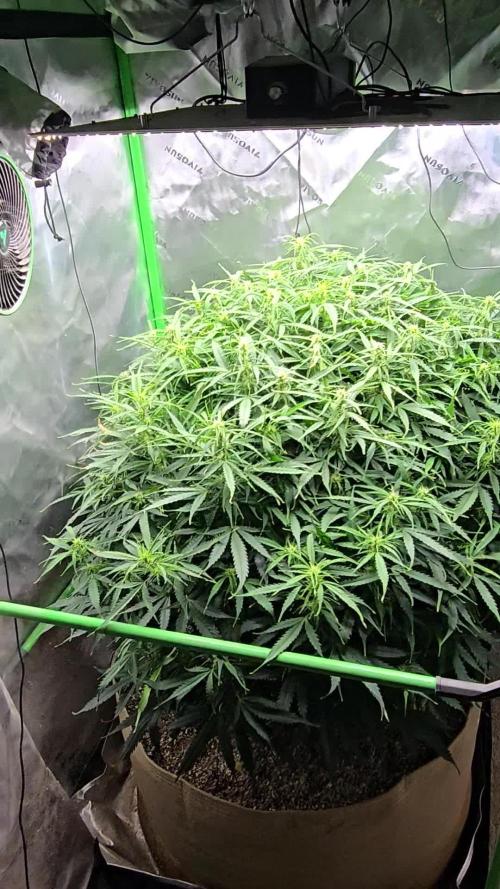
Decided to start dark period(24-48hrs) day 85 mostly milky not much amber maybe some amber on the sugar leaves. I wanted to go 90+days with this auto but I needed the space in the tent for my photos and she looks almost ready, would’ve liked to see a little more amber but nevertheless I haven’t grown much at all so don’t have too much preference yet on trichomes. I’ll chop in a day or two and dry in my smaller tent and hopefully it goes well, my first harvest I dried too fast in low humidity and wasn’t that pleased with the end result. This time I’m planning on lowering exhaust speed and to not be so scared of 50+humidity in drying area and raise it to around 60humidity after a few days. Can’t think of anything else to write, but I’ll update after the chop and dry and 🙏 hopefully all goes well.

Likes
1
Share
Getting up there with the longest fattest buds ive had on a plant still a long way to go been a breeze to grow no problems or hiccups had the best start to life and the best nuitrents since switching to xpertnuitrents ive seen a massive improvement in my buds quality amd size
Likes
18
Share
Green light is radiation with wavelengths between 520 and 560 nm and it affects photosynthesis, plant height, and flowering. Plants reflect green light and this is why they appear green to our eyes. As a result, some growers think that plants don’t use green wavelengths, but they actually do! In fact, only around 5 – 10% of green light is reflected from leaves and the rest (90 – 95 %) is absorbed or transmitted to lower leaves [1]. Green wavelengths get used in photosynthesis. Chlorophyll pigments absorb small amounts of green wavelengths. Light that doesn’t get absorbed is transmitted to leaves that are shaded out from direct light. This means that leaves at the bottom of the canopy get more green light than leaves at the top. A high proportion of green wavelengths compared to other colors tells lower leaves that they are being shaded out, so they are able to react accordingly. Lower leaves may react by opening or closing their stomata or growing longer stems that help the leaves reach brighter light [1, 2, 3]. When it comes to growing cannabis, many cultivators are interested in the quality of light used for the flowering stage. In many plants, flowering is regulated by two main photoreceptors: cryptochrome and phytochrome. Both photoreceptors primarily respond to blue light but can also respond to green, although to a lesser extent. Green can accelerate the start of flowering in several species (although cannabis has yet to be tested) [1, 4, 5]. However, once flowering has begun, it’s important to provide plants with a “full spectrum” light that has high amounts of blue and red light, and moderate amounts of green, in order for photosynthesis to be optimized. Green light mediates seed germination in some species. Seeds use green wavelengths to decide whether the environment is good for germination. Shade environments are enriched in green relative to red and blue light, so a plant can tell if it is shady or sunny. A seed that senses a shaded environment may stay dormant to avoid poor growing conditions [1]. Some examples of plant species where researchers have documented this response are: ryegrass (a grass that grows in tufts) and Chondrilla (a plant related to dandelion) [1, 6]. Although green wavelengths generally tell plants NOT to germinate, there are some exceptions! Surprisingly, green wavelengths can stimulate seed germination in some species like Aeschynomene, Tephrosia, Solidago, Cyrtopodium, and Atriplex [1, 6, 7]. Of course, light is not the only factor affecting seed germination – it’s a combination of many factors, such as soil moisture, soil type, temperature, photoperiod, and light quality. When combined with red and blue light, green can really enhance plant growth [1, 8]. However, too much green light (more than 50% of the total light) can actually reduce plant growth [8]. Based on the most current research, the ideal ratio of green, red, and blue light is thought to be around 1:2:1 for green:blue:red [9]. When choosing a horticultural light, choose one that has high amounts of blue and red light and moderate amounts of green and other colors of light. Not many studies can be found about the effect of green light on cannabis growth or metabolism. However, if one reads carefully, there are clues and data available even from the very early papers. Mahlberg and Hemphill (1983) used colored filters in their study to alter the sunlight spectrum and study green light among others. They concluded that the green filter, which makes the environment green by cutting other wavelengths out, reduced the THC concentration significantly compared to the daylight control treatment. It has been demonstrated that green color can reduce secondary metabolite activity with other species as well. For example, the addition of green to a light spectrum decreases anthocyanin concentration in lettuce (Zhang and Folta 2012). If green light only reverses the biosynthesis of some secondary metabolites, then why put green light into a growth spectrum at all? Well, there are a couple of good reasons. One is that green penetrates leaf layers effectively. Conversely red and blue light is almost completely absorbed by the first leaf layer. Green travels through the first, second, and even third layers effectively (Figure 2). Lower leaf layers can utilize green light in photosynthesis and therefore produce yields as well. Even though a green light-specific photoreceptor has not yet been found, it is known that green light has effects independent from the cryptochrome but then again, also cryptochrome-dependent ones, just like blue light. It is known that green light in low light intensity conditions can enhance far red stimulating secondary metabolite production in microgreens and then again, counteracts the production of these compounds in high-intensity light conditions (Kim et al. 2004). In many cases, green light promoted physiological changes in plants that are opposite to the actions of blue light. In the study by Kim et al. blue light-induced anthocyanin accumulation was inhibited by green light. In another study it has been found that blue light promotes stomatal opening whereas green light promotes stomatal closure (Frechilla et al. 2000). Blue light inhibits the early stem elongation in the seedling stage whereas green light promotes it (Folta 2004). Also, blue light results in flowering induction, and green light inhibits it (Banerjee et al., 2007). As you can see, green light works very closely with blue light, and therefore not only the amount of these two wavelengths separately is important but also the ratio (Blue: Green) between these two in the designed spectrum. Furthermore, green light has been found to affect the elongation of petioles and upward leaf reorientation with the model plant Arabidopsis thaliana both of which are a sign of shade avoidance symptoms (Zhang et al. 2011) and also gene expression in the same plant (Dhingra et al. 2006). As mentioned before, green light produces shade avoidance symptoms which are quite intuitive if you consider the natural conditions where the plants grow. Not all the green light is reflected from the highest canopy leaves in nature but a lot of it (50-90%) has been estimated to penetrate the upper leaves at the plant level ((Terashima et al., 2009; Nishio, 2000). For the plant growing in the understory of the forest green light is a signal for the plant of being in the shade of a bigger plant. Then again, the plants growing under unobstructed sunlight can take advantage of the green photons that can more easily penetrate the upper leaves than the red and blue photons. From the photosynthetic pigments in higher plants, chlorophyll is crucial for plant growth. Dissolved chlorophyll and absorb maximally in the red (λ600–700 nm) and blue (λ400–500 nm) regions of the spectrum and not as easily in the green (λ500–600 nm) regions. Up to 80% of all green light is thought to be transmitted through the chloroplast (Terashima et al., 2009) and this allows more green photons to pass deeper into the leaf mesophyll layer than red and blue photons. When the green light is scattered in the vertical leaf profile its journey is lengthened and therefore photons have a higher chance of hitting and being absorbed by chloroplasts on their passage through the leaf to the lower leaves of the plant. Photons of PPFD (photosynthetic photon flux density) are captured by chlorophyll causing an excitation of an electron to enter a higher energy state in which the energy is immediately passed on to the neighboring chlorophyll molecule by resonance transfer or released to the electron transport chain (PSII and PSI). Despite the low extinction coefficient of chlorophyll in the green 500–600 nm region it needs to be noted that the absorbance can be significant if the pigment (chlorophyll) concentration in the leaf is high enough. The research available clearly shows that plants use green wavelengths to promote higher biomass and yield (photosynthetic activity), and that it is a crucial signal for long-term developmental and short-term dynamic acclimation (Blue:Green ratio) to the environment. It should not be dismissed but studied more because it brings more opportunities to control plant gene expression and physiology in plant production. REFERENCES Banerjee R., Schleicher E., Meier S. Viana R. M., Pokorny R., Ahmad M., Bittl R., Batschauer. 2007. The signaling state of Arabidopsis cryptochrome 2 contains flavin semiquinone. The Journal of Biological Chemistry 282, 14916–14922. Dhingra, A., Bies, D. H., Lehner, K. R., and Folta, K. M. 2006. Green light adjusts the plastic transcriptome during early photomorphogenic development. Plant Physiol. 142, 1256-1266. Folta, K. M. 2004. Green light stimulates early stem elongation, antagonizing light-mediated growth inhibition. Plant Physiol. 135, 1407-1416. Frechilla, S., Talbott, L. D., Bogomolmi, R. A., and Zeiger, E. 2000. Reversal of blue light -stimulated stomatal opening by green light. Plant Cell Physiol. 41, 171-176. Kim, H.H., Goins, G. D., Wheeler, R. M., and Sager, J. C. 2004.Green-light supplementation for enhanced lettuce growth under red- and blue-light emitting diodes. HortScience 39, 1617-1622. Nishio, J.N. 2000. Why are higher plants green? Evolution of the higher plant photosynthetic pigment complement. Plant Cell and Environment 23, 539–548. Terashima I., Fujita T., Inoue T., Chow W.S., Oguchi R. 2009. Green light drives leaf photosynthesis more efficiently than red light in strong white light: revisiting the enigmatic question of why leaves are green. Plant & Cell Physiology 50, 684–697. Zhang, T., Maruhnich, S. A., and Folta, K. M. 2011. Green light induces shade avoidance symptoms. Plant Physiol. 157, 1528-156. Wang, Y. & Folta, K. M. Contributions of green light to plant growth and development. Am. J. Bot. 100, 70–78 (2013). Zhang, T. & Folta, K. M. Green light signaling and adaptive response. Plant Signal. Behav. 7, 75–78 (2012). Johkan, M. et al. Blue light-emitting diode light irradiation of seedlings improves seedling quality and growth after transplanting in red leaf lettuce. HortScience 45, 1809–1814 (2010). Kasajima, S., et al. Effect of Light Quality on Developmental Rate of Wheat under Continuous Light at a Constant Temperature. Plant Prod. Sci. 10, 286–291 (2007). Banerjee, R. et al. The signaling state of Arabidopsis cryptochrome 2 contains flavin semiquinone. J. Biol. Chem. 282, 14916–14922 (2007). Goggin, D. E. & Steadman, K. J. Blue and green are frequently seen: responses of seeds to short- and mid-wavelength light. Seed Sci. Res. 22, 27–35 (2012). Mandák, B. & Pyšek, P. The effects of light quality, nitrate concentration and presence of bracteoles on germination of different fruit types in the heterocarpous Atriplex sagittata. J. Ecol. 89, 149–158 (2001). Darko, E. et al. Photosynthesis under artificial light: the shift in primary and secondary metabolism. Philos. Trans. R. Soc. B Biol. Sci. 369 (2014). Lu, N. et al. Effects of Supplemental Lighting with Light-Emitting Diodes (LEDs) on Tomato Yield and Quality of Single-Truss Tomato Plants Grown at High Planting Density. Environ. Control Biol. 50, 63–74 (2012).
Likes
3
Share
@ElJrrero
Follow
Solo un riego mas con abono y hago lavado de raíces..:D
Likes
2
Share
@dauntless
Follow
Week 12 Started on June 19, 2022 Finally recovered and lots and lots of defoliation happened, I am talking a compressed ball of leaves and stems the size of a softball. That means I got rid of most the weight below the buds, snipped the buds I didn't want to see straggling, and lollipopped colas -- left a few leaves on. Took a few clones to see what happens. She is doing well, more pics soon. I cleaned the reservoir again, fresh water, drained the autopot and made sure my Ph is 6.3 to 6.7 Adding weak calmag+ to deter the iron lockout I think I saw in early week 11, figuring out dosing now, might need a bit more. Not a ton of nutes added as the plant is progressing well, added a tiny amount of MOAB, also just thinking my single COB flower light is gonna be too weak on its own. We'll see it's early yet. Might need to turn on the supplemental light next week, old school HPS 150 Watt on its last grow. The heat will drive the humidity way way down, and that will be a good thing, just gotta crank the fans on high and no looking back after that. That will be 400 watts in a 3x3 -- HPS is hot as can be. When compared with growth like this: https://growdiaries.com/diaries/135853-grow-journal-by-kushdoctor/week/766680#gallery=5630051 I worry about the size right now on day 18 of flower, not that big and no sugary stuff yet, I think I need to let her just grow and perhaps add just a bit more flower nutes, but I will wait until she fills in just a bit more, I seriously took off SO MUCH, but last grow I should have taken more off than I did, I was was super aggressive, I don't want larf.
Likes
33
Share
@Roberts
Follow
Jack Herer auto is doing really good. Her colas are starting to stack. Curious to how well she will do under a 100 watt light. Everything is going good at the moment. Thank you ILGM, and Athena nutrition. 🤜🏻🤛🏻🌱🌱🌱 Thank you grow diaries community for the 👇likes👇, follows, comments, and subscriptions on my YouTube channel👇. ❄️🌱🍻 Happy Growing 🌱🌱🌱 https://youtube.com/channel/UCAhN7yRzWLpcaRHhMIQ7X4g
Likes
11
Share
@VicFor
Follow
Week 3 of flowering, the 3 little girls are fine
Likes
7
Share
@Messypies
Follow
In the second week the plant has now started to produce its first set of single bladed leafs.
Likes
16
Share
Day 57 No water new bigger fan loosely tied her in and dropped net an inch - most hopefuls had made it up there themselves but some need encouragement - anyway pics speak for themselves Day 58 500ml plain rain She looks a little confused - she hasn't got all the stuff off from underneath yet - just letting a couple of latecomers get to the net, then I'll whip the lower factory leaves off and fim for last time Day 59 Just 100ml plain rain - nutes tomorrow Day 60 2:1000ml TIger Bloom Grow Big 1.5:1000ml Calmag 3:1000ml Big Bloom 7:1000ml Unsulph Molasses in 700ml pH6.7 water Temp 27C rH55 Last Grow Big - Bloom all way now Day 61 Got the temp / rH just right now she is drinking 800ml 6.5pH rain water in 24hr period - lights good height but loads of room to raise so that's cool. Checked for mites - found a black one a week ago and squished it - defoliation prob helped a great deal coz no signs anywhere of any larvae, Love the genetics of this plant. The uniformity of the leaves just stunning - would be a good mother - did try cloning a few cuttings but 3 wks into flower... It is a myth you can't do cuttings in early flower but it is way harder than doing them like 2 wks before and before you throw the hormones all over the place by transitioning LOL and as I can't be bothered to do it properly - they will most likely all die 😁 just did coz hate to throw away a stem cutting 😏 - lol they all died Day 62 300ml ph6.5 water Day 63 3:1000ml Big Bloom 2:1000ml Tiger Bloom 1.5:1000ml Calmag 7:1000ml Unsulphured Molasses in 670ml pH6.5 rainwater
Processing
Likes
3
Share
@Kushizlez
Follow
Day 33-40 (May 24th-May 31st) (Day 34) I just found a herm branch on the tight blueberry pheno. It looks like a random pollen sack opened right above a lower branch. I removed the sack but I saw a small amount of dust fall onto one of the lower branches. I’m going to leave it to see if it will pollinate that small branch at all. I spent a good 5 minutes looking closely for bananas or claws but couldn’t find anymore. The main bud is clearly unaffected so I will just leave it unless it is visibly seeding itself. Too bad because I’m really excited for this plant. (Day 36) Not a lot has happened since I flushed them. Growth actually looks healthy and I don’t see any deficiencies on anything yet. (Day 37) Both of these badazz cheese phenos are picture perfect and easily hold up against Canadian and California quad grade. I might try to reveg them at the end and take some clones. They have this unique pungent, grassy, sour milk smell that is just wonderful. The density and bud structure is looking great too. This whole plant will probably take 3 minutes to trim if that. (Day 38) Just found a banana on the shitty blueberry pheno. This pheno is trash and I would honestly throw it away if it didn’t mess up the 3 perfect rows. It has almost no frost, no smell, is airy and has bad structure. I’ve actually never seen a plant with such little frost. Even outdoors. (Day 39) I think most of this tent will be done by day 60 but I will probably ride it out until day 70+. I don’t think the blueberries or the jacks will fill out very much either way but taking it too day 70 will ensure maximum production from each plant.
Likes
53
Share
Salutations, fellow cultivators! Week 2 unfolds with the grace of a symphony, and the tale of my Blackberry Auto continues to captivate. The journey is both an art and a science, and every green leaf is a brushstroke on the canvas of cultivation. Our heroine has found her throne – a final 16L AutoPot. What makes AutoPots the crown jewel of cultivation, you ask? These self-watering wonders provide a dynamic, gravity-fed watering system, ensuring the plant receives precisely what it needs when it needs it. It's the epitome of hands-off perfection, allowing the plant to dictate its own hydration destiny. Transplant day is a ritual, a moment where roots meet Mycor Mix magic. This mix, a blend of mycorrhizae species, becomes the plant's ally, expanding the root system and fostering nutrient uptake. It's like giving my Blackberry Auto a superhero sidekick, enhancing her abilities and resilience. The transplantation dance continues with the application of Aptus Holland Mycor Mix on the roots and surroundings. This isn't just a transplant; it's a ritual of care. Mycor Mix establishes a symbiotic relationship, unlocking nutrients and fortifying the soil with beneficial microorganisms. It's a small act with profound effects, ensuring my plant's journey is supported at its very foundation. As the pot receives its royal guest, the soil is adorned with 75g of Aptus All-in-One pellets (NPK). This powerhouse blend provides a balanced nutrient feast, a banquet for optimal growth. The soil is further enriched with Aptus Micro Mix, a harmonious supplement that fine-tunes the nutrient symphony, ensuring every note is in perfect balance. Post-transplant, the ritual concludes with a nourishing bath – my Veg Aptus Recipe. This elixir, carefully concocted, ensures a smooth transition for Blackberry Auto. It's not just water; it's a potion that whispers the promise of health, strength, and vitality. The week embraces low-stress training, a dance where leaves are gently bent to shape the plant's architecture. Blackberry Auto, the prima ballerina, responds with joy. This technique not only encourages lateral growth but also maximizes light exposure, orchestrating a symphony of photosynthesis. As I witness this botanical ballet, I'm reminded that cultivation is a dialogue between caretaker and plant. Together, we embark on a journey where each element, from AutoPot elegance to Mycor Mix finesse, plays a vital role. Stay tuned for the continued saga of Blackberry Auto – a story told leaf by leaf, in every graceful twist and turn. Genetics Blackberry Auto @Fast_Buds Food - @aptusholland @aptus_world As always thank you all for stopping by, for the love and for it all , this journey of mine wold just not be the same without you guys, the love and support is very much appreciated and i fell honored and blessed with you all in my life
Likes
3
Share
Lots of dropping leaves , day 55 gave 3ml/l of bloom booster to all . They seem very hungry sour stomper 1 is super dense already topped sky stomper is slowly gaining weight for sure
Likes
21
Share
@w33dhawk
Follow
Moin moin liebe Leute erstmal Entschuldigung das ich Woche 8 nicht hoch geladen habe, hab einfach den Kopf zu voll zur Zeit der grow läuft an sich ganz gut alle 2 Tage muss ich die Arme der okto moms neu anpassen mit der Höhe damit die Äste einiger maßen auf gleicher Höhe bleiben. Hab zusätzlich heraus gefunden was die Flecken auf den blättern verursacht ich hab die ganze zeit extract und bat boost gleichzeitig genutzt dabei werden die Zusätze getrennt benutzt (ich depp wieder) extract für vegi phase und in blüte umstellen auf bat boost naja die okto moms leben und gedeihen werde die tage auch auf 12/12 licht plan umstellen und somit ist dann auch die Hälfte des grows schon wieder rum euch noch ein schönen Sonntag meine homies und growmies
Likes
6
Share
@Koopee
Follow
The flowers are very swollen, very nice t
Likes
15
Share
Moved into 2x4 - adjusted PPFD from 250 to 190. Light stress. - worried over red Clover mites. Captain Jack’s,
Likes
2
Share
@YAMA47
Follow
Dia 67 desde germinacio.aqui muestro las 2 mas avanzadas.comparando cultivos de bsf Arg. Con Bsf España. LLEGO A LA.CONCLUSION QUE A NOS NOS TRATAN DE SUDACAS Y NOS MANDAN SEMAS DE CALIDAD MEDIA.PROX CULTIVOS CAMBIO E BANCO¡
Likes
5
Share
Hallo zusammen 🤙 Sie wächst sehr schön und macht keine Probleme Rabattcode für den BIOTABS-Webshop https://biotabs.nl/en/shop/ GDBT420, damit erhalten Sie 15 Prozent
Processing
Likes
9
Share
@Wsummers
Follow
Anyone seen these bugs b4 an what is the best way to get rid of them, plants still look really healthy
Likes
13
Share
Blütetag 21. VPD kann ich mit meinem Luftentfeuchter und einer aktuellen RLF von ca. 56% auf 1,5 in der Lichtphase halten und 1,2 in der Dunkelphase. Wenn es weiter so feucht/regnerisch hier bei mir bleibt, wird es schwer die RLF selbst mit Luftentfeuchter unter 40% zu bekommen. Mal gucken. Der Grow sollte insgesamt dann noch 5-7 Wochen gehen.
Processing
Likes
6
Share
@Ferenc
Follow
No more fertilization. They will be harvested in 2 weeks very stinky ones.... Alll good just keep flushing them and removing upcoming yellow leaves. :) They are quote wet so just giving them 200ml.of water a day to.not to over water them.
Likes
6
Share
@Micogrow
Follow
So if you haven’t noticed before, you probably see it now. LOTS of tied up branches. I was not prepared for how much weight management I was going to have to do lol. Granted, this plant is a whole lot bigger than the lil 2x2 tent plants I’m used to. I don’t typically have to worry about weight at all. Either way, it’ll all workout. Just means it was more tedious work and my hands had to get a bit stickier. Next summer I’ll come up with an actual plant to manage weight. Enjoy the video, does a lot better justice to the amount of bud in this thing.