The Grow Awards 2026 🏆 












Likes
Comments
Share
@Adam22
Follow
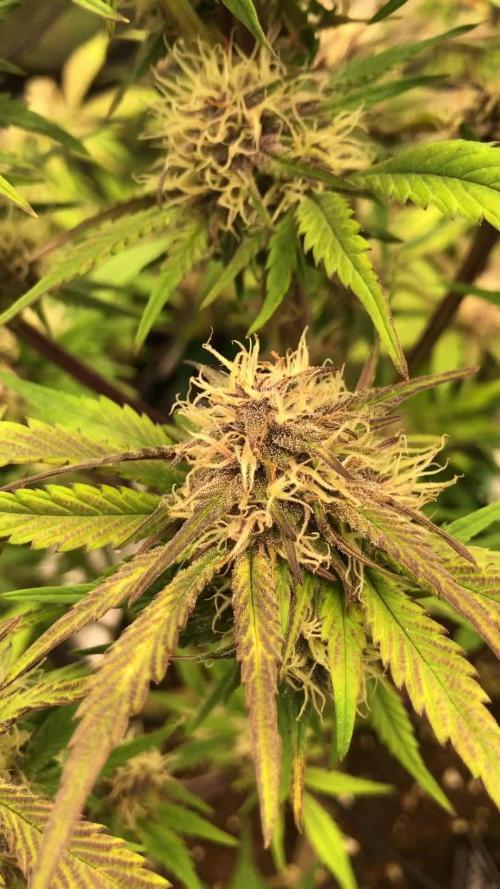
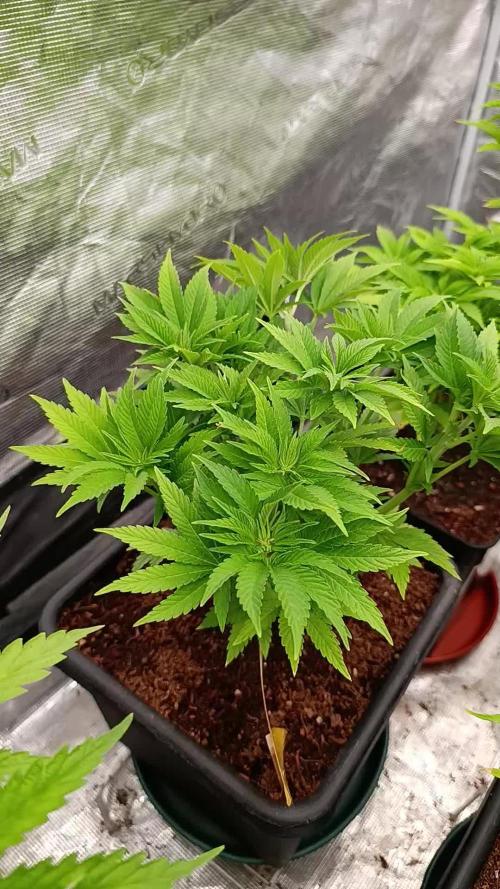
Week 5 day 35 today I turned the plants 180° and defoliated not too sure if I absolutely butchered them but its done now time will tell....they've been watered straight after also I've noticed no yellow tips or deficiency on leafs all through pur which is shocking...this strain is the best one I have grown soo far I've done about 5 so far over 10 years with big gaps so learning again for sure slowly 👍 would like to grow this again soon but properly next time... temps are around 26-27 still using the cfls to keep temps up and is going well so far. Im looking for seeds for next time I want to grow but can't seem to find this strain anywhere 😕
Likes
17
Share
@Buddyhighs
Follow
Day42: 20 degrees 77% humidity 1l water
Day 43 : 19 degrees 69% humidity 500 ml water and feed
Day 44: 20 degrees 72 % humidity 1l water
Day 45 : no readings no water heavy defo added heat after advice on coments
Day 46 : 21 degrees 57% humidity 300ml water
Day 47: day of pics 22 degrees 64% humidity 2l water
Week avg : 20 degrees 67% humidity 800ml water
Purple colours showing
Advice from comments seem to work

Likes
12
Share
@DrGreenbutterThumb
Follow
Loving the look and bid formation. Seeing the difference in how my Gelato cake had previously budded and this is a way different experience lollipopping and mainline attempt definitely change the bud arrangement the smells are so wonderful. And now to see them lineup and stack they way are with only another 4 days til I stop everything but purpinator for another 4 days then force them to drink up last remainder of what's left in the coco during a 3 day dry spell and finally flushing before harvest.
Likes
9
Share
@Rckeh
Follow
This week will arrive Bug Bud and Carboload by Advanced nutrients, let´s see how she responds :). Next week will rain a lot, so i will prepare myself and start giving her Botryprot by Prot Eco to prevent mold.
Day 50 - She´s healthy. today is the first foliar day. I used 2,5ml/L of Botryprot. Overall she looks very happy, maybe needing some PK. She´s starting to have some fresh blueberry aroma. Fingers get sticky
Day 52 - Feeding day. I added 1ml/L Alga Bloom making a total of 3ml/L. Sprayed her today again.
Day 55 - Has been hot these days, feeding day today again. Today i added 1ml/L Bid Bud, 2ml/L Carboload and 1ml/L Alga Bloom. As she´s healthy i didn´t feel i needed to slowly introduce. Let´s see how she responds, but my experiments are going well :) I´m confident.
Day 57 - Foliar spray today again. The storm will come in strong.
Processing
Likes
3
Share
@CanapaBella617
Follow
Tried not to mess with them too much this week. Less stress for everyone!


Likes
8
Share
@pegas
Follow
Unas cuantas moscas de sustrato obligaron a regar con aceite de neem y jabón potasico, la planta estresasa sigue creciendo bien incluso es más alta que la otra aunque sigue teniendo un color más claro.

Likes
42
Share


Likes
5
Share
@Hempcules
Follow
WEEK 8 (DAY50-56)
This week, my beloved Dos-si-dos have put on a good amount of bulk. Due to the very small pots in the SOG setup and the aggressive mainlining, the plants have taken on quite a bonsai-like appearance. The stretch is still ongoing, but I don't think it plays a major role here. Otherwise, all the plants have developed beautiful, even shoots that are already fully covered with young, delicate buds.
The stems of the plants have already reached over 15mm in thickness, which I find quite impressive for their size. Essentially, one could say that Dos-si-dos grow quickly and in a very compact manner.
Starting this week, I have supplemented the fertilization schedule with Green Sensation from Plagron, which I now use about once or twice a week.
Additionally, I have adjusted my lamp upwards again. On average, I now have a light intensity of approximately 700 PPFD, which, over a 20-hour period, results in a DLI of around 55. I try to keep the humidity consistently below 60%.
The next few weeks will be interesting with this strain. I believe the plants will ultimately look quite peculiar due to their small stature but productive growth. Even aromatically, the Dos-si-dos are beginning to develop a pleasantly sweet scent.
With this code, you will receive a 20% discount on your next Zamnesia order:
ZAMMIGROW2024

Likes
18
Share
@thenotillwizard
Follow
Harvested at day 76, after 72h of darkness.
Very good yield!
3.3 pounds of dry buds + 1 pound of trim
The 2 keepers yielded 366 and 342g of premium quality smoke.
Very uplifting and energizing high :) Love it!

Likes
32
Share
@MadeInGermany
Follow
Info:
Unfortunately, I had to find out that my account is used for fake pages in social media.
I am only active here on growdiaries.
I am not on facebook instagram twitter etc All accounts except this one are fake.
Have fun with the update.
Flowering day 47
since time change
to 12/12 h.
Hey everyone 😃.
The lady looks beautiful 😍.
The buds get thicker and thicker 👍.
They smell incredibly delicious 😬.
It was poured twice with 1.4 l.
The tent was cleaned and the humidifier refilled.
I wish you a lot of fun and all the best 👍
You can buy this Strain at :
www.Zamnesia.com
Type:
Banana
☝️🏼
Genetics:
OG Kush x unkown
👍
Vega lamp:
2 x Todogrow Led
Quantum Board 100 W
💡
Bloom Lamp :
2 x Todogrow Led
Cxb 3590 COB 3500 K 205W
💡💡☝️🏼
Soil :
Canna Coco Professional +
☝️🏼
Fertilizer:
Green House Powder Feeding
☝️🏼🌱
Water:
Osmosis water mixed with normal water (24 hours stale that the chlorine evaporates) to 0.2 EC. Add Cal / Mag to 0.4 Ec Ph with Organic Ph - to 5.5 - 5.8 .
Likes
22
Share
@GreenISR
Follow
Flashing time ~~
Mid week did a hair cut to the plant .
That smell is so lemon🤩🤩😍
So there is nothing much to say except my vent take a brake for a night and i have look at termo and it said 99 humidity ⛔⛔ omg the tent was sweaty ,long story short big problen with fast fix .

Likes
6
Share
@MisterTree
Follow
Sind in der 8ten Woche aktuell, am Donnerstag den 30.10 wurde die Ladys großzügig entlaubt.
Bin sehr gehyped jetzt auf den Endspurt.
Likes
4
Share
@KhaVigga
Follow
-everything is on schedule and good, tried 3 times rapid of nutrient tea(just lightly bit of kelp and alfafa and aerated 24hrs) and she loves it
-i'm using a type of kale as cover crop for many benefits but i need most from it is heat fix(it's damn hot outside :D)

Likes
32
Share
@AsNoriu
Follow
Day 82. First one from Mimosas is ready ! Mini of all mini trim jail's ;))))))
Day 89. First in jars !
Day 92. Trim jail .... One will be great producer, other waste of time a bit ...
Day 102. All job done with them.
Happy Growing !!!
Likes
85
Share
@Tropicannibis_Todd
Follow
Start of day 42 ...... Nov 20 Start of week 3 of Flowering ........ 6 Weeks in
Check out the full grow video on latest weekly update
Super Exceptional Growth Daily
Still adjusting LST when needed and leaf tucking.......
Water Only when needed but its drinking more every otherday and adjusting lights when needed......
Rain Water Only .......
( DAY 48 AND IT SHOWS ZERO DEFICIENCIES ) IM ALSO DOING VERY LITTLE, SLIGHT DEFOLIATION
( DAY 48 AND YET ZERO RESIN PRODUCTION ) I am a little concerned due to the amount of bud developing but time will tell ??.....
I hope you enjoy my growlog...


Likes
4
Share
@420DeepGrow
Follow
📆 Semana 2:
Esta semana pasada hice lavado de sales que arrastraba el coco de fábrica, es la primera vez que cultivo en este medio y daba EC de 10 🤢
Una vez estabilizada la EC, aplico riegos suaves hasta que la planta demande más.
Ya se aprecia un olor a naranja 😍.
Seguimos creciendo fuerte 💪

Likes
8
Share
@LoccoMotive
Follow
🌿 Woche 5
🌱 Wachstum & Training 🌱
Das Training läuft fantastisch – ein täglicher, stetiger Prozess. 😬✂️
Beide Damen sehen rundum gesund aus, mit kräftig grünen Blättern. 💪🍀
Sogar ein halb abgebrochener Trieb hat sich richtig gut erholt. 👌🌱
Man merkt inzwischen, dass eine der Damen dominanter ist. 👑🔥
Der mittlere Bereich ist hart umkämpft – vielleicht doch ein Ticken zu eng für zwei Pflanzen. 🤼♀️😨🌱
Ich habe daher ordentlich entlaubt und ein paar kleinere Triebe entfernt. ✂️🍃🗑️
Langsam füllt sich der gesamte Raum mit einem gleichmäßigen Blätterdach. 🌳💚
Der Stretch hat begonnen – und alle Triebe haben richtig Bock, steil zu gehen! 🚀🌿🎯
💧 Living Soil – Only Water 💧🌍
Wie man sieht: Kein einziger Trieb oder ein Blatt mit Mängeln. ✅🌱👌
Die Vegetationsphase lief absolut problemlos – ganz ohne Temperatur- oder Luftfeuchtigkeitsunterstützung. 🌡️💨❌
Nur mit einer Mischung aus destilliertem Wasser und Leitungswasser. 💧🚰
🔄 Drehbarer Topf 🎥
Ich bin nach wie vor ein großer Fan dieser Lösung! 😄👍
Nicht nur entstehen witzige kleine Videos, sondern es hilft enorm beim Training. 📸✂️
Ich achte beim Formen stets darauf, die Drehfunktion nicht einzuschränken – klappt bisher richtig gut. 🔄✔️
💡 Licht & Schatten 🔆🌘
Im Laufe der Woche habe ich das Licht auf bis zu 400 PPF hochgedreht. 💡📈
So streben die Triebe weiter aktiv nach Licht – bekommen aber auch nicht zu wenig. 🌞🌱➡️💥
💧 Blumat & Gießen 💧🚿
🕒 Alle paar Tage bei 110 mbar
🚿 Jeweils 2 l Wasser 💦
☀️ Wetter 🌡️🔥
Die Temperaturen waren (und sind) brutal: 26°–33 °C. ☀️
Scheint aber bisher alles gut zu verkraften. 😌🌿💪
🎶 The Grow must go on! 🌱🎵💚✨


Processing
Likes
26
Share
@eldruida_lamota
Follow
Esa familia, a que pintan fenómeno estas skunks?.
Es que Zambeza hizo un gran trabajo con esta variedad, es una cepa que es bastante rápida en floración, crece muy bien en su etapa de crecimiento, y sobretodo es aparte de típica, muy sencilla de cultivar.
De mis favoritas hasta ahora para indoor, como siempre, controlamos el ph y la humedad (siempre dentro de los parámetros correctos establecidos).
La semana que viene nos vemos con más avances , un saludo.
