


Likes
Comments
Share


@pifflestikkz
Follow
Day 73
Day 38 Flower
Monday 6th
Camera is doing no justice, little video, although to my own fault I did not have phone with me when feeding yesterday for decent pictures. I will update again on water tomorrow ✌️
So far stretch has stopped, the recovery from lollipopping and defoliating is immaculate, she is so strong, already seeing denser bud sites and focused energy towards tops.
Day 74 - picture updates, looking great 😍💪💚

Likes
52
Share


@Ultraviolet
Follow
Flattened canopy a little by bending and gently cropping stems over several days. Dropped hours of light to 16 and switched to a spectrum more suited to flowers. Will give her one more week to prepare and develop.
INFINITY
Dodecahedron is the only platonic solids that has infinite numerical pathways. The Aether.
Saturday I switched to 12, I forgot for a second this strain is 100% Sativa, I thought she wouldn't stretch much because the PPFD was high. Never noticed such an obvious change in temperament from a plant overnight, it has been a sleepy, lazy leaf veg cycle for the most part, there are no signs of flowers yet ofc, but just the way she exploded into a more satellite disciplined formation, ITS TIME, so it begins, no turning back now....... my poor electricity bill.

Likes
132
Share


@rhodes68
Follow
2/1 Week 12!
Re-introducing the Peak PK in low dose as I begin to migrate the plant to all Peak and then flush I hope all in less than two weeks.
Will step things daily, tomorrow it will be 10 ml CT 10 ml Peak with an eye on the ppm. You get the idea, she has to finish and fast.
Valuable lesson, don't have anything ever backed up behind a sativa grow waiting on them to finish, it aint worth it. Grow em at the end of a cycle.
2/2 put the feed at 12ml CT 7ml Peak thought maybe its too much of a swing, tomorrow 10 and 10
2/3 10ml of each this morning.
Got to move things along, new plan is to begin flush at start of new week this weekend,
At flush changing lights to 12/12 , binding her back up just a little, then placing one of the testers on a stand in the tent to take pressure off the veg tent.
5-7 days later we harvest based on what we see.
We cannot come up with anything better
As far as growth she is doing great, its a heavy plant and the hairs are still straight and 95% white! Build so fast
2/4 All is well
Tara really seems to like the 10-10 dose so leaving it for now.
Changed light schedule to match the veg tent. This is to accommodate the near arrival of one of the photos.
In a few days the plant will have to finish off at 12-12 so the photo can flip. Not ideal but practical from our point of view.
Keeping our hopes up here and uttering my characteristic prayer... Please God dont let me foul this up... Amen
2/5 Feeding as before
Had to bind her up a bit, she is so heavy we were afraid of her toppling over. Seriously this plant is TOP HEAVY.
Which is good I guess 😬
Not flushing till I see it is time, not messing this one up.
Dont get plants like this everyday.
2/7 Ending the week with a full tent again
Switched lights to 12-12 and bound her up to fit in half the tent, we literally could not come up with anything else for this.
She just keeps going and going lol
DRY WEIGHT ON RIPLEY!
261 grams
Hoped for more but meh sativas.
Still nothing to sneeze at 😇

Likes
3
Share

@AestheticGenetix
Follow
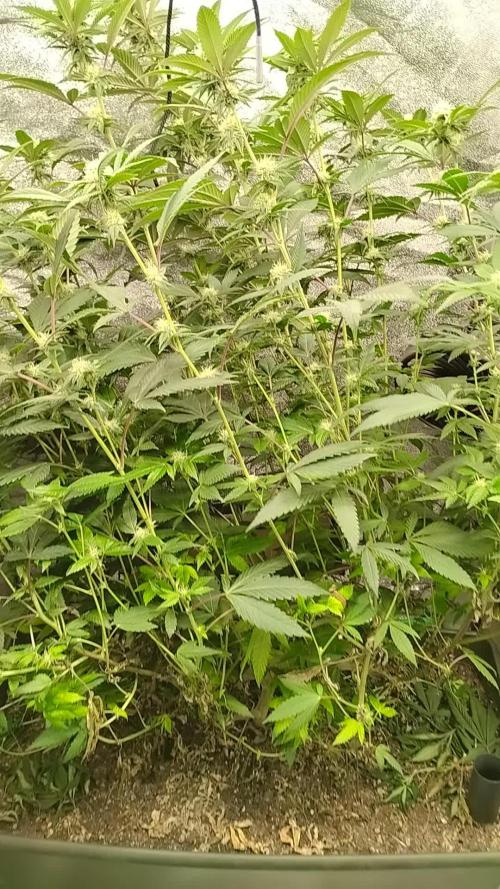
Look at how freaking big this plant is. Added cal mag. Added Dr earth flower girl and Dr earth 222. Added some more leaves and branches from lollipopping and defoliation. Earthboxes are dope but this is an absolute monster of a plant for this small of a space. I want to add another and fill my tent with 2 plants like this
Likes
48
Share


@Nvchods3
Follow
esta semana le aplique big one de forma foliar para empezar a estimular la Pre-floracion !

Likes
4
Share


@Canna055
Follow
Transplant them in 25L Living soil
Ill let them grow a little bit bigger so the space is filled nice & Even


Likes
62
Share


@Santica_Garden
Follow
End of Week 3 update for the Exodus Cheese and GH Cheese, looking really good, just need to feed em abit more Nutes because they are looking hungry. I have uploaded a video for you guys 👍🏾🌱💚😎


Likes
11
Share

@NoProbation4Weed
Follow
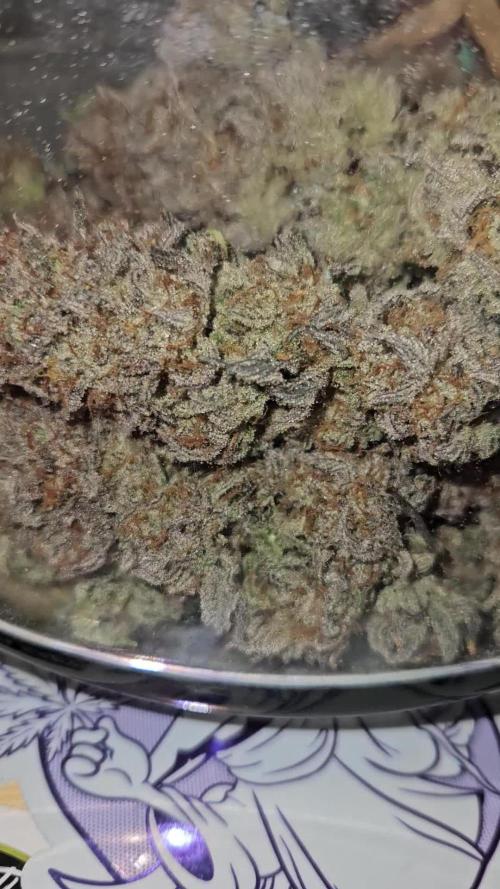
last 3 days no watering and last 48 no light.
drying conditions are RH 50% and temp 14°C.
Likes
5
Share


@VeeDro203
Follow
Well! We are looking great! I filmed one time and it paid off! Will be doing more branches next run. (LONDON POUND CAKE)
anyway got some good dark purple coming in strong!!
Likes
44
Share


@APOLLO
Follow
Flowering Week # 4
Overall steady week. Its been raining and stuff so weather is ideal again for them. They seem to be enjoying themselves 😊
She smells amazing, if it tastes nearly as good as it smells right now, I'm sold 😍
I gave her another defoliation midweek as it seemed necessary, I seem to have done the right thing.
New growth on buds gave that light green vibe, I thought I would give a bit more cal mag on two feedings, they seem okay now unless someone points out (pretty please?)
I am well happy with the LST , shes very photogenic 😄
Not much else to report, hopefully she will stack up nicely. Cyall next week

Likes
27
Share


@Dreamchvser
Follow
Day 35
All plants but one are doing pretty good and growing in different kind of ways.
Two pretty bushy plants with big leaves and one that’s not developing big fan leaves till now but is still growing nicely.
I sadly overwatered the smallest one last week, but she’s still giving her best to survive my mistakes.
I do light LST every morning and will report them into 19L next week. Not sure if should keep the small one in the 4L for now and repot her at later stage so she can recover.
I appreciate everyone helping me out or sharing advice
/update Day 36
Today I topped one of my ladies again, because I topped her wrong the first time she started developing the two tops a node lower. As the two fan leaves on top won’t give her anything else than shadow I decided to cut that part.
I appreciate every advice 🙏🏾

Likes
1
Share

@Potgoblin
Follow
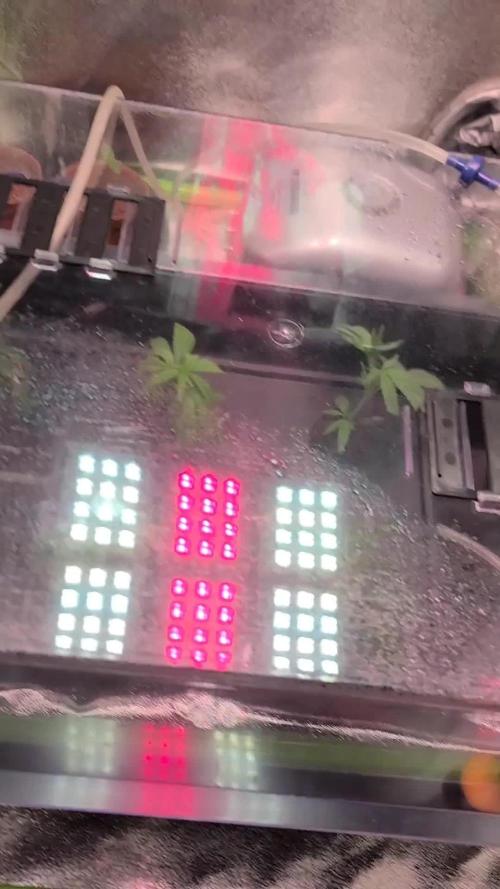
So this is going to be the last week of veg for my ladies and I think ill be flipping by Wednesday "ish". A fair bit has happened in the last week, I managed to split the main stem.of the dark phoneix the other day being a bit too rough with her, thankfully the split went straight down the middle.and didn't even make her droop or wilt at all, 2 cable ties and some.string and she's right as rain again lol. Really want that break to heal before flipping her so I can get those cable ties off the main stem before the stretch! Last thing I want is her growing into them and making it impossible to remove.
I managed to over water the smaller girls as well so im not paying too much attention to those ladies now, whatever they produce they produce my investment is my big girl. I Will say that john innes stuff is SUPER heavy and im.really struggling with drainage so back to bio bizz light mix after this that added perlite makes a big difference!
I have also made a mini aeroponic cloner today which fits inside my propagator, who new an old plastic cracker tub, some soil plugs and a few airstones could make something so useful 🤣 This dark phoenix is such a tough plant I don't want to lose her genetics so im goin to try my best to root these cuttings before flipping her to flower next week. All being well by the time these plants are finished I will have at least 4 nice big healthy girls ready to send straight into flower as soon as this stuff is down and dried 🤞
Think that's all for this week see you all when she starts her flowering cycle 👍
Happy smoking people
Likes
19
Share

@Northern_Ent
Follow
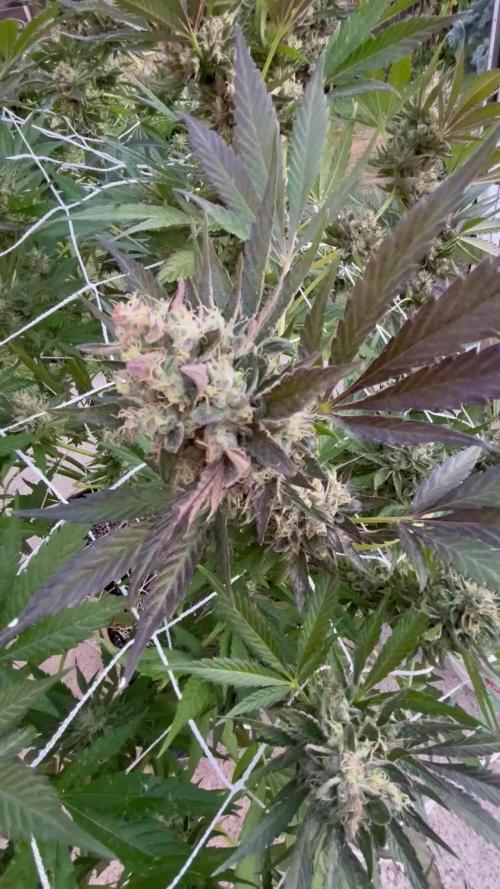
Sep 27: lots of buds remaining and I did a big defoliation to expose the buds to sunlight. Lowered scrog net during the defoliation.
Oct 1: the remaining lower buds are almost ready to harvest. Likely this weekend.
Oct 3: harvesting for buds and mostly for extracts. Today was 1520 g wet buds and leaf. Toal wet of 2870 g which is equivalent to about 640 g dried. Nice.
Likes
2
Share

@fadedgreentaurus
Follow
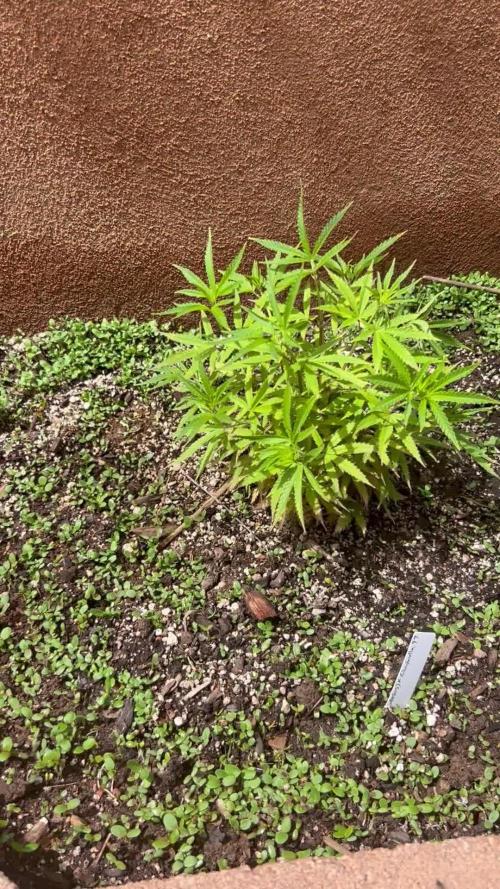
Something to note as the weeks go on is the placement of my grow space due to its east west walls planting late march early april allows me to get 2 pre flowering growths spurts out of 1 outdoor season and has directly contributed to huge success for me in years past. As of now preseason planning this grow is all coming to a nice crescendo. Soils happy cover crop sprouting hoping for scattered shower and the ability to collect rain water. Planning on keeping tea brewing as often as I can and sorta winging it, outdoor grow with an overnight work schedule makes for awkward documentation and work hours. Though this seems to be my most well organized. Grow as opposed to years past. Praying for lots of rain a humid summer and well timed pest management.
Likes
29
Share


@eldruida_lamota
Follow
Que pasa familia, aquí va la 3 semana de floración de estas Titan f1 de RoyalQueenSeeds.
Tienen buen color y si siguen este ritmo van a salir fantásticas, a ver cómo pasa estas semanas cómo se forman las flores y cómo sigue formándose la planta en si.
Temperaturas máximas de 27 y mínimas de 24 grados.
La humedad relativa está en torno al 55%
Agrobeta:
https://www.agrobeta.com/agrobetatiendaonline/36-abonos-canamo
Mars hydro:
Code discount: EL420
https://www.mars-hydro.com/
Hasta aquí es todo , espero que lo disfrutéis, buenos humos 💨💨.
Likes
45
Share


@valiotoro
Follow
Very very sticky i had to change gloves every 2-3 buds!🤓
Delicious smell🤤


Processing
Likes
47
Share

@rhodes68
Follow
11/17 Week 8
Man I will be glad when this grow is over, if making mistakes promotes learning well... Im a fricking PHD ...
Ok progress on Maggie the yellow is limited to the very top as buds are building in particular those a couple inches from the top.
Thinking another root drench is in order, cant hurt and letting her dry a bit as a prep.
Looks like tomorrow
Layla doing ok she exhibits far fewer problems but the same issue are present she is just a hell of plant along with the Runtz which she shares the tent.
Thinking about the feeding tomorrow will decide what to do then.
They have plenty of time to finish up, had some issues on germination on the grow following so looks like it may be delayed a week from the scheduled 2 weeks.
Maggie may need it.
11/19
Have stumbled onto to something it seems. The further I move the lights out, they are now at twice the "ideal" placement of 14" at 28" and the yellowing is disappearing to a great extent.
Problem with this of course is not enough light at bud sites not on the canopy which lets face it is most of your bud.
It is absolutely something that makes the plants insanely susceptible to light burn. New one for me but maybe some of yall know so making a question of it. Pics at lights out only and I missed today so new pics later if I get back in time.
Update :
Defoliated and tightened training on all three to spread things out from the center and open up the light and air paths. Raising the lights is working just wish I knew why as lights are higher than crap with little room for more than a few more inches. Would drop the watts to 450 but need the heat to keep the grow room level as our temps here swing 40 degrees all the time. Something I learned with the help of a carbon filter. If things normalize will begin dropping lights to see what happens.
11/20
Setting the lights at 24" as I am not risking yield any further than that on Layla and the Runtz, Have the canopy as level as it can be with Brandy getting the least light being on a coco coir block (heh) for height, which she is responding well to since I opened up the plant and no longer worried over mold issues in that main bud.
Have Layla on a milk crate to bring her into decent light as well as the Runtz. She is just a lovely thing building those white crystalline buds.
Maggie has turned into a beast at least I know her root ball is huge from the growth above. Seriously defoliated her removing several small lower branches and leaves blocking light and air paths. Next feed will be continuing what seems to be working, Epsom salt and bloom nuets (no calmag with epsom salt) with a foliar feed after lights out which may well be with calmag.
Foliar feeding today at lights out, one quart sprayer with 1ml CaliMagic and 0.5ml wetting agent un-PH warmed to 75 F before spraying (our tap water comes out at @50F so...), just trying to hit hard and effective
* New Pics after foliar
Update
Folks its taken 8 weeks and a final piece of the puzzle provided by Grey_wolf resulted in a near full strength cal-mag foliar feeding and the last def bites the dust.
See what happens from here but its the first time I have felt good about this grow since the bad time germing at week one. *big sigh of relief*
Have a whole list of things I will never do again in soil more about that at harvest.
Right now I need to work on why calcium is blocked at the roots but thats another day right now I just wanna look at em. 😁
11/22 Another foliar feed same as before just diluted 30% and all three got it today JIC
Cannot find a pale leaf or top and hairs are standing up on the top buds for once and buds building nice on the lower ares the defs were cleared up first.
Going to stop the foliars for a few days see what happens but will resume at first sign of need.
Maggie has potential even after all this and we going to help her be all she can :D
11/22 Feeding day -
Bio-Bloom 7ml - calmag 4ml - Recharge .5tsp / gal at 6.5PH to all three. No foliar today
11/23
The thickness of the hair growth on Layla is amazing! Will try and get pics at lights out of it if my crappy camera will catch it.
Never seen anything like it, once again THIS this is what we intended by growing Stardawg :)
Update:
Pics and vid hope it comes through well enough as for the green in that tent and the dense hairs on Layla
Likes
1
Share

@Growfather1
Follow
Hello everyone,
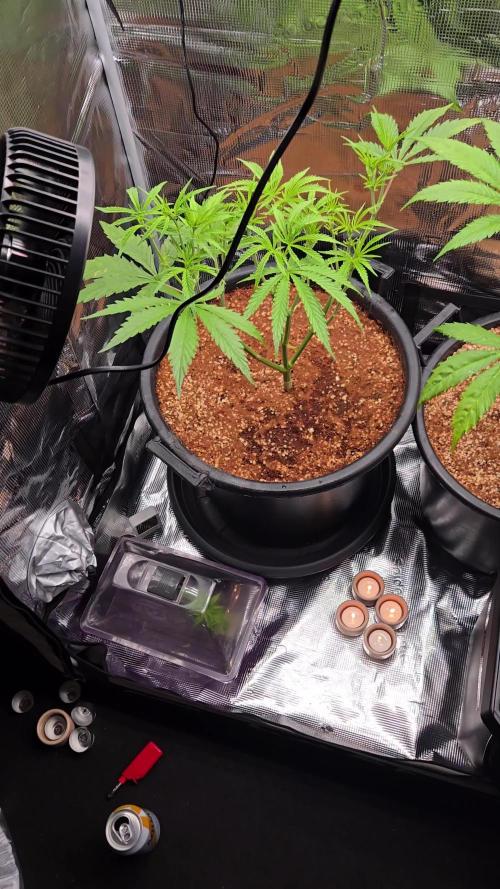
I just finished setting up the 150x150x200cm tent and as you know it takes time to tie the wires to the poles.
The 2 amnesia plants by expert seeds are on schedule and will flip one to flower within 5 days from now, i need to see roots coming out of the bottom of the pot before going into flower.
The amnesia fast by advanced seeds is also doing great taking in mind she is only 5 weeks old, she will go into flower next week.
The mac1 by expert seeds sits in a dwc bucket but she is doing terrible from the moment she sprouted 5 weeks ago, i have an amnesia clone from expert seeds to replace her.
In the other dwc system sits a clone of the amnesia fast and the roots are developing.
Thank you for reading my diary and have a nice day.


Likes
25
Share


@Kakui
Follow
Veg15, han crecido como 2 centímetros desde el transplante, aún no necesitan riego, desde ahora regaré cada 3~4 días, cuando el sustrato este un 80~90% seco, han estirado un poco desde que subí la distancia del LED y bajé su intensidad, mañana haré Main Lining.
Veg16, hoy se torturaron las plantas con Main Lining, se cortó arriba del segundo nodo y se cortaron también las hojas de un dedo bajo el primer nodo, las plantas que tenían suficiente crecimiento de les hizo LST también, cuando se apague la luz se efectuará un spray foliar con B-52, y mañana un nuevo riego.
Veg17, riego con 5.5 pH y EC 1.8~1.9, se regaron con 1.5 litros y no se obtuvo drenaje, próximo riego tendrá que ser con más cantidad de agua para obtener drenaje, el agua se calentó a 23 grados y se oxigenó antes de regar, mañana se ajustará el LST ya que siguen creciendo muy bien.
Veg18, hoy solo se ajusto el LST, siguen creciendo bien.
Veg19, ajuste de LST, nada más que anotar.
Veg20, siguen creciendo, talvez hay que ajustar la cantidad de luz DLI.
Veg21, tuve que poner una estufa para aumentar la temperatura en el indoor y bajar la intensidad del LED a un 50% para alcanzar un DLI óptimo. Hoy haré ajuste de LST y revisar la humedad del sustrato.
