


Likes
Comments
Share


@SpartacaZ
Follow
Pultroppo non c'è molto sole ma fa molto freddo ...questo giro poca resa ma tanta resina



Likes
5
Share


@Johnny_0G
Follow
What a monster I'm happy to have stepped up to the big pot. I'm going bigger 😳🤓.... This girl is a little restricted but I gave her a good defoli and the smooth light is spread out as best as i can get.

Likes
Comments
Share


@OrganicBuds030
Follow
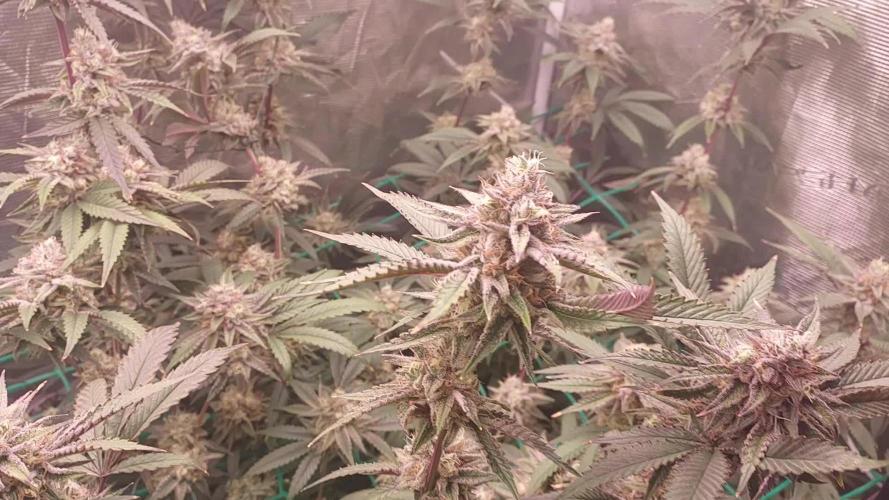
Forbidos wächst klein und buschig, eigentlich genau was ich suche. Bin gespannt ob sie das Topping genauso gut wie Jelly Breath annehmen werden.



Likes
11
Share


@Karl_Heinz420
Follow
Tag 10 🌺
Die Ladys befinden sich voll im Stretch. Besonders die Pure Kush von OSS hat in den letzten Tagen ordentlich an Höhe dazugewonnen 🙌🏼 Die Pure Kush wird täglich mit 1,5l Osmosewasser gegossen, die zwei Ladys vorne (Bruce Banner #3 - links und Critical Kush - rechts) fordern lediglich alle zwei Tage 1,5l Osmosewasser.
Tag 12 🌺
Lollipopping 🌳 - 🌿
Tag 13 🌺
Sanlight Evo 3-60 100% (1000-1200 PPFD)
Temperatur: 24-27 grad Celsius
r.Lf.: 50-57%


Likes
24
Share


@CovikLaFlaire
Follow
I found out that my ph was off too, so the plants look ok if we take all my f ups in count.

Likes
24
Share


@OGOZHigh
Follow
Leider spielt das Wetter nicht so mit daher langsame Fortschritte.
Update : 21.06
Das Wetter wird besser und die Ladys geben langsam richtig gas 🥦🔥


Likes
Comments
Share


@jporfiado
Follow
Esta semana aplique la tecnica lst. Hubiera preferido hacerlo antes pero estaba esperando por que antes queria trasplantarlas. Pero no he podido comprar macetas, ni el medio de cultivo. Entonces decidi hacerlo en las macetas actuales para comenzar a guiar la planta, ya que va creciendo muy rapido.
Junto con la tecnica lst tambien hice defoliacion a todas las plantas.
Comence a regar con fertilizante en polvo Green House para la etapa de vegetacion. Uso 0.5g / 1L . Ocupo unos 2L para regar cada planta.

Likes
20
Share


@GREENPHOENIX6262
Follow
06/06 - As we get closer to harvest the prep work will begin by the end of this coming week - I will give them 1 maybe 2 more nutrient feeds then switch to clean water with Carbo flush to remove the salt build up in the clones - I have dropped the light intensity to about 25% to allow for the trichomes and terps to set under ideally conditions. They will also get the bigger leaves defoliated little by little as we approach harvest.. 😎😎😎😎
06/07 - The babies are coming along perfectly without any issues - Since increasing the Cane Molasse dosage for their feeds trichome development has increased tremendously - Dropped the light intensity by 25% - maintaining low temps and average humidity through out harvest - She will receive 1 maybe 2 more nute feeds before flushing with clean water - The cold water treatment seems to be working with positive results in terps and trichomes.
06/10 - As we near harvest I will only be applying one maybe 2 more nute feeds and that will be it - Clean water feeds after that for about a week then chopping down - The last 2 feeds will consist of heavy silica for nutrient absorption and Cane molasses for terp setting and trichome build up - currently the nuggs are dense and rich in resin - I will be trimming in 3 stages ( 1 wet trim prior to cut down and 2 after harvest both dry ). Stay tunned for final cut down updates. Peace and Bud!! 😎😎😎😎😎😎😎😎😎😎😎😎😎😎😎😎😎
06/12 - As we approach harvest (This weekend) the terps are locking in pre cure and dry - I planned on flushing but figured since the PPM's are as low as they are why bother - 3 trim set, pre harvest trim (Fan leaves etc), after dry trim larger sugar leaves, final trim (Excess sugar leaves, longer stems etc). Drying will be between 7 to 10 days with a 60/60 temp humidity set if possible though with this heat wave added equipment might be needed.


Likes
32
Share


@biggreens420
Follow
bubbas doing well fading out and she smells kind of earthy berry at this point it's nice she's getting covered in trichs and some nice colours coming through on the buds . removed faded leaves as they fade and she's nice and sticky when touching will be giving a feed with bactrex 1g into 1l to help use what's left in the soil thanks for reading happy growing guys

Likes
18
Share


@Domenik
Follow
Day 67 and the last one is ready. The smell is incredible and the trichomes are crazy. Love this strain and gonna grow it again


Likes
15
Share


@EasyAutos
Follow
Absolutely lovely, terpene profile is strong and pungent. With sweet vanilla and fruity pineapple smells. Will update once dried and cured. 🙏
💎💎💎💎💎


Likes
23
Share


@GreenthumbJacobs
Follow
Heute geerntet und wow! Tag 83 und sie riecht so fruchtig ! Die trichome haben eine schöne gelbliche ,milchige Farbe.
Sie hat nass 352g auf die wasge
Heute den groben Trimm gemacht und gewogen. 105g und sie riecht so brutal gut und voller trichome
Likes
17
Share


@HowtoBubatz
Follow
We’ve hit week five of flowering, and things are getting really exciting! 🌸
The plant is now covered in trichomes, and many of them are already turning a milky color—such a great sign that things are progressing perfectly.
The buds are starting to look really frosty. ❄️✨
I’ve been following the BioBizz week 6 feeding schedule, as it’s almost time to flush the plant—just 2-3 more weeks to go! 💧
I’m getting more excited each day as we move closer to harvest. Can’t wait to see how everything finishes up! 😁🌱
Likes
55
Share


@Ultraviolet
Follow
What's in the soil? What's not in the soil would be an easier question to answer. 16-18 DLI @ the minute. +++ as she grows.
Probably not recommended, but to get to where it needs to be, I need to start now.
Vegetative @1400ppm 0.8–1.2 kPa 80–86°F (26.7–30°C) 65–75%, LST Day 10, Fim'd Day 11
CEC (Cation Exchange Capacity):
This is a measure of a soil's ability to hold and exchange positively charged nutrients, like calcium, magnesium, and potassium. Soils with high CEC (more clay and organic matter) have more negative charges that attract and hold these essential nutrients, preventing them from leaching away.
Biochar is highly efficient at increasing cation exchange capacity (CEC) compared to many other amendments. Biochar's high CEC potential stems from its negatively charged functional groups, and studies show it can increase CEC by over 90%. Amendments like compost also increase CEC but are often more prone to rapid biodegradation, which can make biochar's effect more long-lasting. biochar acts as a long-lasting Cation Exchange Capacity (CEC) enhancer because its porous, carbon-rich structure provides sites for nutrients to bind to, effectively improving nutrient retention in soil without relying on the short-term benefits of fresh organic matter like compost or manure. Biochar's stability means these benefits last much longer than those from traditional organic amendments, making it a sustainable way to improve soil fertility, water retention, and structure over time. Needs to be charged first, similar to Coco, or it will immobilize cations, but at a much higher ratio.
a high cation exchange capacity (CEC) results in a high buffer protection, meaning the soil can better resist changes in pH and nutrient availability. This is because a high CEC soil has more negatively charged sites to hold onto essential positively charged nutrients, like calcium and magnesium, and to buffer against acid ions, such as hydrogen.
EC (Electrical Conductivity):
This measures the amount of soluble salts in the soil. High EC levels indicate a high concentration of dissolved salts and can be a sign of potential salinity issues that can harm plants.
The stored cations associated with a medium's cation exchange capacity (CEC) do not directly contribute to a real-time electrical conductivity (EC) reading. A real-time EC measurement reflects only the concentration of free, dissolved salt ions in the water solution within the medium.
98% of a plants nutrients comes directly from the water solution.
2% come directly from soil particles.
CEC is a mediums storage capacity for cations. These stored cations do not contribute to a mediums EC directly.
Electrical Conductivity (EC) does not measure salt ions adsorbed (stored) onto a Cation Exchange Capacity (CEC) site, as EC measures the conductivity of ions in solution within a soil or water sample, not those held on soil particles.
A medium releases stored cations to water by ion exchange, where a new, more desirable ion from the water solution temporarily displaces the stored cation from the medium's surface, a process also seen in plants absorbing nutrients via mass flow. For example, in water softeners, sodium ions are released from resin beads to bond with the medium's surface, displacing calcium and magnesium ions which then enter the water. This same principle applies when plants take up nutrients from the soil solution: the cations are released from the soil particles into the water in response to a concentration equilibrium, and then moved to the root surface via mass flow.
An example of ion exchange within the context of Cation Exchange Capacity (CEC) is a soil particle with a negative charge attracting and holding positively charged nutrient ions, like potassium (K+) or calcium (Ca2+), and then exchanging them for other positive ions present in the soil solution. For instance, a negatively charged clay particle in soil can hold a K+ ion and later release it to a plant's roots when a different cation, such as calcium (Ca2+), is abundant and replaces the potassium. This process of holding and swapping positively charged ions is fundamental to soil fertility, as it provides plants with essential nutrients.
Negative charges on soil particles: Soil particles, particularly clay and organic matter, have negatively charged surfaces due to their chemical structure.
Attraction of cations: These negative charges attract and hold positively charged ions, or cations, such as:
Potassium (K+)
Calcium (Ca2+)
Magnesium (Mg2+)
Sodium (Na+)
Ammonium (NH4+)
Plant roots excrete hydrogen ions (H+) through the action of proton pumps embedded in the root cell membranes, which use ATP (energy) to actively transport H+ ions from inside the root cell into the surrounding soil. This process lowers the pH of the soil, which helps to make certain mineral nutrients, such as iron, more available for uptake by the plant.
Mechanism of H+ Excretion
Proton Pumps: Root cells contain specialized proteins called proton pumps (H+-ATPases) in their cell membranes.
Active Transport: These proton pumps use energy from ATP to actively move H+ ions from the cytoplasm of the root cell into the soil, against their concentration gradient.
Role in pH Regulation: This active excretion of H+ is a major way plants regulate their internal cytoplasmic pH.
Nutrient Availability: The resulting decrease in soil pH makes certain essential mineral nutrients, like iron, more soluble and available for the root cells to absorb.
Ion Exchange: The H+ ions also displace positively charged mineral cations from the soil particles, making them available for uptake.
Iron Uptake: In response to iron deficiency stress, plants enhance H+ excretion and reductant release to lower the pH and convert Fe3+ to the more available form Fe2+. The altered pH can influence the activity and composition of beneficial microbes in the soil. The H+ gradient created by the proton pumps can also be used for other vital cell functions, such as ATP synthesis and the transport of other solutes. The hydrogen ions (H+) excreted during photosynthesis come from the splitting of water molecules. This splitting, called photolysis, occurs in Photosystem II to replace the electrons used in the light-dependent reactions. The released hydrogen ions are then pumped into the thylakoid lumen, creating a proton gradient that drives ATP synthesis.
Plants release hydrogen ions (H+) from their roots into the soil, a process that occurs in conjunction with nutrient uptake and photosynthesis. These H+ ions compete with mineral cations for the negatively charged sites on soil particles, a phenomenon known as cation exchange. By displacing beneficial mineral cations, the excreted H+ ions make these nutrients available for the plant to absorb, which can also lower the soil pH and indirectly affect its Cation Exchange Capacity (CEC) by altering the pool of exchangeable cations in the soil solution.
Plants use proton (H+) exudation, driven by the H+-ATPase enzyme, to release H+ ions into the soil, creating a more acidic rhizosphere, which enhances nutrient availability and influences nutrient cycling processes. This acidification mobilizes insoluble nutrients like iron (Fe) by breaking them down, while also facilitating the activity of beneficial microbes involved in the nutrient cycle. Therefore, H+ exudation is a critical plant strategy for nutrient acquisition and management, allowing plants to improve their access to essential elements from the soil.
A lack of water splitting during photosynthesis can affect iron uptake because the resulting energy imbalance disrupts the plant's ability to produce ATP and NADPH, which are crucial for overall photosynthetic energy conversion and can trigger a deficiency in iron homeostasis pathways. While photosynthesis uses hydrogen ions produced from water splitting for the Calvin cycle, not to create a hydrogen gas deficiency, the overall process is sensitive to nutrient availability, and iron is essential for chloroplast function.
In photosynthesis, water is split to provide electrons to replace those lost in Photosystem II, which is triggered by light absorption. These electrons then travel along a transport chain to generate ATP (energy currency) and NADPH (reducing power). Carbon Fixation: The generated ATP and NADPH are then used to convert carbon dioxide into carbohydrates in the Calvin cycle. Impaired water splitting (via water in or out) breaks the chain reaction of photosynthesis. This leads to an imbalance in ATP and NADPH levels, which disrupts the Calvin cycle and overall energy production in the plant. Plants require a sufficient supply of essential mineral elements like iron for photosynthesis. Iron is vital for chlorophyll formation and plays a crucial role in electron transport within the chloroplasts. The complex relationship between nutrient status and photosynthesis is evident when iron deficiency can be reverted by depleting other micronutrients like manganese. This highlights how nutrient homeostasis influences photosynthetic function. A lack of adequate energy and reducing power from photosynthesis, which is directly linked to water splitting, can trigger complex adaptive responses in the plant's iron uptake and distribution systems.
Plants possess receptors called transceptors that can directly detect specific nutrient concentrations in the soil or within the plant's tissues. These receptors trigger signaling pathways, sometimes involving calcium influx or changes in protein complex activity, that then influence nutrient uptake by the roots. Plants use this information to make long-term adjustments, such as Increasing root biomass to explore more soil for nutrients. Modifying metabolic pathways to make better use of available resources. Adjusting the rate of nutrient transport into the roots. That's why I keep a high EC. Abundance resonates Abundance.
Likes
5
Share


@SamDoze
Follow
So for now i am free to grow anything. No restriction at all ¡¡¡
Now i use the "" Atami Janeco Lightmix "" substrate for this plant...
I hope this one are the same quality of LIGHT MIX BIOBIZZ

Likes
5
Share


@Stretch448
Follow
Not sure why the other seeds didn’t germinate. One of the other Bananacane’s started to but died off upon sprouting
Likes
7
Share


@in_a_few_weeks
Follow
Minimum Low Stress Training from the beginning and a big Flower Power. Without 8“ Carbon Filter i wouldnt do it haha. 4 Plants exploded in the Tent. Not in heigth but in width
Likes
6
Share


@SleepHuntMadScience
Follow
Got through the wet and grey of the last week, should see some sun in the next few days to help finish the plant off.
Quite aesthetic with gdp colours and whit widow scent coming on strong.
Lookin forward to havest in the next week or two. Thanks to everyone who answered my grow question last week